JUN 15, 2023
Computational drug design and chemo-informatics: a hands-on course at the University of Antwerp


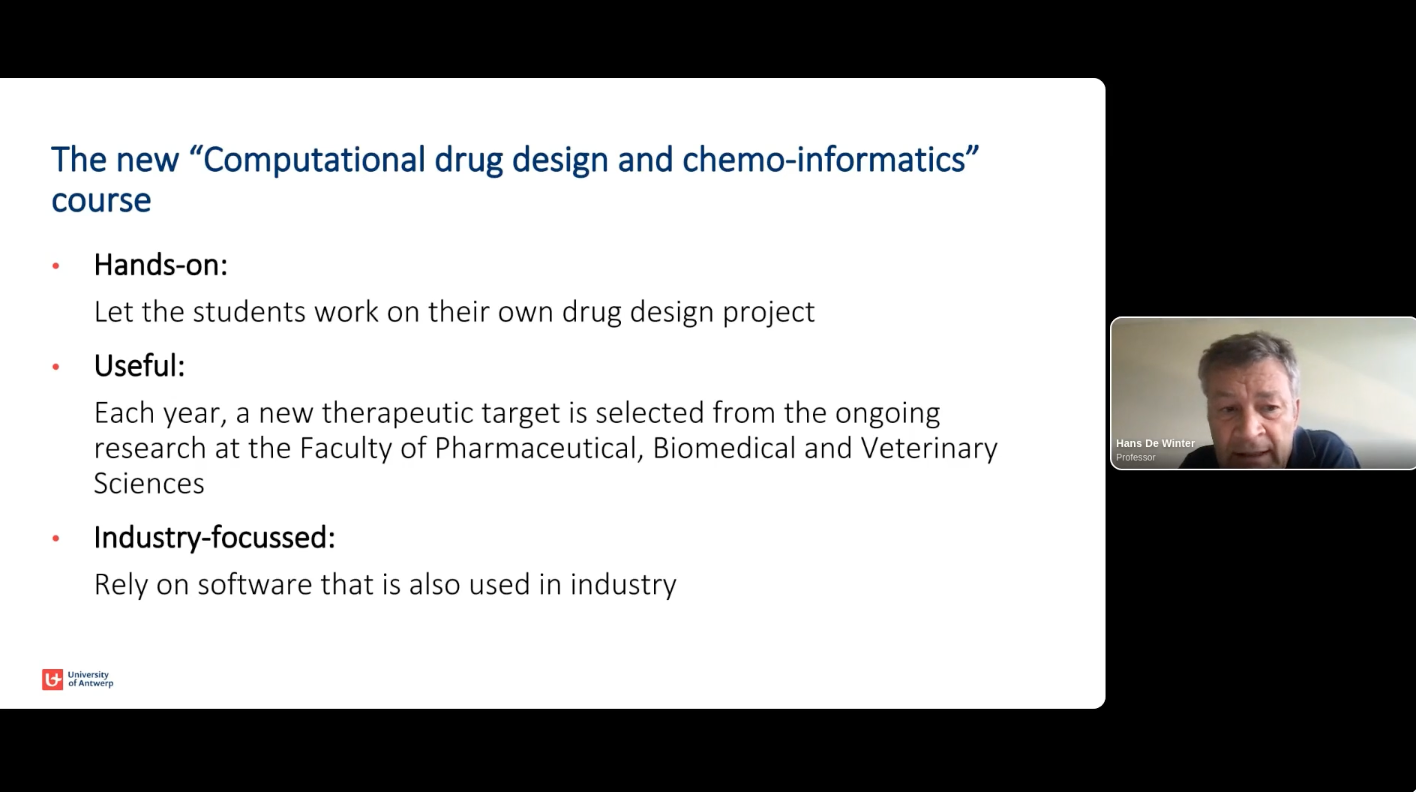
The University of Antwerp is the third-largest university in the Dutch-speaking region of Belgium, with over 20,000 students annually. Within the Biochemistry and Biotechnology curriculum, students have the option to take a three-ECTS course on computational drug design and chemo-informatics. The course is organized in a modular fashion and covers both theoretical and practical sessions.
During the theoretical sessions, students learn about chemo-informatics and virtual screening, which includes concepts such as chemical fingerprints, molecular similarity, clustering, machine learning models, and virtual screening performance metrics. The course also covers molecular docking and pharmacophore searching. The concepts covered in the theoretical sessions are then put into practice in a series of hands-on sessions.
For the chemo-informatics tasks, the students use Google Colab with RDKit as a chemo-informatics toolkit, while for the pharmacophore and docking-related aspects, they use Maestro, Phase, and Glide. These tools are made available through the “”Teaching with Schrödinger”” web-based virtual workstations, which allows students to access them from anywhere at any time. Finally, using an internally-developed virtual reality system, the students can graphically study the non-bonded interactions between ligand and protein.
At the start of the course, a drug design project is defined based on ongoing research programs in the Faculty. The goal of the project is to identify a limited number of commercially-available compounds (5-10) that are subsequently purchased and biochemically characterized for their inhibitory properties. The students complete the program with a written report, which serves as the basis for the oral examination at the end.
Our Speaker

Hans De Winter
University of Antwerp
Hans De Winter was appointed in 2013 as a professor of Computational Drug Design at the University of Antwerp (Belgium) after a long career in industry, first as a senior scientist at Johnson & Johnson in Beerse, Belgium, and subsequently as a co-founder and CSO of Silicos NV. He holds a PhD from the University of Leuven (Belgium) and completed post-doctoral stays at the Victorian College of Pharmacy (Australia) and the Rega Institute in Leuven (Belgium) before starting his career as a scientist in the pharmaceutical industry. Despite his elaborated industrial background during a period of more than 20 years, he has over 60 scientific publications and is listed as inventor on eight granted patents. Hans’ research interests are mainly situated in the field of computational medicinal chemistry and cheminformatics. Current research activities include: 1) molecular dynamics-based modeling of protein-protein interactions and unraveling the kinetics of lipid membrane-bound protein complexes using large-scale molecular dynamics calculations with Markov chain modeling; 2) the elaboration of spectrophore-based algorithms for exploration of ligand/protein interaction space; 3) the development of automated in silico ligand design systems. Additional focus points are the development of open-source and cloud-based interrogation software for large chemical and biological data repositories. Finally, his expertise in in silico drug design is used in several ongoing targeted drug discovery projects. Prof. Hans De Winter is the coordinating promoter or co-promoter of a number of PhDs and has a broad research network both in industry and in academia based on his expertise in modeling/chemoinformatics. He is also chairman of the Flemish computational chemistry division of the European Association of Chemical and Molecular Sciences (EuCheMS) since 2015. He teaches ‘organic chemistry’ to 1st year bachelor students in Pharmaceutical Sciences, and ‘computational drug design and cheminformatics’ to 1st year master students in Biochemistry at the University of Antwerp.