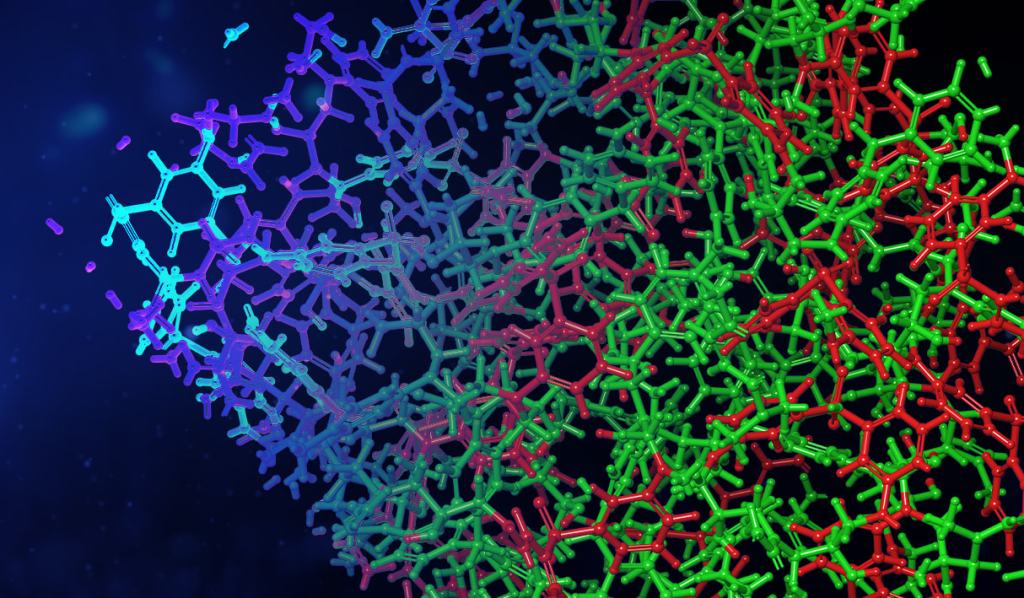
Polymeric materials

Develop higher performing, more sustainable polymers, faster

Polymeric Materials

Harness molecular simulation to develop tomorrow’s polymeric materials

R&D scientists across broad industries face challenges in developing the next-generation of polymers and composites that are high-performance, multifunctional, and meet society’s demands for sustainability.

Schrödinger’s digital chemistry platform allows scientists to understand and predict product performance through simulations of polymers at molecular and atomic scales, to tackle materials challenges across diverse polymer applications.

background pattern

Intuitive computational workflows designed by polymer experts

Easy-to-use system builders for all polymer types
Powerful workflows for molecular simulation, machine learning, and data analysis
Dedicated customer support and extensive training resources

Predict key properties to drive polymer development & design

Design new monomers, gain a deeper understanding of polymer synthesis and degradation, and improve polymer formulations.

Better understand polymer and fluid formulations

  • Predict binding to polymer molecules and interfaces, small molecule leaching, and gas permeation for applications in medical device, consumer packaged goods, and membranes
  • Calculate polymer Rg in solution to understand the solvation in lubricants, cosmetics, and more
  • Determine the impact of components and conditions on aggregation and phase behavior

Deliver more efficient electronic polymers

  • Simulate interactions of packaging polymers with processing solvents and water to predict stability during use
  • Simulate atomic interactions and transport of ions in liquid and polymer electrolytes
  • Calculate electronic and optical properties

Discover new biopolymers

  • Simulate and predict properties of high-performance resins made from bio-based materials, and automate discovery of new biomaterials
  • Predict miscibility, structure, and properties of bio-based polymer mixtures
  • Simulate the behavior of bio-based polymers in solution

Identify high-performance polymer composites

  • Model water uptake and co-continuous morphological stability in polymer composites
  • Predict glass transition, thermal stability, and thermal expansion with new polymers
  • Predict polymer gel point during curing process

Case studies & webinars

Molecular dynamics simulations accelerate the development and optimization of recyclable tire materials

Materials Science Webinar

Getting started in polymer compute-driven design: Predicting glass transition temperature in the Materials Science Suite

Learn from a live demo of building polymers and polymer formulations and running a Tg prediction workflow.

Materials Science Webinar

Accelerating product development with computational materials engineering

Learn how Ansys and Schrödinger are transforming product development with Integrated Computational Materials Engineering (ICME) to accelerate material discovery and innovation.

Materials Science Webinar

Accelerating materials discovery with physics-informed AI/ML

This webinar series will explore how cutting-edge computational methods are revolutionizing the design and optimization of pharmaceutical drugs, biologics , and advanced materials.

Materials Science Webinar

Advancing machine learning force fields for materials science applications

In this webinar, we will introduce Schrödinger’s state-of-the-art MLFF architecture, called Message Passing Network with Iterative Charge Equilibration (MPNICE), which incorporates explicit electrostatics for accurate charge representations.

Materials Science Webinar

Accelerating chemical innovation with AI/ML: Breakthroughs across materials applications

In this webinar, we will explore how AI/ML is driving impactful advancements in materials innovation, highlighting case studies that illustrate cutting-edge ML techniques in diverse applications.

Life Science Webinar

Computational insights into polymer excipient selection for amorphous solid dispersions

In this webinar, we will highlight how molecular models can aid our ability to screen through standard polymer excipients for target lists to push into lab testing.

Materials Science Webinar

High-performance materials discovery: A decade of cloud-enabled breakthroughs

This talk will showcase how Schrödinger’s integrated materials science platform enables massive parallel screening and de novo design campaigns across diverse applications.

Materials Science Webinar

Accelerating the Design of Asymmetric Catalysts with Schrödinger’s Digital Chemistry Platform

In this webinar, we demonstrate how Schrödinger’s advanced digital chemistry platform can be used to accelerate the direct design and discovery of asymmetric catalysts.

Materials Science Webinar

How Physics-based Modeling and Machine Learning Enable Accelerated Development of Battery Materials

In this webinar, we focus on examples to demonstrate the application of automated solutions for accurate prediction of thermodynamic stability and voltage profile of cathode materials, ion diffusion pathways and kinetics in electrode materials, transport properties of liquid electrolytes and modeling the nucleation and growth of solid electrolyte interphase (SEI) layers using Schrödinger’s SEI simulator module.

Materials Science Webinar

AI/ML meets physics-based simulations: A new era in complex materials design

In this webinar, we demonstrate the application of this combined approach in designing materials and formulations across diverse materials science applications, from battery electrolytes and fuel mixtures to thermoplastics and OLED devices. 

Address polymer challenges across industries

Automotive

Develop high-performance polymers that are durable, lightweight, sustainable and processable.

Learn more
Specialty Polymers

Enhance performance and production of raw materials for downstream applications.

Learn more
Batteries

Discover the best-performing polymer electrolyte materials and improve battery performance.

Learn more
Pharmaceutical Formulation

Optimize the design of drug carriers and formulations for effective drug delivery.

Learn more
CPG Packaging

Innovate with natural materials for high-performance, sustainable packaging materials.

Learn more
Aerospace

Design high-performance composites and sealants for high-temperature applications and flame stability.

Learn more
Featured CourseMolecular modeling for materials science applications: Polymeric materials course

Molecular modeling for materials science applications: Polymeric materials course

Online certification course: Level-up your skill set in polymer modeling

Learn how to apply industry-leading computational software to predict key properties of simple and complex polymer mixtures with automated workflows and machine learning models.

  • Self-paced learning content
  • Hands-on access to Schrödinger software
  • Guided and independent case studies
Learn More

Documentation & Tutorials

Get answers to common questions and learn best practices for using Schrödinger’s software.

Materials Science Documentation

Machine Learning Force Fields

Machine Learning Force Fields (MLFFs) offer a novel approach for predicting the energies of arbitrary systems.

Materials Science Tutorial

Machine Learning Force Field

Learn how to use machine learning force field optimization methods to prepare and simulate various systems.

Materials Science Documentation

MS Transport

Efficient molecular dynamics (MD) simulation tool for predicting liquid viscosity and diffusions of atoms and molecules.

Materials Science Documentation

MS Penetrant Loading

Molecular dynamics (MD) modeling for predicting water loading and small molecule gas adsorption capacity of a condensed system.

Materials Science Documentation

MS Dielectric

An automatic workflow to calculate dielectric properties and refractive index.

Materials Science Documentation

Formulation ML

A machine learning solution to generate accurate formulation-property relationships and screen new formulations with desired properties.

Materials Science Documentation

MS CG

Efficient coarse-grained (CG) molecular dynamics (MD) simulations for large systems over long time scales.

Materials Science Tutorial

Umbrella Sampling

Learn to calculate the free energy profile for butanol permeation through a DMPC membrane using umbrella sampling.

Materials Science Tutorial

Applied Machine Learning for Formulations

Learn to apply the Formulation Machine Learning Panel across a range of materials applications. This tutorial assumes that you have already completed the Machine Learning for Formulations tutorial.

Materials Science Tutorial

Thermal Conductivity

Learn to use the Thermal Conductivity Calculation and Results panels to calculate thermal conductivity.

Key Products

Learn more about the key computational technologies available to progress your research projects.

MS Formulation ML

Automated machine learning solution to generate accurate formulation-property relationships and screen new formulations with desired properties

Virtual Cluster

Secure, scalable environment for running simulations on the cloud

MS Maestro

Complete modeling environment for your materials discovery

MS Penetrant Loading

Molecular dynamics (MD) modeling for predicting water loading and small molecule gas adsorption capacity of a condensed system

MS Transport

Efficient molecular dynamics (MD) simulation tool for predicting liquid viscosity, conductivity and diffusions of atoms and molecules

Desmond

High-performance molecular dynamics (MD) engine providing high scalability, throughput, and scientific accuracy

MS CG

Efficient coarse-grained (CG) molecular dynamics (MD) simulations for large systems over long time scales

OPLS4 & OPLS5 Force Field

A modern, comprehensive force field for accurate molecular simulations

DeepAutoQSAR

Automated, scalable solution for the training and application of predictive machine learning models

Publications

Browse the list of peer-reviewed publications using Schrödinger technology in related application areas.

Materials Science Publication

Designing the Next Generation of Polymers with Machine Learning and Physics-Based Models

Materials Science Publication

Optimization of fluorinated phenyl azides as universal photocrosslinkers for semiconducting polymers

Materials Science Publication

Advancing material property prediction: using physics-informed machine learning models for viscosity

Materials Science Publication

Tuning the Mobility of Indacenodithiophene-Based Conjugated Polymers via Coplanar Backbone Engineering

Materials Science Publication

Physics-based molecular modeling of biosurfactants

Materials Science Publication

Molecular-scale exploration of mechanical properties and interactions of poly(lactic acid) with cellulose and chitin

Materials Science Publication

Study of water sorption in Methacryl-based Polyhedral Oligomeric Silsesquioxane (POSS) dental composites using molecular dynamics simulations

Materials Science Publication

Whole-cell mediated carboxylation of 2-Furoic acid towards the production of renewable platform chemicals and biomaterials

Materials Science Publication

Understanding the Effect of the Oil-to-Surfactant Ratio on Eugenol Oil-in-Water Nanoemulsions Using Experimental and Molecular Dynamics Investigations

Materials Science Publication

Linking Redox Characteristics to Dissolved Organic Matter Derived from Different Biowaste Composts: A Theoretical Modeling Approach Based on FT–ICR MS Analysis

Schedule a consultation on Schrödinger Polymer Solutions

Contact us today to explore how you can leverage advanced simulation and AI/ML to gain competitive advantage in your industry.

Don’t see your areas of interest in the current lists above? Reach out so we can help.

Form submitted

Thank you, we’ll be in touch soon.

Software and services to meet your organizational needs

Software Platform

Deploy digital materials discovery workflows with a comprehensive and user-friendly platform grounded in physics-based molecular modeling, machine learning, and team collaboration.

Research Services

Leverage Schrödinger’s expert computational scientists to assist at key stages in your materials discovery and development process.

Support & Training

Access expert support, educational materials, and training resources designed for both novice and experienced users.