
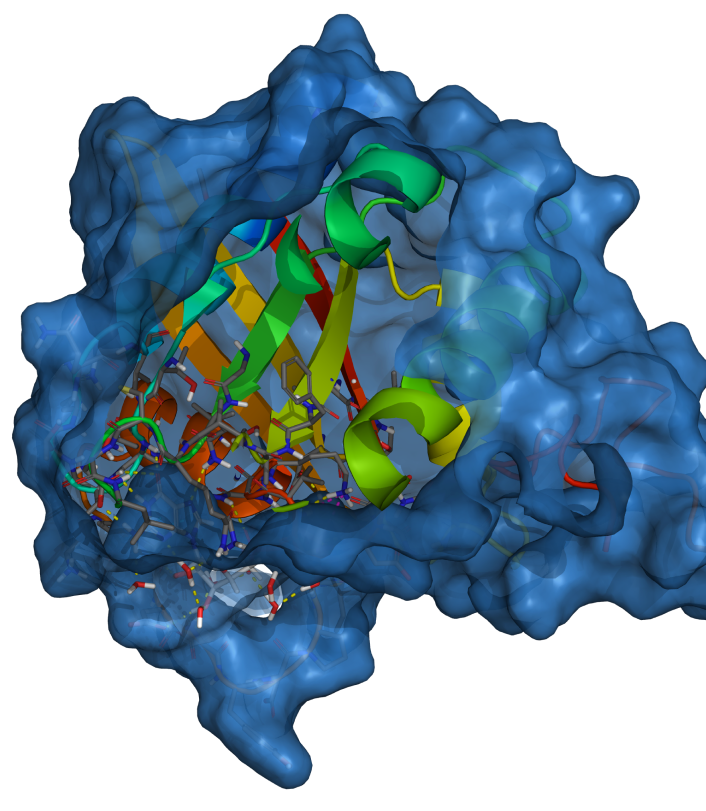

Peptide Discovery

Design peptidic drugs using in silico structure-based methods

Peptide Discovery
background pattern

Explore the benefits of computationally-guided peptide design

Enumerate and ideate beyond initial natural peptides on a large scale

Explore mutation to standard and non-standard amino acids, custom backbone modifications, and a wide variety of cyclizations to create novel natural peptides or peptidomimetics with desired properties.

Explore conformational landscapes

Predict 3D structure, calculate relative binding free energies of structurally diverse conformations, and select the most plausible binding mode.

Predict key properties of peptides

Guide peptide discovery by facilitating the design and optimization of peptide structures with desired properties and the associated physicochemical characteristics, such as membrane permeability and solubility.

Understand peptide-target interactions

Employ specialized docking tools, molecular dynamics, and advanced free energy perturbation calculations to predict binding affinity, selectivity, thermostability, and pH-dependencies at accuracies approaching experimental level.


Design high-quality biologics with Schrödinger’s cutting-edge software
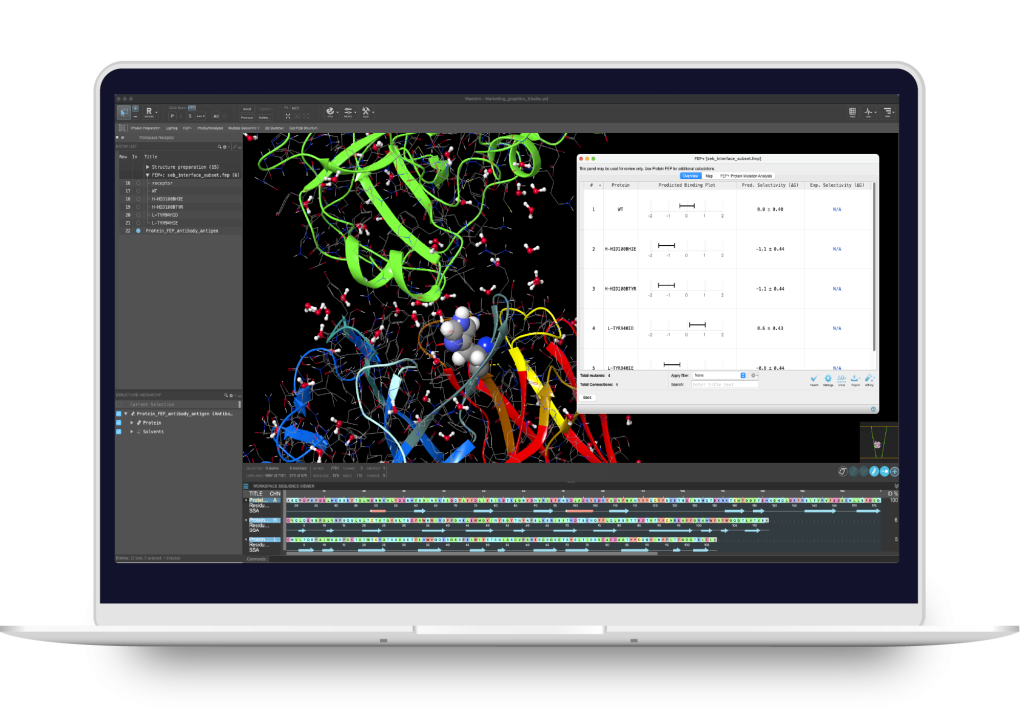
BioLuminate


Modeling environment for biologics discovery

LiveDesign


Collaborative digital biologics design and discovery lab

Publications

Browse the list of peer-reviewed publications using Schrödinger technology in related application areas.

Life Science Publication

Basic Residues at Position 11 of α-Conotoxin LvIA Influence Subtype Selectivity between α3β2 and α3β4 Nicotinic Receptors via an Electrostatic Mechanism

Life Science Publication

Structure-based assessment and druggability classification of protein-protein interaction sites

Life Science Publication

Computational Design and Biological Evaluation of Analogs of Lupin Peptide P5 Endowed with Dual PCSK9/HMG-CoAR Inhibiting Activity

Life Science Publication

Plasticity in ligand recognition at somatostatin receptors

Life Science Publication

Potency- and selectivity-enhancing mutations of conotoxins for nicotinic acetylcholine receptors can be predicted using accurate free-energy calculations

Life Science Publication

Potency-Enhancing Mutations of Gating Modifier Toxins for the Voltage-Gated Sodium Channel NaV1.7 Can Be Predicted Using Accurate Free-Energy Calculations

Life Science Publication

Water Thermodynamics of Peptide Toxin Binding Sites on Ion Channels

Life Science Publication

Automated Design of Macrocycles for Therapeutic Applications: From Small Molecules to Peptides and Proteins

Life Science Publication

Advancing Therapeutic Protein Discovery and Development through Comprehensive Computational and Biophysical Characterization

Life Science Publication

Multi-Granulin Domain Peptides Bind to Pro-Cathepsin D and Stimulate Its Enzymatic Activity More Effectively Than Progranulin in Vitro

Documentation & Tutorials

Get answers to common questions and learn best practices for using Schrödinger’s software.

Life Science Documentation

Prime

A fully-integrated protein structure prediction solution that incorporates homology modeling and fold recognition into a single solution.

Life Science Documentation

LiveDesign ML

A LiveDesign plug-in that provides a highly-automated system for deploying supervised learning modeling pipelines within LiveDesign.

Life Science Documentation

FEP+

Computational prediction of protein-ligand binding using physics-based free energy perturbation technology at an accuracy matching experimental methods.

Life Science Documentation

Force Field Builder

Customize torsions not explicitly included in the OPLS4 or OPLS5 force field by fitting to quantum-mechanical calculations for a set of molecules.

Life Science Documentation

Desmond

Simulate biological systems with a GPU-powered high-performance molecular dynamics (MD) engine.

Life Science Documentation

BioLuminate

Schrödinger’s comprehensive modeling platform for biologics discovery.

Life Science Tutorial

Protein pKa Prediction with Constant pH Molecular Dynamics

Determine pKa values and protonation states for protein residues.

Life Science Tutorial

Peptide Modeling with BioLuminate

Dock peptides to a protein receptor, identify possible binding hotspots, perform lead optimization, and predict binding affinity with QSAR.

Key Products

Learn more about the key computational technologies available to progress your research projects.

BioLuminate

Comprehensive modeling platform for biologics discovery

LiveDesign

Your complete digital molecular design lab

Prime

A powerful and innovative solution for accurate protein structure prediction

MacroModel

Versatile, full-featured molecular modeling program

Glide

Industry-leading ligand-receptor docking solution

PIPER

A state-of-the-art protein-protein docking program

FEP+

High-performance free energy calculations for drug discovery

Software and services to meet your organizational needs

Software Platform

Deploy digital drug discovery workflows using a comprehensive and user-friendly platform for molecular modeling, design, and collaboration.

Research Services

Leverage Schrödinger’s computational expertise and technology at scale to advance your projects through key stages in the drug discovery process.

Support & Training

Access expert support, educational materials, and training resources designed for both novice and experienced users.