JUN 14, 2023
Curriculum redesign through design: A PyMOL poster project to assess program learning outcomes


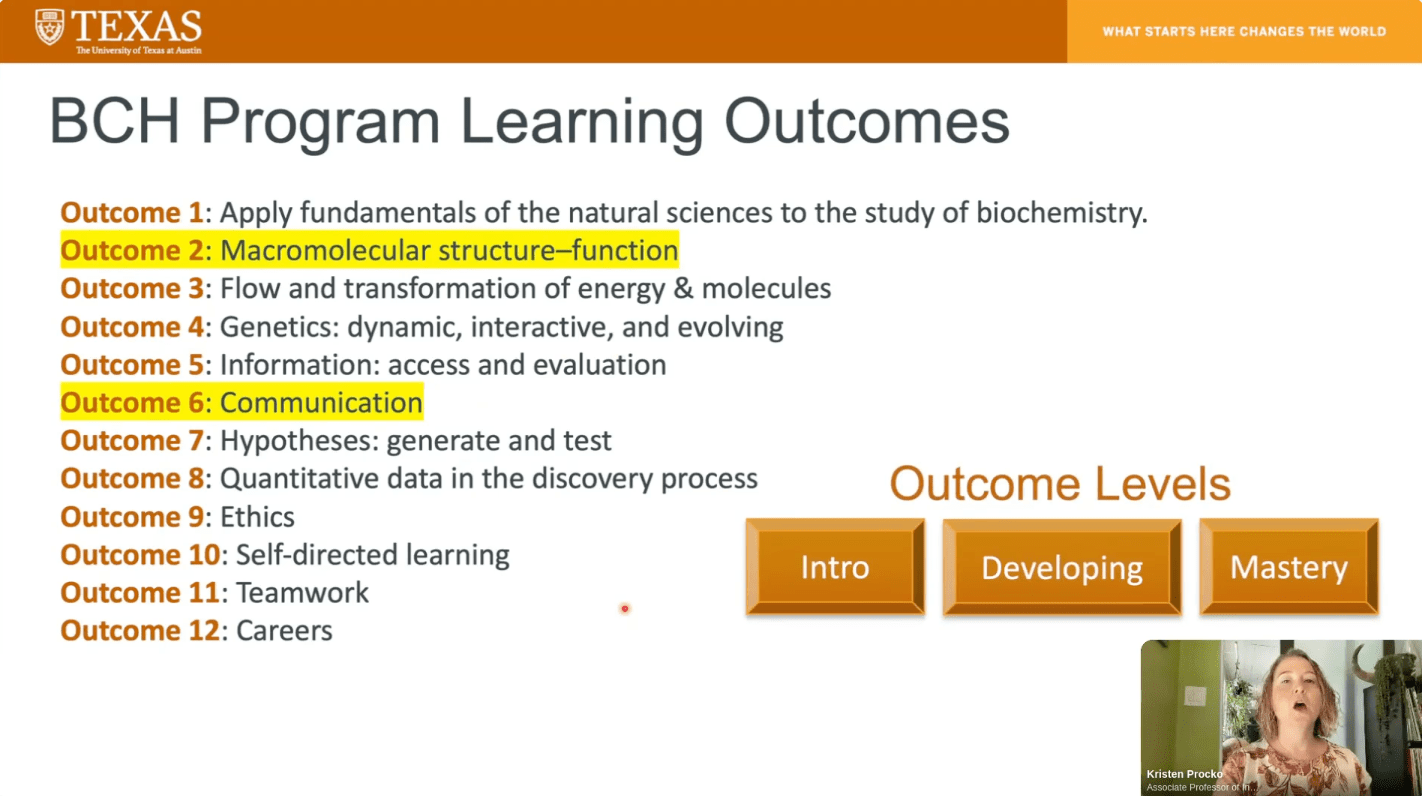
Teaching biomolecular visualization skills can improve students’ comprehension of foundational concepts in life science education. Molecular modeling is a gateway to understanding molecular interactions, structure-function relationships, and the use of appropriate renderings to convey specific information about a protein structure. Accordingly, a major goal of the curriculum redesign effort at the University of Texas at Austin is to incorporate modeling throughout the biochemistry degree plan. Scaffolded PyMOL activities have been developed to advance students’ modeling skills from beginner level to comfortably displaying molecular interactions and producing high-quality images. In Foundations of Biochemistry, the first upper division course in the degree plan, these skills are integrated in a culminating Signature Assignment: a task that best encompasses the knowledge and skills essential to the course objectives. Students explore enzyme inhibition in the context of small molecule disease treatment, and, throughout the latter half of the semester, craft a scientific poster. Presentations incorporate students’ original PyMOL images and connect the enzyme–inhibitor interaction to the biochemistry of the disease. Importantly, this project is one of several being developed to track students’ achievement of programmatic learning outcomes for the biochemistry degree plan and will ultimately be used as one measure to assess student success and the overall curriculum redesign effort.
Our Speaker

Kristen Procko
The University of Texas at Austin
An advocate for teaching biochemistry through molecular visualization, Dr. Kristen Procko earned her PhD in chemistry from the University of Texas at Austin, where she currently serves as an Associate Professor of Instruction. Her biochemistry classroom is an active learning environment, in which students build their molecular visualization skills through scaffolded modeling activities and a culminating project. She is also the Biochemistry Education Fellow for the major, coordinating curriculum redesign and assessment of the transformed biochemistry degree. Dr. Procko’s research interests include the evaluation of students’ visual literacy skills and assessment validation. In her role as Director of BioMolViz (biomolviz.org), a community of educators working to improve biomolecular visualization instruction and evaluation, she led the development of a visual literacy assessment repository for life science educators. Alongside her team, she provides professional development workshops for faculty, both in backward design of assessments that target visualization skills and in the use of popular programs for biomolecular modeling. She blends her PyMOL skills with her passion for videomaking to create animated molecular explorations, available on her YouTube channel, Molecular Memory.