APR 29, 2026
A “Crowdsourcing” Team-based Learning Approach to Teach Structure-Based Drug Design


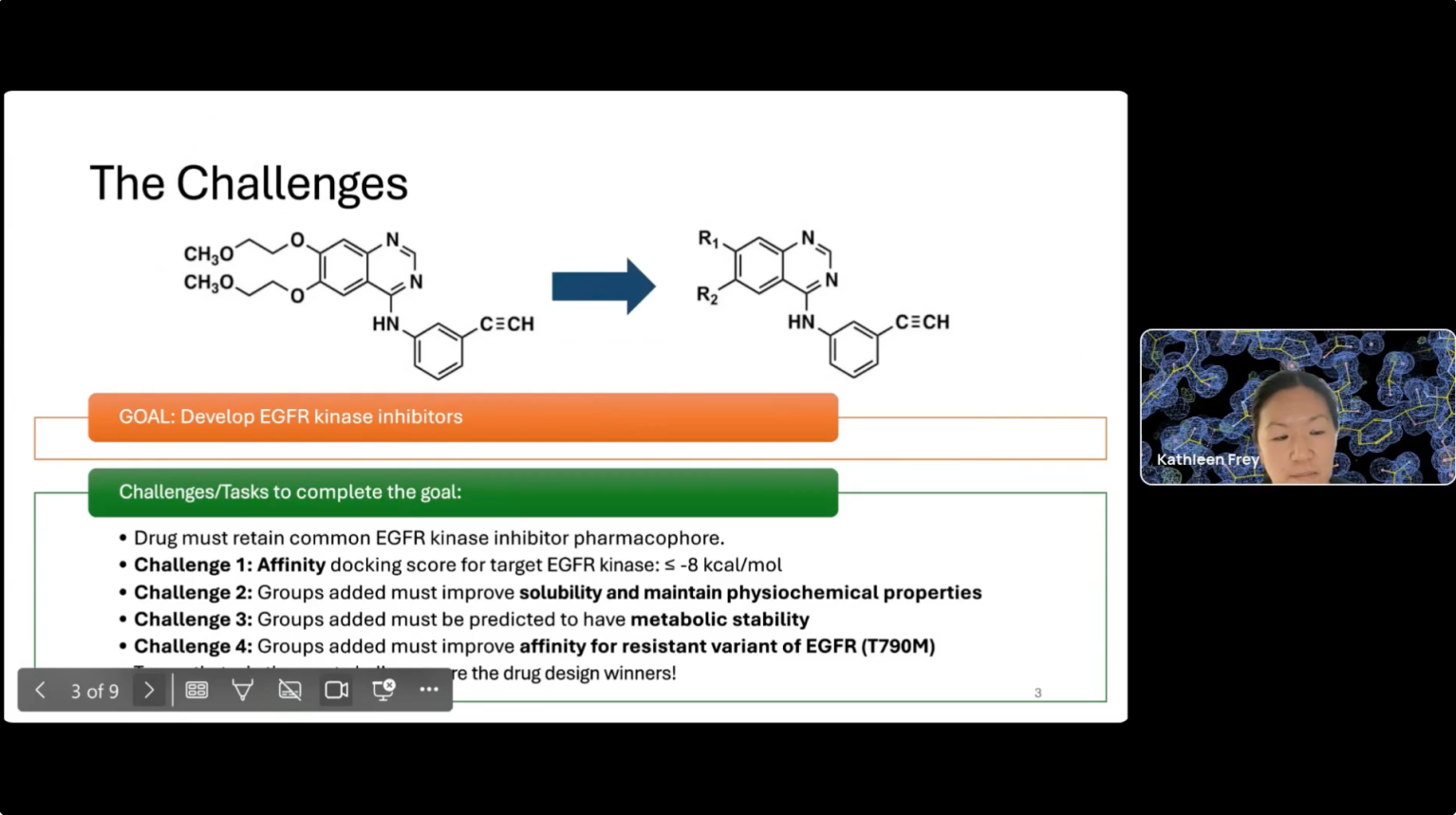
Structure-based drug design is an important discipline introduced in advanced undergraduate courses, incorporated in pharmacy curriculums, and explored in depth within graduate programs. This presentation will outline a team-based learning strategy and workflow that uses a crowdsourcing model to teach structure-based drug design and medicinal chemistry. This workflow has been implemented in PHRM 8213: Principles of Drug Design, an elective course offered to professional pharmacy students. Within the course, students work in teams to redesign inhibitor erlotinib for protein-based target, EGFR kinase (PDB: 4HJO). The following 4 challenges are given to students every 2-3 weeks with the following goals: 1) Improve affinity; 2) improve physiochemical properties; 3) improve metabolic stability; and 4) improve the resistance profile for the mutant form of EGFR kinase (T790M). Students are provided with strategies and case studies from the instructor to help with each challenge, then use the Schrodinger Maestro software to design compounds to meet each goal. Students may submit multiple compounds for computational testing and evaluation of structure-activity relationships. After each challenge submission closes, the instructor uses the Schrodinger Basic Modeling Package and other available programs to evaluate the compounds. The results are then presented by the instructor each week where a winning compound is selected and reviewed with the class. The instructor also provides class data for all compound submissions for each challenge. Course feedback from the last 5 years shows that students enjoy this hands-on approach to learning structure-based drug design.
Slides
Our Speaker

Kathleen Frey
Researcher
Dr. Kathleen Frey joined the College of Pharmacy and Health Sciences in January 2019. Dr. Frey received a BS in Molecular and Cell Biology and a Ph.D. in Pharmaceutical Sciences (specializing in Medicinal Chemistry) from the University of Connecticut. Following graduate studies, Dr. Frey completed a postdoctoral fellowship in Pharmacology at Yale University School of Medicine. At Yale, Dr. Frey received the NIH Ruth L. Kirschstein National Research Service Award (NRSA) to develop structure-activity and structure-property relationships for non-nucleoside compounds targeting HIV. Dr. Frey has published over 30 peer-reviewed research articles on structure-based drug design for HIV, MRSA, opportunistic infections, and cancer. In addition to research, Dr. Frey was also a postdoctoral teaching scholar at Yale University and received training from Yale Center for Teaching and Learning. Dr. Frey’s research uses computational chemistry, crystal structures, and modeling to analyze drug-target interactions. She uses these approaches to design small molecules and biologics with improved pharmacological and physiochemical properties. Dr. Frey is also interested in modeling and predicting the effects of resistance-associated mutations in drug targets.