APR 29, 2026
Hands-On Workshop: Mapping the Reaction “Mountain Pass” and Visualizing Transition States with Schrödinger’s AutoTS Workflow


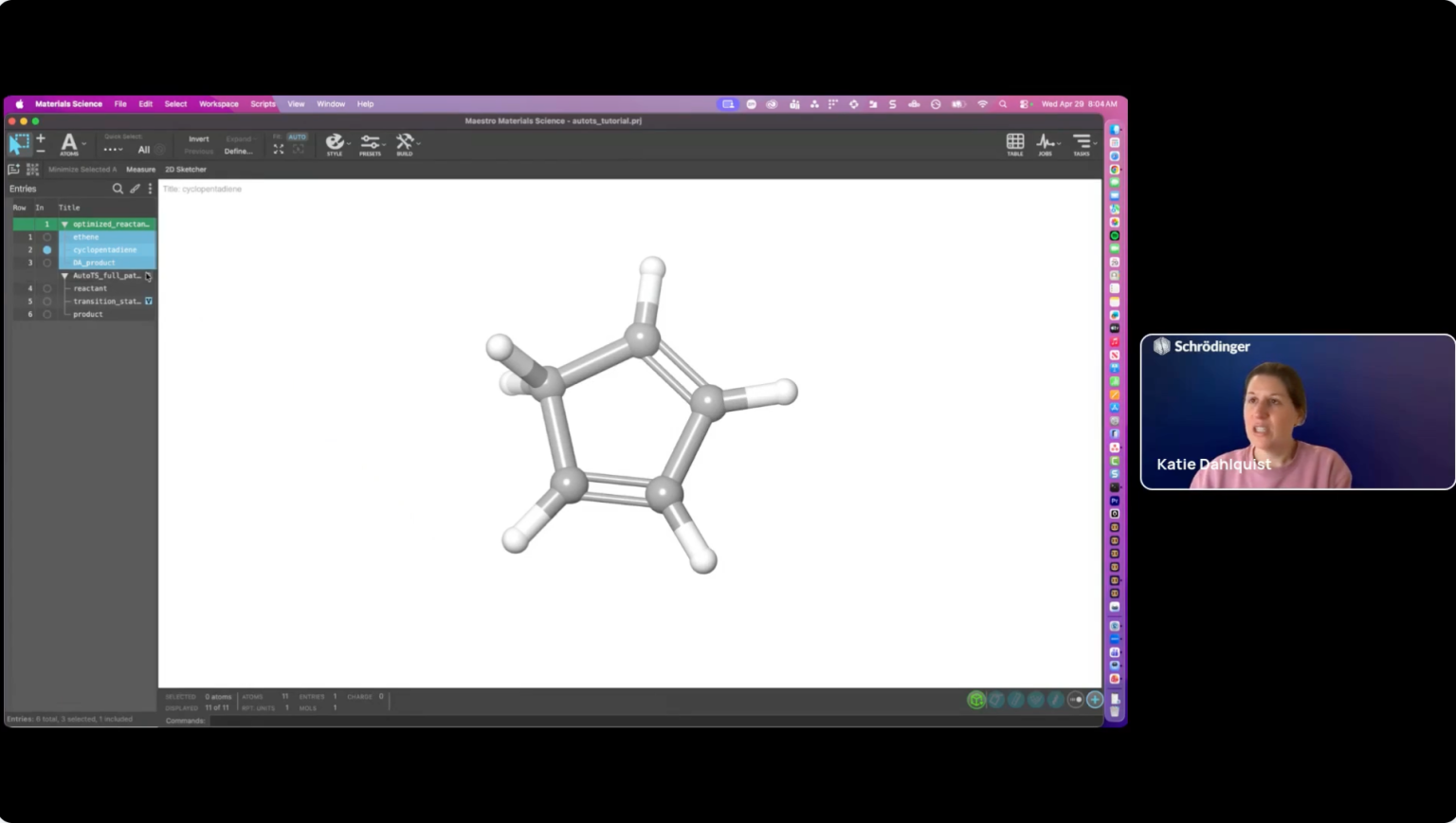
Teaching reaction kinetics often relies on static 2D diagrams that leave students struggling to visualize the physical reality of chemical transformations. This hands-on workshop introduces faculty to Schrödinger’s Jaguar and AutoTS panels as tools for bridging the gap between abstract energy curves and 3D molecular movement. Participants will learn to guide students in identifying the Transition State (TS) not as a “hump” on a graph, but as a specific vibrational structure, using imaginary frequency animations to illustrate the synchronous breaking and forming of bonds.
Beyond simple visualization, the session focuses on inquiry-based pedagogy, demonstrating how to implement an “in silico” discovery lab where students map their own reactant-to-product transitions. Attendees will explore ways to challenge students to test mechanistic hypotheses and use computational data, such as Activation Energy, to defend their scientific conclusions.
By measuring bond lengths in calculated transition states, students can “prove” Hammond’s Postulate, transforming rote memorization into a data-driven justification of whether a TS is reactant-like or product-like. Attendees will leave with a concrete framework for turning complex quantum mechanical concepts into accessible, measurable classroom exercises.
Learning Objectives:
- Bridge the Abstract-to-Concrete Gap: Visualizing Reaction Coordinates
- Facilitate Inquiry-Based Learning: The “In Silico” Experiment
- Evidence-Based Reasoning: Proving Hammond’s Postulate
Slides
Our Speakers

Dr. Katie Dahlquist
Materials Science Education Specialist, Schrödinger
Dr. Katie Dahlquist is a Materials Science Education Specialist at Schrödinger. Katie earned her PhD in computational chemistry from the University of Iowa, where she modeled the reactivity of toxic metals adsorbing to aluminum nanoparticles. Continuing at the University of Iowa, she then joined the College of Pharmacy for her postdoctoral research where she studied allosteric inhibition of glutamate racemase. After the University of Iowa, Katie continued to learn various computational techniques by modeling a variety of properties for small organic molecules and polymers. Since joining Schrödinger’s Education Team, Katie has worked closely with Schrödinger’s Materials Science Team to lead the development of Schrödinger’s newest online certification course titled Battery Materials. Battery Materials is one of seven materials science online certification courses that Katie is a part of delivering. Dr. Katherine Bay is a Senior Scientist responsible for leading the Teaching with Schrödinger program. She develops academic curricula that integrates Schrödinger’s molecular modeling tools into the classroom. Prior to joining Schrödinger in 2021, she was an Assistant Professor of Organic Chemistry where she designed her course as a flipped classroom model in response to the COVID-19 pandemic. She earned her Ph.D. in Organic Chemistry from the University of California, Los Angeles elucidating reactions using density functional theory.

Kat Bay
Manager, Teaching with Schrödinger
Dr. Katherine Bay is a Senior Scientist responsible for leading the Teaching with Schrödinger program. She develops academic curricula that integrates Schrödinger’s molecular modeling tools into the classroom. Prior to joining Schrödinger in 2021, she was an Assistant Professor of Organic Chemistry where she designed her course as a flipped classroom model in response to the COVID-19 pandemic. She earned her Ph.D. in Organic Chemistry from the University of California, Los Angeles elucidating reactions using density functional theory.