APR 28, 2026
Integrating Computational Molecular Modeling into Chemical Education: Teaching [2+2] and [2+4] Cycloaddition Reaction Mechanisms


The incorporation of computational molecular modeling into chemistry education provides an effective strategy for connecting theoretical principles with molecular-level understanding of reaction mechanisms. This work presents a computational teaching framework using the Gaussian 16 software suite to investigate pericyclic reactions, specifically the photochemical [2+2] cycloaddition and the thermally allowed [2+4] cycloaddition (Diels-Alder reaction). These reactions serve as ideal model systems to introduce students to orbital symmetry, reaction energetics, and transition state theory.
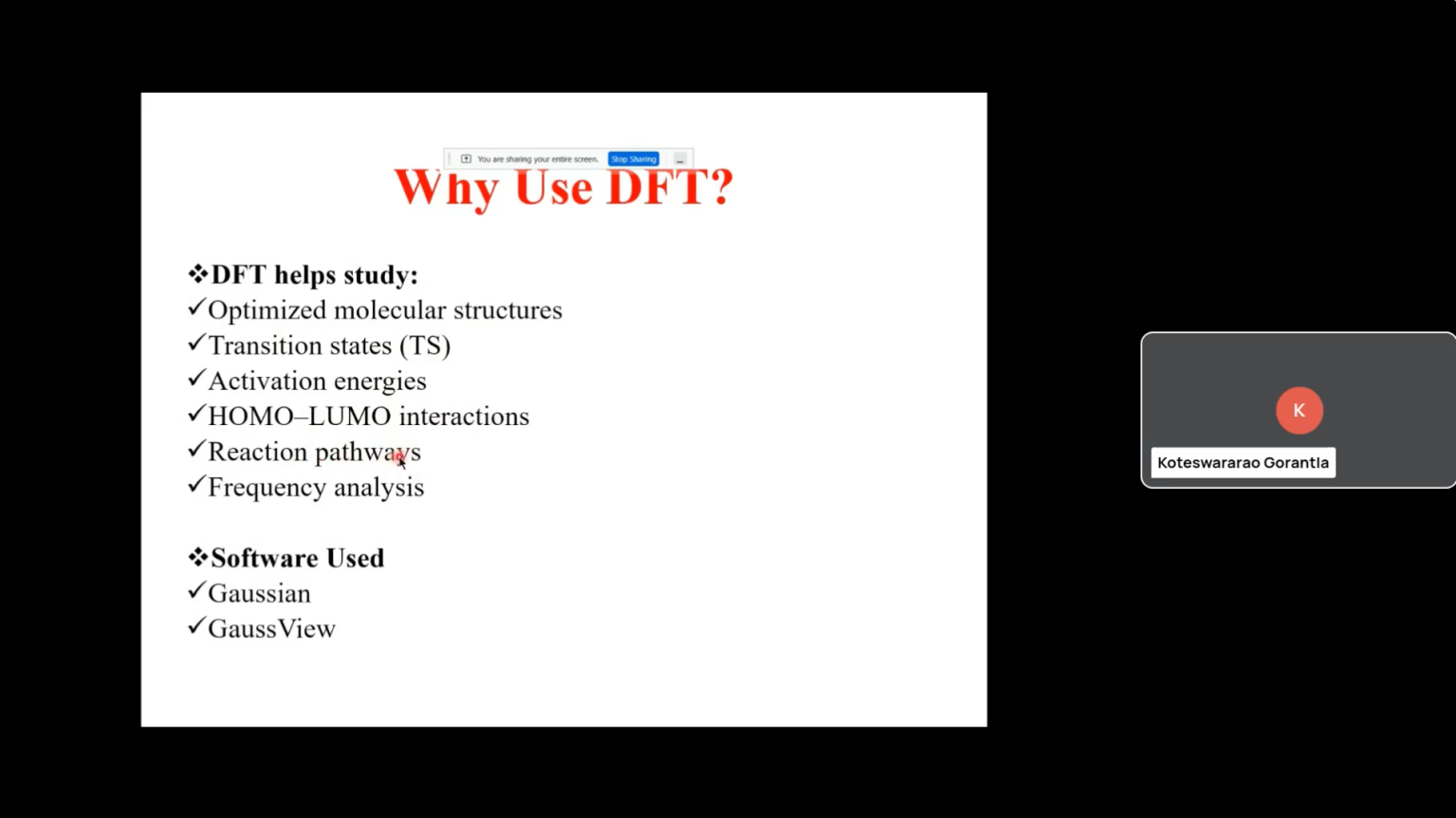
Students perform geometry optimizations of reactants and products using Density Functional Theory (DFT), followed by transition state searches using the Quadratic Synchronous Transit method (QST2) implemented in Gaussian 16. This approach allows students to identify transition structures, verify them through frequency analysis, and construct reaction energy profiles. Natural Bond Orbital (NBO) analysis is further employed to examine donor–acceptor interactions, orbital overlap, and electron density redistribution during bond formation. Through visualization of frontier molecular orbitals (HOMO and LUMO), students gain insight into symmetry-allowed and symmetry-forbidden pathways in accordance with Woodward-Hoffmann rules.
This computational workflow enables learners to connect abstract concepts such as orbital symmetry, reaction coordinates, and electronic structure with observable molecular transformations. The use of Gaussian 16 provides hands-on experience with professional computational chemistry tools widely used in research, thereby enhancing student preparedness for careers in academia, materials science, and pharmaceutical research. Furthermore, visualization of optimized structures, transition states, and orbital interactions promotes active learning and improves conceptual retention.
This educational approach demonstrates that integrating software tools like Gaussian-based computational modeling into chemistry curricula significantly enhances student understanding of pericyclic reactions. By combining theoretical instruction with computational experimentation, educators can provide students with a deeper, research-oriented perspective on chemical reactivity and molecular design.
Our Speaker

Koteswararao Gorantla
Assistant Professor, VIT-AP University
Dr. Koteswara Rao Gorantla is an Assistant Professor at VIT-AP University, working at the interface of theoretical, computational, and bioinorganic chemistry. He earned his M.Sc. in Analytical Chemistry from NIT Warangal and completed his Ph.D. at IIT Hyderabad, where he developed advanced computational strategies to investigate transition metal–mediated catalytic processes. He further expanded his research expertise through postdoctoral studies at the Department of Chemistry, Michigan Technological University (MTU), USA. Dr. Gorantla’s research program focuses on elucidating reaction mechanisms in first-row transition metal complexes relevant to catalytic water oxidation and sustainable energy chemistry. He also investigates mechanistic pathways of metalloenzymes, particularly Zn-dependent systems such as MMP1, to understand collagen degradation at the molecular level. His work integrates Density Functional Theory (DFT), Ab Initio Molecular Dynamics (AIMD), and QM/MM approaches to capture both electronic structure and dynamic effects in complex catalytic and biological systems. His broader research vision emphasizes multiscale computational modeling for rational catalyst design, sustainable energy transformations, enzyme mechanism elucidation, and nano-catalysis. He actively integrates computational chemistry into teaching and research training, mentoring students in advanced electronic-structure methods, molecular simulations, and reaction-mechanism analysis.