APR 28, 2026
Teaching Biomolecular Visualization in a Biochemistry Lab Course: From PyMOL Training with an OER to Modeling Phosphomimetic Mutants of Malate Dehydrogenase


Teaching Biomolecular Visualization in a Biochemistry Lab Course: From PyMOL Training with an OER to Modeling Phosphomimetic Mutants of Malate Dehydrogenase
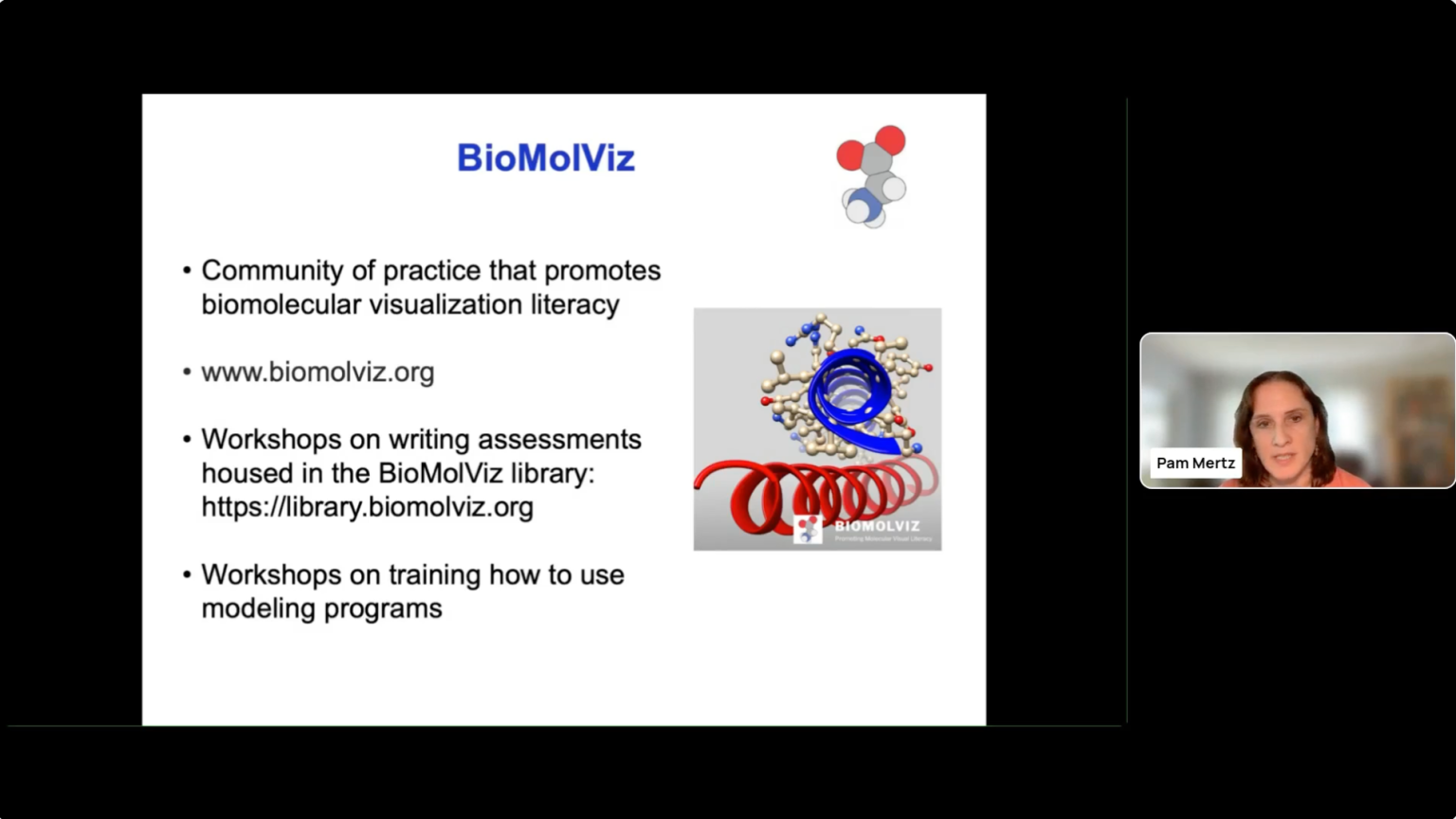
Molecular visualization literacy is an important skill for life science students to master at the undergraduate level to understand the structure and function of biomolecules. BioMolViz recently launched an Open Educational Resource (OER), “Seeing the Invisible: Learning to Teach with Biomolecular Visualization,” funded by the National Science Foundation (award # 1920270). This book provides background on pedagogy for teaching molecular visualization using the Biomolecular Visualization Framework and activities for learning Chimera X, PyMOL, iCn3D, Mol*, and PyMOL, from how to get started to more advanced features. In the Fall 2025 semester, PyMOL activities from this OER were completed by students in an undergraduate Biochemistry I lab course with a malate dehydrogenase course-based undergraduate research experience (CURE). Students used the training from the PyMOL activities to model human mitochondrial malate dehydrogenase (MDH2) with an inhibitor bound. Later in the course they developed a hypothesis about assigned phosphomimetics of MDH2, where either a threonine or tyrosine was changed to a glutamic acid. The residues were chosen based on preliminary evidence suggesting they may be phosphorylated inside the cell. Students were tasked with using PyMOL to study the environment around their assigned mutant residues. To test their hypotheses, they purified recombinant mutants from E. coli and performed kinetic assays. The students analyzed their data and presented their work orally at the end of the semester. The OER (the author submitting this abstract was one of the authors of this resource) and the MDH modeling exercises will be described for the Schrödinger presentation.
Our Speaker

Pamela Mertz
Professor, St. Mary’s College of Maryland
Pam Mertz is a professor of chemistry and biochemistry at St. Mary’s College of Maryland. She received her B.A. in chemistry from Juniata College and Ph.D. in biochemistry from the Mayo Graduate School. She played an instrumental role in planning and implementing the biochemistry curriculum at St. Mary’s since the start of the major, including achieving accreditation of the program by the American Society for Biochemistry and Molecular Biology (ASBMB) in 2016. She was a department co-leader for the CUR Transformations Project, which involved scaffolding undergraduate research experiences throughout the curricula for chemistry and biochemistry students. She has held various leadership roles on ASBMB education-focused committees and was a main organizer of the 2023 ASBMB meeting, “Transforming Undergraduate Education in the Molecular Life Sciences.” She is an Associate Director of BioMolViz, serves as a mentor for the Malate Dehydrogenase CUREs Community, and is the recipient of the ASBMB 2026 William C. Rose Award for Exemplary Contributions to Education.