JUL 28, 2021
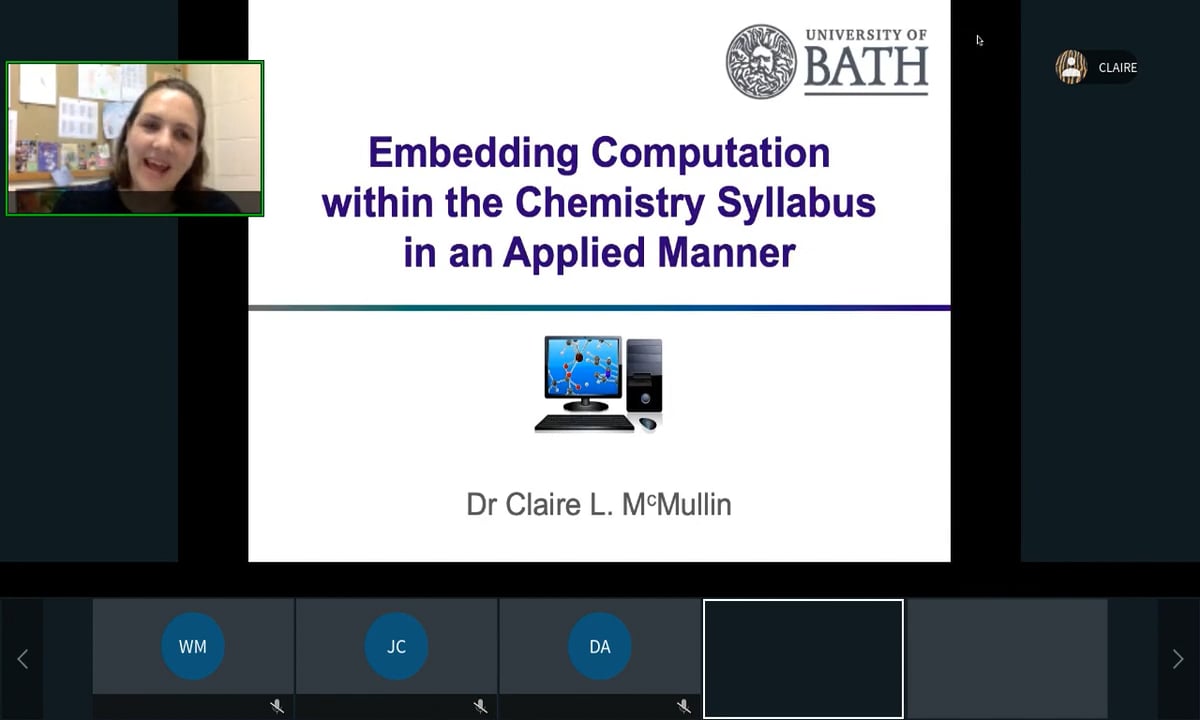
Embedding Computation within the Chemistry Syllabus in an Applied Manner


With advancing technology, the importance of computational chemistry continues to grow. This topic should not remain for postgraduate education or higher, but holistically included in undergraduate curriculum at every stage to provide students modern transferable skills and prepare them for their future workplace. There are two branches of computational chemistry that we have focused on teaching our students; molecular modelling and programming. Both require students to be proficient in data analysis – an important skill to nurture. Our fundamental approach is based on understanding why certain methodologies are chosen to answer a particular chemistry question by knowing each method’s limitations and then vitally linking results back to real chemistry scenarios.
Our Speaker

Claire McMullin
University of Bath
Claire joined the University of Bath in September 2015 as a Computational Chemistry Teaching Fellow. Since then she has established a range of collaborations and has moved into computing main group reaction systems, whilst leading on the computational component of lab teaching and introductory lecture content. Previously, she was a Post-Doc with Prof. Stuart A. Macgregor at Heriot-Watt University working on the mechanism for C-H activation and functionalisation of neutral substrates with Rh(III) and Ru(II) catalysts. Before heading to Edinburgh for three years, Claire spent a year in America as a Post-Doc at the University of North Texas working with Prof. Tom Cundari on late transition metal catalysis. Claire completed her Ph.D. at the University of Bristol (UK) in July 2011 with Guy Orpen and Natalie Fey, her research included expanding the Ligand Knowledge Base (LKB), dispersion corrected modeling of Pd-catalyzed oxidative addition and BuchwaldHartwig amination, developing novel chiral measures to quantify chirality in organometallic asymmetric catalysis (in collaboration with the CCDC), and solving a variety of crystal structures from research groups at the University of Bristol.