JUN 11, 2026
Physics-Based Approaches for Exploring Off-Target Compound Binding: An In Silico Kinase Panel


Hosted by C&EN:
Understanding the structure and function of protein binding sites provides useful context for structure-based approaches applied across drug discovery. A range of computational tools has been developed to explore binding sites, assess binding site properties, and examine potential compound binding poses. These approaches are most commonly used to support work on intended targets; here, we consider their application for exploring potential off-target interactions.
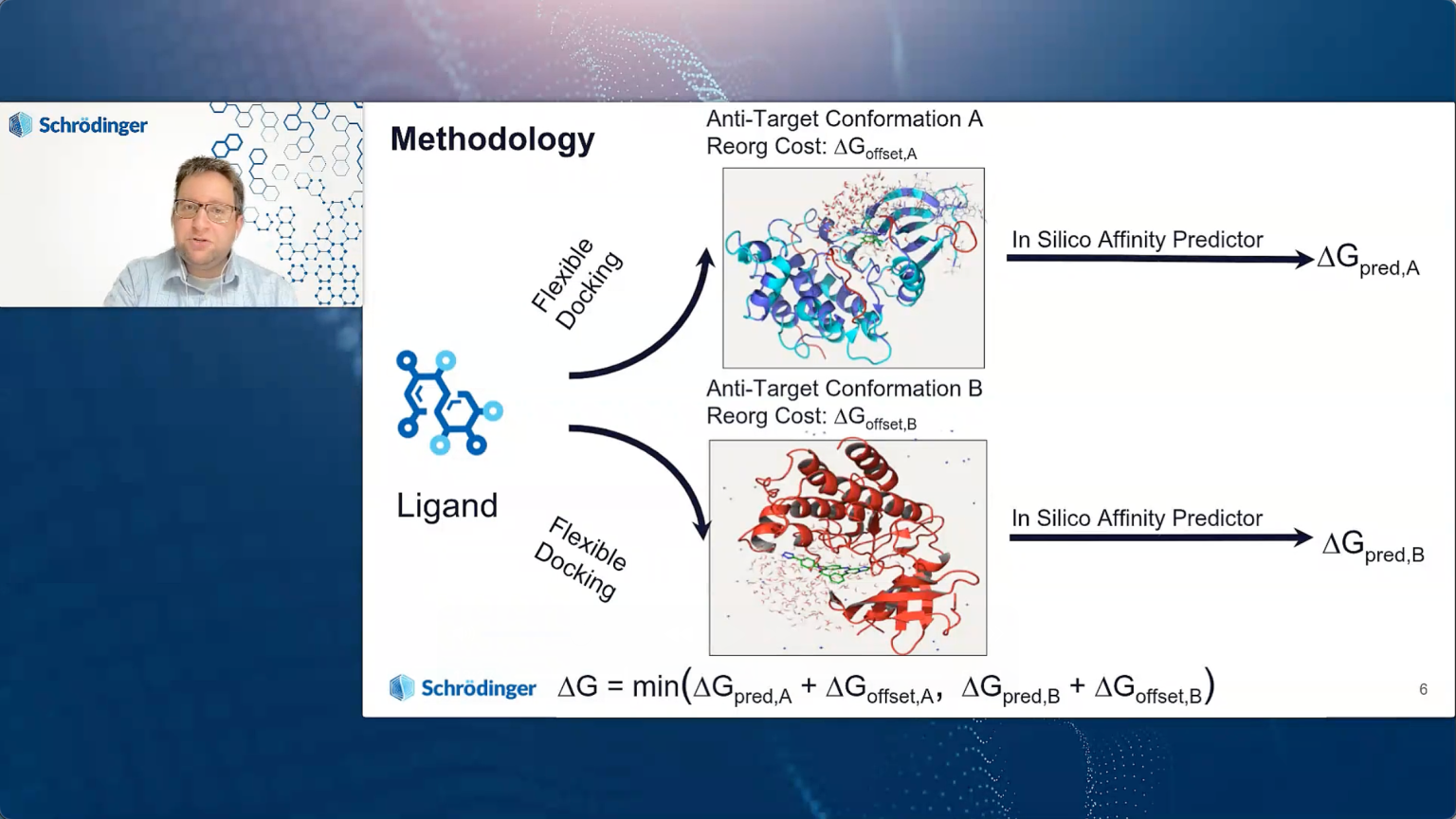
This presentation describes an evaluation of a workflow based on Schrödinger’s IFD-MD and FEP methodologies applied within an in silico kinase panel. Example applications are discussed across kinase and non-kinase targets. These modeling approaches have been applied alongside experimental data to support exploration of structure-activity relationships in medicinal chemistry programs.
Key Learning Objectives:
- Enabling affinity predictions with absolute-binding free energy calculations
- Including protein strain as an offset to allow for comparison with experimental data
- Identifying kinase liabilities, even in non-kinase small molecule programs
- Using in silico off-target binding for detection and de-risking of off-target interactions
Who Should Attend:
- Medicinal Chemists
- Toxicologists
- Computational Chemists & Modelers
- Drug Discovery Leads
Our Speaker

Ed Miller
Vice President, Life Science Software, Schrödinger
Edward Miller, Vice President, Life Science Software, joined Schrödinger in 2014, and is responsible for advancing the domain of applicability of structure-based drug discovery into challenging targets and off-targets. Dr. Miller obtained his PhD from Columbia University, where he was awarded a DOE research fellowship. His thesis work with Professor Richard Friesner involved developing methods to accurately model loop conformations across a broad array of protein families. His recent work has been focused on methods development for induced fit docking and protein structure refinement.