DEC 16, 2025
Predictive toxicology solutions: Actionable, structure-based insights to dial-out tox liabilities early


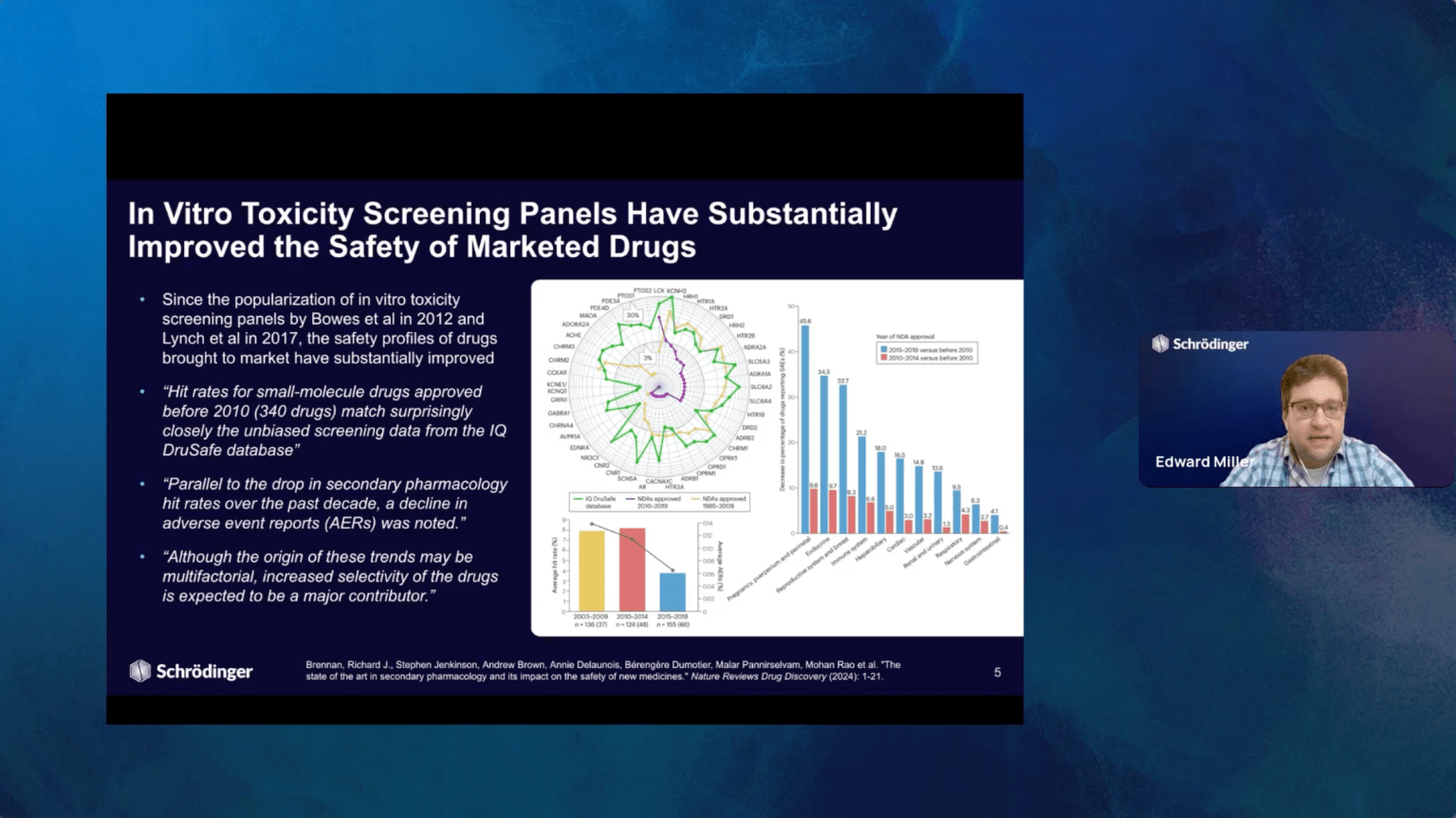
A key challenge and bottleneck in modern drug discovery is the high attrition rate caused by late-stage toxicity. Standard in vitro assays can identify a liability but provide little to no insight into why off-target binding occurs, leaving medicinal chemistry teams to rely on costly, time-consuming guesswork to resolve liabilities, or to undertake a slow and expensive structural biology campaign on one or more off-targets.
Join us to see how our new Predictive Toxicology Solutions fundamentally change the design process, going far beyond the industry norm by offering quantitative, actionable readouts for magnitude assessment and atom-level and R-group attribution to pinpoint the exact molecular features driving unwanted effects to de-risk early.
Key Highlights:
- Predictive Toxicology Solution: Introduction to Schrödinger’s structure-based approach to enable rational drug design for early de-risking
- Live Demo: See the platform in action, showcasing how quickly you can go from a toxic prediction to a viable design modification
- Live Q&A: Meet with the scientist for a first-hand discussion on questions you might have
Who Should Attend: Medicinal Chemists, Computational Chemists, Heads of Lead Optimization, and Drug Discovery Directors seeking to improve the quality and safety of their pipeline compounds.
Our Speaker

Ed Miller
Executive Director of Protein Structure Modeling, Schrödinger
Edward Miller, Senior Director of Protein Structure Modeling, joined Schrödinger in 2014, and is responsible for advancing the domain of applicability of structure-based drug discovery into challenging targets and off-targets. Dr. Miller obtained his PhD from Columbia University, where he was awarded a DOE research fellowship. His thesis work with Professor Richard Friesner involved developing methods to accurately model loop conformations across a broad array of protein families. His recent work has been focused on methods development for induced fit docking and protein structure refinement.