MAY 28, 2024
Target-Based Antibiotic Discovery in the Undergraduate Laboratory Empowered by Virtual Screening with Teaching with Schrödinger


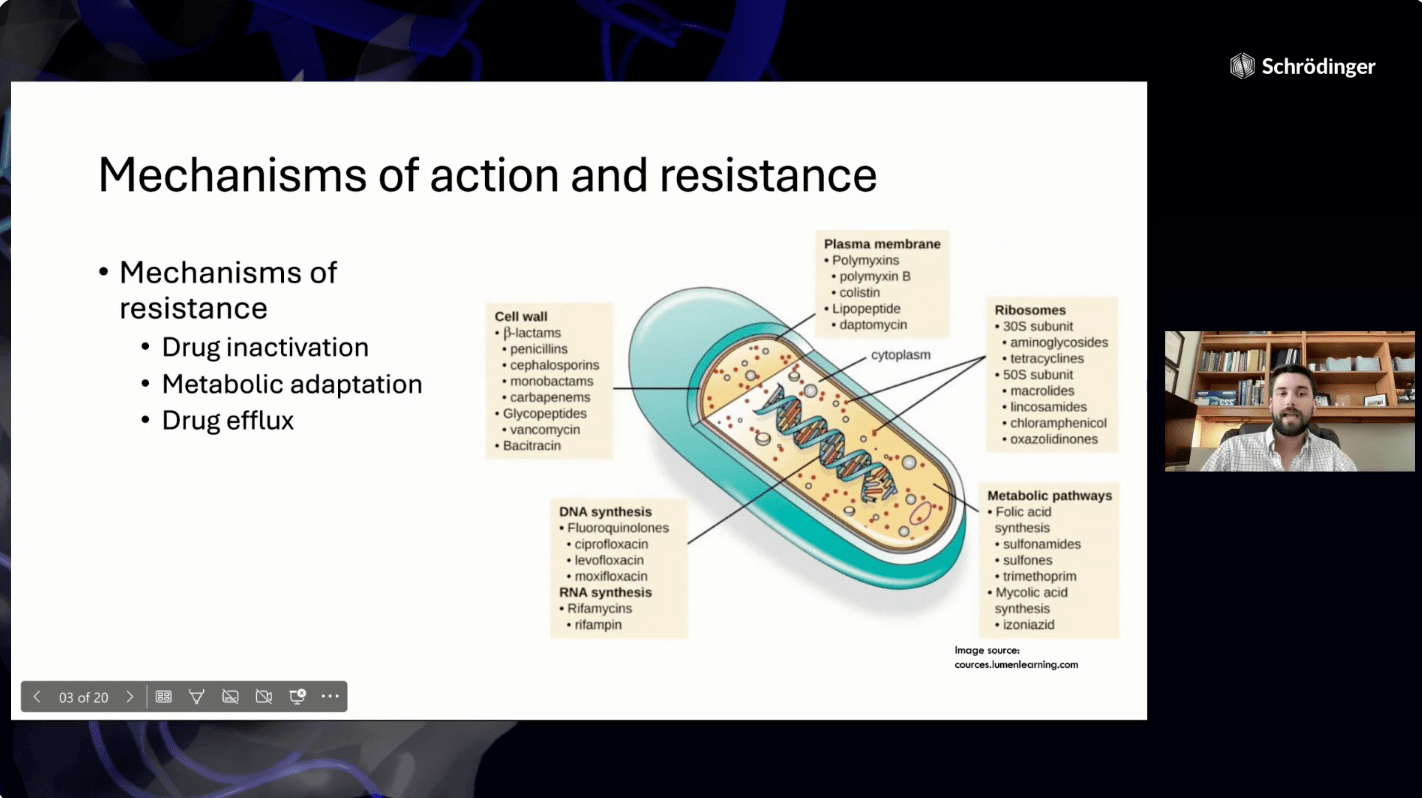
The antibiotic resistance crisis is one of the fastest growing public health concerns today. The development of and propagation of resistance genes is rapidly outpacing antibiotic development. As such, there is a critical need not only for the development of new drugs, but of new compounds that target novel pathways for the treatment of bacterial infections. Course-based undergraduate research experiences (CUREs) have been of tremendous influence in laboratory education over the past decade. These courses give students the opportunity to address real research problems rather than just repeat well-known standard experiments. Antibiotic discovery presents and excellent opportunity for the development of a CURE curriculum, as it gives students the opportunity to engage in a truly critical area of need. While exciting, progress in a CURE course such as this is often hampered by time and budgetary constraints, greatly limiting the throughput of any screening program. The use of computational tools such as Schrödinger software allows students to evaluate much larger numbers of compounds to prioritize candidates for experimental testing. Herein is presented a CURE curriculum that encompasses a high throughput screening platform for two distinct antibiotic targets. The use of Teaching with Schrödinger at several areas of the discovery pipeline such as high throughput and lead optimization with ligand designer will be discussed.
Our Speaker
Nicholas Clanton
University of Texas at San Antonio
Dr. Nicholas Clanton received his B.S. degree in biochemistry from Samford University in 2016 and his Ph.D. in Chemistry from the University of Texas at San Antonio in 2021 with a research focus on anticancer drug discovery based on natural product scaffolds. He is currently the assistant director of the Voelcker Preclinical Pharmacology Core at the University of Texas at San Antonio, which specializes in early-stage ADME screening, rodent pharmacokinetics, and quantitative bioanalysis of xenobiotics and natural metabolites. Dr. Clanton also teaches the biochemistry II laboratory course in the department of chemistry where he works with students on target-based antibiotic drug discovery employing high throughput screening and computer aided drug design.