JUN 15, 2023
Teach computer-aided drug design (CADD) in the upper-level bioinformatics/biochemistry /molecular modeling courses using schrodinger package


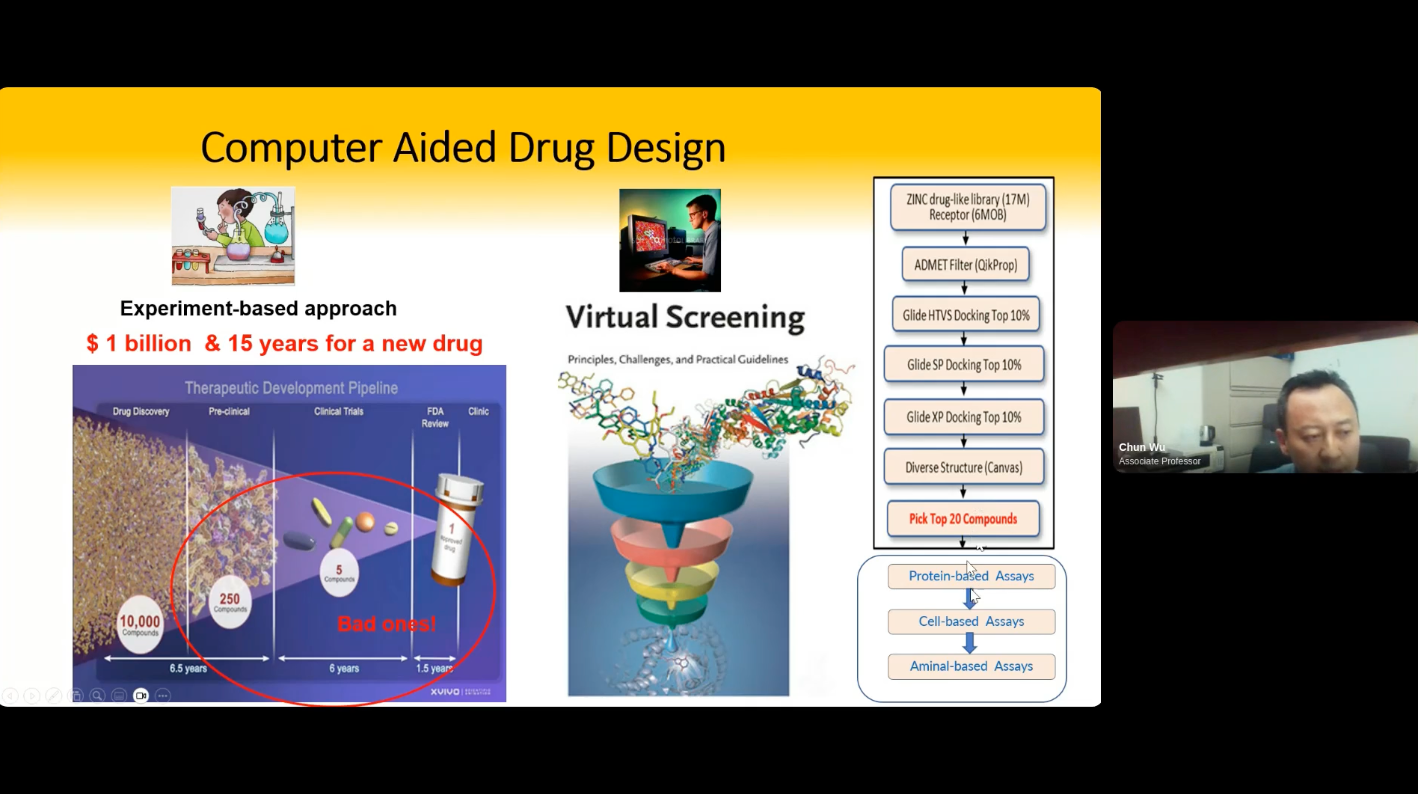
Computer-aided drug design (CADD) has become an integral part of modern drug discovery and development processes. To equip students with essential skills in CADD, it is imperative to incorporate relevant tools and software packages into the curriculum of bioinformatics, biochemistry, and molecular modeling courses. This talk presents the effective integration of the Schrödinger Small-Molecule Drug Discovery Suite, a widely used suite of computational chemistry tools, in teaching CADD concepts to students at the upper-level courses. The Schrödinger package offers a comprehensive range of modules and functionalities for homology modeling, molecular docking, virtual screening, and molecular dynamics simulations. By introducing students to this powerful software package, they can gain hands-on experience in utilizing computational techniques for rational drug design. The talk discusses the potential benefits, challenges, and strategies for integrating the Schrödinger package into the curriculum, focusing on enhancing students’ understanding of CADD principles, fostering critical thinking skills, and providing practical training for future research and industry applications. Furthermore, it highlights the importance of incorporating real-world case studies and collaborative projects to reinforce the learning experience and encourage interdisciplinary approaches. Through the incorporation of the Schrödinger package in upper-level courses, students can develop valuable computational skills and be better prepared to contribute to the rapidly evolving field of drug discovery and design.
Our Speaker
Chun Wu
Rowan University
Dr. Chun Wu is a tenured associate professor with a joint appointment in the Departments of Chemistry & Biochemistry and the Biological Biomedical Sciences at Rowan University. He obtained his PhD from University of Delaware where he developed protein force fields and conducted molecular dynamics simulations of amyloidogenic peptides. He then trained at the University of California Davis and Santa Barbara as a postdoctoral researcher studying the modeling of oligomers of amyloidogenic peptides. At Rowan, using genomic datasets his lab is developing a novel evolution theory (near-neutral balanced selection theory/NNBST) not only to best explain the molecular evolution of SARS-COV-2 and other pathogens but also to accurately identify hotspots in their genome for developing first/next generation vaccines and drugs to treat these infectious diseases; using molecular docking, homology modeling and molecular dynamics simulations, his computer aided drug design (CADD) lab is investigating the binding interactions between various protein receptors and ligands toward novel drug design. Working collaboratively with experimental groups, the Wu lab aims to discover novel protein receptors and small molecules as potential anti-cancer agents, antiviral agents, anti-neural-disorder agents, and to optimize ionic liquids for protein and nucleic acid stabilization. With over 92 peer-reviewed publications and a total awarded external grant of $1.5 million and 3.3 million CPU hours as a PI and co-PI, he has achieved a h-index of 35 and total citations of 8857+. His contributions to the field of computational biochemistry, molecular modeling and simulation and CADD are widely recognized by his peers. He has been invited to present at national and international meetings, and top Chinese institutes, and he was named the World Class Professor by the Indonesia Ministry of Education and Culture in 2021. In addition to his research, Chun is also passionate about teaching and mentoring students at both the undergraduate and graduate level. At Rowan, he has supervised over 30 MS graduate students and 100 undergraduates in research leading to over 28+23 publications and 69+83 posters.