JUN 22, 2022
Virtual Chemistry: Revolutionizing Pharmacy Learning


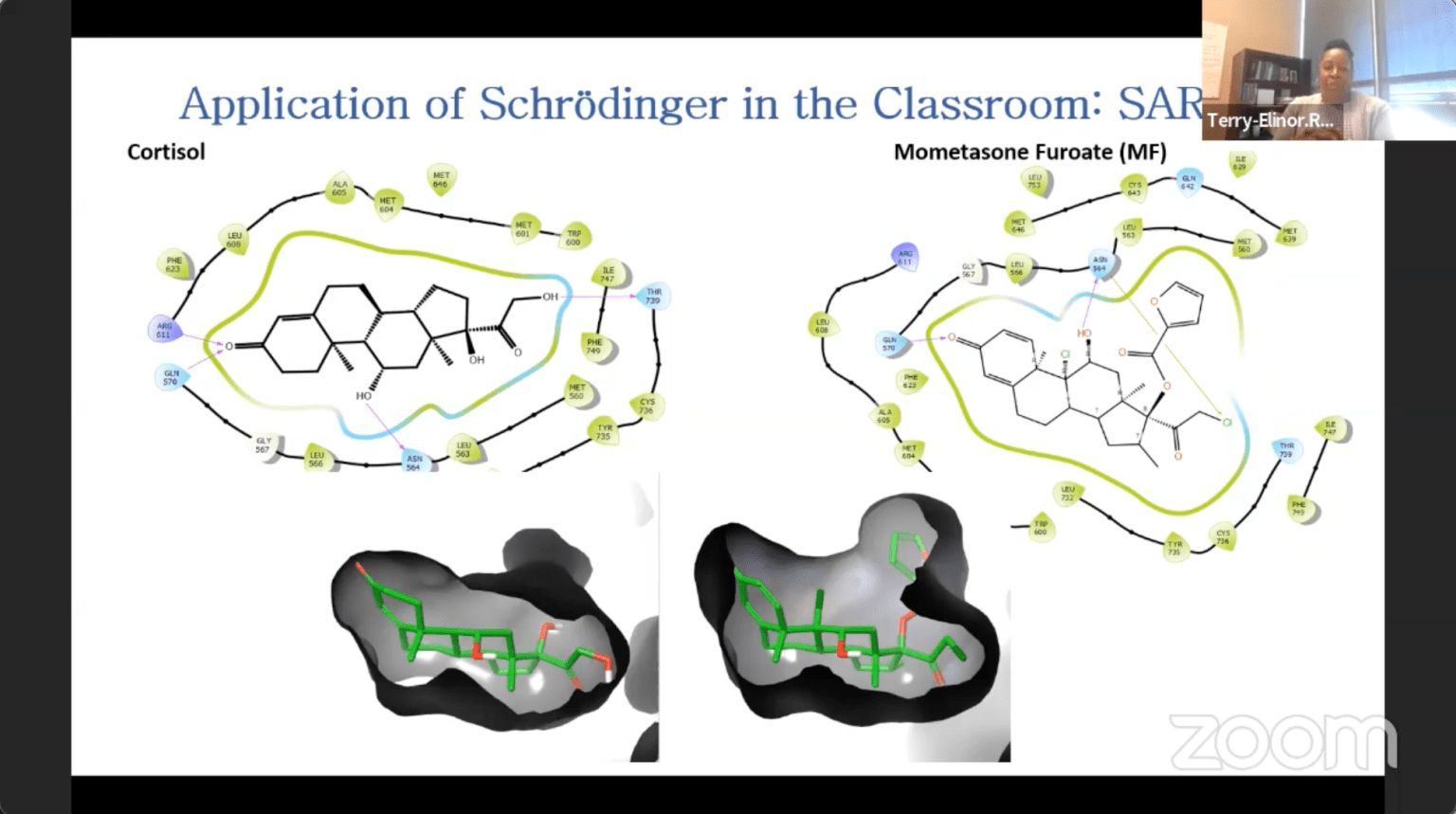
One of the most dreaded courses, that is essential in pharmacy education, is Medicinal Chemistry. The course is difficult in part due to the abstract nature of science. Concepts such as protein-drug interaction which informs the mechanism of action, rational drug design, and the pharmacokinetics of a drug can be challenging topics for students to grasp and in turn applied to make clinical decisions. Within our Pharmacology and Medicinal Chemistry course series, we have introduced the Schrödinger Small Molecule Drug Discovery platform to the classroom as both a teaching aid and a virtual learning and exploration tool for pharmacy students. Its application in the classroom provides a platform for experiential and exploratory learning. It fosters the active learning pedagogy, which encourages collaboration, reinforces important scientific concepts, reduces ambiguity, promotes critical thinking, and motivates students to learn. This presentation will highlight ways in which we use the Schrödinger Computational Software to enhance the teaching and learning of concepts taught in Pharmacology & Medicinal Chemistry. In addition, we will describe how students apply what they learn through a drug design project and poster presentation that is held at the end of the course series.
Our Speaker

Terry-Elinor Reid
Concordia University Wisconsin School of Pharmacy
Dr. Terry-Elinor Reid is an Assistant Professor and Medicinal-Computational Chemist at the Concordia University Wisconsin School of Pharmacy. She obtained a bachelor’s of Science degree in Chemical engineering in 2005 from Howard University, and a Ph.D. in Pharmaceutical Sciences in 2015 also from Howard University in Washington DC. Dr. Reid held roles in the biotech industry, healthcare, and academia where she still maintains collaborations with industry partners. Dr. Reid actively maintains multiple research programs involving the discovery and design of HIV latency-reversing agents, anti-cancer agents, and antimicrobial agents. If you are interested in learning about Dr. Reid’s research endeavors, you can find her published work in journals such as the Journal of Chemical Information, Modeling and Current Topics in Medicinal Chemistry, just to name a few. Dr. Reid has found a way to incorporate computational tools like Schrodinger into her teaching to allow for a practical experience that is impossible to gain in the lab given the limited teaching hours as a result of the rigorous nature of the Pharmacy program.