MAY 1, 2026
Controlling Fluorescence in DNA Probes: Structural Design of Perylene-Modified Nucleic Acids for Enhanced Imaging


Abstract:
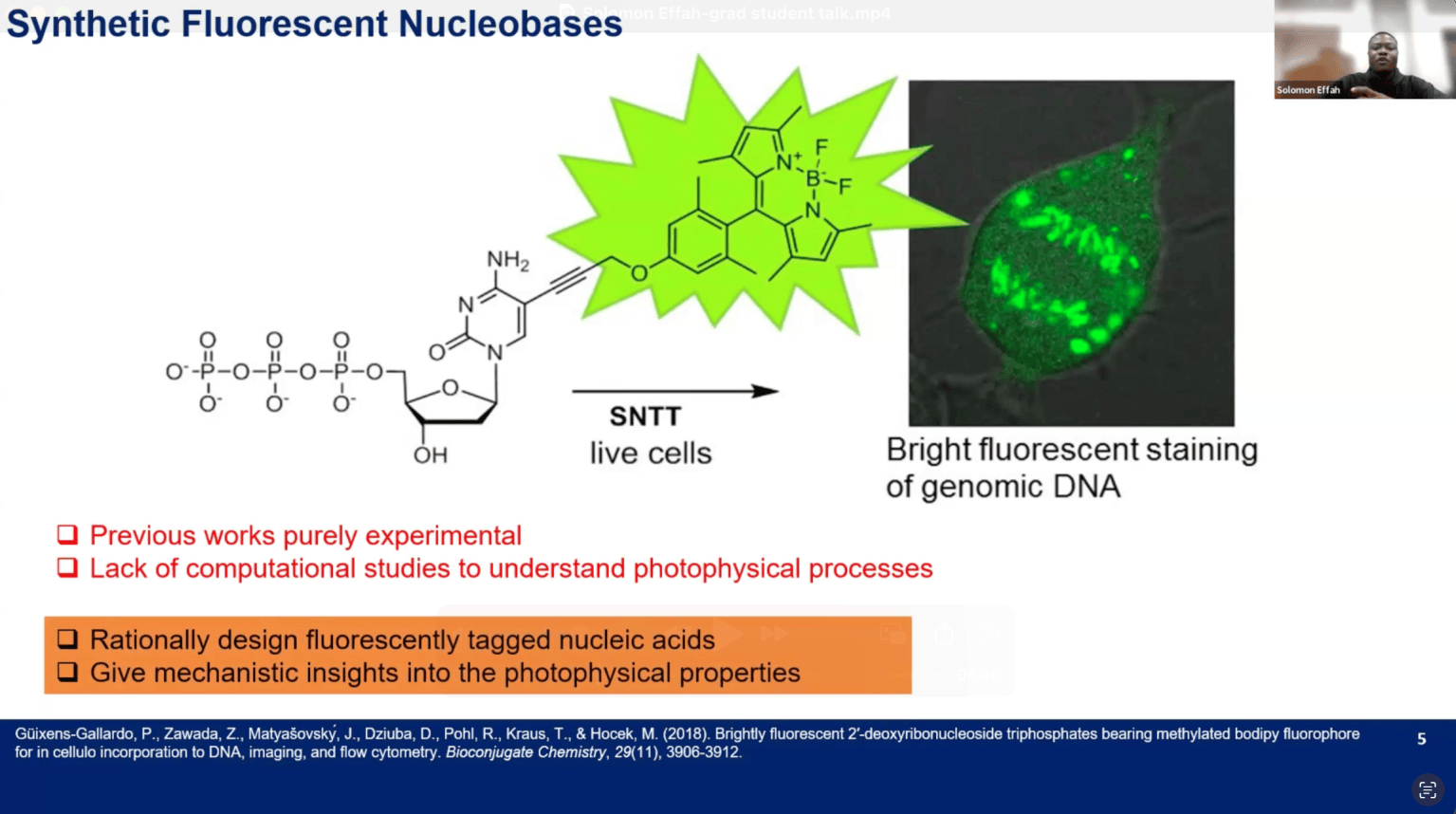
Real-time visualization of DNA replication is crucial for understanding cellular processes and developing targeted cancer therapeutics, yet designing effective fluorescent probes remains challenging. Our research combines state-of-the-art computational approaches to unravel the fundamental principles governing fluorescent DNA probe design. Using excited-state QM/MM dynamics with TDDFT (ωPBE functional) and classical molecular dynamics, we systematically investigated perylene-modified nucleotides across multiple attachment positions and nucleobases. We discovered that fluorescence properties are exquisitely sensitive to geometric factors – specifically, a critical 90° dihedral angle between perylene and nucleobase that triggers rapid fluorescence quenching through charge transfer pathways. This understanding enabled us to strategically control probe brightness through structural modifications. We demonstrate that phosphate groups stabilize excited states and reduce unwanted charge transfer, while ethynylene linkers maintain high fluorescence by restricting conformational flexibility. Remarkably, adenine-based probes exhibit superior stability compared to guanine derivatives, where attachment position dramatically influences photophysical properties. These insights provide clear design principles for developing next-generation fluorescent probes with optimized properties for biological imaging. Our computational framework not only advances fundamental photophysics but also accelerates the development of practical tools for studying DNA replication in cancer research and drug discovery. This work exemplifies how theoretical chemistry can drive innovations in biological imaging and disease research.
Presenter:
Solomon Effah from Wayne State University
Solomon Yamoah Effah is a PhD candidate in Physical Chemistry at Wayne State University, where he works in the Walker Lab under Dr. Alice R. Walker. His research focuses on computational medicinal chemistry and structure-based drug design, combining quantum mechanics, molecular dynamics, and free energy methods to address challenges in cancer research and antiviral drug discovery. Solomon’s work on fluorescent perylene-modified nucleic acid probes applies excited-state QM/MM dynamics and TDDFT to establish design principles for next-generation DNA imaging tools. He has also led computational campaigns identifying novel heparanase inhibitors as potential anticancer agents and contributed to HTLV-1 protease inhibitor discovery. His publications span the Journal of Medicinal Chemistry, the Journal of Chemical Information and Modeling, and Biochemistry. Solomon is an elected Full Member of Sigma Xi, The Scientific Research Honor Society, and a recipient of the Rumble Fellowship (A. Paul and Carole C. Schaap Endowed Distinguished Graduate Award) at Wayne State University. His fluorescent probe research has been featured in GhanaWeb and other international media outlets for its potential to advance early cancer detection. He served as Vice President (2024–2025) of the Wayne State NOBCChE Chapter and mentors Detroit-area youth in STEM through the Motor City STEAM Foundation.