MAY 1, 2026
QMzyme: Taming the Complexity of QM-Based Enzyme Modeling


Abstract:
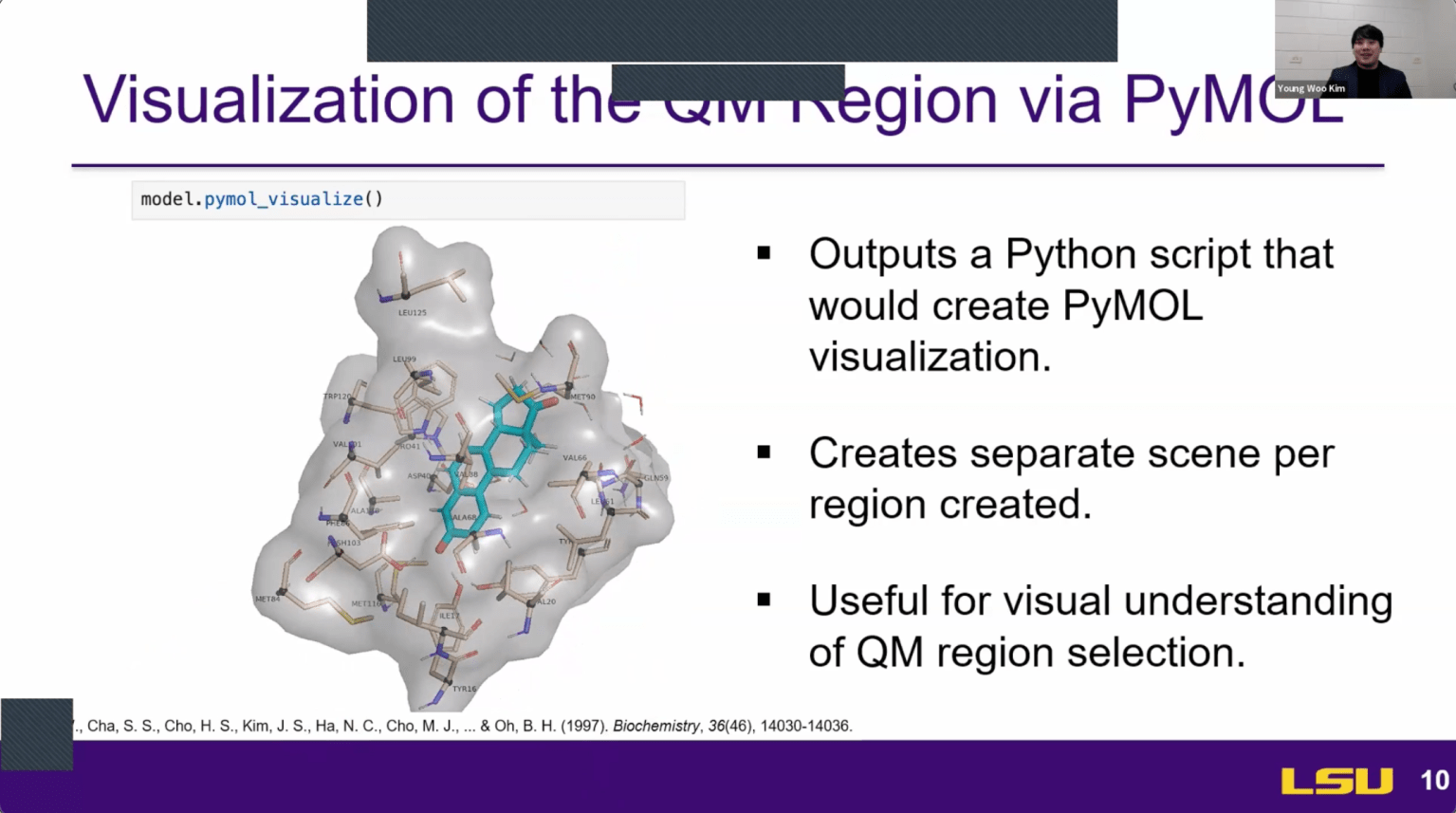
Mechanistic insight is central to understanding enzyme catalysis and guiding drug design, and quantum mechanical (QM) methods are well-suited to capture the underlying chemistry of biological complexes. However, the quality and reproducibility of enzyme QM studies depend heavily on user-defined choices during model construction. These choices, combined with the tedious nature of QM calculations, often introduce human error and limit reproducibility across studies. We hypothesize that these challenges can be addressed by a computational ecosystem that streamlines input preparation and QM output data consolidation and analysis. To this end, we introduce QMzyme, a Python package that facilitates QM-based enzyme workflows. QMzyme automates the construction of partitioned biomolecular models for QM/MM or QM-only calculations using modular TruncationScheme and SelectionScheme classes, including DistanceCutoff, ChargeShiftAnalysis, and FukuiShiftAnalysis. Each QMzymeModel encodes its construction history, ensuring transparency and reproducibility. A PyMOL script is generated alongside the QMzymeModel for automated, publication-quality visualization of selected regions within the full biological context. This visualization feature has driven the integration of QMzyme into undergraduate and graduate courses, enabling students with little to no computational experience to engage with biomolecular modeling. QMzyme further enables systematic analysis by attributing QM output into the model object, allowing for straightforward comparison of modeling decisions. Models can be serialized into machine-readable JSON formats, promoting data accessibility, and supporting data-driven modeling and LLM-based workflows, directions we aim to pursue next. The well-characterized enzyme ketosteroid isomerase (KSI) is used to demonstrate how QMzyme enables exploration of how modeling choices influence computed properties such as electric fields and reaction energetics. By automating key steps in QM workflows, QMzyme reduces human error while enhancing transparency, reproducibility, and data accessibility. As an extensible, community-driven platform, QMzyme will continue to evolve to meet emerging needs in computational enzymology.
Presenter:
Young Woo Kim from Louisiana State University
Young Woo Kim is a first-year graduate student at Louisiana State University (LSU),
specializing in computational biophysical chemistry in the Klem Lab. He earned his
bachelor’s degree in Biochemistry and Molecular Biology from the College of Wooster.
His research focuses on enzyme modeling using quantum mechanics (QM) and
molecular dynamics (MD) approaches to investigate enzyme mechanisms with
applications in plastic recycling and medicinal chemistry. Currently, he is contributing to
the development of QMzyme, an open-source computational tool designed to facilitate
QM-based enzyme workflows for the broader scientific community.