FEP+ Pose Builder — maximizing utility and productivity in FEP simulations


The Challenge:
Bridging the Scalability Gap in FEP+
FEP+ is the industry standard for relative binding affinity prediction. However, the demanding requirement for high-fidelity initial ligand poses has traditionally imposed a significant barrier to throughput and cost-effectiveness.
Traditional FEP+ pose setup is constrained by three primary factors:
- Time and Resource Intensive: Establishing a robust protocol involves iteratively testing and comparing outputs from multiple docking and alignment algorithms (e.g., MCS alignment, Glide) to address the critical dependence of FEP+ performance on input pose. This process often consumes dedicated person days of effort.
- Steric Clashes Complication: As FEP is an all atom MD simulation based method, it can usually resolve minor protein-ligand clashes during initial equilibration. However, more severe clashes, such as when a chain threads through a ring, are not resolvable and should be avoided in the initial pose. Conventional pose generation methods are either not clash aware (e.g. ligand alignment may generate poses with perfect core alignment but with severe clashes) or too clash sensitive (e.g. docking may avoid clashes by generating ligand poses with insufficiently aligned cores resulting in suboptimal atom mapping to the FEP reference required for robust simulations).
- System Complexity: The traditional, multi-algorithmic approach necessitates managing complex external software dependencies and protocols.
FEP+ Pose Builder:
Automated, FEP-Ready Protocol Generation
FEP+ Pose Builder is a methodological advancement introduced as an integrated feature to drastically enhance accessibility, user-friendliness, and productivity within the FEP+ pipeline.
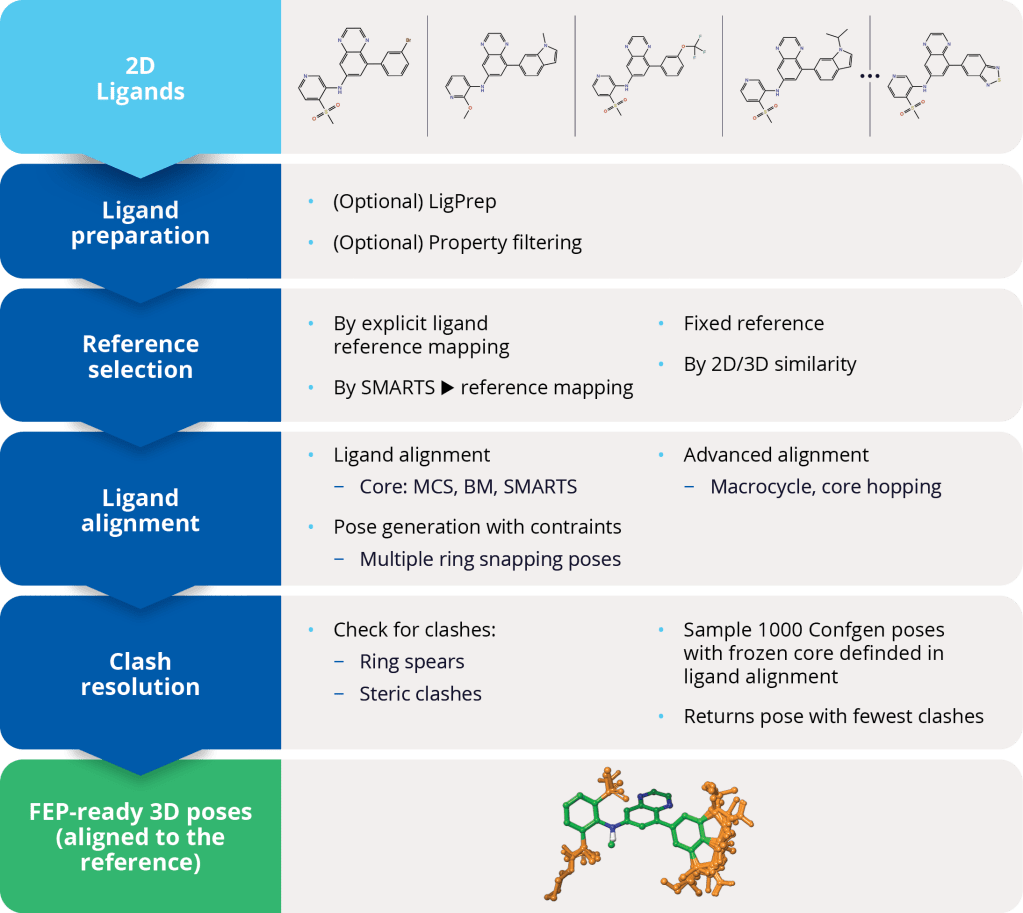
FEP+ Pose Builder transforms 2D or 3D ligand inputs into FEP-ready poses via a single, automated, four-stage protocol shown in Fig. 1:

Ligand Preparation:
Prepares and filters the ligand with Ligprep and Ligfilter to generate the optimal ligand state(s)
Reference Identification:
Determines the optimal reference ligand based on user input or 2D/3D structure similarity
Ligand Alignment:
Based on user input and ligand types, FEP+ Pose Builder automatically selects the appropriate ligand alignment method, including core alignment, constrained pose generation, and advanced R-group alignment.
Clash Resolution:
FEP+ Pose Builder detects steric clashes between aligned ligands and the receptor and distinguishes the tolerable close contact clashes and the unresolvable clashes. To resolve severe clashes, up to 1000 conformers are generated with the aligned core atoms fixed and the conformer with the fewest bad clashes is returned.
Performance and Quantifiable Value
We benchmarked the quality of poses generated by FEP+ Pose Builder with a dataset from a recent publication1. Shown in Fig. 2, the poses generated by FEP+ Pose Builder are similar to the poses curated manually by an expert modeler in a fraction of the time.

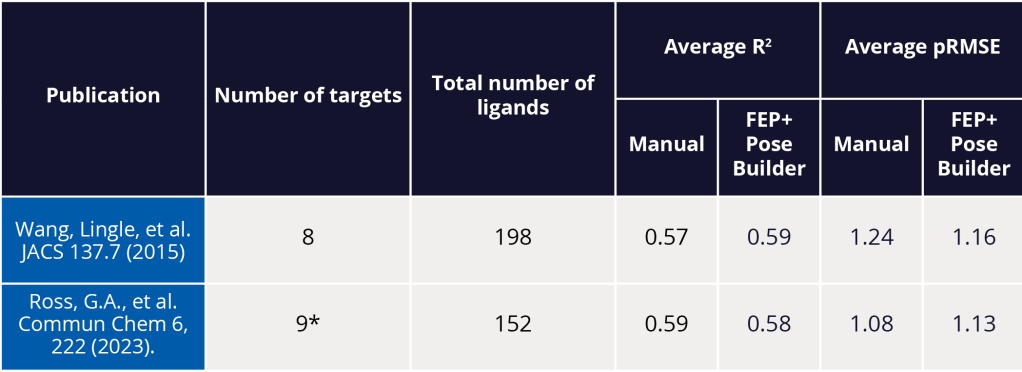
We also evaluated FEP+ performance of FEP+ Pose Builder poses using datasets from two publications.
Shown in Table 1, poses generated by FEP+ Pose Builder showed similar performance in FEP+ simulations
compared with the manually curated poses.
Benefits

Expert like accuracy:
FEP+ Pose Builder delivers poses similar to those curated by experts and results in comparable FEP+ accuracy.

Time and cost effective:
FEP+ Pose Builder is designed to offer automated, FEP-ready protocol generation that requires minimal FTE effort.

Highly scalable:
FEP+ Pose Builder workflow is massively scalable for Hit to Lead / Lead optimization projects.
Conclusion
FEP+ Pose Builder is a critical methodological enhancement that addresses the primary bottleneck in FEP+ deployment—structural input preparation. By delivering fully automated, high-quality, and clash-aware alignment, FEP+ Pose Builder maximizes the accessibility, productivity, and cost-effectiveness of FEP+. This feature standardizes the creation of reliable FEP-ready inputs, allowing computational scientists to leverage the full power of FEP+ for molecular innovation at scale.
References
-
Accurate and reliable prediction of relative ligand binding potency in prospective drug discovery by way of a modern free-energy calculation protocol and force field.
Wang, L., Wu, Y., Deng, Y., et al. Journal of the American Chemical Society, 7, 137 (2015). https://doi.org/10.1021/ja512751q
-
The maximal and current accuracy of rigorous protein-ligand binding free energy calculations.
Ross, G.A., Lu, C., Scarabelli, G. et al. Commun Chem, 6, 222 (2023). https://doi.org/10.1038/s42004-023-01019-9
Software and services to meet your organizational needs
Industry-Leading Software Platform
Deploy digital drug discovery workflows using a comprehensive and user-friendly platform for molecular modeling, design, and collaboration.
Modeling Services
Leverage Schrödinger’s team of expert computational scientists to advance your projects through key stages in the drug discovery process.
Scientific and Technical Support
Access expert support, educational materials, and training resources designed for both novice and experienced users.