FEB 10, 2026
Physics-driven ML to accelerate the design of layered multicomponent electronic devices


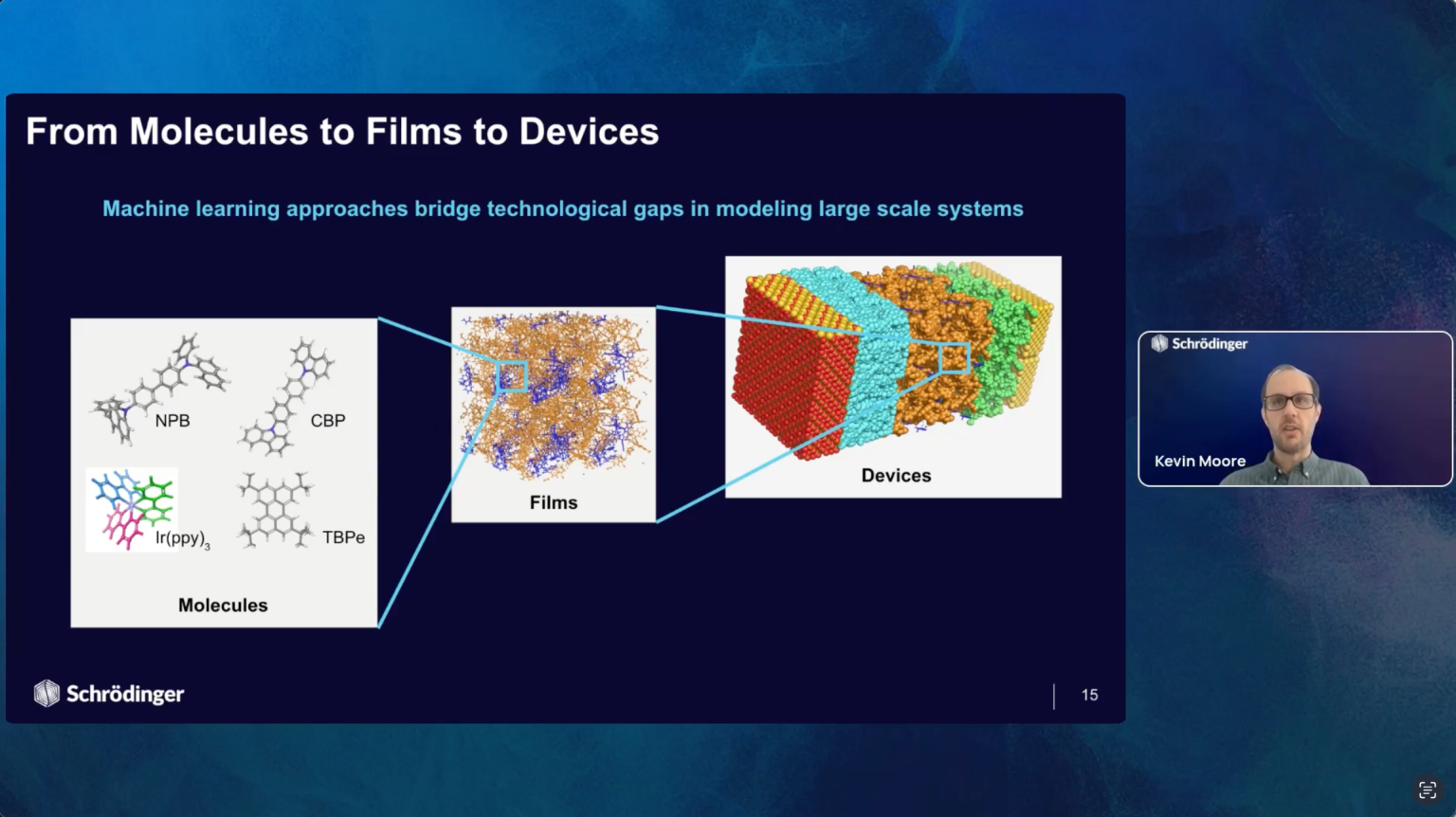
Many advanced electronic devices – such as OLEDs, batteries, solar cells, and transistors – rely on complex multilayer architectures composed of multiple materials. Optimizing device performance, stability, and efficiency requires precise control over layer composition and arrangement, yet experimental exploration of new designs is costly and time-intensive. Although physics-based simulations offer insight into individual materials, they are often impractical for full device architectures due to computational expense and methodological limitations.
Schrödinger has developed a machine learning (ML) framework that enables users to predict key performance metrics of multilayered electronic devices from simple, intuitive descriptions of their architecture and operating conditions. This approach integrates automated ML workflows with physics-based simulations in the Schrödinger Materials Science suite, leveraging physics-based simulation outputs to improve model accuracy and predictive power. This advancement provides a scalable solution for rapidly exploring novel device design spaces – enabling targeted evaluations such as modifying layer composition, adding or removing layers, and adjusting layer dimensions or morphology. Users can efficiently predict device performance and uncover interpretable relationships between functionality, layer architecture, and materials chemistry. While this webinar focuses on single-unit and tandem OLEDs, the approach is readily adaptable to a wide range of electronic devices.
Key highlights:
- A machine learning framework for modeling electronic device performance, allowing users to define architectural features to explore novel device configurations
- Model accuracy demonstrated with a dataset of over 2,000 OLED architectures for multiple key performance metrics
- Pre-trained ML models for six device performance metrics available out-of-the box, including external quantum efficiency, current efficiency, power efficiency, electroluminescence maximum peak position, bandwidth, and emission color
- Intuitive graphical interface for designing, training, and exploring new chemistries and device architectures
- Demonstration of the framework’s extensibility to a broad range of electronic devices
Who should attend:
- Device developers
- R&D leaders
- Innovation managers
- Digitization managers
- Synthetic chemists
- Computational materials scientists
Our Speaker

Kevin Moore
Senior Scientist II, Materials Science Software, Schrödinger
Kevin Moore is a scientist at Schrӧdinger working on development of multiscale and hybrid physics-AI predictive frameworks for discovery and optimization of next generation materials, devices and fabrication. Prior to joining Schrӧdinger, he earned a Ph.D. in computational chemistry from the University of Georgia and conducted postdoctoral research at Argonne National Laboratory. He specializes in quantum physics-based calculations to predict the structure, properties, and reactivity of chemical systems. Recently, his efforts have been on training and validating new ML architectures and models, leveraging first-principles data, informatics and physics featurization. These new AI frameworks bridge chemistries and length scales, spanning from atoms to devices. One particular target area involves the design of electronic devices such as OLEDs, batteries, solar cells, transistors, and more.