APR 30, 2026
Parallel exploration of virtual protein-ligand docking workflow and benchtop


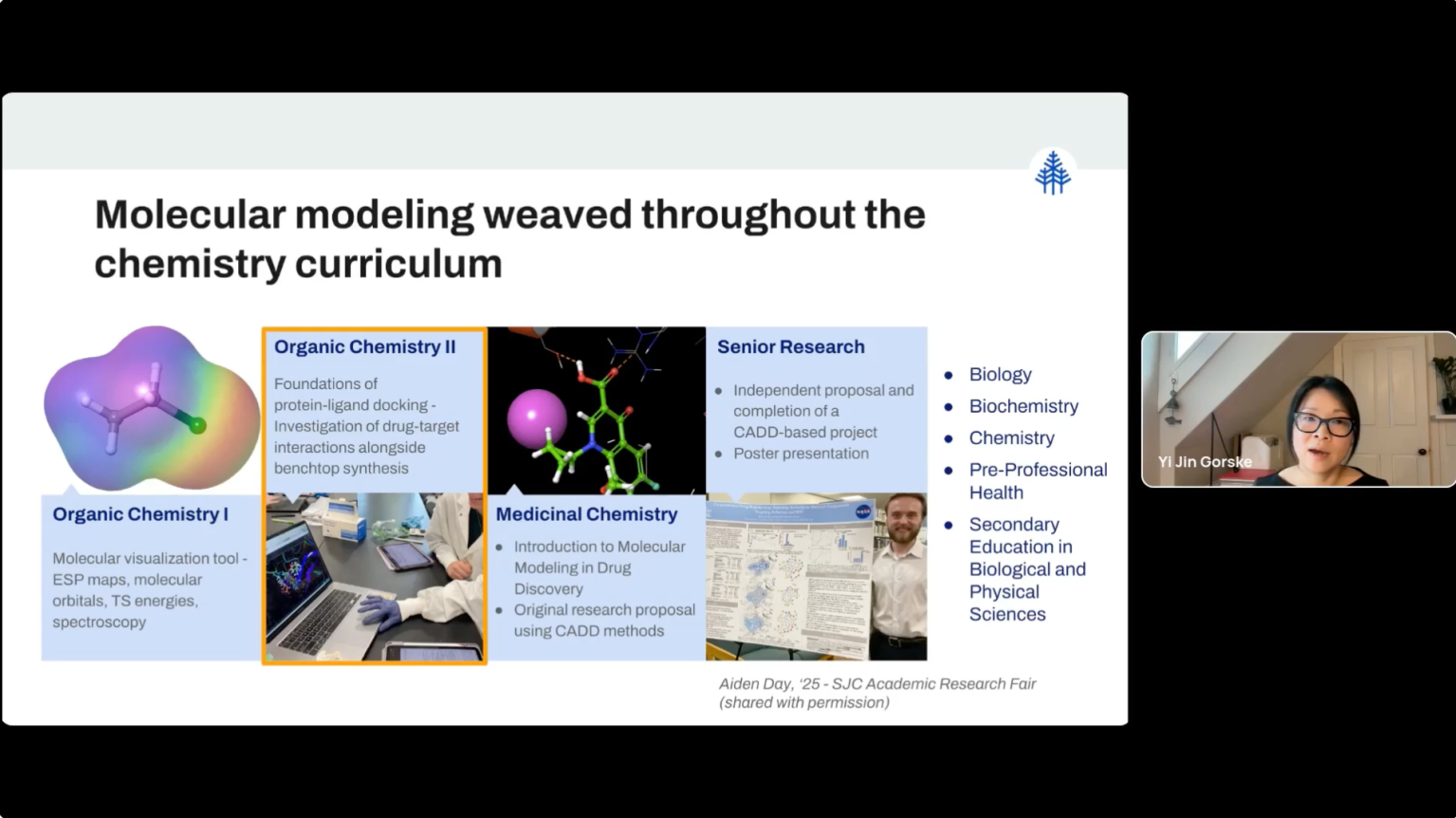
Computational molecular modeling tools provide a highly relevant and meaningful learning opportunity for students in a modern organic chemistry curriculum. We have implemented a semester-long laboratory project in organic chemistry II that allows students to explore computer-aided drug discovery (CADD) methods alongside traditional benchtop synthesis of small molecule drug compounds. Students work in teams to complete both a virtual protein-ligand docking workflow and a benchtop synthesis of known quinolone antibiotic analogs. Students use Maestro through Teaching with Schrödinger to download PDB structures of DNA gyrase and topoisomerase IV bound to a fluoroquinolone; prepare and validate the structure for docking; evaluate key non- covalent interactions between the drug and the binding site; and then dock their laboratory-prepared quinolone analogs for evaluation. While this project was implemented for second-semester organic chemistry students who have had some experience with the Maestro platform in organic chemistry I, this lesson can also be adapted for courses where virtual molecular modeling tools are just being introduced. Student learning gains are assessed based on a lab presentation of this project at the end of the semester. A PDF of the student guidelines for the project that include PDB numbers, how to prepare the proteins, discussion questions, along with useful references will be provided.
Our Speaker
Yi Jin Gorske
Associate Professor of Chemistry, Saint Joseph’s College in Standish, Maine
Dr. Yi Jin Kim Gorske is an Associate Professor of Chemistry at Saint Joseph’s College in Standish, Maine. She received her B.A. in Molecular and Cell Biology from University of California-Berkeley, before completing her Ph.D. work in Organic Chemistry at University of Wisconsin-Madison, where she focused on synthetic methodology development and natural product total synthesis. Prior to entering academia, Dr. Gorske worked on antibacterial research & development as a medicinal chemist at a biopharmaceutical company in New Jersey. She currently teaches Organic Chemistry and Medicinal Chemistry at Saint Joseph’s College, where she focuses on the design and synthesis of small molecules that can be used as antiviral and antibacterial agents.