MAY 28, 2026
Embracing a new era of toxicity screening: Atomic-resolution modeling to mitigate off-target liabilities


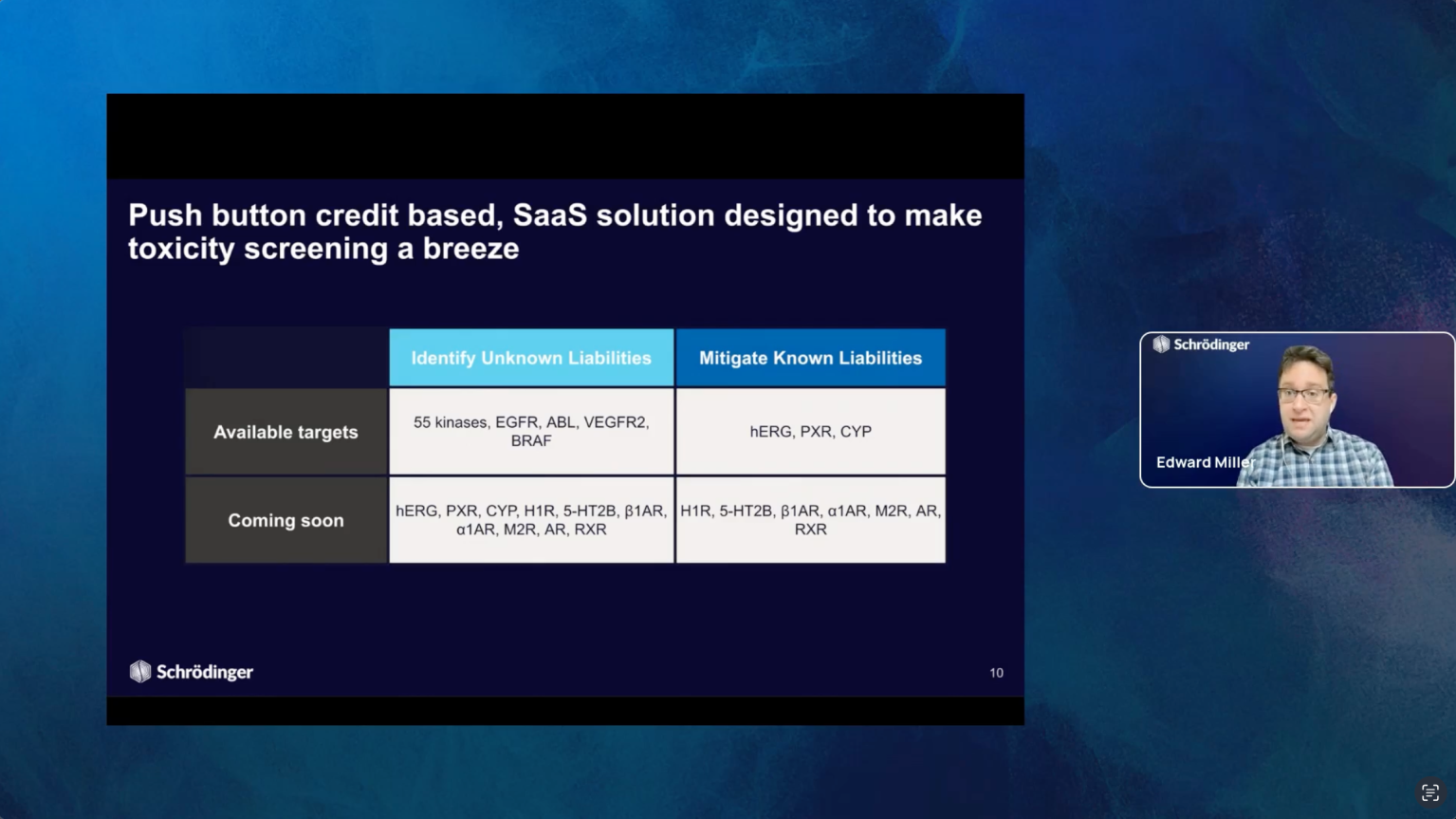
Late-stage discovery failures due to off-target liabilities, particularly hERG, CYP, and nuclear receptor interactions, remain a primary driver of project delays and sunk costs. Traditional predictive methods often act as “black boxes,” providing binary pass/fail flags without the mechanistic context needed to guide chemical synthesis. Without an atomically accurate understanding of why a molecule is hitting an anti-target, medicinal chemistry teams are often forced into blind “guess-and-check” cycles, risking both potency and safety.
Join us for a technical overview of Schrödinger’s Predictive Toxicology solution. This session will demonstrate how physics-based, atomic-resolution modeling transforms toxicology from a reactive “filter” into a proactive “design tool.” We will explore how to move beyond simple predictions to generate actionable binding hypotheses, allowing teams to surgically engineer out liabilities while maintaining primary activity. By integrating these insights directly into the DMTA cycle, discovery teams can significantly reduce synthesis costs and accelerate the path to a clean lead.
Key Highlights:
- Mechanistic Attribution: Learn how to move from binary toxicity “flags” to atom-level structural rationales
- Accelerated DMTA Cycles: See how predictive structural models can reduce experimental timelines by >10X
- Structural SAR: Strategies for performing surgical chemical modifications to mitigate hERG and CYP risk without sacrificing potency
- Live Demo: See the platform in action, showcasing how quickly you can go from a toxic prediction to a viable design modification
Who Should Attend:
- Medicinal Chemists looking to rationalize and design around off-target SAR
- Toxicologists interested in mechanistic, structural-based risk assessment
- Computational Chemists & Modelers seeking to integrate high-fidelity tox predictions into their design workflows
- Discovery Leads focused on reducing late-stage attrition and optimizing project budgets
Our Speakers

Ed Miller
Vice President, Life Science Software, Schrödinger
Edward Miller, Senior Director of Protein Structure Modeling, joined Schrödinger in 2014, and is responsible for advancing the domain of applicability of structure-based drug discovery into challenging targets and off-targets. Dr. Miller obtained his PhD from Columbia University, where he was awarded a DOE research fellowship. His thesis work with Professor Richard Friesner involved developing methods to accurately model loop conformations across a broad array of protein families. His recent work has been focused on methods development for induced fit docking and protein structure refinement.

Steven Albanese
Research Leader, Computational Chemistry, Therapeutics Group, Schrödinger
Steven Albanese joined Schrödinger in 2019 as a Computational Chemist in the Therapeutics group, with a focus on the application of Schrödinger’s computational platform to small molecule drug discovery projects. Dr. Albanese received his PhD from Gerstner Sloan Kettering at Memorial Sloan Kettering Cancer Center, where he studied with Dr. John Chodera. His thesis work focused on the application of free energy calculations to predict resistance and selectivity for small molecule kinase inhibitors. He has continued his research on predicting drug resistance, and is an inventor on a number of small molecule patents as well.