DEC 2, 2025
Rethinking the rules: Exploiting solvent exposed salt-bridge interactions with free energy perturbation simulations for the discovery of potent inhibitors of SOS1


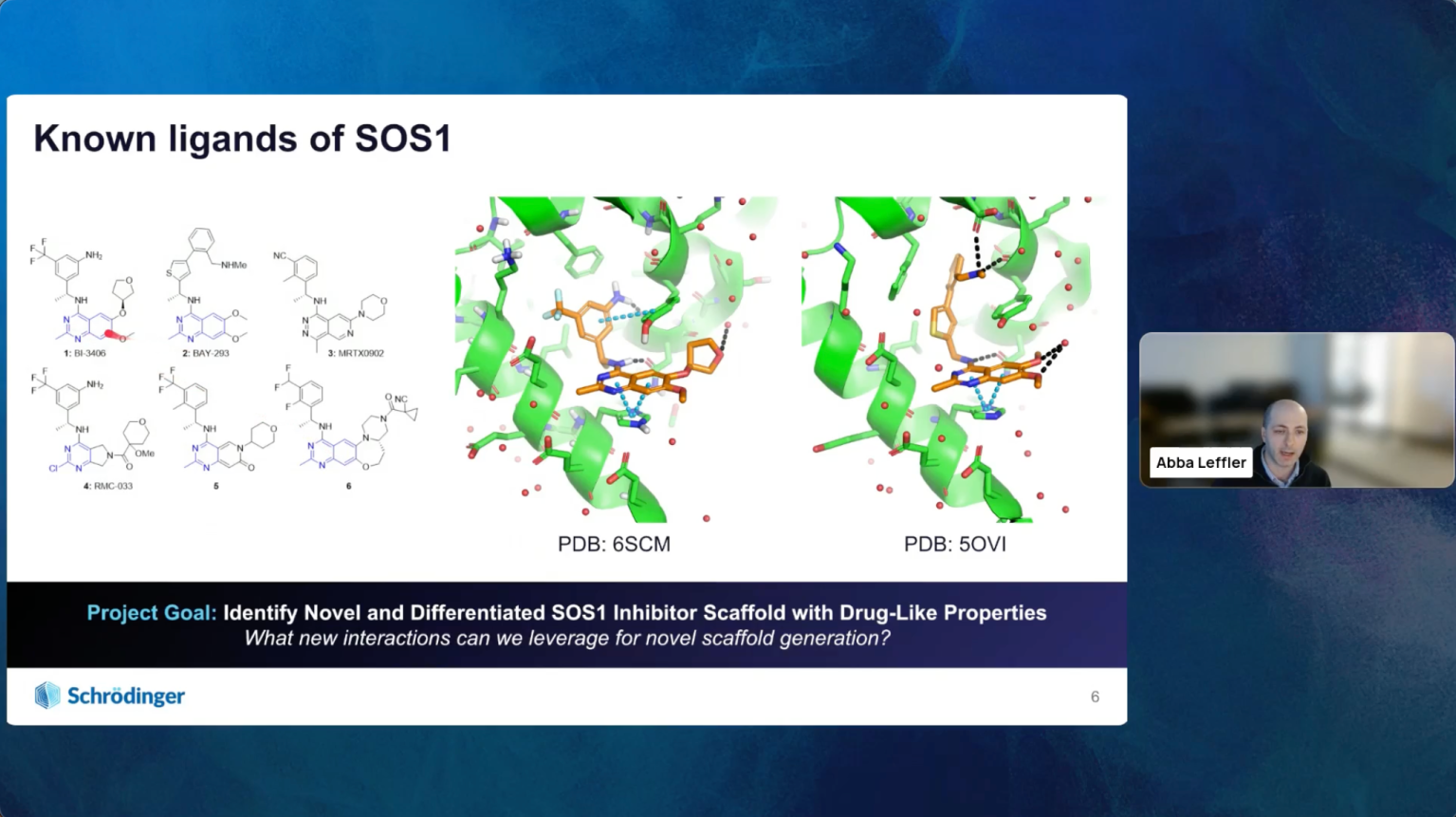
As chemists, we often search for ways to drive potency using traditional “rules” of medicinal chemistry, but what should be done when that doesn’t get a program to where it needs to be? In silico prediction techniques like free energy perturbation (FEP+) can now offer opportunities to explore new territory and quickly test what happens if we rethink the rules by exploring new regions of chemical space in unconventional ways. In our SOS1 program, the Schrödinger therapeutics team sought to exploit overlooked interactions to discover novel and potent chemical series. FEP+ gave us the ability to explore non-traditional regions of the binding pocket with low risk and high confidence, culminating in the IND-ready SOS1 inhibitor SGR-4174.
Guided by free energy perturbation (FEP+) simulations, we discovered that two acidic residues on the perimeter of a known small molecule binding site on SOS1, E906 and E909, constitute a potency handle that can improve inhibitor affinity by as much as 750-fold when targeted with basic groups to form salt bridges, despite being solvent exposed. Structure-activity relationship (SAR) and X-ray crystallographic studies demonstrate that this effect is attributable to the electrostatic interaction between the protein and ligand. This interaction could be repurposed to create new SOS1 inhibitors, documenting its general utility for core exploration.
Furthermore, recent examples in the literature suggest that this phenomenon may be applicable to a number of target classes. In this webinar, we will walk you through the SOS1 program, as well as our exploration of other examples where these salt-bridge interactions are influential.
Webinar Highlights:
- Learn new in silico strategies for exploring non-traditional regions of the binding pocket to drive potency that can be applied to your drug discovery programs
- Discover how a ‘predict-first’ strategy using FEP+ enabled the exploration of new design ideas, leading to the identification of influential solvent-exposed salt bridge interactions
- See how the Schrödinger team applied this new understanding to explore the effects of solvent-exposed salt bridges in other systems
- Ask questions to gain further insight from the speakers to apply to your work
Our Speaker

Abba Leffler
Senior Principal Scientist, Computational Chemistry, Therapeutics Group, Schrödinger
Abba E. Leffler, Ph.D. is a senior principal scientist in the therapeutics group at Schrödinger, where he currently focuses on small-molecule drug discovery. He received his AB in Chemistry with a Certificate in Applied Mathematics from Princeton University, after which he worked at D. E. Shaw Research before going on to obtain his PhD in Neuroscience from NYU School of Medicine. His research has been published in Science, The Journal of Neuroscience, The Journal of Chemical Information and Modeling, and Proceedings of the National Academy of Sciences among others. He is an inventor on multiple patents as well.