DELTA50: A Highly Accurate Database of Experimental 1H and 13C NMR Chemical Shifts Applied to DFT Benchmarking
GRC Computational Chemistry

Conference
GRC Computational Chemistry
 Date & Time
 - July 21st-26th, 2024
- 7:55 PM – 8:25 PM
 Location
 - Portland, Maine


Schrödinger is excited to be participating in the GRC Computational Chemistry conference taking place on July 21st – 26th in Portland, Maine. Join us for a presentation by Pavel Dub, Product Manager at Schrödinger, titled “Molecular Catalysts Design with Massively Parallel Physics-Based Computational Workflow.”
GRC Computational Materials Science and Engineering

Conference
GRC Computational Materials Science and Engineering
Date & Time - July 21st-26th, 2024
Location - Newry, Maine
Schrödinger is excited to be participating in the GRC Computational Materials Science and Engineering conference taking place on July 21st – 26th in Newry, Maine. Join us for a poster by Atif Afzal, Principal Scientist at Schrödinger, titled “Advancements in Polymer Electrolyte Dynamics through Machine Learning-Based Force Fields.”
Biennial Conference on Chemical Education 2024

Conference
Biennial Conference on Chemical Education 2024
Date & Time - July 28th – August 1st, 2024
Location - Lexington, Kentucky
Schrödinger is excited to be participating in the Biennial Conference on Chemical Education 2024 taking place on July 28th – August 1st in Lexington, Kentucky. Join us for a workshop by Rachel Clune, Senior Scientist I at Schrödinger, titled “Online certification courses to help experimental graduate students incorporate molecular modeling into their research.” Stop by booth 43 to speak with Schrödinger scientists.
Speaker:
Rachel Clune, Senior Scientist I, Schrödinger
Abstract:
Schrödinger’s materials science online certification courses teach students about applications of molecular modeling in chemistry and materials science through the use of the Schrödinger Materials Science platform. The target audience of the courses are experimental scientists and engineers wishing to broaden the tools they have at their disposal to understand and advance their research. The courses come with access to computing resources, allowing for researchers without access to computing clusters to still perform complex calculations. This makes the courses particularly useful for graduate students whose main focus is in experimental domains but want to make use of computational tools to further improve their research.
For the workshop, participants will be given a limited license to the Schrödinger Materials Science platform and access to a virtual cluster to run calculations. The courses are guided by active learning principles, with tutorials on how to set up and run different calculations interspersed with short (~10 minute) lectures. We will guide participants through one of the materials science online certification courses for the first 1.5-2 hours of the workshop with periodic breaks for discussion and to make sure participants are staying on track. Examples of the types of tools that will be discussed include density functional theory calculations, all-atom molecular dynamics simulations, and the use of machine learning for predicting material properties. The last hour will be reserved for participants to attempt their own calculations with guidance and help from the workshop presenters. By the end of the workshop, participants should feel comfortable using the Schrödinger’s Materials Science platform and have an understanding of how computational modeling can be an asset to their research goals.
Participants will need to bring their own laptop that is able to connect to the venue wifi and the workshop presenters will need access to a projector.
Leveraging atomistic simulation, machine learning, and cloud-based collaborative ideation for display materials discovery
AUG 7, 2024
Leveraging atomistic simulation, machine learning, and cloud-based collaborative ideation for display materials discovery
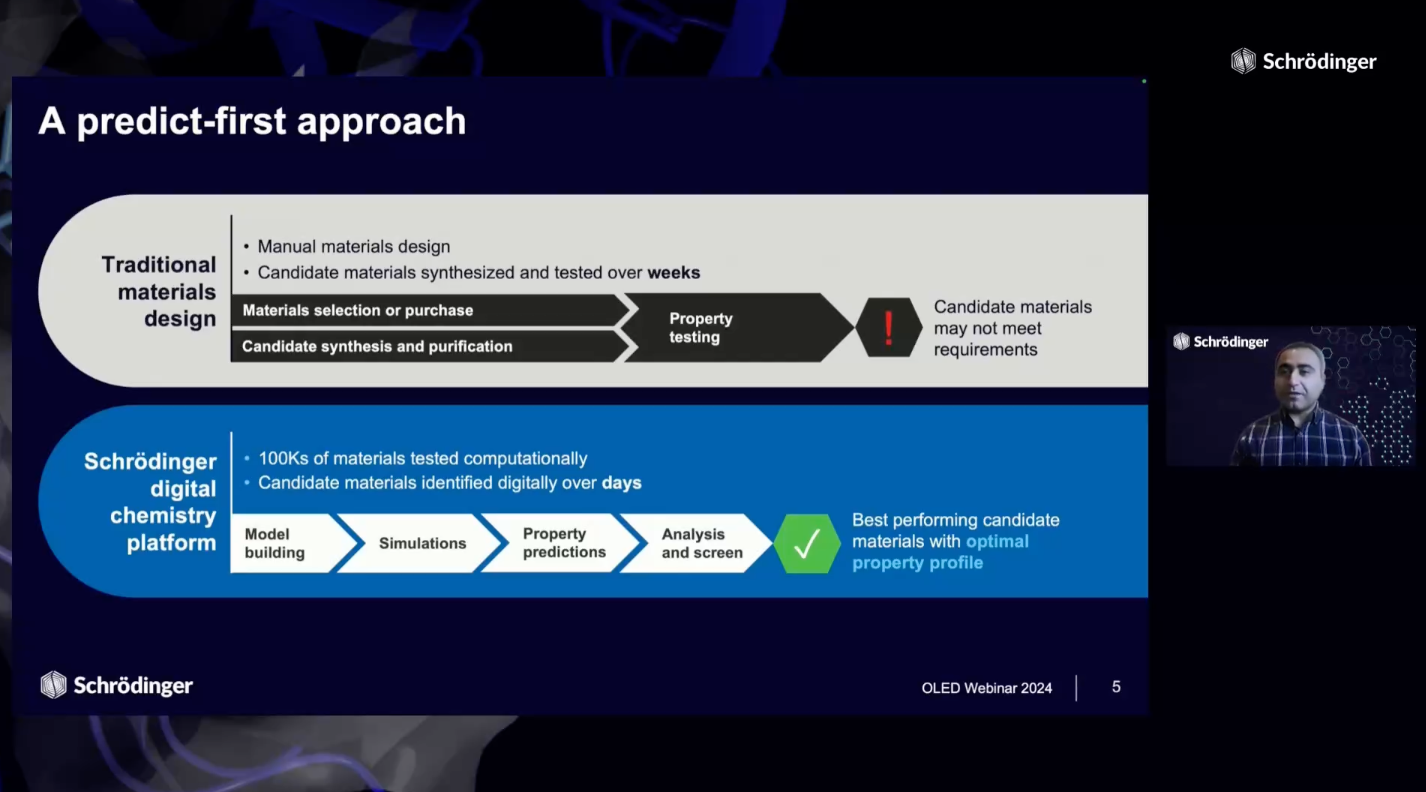
The rapid evolution of display technology requires the use of cutting-edge research methods to maintain progress. This webinar will explore the union of physics-based simulations, machine learning (ML), and cloud-native collaboration and informatics tools in revolutionizing R&D innovation for display materials.
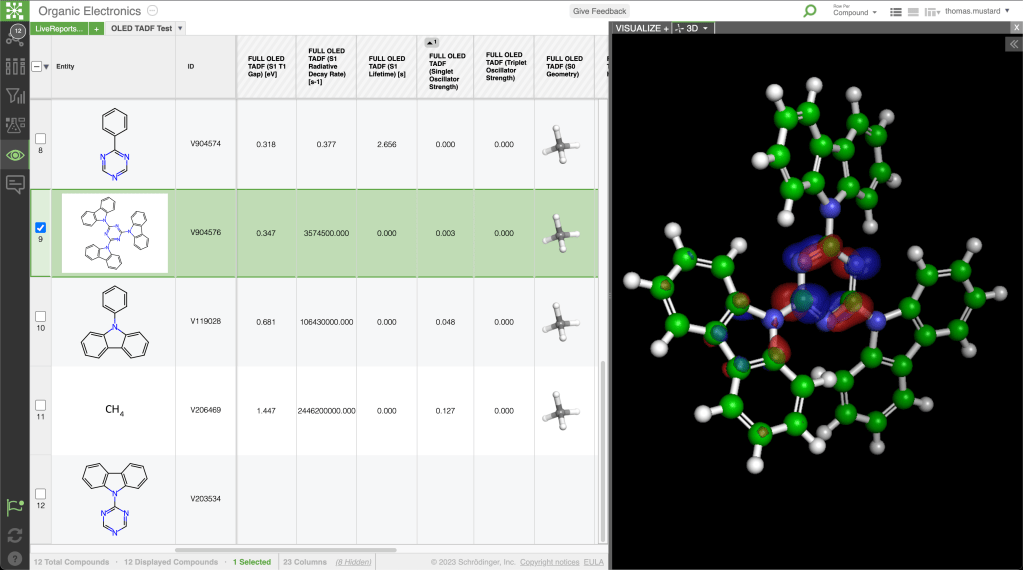
We will delve into how physics-based simulations provide a robust foundation for understanding and predicting material behaviors, while ML modeling accelerates the discovery and optimization of new materials through data-driven insights. Furthermore, we will introduce Schrödinger’s LiveDesign, a cutting-edge web-based collaboration platform, designed to facilitate R&D in a modern, digital working environment. LiveDesign supports comprehensive functionalities, including modeling, data processing, data storage, and collaborative ideation, empowering teams to work seamlessly across diverse geographical locations.
Join us to gain a deeper understanding of:
- The principles and benefits of combining physics-based simulation and machine learning models
- Strategies for seamless integration of computational approaches in your R&D workflow
- Real-world examples illustrating the application and impact of integrated models in developing superior display materials
- How to leverage LiveDesign for collaborative ideation, advanced modeling, and project management
Our Speaker

Hadi Abroshan
Principal Scientist I, Schrödinger
Hadi Abroshan is the Product Manager for Organic Electronics at Schrödinger, Inc. He holds a Ph.D. from Carnegie Mellon University and has conducted research at Stanford University and Georgia Tech. Hadi specializes in multiscale simulations, leading projects to design cost-effective multifunctional materials for optoelectronics. His expertise lies in developing computational strategies that bridge atomistic structures to multilayered device scales, using a blend of physics-based methodologies and machine learning techniques. His work has led to the discovery of novel, environmentally friendly materials and processes with superior efficiencies.
Discovery of a novel mutant-selective epidermal growth factor receptor inhibitor using an in silico enabled drug discovery platform
58th International Conference on Medicinal Chemistry 2024

Conference
58th International Conference on Medicinal Chemistry 2024
Date & Time - July 3rd-5th, 2024
Location - Bordeaux, France
Schrödinger is excited to be participating in the 58th International Conference on Medicinal Chemistry 2024 taking place on July 3rd – 5th in Bordeaux, France. Join us for a workshop by Jelena Vucinic and Jean-Christophe Mozziconacci, titled “Computational Approaches for Engineering Peptides with Enhanced Properties.” Stop by booth 25 to speak with Schrödinger scientists.
Speakers:
Jelena Vucinic, Senior Scientist I, Schrödinger
Jean-Christophe Mozziconacci, Senior Principal Scientist, Schrödinger
Abstract:
The enhancement of existing properties and the introduction of new functionalities are pivotal objectives in the development of therapeutic protein modalities such as peptides. Typically, achieving these goals involves iterative rounds of time-consuming directed evolution. However, the incorporation of computational structure-based methods, rooted in physics, can expedite this process by providing reliable predictions for the location and identities of potentially beneficial mutations. This approach resulted in targeted selection of a few productive variants, prioritized for expression, or a smaller enriched library that simplifies variant screening. Our workflow has been seamlessly integrated into the Schrödinger collaborative design platform, LiveDesign. This integration allows for the assimilation of various technologies, expediting the discovery cycle.
In our upcoming workshop, we will cover:
- Introduction to LiveDesign
- Support of biologics modalities within LiveDesign
- Working with peptide sequence, structures, experimental and in silico data within LiveDesign
- Workflows for examining and identifying therapeutic peptide candidates with desirable properties
This workshop aims to provide valuable insights and practical approaches for leveraging computational methods in the design and optimization of therapeutic modalities.