Organic radical emitters: nature of doublet excitons in emissive layers
The positional effect of arylamines on pyrene core in a blue fluorescent dopant significantly affecting the performance of organic light emitting diodes
Calcium Bistriflimide-Mediated Sulfur(VI)-Fluoride Exchange (SuFEx): Mechanistic Insights toward Instigating Catalysis
Through-Bond-Driven Through-Space Interactions in a Fullerene C60 Noncovalent Dyad: An Unusual Strong Binding between Spherical and Planar ‘ Electron Clouds and Culmination of Dyadic Fractals
Compound for organic electric element, organic electric element using same and electronic device thereof
Benchmarking Machine Learning Descriptors for Crystals
Machine Learning for the Design of Novel OLED Materials
Leveraging Atomic Scale Modeling for Design and Discovery of Next-Generation Battery Materials
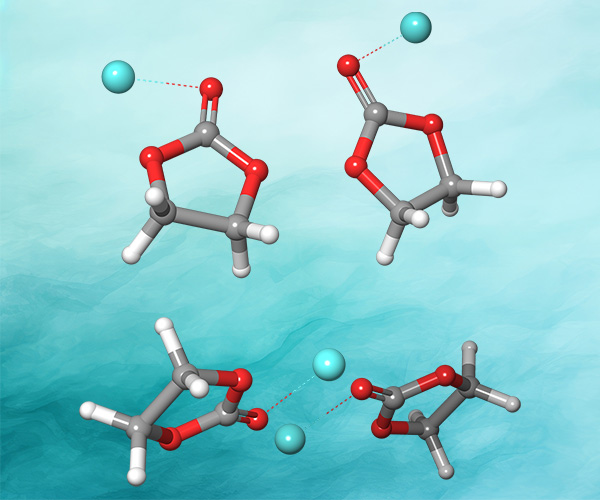

SEPT 22, 2022
Leveraging Atomic Scale Modeling for Design and Discovery of Next-Generation Battery Materials


Speaker
Garvit Agarwal
Senior Scientist
Abstract
The development of rechargeable Li-ion batteries (LIBs) has revolutionized electric vehicles and portable electronic devices. Further advancements are needed to improve the power density, safety, reliability, and lifetime of LIBs. Over the past few decades, atomistic modeling of battery materials has complemented experimental characterization techniques and has become an integral part of the development of new technologies. Reliable atomic scale modeling enables rapid initial evaluation of large chemical and material design space accelerating the development cycle of next-generation battery technologies.
In this webinar, we will demonstrate how Schrödinger’s advanced digital chemistry platform can be leveraged to accelerate the design and discovery of next-generation battery materials with improved properties. We will discuss the application of both physics-based and machine learning techniques for understanding structure-property relationships of different components of batteries including electrodes, electrolytes and electrode-electrolyte interfaces. We also discuss the automated active learning framework for the development of state-of-the-art neural network force fields for modeling liquid electrolytes. The framework allows training the force field using highly accurate range-separated hybrid density functional theory data which enables accurate prediction of critical bulk properties of high-performance liquid electrolytes for application in advanced batteries.
Key Learning Objectives:
- Understand predictive capabilities of physics-based modeling for battery materials
- Learn how automated high throughput simulation workflows enable rapid screening of new battery material candidates
- Application of advanced neural network force fields for accurate electrolyte property prediction
Chinese: Driving the development of bio-based polymer materials with molecular simulations | 分子模拟技术推进生物基聚合物材料的发展


SEPT 15, 2022
Chinese Webinar: Driving the development of bio-based polymer materials with molecular simulations | 分子模拟技术推进生物基聚合物材料的发展
Speakers
讲师:Miao Shi, Ph.D., Schrödinger, Inc
嘉宾:Lihua Chen, Ph.D., Schrödinger, Inc
Summary
生物基聚合物(由可再生资源制成的聚合物材料)的应用正在为各个行业,从消费品包装到碳纤维复合材料,带来整体效益。这项材料的转变对研发和制造团队的现有经验提出了挑战,团队需考虑如何从石油基聚合物扩展到这些新系统。分子模拟为团队了解生物基聚合物的行为方式以及如何有效地在配方中使用它们提供了一个关键窗口。
本次网络研讨会将为研发管理者、材料科学家和工程师以及聚合物科学家提供学习聚合物模拟技术的机会以及筛选和评估生物基聚合物材料性能的案例。
通过参加本次网络研讨会,您将了解:
- 生物基材料开发的新数字方法
- 分子模拟如何缩短配方开发周期
- 确定您研发过程中分子模拟可提供价值的关键领域
Accelerating Digital Drug Design With Automated Informatics Workflow

SEPT 8, 2022
Accelerating Digital Drug Design With Automated Informatics Workflow
Speakers
Jay McGill, PhD, Chief Operating Officer, IBRI
Mary Mader, PhD, VP Molecular Innovation, IBRI
Vipin Vijayakumar, VP Research Infrastructure, Maze Therapeutics
Abstract
In this webinar, research leaders from Maze Therapeutics and Indiana Biosciences Research Institute (IBRI) will discuss their best practices in managing and deriving insights from complex data by leveraging best-in-class informatics tools to create discovery workflows that span data capture and organization to compound design and analysis.
Learning Objectives:
- How do informatics technologies drive scientific discoveries
- What are the biggest data challenges to new companies and what are the recommended ways to address them
- How to select the right tools based on the problems to be addressed
Exploring the formulations of personal care products using a digital chemistry strategy

AUG 30, 2022
Exploring the formulations of personal care products using a digital chemistry strategy
Speaker
Jeffrey Sanders
Product Manager of Consumer Packaged Goods
Abstract
The demand for new and innovative personal care products is increasing due to changes in consumer trends and sustainability goals for CPG companies. Customers are becoming more discerning – choosing products based on understanding the ingredients and whether a product is made with natural or petroleum-based materials. These concerns highlight challenges for consumer goods research and development. To meet these challenges and retain their position in the consumer marketplace, new product formulations need to be developed and match the existing formulation’s key properties. Understanding how ingredients behave in products and “in action” will be necessary to drive not only new development but also end-to-end product tracing. To streamline this process, multi-scale physics simulations can be utilized to cut down product development timeline and cost, as well as optimize large-scale production by simulating digital twins. Molecular simulation provides a unique opportunity to predict how individual ingredients will behave in formulations. Atomistic simulations can help researchers and engineers understand product morphology, solubility, and other physical properties if the components are known. Unlike process simulations, only the chemistry and composition are required to build molecular models of up to millions of atoms and predict properties. Beyond physics-based modeling, chemical information can be used to build machine-learned models with existing experimental or sensory data. In this talk, we will show you molecular modeling in action and explore how digital chemistry strategies are driving innovation in personal care product formulations.
Learning Objectives:
- How to gain insight of individual ingredient behavior and key properties of components in formulation using multi-scale physics simulations
- How to predict key properties of formulations with advanced machine learning
- How digital chemistry can accelerate your research and development in personal care product