APR 28, 2026
Molecular Dynamics fundamentals and applications minicourse


Molecular Dynamics fundamentals and applications minicourse
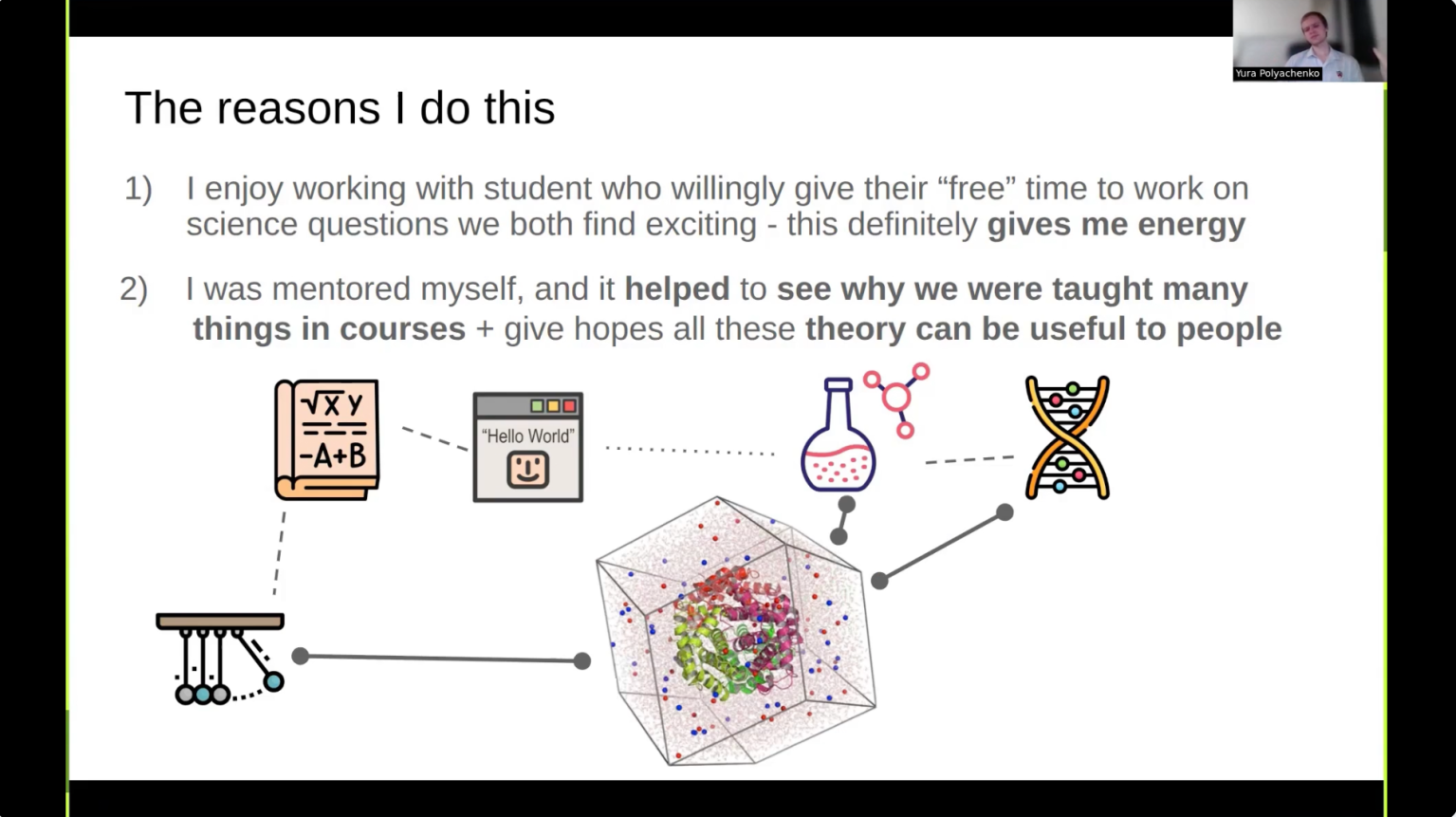
Molecular simulations combine many fields like physics, chemistry, math, programming, which are often separated in younger minds. I can tell from my experience that building bridges and showing how this leads to real-world applications can significantly boost motivation to learning other subjects, and also give a clear profession-oriented goal. However, teaching molecular simulations may be tricky because of such multi-disciplinarity. My contribution to spreading knowledge about molecular simulations mainly comes as mentorship of small groups or individual students, often freshmen.
Over the years, I developed a toy-project exercise that I use to introduce interested students to molecular simulations. I also used this toy-project as a selection process to recommend hiring undergrad researchers to research groups both at MIPT and at Princeton. The selected undergrads proved to be great matches for the groups, so I want to give a quick overview of the toy-project stages and my approaches.
I started this in my undergraduate, where I guided 9 students in my 4th year and 5 students in my 5th year. Three were hired by our research group at MIPT, one was accepted to a grad-level CECAM summer program on LAMMPS. Later at Princeton, this toy-project helped me to select at least one undergraduate each year, with whom we later successfully secured their full-time summer funding every year. Two undergrads chose other summer options, and two worked with me. Now both of them are my co-authors on conference reports and papers.
Slides | Doc
Our Speaker

Yury Polyachenko
Ph.D. Student, Princeton University
My name is Yury, and I am doing my PhD in theoretical chemistry at Princeton University. Two things I always enjoyed as a kid were finding out how real things worked and also playing video games. I was lucky enough to find a job where I am paid to do both, and I am happy to share my story. Computer simulations nicely combined my passions, and during my BSc in Applied Math and Physics, I tried out simulating things like stellar dynamics, neutron scattering, and elastic waves. I realized I found my field when I tried modeling matter at the molecular scale because this felt grounded enough in physics we fundamentally understand, yet rich and applied enough to provide novel insights like new drugs and materials. Other people get excited about this field too; for example, a Nobel laureate, Richard Feynman, gave his famous lecture “”There’s Plenty of Room at the Bottom”” that inspired people to look precisely at that: possibilities opened by manipulating matter at the atomic level. Computers turn out to be particularly helpful in this because many molecular effects are collective, but human brains are not made to track thousands of things at once. Even more exciting, computer models also allow us to run “”experiments”” that break certain physical laws but efficiently yield useful predictions. Throughout my journey, I mastered many practical ways to utilize computers to model protein crystals, membrane nanopores, GPCR receptors, self-assembly on disordered proteins, binding between proteins and drugs, as well as surface adsorption chemistry, semiconductor plasma processing, and ionic collisions. I am happy to talk about any of these, how they helped me throughout my college, for grad school applications, and later.