Accelerating the Design of Asymmetric Catalysts with a Digital Chemistry Platform

APR 18, 2023

Accelerating the Design of Asymmetric Catalysts with a Digital Chemistry Platform

Speaker

Pavel A. Dub
Senior Principal Scientist

Abstract

Asymmetric catalysis has become an integral part of the science-driven technological revolution in the second half of the 21st century, leading to decreased energy demands, sustainable chemical processes and the realization of “impossible” transformations. Asymmetric catalysis based on chiral transition-metal complexes plays an important role in the synthesis of single-enantiomer drugs, perfumes and agrochemicals. The importance of the field is recognized by two Nobel Prize Awards in 2001 (transition-metal catalysis) and 2021 (organocatalysis).

Asymmetric catalysts are traditionally designed by experimental trial-and-error methods, which are resource-, time- and labor-consuming, and thus extremely expensive. Digital methods offer the opportunity to expedite catalyst design. Until recently, computational chemistry, typically quantum chemical studies, indirectly contributed to asymmetric catalyst design by providing rationalization for the mechanism of generation of chirality. With the development of more advanced methods, algorithms and an included layer of automation, computational catalysis is now providing the possibility for direct asymmetric catalyst design.

In this webinar, we will demonstrate how Schrödinger’s advanced digital chemistry platform can be used to accelerate the direct design and discovery of asymmetric catalysts.

Key Learning Objectives:

  • Learn how to design an asymmetric catalyst with computational chemistry
  • Learn how automated high-throughput simulation workflows enable rapid asymmetric catalyst design
  • Understand the intersection of physics-based and machine learning techniques in asymmetric catalyst design

Battery Tech – Leveraging Atomic Scale Modeling for Design and Discovery of Next-Generation Battery Materials

MAR 29, 2023

Battery Tech – Leveraging Atomic Scale Modeling for Design and Discovery of Next-Generation Battery Materials

Speaker

Garvit Agarwal
Senior Scientist

Abstract

Rechargeable Li-ion batteries (LIBs) are revolutionizing electric vehicles and portable devices, but improvements are needed in areas such as power density, safety, reliability, and lifetime. Reliable atomic scale modeling enables rapid initial evaluation of large chemical and material design space, accelerating the development cycle of next-generation battery technologies.

Attend this webinar to learn about an advanced digital chemistry platform for developing next-generation battery materials with improved properties. The presentation will include use of physics-based and machine learning techniques for understanding structure-property relationships of different battery components. It will also outline an automated active learning framework for the development of neural network force fields to predict critical bulk properties of high-performance liquid electrolytes used in advanced batteries.

Attend this webinar and learn:

  • Predictive capabilities of physics-based modeling for battery materials
  • How automated high-throughput simulation workflows enable rapid screening of new material candidates
  • How advanced neural network force fields can be applied for accurate electrolyte property prediction

Accelerating catalysis and reactivity R&D with atomic-scale simulation, machine learning, and enterprise informatics

Accelerating catalysis and reactivity r&d with atomic-scale simulation, machine learning, and enterprise informatics

As market demands evolve, R&D scientists across industries — from consumer packaged goods to automotives — face similar challenges in developing and optimizing the next-generation of catalysts. Scientists need new catalysts that help them reduce energy requirements, eliminate unwanted side products, and improve the selectivity and reactivity of reactions.

Solution Overview

We need new materials, and we need them fast. Fortunately, the continual march of scientific progress promises faster answers than in the past. Computer-driven molecular design, with its ability to generate massive quantities of simulated data, facilitates entry into new frontiers of chemical discovery for sustainable materials design. It brings the promise of speed and accuracy, and it allows R&D scientists to scan through large molecular space to triage down and experimentally test only the most promising chemistries.

Schrödinger’s Materials Science platform leverages the power of physics-based simulation, machine learning, and enterprise informatics to enable the optimization and discovery of effective and selective catalysts and reactive systems by offering:

  • Differentiated model builders
  • Interactive visualization and analysis tools
  • Highly-efficient density functional theory (DFT) engines
  • Customizable automated reaction workflows
  • A collaborative enterprise platform solution


Application Overview

Catalysts

  • Advance the knowledge of catalytic mechanisms: Simulate catalytic pathways to fundamentally understand the forces providing reactivity and selectivity
  • Improve the lifetime of catalysts: Predict stability and degradation of catalysts and products
  • Design and optimize catalysts: Automatically run high-throughput screening of catalysts by leveraging known mechanistic pathways with novel catalysts
  • Benefit from inherently chemically agnostic workflows: Accelerate and automate any reaction mechanism in both homogeneous and heterogeneous screening workflows


Reactive Systems

  • Understand reaction mechanism and pathways: Simulate reaction thermodynamics, kinetics, reaction rates, and barriers
  • Accelerate product development: Automatically predict selectivity and activity of reactions with a library of interesting substrates and catalysts
  • Optimize product properties: Compute tacticity of polymers with relative reaction pathway energies
  • Predict product distribution: Automatically locate transition state
  • Drive innovation in reaction design: Study effect of steric, electronic, and ligand on the reactivity


Team Collaboration and Digital Data Management

  • Empower team collaboration: Employ webbased enterprise informatics tools for sharing experimental and predictive models seamlessly
  • Amplify research with improved decisionmaking: Rapidly deploy automated reaction workflows and machine learning models to drive large-scale predictions and assist novel design approaches
  • Improve project management: Accelerate project communication and collective learning by capturing, analyzing, and testing new ideas and data in a centralized platform


Products

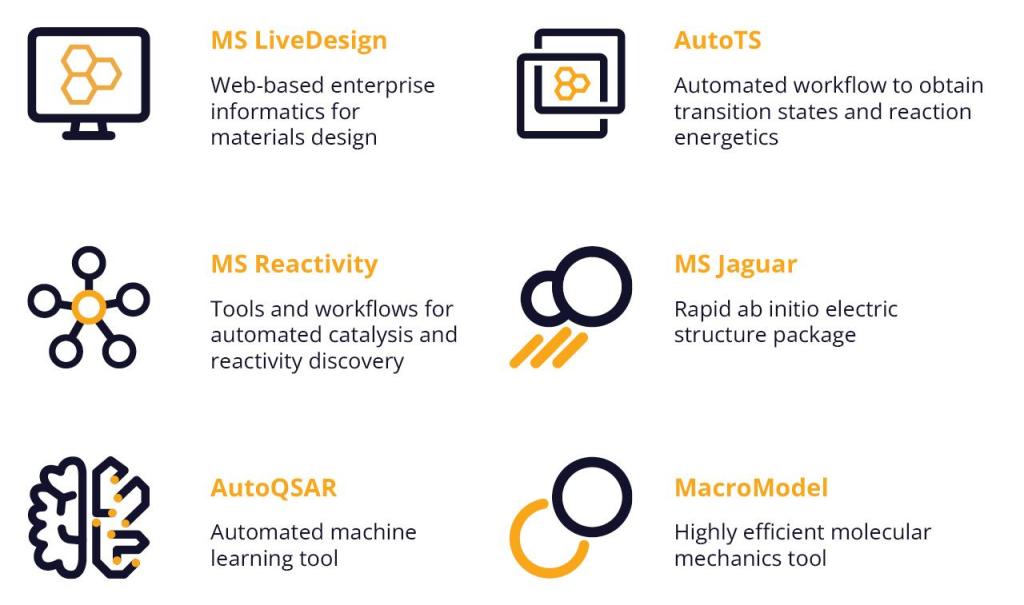
Discover the Schrödinger products that enable your success in the catalysis industry.


Discover the Schrödinger products that enable your success in the catalysis industry.

Selected publications

  1. Iron-catalysed Synthesis and Chemical Recycling of Telechelic 1,3-enchained Oligocyclobutanes.

    Chirik P. J. et al. Nature Chemistry 2021, 13, 1 56-162.

  2. Exploring the Mechanism of Cr(VI) Catalyzed Hypochlorous Acid Decomposition.

    Busch M et al. ChemCatChem 2022, e202101850.

  3. Intramolecular Hydroxyl Nucleophilic Attack Pathway by a Polymeric Water Oxidation Catalyst with Single Cobalt Sites.

    Sun L. et al. Nature Catalysis 2022, 5, 414–429.

  4. Olefin Metathesis Catalyzed by a Hoveyda– Grubbs-like Complex Chelated to Bis(2- mercaptoimidazolyl) Methane: A Predictive DFT Study.

    Martínez J. P. et al. J. Phys. Chem. A 2022, 126, 5, 720–732.

  5. Mechanistic Study of Metal–Ligand Cooperativity in Mn(II)-Catalyzed Hydroborations: Hemilabile SNS Ligand Enables Metal Hydride-Free Reaction Pathway.

    Baker R. T. et al. ACS Catal. 2021, 11, 15, 9043–9051.

  6. Cut-off Scale and Complex Formation in Density Functional Theory Computations of Epoxy-Amine Reactivity.

    Laurikainen P. V. et al. ACS Omega 2021, 6, 44, 29424–29431.

  7. Decarbonylative Fluoroalkylation at Palladium(II): From Fundamental Organometallic Studies to Catalysis.

    Sanford M. S. et al. J. Am. Chem. Soc. 2021, 143, 44, 18617–18625.

  8. One-Pot Chemo-bioprocess of PET Depolymerization and Recycling Enabled by a Biocompatible Catalyst, Betaine.

    Kim K. H. et al. ACS Catal. 2021, 11, 7, 3996–4008.

  9. Automated Transition State Search and Its Application to Diverse Types of Organic Reactions.

    Friesner R. A. et al. J. Chem.

Software and services to meet your organizational needs

Industry-Leading Software Platform

Deploy digital drug discovery workflows using a comprehensive and user-friendly platform for molecular modeling, design, and collaboration.

Research Enablement Services

Leverage Schrödinger’s team of expert computational scientists to advance your projects through key stages in the drug discovery process.

Scientific and Technical Support

Access expert support, educational materials, and training resources designed for both novice and experienced users.