APR 28, 2026
Designing BMS-8 Derivatives


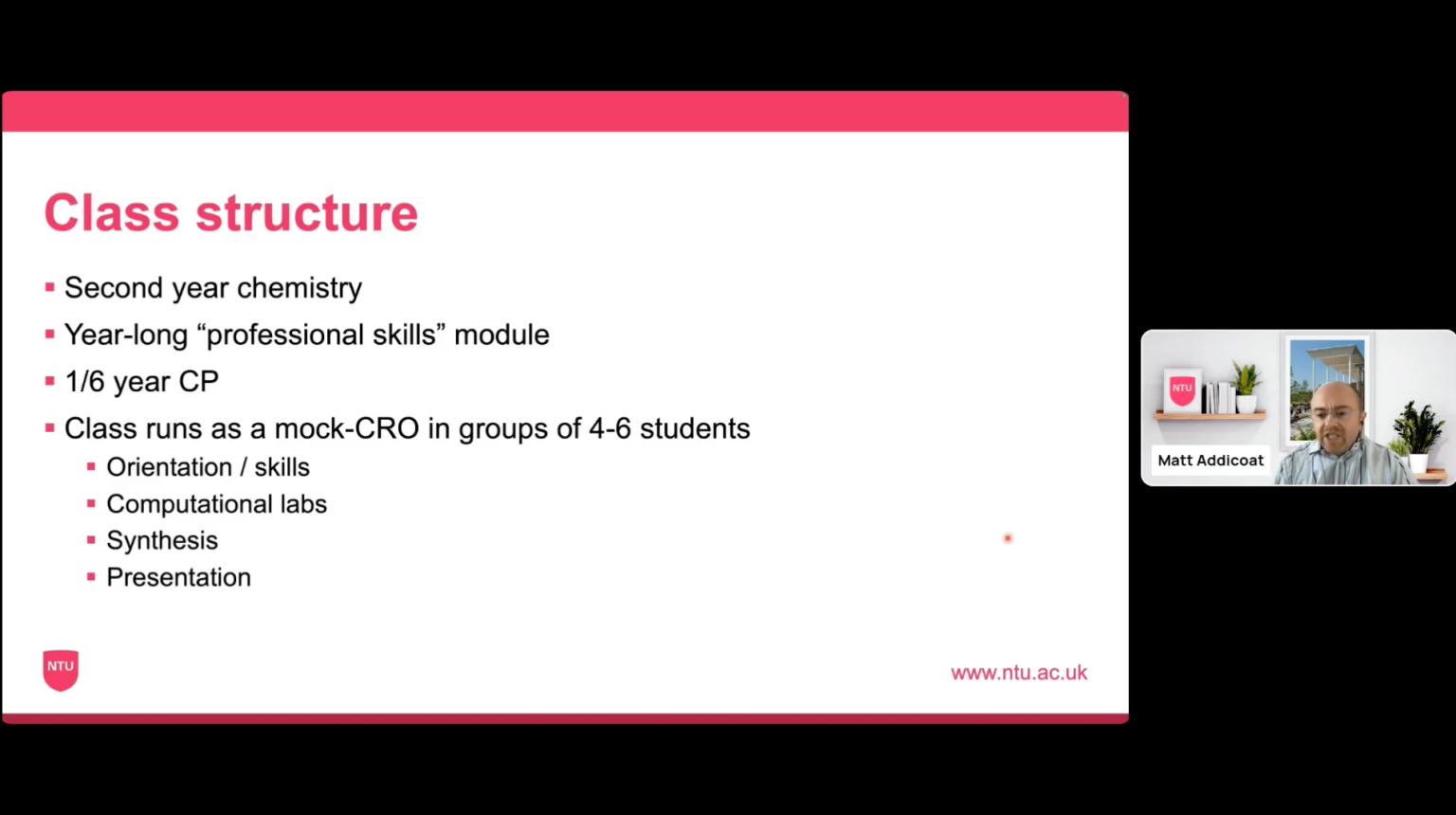
At Nottingham Trent University, second year bachelor students form a mock pharmaceutical Contract Research Organisation. Over the year, students complete a computational and synthetic exploration of derivatives of BMS-8. [1]
The computational sessions take place before students enter the synthetic labs. Given the paper, [1] students download the ligand-docked protein from the Protein Data Bank, and identify the key ligand-protein interactions. Students then import the structure into GaussView and remove all bar the ligand and interacting residues. Using this binding pocket structure, students undertake a series of calculations to compute the overall binding energy and the energy of specific hydrogen-bonding and pi-stacking interactions. With this understanding of the different interactions between the ligand and protein residues, students then consider derivatives of BMS-8, and which of the previously identified ligand-protein interactions are likely to be altered by each modification of the ligand, and link this to a synthesis plan, which students then take into the laboratory. I will share our student worksheet.
Slides | Spreadsheet | Doc
Our Speaker

Matt Addicoat
Senior Lecturer, Nottingham Trent University
Matthew A. Addicoat is a Senior Lecturer in Chemistry at Nottingham Trent University whose research focuses on computational combinatorial chemistry, particularly the design and discovery of molecular framework materials such as metal–organic frameworks, covalent organic frameworks. He is passionate about integrating digital, data and computational chemistry within existing O/I/P/A curricula at all levels. His introduction to python for chemists is a fully open-source workbook, and he has recently developed a masters level computational chemistry laboratory project where the class publishes a full paper. [Phys. Chem. Chem. Phys., 2026, 28, 1528-1537, Phys. Chem. Chem. Phys., 2026, 28, 1515-1527]