
Surface chemistry

Surface chemistry

Surface chemistry


Molecular quantum mechanics, periodic quantum mechanics, and machine learning approaches for studying atomic layer processing and heterogeneous catalysis

Details
Available Languages
Chinese, English, Japanese, Korean
Duration
6 weeks / ~25 hours to complete
Level
Introductory
Cost
$600 for non-student users
$160 for student / post-doc
Course Timeframe
When registering for the course, you will be able to choose your preferred start and end date. Within those dates, you will have asynchronous access to the course to work on your preferred schedule

Overview

Computational molecular modeling tools have proven effective in materials science research and development. Chemists, physicists and engineers working in materials science will increasingly encounter molecular modeling throughout their careers, making it critical to have a foundational understanding of the cutting edge tools and methods. These courses are ideal for those who wish to develop professionally and expand their CV by earning certification and a badge.

These computational chemistry courses offer an effective and efficient approach to learn practical computational chemistry for materials science:

  • Work hands-on with Schrödinger’s industry-leading Materials Science Maestro software
  • Jump start your research program by learning methods that can be directly applied to ongoing projects
  • Learn topics ranging from density functional theory (DFT) to molecular dynamics to machine learning for materials design
  • Perform a completely independent case study to demonstrate mastery of the course content
  • Benefit from review and feedback from Schrödinger Education Team experts for course assignments and course-related queries
  • Work on the course materials on your own schedule whenever convenient for you


This course comes with access to a web-based version of Schrödinger software with the necessary licenses and compute resources for the course:

Requirements
  • A computer with reliable high speed internet access (8 Mbps or better)
  • A mouse and/or external monitor (recommended but not required)
  • Working knowledge of general chemistry
Certification
  • A certificate signed by the Schrödinger course lead
  • A badge that can be posted to social media, such as LinkedIn

background pattern

What you will learn

MS Maestro interface

Learn how to use an industry-leading interface for materials science modeling. No coding or scripting required to run modeling workflows

Molecular quantum mechanics

Learn to apply density functional theory (DFT) for automated property prediction for organic and organometallic molecules

Periodic quantum mechanics

Learn to apply density functional theory (DFT) for studying surface reactivity

Machine learning

Learn to apply machine learning for rapid and accurate property prediction of organic molecules and periodic crystals

Modules

Module 1
2 Hours

Introduction to materials modeling

Video
Video

Introduction to materials modeling & this online course

Video Tutorial
Video tutorial

Introduction to materials science (MS) Maestro

Video
Video

Modeling for surface chemistry

End checkpoint
Honor code agreement and checkpoint
Module 2
6 Hours + Compute Time

Molecular quantum mechanics

Video
Video

Introduction to Molecular quantum mechanics (mQM)

Tutorial
Tutorials
  • Functionals, basis sets and geometry optimizations
  • QM multistage workflows
  • Energies of reactions
  • R-Group enumeration
  • Organometallic complexes
  • Beta elimination reactions
  • Bond and ligand dissociation
End checkpoint
End of module checkpoint
Module 3
5 Hours + Compute Time

Periodic quantum mechanics

Video
Video

Introduction to periodic quantum mechanics (pQM)

Tutorial
Tutorials
  • Building and manipulating crystals
  • Properties of bulk crystals
  • Modeling surfaces
  • Organometallic complexes
  • Activation energies for reactivity in solids and on surfaces
  • Microkinetic modeling
End checkpoint
End of module checkpoint
Module 4
3 Hours + Compute Time

Machine learning

Video
Video

Introduction to machine learning (ML)

Tutorial
Tutorials
  • Machine learning property prediction
  • Machine learning for materials science
  • Periodic descriptors for inorganic solids
End checkpoint
End of module checkpoint
Module 5
4 Hours + Compute Time

Guided case study

Tutorial
Case Studies
  • Heterogeneous carbon dioxide reduction
  • Atomic layer deposition
  • Palladium precursor design
End checkpoint
End of module checkpoint
Module 6
4 Hours + Compute Time

Independent case study

Assignment
Assignment

Adsorption of formaldehyde onto palladium

Course completion
Course completion and certification
Self-paced video lessons on materials modeling
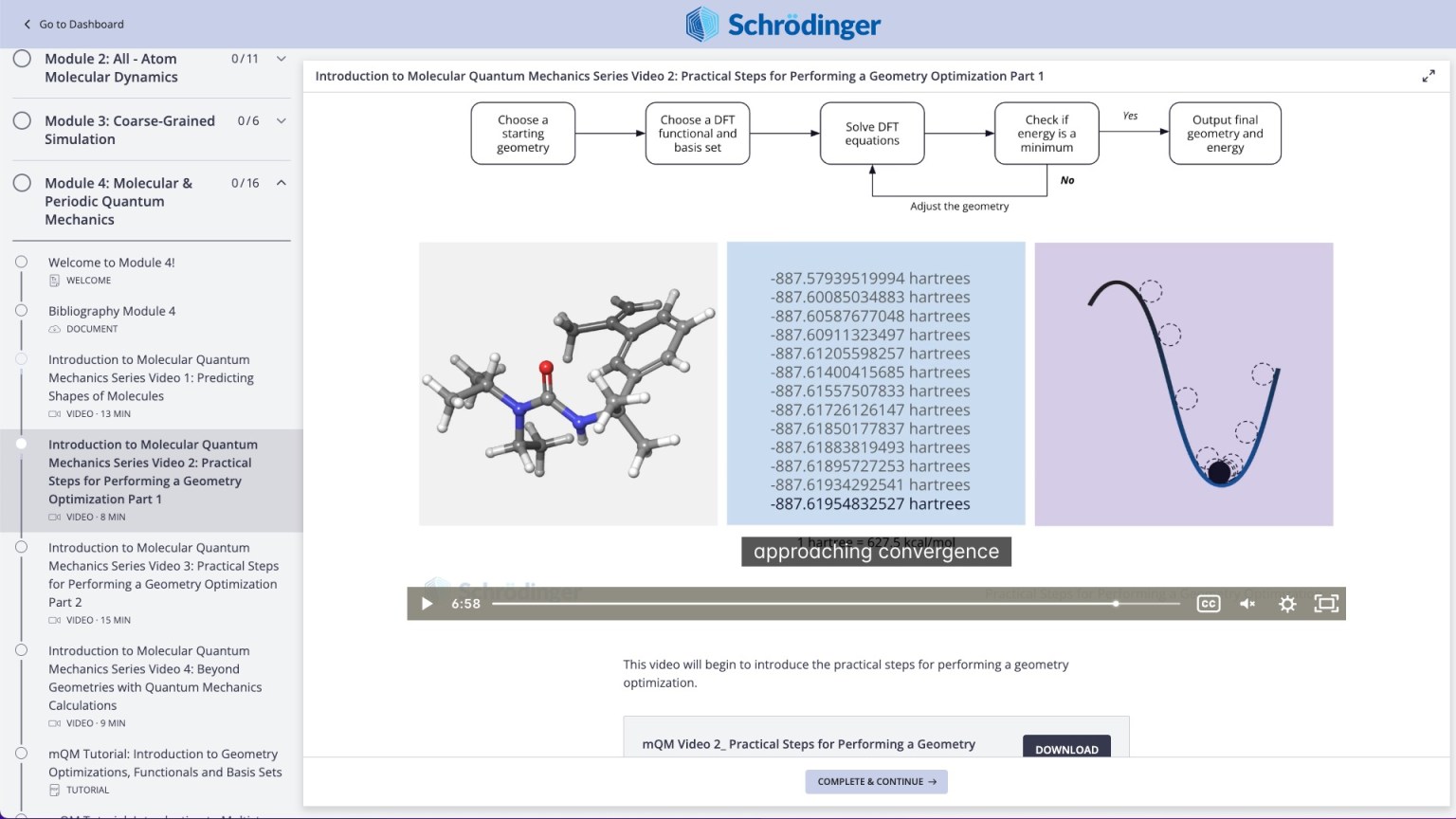
Self-paced video lessons on materials modeling

Videos on practical theory break down complex scientific concepts (e.g. Molecular Quantum Mechanics)
Videos on practical theory break down complex scientific concepts (e.g. Molecular Quantum Mechanics)

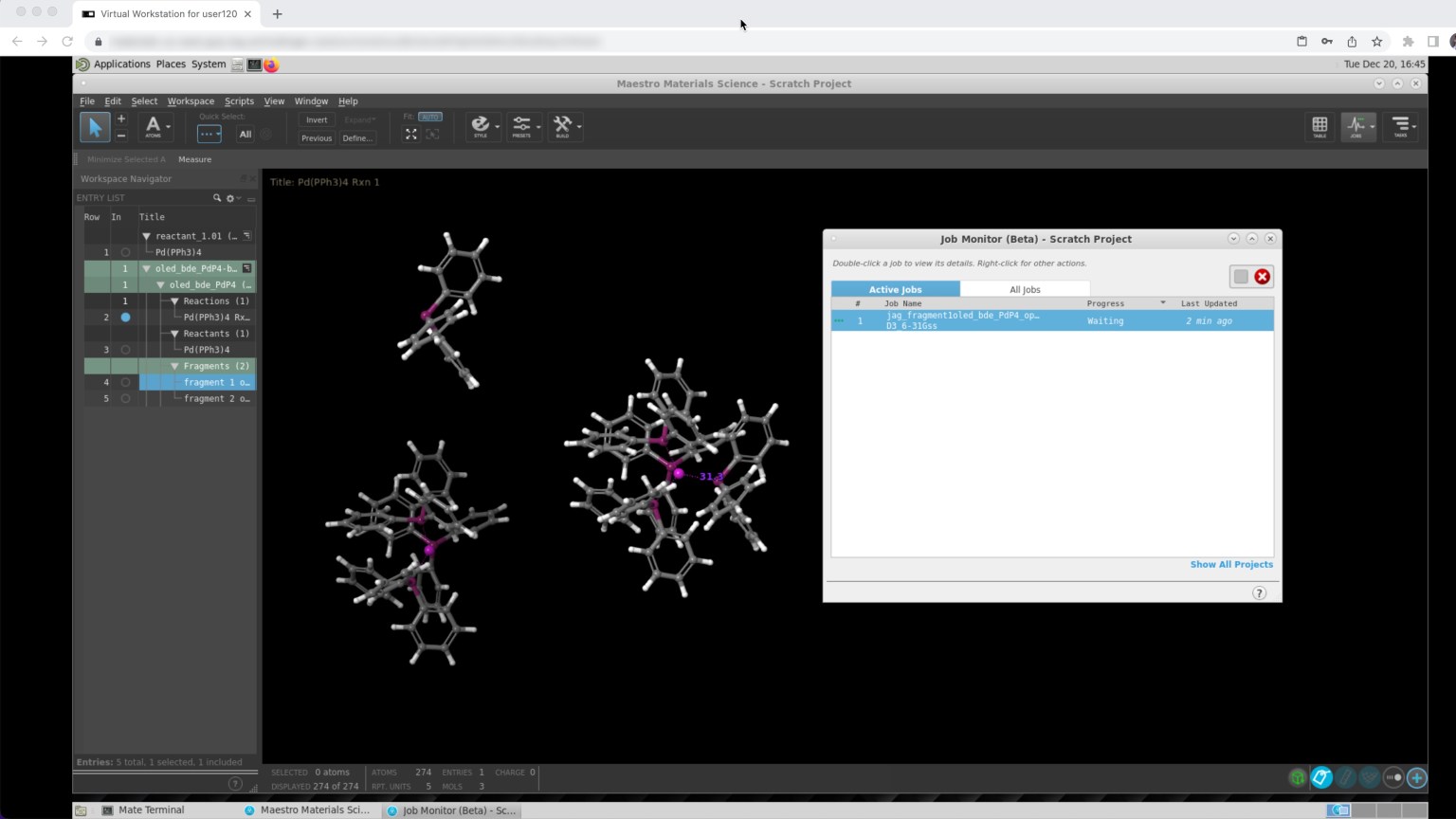
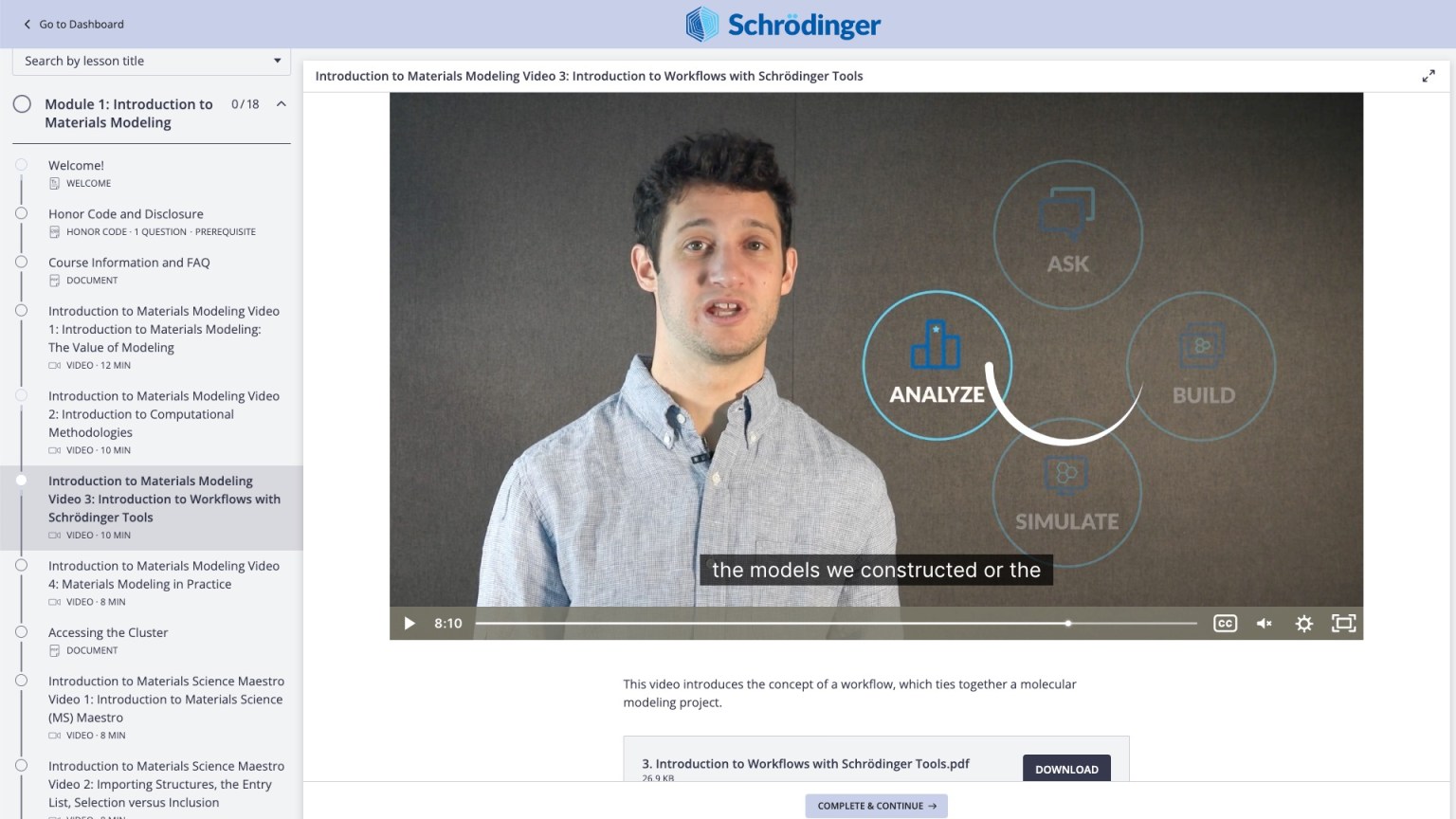
Access cloud-based computing resources to perform calculations yourself
Access cloud-based computing resources to perform calculations yourself

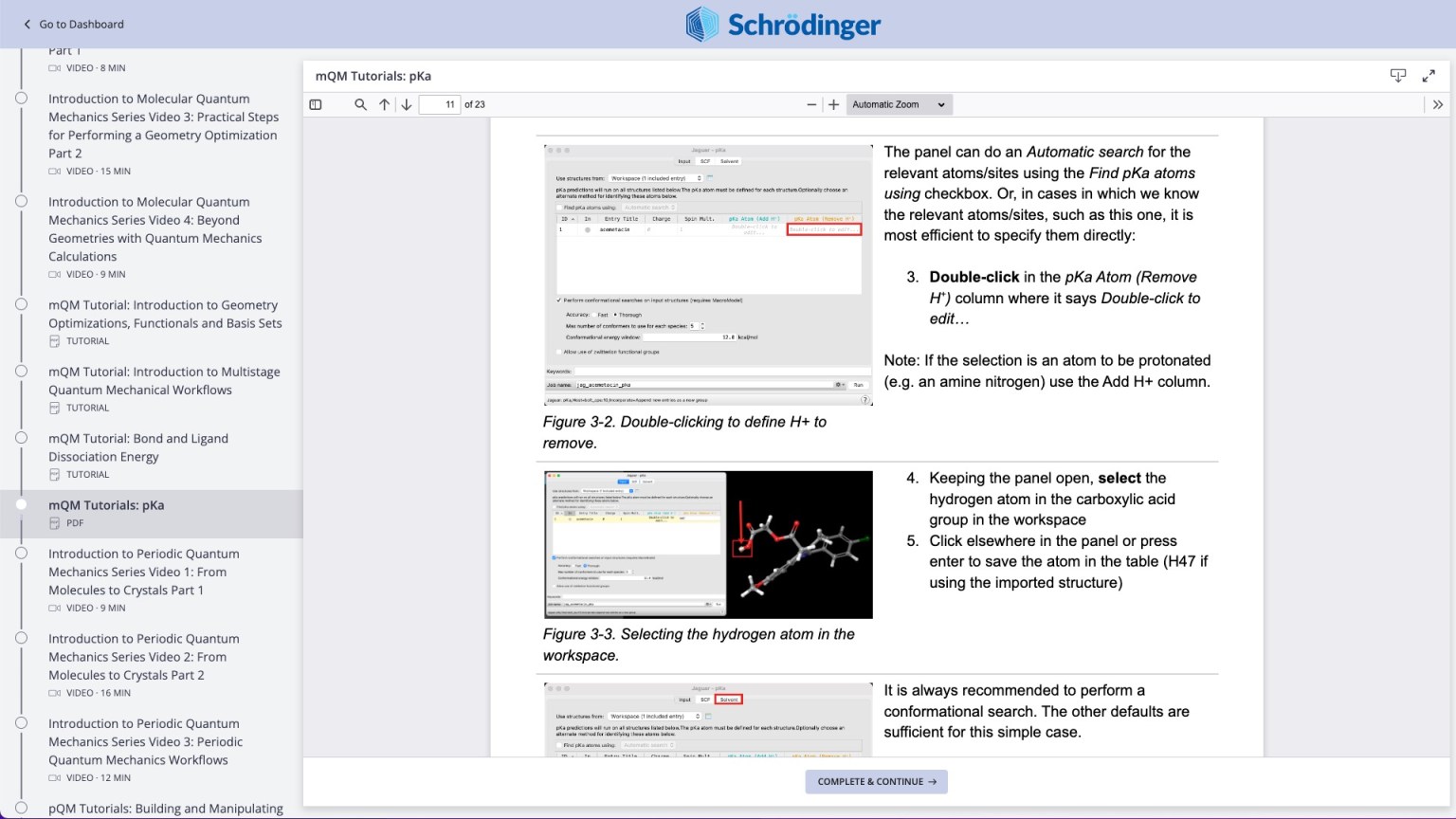
Hands-on step-by-step tutorials (e.g. Pharmaceutical Formulations course, pKa prediction)
Hands-on step-by-step tutorials (e.g. Pharmaceutical Formulations course, pKa prediction)

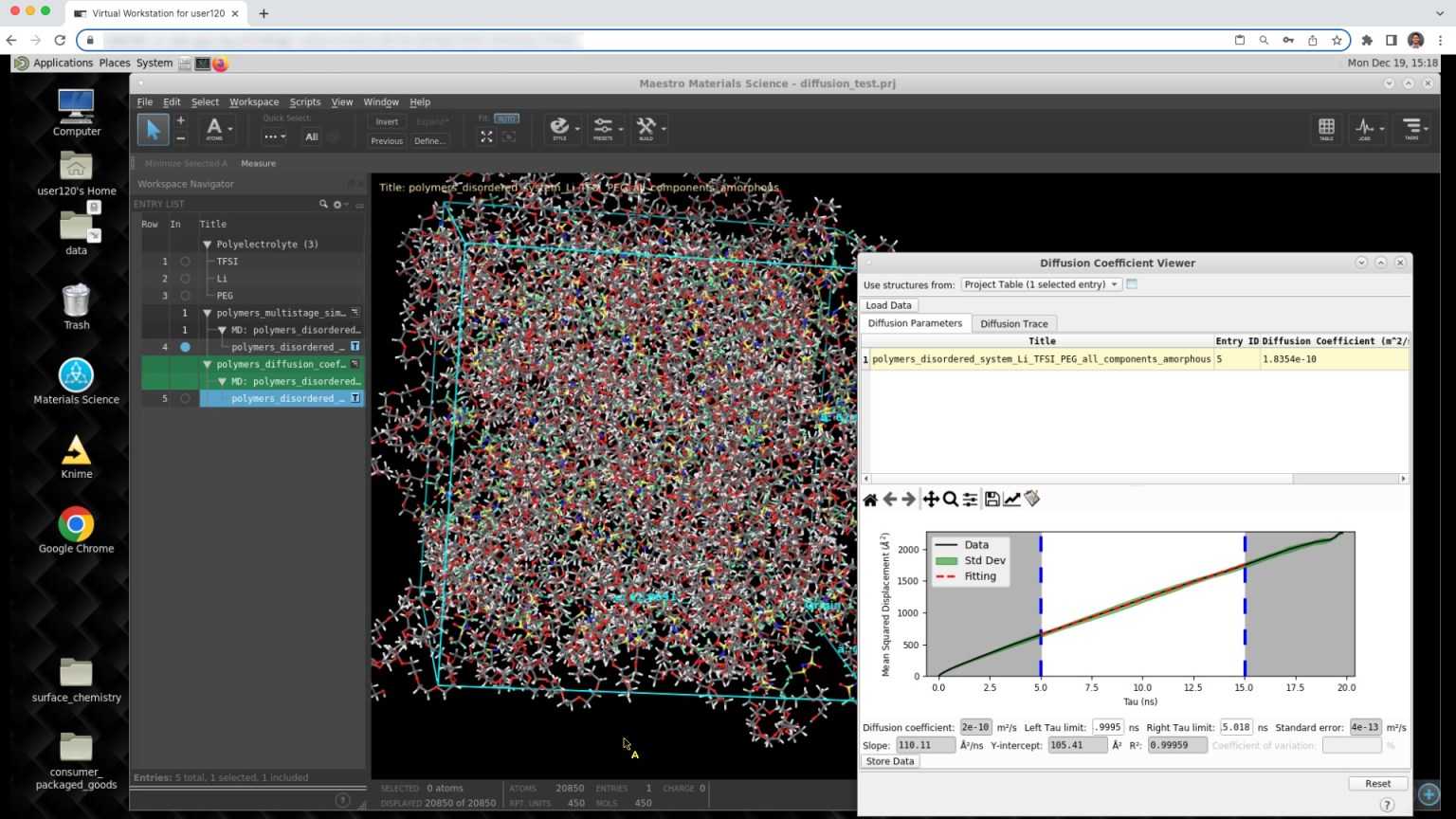
Hands-on modeling in the web-based graphical user interface (e.g. Polymeric Materials course, Diffusion tutorial)
Hands-on modeling in the web-based graphical user interface (e.g. Polymeric Materials course, Diffusion tutorial)

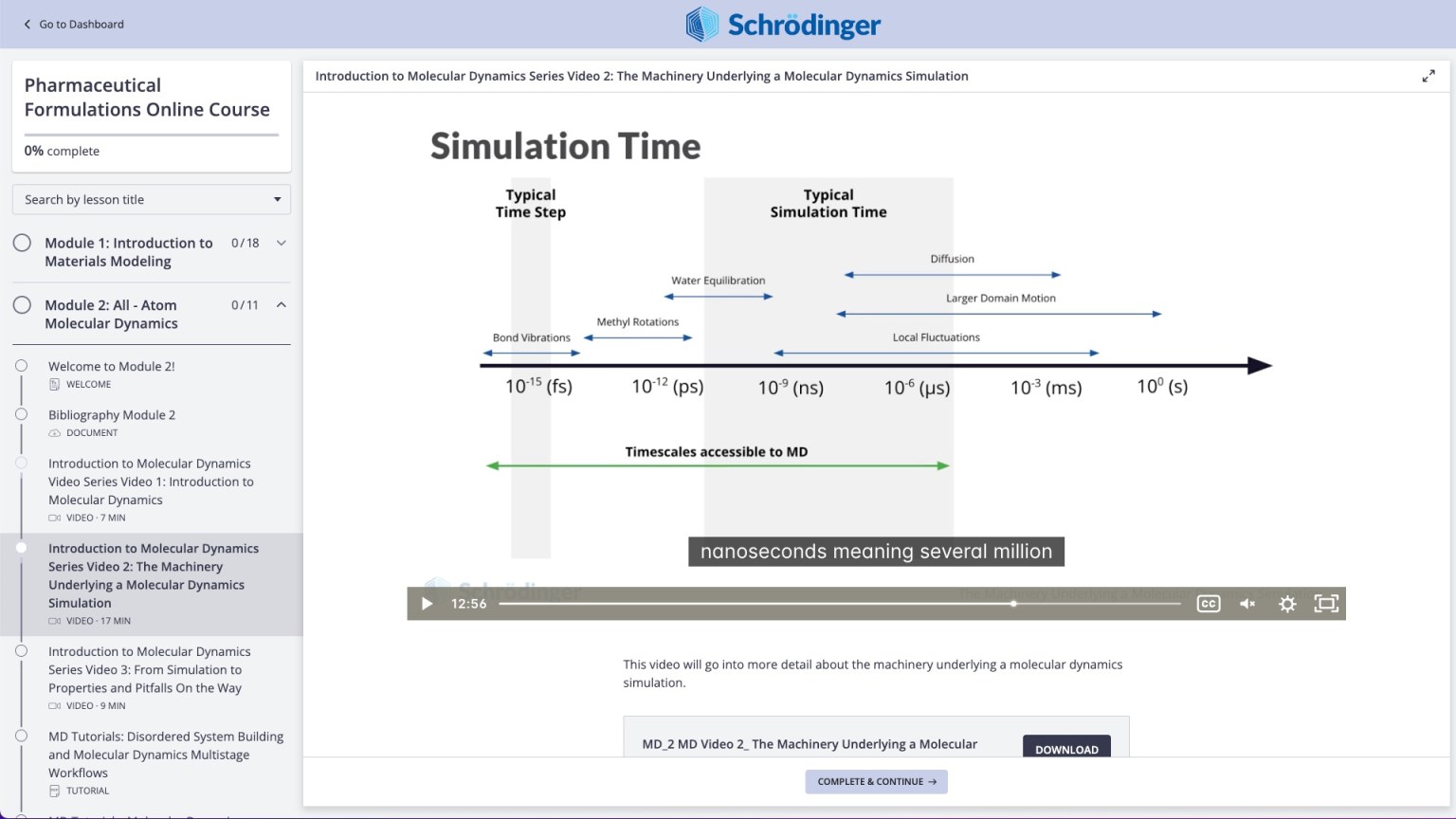
Videos on practical theory break down complex scientific concepts (e.g. Molecular Dynamics)
Videos on practical theory break down complex scientific concepts (e.g. Molecular Dynamics)

On-demand video lessons on materials modeling
On-demand video lessons on materials modeling

Access cloud-based computing resources to perform calculations yourself
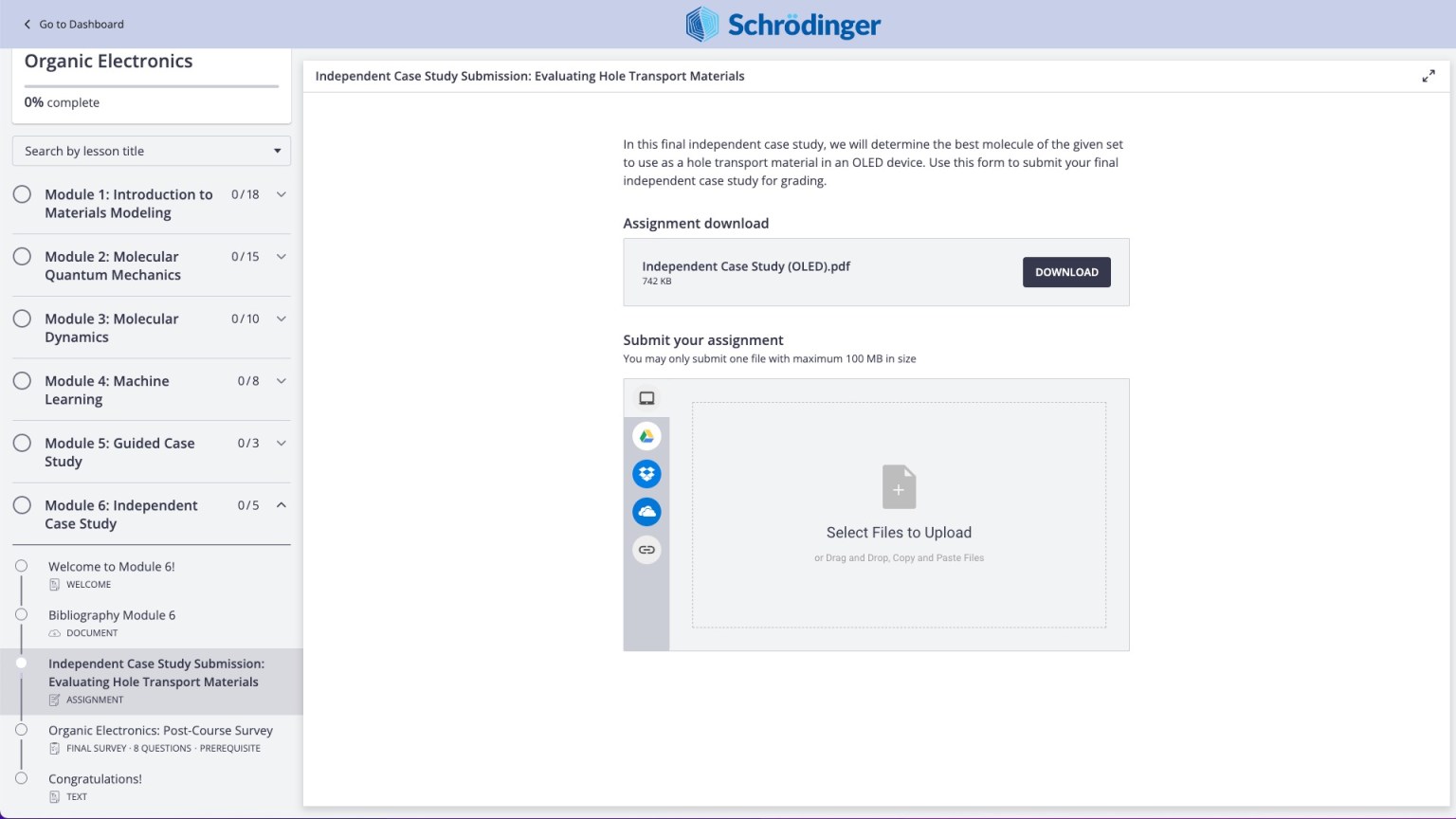
Access cloud-based computing resources to perform calculations yourself

Perform case studies with expert feedback (e.g. Organic Electronic Course, Independent Case Study)
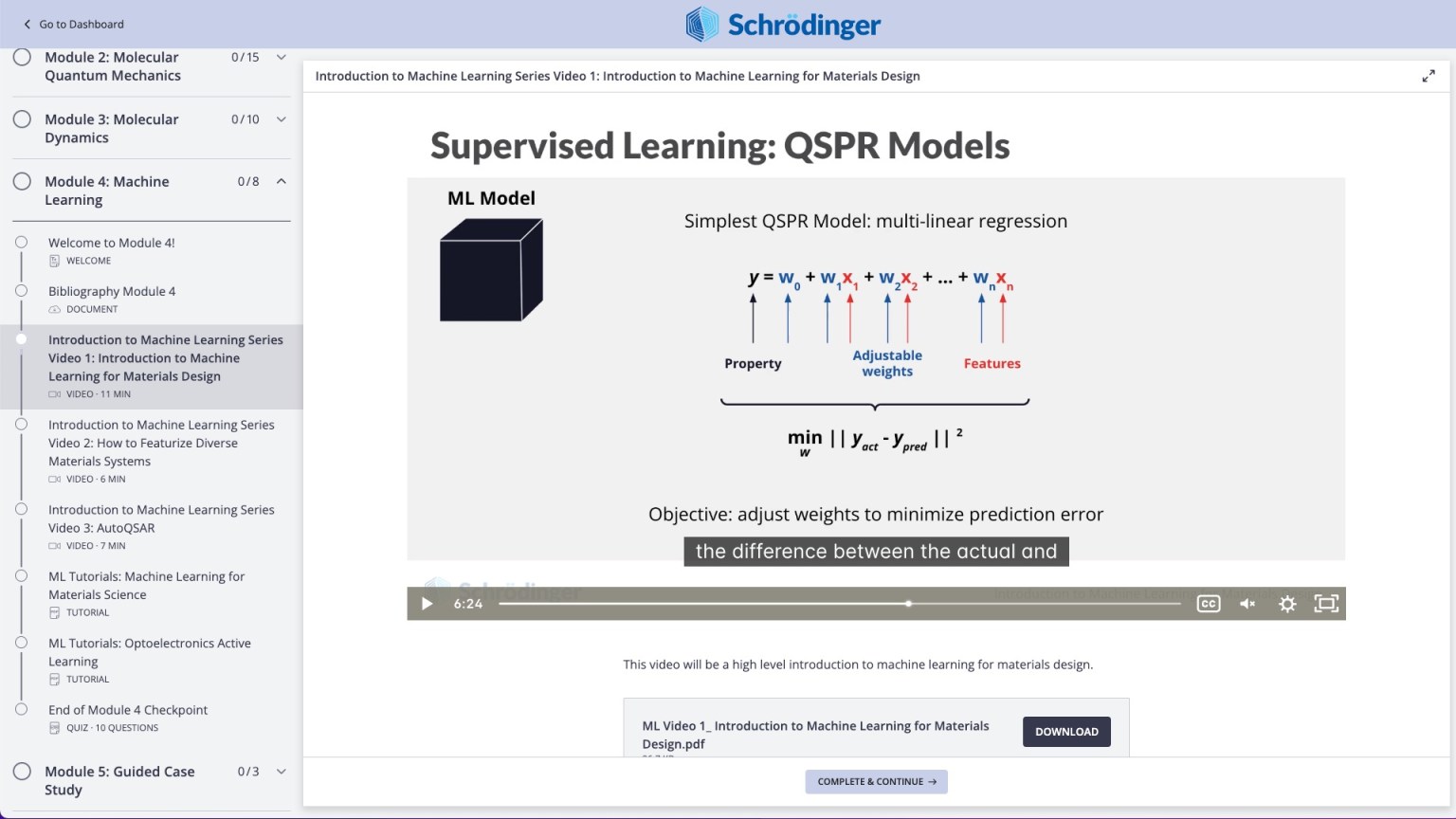
Perform case studies with expert feedback (e.g. Organic Electronic Course, Independent Case Study)

Video on practical theory break down complex scientific concepts (e.g. Machine Learning for Chemistry)
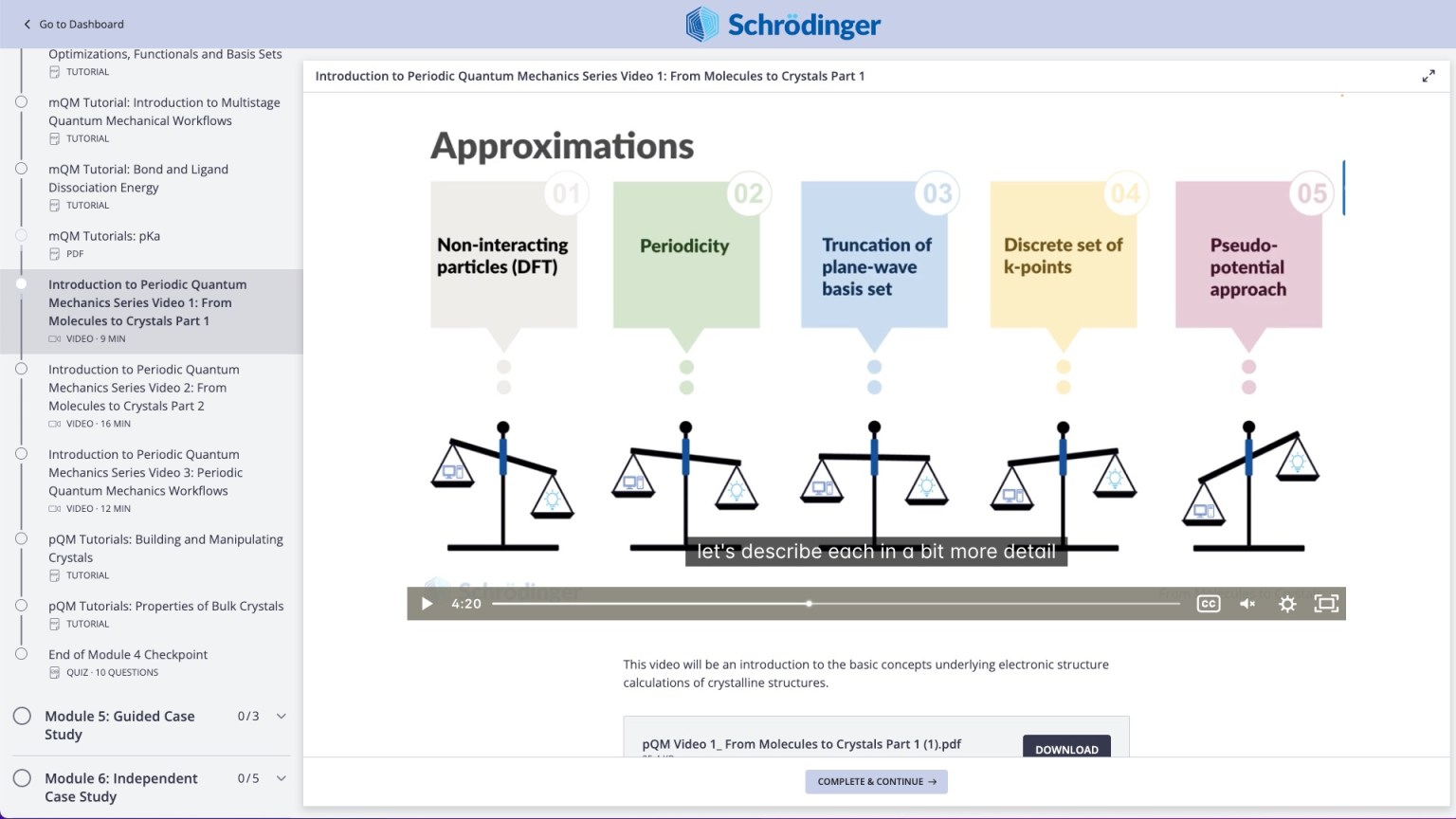
Video on practical theory break down complex scientific concepts (e.g. Machine Learning for Chemistry)

Videos on practical theory break down complex scientific concepts (e.g. Periodic Quantum Mechanics)
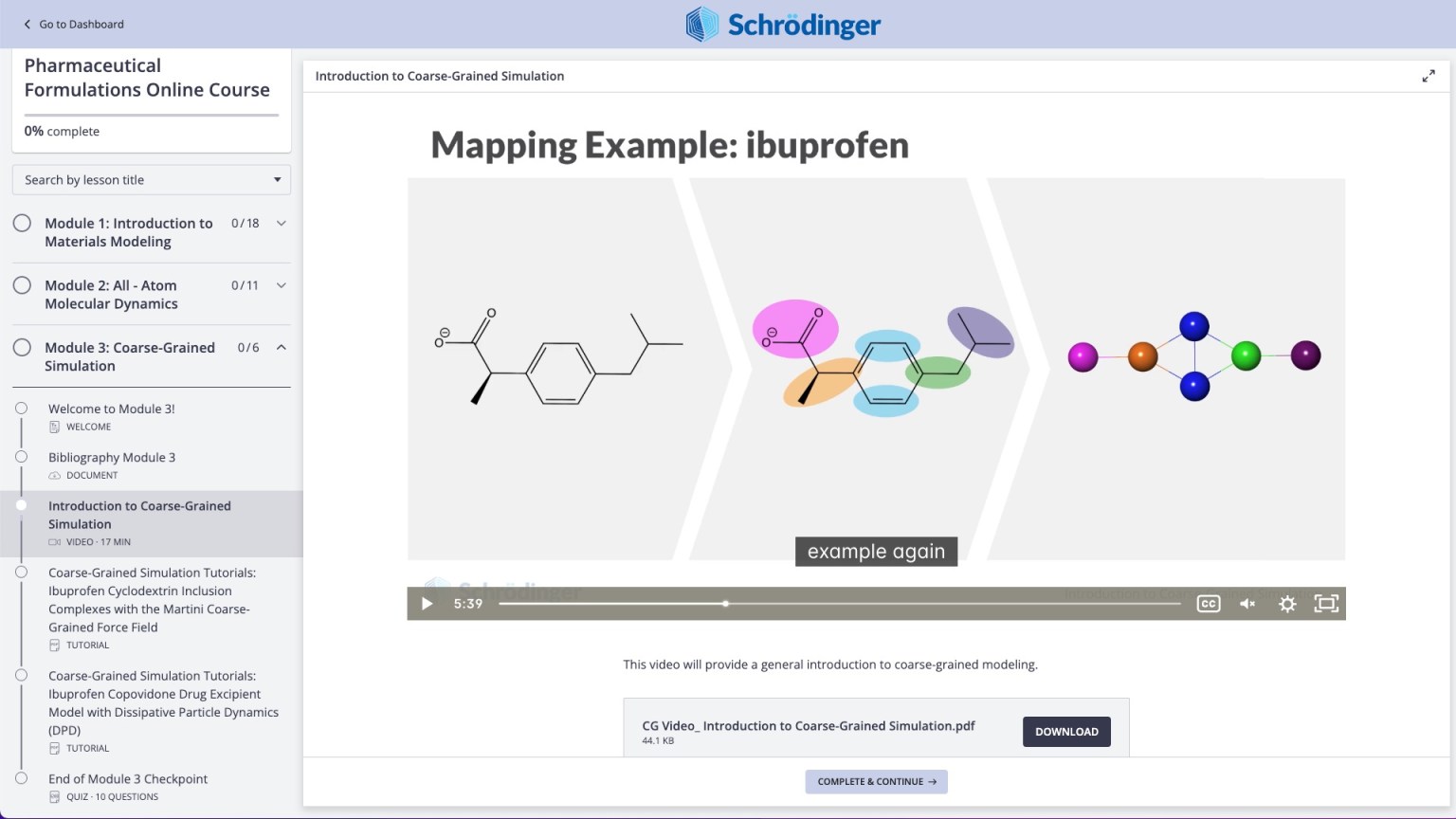
Videos on practical theory break down complex scientific concepts (e.g. Periodic Quantum Mechanics)

Videos on practical theory break down complex scientific concepts (e.g. Coarse-Graining)

Videos on practical theory break down complex scientific concepts (e.g. Coarse-Graining)

Self-paced video lessons on materials modeling
Videos on practical theory break down complex scientific concepts (e.g. Molecular Quantum Mechanics)
Access cloud-based computing resources to perform calculations yourself
Hands-on step-by-step tutorials (e.g. Pharmaceutical Formulations course, pKa prediction)
Hands-on modeling in the web-based graphical user interface (e.g. Polymeric Materials course, Diffusion tutorial)
Videos on practical theory break down complex scientific concepts (e.g. Molecular Dynamics)
On-demand video lessons on materials modeling
Access cloud-based computing resources to perform calculations yourself
Perform case studies with expert feedback (e.g. Organic Electronic Course, Independent Case Study)
Video on practical theory break down complex scientific concepts (e.g. Machine Learning for Chemistry)
Videos on practical theory break down complex scientific concepts (e.g. Periodic Quantum Mechanics)
Videos on practical theory break down complex scientific concepts (e.g. Coarse-Graining)
Need help obtaining funding for a Schrödinger Online Course?

We proudly support the next generation of scientists and are committed to providing opportunities to those with limited resources. Learn about your funding options for our online certification courses as a student, post-doc, or industry scientist and enroll today!

What our alumni say

“Clear instructions with a well-designed interface allowed me to run some of my own first molecular dynamics simulations. The information from the course felt much more secure than the information from YouTube because I knew it was developed by experts”
Graduate Student
“The course let me talk confidentially about molecular modeling and what it can do. For me, this was a nice experience which left me with many ideas for applying molecular modeling in the research area of our department, not only for me but also for my colleagues.”
Graduate Student
“As always, the course is very well designed. Formulation is quite outside my comfort zone in terms of theory and modeling but this course provided me with knowledge of evaluating what modeling can facilitate in the real world. Really great design and education process.”
Senior DirectorTherapeutic Protein Design

Show off your newly acquired skills with a course badge and certificate

When you complete a course with us in molecular modeling and are ready to share what you learned with your colleagues and employers, you can share your certificate and badge on your LinkedIn profile.

Frequently asked questions

How much do the online courses cost?

Pricing varies by each course and by the participant type. For students wishing to take these courses, we offer a student price of $150 for introductory courses, $305 for the Materials Science bundle, and $870 for advanced courses. For commercial participants, the course price is $575 for introductory courses and $1435 for advanced courses and bundles.

When does the course start?

The courses run on sessions, which range from 3-6 week periods during which the course and access to software are available to participants. You can find the course session and start dates on each course page.

What time are the lectures?

Once the course session begins, all lectures are asynchronous and you can view the self-paced videos, tutorials, and assignments at your convenience.

How could I pay for this course?

Interested participants can pay for the course by completing their registration and using the credit card portal for an instant sign up. Please note that a credit card is required as we do not accept debit cards. Additionally, we can provide a purchase order upon request, please email online-learning@schrodinger.com if you are interested in this option. If you have any questions regarding how to pay for the course, please visit our funding options page.

How can I preview the course before registering?
Are there any scholarship opportunities available for students?

Schrödinger is committed to supporting students with limited resources. Schrödinger’s mission is to improve human health and quality of life by transforming the way therapeutics and materials are discovered. Schrödinger proudly supports the next generation of scientists. We have created a scholarship program that is open to full-time students or post-docs to students who can demonstrate financial need, and have a statement of support from the academic advisor. Please complete the application form if you qualify for our scholarship program!

Will material still be available after a course ends?

While access to the software will end when the course closes, some of the material within the course (slides, papers, and tutorials) are available for download so that you can refer back to it after the course. Other materials, such as videos, quizzes, and access to the software, will only be available for the duration of the course.

Do I need access to the software to be able to do the course? Do I have to purchase the software separately?

For the duration of the course, you will have access to a web-based version of Maestro, Bioluminate, Materials Science Maestro and/or LiveDesign (depending on the course). You do not have to separately purchase access to any software. While access to the software will end when the course closes, some of the material within the course (slides, papers, and tutorials) are available for download so that you can refer back to it after the course. Other materials, such as videos, quizzes, and access to the software, will only be available for the duration of the course. Please note that Schrödinger software is only to be used for course-related purposes.

Related Courses

Online certification course: Level-up your skill set in catalysis modeling Materials Science Materials Science
Homogeneous catalysis & reactivity

Molecular quantum mechanics and machine learning approaches for studying reactivity and mechanism at the molecular level

Molecular modeling for materials science applications: Battery materials course Materials Science Materials Science
Battery materials

Molecular and periodic quantum mechanics, all atom molecular dynamics, and machine learning for studying battery materials and their properties under various conditions

Molecular modeling for materials science applications: course bundle Materials Science Materials Science
Course bundle

Access all materials science courses with a single, discounted registration

Supporting Associations

nanoHUB

Polymeric materials

Polymeric-Materials_Hero

Polymeric materials


All-atom molecular dynamics and machine learning approaches for studying polymeric materials and their properties under various conditions

Details
Available Languages
Chinese, English, Japanese, Korean
Duration
6 weeks / ~25 hours to complete
Level
Introductory
Cost
$600 for non-student users
$160 for student / post-doc
Course Timeframe
When registering for the course, you will be able to choose your preferred start and end date. Within those dates, you will have asynchronous access to the course to work on your preferred schedule

Overview

Computational molecular modeling tools have proven effective in materials science research and development. Chemists, physicists and engineers working in materials science will increasingly encounter molecular modeling throughout their careers, making it critical to have a foundational understanding of the cutting edge tools and methods. These courses are ideal for those who wish to develop professionally and expand their CV by earning certification and a badge.

These computational chemistry courses offer an effective and efficient approach to learn practical computational chemistry for materials science:

  • Work hands-on with Schrödinger’s industry-leading Materials Science Maestro software
  • Jump start your research program by learning methods that can be directly applied to ongoing projects
  • Learn topics ranging from density functional theory (DFT) to molecular dynamics to machine learning for materials design
  • Perform a completely independent case study to demonstrate mastery of the course content
  • Benefit from review and feedback from Schrödinger Education Team experts for course assignments and course-related queries
  • Work on the course materials on your own schedule whenever convenient for you


This course comes with access to a web-based version of Schrödinger software with the necessary licenses and compute resources for the course:

Requirements
  • A computer with reliable high speed internet access (8 Mbps or better)
  • A mouse and/or external monitor (recommended but not required)
  • Working knowledge of general chemistry
Certification
  • A certificate signed by the Schrödinger course lead
  • A badge that can be posted to social media, such as LinkedIn
background pattern

What you will learn

MS Maestro interface

Learn how to use an industry-leading interface for materials science modeling. No coding or scripting required to run modeling workflows

Automated workflows

Learn to leverage automated workflows for complex property prediction, such as glass transition temperature and dielectric properties

Molecular dynamics

Learn to apply all-atom molecular dynamics for polymeric materials property prediction

Machine learning

Learn to apply machine learning for rapid and accurate property prediction of organic molecules and polymers

Modules

Module 1
2 Hours

Introduction to materials modeling

Video
Video

Introduction to materials modeling

Video Tutorial
Video tutorial

Introduction to materials science (MS) Maestro

Video
Video

Introduction to modeling for polymeric materials

End checkpoint
Honor code agreement and checkpoint
Module 2
7 Hours + Compute Time

Molecular dynamics

Video
Video

Introduction to molecular dynamics (MD)

Tutorial
Tutorials
  • Disordered system building and MD multistage workflows
  • Building, equilibrating and analyzing polymers
  • Building polymer-polymer interfaces
  • Building semicrystalline polymers
  • Crosslinking polymers
End checkpoint
End of module checkpoint
Module 3
6 Hours + Compute Time

Molecular dynamics

Tutorial
Tutorials
  • Polymer property prediction
  • Penetrant loading
  • Droplet contact angle
  • Diffusion
  • Dielectric properties
  • Thermal conductivity
End checkpoint
End of module checkpoint
Module 4
3 Hours + Compute Time

Machine learning

Video Tutorial
Video tutorial

Introduction to machine learning (ML)

Tutorial
Tutorials
  • Machine learning property prediction
  • Machine learning for materials science
  • Polymer descriptors for machine learning
  • Molecular dynamics descriptors for machine learning
  • Machine learning for formulations
End checkpoint
End of module checkpoint
Module 5
2 Hours + Compute Time

Guided case study

Tutorial
Case Studies
  • Epoxy formulations
  • Diffusion of oxygen through an amorphous polymer matrix
End checkpoint
End of module checkpoint
Module 6
4 Hours + Compute Time

Independent case study

Assignment
Assignment

Polymer-mediated graphene dispersion

Course completion
Course completion and certification
Self-paced video lessons on materials modeling

Self-paced video lessons on materials modeling

Videos on practical theory break down complex scientific concepts (e.g. Molecular Quantum Mechanics)

Videos on practical theory break down complex scientific concepts (e.g. Molecular Quantum Mechanics)

Access cloud-based computing resources to perform calculations yourself

Access cloud-based computing resources to perform calculations yourself

Hands-on step-by-step tutorials (e.g. Pharmaceutical Formulations course, pKa prediction)

Hands-on step-by-step tutorials (e.g. Pharmaceutical Formulations course, pKa prediction)

Hands-on modeling in the web-based graphical user interface (e.g. Polymeric Materials course, Diffusion tutorial)

Hands-on modeling in the web-based graphical user interface (e.g. Polymeric Materials course, Diffusion tutorial)

Videos on practical theory break down complex scientific concepts (e.g. Molecular Dynamics)

Videos on practical theory break down complex scientific concepts (e.g. Molecular Dynamics)

On-demand video lessons on materials modeling

On-demand video lessons on materials modeling

Access cloud-based computing resources to perform calculations yourself

Access cloud-based computing resources to perform calculations yourself

Perform case studies with expert feedback (e.g. Organic Electronic Course, Independent Case Study)

Perform case studies with expert feedback (e.g. Organic Electronic Course, Independent Case Study)

Video on practical theory break down complex scientific concepts (e.g. Machine Learning for Chemistry)

Video on practical theory break down complex scientific concepts (e.g. Machine Learning for Chemistry)

Videos on practical theory break down complex scientific concepts (e.g. Periodic Quantum Mechanics)

Videos on practical theory break down complex scientific concepts (e.g. Periodic Quantum Mechanics)

Videos on practical theory break down complex scientific concepts (e.g. Coarse-Graining)
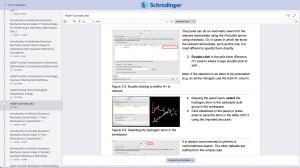
Videos on practical theory break down complex scientific concepts (e.g. Coarse-Graining)

Self-paced video lessons on materials modeling
Videos on practical theory break down complex scientific concepts (e.g. Molecular Quantum Mechanics)
Access cloud-based computing resources to perform calculations yourself
Hands-on step-by-step tutorials (e.g. Pharmaceutical Formulations course, pKa prediction)
Hands-on modeling in the web-based graphical user interface (e.g. Polymeric Materials course, Diffusion tutorial)
Videos on practical theory break down complex scientific concepts (e.g. Molecular Dynamics)
On-demand video lessons on materials modeling
Access cloud-based computing resources to perform calculations yourself
Perform case studies with expert feedback (e.g. Organic Electronic Course, Independent Case Study)
Video on practical theory break down complex scientific concepts (e.g. Machine Learning for Chemistry)
Videos on practical theory break down complex scientific concepts (e.g. Periodic Quantum Mechanics)
Videos on practical theory break down complex scientific concepts (e.g. Coarse-Graining)
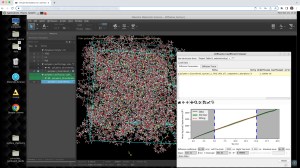
Need help obtaining funding for a Schrödinger Online Course?

We proudly support the next generation of scientists and are committed to providing opportunities to those with limited resources. Learn about your funding options for our online certification courses as a student, post-doc, or industry scientist and enroll today!

What our alumni say

“Clear instructions with a well-designed interface allowed me to run some of my own first molecular dynamics simulations. The information from the course felt much more secure than the information from YouTube because I knew it was developed by experts”
Graduate Student
“The course let me talk confidentially about molecular modeling and what it can do. For me, this was a nice experience which left me with many ideas for applying molecular modeling in the research area of our department, not only for me but also for my colleagues.”
Graduate Student
“As always, the course is very well designed. Formulation is quite outside my comfort zone in terms of theory and modeling but this course provided me with knowledge of evaluating what modeling can facilitate in the real world. Really great design and education process.”
Senior DirectorTherapeutic Protein Design

Show off your newly acquired skills with a course badge and certificate

When you complete a course with us in molecular modeling and are ready to share what you learned with your colleagues and employers, you can share your certificate and badge on your LinkedIn profile.

Frequently asked questions

How much do the online courses cost?

Pricing varies by each course and by the participant type. For students wishing to take these courses, we offer a student price of $150 for introductory courses, $305 for the Materials Science bundle, and $870 for advanced courses. For commercial participants, the course price is $575 for introductory courses and $1435 for advanced courses and bundles.

When does the course start?

The courses run on sessions, which range from 3-6 week periods during which the course and access to software are available to participants. You can find the course session and start dates on each course page.

What time are the lectures?

Once the course session begins, all lectures are asynchronous and you can view the self-paced videos, tutorials, and assignments at your convenience.

How could I pay for this course?

Interested participants can pay for the course by completing their registration and using the credit card portal for an instant sign up. Please note that a credit card is required as we do not accept debit cards. Additionally, we can provide a purchase order upon request, please email online-learning@schrodinger.com if you are interested in this option. If you have any questions regarding how to pay for the course, please visit our funding options page.

How can I preview the course before registering?
Are there any scholarship opportunities available for students?

Schrödinger is committed to supporting students with limited resources. Schrödinger’s mission is to improve human health and quality of life by transforming the way therapeutics and materials are discovered. Schrödinger proudly supports the next generation of scientists. We have created a scholarship program that is open to full-time students or post-docs to students who can demonstrate financial need, and have a statement of support from the academic advisor. Please complete the application form if you qualify for our scholarship program!

Will material still be available after a course ends?

While access to the software will end when the course closes, some of the material within the course (slides, papers, and tutorials) are available for download so that you can refer back to it after the course. Other materials, such as videos, quizzes, and access to the software, will only be available for the duration of the course.

Do I need access to the software to be able to do the course? Do I have to purchase the software separately?

For the duration of the course, you will have access to a web-based version of Maestro, Bioluminate, Materials Science Maestro and/or LiveDesign (depending on the course). You do not have to separately purchase access to any software. While access to the software will end when the course closes, some of the material within the course (slides, papers, and tutorials) are available for download so that you can refer back to it after the course. Other materials, such as videos, quizzes, and access to the software, will only be available for the duration of the course. Please note that Schrödinger software is only to be used for course-related purposes.

Related Courses

Molecular modeling for materials science applications: course bundle Materials Science Materials Science
Course bundle

Access all materials science courses with a single, discounted registration

Online certification course: Level-up your skill set in catalysis modeling Materials Science Materials Science
Homogeneous catalysis & reactivity

Molecular quantum mechanics and machine learning approaches for studying reactivity and mechanism at the molecular level

Molecular Modeling for Materials Science: Pharmaceutical Formulations Materials Science Materials Science
Pharmaceutical formulations

Molecular and periodic quantum mechanics, all atom molecular dynamics, and coarse-grained approaches for studying active pharmaceutical ingredients and their formulations

Supporting Associations

nanoHUB

Course bundle

Molecular modeling for materials science applications: course bundle

Course bundle


Includes access to all paid, materials science courses such as, Organic Electronics, Catalysis, Surface Chemistry, Formulations, Battery Materials and more! Note: The PyMOL course is excluded

Details
Available Languages
Chinese, English, Japanese, Korean
Duration
6 weeks / ~100 hours to complete
Level
Introductory, Bundle
Cost
$1510 for non-student users
$320 for student / post-doc
Course Timeframe
When registering for the course, you will be able to choose your preferred start and end date. Within those dates, you will have asynchronous access to the course to work on your preferred schedule

Overview

Computational molecular modeling tools have proven effective in materials science research and development. Chemists, physicists and engineers working in materials science will increasingly encounter molecular modeling throughout their careers, making it critical to have a foundational understanding of the cutting edge tools and methods.

This course is ideal for those who wish to develop professionally and expand their CV by earning certification and a badge. These computational chemistry courses offer an effective and efficient approach to learn practical computational chemistry for materials science:

  • Work hands-on with Schrödinger’s industry-leading Materials Science Maestro software
  • Jump start your research program by learning methods that can be directly applied to ongoing projects
  • Learn multi-scale approaches for materials design
  • Perform a completely independent case study to demonstrate mastery of the course content
  • Benefit from review and feedback from Schrödinger Education Team experts for course assignments and course-related queries
  • Work on the course materials on your own schedule whenever convenient for you


This course comes with access to a web-based version of Schrödinger software with the necessary licenses and compute resources for the course:

Requirements
  • A computer with reliable high speed internet access (8 Mbps or better)
  • A mouse and/or external monitor (recommended but not required)
  • Working knowledge of general chemistry
Certification
  • A certificate signed by the Schrödinger course lead
  • A badge that can be posted to social media, such as LinkedIn
background pattern

What you will learn

MS Maestro interface

Learn how to use an industry-leading interface for materials science modeling. No coding or scripting required to run modeling workflows

Quantum mechanics

Learn to apply molecular and periodic density functional theory (DFT) for automated property prediction for organic and inorganic systems

Molecular dynamics

Learn to leverage all-atom and coarse-grained molecular dynamics simulations for simulating soft matter and complex formulations

Machine learning

Learn to apply machine learning for rapid and accurate property prediction

Course syllabus

The course bundle includes access to the following seven courses in their entirety during the single course session.

Organic Electronics
Homogeneous Catalysis & Reactivity
Surface Chemistry
Battery Materials
Pharmaceutical Formulations
Polymeric Materials
Consumer Packaged Goods
Self-paced video lessons on materials modeling

Self-paced video lessons on materials modeling

Videos on practical theory break down complex scientific concepts (e.g. Molecular Quantum Mechanics)

Videos on practical theory break down complex scientific concepts (e.g. Molecular Quantum Mechanics)

Access cloud-based computing resources to perform calculations yourself

Access cloud-based computing resources to perform calculations yourself

Hands-on step-by-step tutorials (e.g. Pharmaceutical Formulations course, pKa prediction)

Hands-on step-by-step tutorials (e.g. Pharmaceutical Formulations course, pKa prediction)

Hands-on modeling in the web-based graphical user interface (e.g. Polymeric Materials course, Diffusion tutorial)

Hands-on modeling in the web-based graphical user interface (e.g. Polymeric Materials course, Diffusion tutorial)

Videos on practical theory break down complex scientific concepts (e.g. Molecular Dynamics)

Videos on practical theory break down complex scientific concepts (e.g. Molecular Dynamics)

On-demand video lessons on materials modeling

On-demand video lessons on materials modeling

Access cloud-based computing resources to perform calculations yourself

Access cloud-based computing resources to perform calculations yourself

Perform case studies with expert feedback (e.g. Organic Electronic Course, Independent Case Study)

Perform case studies with expert feedback (e.g. Organic Electronic Course, Independent Case Study)

Video on practical theory break down complex scientific concepts (e.g. Machine Learning for Chemistry)

Video on practical theory break down complex scientific concepts (e.g. Machine Learning for Chemistry)

Videos on practical theory break down complex scientific concepts (e.g. Periodic Quantum Mechanics)

Videos on practical theory break down complex scientific concepts (e.g. Periodic Quantum Mechanics)

Videos on practical theory break down complex scientific concepts (e.g. Coarse-Graining)
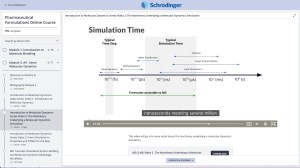
Videos on practical theory break down complex scientific concepts (e.g. Coarse-Graining)

Self-paced video lessons on materials modeling
Videos on practical theory break down complex scientific concepts (e.g. Molecular Quantum Mechanics)
Access cloud-based computing resources to perform calculations yourself
Hands-on step-by-step tutorials (e.g. Pharmaceutical Formulations course, pKa prediction)
Hands-on modeling in the web-based graphical user interface (e.g. Polymeric Materials course, Diffusion tutorial)
Videos on practical theory break down complex scientific concepts (e.g. Molecular Dynamics)
On-demand video lessons on materials modeling
Access cloud-based computing resources to perform calculations yourself
Perform case studies with expert feedback (e.g. Organic Electronic Course, Independent Case Study)
Video on practical theory break down complex scientific concepts (e.g. Machine Learning for Chemistry)
Videos on practical theory break down complex scientific concepts (e.g. Periodic Quantum Mechanics)
Videos on practical theory break down complex scientific concepts (e.g. Coarse-Graining)
Need help obtaining funding for a Schrödinger Online Course?

We proudly support the next generation of scientists and are committed to providing opportunities to those with limited resources. Learn about your funding options for our online certification courses as a student, post-doc, or industry scientist and enroll today!

What our alumni say

“Clear instructions with a well-designed interface allowed me to run some of my own first molecular dynamics simulations. The information from the course felt much more secure than the information from YouTube because I knew it was developed by experts”
Graduate Student
“The course let me talk confidentially about molecular modeling and what it can do. For me, this was a nice experience which left me with many ideas for applying molecular modeling in the research area of our department, not only for me but also for my colleagues.”
Graduate Student
“As always, the course is very well designed. Formulation is quite outside my comfort zone in terms of theory and modeling but this course provided me with knowledge of evaluating what modeling can facilitate in the real world. Really great design and education process.”
Senior DirectorTherapeutic Protein Design

Show off your newly acquired skills with a course badge and certificate

When you complete a course with us in molecular modeling and are ready to share what you learned with your colleagues and employers, you can share your certificate and badge on your LinkedIn profile.

Frequently asked questions

How much do the online courses cost?

Pricing varies by each course and by the participant type. For students wishing to take these courses, we offer a student price of $150 for introductory courses, $305 for the Materials Science bundle, and $870 for advanced courses. For commercial participants, the course price is $575 for introductory courses and $1435 for advanced courses and bundles.

When does the course start?

The courses run on sessions, which range from 3-6 week periods during which the course and access to software are available to participants. You can find the course session and start dates on each course page.

What time are the lectures?

Once the course session begins, all lectures are asynchronous and you can view the self-paced videos, tutorials, and assignments at your convenience.

How could I pay for this course?

Interested participants can pay for the course by completing their registration and using the credit card portal for an instant sign up. Please note that a credit card is required as we do not accept debit cards. Additionally, we can provide a purchase order upon request, please email online-learning@schrodinger.com if you are interested in this option. If you have any questions regarding how to pay for the course, please visit our funding options page.

How can I preview the course before registering?
Are there any scholarship opportunities available for students?

Schrödinger is committed to supporting students with limited resources. Schrödinger’s mission is to improve human health and quality of life by transforming the way therapeutics and materials are discovered. Schrödinger proudly supports the next generation of scientists. We have created a scholarship program that is open to full-time students or post-docs to students who can demonstrate financial need, and have a statement of support from the academic advisor. Please complete the application form if you qualify for our scholarship program!

Will material still be available after a course ends?

While access to the software will end when the course closes, some of the material within the course (slides, papers, and tutorials) are available for download so that you can refer back to it after the course. Other materials, such as videos, quizzes, and access to the software, will only be available for the duration of the course.

Do I need access to the software to be able to do the course? Do I have to purchase the software separately?

For the duration of the course, you will have access to a web-based version of Maestro, Bioluminate, Materials Science Maestro and/or LiveDesign (depending on the course). You do not have to separately purchase access to any software. While access to the software will end when the course closes, some of the material within the course (slides, papers, and tutorials) are available for download so that you can refer back to it after the course. Other materials, such as videos, quizzes, and access to the software, will only be available for the duration of the course. Please note that Schrödinger software is only to be used for course-related purposes.

Related courses

Molecular modeling for materials science applications: Polymeric materials course Materials Science Materials Science
Polymeric materials

All-atom molecular dynamics and machine learning approaches for studying polymeric materials and their properties under various conditions

Molecular modeling for materials science applications Materials Science Materials Science
Surface chemistry

Molecular quantum mechanics, periodic quantum mechanics, and machine learning approaches for studying atomic layer processing and heterogeneous catalysis

Molecular Modeling for Materials Science: Pharmaceutical Formulations Materials Science Materials Science
Pharmaceutical formulations

Molecular and periodic quantum mechanics, all atom molecular dynamics, and coarse-grained approaches for studying active pharmaceutical ingredients and their formulations

Supporting associations

nanoHUB

Organic electronics

OLED_Course_Hero

Organic electronics


Molecular quantum mechanics, all-atom molecular dynamics, and machine learning approaches for studying challenges in OLED design and discovery

Details
Available Languages
Chinese, English, Japanese, Korean
Duration
6 weeks / ~25 hours to complete
Level
Introductory
Cost
$600 for non-student users
$160 for student / post-doc
Course Timeframe
When registering for the course, you will be able to choose your preferred start and end date. Within those dates, you will have asynchronous access to the course to work on your preferred schedule

Overview

Computational molecular modeling tools have proven effective in materials science research and development. Chemists, physicists and engineers working in materials science will increasingly encounter molecular modeling throughout their careers, making it critical to have a foundational understanding of the cutting edge tools and methods. These courses are ideal for those who wish to develop professionally and expand their CV by earning certification and a badge.

These computational chemistry courses offer an effective and efficient approach to learn practical computational chemistry for materials science:

  • Work hands-on with Schrödinger’s industry-leading Materials Science Maestro software
  • Jump start your research program by learning methods that can be directly applied to ongoing projects
  • Learn topics ranging from density functional theory (DFT) to molecular dynamics to machine learning for materials design
  • Perform a completely independent case study to demonstrate mastery of the course content
  • Benefit from review and feedback from Schrödinger Education Team experts for course assignments and course-related queries
  • Work on the course materials on your own schedule whenever convenient for you


This course comes with access to a web-based version of Schrödinger software with the necessary licenses and compute resources for the course:

Requirements
  • A computer with reliable high speed internet access (8 Mbps or better)
  • A mouse and/or external monitor (recommended but not required)
  • Working knowledge of general chemistry
Certification
  • A certificate signed by the Schrödinger course lead
  • A badge that can be posted to social media, such as LinkedIn
background pattern

What you will learn

MS Maestro interface

Learn how to use an industry-leading interface for materials science modeling. No coding or scripting required to run modeling workflows

Density functional theory

Learn to apply DFT for automated property prediction for organic and inorganic molecules

Molecular dynamics

Learn to leverage all-atom MD simulations for simulating device layers and deposition processes

Machine learning

Learn to apply machine learning for rapid and accurate property prediction of organic molecules and catalytically active complexes

Modules

Module 1
2 Hours

Introduction to materials modeling

Video
Video

Introduction to materials modeling

Video Tutorial
Video tutorials

Introduction to materials science (MS) Maestro

Video
Video

Introduction to modeling for organic electronics

End checkpoint
Honor code agreement and checkpoint
Module 2
7 Hours + Compute Time

Molecular quantum mechanics

Video
Video

Introduction to molecular quantum mechanics (mQM)

Tutorial
Tutorials
  • Functionals, basis sets and geometry optimizations
  • QM multistage workflows
  • Molecular library building
  • Bond and ligand dissociation energy
  • Optoelectronics properties
End checkpoint
End of module checkpoint
Module 3
6 Hours + Compute Time

All-atom molecular dynamics

Video
Video

Introduction to molecular dynamics (MD)

Tutorial
Tutorials

Thin film processing
  • Disordered system building and MD multistage workflows
  • Molecular deposition
  • Evaporation
Thin film properties
  • Kinetic monte carlo charge mobility
  • Calculating transition dipole moments
  • Singlet excitation energy transfer
  • Molecular dielectric properties
  • Glass transition temperature
End checkpoint
End of module checkpoint
Module 4
3 Hours + Compute Time

Machine learning

Video
Video

Introduction to machine learning (ML)

Tutorial
Tutorials
  • Machine learning property prediction
  • Machine learning for materials science
  • Genetic optimization
  • Optoelectronics active learning
End checkpoint
End of module checkpoint
Module 5
3 Hours + Compute Time

Guided case study

Assignment
Case studies
  • Modeling intermolecular interactions in the emissive layer
  • Active learning on quantum dot light-emitting diodes
End checkpoint
End of module checkpoint
Module 6
4 Hours + Compute Time

Independent case study

Assignment
Assignment

Evaluating hole transport materials

Course completion
Course completion and certification
Self-paced video lessons on materials modeling

Self-paced video lessons on materials modeling

Videos on practical theory break down complex scientific concepts (e.g. Molecular Quantum Mechanics)

Videos on practical theory break down complex scientific concepts (e.g. Molecular Quantum Mechanics)

Access cloud-based computing resources to perform calculations yourself

Access cloud-based computing resources to perform calculations yourself

Hands-on step-by-step tutorials (e.g. Pharmaceutical Formulations course, pKa prediction)

Hands-on step-by-step tutorials (e.g. Pharmaceutical Formulations course, pKa prediction)

Hands-on modeling in the web-based graphical user interface (e.g. Polymeric Materials course, Diffusion tutorial)

Hands-on modeling in the web-based graphical user interface (e.g. Polymeric Materials course, Diffusion tutorial)

Videos on practical theory break down complex scientific concepts (e.g. Molecular Dynamics)

Videos on practical theory break down complex scientific concepts (e.g. Molecular Dynamics)

On-demand video lessons on materials modeling

On-demand video lessons on materials modeling

Access cloud-based computing resources to perform calculations yourself

Access cloud-based computing resources to perform calculations yourself

Perform case studies with expert feedback (e.g. Organic Electronic Course, Independent Case Study)

Perform case studies with expert feedback (e.g. Organic Electronic Course, Independent Case Study)

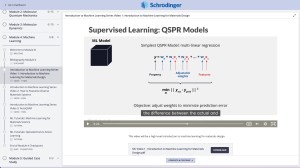
Video on practical theory break down complex scientific concepts (e.g. Machine Learning for Chemistry)

Video on practical theory break down complex scientific concepts (e.g. Machine Learning for Chemistry)

Videos on practical theory break down complex scientific concepts (e.g. Periodic Quantum Mechanics)

Videos on practical theory break down complex scientific concepts (e.g. Periodic Quantum Mechanics)

Videos on practical theory break down complex scientific concepts (e.g. Coarse-Graining)
Videos on practical theory break down complex scientific concepts (e.g. Coarse-Graining)
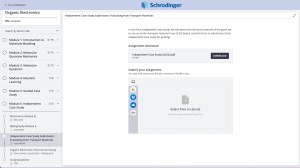
Self-paced video lessons on materials modeling
Videos on practical theory break down complex scientific concepts (e.g. Molecular Quantum Mechanics)
Access cloud-based computing resources to perform calculations yourself
Hands-on step-by-step tutorials (e.g. Pharmaceutical Formulations course, pKa prediction)
Hands-on modeling in the web-based graphical user interface (e.g. Polymeric Materials course, Diffusion tutorial)
Videos on practical theory break down complex scientific concepts (e.g. Molecular Dynamics)
On-demand video lessons on materials modeling
Access cloud-based computing resources to perform calculations yourself
Perform case studies with expert feedback (e.g. Organic Electronic Course, Independent Case Study)
Video on practical theory break down complex scientific concepts (e.g. Machine Learning for Chemistry)
Videos on practical theory break down complex scientific concepts (e.g. Periodic Quantum Mechanics)
Videos on practical theory break down complex scientific concepts (e.g. Coarse-Graining)
Need help obtaining funding for a Schrödinger Online Course?

We proudly support the next generation of scientists and are committed to providing opportunities to those with limited resources. Learn about your funding options for our online certification courses as a student, post-doc, or industry scientist and enroll today!

What our alumni say

“Clear instructions with a well-designed interface allowed me to run some of my own first molecular dynamics simulations. The information from the course felt much more secure than the information from YouTube because I knew it was developed by experts”
Graduate Student
“The course let me talk confidentially about molecular modeling and what it can do. For me, this was a nice experience which left me with many ideas for applying molecular modeling in the research area of our department, not only for me but also for my colleagues.”
Graduate Student
“As always, the course is very well designed. Formulation is quite outside my comfort zone in terms of theory and modeling but this course provided me with knowledge of evaluating what modeling can facilitate in the real world. Really great design and education process.”
Senior DirectorTherapeutic Protein Design

Show off your newly acquired skills with a course badge and certificate

When you complete a course with us in molecular modeling and are ready to share what you learned with your colleagues and employers, you can share your certificate and badge on your LinkedIn profile.

Frequently asked questions

How much do the online courses cost?

Pricing varies by each course and by the participant type. For students wishing to take these courses, we offer a student price of $150 for introductory courses, $305 for the Materials Science bundle, and $870 for advanced courses. For commercial participants, the course price is $575 for introductory courses and $1435 for advanced courses and bundles.

When does the course start?

The courses run on sessions, which range from 3-6 week periods during which the course and access to software are available to participants. You can find the course session and start dates on each course page.

What time are the lectures?

Once the course session begins, all lectures are asynchronous and you can view the self-paced videos, tutorials, and assignments at your convenience.

How could I pay for this course?

Interested participants can pay for the course by completing their registration and using the credit card portal for an instant sign up. Please note that a credit card is required as we do not accept debit cards. Additionally, we can provide a purchase order upon request, please email online-learning@schrodinger.com if you are interested in this option. If you have any questions regarding how to pay for the course, please visit our funding options page.

How can I preview the course before registering?
Are there any scholarship opportunities available for students?

Schrödinger is committed to supporting students with limited resources. Schrödinger’s mission is to improve human health and quality of life by transforming the way therapeutics and materials are discovered. Schrödinger proudly supports the next generation of scientists. We have created a scholarship program that is open to full-time students or post-docs to students who can demonstrate financial need, and have a statement of support from the academic advisor. Please complete the application form if you qualify for our scholarship program!

Will material still be available after a course ends?

While access to the software will end when the course closes, some of the material within the course (slides, papers, and tutorials) are available for download so that you can refer back to it after the course. Other materials, such as videos, quizzes, and access to the software, will only be available for the duration of the course.

Do I need access to the software to be able to do the course? Do I have to purchase the software separately?

For the duration of the course, you will have access to a web-based version of Maestro, Bioluminate, Materials Science Maestro and/or LiveDesign (depending on the course). You do not have to separately purchase access to any software. While access to the software will end when the course closes, some of the material within the course (slides, papers, and tutorials) are available for download so that you can refer back to it after the course. Other materials, such as videos, quizzes, and access to the software, will only be available for the duration of the course. Please note that Schrödinger software is only to be used for course-related purposes.

Related Courses

Molecular modeling for materials science applications: Polymeric materials course Materials Science Materials Science
Polymeric materials

All-atom molecular dynamics and machine learning approaches for studying polymeric materials and their properties under various conditions

Molecular modeling for materials science applications: course bundle Materials Science Materials Science
Course bundle

Access all materials science courses with a single, discounted registration

Molecular Modeling for Materials Science: Pharmaceutical Formulations Materials Science Materials Science
Pharmaceutical formulations

Molecular and periodic quantum mechanics, all atom molecular dynamics, and coarse-grained approaches for studying active pharmaceutical ingredients and their formulations

Supporting Associations

nanoHUB

Battery materials

Battery_Course_Hero

Battery materials


Molecular and periodic quantum mechanics, all-atom molecular dynamics, and machine learning for studying battery materials and their properties under various conditions

Details
Available Languages
Chinese, English, Japanese, Korean
Duration
6 weeks / ~25 hours to complete
Level
Introductory
Cost
$600 for non-student users
$160 for student / post-doc
Course Timeframe
When registering for the course, you will be able to choose your preferred start and end date. Within those dates, you will have asynchronous access to the course to work on your preferred schedule

Overview

Computational molecular modeling tools have proven effective in materials science research and development. Chemists, physicists and engineers working in materials science will increasingly encounter molecular modeling throughout their careers, making it critical to have a foundational understanding of the cutting edge tools and methods. These courses are ideal for those who wish to develop professionally and expand their CV by earning certification and a badge.

These computational chemistry courses offer an effective and efficient approach to learn practical computational chemistry for materials science:

  • Work hands-on with Schrödinger’s industry-leading Materials Science Maestro software
  • Jump start your research program by learning methods that can be directly applied to ongoing projects
  • Learn topics ranging from density functional theory (DFT) to molecular dynamics to machine learning for materials design
  • Perform a completely independent case study to demonstrate mastery of the course content
  • Benefit from review and feedback from Schrödinger Education Team experts for course assignments and course-related queries
  • Work on the course materials on your own schedule whenever convenient for you


This course comes with access to a web-based version of Schrödinger software with the necessary licenses and compute resources for the course:

Requirements
  • A computer with reliable high speed internet access (8 Mbps or better)
  • A mouse and/or external monitor (recommended but not required)
  • Working knowledge of general chemistry
Certification
  • A certificate signed by the Schrödinger course lead
  • A badge that can be posted to social media, such as LinkedIn
background pattern

What you will learn

MS Maestro interface

Learn how to use an industry-leading interface for materials science modeling. No coding or scripting required to run modeling workflows

Quantum mechanics

Learn to apply molecular & periodic density functional theory (DFT) for automated property prediction for organic & inorganic molecules

Molecular dynamics

Learn to leverage all-atom MD simulations for simulating device layers & electrolyte properties

Machine learning

Learn to apply machine learning for rapid & accurate property prediction of battery-relevant organic molecules

Modules

Module 1
2 Hours

Introduction to materials modeling

Video
Video

Introduction to materials modeling & this online course

Video Tutorial
Video tutorial

Introduction to materials science (MS) Maestro

Video
Video

Introduction to modeling for batteries

End checkpoint
Honor code agreement and checkpoint
Module 2
7 Hours + Compute Time

Molecular & periodic quantum mechanics

Video
Video

Introduction to molecular & periodic quantum mechanics (mQM & pQM)

Tutorial
Tutorials
  • Quantum mechanical workflows & properties: Part 1
  • Quantum mechanical workflows & properties: Part 2
  • Bond and ligand dissociation energy
  • Nanoreactor
  • Building bulk crystals and calculating properties
  • Calculating intercalation and voltage curves
  • Lithium ion migration barrier (NEB)
End checkpoint
End of module checkpoint
Module 3
6 Hours + Compute Time

All-atom molecular dynamics

Video
Video

Introducing to molecular dynamics (MD)

Tutorial
Tutorials
  • Disordered system building & MD multistage workflows
  • Building, equilibrating & analyzing polymers
  • Diffusion
  • Polymer electrolyte analysis
  • Liquid electrolyte properties: Part 1
  • Liquid electrolyte properties: Part 2
  • Solid electrolyte interphase builder
End checkpoint
End of module checkpoint
Module 4
3 Hours + Compute Time

Machine learning

Video
Video

Introduction to machine learning (ML)

Tutorial
Tutorials
  • Machine learning property prediction
  • Machine learning for materials science
  • Machine learning for ionic conductivity
  • Molecular dynamics descriptors for machine learning
  • Machine learning for formulations
End checkpoint
End of module checkpoint
Module 5
3 Hours + Compute Time

Guided case study

Tutorial
Case Studies
  • EC decomposition on a Li (001) surface
  • Ab initio molecular dynamics simulations of Li-ion diffusion in solid-state electrolytes
End checkpoint
End of module checkpoint
Module 6
4 Hours + Compute Time

Independent case study

Assignment
Assignment

Modifying battery electrolyte components

Course completion
Course completion & certification
Self-paced video lessons on materials modeling

Self-paced video lessons on materials modeling

Videos on practical theory break down complex scientific concepts (e.g. Molecular Quantum Mechanics)

Videos on practical theory break down complex scientific concepts (e.g. Molecular Quantum Mechanics)

Access cloud-based computing resources to perform calculations yourself

Access cloud-based computing resources to perform calculations yourself

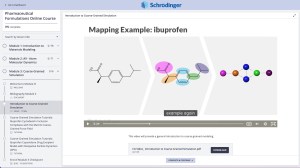
Hands-on step-by-step tutorials (e.g. Pharmaceutical Formulations course, pKa prediction)

Hands-on step-by-step tutorials (e.g. Pharmaceutical Formulations course, pKa prediction)

Hands-on modeling in the web-based graphical user interface (e.g. Polymeric Materials course, Diffusion tutorial)

Hands-on modeling in the web-based graphical user interface (e.g. Polymeric Materials course, Diffusion tutorial)

Videos on practical theory break down complex scientific concepts (e.g. Molecular Dynamics)

Videos on practical theory break down complex scientific concepts (e.g. Molecular Dynamics)

On-demand video lessons on materials modeling

On-demand video lessons on materials modeling

Access cloud-based computing resources to perform calculations yourself

Access cloud-based computing resources to perform calculations yourself

Perform case studies with expert feedback (e.g. Organic Electronic Course, Independent Case Study)

Perform case studies with expert feedback (e.g. Organic Electronic Course, Independent Case Study)

Video on practical theory break down complex scientific concepts (e.g. Machine Learning for Chemistry)

Video on practical theory break down complex scientific concepts (e.g. Machine Learning for Chemistry)

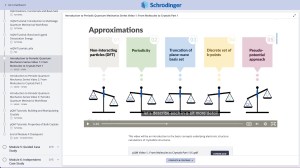
Videos on practical theory break down complex scientific concepts (e.g. Periodic Quantum Mechanics)

Videos on practical theory break down complex scientific concepts (e.g. Periodic Quantum Mechanics)

Videos on practical theory break down complex scientific concepts (e.g. Coarse-Graining)
Videos on practical theory break down complex scientific concepts (e.g. Coarse-Graining)
Self-paced video lessons on materials modeling
Videos on practical theory break down complex scientific concepts (e.g. Molecular Quantum Mechanics)
Access cloud-based computing resources to perform calculations yourself
Hands-on step-by-step tutorials (e.g. Pharmaceutical Formulations course, pKa prediction)
Hands-on modeling in the web-based graphical user interface (e.g. Polymeric Materials course, Diffusion tutorial)
Videos on practical theory break down complex scientific concepts (e.g. Molecular Dynamics)
On-demand video lessons on materials modeling
Access cloud-based computing resources to perform calculations yourself
Perform case studies with expert feedback (e.g. Organic Electronic Course, Independent Case Study)
Video on practical theory break down complex scientific concepts (e.g. Machine Learning for Chemistry)
Videos on practical theory break down complex scientific concepts (e.g. Periodic Quantum Mechanics)
Videos on practical theory break down complex scientific concepts (e.g. Coarse-Graining)

Need help obtaining funding for a Schrödinger Online Course?

We proudly support the next generation of scientists and are committed to providing opportunities to those with limited resources. Learn about your funding options for our online certification courses as a student, post-doc, or industry scientist and enroll today!

What our alumni say

“Clear instructions with a well-designed interface allowed me to run some of my own first molecular dynamics simulations. The information from the course felt much more secure than the information from YouTube because I knew it was developed by experts”
Graduate Student
“The course let me talk confidentially about molecular modeling and what it can do. For me, this was a nice experience which left me with many ideas for applying molecular modeling in the research area of our department, not only for me but also for my colleagues.”
Graduate Student
“As always, the course is very well designed. Formulation is quite outside my comfort zone in terms of theory and modeling but this course provided me with knowledge of evaluating what modeling can facilitate in the real world. Really great design and education process.”
Senior DirectorTherapeutic Protein Design

Show off your newly acquired skills with a course badge and certificate

When you complete a course with us in molecular modeling and are ready to share what you learned with your colleagues and employers, you can share your certificate and badge on your LinkedIn profile.

Frequently asked questions

How much do the online courses cost?

Pricing varies by each course and by the participant type. For students wishing to take these courses, we offer a student price of $150 for introductory courses, $305 for the Materials Science bundle, and $870 for advanced courses. For commercial participants, the course price is $575 for introductory courses and $1435 for advanced courses and bundles.

When does the course start?

The courses run on sessions, which range from 3-6 week periods during which the course and access to software are available to participants. You can find the course session and start dates on each course page.

What time are the lectures?

Once the course session begins, all lectures are asynchronous and you can view the self-paced videos, tutorials, and assignments at your convenience.

How could I pay for this course?

Interested participants can pay for the course by completing their registration and using the credit card portal for an instant sign up. Please note that a credit card is required as we do not accept debit cards. Additionally, we can provide a purchase order upon request, please email online-learning@schrodinger.com if you are interested in this option. If you have any questions regarding how to pay for the course, please visit our funding options page.

How can I preview the course before registering?
Are there any scholarship opportunities available for students?

Schrödinger is committed to supporting students with limited resources. Schrödinger’s mission is to improve human health and quality of life by transforming the way therapeutics and materials are discovered. Schrödinger proudly supports the next generation of scientists. We have created a scholarship program that is open to full-time students or post-docs to students who can demonstrate financial need, and have a statement of support from the academic advisor. Please complete the application form if you qualify for our scholarship program!

Will material still be available after a course ends?

While access to the software will end when the course closes, some of the material within the course (slides, papers, and tutorials) are available for download so that you can refer back to it after the course. Other materials, such as videos, quizzes, and access to the software, will only be available for the duration of the course.

Do I need access to the software to be able to do the course? Do I have to purchase the software separately?

For the duration of the course, you will have access to a web-based version of Maestro, Bioluminate, Materials Science Maestro and/or LiveDesign (depending on the course). You do not have to separately purchase access to any software. While access to the software will end when the course closes, some of the material within the course (slides, papers, and tutorials) are available for download so that you can refer back to it after the course. Other materials, such as videos, quizzes, and access to the software, will only be available for the duration of the course. Please note that Schrödinger software is only to be used for course-related purposes.

Related Courses
Online certification course: Level-up your skill set in catalysis modeling Materials Science Materials Science
Homogeneous catalysis & reactivity

Molecular quantum mechanics and machine learning approaches for studying reactivity and mechanism at the molecular level
Molecular modeling for materials science applications: course bundle Materials Science Materials Science
Course bundle

Access all materials science courses with a single, discounted registration

Molecular modeling for materials science applications: Polymeric materials course Materials Science Materials Science
Polymeric materials

All-atom molecular dynamics and machine learning approaches for studying polymeric materials and their properties under various conditions
Supporting Associations

nanoHUB

Introduction to molecular modeling in drug discovery

Introduction to molecular modeling in drug discovery

Introduction to molecular modeling in drug discovery


Protein preparation, ligand docking, collaborative design, and other fundamentals of small molecule drug discovery with Maestro and LiveDesign

Details
Available Languages
Chinese, English, Japanese, Korean
Duration
5 weeks / ~20 hours to complete
Level
Introductory
Cost
$600 for non-student users
$160 for student / post-doc
Course Timeframe
When registering for the course, you will be able to choose your preferred start and end date. Within those dates, you will have asynchronous access to the course to work on your preferred schedule

Overview

Computational molecular modeling tools have proven effective in drug discovery and are increasing in use across the pharmaceutical industry. The drug hunters of today will continue to encounter molecular modeling throughout their careers making it critical to have a foundational understanding of the relevant tools and methods.

This course is ideal for those who wish to develop professionally and expand their CV by earning certification and a badge.

  • Work hands-on with Schrodinger’s Maestro and LiveDesign on your own schedule whenever convenient for you within the course session
  • Jump start your research program by learning methods that can be directly applied to ongoing projects
  • Learn topics ranging from protein structure preparation to ligand docking
  • Perform a completely independent case study to demonstrate mastery of the course content
  • Benefit from the review and feedback of Schrödinger experts for course assignments and queries


This course comes with access to a web-based version of Schrödinger software with the necessary licenses and compute resources for the course:

Requirements
  • A computer with reliable high speed internet access (8 Mbps or better)
  • A mouse and/or external monitor (recommended but not required)
  • Be familiar with the concepts of protein structure, compound potency, molecular mass, and pKa
Certification
  • A certificate signed by the Schrödinger course lead
  • A badge that can be posted to social media, such as LinkedIn
background pattern

What you will learn

Maestro interface

Use an industry-leading graphical user interface for small molecule modeling. Please note that there is no coding or scripting required to run modeling workflows in this course

Fundamentals of computational drug design

Learn how computational tools are already being used on drug discovery projects, and basic theory behind some of the most common workflows

Structure and ligand-based modeling workflows

Best practices for protein and ligand preparation, structure and ligand-based virtual screening, and multi-parameter ligand optimization

Applying workflows to projects

Apply your skills in an open-ended case study where you design novel VEGR2 inhibitors using a collaborative enterprise informatics platform

Modules

Module 1
2 Hours

Introduction to modeling and scene setting

Checkpoint
Syllabus and honor code

Expectations surrounding academic integrity

Video
Video

Introducing the value of molecular modeling and case studies

End checkpoint
End of module checkpoint
Module 2
3 Hours

Fundamental tasks in the Maestro user interface

Video Tutorial
Video tutorial

Getting started and modifying small molecules

End checkpoint
End of module checkpoint
Module 3
4 Hours

Viewing protein-ligand interactions

Video Tutorial
Video tutorials
  • Navigating the structure hierarchy and adding surfaces
  • Ligand Interaction Diagram and sharing generated images
  • Ligand preparation with LigPrep, and Ligand Alignment
End checkpoint
End of module checkpoint
Module 4
4 Hours

Structure-based virtual screening techniques

Video Tutorial
Video tutorials
  • Choosing a virtual screening method and structure based virtual screening with ligand docking
  • Protein structure inspection and preparation, docking grid generation, and docking analysis
  • Enumeration and analysis with the Ligand Designer
End checkpoint
End of module checkpoint
Module 5
2 Hours

Ligand-based virtual screening techniques

Video Tutorial
Video tutorial

Ligand-based virtual screening methods

Tutorial
Tutorial

Shape-based screening of a ligand database

End checkpoint
End of module checkpoint
Module 6
4 Hours

Workflows and exercises in LiveDesign

Video Tutorial
Video tutorials
  • Organize data and collaborate effectively in drug discovery
  • Workflows for collaborative drug design
Tutorial
Tutorial

Ideation for drug discovery projects, including building and analyzing data in LiveDesign

End checkpoint
End of module checkpoint
Module 7
6 Hours

Case study on VEGFR2

Video
Video

Background on kinase structure and activity

Tutorial
Tutorials
  • Perform docking
  • Calculate enrichment
  • Analyze hit series
  • Analog ideation
Assignment
Assignments
  • Enrichment submission
  • Final compound submission
Course completion
Course completion and certification

Need help obtaining funding for a Schrödinger Online Course?

We proudly support the next generation of scientists and are committed to providing opportunities to those with limited resources. Learn about your funding options for our online certification courses as a student, post-doc, or industry scientist and enroll today!

What our alumni say

“I learned new concepts even though I have been in this field for almost 30 years. The final LiveDesign exercise was particularly enjoyable and eye-opening. I recommend this course for both beginners and experience medicinal chemists.”
Michael WaltersResearch Associate Professor, University of Minnesota
“The courteous instructor made even the trickiest concepts feel clear. The engaging explanations, punctuated by real-world examples, kept me glued. But the true gem was the hands-on work with Maestro.”
Oluwaseun AjayiGraduate Student at University of Georgia
“The course content was meticulously structured, offering a comprehensive overview of molecular modelling techniques and their applications. The instructors distilled complex concepts into digestible modules, making the material accessible to participants with varying levels of expertise.”
Mursal MohdStudent at Integral University
“This is a well-structured, concise, and information-dense course. The final project applies docking knowledge to analyze hit series of ligands, and perform ligand analog ideation using the LiveDesign platform. I am extremely thankful to Schrödinger for crafting this accessible and comprehensive introductory course.”
Sthitadhi MaitiPhD Graduate Student at Arizona State University
“As a medicinal chemist, the power of structure enabled drug design is clear to me, but I have not used it in my workflows in my previous roles. The course was a great starter for me to begin adding these tools to my kit. I was happy to see how easy it was to jump right into Maestro and LiveDesign.”
Bruce MelanconSenior Principal Scientist
“The knowledge gained here will undoubtedly enhance my career prospects in the pharmaceutical industry and open new avenues for innovative drug design.”
Meng WangPostdoctoral research fellow at Dana-Farber Cancer Institute
“I would highly recommend this course to anyone conducting research in the medicinal chemistry field, or anyone wanting to further their understanding of in silico drug modeling.”
Vasili KoutouratsasResearch Assistant (PharmD Candidate) at St. John’s University
“Great course to start approaching molecular modeling in drug discovery. Maestro and Live Design are excellent and powerful platforms for docking and correlation of modeling results and ADME properties.”
Paolo RicciAssociate Principal Scientist at Domainex
“The Schrödinger online course is well-organized, with interactive, step-by-step instructions that provide a rich learning experience for using its CADD toolbox. I highly recommend this course.”
Zhiwei ZhangHead of Medicinal Chemistry at Institute of Innovative Medicine, Grand Pharma
“Introduction to molecular modeling in drug discovery has been a journey in the modeling approach of screening compounds in drug discovery. It will be a precious support for the development of my career as a medicinal chemist.”
Marianna GirardiScientist II at Ryvu Therapeutics

Show off your newly acquired skills with a course badge and certificate

When you complete a course with us in molecular modeling and are ready to share what you learned with your colleagues and employers, you can share your certificate and badge on your LinkedIn profile.

Frequently asked questions

How much do the online courses cost?

Pricing varies by each course and by the participant type. For students wishing to take these courses, we offer a student price of $150 for introductory courses, $305 for the Materials Science bundle, and $870 for advanced courses. For commercial participants, the course price is $575 for introductory courses and $1435 for advanced courses and bundles.

When does the course start?

The courses run on sessions, which range from 3-6 week periods during which the course and access to software are available to participants. You can find the course session and start dates on each course page.

What time are the lectures?

Once the course session begins, all lectures are asynchronous and you can view the self-paced videos, tutorials, and assignments at your convenience.

How could I pay for this course?

Interested participants can pay for the course by completing their registration and using the credit card portal for an instant sign up. Please note that a credit card is required as we do not accept debit cards. Additionally, we can provide a purchase order upon request, please email online-learning@schrodinger.com if you are interested in this option. If you have any questions regarding how to pay for the course, please visit our funding options page.

How can I preview the course before registering?
Are there any scholarship opportunities available for students?

Schrödinger is committed to supporting students with limited resources. Schrödinger’s mission is to improve human health and quality of life by transforming the way therapeutics and materials are discovered. Schrödinger proudly supports the next generation of scientists. We have created a scholarship program that is open to full-time students or post-docs to students who can demonstrate financial need, and have a statement of support from the academic advisor. Please complete the application form if you qualify for our scholarship program!

Will material still be available after a course ends?

While access to the software will end when the course closes, some of the material within the course (slides, papers, and tutorials) are available for download so that you can refer back to it after the course. Other materials, such as videos, quizzes, and access to the software, will only be available for the duration of the course.

Do I need access to the software to be able to do the course? Do I have to purchase the software separately?

For the duration of the course, you will have access to a web-based version of Maestro, Bioluminate, Materials Science Maestro and/or LiveDesign (depending on the course). You do not have to separately purchase access to any software. While access to the software will end when the course closes, some of the material within the course (slides, papers, and tutorials) are available for download so that you can refer back to it after the course. Other materials, such as videos, quizzes, and access to the software, will only be available for the duration of the course. Please note that Schrödinger software is only to be used for course-related purposes.

Related courses

Introduction to Computational Antibody Engineering Course Life Science Life Science
Introduction to computational antibody engineering

Structure-based workflows for assessing and improving the developability, stability, affinity, and ‘humanness’ of antibody therapeutics with BioLuminate

Molecular Modeling for Materials Science: Pharmaceutical Formulations Life Science Life Science
Pharmaceutical formulations

Molecular and periodic quantum mechanics, all atom molecular dynamics, and coarse-grained approaches for studying active pharmaceutical ingredients and their formulations

Introduction to computational antibody engineering

Introduction to Computational Antibody Engineering Course

Introduction to computational antibody engineering


Structure-based workflows for assessing and improving stability, affinity, and ‘humanness’ of antibody therapeutics with BioLuminate

Details
Available Languages
Chinese, English, Japanese, Korean
Duration
5 weeks / ~20 hours to complete
Level
Introductory
Cost
$600 for non-student users
$160 for student / post-doc
Course Timeframe
When registering for the course, you will be able to choose your preferred start and end date. Within those dates, you will have asynchronous access to the course to work on your preferred schedule
Who Should Take This Course?
Antibody engineers, computational biologists, structural biologists, biophysical characterization scientists

Overview

Computational molecular modeling tools have proven effective in antibody development and are increasing in use across the antibody discovery industry. The antibody engineers of today will frequently encounter molecular modeling throughout their careers making it critical to have foundational understanding of the relevant tools and methods.

This course is ideal for those who wish to develop professionally and expand their CV by earning certification and a badge.

  • Work hands-on with Schrödinger’s industry-leading BioLuminate and LiveDesign
  • Jump start your research program by learning methods that can be directly applied to ongoing projects
  • Learn topics ranging from antibody structure prediction to developability analysis
  • Independently perform a case study to demonstrate mastery of the course content
  • Benefit from review and feedback from Schrödinger Education Team experts for course assignments and course-related queries
  • Work on the course materials on your own schedule whenever convenient for you within the course session


This course comes with access to a web-based version of Schrödinger software with the necessary licenses and compute resources for the course:

Requirements
  • A computer with reliable high speed internet access (8 Mbps or better)
  • A mouse and/or external monitor (recommended but not required)
  • Be familiar with the basics of protein structure
Certification
  • A certificate signed by the Schrödinger course lead
  • A badge that can be posted to social media, such as LinkedIn
background pattern

What you will learn

BioLuminate interface

Learn how to use an industry-leading interface for biologics modeling. No coding or scripting required to run modeling workflows

Structure and sequence-based modeling 

Antibody structure prediction, prepare antibody structures loaded from the PDB, structure reliability analysis, sequence alignment, and sequence annotation

Antibody modeling workflows

Best practices for developability analysis, humanization, computational mutagenesis, and antibody-antigen docking

Applying workflows to projects

Apply your skills in an open-ended case study where you will propose variants for an antibody targeting IFNGR1

Modules

Module 1
3 Hours

Introduction and overview

Video
Videos
  • Course overview
  • Introduction to computational antibody engineering
  • Introduction to workflows with Schrödinger tools
Assignment
Required reading

Development of therapeutic antibodies for the treatment of disease

End checkpoint
End of module checkpoint
Module 2
3 Hours

Basic tasks and workflows in BioLuminate

Video Tutorial
Video tutorials
  • Getting started
  • Importing, selecting, including, and styling structures
  • Introducing workspace toggles, the structure hierarchy, and measurements
  • Renaming chains and interacting with the project table
Assignment
Required reading

Computational developability guidelines for antibody profiling

End checkpoint
End of module checkpoint
Module 3
4 Hours

Exploring your toolbox for structure-based and sequence-based design

Video Tutorial
Video tutorials
  • Protein preparation workflow and reliability analysis
  • Antibody structure prediction and refinement
  • Protein interaction analysis
  • Introduction to the multiple sequence viewer/editor parts 1 and 2
Video
Videos
  • Introduction to antibody structure prediction
  • Working with novel/exotic antibody formats
Assignment
Assignment

Antibody structure prediction of an FDA approved monoclonal antibody

End checkpoint
End of module checkpoint
Module 4
5 Hours

Antibody modeling case studies

Assignment
Assignment

Engineering the surface properties of a human monoclonal antibody prevents self-association and rapid clearance in vivo

Video Tutorial
Videos and tutorials
  • Protein surface analysis – looking for aggregation hotspots
  • Antibody humanization and back mutations
  • Protein-protein docking and analysis
  • Residue scanning
  • Integrated informatics for antibody discovery
End checkpoint
End of module checkpoint
Module 5
5 Hours

Final case study

Video
Video

Introduction to the final case study

Tutorial
Tutorials
  • Analyzing the A6-IFNGR1 interface
  • Alanine scanning
  • Homolog sequence analysis of IFNGR1
  • Residue scanning to improve affinity toward IFNGR1
Assignment
Assignment

Final assignment

Course completion
Course completion and certification

Need help obtaining funding for a Schrödinger Online Course?

We proudly support the next generation of scientists and are committed to providing opportunities to those with limited resources. Learn about your funding options for our online certification courses as a student, post-doc, or industry scientist and enroll today!

What our alumni say

“This is more than a course that shows you how to use a piece of software, it’s a great introduction to antibody modeling as a field and the techniques used by experts in the field.”
Dustin WoodsSenior Scientist, Evotec SE
“The course was well-designed and walked me through several computational tools that will be helpful in modeling mutations and assessing their potential effects on antibody developability and affinity.”
Jennifer KungScientist, Denali Therapeutics
“Great intro to computational antibody engineering even for someone with limited experience.”
Sophie KongScientist, EpiBiologics
“The course has been a really good intro to a powerful piece of software we can use in our engineering programs.”
Alex KinnaDirector, Research, Autolus Therapeutics plc
“This course was very informative and easy to follow. The hands-on approach with the software and tutorials helped to build skills with this program.”
Robert JamesMedical Laboratory Technician III, IDEXX
“I’m confident that the skills I gained will directly support my future work in antibody engineering and therapeutic design.”
Justyna JabłońskaSenior Scientist, Ryvu Therapeutics
“I am hoping I can apply at least some of what I learned here to future antibody engineering work.”
Yan HuangPrincipal Scientist, Scholar Rock
“The Computational Antibody Engineering course was an excellent learning experience. I gained a lot of new knowledge, and the content was clear and easy to follow.”
Jaime GuillenSenior Scientist, Imcheck
“It was a very good learning experience which will enable me to conduct my own antibody engineering projects in the future using computational software.”
Bart AckerschottSenior Research Technician, Smivet B.V.

Show off your newly acquired skills with a course badge and certificate

When you complete a course with us in molecular modeling and are ready to share what you learned with your colleagues and employers, you can share your certificate and badge on your LinkedIn profile.

Frequently asked questions

How much do the online courses cost?

Pricing varies by each course and by the participant type. For students wishing to take these courses, we offer a student price of $150 for introductory courses, $305 for the Materials Science bundle, and $870 for advanced courses. For commercial participants, the course price is $575 for introductory courses and $1435 for advanced courses and bundles.

When does the course start?

The courses run on sessions, which range from 3-6 week periods during which the course and access to software are available to participants. You can find the course session and start dates on each course page.

What time are the lectures?

Once the course session begins, all lectures are asynchronous and you can view the self-paced videos, tutorials, and assignments at your convenience.

How could I pay for this course?

Interested participants can pay for the course by completing their registration and using the credit card portal for an instant sign up. Please note that a credit card is required as we do not accept debit cards. Additionally, we can provide a purchase order upon request, please email online-learning@schrodinger.com if you are interested in this option. If you have any questions regarding how to pay for the course, please visit our funding options page.

How can I preview the course before registering?
Are there any scholarship opportunities available for students?

Schrödinger is committed to supporting students with limited resources. Schrödinger’s mission is to improve human health and quality of life by transforming the way therapeutics and materials are discovered. Schrödinger proudly supports the next generation of scientists. We have created a scholarship program that is open to full-time students or post-docs to students who can demonstrate financial need, and have a statement of support from the academic advisor. Please complete the application form if you qualify for our scholarship program!

Will material still be available after a course ends?

While access to the software will end when the course closes, some of the material within the course (slides, papers, and tutorials) are available for download so that you can refer back to it after the course. Other materials, such as videos, quizzes, and access to the software, will only be available for the duration of the course.

Do I need access to the software to be able to do the course? Do I have to purchase the software separately?

For the duration of the course, you will have access to a web-based version of Maestro, Bioluminate, Materials Science Maestro and/or LiveDesign (depending on the course). You do not have to separately purchase access to any software. While access to the software will end when the course closes, some of the material within the course (slides, papers, and tutorials) are available for download so that you can refer back to it after the course. Other materials, such as videos, quizzes, and access to the software, will only be available for the duration of the course. Please note that Schrödinger software is only to be used for course-related purposes.

Related courses

Introduction to Molecular Modeling for Drug Discovery Life Science Life Science
Introduction to molecular modeling in drug discovery

Protein preparation, ligand docking, collaborative design, and other fundamentals of small molecule drug discovery with Maestro and LiveDesign

Free Energy Calculation for Drug Design with FEP+ Life Science Life Science
Free energy calculations for drug design with FEP+

Running, analyzing, and troubleshooting relative binding FEP+ calculations for small molecule lead optimization

Supporting associations

Supporting associations_Antibody Socieity Logo

Pharmaceutical formulations

Pharmaceutical formulations

Pharmaceutical formulations


Molecular and periodic quantum mechanics, all- atom molecular dynamics, and coarse-grained approaches for studying active pharmaceutical ingredients and their formulations

Details
Available Languages
Chinese, English, Japanese, Korean
Duration
6 weeks / ~25 hours to complete
Level
Introductory
Cost
$600 for non-student users
$160 for student / post-doc
Course Timeframe
When registering for the course, you will be able to choose your preferred start and end date. Within those dates, you will have asynchronous access to the course to work on your preferred schedule

Overview

Computational molecular modeling tools have proven effective in materials science research and development. Chemists, physicists and engineers working in materials science will increasingly encounter molecular modeling throughout their careers, making it critical to have a foundational understanding of the cutting edge tools and methods. These courses are ideal for those who wish to develop professionally and expand their CV by earning certification and a badge.

These computational chemistry courses offer an effective and efficient approach to learn practical computational chemistry for materials science:

  • Work hands-on with Schrödinger’s industry-leading Materials Science Maestro software
  • Jump start your research program by learning methods that can be directly applied to ongoing projects
  • Learn topics ranging from density functional theory (DFT) to molecular dynamics to machine learning for materials design
  • Perform a completely independent case study to demonstrate mastery of the course content
  • Benefit from review and feedback from Schrödinger Education Team experts for course assignments and course-related queries
  • Work on the course materials on your own schedule whenever convenient for you


This course comes with access to a web-based version of Schrödinger software with the necessary licenses and compute resources for the course:

Requirements
  • A computer with reliable high speed internet access (8 Mbps or better)
  • A mouse and/or external monitor (recommended but not required)
  • Working knowledge of general chemistry
Certification
  • A certificate signed by the Schrödinger course lead
  • A badge that can be posted to social media, such as LinkedIn
background pattern

What you will learn

MS Maestro interface

Learn how to use an industry-leading interface for materials science modeling. No coding or scripting required to run modeling workflows

Molecular and periodic quantum mechanics

Learn to apply molecular and periodic density functional theory (DFT) for automated property prediction for amorphous and crystalline active pharmaceutical ingredients

Molecular dynamics

Learn to leverage all-atom MD simulations for simulating properties of complete formulations including miscibility and hygroscopicity

Coarse-grained modeling

Access larger length scale and longer time scales by employing coarse-grained methods to study formulations

Modules

Module 1
2 Hours

Introduction to materials modeling

Video
Video

Introduction to materials modeling & this online course

Video Tutorial
Video tutorial

Introduction to materials science (MS) Maestro

Video
Video

Modeling for pharmaceutical formulations

End checkpoint
Honor code agreement and checkpoint
Module 2
6 hours + Comp Time

Molecular & periodic quantum mechanics

Video
Video

Introduction to quantum mechanics (mQM & pQM)

Tutorial
Tutorials
  • Quantum mechanical workflows and properties
  • API degradation
  • pKa predictions
  • Spectroscopy (molecular)
  • Building and Manipulating Crystals
  • Properties of Bulk Molecular Crystals
  • Spectroscopy (solid-state)
End checkpoint
End of Module Checkpoint
Module 3
5 Hours + Compute Time

All-atom molecular dynamics

Video
Video

Introduction to molecular dynamics (MD)

Tutorial
Tutorials
  • Disordered system building and MD multistage workflows
  • Molecular dynamics simulations for API (active pharmaceutical ingredient) Miscibility
  • Glass transition temperature and hygroscopicity for APIs
  • Hygroscopicity
  • Crystal morphology
End checkpoint
End of module checkpoint
Module 4
5 Hours + Compute Time

Coarse-grained simulation

Video
Video

Introduction to coarse-graining  (CG)

Tutorial
Tutorials
  • Ibuprofen cyclodextrin inclusion complexes with the martini coarse-grained force field
  • Ibuprofen copovidone drug excipient model with dissipative particle dynamics (DPD)
End checkpoint
End of module checkpoint
Module 5
2 Hours + Compute Time

Machine learning

Video
Video

Introduction to machine learning (ML)

Tutorial
Tutorials
  • Machine learning for materials science
  • Machine learning for formulations
End checkpoint
End of module checkpoint
Module 6
2 Hours + Compute Time

Guided case study

Tutorial
Tutorials
  • Nanoemulsions with automated DPD parameterization
  • Building pH dependent systems of Diclofenac
End checkpoint
End of module checkpoint
Module 7
4 Hours + Compute Time

Independent case study

Assignment
Assignment

API Property Prediction

Course completion
Course completion and certification
Self-paced video lessons on materials modeling

Self-paced video lessons on materials modeling

Videos on practical theory break down complex scientific concepts (e.g. Molecular Quantum Mechanics)

Videos on practical theory break down complex scientific concepts (e.g. Molecular Quantum Mechanics)

Access cloud-based computing resources to perform calculations yourself

Access cloud-based computing resources to perform calculations yourself

Hands-on step-by-step tutorials (e.g. Pharmaceutical Formulations course, pKa prediction)

Hands-on step-by-step tutorials (e.g. Pharmaceutical Formulations course, pKa prediction)

Hands-on modeling in the web-based graphical user interface (e.g. Polymeric Materials course, Diffusion tutorial)

Hands-on modeling in the web-based graphical user interface (e.g. Polymeric Materials course, Diffusion tutorial)

Videos on practical theory break down complex scientific concepts (e.g. Molecular Dynamics)

Videos on practical theory break down complex scientific concepts (e.g. Molecular Dynamics)

On-demand video lessons on materials modeling

On-demand video lessons on materials modeling

Access cloud-based computing resources to perform calculations yourself

Access cloud-based computing resources to perform calculations yourself

Perform case studies with expert feedback (e.g. Organic Electronic Course, Independent Case Study)

Perform case studies with expert feedback (e.g. Organic Electronic Course, Independent Case Study)

Video on practical theory break down complex scientific concepts (e.g. Machine Learning for Chemistry)

Video on practical theory break down complex scientific concepts (e.g. Machine Learning for Chemistry)

Videos on practical theory break down complex scientific concepts (e.g. Periodic Quantum Mechanics)

Videos on practical theory break down complex scientific concepts (e.g. Periodic Quantum Mechanics)

Videos on practical theory break down complex scientific concepts (e.g. Coarse-Graining)

Videos on practical theory break down complex scientific concepts (e.g. Coarse-Graining)

Self-paced video lessons on materials modeling
Videos on practical theory break down complex scientific concepts (e.g. Molecular Quantum Mechanics)
Access cloud-based computing resources to perform calculations yourself
Hands-on step-by-step tutorials (e.g. Pharmaceutical Formulations course, pKa prediction)
Hands-on modeling in the web-based graphical user interface (e.g. Polymeric Materials course, Diffusion tutorial)
Videos on practical theory break down complex scientific concepts (e.g. Molecular Dynamics)
On-demand video lessons on materials modeling
Access cloud-based computing resources to perform calculations yourself
Perform case studies with expert feedback (e.g. Organic Electronic Course, Independent Case Study)
Video on practical theory break down complex scientific concepts (e.g. Machine Learning for Chemistry)
Videos on practical theory break down complex scientific concepts (e.g. Periodic Quantum Mechanics)
Videos on practical theory break down complex scientific concepts (e.g. Coarse-Graining)

Need help obtaining funding for a Schrödinger Online Course?

We proudly support the next generation of scientists and are committed to providing opportunities to those with limited resources. Learn about your funding options for our online certification courses as a student, post-doc, or industry scientist and enroll today!

What our alumni say

“Clear instructions with a well-designed interface allowed me to run some of my own first molecular dynamics simulations. The information from the course felt much more secure than the information from YouTube because I knew it was developed by experts”
Graduate Student
“The course let me talk confidentially about molecular modeling and what it can do. For me, this was a nice experience which left me with many ideas for applying molecular modeling in the research area of our department, not only for me but also for my colleagues.”
Graduate Student
“As always, the course is very well designed. Formulation is quite outside my comfort zone in terms of theory and modeling but this course provided me with knowledge of evaluating what modeling can facilitate in the real world. Really great design and education process.”
Senior DirectorTherapeutic Protein Design

Show off your newly acquired skills with a course badge and certificate

When you complete a course with us in molecular modeling and are ready to share what you learned with your colleagues and employers, you can share your certificate and badge on your LinkedIn profile.

Frequently asked questions

How much do the online courses cost?

Pricing varies by each course and by the participant type. For students wishing to take these courses, we offer a student price of $150 for introductory courses, $305 for the Materials Science bundle, and $870 for advanced courses. For commercial participants, the course price is $575 for introductory courses and $1435 for advanced courses and bundles.

When does the course start?

The courses run on sessions, which range from 3-6 week periods during which the course and access to software are available to participants. You can find the course session and start dates on each course page.

What time are the lectures?

Once the course session begins, all lectures are asynchronous and you can view the self-paced videos, tutorials, and assignments at your convenience.

How could I pay for this course?

Interested participants can pay for the course by completing their registration and using the credit card portal for an instant sign up. Please note that a credit card is required as we do not accept debit cards. Additionally, we can provide a purchase order upon request, please email online-learning@schrodinger.com if you are interested in this option. If you have any questions regarding how to pay for the course, please visit our funding options page.

How can I preview the course before registering?
Are there any scholarship opportunities available for students?

Schrödinger is committed to supporting students with limited resources. Schrödinger’s mission is to improve human health and quality of life by transforming the way therapeutics and materials are discovered. Schrödinger proudly supports the next generation of scientists. We have created a scholarship program that is open to full-time students or post-docs to students who can demonstrate financial need, and have a statement of support from the academic advisor. Please complete the application form if you qualify for our scholarship program!

Will material still be available after a course ends?

While access to the software will end when the course closes, some of the material within the course (slides, papers, and tutorials) are available for download so that you can refer back to it after the course. Other materials, such as videos, quizzes, and access to the software, will only be available for the duration of the course.

Do I need access to the software to be able to do the course? Do I have to purchase the software separately?

For the duration of the course, you will have access to a web-based version of Maestro, Bioluminate, Materials Science Maestro and/or LiveDesign (depending on the course). You do not have to separately purchase access to any software. While access to the software will end when the course closes, some of the material within the course (slides, papers, and tutorials) are available for download so that you can refer back to it after the course. Other materials, such as videos, quizzes, and access to the software, will only be available for the duration of the course. Please note that Schrödinger software is only to be used for course-related purposes.

Related courses

Online certification course: Level-up your skill set in catalysis modeling Materials Science Materials Science
Homogeneous catalysis & reactivity

Molecular quantum mechanics and machine learning approaches for studying reactivity and mechanism at the molecular level

Molecular modeling for materials science applications: course bundle Materials Science Materials Science
Course bundle

Access all materials science courses with a single, discounted registration

Molecular modeling for materials science applications: Polymeric materials course Materials Science Materials Science
Polymeric materials

All-atom molecular dynamics and machine learning approaches for studying polymeric materials and their properties under various conditions

Supporting Associations

nanoHUB

Free energy calculations for drug design with FEP+

Free energy calculations for drug design with FEP+

Free energy calculations for drug design with FEP+


Running, analyzing, and troubleshooting relative binding FEP+ calculations for small molecule lead optimization

Details
Available Languages
Chinese, English, Japanese, Korean
Duration
3 weeks / ~15 hours to complete
Level
Advanced
Cost
$1510 for non-student users
$915 for student / post-doc
Course Timeframe
When registering for the course, you will be able to choose your preferred start and end date. Within those dates, you will have asynchronous access to the course to work on your preferred schedule

Overview

Computational methods can help drive forward drug discovery campaigns through prediction of binding affinities of small molecules to protein targets.  Free energy perturbation techniques, such as Schrödinger’s FEP+, can provide accurate predictions for binding affinities in drug design. However, these are advanced calculations that require expertise to deploy. Computational chemists and drug designers can benefit from hands-on training in running FEP+ to ensure best practices are used and thorough analysis can be done on the results. In this course you will get an overview of how Schrödinger’s FEP+ works, apply relative binding affinity FEP+ technology to several data sets, and perform common analysis techniques.

This course is ideal for those who wish to develop professionally and expand their CV by earning certification and a badge.

  • Work hands-on with Schrödinger’s industry-leading FEP+
  • Jump start your research program by learning methods that can be directly applied to ongoing projects
  • Learn topics ranging from FEP+ map generation to pKa correction
  • Complete a case study by designing new compounds and running prospective FEP+ to demonstrate mastery of the course content
  • Benefit from review and feedback from Schrödinger Education Team experts for course assignments and course-related queries
  • Work on the course materials on your own schedule whenever convenient for you within the course session


This course comes with access to a web-based version of Schrödinger software with the necessary licenses and compute resources for the course:

Requirements
  • A computer with reliable high speed internet access (8 Mbps or better)
  • A mouse and/or external monitor (recommended but not required)
  • Working knowledge of general chemistry
  • Working knowledge of Maestro. This course will not teach you how to navigate the Schrödinger graphical user interface, Maestro. Please work through our Getting Started with Maestro resources to become familiar with using Maestro.
Certification
  • A certificate signed by the Schrödinger course lead
  • A badge that can be posted to social media, such as LinkedIn
background pattern

What you will learn

Fundamentals of free energy perturbation

Gain and understanding of the history and theory behind free energy perturbation methods, as well as how they are already having impact on drug discovery programs

Preparing structures for FEP+

Best practices for preparing proteins and ligands for relative binding FEP+ jobs

Common troubleshooting techniques

Exploring using extended simulation times, pKa correction, Custom Cores, and adding protein residues to the REST region to improve FEP+ performance 

Applying FEP+ to projects

Apply your skills in a hands-on case study where you design novel spleen tyrosine kinase (Syk) inhibitors and profile them prospectively using FEP+

Modules

Module 1
2 Hours

Free energy perturbation introduction and scene setting

Video
Video

Course overview: free energy calculations for drug design with FEP+

Checkpoint
Checkpoint

Honor code agreement

Video
Video

Introduction to free energy perturbation and FEP+ methods

End checkpoint
End of module checkpoint
Module 2
4 Hours + Compute Time

Preparing structures for FEP+

Video
Video

FEP+ best practices and the importance of structure preparation

Video Tutorial
Video tutorials
  • Preparing and validating proteins
  • Ligand preparation and alignment
End checkpoint
End of module checkpoint
Module 3
3 Hours + Compute Time

Relative binding FEP+: setting up and running a calculation

Video Tutorial
Video tutorials
  • An introduction to the FEP+ panel
  • Map generation and running a retrospective relative binding affinity FEP+ calculation 
End checkpoint
End of module checkpoint
Module 4
4 Hours + Compute Time

Analyzing and troubleshooting FEP+ jobs

Video Tutorial
Video tutorial

FEP+ results analysis 

Assignment
Assignment

Correlation plot generation

Tutorial
Tutorial

Troubleshooting FEP+ results

End checkpoint
End of module checkpoint
Module 5
2 Hours + Compute Time

Small molecule drug design FEP+ guided case study

Tutorial
Tutorials
  • Designing new compounds and running a prospective relative binding affinity FEP+ calculation
  • Merging FEP+ maps: analyzing new and previously validated compounds
Assignment
Assignment

Review and discuss case study findings

Course completion
Course completion and certification

Need help obtaining funding for a Schrödinger Online Course?

We proudly support the next generation of scientists and are committed to providing opportunities to those with limited resources. Learn about your funding options for our online certification courses as a student, post-doc, or industry scientist and enroll today!

What our alumni say

“The course clearly outlined the basic principles and workflows of FEP+ calculations. I highly recommend the course to anyone interested in using computational modeling for drug design.”
Kate KostenovaPostdoctoral Research Associate
“I was pleasantly surprised by the strong focus on structure quality assessment at the start of the course. This is an aspect that’s…overlooked in practice, in the rush to get projects off the ground, but one I feel is incredibly important.”
Ivan SergeyevPricipal Scientist, Computational Chemistry, ROME Therapeutics
“I would highly recommend the Schrödinger online courses to anyone who wishes to learn more about applications of computational chemistry to structure-based drug design.”
Postgraduate computational chemist
“Clear explanations […] made difficult tasks very easy to complete. The knowledge I gained helps me design experiments of my current projects and understand papers related to them much faster than before.”
Anna DudekPostdoctoral Research, Chang Gung Medical Foundation
“The hands-on exercises and real-world case studies were particularly valuable, reinforcing my understanding of FEP+ and how to integrate it into computational workflows for lead optimization. It was a great learning experience that deepened my confidence in using FEP+ for rational drug design.”
Hale HasdemirUniversity of Illinois
“I was happy to refresh my knowledge and skills in the free energy calculation with FEP+. This course will definitely be of help in my further projects.”
Nikolay KuzmichWeizmann Institute of Science
“Learning this course gave exposure to applying relative binding FEP in my research and I have confidence that it will give better predicted binding affinity to my new designs based on the experimental affinity of reference compounds.”
Anirudh Manoj and ​​Sindu ThangarajJubilant Biosys Ltd.

Show off your newly acquired skills with a course badge and certificate

When you complete a course with us in molecular modeling and are ready to share what you learned with your colleagues and employers, you can share your certificate and badge on your LinkedIn profile.

Frequently asked questions

How much do the online courses cost?

Pricing varies by each course and by the participant type. For students wishing to take these courses, we offer a student price of $150 for introductory courses, $305 for the Materials Science bundle, and $870 for advanced courses. For commercial participants, the course price is $575 for introductory courses and $1435 for advanced courses and bundles.

When does the course start?

The courses run on sessions, which range from 3-6 week periods during which the course and access to software are available to participants. You can find the course session and start dates on each course page.

What time are the lectures?

Once the course session begins, all lectures are asynchronous and you can view the self-paced videos, tutorials, and assignments at your convenience.

How could I pay for this course?

Interested participants can pay for the course by completing their registration and using the credit card portal for an instant sign up. Please note that a credit card is required as we do not accept debit cards. Additionally, we can provide a purchase order upon request, please email online-learning@schrodinger.com if you are interested in this option. If you have any questions regarding how to pay for the course, please visit our funding options page.

How can I preview the course before registering?
Are there any scholarship opportunities available for students?

Schrödinger is committed to supporting students with limited resources. Schrödinger’s mission is to improve human health and quality of life by transforming the way therapeutics and materials are discovered. Schrödinger proudly supports the next generation of scientists. We have created a scholarship program that is open to full-time students or post-docs to students who can demonstrate financial need, and have a statement of support from the academic advisor. Please complete the application form if you qualify for our scholarship program!

Will material still be available after a course ends?

While access to the software will end when the course closes, some of the material within the course (slides, papers, and tutorials) are available for download so that you can refer back to it after the course. Other materials, such as videos, quizzes, and access to the software, will only be available for the duration of the course.

Do I need access to the software to be able to do the course? Do I have to purchase the software separately?

For the duration of the course, you will have access to a web-based version of Maestro, Bioluminate, Materials Science Maestro and/or LiveDesign (depending on the course). You do not have to separately purchase access to any software. While access to the software will end when the course closes, some of the material within the course (slides, papers, and tutorials) are available for download so that you can refer back to it after the course. Other materials, such as videos, quizzes, and access to the software, will only be available for the duration of the course. Please note that Schrödinger software is only to be used for course-related purposes.

Related courses

Introduction to Molecular Modeling for Drug Discovery Life Science Life Science
Introduction to molecular modeling in drug discovery

Protein preparation, ligand docking, collaborative design, and other fundamentals of small molecule drug discovery with Maestro and LiveDesign

Molecular Modeling for Materials Science: Pharmaceutical Formulations Life Science Life Science
Pharmaceutical formulations

Molecular and periodic quantum mechanics, all atom molecular dynamics, and coarse-grained approaches for studying active pharmaceutical ingredients and their formulations