Applications of free energy calculations in modern drug hunting

Applications of Free Energy Calculations Course_Hero

Applications of free energy calculations in modern drug hunting

Learn the basics of free energy calculations, their applications, and how to best integrate them into a drug discovery program

Details
Modules
4
Duration
3 weeks from selected start date
Level
Introductory
Cost
Free
Who should take this course?
1.) Medicinal chemists
2.) Anyone new to free energy calculations and their applications

Overview

As free energy calculations become standard in modern drug hunting, the ability to interpret and apply insights from them has become a critical skill for the entire design team.This course is intended to break down traditional silos between disciplines and provide the foundational literacy needed to facilitate and support the successful integration of FEP+ into your drug discovery programs.

Whether you want to have more effective conversations with your computational colleagues or simply understand what is possible, this course will equip you with the strategic understanding to leverage free energy calculations effectively to predict on-target potency, solubility, selectivity, functional response, etc.


Note:
This is an introductory course focusing on background, application, and impact. This is not a hands-on course. For a hands-on introduction to FEP+, please look at our Free energy calculations for drug design with FEP+ online certification course.


Ideal for scientists looking to gain exposure to free energy methods and applications, this course also provides a certification and digital badge to showcase your expertise in this cutting-edge field.

  • Improve your ability to communicate about free energy calculations with your computational colleagues 
  • Broaden your understanding of the different problems free energy calculations can help solve during a drug discovery program (on-target potency, solubility, selectivity, etc.)

This course comes with access to a web-based version of Schrödinger software with the necessary licenses and compute resources for the course:

Requirements
  • Working knowledge of organic chemistry
  • Background in drug discovery
Certification
  • A certificate signed by the Schrödinger course lead to add to your CV or resume
  • A badge that can be posted to social media, such as LinkedIn

background pattern

What you will learn

The basics of FEP+

Gain a clear, conceptual understanding of how FEP+ works and the key terminology required to discuss and interpret results

Applications beyond affinity

Discover how FEP+ methods are utilized for diverse drug design challenges beyond standard relative-binding affinity prediction, including selectivity and solubility

The democratization of FEP+

Explore best practices for putting the power of FEP+ into the hands of the whole design team, enabling you to triage your own compounds directly in the LiveDesign interface

Integrating FEP+ into a drug discovery program

Learn how to structure effective collaborations between medicinal and computational chemistry teams to integrate FEP+ into your design cycles

Modules

Module 1

Course Introduction

Video
Videos
  • Course overview
  • Fundamental concepts of relative binding free energy perturbation (FEP) calculations
End checkpoint
End of module checkpoint
Module 2

Overview FEP+ and its Applications

Video
Videos
  • Relative binding FEP+ map topologies
  • Relative binding FEP+ performance, throughput, and subtypes
  • Small molecule FEP+ in practice
  • Introduction to absolute binding free energy perturbation
  • FEP+ beyond standard small molecule potency prediction
Assignment
PDF

Key FEP+ references

End checkpoint
End of module checkpoint
Module 3

Democratizing FEP+ Access Through LiveDesign

Video
Videos
  • Single-edge FEP+ in LiveDesign part 1
  • Single-edge FEP+ in LiveDesign part 2
Module 4

FEP+ Case Studies

Video
Videos
  • Case study: FEP+ for selectivity
  • Case study: Core hopping with FEP+
  • Case study: Uncovering unexpectedly advantageous interactions with FEP+
  • Course summary
Assignment
Handout

FEP+ in recent drug discovery publications

Frequently asked questions

What time are the lectures?

Once the session begins, you can view the videos and quizzes at your convenience. When registering, you will select a start and end date, and you will have access to the course materials 24/7 during that window to fit your schedule.

How could I pay for this course?

No, this course is available free of charge. Payment is not considered for this course.

Will material still be available after a course ends?

Some of the material within the course (slides, papers, and tutorials) are available for download so that you can refer back to it after the course. Other materials, such as videos, quizzes will only be available for the duration of the course

Related courses
Virtual screening Life Science Life Science
Virtual screening with integrated physics & machine learning

Acquire essential skills in next-generation virtual screening, integrating physics and machine learning for smarter hit identification
Target Enablement Course Image_Edu_R1-2Website_Featured Image Life Science Life Science
Target enablement, preparation, & validation

Enabling protein structures from x-ray crystallography, cryo-EM, ML-methods, and homology modeling for structure-based computational workflows
Free Energy Calculation for Drug Design with FEP+ Life Science Life Science
Free energy calculations for drug design with FEP+

Running, analyzing, and troubleshooting relative binding FEP+ calculations for small molecule lead optimization

Teaching with Schrödinger introduction

Teaching with Schrodinger Introduction Course. Laptop screen featuring Maestro in a classroom.

Teaching with Schrödinger introduction

This preview course is intended to introduce computational molecular modeling tools for teaching and provides curriculum integration strategies and resources for educators

Details
Modules
5
Duration
1 week from selected start date / 1 hour to complete
Level
Beginner
Cost
$49
Who should take this course?
1.) Chemistry and biology professors (undergraduate, graduate)
2.) High school chemistry and biology teachers (college prep, honors, AP/IB level)
3.) Chemistry and biology postdoctoral scholars and graduate students who are interested in teaching or integrating molecular modeling into education

Overview

This course is designed for high school and university-level educators seeking to modernize their chemistry and biology curricula by incorporating industry-standard molecular modeling skills. You will learn about the Teaching with Schrödinger program and how to immediately deploy its resources in your classroom to make abstract molecular concepts concrete and engaging.

Note that this course does not contain virtual cluster access but includes a library of educational resources to introduce you to the Teaching with Schrödinger program.

background pattern

What you will learn

The Program and Access

Understand the core features of Teaching with Schrödinger, including the elimination of technical barriers via web-based, virtual desktop access to Schrödinger software

Curriculum Integration & Resource Mapping

Discover the library of pre-configured lesson plans and lab assignments that use project-based learning techniques in chemistry and biology

Skill Development for the Future

Learn how to leverage the program to provide students with essential molecular modeling skills that are critical for scientific research and desired by industry

Introduction to Computational Modeling

Transform abstract scientific concepts into highly visual and interactive learning opportunities

Modules

Module 1
15 Minutes

Introduction to the Teaching with Schrödinger Program

Video
Videos
  • Introduction to Schrödinger and its Educational Resources
  • The Teaching with Schrödinger Program
Module 2
15 Minutes

Faculty Success Stories and Curriculum Integration Strategies

Video
Videos
  • Computational Molecular Modeling in Education: Faculty Success Stories
  • Curriculum Integration Strategies
  • Faculty Webinar Series: Hear Directly from Educators
Module 3
10 Minutes

Web-Based Software Access and Virtual Cluster Details

Video
Videos
  • What is a virtual cluster and workstation?
  • Virtual Cluster FAQs
Module 4
10 Minutes

Chemistry Examples for Project-Based Learning

Tutorial
Handouts
  • General Chemistry — Molecule Builder Challenge: Shape & Polarity
  • Organic Chemistry — Modeling Reaction Mechanisms and Transition States
  • Analytical Chemistry — Computational IR Spectroscopy: Structure, Function & Fingerprints
Module 5
10 Minutes

Biology Examples for Project-Based Learning

Tutorial
Handouts
  • Biochemistry: Validating Your Protein-Ligand Docking Protocol
  • Medicinal chemistry: Building a Better Ibuprofen using Structure-Based Drug Design Techniques
Course completion
Course completion

Related courses

Introduction to Molecular Modeling for Drug Discovery Life Science Life Science
Introduction to molecular modeling in drug discovery

Protein preparation, ligand docking, collaborative design, and other fundamentals of small molecule drug discovery with Maestro and LiveDesign

Online certification course: Level-up your skill set in catalysis modeling Life Science Life Science
Homogeneous catalysis & reactivity

Molecular quantum mechanics and machine learning approaches for studying reactivity and mechanism at the molecular level

Introduction to Computational Antibody Engineering Course Life Science Life Science
Introduction to computational antibody engineering

Structure-based workflows for assessing and improving the developability, stability, affinity, and ‘humanness’ of antibody therapeutics with BioLuminate

Hit discovery course bundle

Hit Discovery Course Bundle_Hero

Hit discovery course bundle

Includes access to all paid, intermediate life science courses, including: designing quality ligand libraries, target enablement, validation, and preparation, and virtual screening with integrated physics and machine learning

Details
Available Languages
Chinese, English, Japanese, Korean
Duration
3 months from selected start date
Level
Intermediate
Cost
$1510 for non-student users
$525 for student / post-doc
Who should take this course?
Medicinal chemists, cheminformaticians, ML scientists, new computational chemists

Overview

As structural data and ligand libraries continue to grow, so does the demand for validated, scalable, and computationally efficient hit discovery workflows. 

This course bundle combines all three of Schrödinger’s intermediate life science courses into one powerful program, designed to build practical expertise across the entire virtual screening pipeline.

Through this series you’ll gain hands-on experience with Schrödinger’s industry-leading Maestro and command-line interface. Ideal for scientists looking to enhance their practical skills in structure-based modeling, ligand library design, and virtual screening techniques. 

An opportunity to professionally develop, deepen drug discovery skills, and earn certifications and digital badges that demonstrate capabilities across all major stages of the target validation and hit discovery process.

  • Prepare and refine protein structures, including exercises with AlphaFold structures and cryptic pocket identification
  • Understand the vastness of chemical space, and design and filter ligand libraries using profiling and enumeration strategies
  • Execute virtual screening campaigns with Active Learning Glide and other advanced computational tools
  • Work through real-world case studies challenging your skills in each focus area
  • Learn on your own schedule with expert guidance and curated learning content


This course comes with temporary access to a web-based version of Schrödinger software, complete with licenses and compute resources

Requirements
  • A computer with reliable high speed internet access (8 Mbps or better)
  • A mouse and/or external monitor (recommended but not required)
  • Working knowledge of general chemistry
  • Working knowledge of Maestro. Please work through our Getting Going with Maestro resources to become familiar with using Maestro.
  • (Optional) Prior completion of the Introduction to molecular modeling in drug discovery online certification course.
Certification
  • A certificate signed by the Schrödinger course lead to add to your CV or resume
  • A badge that can be posted to social media, such as LinkedIn
background pattern

What you will learn

Target enablement and assessment

Prepare, assess, and refine experimental (X-ray, cryo-EM) and ML-predicted (AlphaFold, homology) structures. Identify druggable binding sites and characterize cryptic pockets

Library design

Explore chemical space, profile vendor libraries, and generate tailored in silico enumerated libraries. Learn strategies to filter libraries to remove liabilities while preserving diversity

Executing and validating virtual screens

Run pilot virtual screens, prepare receptor grids, apply known active enrichment validation techniques

Hit evaluation and prioritization

Evaluate and prioritize hits, including inspection and clustering. Scale screening with machine learning and AB-FEP+

Course syllabus

The course bundle includes access to the following three courses in their entirety during the single course session.

Designing quality ligand libraries
Target enablement, preparation, & validation
Virtual screening with integrated physics & machine learning

Need help obtaining funding for a Schrödinger Online Course?

We proudly support the next generation of scientists and are committed to providing opportunities to those with limited resources. Learn about your funding options for our online certification courses as a student, post-doc, or industry scientist and enroll today!

What our alumni say

“It is wonderful to have a group of high-quality professors teaching you computational chemistry. I think that the creation of ligand libraries in silico is an extremely useful skill in many circumstances. As a computational biologist it is gratifying to have this skill in my curriculum. Very grateful for the whole process, as always Schrödinger the best.”
Andres. R. Ch. PradaBiologist. M.Sc. Biostatistics. M.Sc. Computational Biology. Master in Molecular Biology, Andes University
“As a Data Engineer with a general background in software engineering, this course has had a hugely positive impact on my ability to collaborate with computational chemists. This course provided a valuable balance of theory and practice, giving me the scientific context necessary for making technical decisions when designing pipelines for my colleagues.”
Lillian Campbell
Lillian CampbellData Engineer, Oddity Labs
“The course was designed to tackle the pressing need of drug discovery acceleration when high precision protein prediction methods are readily available. I highly recommend this course.”
Wei WangAssistant Professor, Icahn School of Medicine
“The course was easy and enjoyable to follow, with background information that gives insight into how each technique is valued in modern drug discovery research. I now feel like an adept Maestro user and can steer my career towards molecular modeling with confidence.”
Joseph EganIntern, center of medicine research and innovation
“I had an amazing experience with the virtual working station! As a PhD candidate with a background in medicinal chemistry, the knowledge and skills I acquired in this course will benefit me in reaching my career goal.”
Sumaiya NahidGraduate Research Assistant, University of Nebraska Medical Center (UNMC)
“The course provided a comprehensive understanding of virtual screening methodologies that helped streamline my drug discovery process. It had a direct impact on the progress and success of my research projects.”
Abdulbasit Haliru YakubuPhD student, University of Southampton

Show off your newly acquired skills with a course badge and certificate

When you complete a course with us in molecular modeling and are ready to share what you learned with your colleagues and employers, you can share your certificate and badge on your LinkedIn profile.

Frequently asked questions

How much does the Hit discovery course bundle online course cost?

Pricing varies by each course and by the participant type. For students wishing to take this, we offer a student price of $500, and $1435 for non-students.

What time are the lectures?

Once the course session begins, all lectures are asynchronous and you can view the self-paced videos, tutorials, and assignments at your convenience. When registering for the course you will select the start and end date. Within those dates, you will have asynchronous access to the course material and virtual workstation to work on the course when it best suits your schedule.

How could I pay for this course?

Interested participants can pay for the course by completing their registration and using the credit card portal for an instant sign up. Please note that a credit card is required as we do not accept debit cards. Additionally, we can provide a purchase order upon request, please email online-learning@schrodinger.com if you are interested in this option. If you have any questions regarding how to pay for the course, please visit our funding options page.

How can I preview the course before registering?
Are there any scholarship opportunities available for students?

Schrödinger is committed to supporting students with limited resources. Schrödinger’s mission is to improve human health and quality of life by transforming the way therapeutics and materials are discovered. Schrödinger proudly supports the next generation of scientists. We have created a scholarship program that is open to full-time students or post-docs to students who can demonstrate financial need, and have a statement of support from the academic advisor. Please complete the application form if you qualify for our scholarship program!

Will material still be available after a course ends?

While access to the software will end when the course closes, some of the material within the course (slides, papers, and tutorials) are available for download so that you can refer back to it after the course. Other materials, such as videos, quizzes, and access to the software, will only be available for the duration of the course.

Do I need access to the software to be able to do the course? Do I have to purchase the software separately?

For the duration of the course, you will have access to a web-based version of Maestro, Bioluminate, Materials Science Maestro and/or LiveDesign (depending on the course). You do not have to separately purchase access to any software. While access to the software will end when the course closes, some of the material within the course (slides, papers, and tutorials) are available for download so that you can refer back to it after the course. Other materials, such as videos, quizzes, and access to the software, will only be available for the duration of the course. Please note that Schrödinger software is only to be used for course-related purposes.

Related courses

Target Enablement Course Image_Edu_R1-2Website_Featured Image Life Science Life Science
Target enablement, preparation, & validation

Enabling protein structures from x-ray crystallography, cryo-EM, ML-methods, and homology modeling for structure-based computational workflows

Designing Quality Ligand Libraries_Featured image Life Science Life Science
Designing quality ligand libraries

Exploring chemical space, profiling and tailoring ligand libraries, validating docking models, and methods of enumeration for hit discovery

Virtual screening Life Science Life Science
Virtual screening with integrated physics & machine learning

Acquire essential skills in next-generation virtual screening, integrating physics and machine learning for smarter hit identification

Virtual screening with integrated physics & machine learning

Virtual Screening_Hero Image

Virtual screening with integrated physics & machine learning

Acquire essential skills in next-generation virtual screening, integrating physics and machine learning for smarter hit identification

Details
Available Languages
Chinese, English, Japanese, Korean
Duration
5 weeks from selected start date
Level
Intermediate
Cost
$715 for non-student users
$270 for student / post-doc
Who should take this course?
Medicinal chemists, cheminformaticians, ML scientists, new computational chemists

Overview

With the growing demand for computationally efficient methods to explore chemical space, machine learning-enabled virtual screening has become a critical tool in modern drug discovery. These techniques empower chemists to rapidly identify and prioritize high-potential hits and chemotypes for experimental validation and downstream development.

Schrödinger’s online course, Virtual screening with integrated physics and machine learning, offers expert instruction and best practices for executing these workflows from start to finish.

Ideal for scientists looking to enhance their practical skills and deepen their understanding of both ligand-based and structure-based approaches, this course also provides a certification and digital badge to showcase your expertise in this cutting-edge field.

  • Accelerate your research through target-diverse hands-on exercises with Schrödinger’s industry-leading Maestro and command line interface.
  • Execute complete, next-generation drug discovery workflows, from initial preparation to large-scale data analysis and informed decision-making.
  • Scale virtual screening workflows using Active Learning Glide.
  • Score compounds with Glide WS and analyze binding affinity data from Free Energy Perturbation (FEP+) calculations.
  • Apply your learning in a comprehensive, real-world case study, showcasing your readiness to tackle advanced virtual screening challenges.
  • Benefit from personalized review and feedback from Schrödinger Education Team experts for course assignments and related queries.


This course comes with temporary access to a web-based version of Schrödinger software, complete with licenses and compute resources

Requirements
Certification
  • A certificate signed by the Schrödinger course lead to add to your CV or resume
  • A badge that can be posted to social media, such as LinkedIn
background pattern

What you will learn

Executing and Validating Virtual Screens

Get hands-on experience with pilot virtual screens, including ligand and receptor grid preparation, and learn critical methods for validating the results of docking simulations

Hit Evaluation and Prioritization

Learn to effectively evaluate and prioritize hits after screening, including inspection, clustering, and scoring

Scaling Workflows with Advanced Methods

Explore how machine learning and Free Energy Perturbation (FEP+) methods can be integrated to scale virtual screening workflows

Practical Application in Drug Discovery

Apply your knowledge through a comprehensive case study, following the end-to-end process of a virtual screen from initial setup to the evaluation of potential drug candidates

Modules

Module 1
2 Hours

Course overview and modern virtual screening methods

Video
Videos
  • Course overview
  • Meet the instructors
Checkpoint
Syllabus and honor code

Expectations surrounding academic integrity

Video Tutorial
Videos
  • In-silico technology at Schrödinger
  • Introduction to hit discovery
End checkpoint
End of module checkpoint
Module 2
5 Hours + compute time

Executing pilot virtual screens and validating Glide docking results

Video
Videos
  • Virtual screening foundations
  • Target enablement
  • Model validation
  • Chemical space
Tutorial
Tutorials:
  • Preparing cognate ligands with LigPrep
  • Receptor grid generation
  • GPU Shape screen
  • Docking model optimization
End checkpoint
End of module checkpoint
Module 3
5 Hours + compute time

Post-screening hit evaluation and prioritization

Video
Videos
  • Clustering and scoring methods
  • Chemical diversity & library design
  • Active Learning Glide
  • Glide WS
Tutorial
Tutorials
  • DISE-like selection
  • Rescoring and rank comparisons of SBVS and LBVS hits
  • Assess AL Glide results: Hit Analyzer
  • Running Glide WS on final compounds
End checkpoint
End of module checkpoint
Module 4
4 Hours

Scaling workflows using machine learning and FEP+

Video
Videos
  • Methods for further evaluating and enriching hits
  • FEP+ methods
  • Active learning ABFEP+
  • Machine learning property predictions
Tutorial
Tutorials
  • Evaluating AL-ABFEP+ results
  • Using ML predicted properties
End checkpoint
End of module checkpoint
Module 5
4 Hours + compute time

Final case study

Video
Video
  • Case study overview
  • Case study findings and course closing
Tutorial
Tutorial

Virtual screen analysis

Assignment
Assignment

Absolute binding FEP+ evaluation of chosen hits

Course completion
Course completion and certification

Need help obtaining funding for a Schrödinger Online Course?

We proudly support the next generation of scientists and are committed to providing opportunities to those with limited resources. Learn about your funding options for our online certification courses as a student, post-doc, or industry scientist and enroll today!

What our alumni say

“I had an amazing experience with the virtual working station! As a PhD candidate with a background in medicinal chemistry, the knowledge and skills I acquired in this course will benefit me in reaching my career goal.”
Sumaiya NahidGraduate Research Assistant, University of Nebraska Medical Center (UNMC)
“The course was expertly designed, combining in-depth theory with practical applications relevant to real-world drug discovery. The hands-on exercises allowed me to apply what I learned in a meaningful way.”
Amandeep SinghPostdoc, Penn State
“This certified course is a great boost to my knowledge about high throughput virtual screening and is a must for anyone with serious applications in mind.”
Wei WangAssistant Professor, Icahn School of Medicine
“This course gave me practical insights into virtual screening and docking workflows, helping me feel more confident in applying these techniques.”
Flobater GawargiPh.D., University of Nebraska Medical Center
“The course provided a comprehensive understanding of virtual screening methodologies that helped streamline my drug discovery process. It had a direct impact on the progress and success of my research projects.”
Abdulbasit Haliru YakubuPhD student, University of Southampton
“The course was easy and enjoyable to follow, with background information that gives insight into how each technique is valued in modern drug discovery research. I now feel like an adept Maestro user and can steer my career towards molecular modeling with confidence.”
Joseph EganIntern, center of medicine research and innovation

Show off your newly acquired skills with a course badge and certificate

When you complete a course with us in molecular modeling and are ready to share what you learned with your colleagues and employers, you can share your certificate and badge on your LinkedIn profile.

Frequently asked questions

How much does the Virtual screening with integrated physics and machine learning online course cost?

Pricing varies by each course and by the participant type. For students wishing to take this, we offer a student price of $240, and $645 for non-students.

What time are the lectures?

Once the course session begins, all lectures are asynchronous and you can view the self-paced videos, tutorials, and assignments at your convenience. When registering for the course you will select the start and end date. Within those dates, you will have asynchronous access to the course material and virtual workstation to work on the course when it best suits your schedule.

How could I pay for this course?

Interested participants can pay for the course by completing their registration and using the credit card portal for an instant sign up. Please note that a credit card is required as we do not accept debit cards. Additionally, we can provide a purchase order upon request, please email online-learning@schrodinger.com if you are interested in this option. If you have any questions regarding how to pay for the course, please visit our funding options page.

How can I preview the course before registering?
Are there any scholarship opportunities available for students?

Schrödinger is committed to supporting students with limited resources. Schrödinger’s mission is to improve human health and quality of life by transforming the way therapeutics and materials are discovered. Schrödinger proudly supports the next generation of scientists. We have created a scholarship program that is open to full-time students or post-docs to students who can demonstrate financial need, and have a statement of support from the academic advisor. Please complete the application form if you qualify for our scholarship program!

Will material still be available after a course ends?

While access to the software will end when the course closes, some of the material within the course (slides, papers, and tutorials) are available for download so that you can refer back to it after the course. Other materials, such as videos, quizzes, and access to the software, will only be available for the duration of the course.

Do I need access to the software to be able to do the course? Do I have to purchase the software separately?

For the duration of the course, you will have access to a web-based version of Maestro, Bioluminate, Materials Science Maestro and/or LiveDesign (depending on the course). You do not have to separately purchase access to any software. While access to the software will end when the course closes, some of the material within the course (slides, papers, and tutorials) are available for download so that you can refer back to it after the course. Other materials, such as videos, quizzes, and access to the software, will only be available for the duration of the course. Please note that Schrödinger software is only to be used for course-related purposes.

What courses are recommended to take in conjunction with this online course?

The Target enablement, preparation, & validation & Designing quality ligand libraries online courses are recommended to be taken before, during, or after the virtual screening with integrated physics and machine learning online course. These offerings are all closely related and are intended for similar audiences. You will notice overlap of some foundational theory videos as these each contain key concepts relevant to each facet of the virtual screening pipeline. However, each course is uniquely focused and is able to elaborate on specific guidance related to the course topic.

Related courses

Designing Quality Ligand Libraries_Featured image Life Science Life Science
Designing quality ligand libraries

Exploring chemical space, profiling and tailoring ligand libraries, validating docking models, and methods of enumeration for hit discovery

Target Enablement Course Image_Edu_R1-2Website_Featured Image Life Science Life Science
Target enablement, preparation, & validation

Enabling protein structures from x-ray crystallography, cryo-EM, ML-methods, and homology modeling for structure-based computational workflows

Free Energy Calculation for Drug Design with FEP+ Life Science Life Science
Free energy calculations for drug design with FEP+

Running, analyzing, and troubleshooting relative binding FEP+ calculations for small molecule lead optimization

Target enablement, preparation, & validation

Target Enablement Course Image of a ligand and protein

Target enablement, preparation, & validation


Enabling protein structures from x-ray crystallography, cryo-EM, ML-methods, and homology modeling for structure-based computational workflows

Details
Available Languages
Chinese, English, Japanese, Korean
Duration
Up to 20 hours over 5 weeks from selected start date
Level
Intermediate
Cost
$715 for non-student users
$270 for student / post-doc
Who should take this course?
Medicinal chemists, cheminformaticians, ML scientists, new computational chemists, and structural biologists

Overview

With the explosion of available structures from x-ray crystallography, cryo-EM and, more recently, machine learning (ML) methods, there is a growing need for tools and workflows for preparing, refining and validating structures for structure-based computational workflows.

Schrödinger’s online course, Target Enablement, Preparation, and Validation will provide expert guidance and best practices to equip you to enable projects for prospective structure-based computational modeling workflows such as virtual screening, molecular dynamics simulations, and free energy perturbation calculations.

This course is ideal for those who wish to develop professionally and expand their CV by earning certification and a badge.

  • Work hands-on with Schrödinger’s industry-leading Maestro and command line interface
  • Jump start your research program by learning methods that can be directly applied to ongoing projects
  • Learn topics ranging from refining AlphaFold structures to cryptic pocket identification
  • Independently perform a case study to demonstrate mastery of the course content
  • Benefit from review and feedback from Schrödinger Education Team experts for course assignments and course-related queries
  • Work on the course materials on your own schedule whenever convenient for you within the course session


This course comes with access to a web-based version of Schrödinger software with the necessary licenses and compute resources for the course:

Requirements
  • A computer with reliable high speed internet access (8 Mbps or better)
  • A mouse and/or external monitor (recommended but not required)
  • Working knowledge of general chemistry and structural biology
  • Working knowledge of Maestro. This course will not teach you how to navigate the Schrödinger graphical user interface, Maestro. Please work through our Getting Started with Maestro resources to become familiar with using Maestro.
Certification
  • A certificate signed by the Schrödinger course lead to add to your CV or resume
  • A badge that can be posted to social media, such as LinkedIn
background pattern

What you will learn

X-ray and cryo-EM structures

Learn best practices for preparing and refining experimental structures of varying quality

ML-predicted structures and homology modeling

Learn best practices for working with and refining ML-predicted structures (such as from AlphaFold) and homology models

Binding site identification

Learn how to evaluate the drugability of small molecule binding site, as well as search for and characterize potential cryptic pockets

Prospective enablement of a target

Apply your skills by independently enabling a target through thorough inspection of available structures, analysis, and refinement

Modules

Module 1
2 Hours

Target enablement methods and the value of structural validation

Video
Video

Course overview

Checkpoint
Syllabus and honor code

Expectations surrounding academic integrity

Video Tutorial
Videos
  • The importance of structure validation in computational experiments for drug discovery
  • Comparing common target enablement methods
End checkpoint
End of module checkpoint
Module 2
5 Hours

Starting point: X-ray crystal and cryogenic electron microscopy structures

Video
Video

Structure availability and experimental considerations

Tutorial
Tutorials:
  • Structure quality metrics
  • Inspection workflows
  • Protein preparation
  • Basic refinement
End checkpoint
End of module checkpoint
Module 3
4 Hours

Starting point: AlphaFold structures and homology models

Video
Video

Generating, inspecting, and validating AlphaFold and homology models

Tutorial
Tutorials
  • Obtaining and reviewing AlphaFold structures
  • Homology modeling
  • Model refinement methods
End checkpoint
End of module checkpoint
Module 4
5 Hours

Next steps: advanced preparation, refinement, and validation of structures

Video
Video

Refinement and validation methods for more challenging targets

Tutorial
Tutorials
  • Manual protein preparation
  • SiteMap
  • Mixed Solvent Molecular Dynamics
  • WaterMap
End checkpoint
End of module checkpoint
Module 5
4 Hours

Case study: prepare and validate a structure for computational drug discovery

Video
Video
  • Case study overview
  • Case study findings and course closing
Tutorial
Tutorial

Structural inspection, preparation, and validation

Assignment
Assignment

Review and discuss case study findings

Course completion
Course completion and certification

Need help obtaining funding for a Schrödinger Online Course?

We proudly support the next generation of scientists and are committed to providing opportunities to those with limited resources. Learn about your funding options for our online certification courses as a student, post-doc, or industry scientist and enroll today!

What our alumni say

“The course was designed to tackle the pressing need of drug discovery acceleration when high precision protein prediction methods are readily available. I highly recommend this course.”
Wei WangAssistant Professor, Icahn School of Medicine

Show off your newly acquired skills with a course badge and certificate

When you complete a course with us in molecular modeling and are ready to share what you learned with your colleagues and employers, you can share your certificate and badge on your LinkedIn profile.

Frequently asked questions

How much does the Target enablement, preparation, and validation online course cost?

Pricing varies by each course and by the participant type. For students wishing to take this, we offer a student price of $240, and $645 for non-students.

What time are the lectures?

Once the course session begins, all lectures are asynchronous and you can view the self-paced videos, tutorials, and assignments at your convenience.

How could I pay for this course?

Interested participants can pay for the course by completing their registration and using the credit card portal for an instant sign up. Please note that a credit card is required as we do not accept debit cards. Additionally, we can provide a purchase order upon request, please email online-learning@schrodinger.com if you are interested in this option. If you have any questions regarding how to pay for the course, please visit our funding options page.

How can I preview the course before registering?
Are there any scholarship opportunities available for students?

Schrödinger is committed to supporting students with limited resources. Schrödinger’s mission is to improve human health and quality of life by transforming the way therapeutics and materials are discovered. Schrödinger proudly supports the next generation of scientists. We have created a scholarship program that is open to full-time students or post-docs to students who can demonstrate financial need, and have a statement of support from the academic advisor. Please complete the application form if you qualify for our scholarship program!

Will material still be available after a course ends?

While access to the software will end when the course closes, some of the material within the course (slides, papers, and tutorials) are available for download so that you can refer back to it after the course. Other materials, such as videos, quizzes, and access to the software, will only be available for the duration of the course.

Do I need access to the software to be able to do the course? Do I have to purchase the software separately?

For the duration of the course, you will have access to a web-based version of Maestro, Bioluminate, Materials Science Maestro and/or LiveDesign (depending on the course). You do not have to separately purchase access to any software. While access to the software will end when the course closes, some of the material within the course (slides, papers, and tutorials) are available for download so that you can refer back to it after the course. Other materials, such as videos, quizzes, and access to the software, will only be available for the duration of the course. Please note that Schrödinger software is only to be used for course-related purposes.

Related courses

Designing Quality Ligand Libraries_Featured image Life Science Life Science
Designing quality ligand libraries

Exploring chemical space, profiling and tailoring ligand libraries, validating docking models, and methods of enumeration for hit discovery

Free Energy Calculation for Drug Design with FEP+ Life Science Life Science
Free energy calculations for drug design with FEP+

Running, analyzing, and troubleshooting relative binding FEP+ calculations for small molecule lead optimization

Designing quality ligand libraries

Designing Quality Ligand Libraries_Hero image

Designing quality ligand libraries


Exploring chemical space, profiling and tailoring ligand libraries, validating docking models, and methods of enumeration for hit discovery

Details
Available Languages
Chinese, English, Japanese, Korean
Duration
5 weeks / up to 20 hours
Level
Intermediate
Cost
$715 for non-student users
$270 for student / post-doc
Course Timeframe
Self-guided over five weeks. When registering for the course you will select the start and end date. Within those dates, you will have asynchronous access to the course material and virtual workstation to work on the course when it best suits your schedule.

With the substantial expansion of both virtual and physical ligand libraries, there is growing interest in filtering and profiling these libraries to be target and project specific prior to using them for hit discovery workflows such as high-throughput virtual screening.

Schrödinger’s online course, Designing Quality Ligand Libraries will teach library design best practices, as well as how to prepare and use ligands for model validation. 

This course is ideal for those who wish to develop professionally and expand their CV by earning certification and a badge.

  • Work hands-on with Schrödinger’s industry-leading Maestro and command line interface
  • Jump start your research program by learning methods that can be directly applied to ongoing projects
  • Learn topics ranging from reaction-based enumeration to library profiling
  • Independently perform a case study to demonstrate mastery of the course content
  • Benefit from review and feedback from Schrödinger Education Team experts for course assignments and course-related queries
  • Work on the course materials on your own schedule whenever convenient for you within the course session


This course comes with access to a web-based version of Schrödinger software with the necessary licenses and compute resources for the course:

Requirements
  • A computer with reliable high speed internet access (8 Mbps or better)
  • A mouse and/or external monitor (recommended but not required)
  • Working knowledge of general chemistry
  • Working knowledge of Maestro. This course will not teach you how to navigate the Schrödinger graphical user interface, Maestro. Please work through our Getting Started with Maestro resources to become familiar with using Maestro.
Certification
  • A certificate signed by the Schrödinger course lead
  • A badge that can be posted to social media, such as LinkedIn
background pattern

What you will learn

Fundamental concepts of real and theoretical chemical space

Profile vendor libraries to assess their composition and perform various enumeration exercises to generate in-silico enumerated libraries

The library design process

Learn strategies and considerations of filtering ligand libraries to remove clear liabilities while maintaining diversity

Enrichment calculations for model validation

Learn popular decoy generation tools as well as various alternate approaches to build appropriate decoy/unknown ligands for your research project

Prospective applications of Library Design for HTVS

Apply your skills by independently preparing a ligand library to meet target and project-specific requirements

Modules

Module 1
2 Hours

The value of quality ligand libraries for high throughput virtual screening

Checkpoint
Syllabus and honor code

Expectations surrounding academic integrity

Video
Videos
  • Course overview
  • Virtual screening overview videos and the importance of quality ligand libraries for virtual screening workflows
End checkpoint
End of module checkpoint
Module 2
6 Hours

Generating chemical space and using commercial ligand libraries

Video
Video
  • Methods of generating chemical space
  • Understanding commercial libraries and the library design process
Tutorial
Tutorials
  • R-group and reaction-based enumeration
  • Library profiling
End checkpoint
End of module checkpoint
Module 3
4 Hours

Filtering and preparing ligand libraries

Video
Video
  • Strategies of filtering ligand libraries
  • Ligand preparation for virtual screening and HTVS next steps
Tutorial
Tutorials
  • Perform substructure and liability filtering
  • Perform LigPrep and prepare for shape screening
End checkpoint
End of module checkpoint
Module 4
4 Hours

Building ligand libraries for model validation

Video
Video
  • The purpose of ligand libraries for model validation
  • Other methods of generating decoy ligand sets
Tutorial
Tutorial

Generate, filter, prepare, and apply a decoy ligand set for enrichment analysis

End checkpoint
End of module checkpoint
Module 5
6 Hours

Final case study: Design a ligand library independently

Video
Videos
  • Case study overview
  • Case study findings and course closing
Tutorial
Tutorial

Generate, filter, prepare, and assess a ligand library for a new project

Assignment
Assignment

Review and discuss case study findings

Course completion
Course completion and certification

Need help obtaining funding for a Schrödinger Online Course?

We proudly support the next generation of scientists and are committed to providing opportunities to those with limited resources. Learn about your funding options for our online certification courses as a student, post-doc, or industry scientist and enroll today!

What our alumni say

“The course was useful because I learnt extra concepts not covered in the introductory course such as profiling and filtering ligands…, as well the criteria for identification of Hits from large libraries.”
Freebown RwereInstructor at Stanford University School of Medicine
“This course was a fantastic introduction to why it’s important to prepare and prescreen your virtual libraries prior to running a HTVS. It has helped my team understand what is happening on the ground when working with our customers, which will facilitate better support. This course is also helpful as we develop our own virtual libraries to think about the compounds which should be included.”
Deren_Koseoglu headshot
Deren KoseogluVice President of Sales, eMolecules
“This was an excellent course to learn how to identify hits with drug-like properties from large libraries. I have enjoyed applying the knowledge in my Case Study and am looking forward to using the knowledge in my research.”
Kate KostenkovaStudent at University of Minnesota
“It is wonderful to have a group of high-quality professors teaching you computational chemistry. I think that the creation of ligand libraries in silico is an extremely useful skill in many circumstances. As a computational biologist it is gratifying to have this skill in my curriculum. Very grateful for the whole process, as always Schrödinger the best.”
Andres. R. Ch. PradaBiologist. M.Sc. Biostatistics. M.Sc. Computational Biology. Master in Molecular Biology, Andes University
“I honestly really enjoyed this course and have learned a great deal. I would definitely recommend this course to other computational chemists.”
Sarah VerhoffPhD candidate, Emory University
“As a Data Engineer with a general background in software engineering, this course has had a hugely positive impact on my ability to collaborate with computational chemists. This course provided a valuable balance of theory and practice, giving me the scientific context necessary for making technical decisions when designing pipelines for my colleagues.”
Lillian Campbell
Lillian CampbellData Engineer, Oddity Labs
“This course provided practical, hands-on training in ligand library design, giving me the skills to optimize compound selections for virtual screening. The case studies and tools directly apply to my work in drug discovery, and I now feel confident filtering libraries for properties, diversity, and target relevance. This knowledge will enhance my research efficiency and decision-making in structure-based projects.”
Weiliang LiuStudent, Jinan University
“The detailed discussions on physicochemical properties, structural diversity, and shape-based filtering enhanced my understanding of how to design libraries that maximize hit rates while minimizing unnecessary complexity. What I found especially valuable was the emphasis on applying theoretical concepts to real-world scenarios. Overall, this course has significantly strengthened my ability to contribute to early drug discovery efforts.”
Rinky SinghPostdoctoral Research Associate, Purdue University
“This course helped me understand how to take a raw ligand library and transform it into a clean, drug-like dataset ready for virtual screening. The tutorials were practical, and I now feel more confident using tools like LigPrep and canvasSearch in my own research. I highly recommend it to anyone working in computational drug discovery.”
Dania BawazirMaster’s student in Genetics, King Abdulaziz University

Show off your newly acquired skills with a course badge and certificate

When you complete a course with us in molecular modeling and are ready to share what you learned with your colleagues and employers, you can share your certificate and badge on your LinkedIn profile.

Frequently asked questions

How much does the Library Design online course cost?

Pricing varies by each course and by the participant type. For students wishing to take this, we offer a student price of $255, and $680 for non-students.

What time are the lectures?

Once the course session begins, all lectures are asynchronous and you can view the self-paced videos, tutorials, and assignments at your convenience.

How could I pay for this course?

Interested participants can pay for the course by completing their registration and using the credit card portal for an instant sign up. Please note that a credit card is required as we do not accept debit cards. Additionally, we can provide a purchase order upon request, please email online-learning@schrodinger.com if you are interested in this option. If you have any questions regarding how to pay for the course, please visit our funding options page.

How can I preview the course before registering?
Are there any scholarship opportunities available for students?

Schrödinger is committed to supporting students with limited resources. Schrödinger’s mission is to improve human health and quality of life by transforming the way therapeutics and materials are discovered. Schrödinger proudly supports the next generation of scientists. We have created a scholarship program that is open to full-time students or post-docs to students who can demonstrate financial need, and have a statement of support from the academic advisor. Please complete the application form if you qualify for our scholarship program!

Will material still be available after a course ends?

While access to the software will end when the course closes, some of the material within the course (slides, papers, and tutorials) are available for download so that you can refer back to it after the course. Other materials, such as videos, quizzes, and access to the software, will only be available for the duration of the course.

Do I need access to the software to be able to do the course? Do I have to purchase the software separately?

For the duration of the course, you will have access to a web-based version of Maestro, Bioluminate, Materials Science Maestro and/or LiveDesign (depending on the course). You do not have to separately purchase access to any software. While access to the software will end when the course closes, some of the material within the course (slides, papers, and tutorials) are available for download so that you can refer back to it after the course. Other materials, such as videos, quizzes, and access to the software, will only be available for the duration of the course. Please note that Schrödinger software is only to be used for course-related purposes.

Related courses

Introduction to Molecular Modeling for Drug Discovery Life Science Life Science
Introduction to molecular modeling in drug discovery

Protein preparation, ligand docking, collaborative design, and other fundamentals of small molecule drug discovery with Maestro and LiveDesign

Free Energy Calculation for Drug Design with FEP+ Life Science Life Science
Free energy calculations for drug design with FEP+

Running, analyzing, and troubleshooting relative binding FEP+ calculations for small molecule lead optimization
Homogeneous catalysis & reactivity

Catalysis_Hero

Homogeneous catalysis & reactivity


Molecular quantum mechanics and machine learning approaches for studying reactivity and mechanism at the molecular level

Details
Available Languages
Chinese, English, Japanese, Korean
Duration
6 weeks / ~25 hours to complete
Level
Introductory
Cost
$575 for non-student users
$150 for student / post-doc
Course Timeframe
When registering for the course, you will be able to choose your preferred start and end date. Within those dates, you will have asynchronous access to the course to work on your preferred schedule

Overview

Computational molecular modeling tools have proven effective in materials science research and development. Chemists, physicists and engineers working in materials science will increasingly encounter molecular modeling throughout their careers, making it critical to have a foundational understanding of the cutting edge tools and methods. These courses are ideal for those who wish to develop professionally and expand their CV by earning certification and a badge.

These computational chemistry courses offer an effective and efficient approach to learn practical computational chemistry for materials science:

  • Work hands-on with Schrödinger’s industry-leading Materials Science Maestro software
  • Jump start your research program by learning methods that can be directly applied to ongoing projects
  • Learn topics ranging from density functional theory (DFT) to molecular dynamics to machine learning for materials design
  • Perform a completely independent case study to demonstrate mastery of the course content
  • Benefit from review and feedback from Schrödinger Education Team experts for course assignments and course-related queries
  • Work on the course materials on your own schedule whenever convenient for you


This course comes with access to a web-based version of Schrödinger software with the necessary licenses and compute resources for the course:

Requirements
  • A computer with reliable high speed internet access (8 Mbps or better)
  • A mouse and/or external monitor (recommended but not required)
  • Working knowledge of general chemistry
Certification
  • A certificate signed by the Schrödinger course lead
  • A badge that can be posted to social media, such as LinkedIn
background pattern

What you will learn

MS Maestro interface

Learn how to use an industry-leading interface for materials science modeling. No coding or scripting required to run modeling workflows

Density functional theory

Learn to apply DFT for automated property prediction for organic and inorganic molecules

Reaction mechanism elucidation

Learn to leverage quantum mechanical workflows to predict reaction pathways and energetics

Machine learning

Learn to apply machine learning for rapid and accurate property prediction of organic molecules and catalytically active complexes

Modules

Module 1
2 Hours

Introduction to materials modeling

Video
Video

Introduction to materials modeling and this online course

Video Tutorial
Video tutorial

Introduction to materials science (MS) Maestro

Video
Video

Modeling for homogeneous catalysis and reactivity

End checkpoint
Honor code agreement and checkpoint
Module 2
7 Hours + Compute Time

Molecular quantum mechanics

Video
Video

Introduction to molecular quantum mechanics (mQM)

Tutorial
Tutorials
  • Functionals, basis sets and geometry optimizations
  • R-group enumeration
  • QM multistage workflows
  • Rigid and relaxed coordinate scans
  • Energies of reactions
  • Organometallic complexes
End checkpoint
End of module checkpoint
Module 3
6 Hours + Compute Time

Molecular quantum mechanics

Tutorial
Tutorials
  • Bond and ligand dissociation energy
  • Beta elimination reactions
  • Locating transition states: Part 1
  • Locating transition states: Part 2
  • Reaction workflow for polyethylene insertion
  • Nanoreactor
  • Design of asymmetric catalysts with automated reaction workflow
End checkpoint
End of module checkpoint
Module 4
3 Hours + Compute Time

Machine learning

Video
Video

Introduction to machine learning (ML)

Tutorial
Tutorials
  • Machine learning for materials science
  • Machine learning for homogeneous catalysis
End checkpoint
End of module checkpoint
Module 5
2 Hours + Compute Time

Guided case study

Tutorial
Tutorials
  • Fundamental organometallic reactivity
  • Combining AutoTS and reaction workflow
End checkpoint
End of Module Checkpoint
Module 6
4 Hours + Compute Time

Independent case study

Assignment
Assignment

Predicting regioselectivity of hydroboration

Course completion
Course completion and certification
Self-paced video lessons on materials modeling

Self-paced video lessons on materials modeling

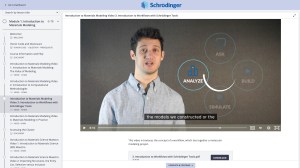
Videos on practical theory break down complex scientific concepts (e.g. Molecular Quantum Mechanics)

Videos on practical theory break down complex scientific concepts (e.g. Molecular Quantum Mechanics)

Access cloud-based computing resources to perform calculations yourself

Access cloud-based computing resources to perform calculations yourself

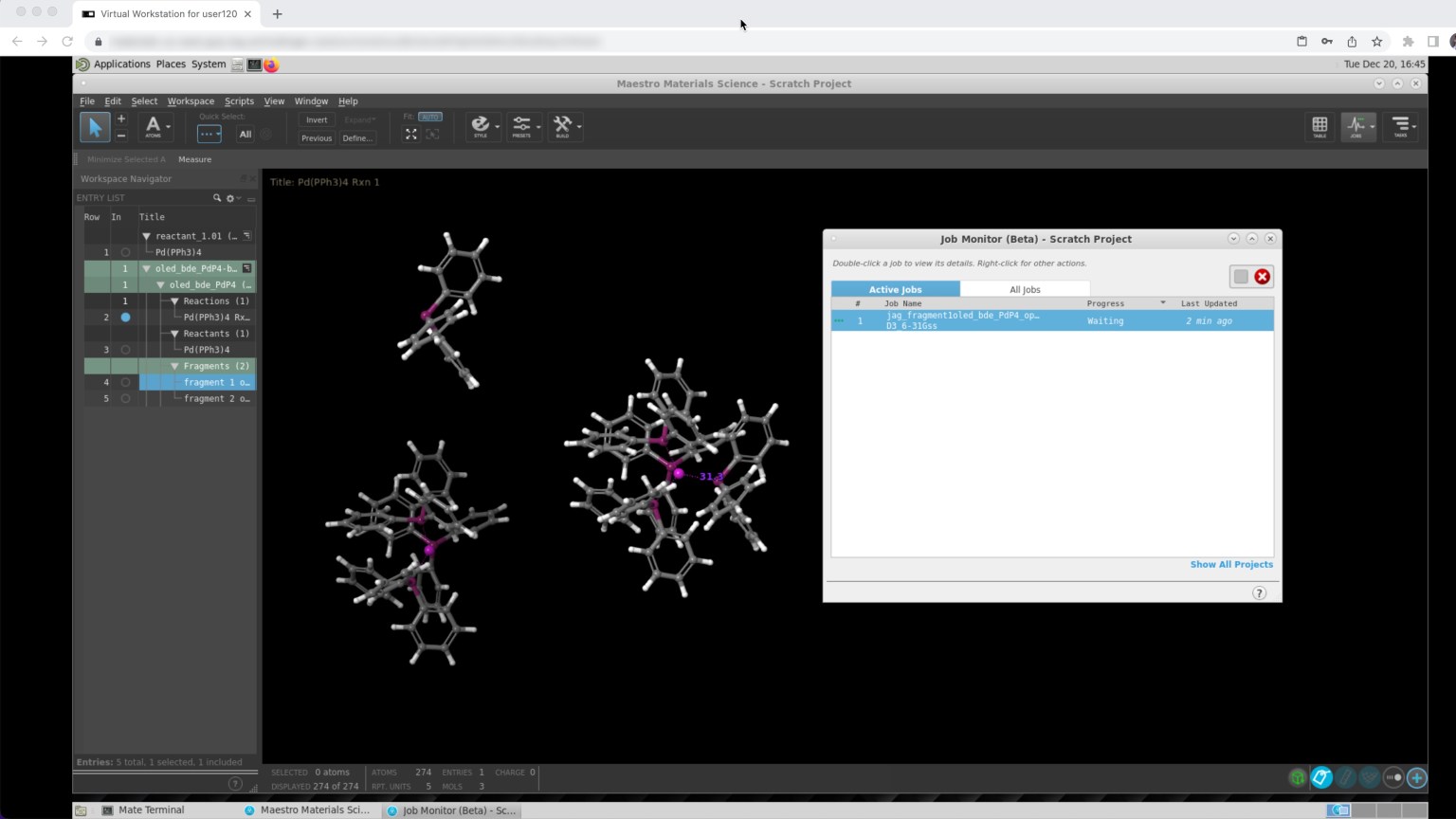
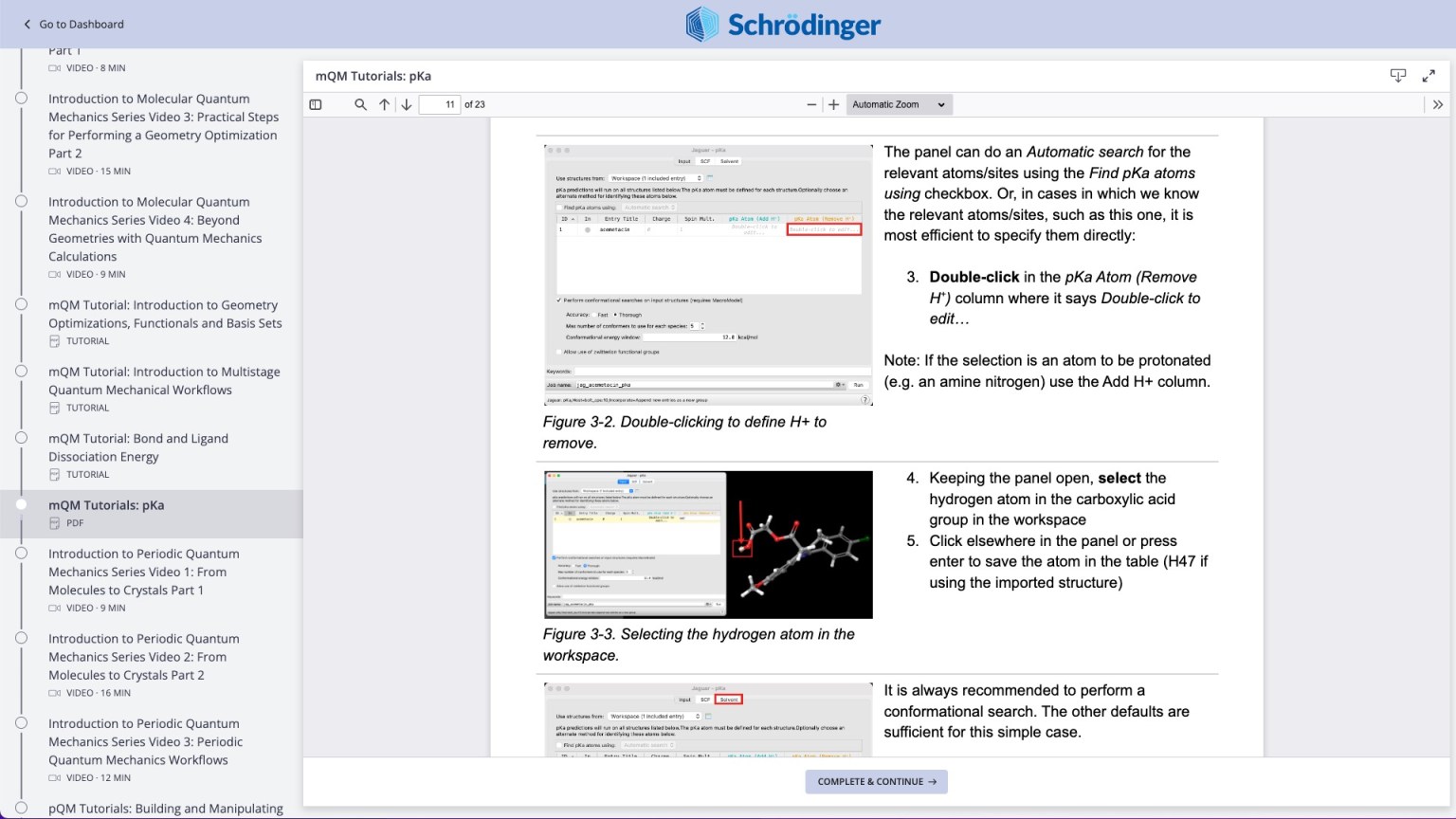
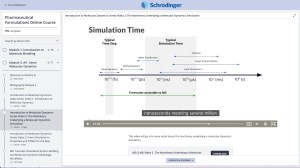
Hands-on step-by-step tutorials (e.g. Pharmaceutical Formulations course, pKa prediction)

Hands-on step-by-step tutorials (e.g. Pharmaceutical Formulations course, pKa prediction)

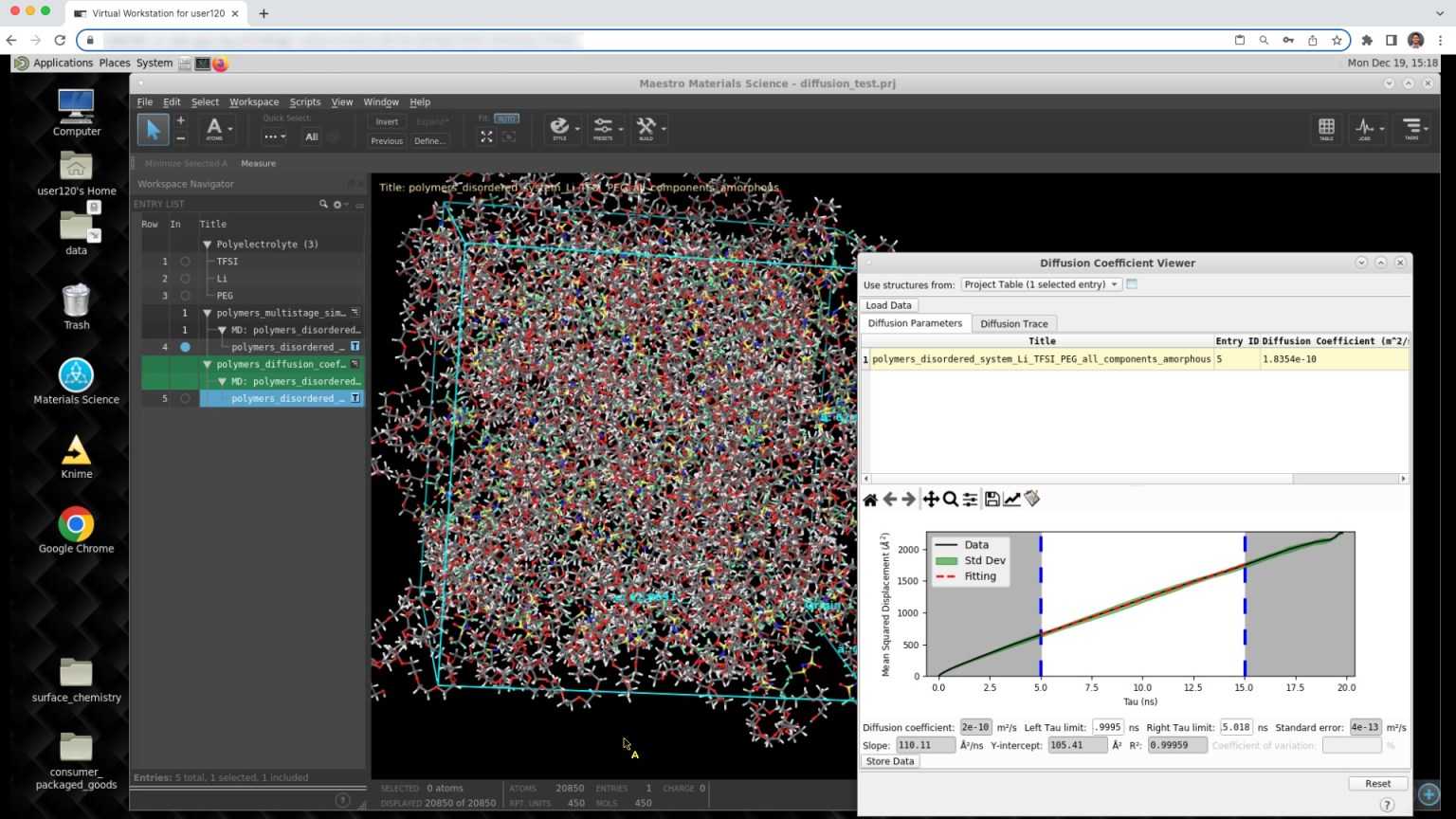
Hands-on modeling in the web-based graphical user interface (e.g. Polymeric Materials course, Diffusion tutorial)

Hands-on modeling in the web-based graphical user interface (e.g. Polymeric Materials course, Diffusion tutorial)

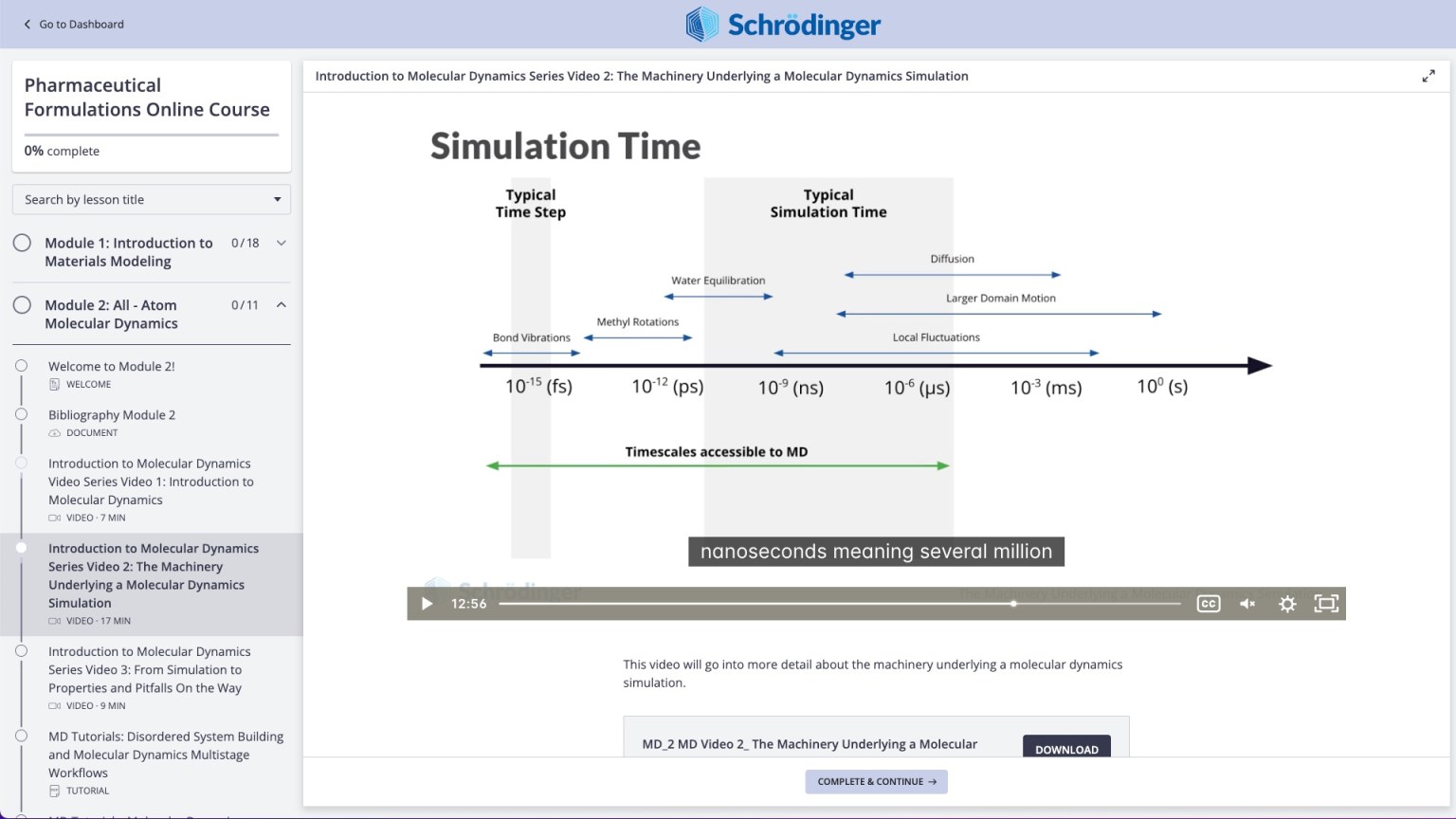
Videos on practical theory break down complex scientific concepts (e.g. Molecular Dynamics)

Videos on practical theory break down complex scientific concepts (e.g. Molecular Dynamics)

On-demand video lessons on materials modeling

On-demand video lessons on materials modeling

Access cloud-based computing resources to perform calculations yourself

Access cloud-based computing resources to perform calculations yourself

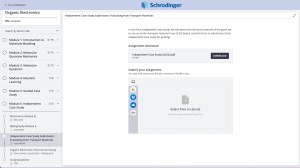
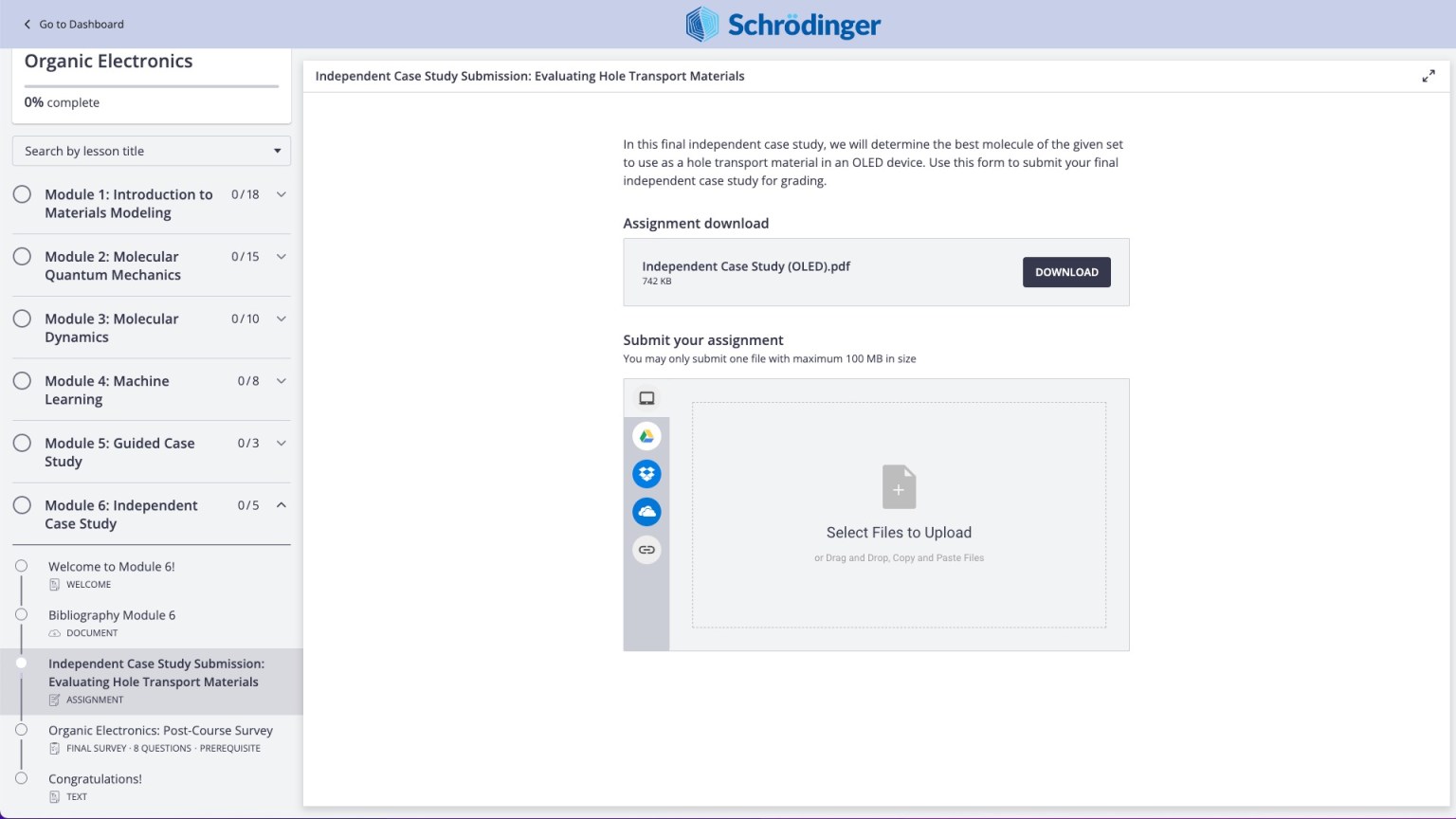
Perform case studies with expert feedback (e.g. Organic Electronic Course, Independent Case Study)

Perform case studies with expert feedback (e.g. Organic Electronic Course, Independent Case Study)

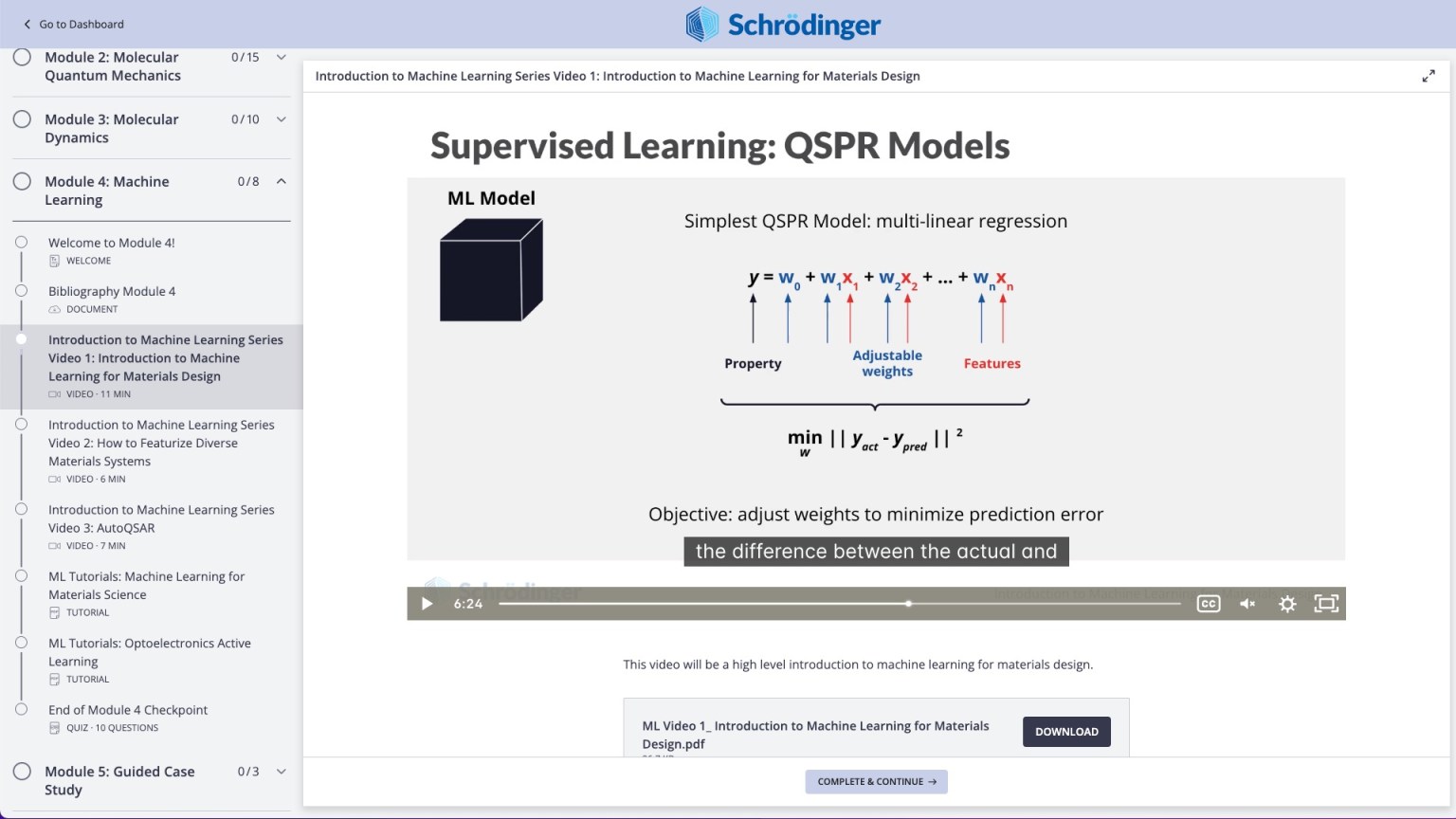
Video on practical theory break down complex scientific concepts (e.g. Machine Learning for Chemistry)

Video on practical theory break down complex scientific concepts (e.g. Machine Learning for Chemistry)

Videos on practical theory break down complex scientific concepts (e.g. Periodic Quantum Mechanics)

Videos on practical theory break down complex scientific concepts (e.g. Periodic Quantum Mechanics)

Videos on practical theory break down complex scientific concepts (e.g. Coarse-Graining)

Videos on practical theory break down complex scientific concepts (e.g. Coarse-Graining)

Self-paced video lessons on materials modeling
Videos on practical theory break down complex scientific concepts (e.g. Molecular Quantum Mechanics)
Access cloud-based computing resources to perform calculations yourself
Hands-on step-by-step tutorials (e.g. Pharmaceutical Formulations course, pKa prediction)
Hands-on modeling in the web-based graphical user interface (e.g. Polymeric Materials course, Diffusion tutorial)
Videos on practical theory break down complex scientific concepts (e.g. Molecular Dynamics)
On-demand video lessons on materials modeling
Access cloud-based computing resources to perform calculations yourself
Perform case studies with expert feedback (e.g. Organic Electronic Course, Independent Case Study)
Video on practical theory break down complex scientific concepts (e.g. Machine Learning for Chemistry)
Videos on practical theory break down complex scientific concepts (e.g. Periodic Quantum Mechanics)
Videos on practical theory break down complex scientific concepts (e.g. Coarse-Graining)

Need help obtaining funding for a Schrödinger Online Course?

We proudly support the next generation of scientists and are committed to providing opportunities to those with limited resources. Learn about your funding options for our online certification courses as a student, post-doc, or industry scientist and enroll today!

What our alumni say

“Clear instructions with a well-designed interface allowed me to run some of my own first molecular dynamics simulations. The information from the course felt much more secure than the information from YouTube because I knew it was developed by experts”
Graduate Student
“The course let me talk confidentially about molecular modeling and what it can do. For me, this was a nice experience which left me with many ideas for applying molecular modeling in the research area of our department, not only for me but also for my colleagues.”
Graduate Student
“As always, the course is very well designed. Formulation is quite outside my comfort zone in terms of theory and modeling but this course provided me with knowledge of evaluating what modeling can facilitate in the real world. Really great design and education process.”
Senior DirectorTherapeutic Protein Design

Show off your newly acquired skills with a course badge and certificate

When you complete a course with us in molecular modeling and are ready to share what you learned with your colleagues and employers, you can share your certificate and badge on your LinkedIn profile.

Frequently asked questions

How much do the online courses cost?

Pricing varies by each course and by the participant type. For students wishing to take these courses, we offer a student price of $150 for introductory courses, $305 for the Materials Science bundle, and $870 for advanced courses. For commercial participants, the course price is $575 for introductory courses and $1435 for advanced courses and bundles.

When does the course start?

The courses run on sessions, which range from 3-6 week periods during which the course and access to software are available to participants. You can find the course session and start dates on each course page.

What time are the lectures?

Once the course session begins, all lectures are asynchronous and you can view the self-paced videos, tutorials, and assignments at your convenience.

How could I pay for this course?

Interested participants can pay for the course by completing their registration and using the credit card portal for an instant sign up. Please note that a credit card is required as we do not accept debit cards. Additionally, we can provide a purchase order upon request, please email online-learning@schrodinger.com if you are interested in this option. If you have any questions regarding how to pay for the course, please visit our funding options page.

How can I preview the course before registering?
Are there any scholarship opportunities available for students?

Schrödinger is committed to supporting students with limited resources. Schrödinger’s mission is to improve human health and quality of life by transforming the way therapeutics and materials are discovered. Schrödinger proudly supports the next generation of scientists. We have created a scholarship program that is open to full-time students or post-docs to students who can demonstrate financial need, and have a statement of support from the academic advisor. Please complete the application form if you qualify for our scholarship program!

Will material still be available after a course ends?

While access to the software will end when the course closes, some of the material within the course (slides, papers, and tutorials) are available for download so that you can refer back to it after the course. Other materials, such as videos, quizzes, and access to the software, will only be available for the duration of the course.

Do I need access to the software to be able to do the course? Do I have to purchase the software separately?

For the duration of the course, you will have access to a web-based version of Maestro, Bioluminate, Materials Science Maestro and/or LiveDesign (depending on the course). You do not have to separately purchase access to any software. While access to the software will end when the course closes, some of the material within the course (slides, papers, and tutorials) are available for download so that you can refer back to it after the course. Other materials, such as videos, quizzes, and access to the software, will only be available for the duration of the course. Please note that Schrödinger software is only to be used for course-related purposes.

Related Courses

Molecular modeling for materials science applications: Polymeric materials course Materials Science Materials Science
Polymeric materials

All-atom molecular dynamics and machine learning approaches for studying polymeric materials and their properties under various conditions

Molecular modeling for materials science applications: course bundle Materials Science Materials Science
Course bundle

Access all materials science courses with a single, discounted registration

Molecular Modeling for Materials Science: Pharmaceutical Formulations Materials Science Materials Science
Pharmaceutical formulations

Molecular and periodic quantum mechanics, all atom molecular dynamics, and coarse-grained approaches for studying active pharmaceutical ingredients and their formulations

Supporting Associations

nanoHUB

Visualizing science with PyMOL 3

aspirin molecule background image for PyMOL course

Visualizing science with PyMOL 3

Details
Available Languages
Chinese, English, Japanese, Korean
Duration
Up to 15 hours over 3 weeks
Level
Introductory
Cost
This course is free for anyone with a working PyMOL 3 installation and a valid license
Course Timeframe
Self guided over three weeks
When registering for the course you will select the start date for your three-week course session. Once your session begins you will have asynchronous access to the course content so you can complete the hands-on tutorials, checkpoints, and the movie-creation assignment when best suits your schedule within the three-week period.

Overview

Help bring your biochemistry to life and learn how to unlock the power of movie making in PyMOL with our Visualizing Science with PyMOL 3 Online Certification Course.

In our Visualizing Science with PyMOL 3 Schrödinger Online Course you will be on track to learn how to navigate the updated PyMOL 3 molecular visualization system, create high quality images and captivating movies, and even bring your science from the Schrödinger platform directly into PyMOL 3.
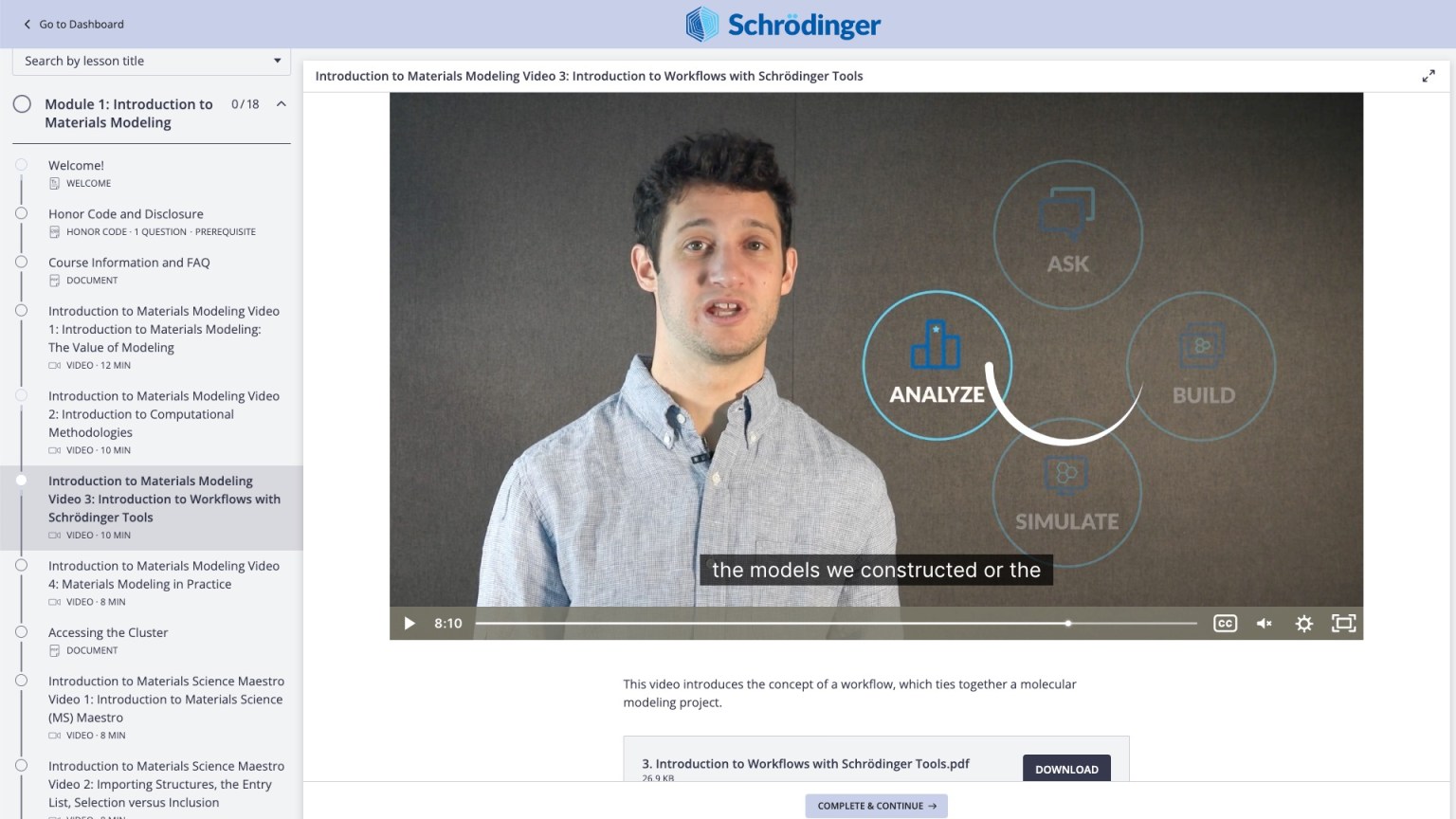
This self-guided 3-week course is designed to introduce both new and experienced PyMOL users to PyMOL 3.

Requirements
This course requires that you use your own PyMOL 3 installation and that you have a valid license.

Click here for PyMOL 3 installation and licensing.
 

Recommendations
  • For the best hands-on experience a three-button mouse and a large or additional monitor are recommended. This will make it easier for you to watch the course video tutorials while following along using your own PyMOL 3 installation.
  • An understanding of chemical and macromolecule structure–such as DNA structure, amino acid structure, and protein structure–and some knowledge of chemical bonds and reactions will be beneficial, but not essential.
Certification
  • A certificate signed by the Schrödinger course lead to add to your CV or resume
  • A badge that can be posted to social media, such as LinkedIn
background pattern

What you will learn

Learn the basics of navigating the PyMOL 3 interface

Introducing PyMOL 3 for both new and experienced PyMOL users: from importing structures and saving session files through to creating and interacting with selections and objects, customizing presets, and ray tracing publication-worthy images

Create quick and easy scenes-based movies in PyMOL 3

Bring results from the Schrodinger suite directly into PyMOL to communicate your findings visually. Learn how to save workspace views and interpolate between them to tell captivating scientific stories in just a few clicks

Get hands-on with advanced movie making features

Transform structural objects, get creative with camera views, and alter style settings with multiple tracks on the new PyMOL 3 Timeline. Create engaging, motion-driven movies by combining dynamic camera programs and multi-state objects, such as NMR structures and molecular dynamics (MD) trajectories

Use course workflows to tell a captivating visual scientific story of your own

Apply your PyMOL 3 skills and course best practices to communicate your science in a creative movie making assignment using a structure and stylings of your choosing

Modules

Module 1
1 Hours

Introduction to the visualizing science with PyMOL 3 course

Video
Video
  • Course scope certification and honor code
  • Introducing PyMOL 3
Assignment
Guidance
  • PyMOL 3 and Maestro installation and licensing
  • Course help and frequently asked questions
End checkpoint
Honor code agreement and checkpoint
Module 2
5 Hours

The basics of navigating the PyMOL 3 interface

Video Tutorial
Video tutorial
  • Getting started with a PyMOL 3 session
  • Defining and styling objects and selections
  • Inspecting structures for scientific storytelling
  • Binding pocket selections, interactions, and labeling
  • Creating and editing presets
  • Saving views, images, and ray tracing
End checkpoint
End of module checkpoint
Module 3
3 Hours

Creating quick and easy movies in PyMOL 3

Video Tutorial
Video tutorials
  • Creating scenes in Maestro to tell a scientific story
  • Sending scenes from Maestro to PyMOL 3 to create a movie
  • Saving scenes in PyMOL 3 and adding them to the timeline to create a movie
End checkpoint
End of module checkpoint
Module 4
6 Hours

Advanced movie creation in PyMOL 3

Video Tutorial
Video tutorials
  • Transforming objects with the gizmo and saving camera views
  • Timeline programs and transparency subtracks
  • Creating multi-state movies
  • Making a movie using molecular dynamics trajectories
Course completion
Certification

Need help obtaining funding for a Schrödinger Online Course?

We proudly support the next generation of scientists and are committed to providing opportunities to those with limited resources. Learn about your funding options for our online certification courses as a student, post-doc, or industry scientist and enroll today!

What our alumni say

“Visualizing Science with PyMOL 3 had very engaging course work that I found enjoyable and the modules were very easy to follow and informative about the new additions in PyMOL 3.”
Joshua FernandezStudent at New York City College of Technology
“The course has been helpful to me, not only in developing my molecular visualization skills with PyMOL 3 but also in introducing me to additional tools that I can leverage in my research. The quality of the output videos and images produced by PyMOL 3 is impressive, hence I will be using PyMOL 3 regularly for my work.”
Anh-Min TranPostdoctoral Researcher, BOKU Wien
“Excellent crash course on movie making that really can benefit both PyMOL beginners and experts.”
Reilly Osadchey BrownGraduate Student, Boston University
“During the course, I noticed significant advancements in PyMOL 3. The new ‘Scenes’ and ‘Timeline’ tabs make it much easier to create high-quality images and videos.”
Haci Aslan Onur İşcilStudent at Akdeniz University
“The course is very useful. I have learnt so many options in PyMOL and how to make movies using MD trajectories”
Sindhu ThangarajSenior Research Scientist, Jubilant Biosys

Show off your newly acquired skills with a course badge and certificate

When you complete a course with us in molecular modeling and are ready to share what you learned with your colleagues and employers, you can share your certificate and badge on your LinkedIn profile.

Frequently asked questions

How much does the PyMOL online course cost?

The course is free for PyMOL license holders. You are required to have your own PyMOL 3 installation and license in order to take this course, complete the assignment, and receive a certificate.
How do I install PyMOL 3?

See instructions here:

Why do I need a PyMOL 3 license and how can I get one?

PyMOL is a user-sponsored molecular visualization system with an open-source foundation, and is maintained and distributed by Schrödinger. It is a commercial product (often referred to as Incentive PyMOL), but Schrödinger makes most of the PyMOL source code freely available under a permissive license (known as Open Source PyMOL).
The open source project is maintained by Schrödinger and is ultimately funded by everyone who purchases a PyMOL license. By becoming a sponsor, subscribers have access to software upgrades for the duration of the subscription term, technical support in English, and access to official online documentation. PyMOL 3 has been recently developed and is the newest release, so many of its new features are only accessible to Incentive subscribers for the time being. For example, the Timeline (used for movie making) in PyMOL 3 will only function if a valid license is detected. To become a sponsor and obtain your Incentive PyMOL license:
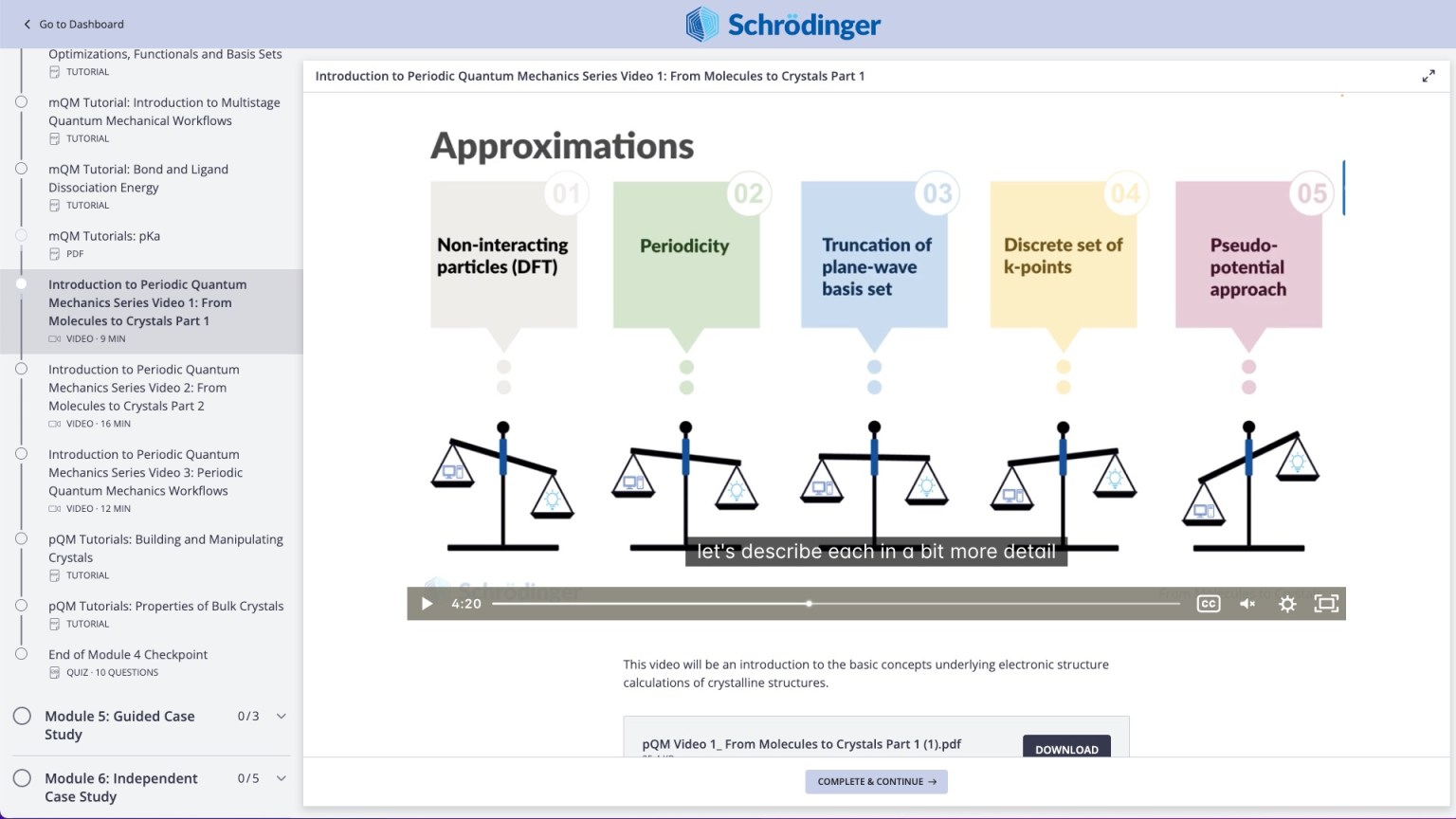
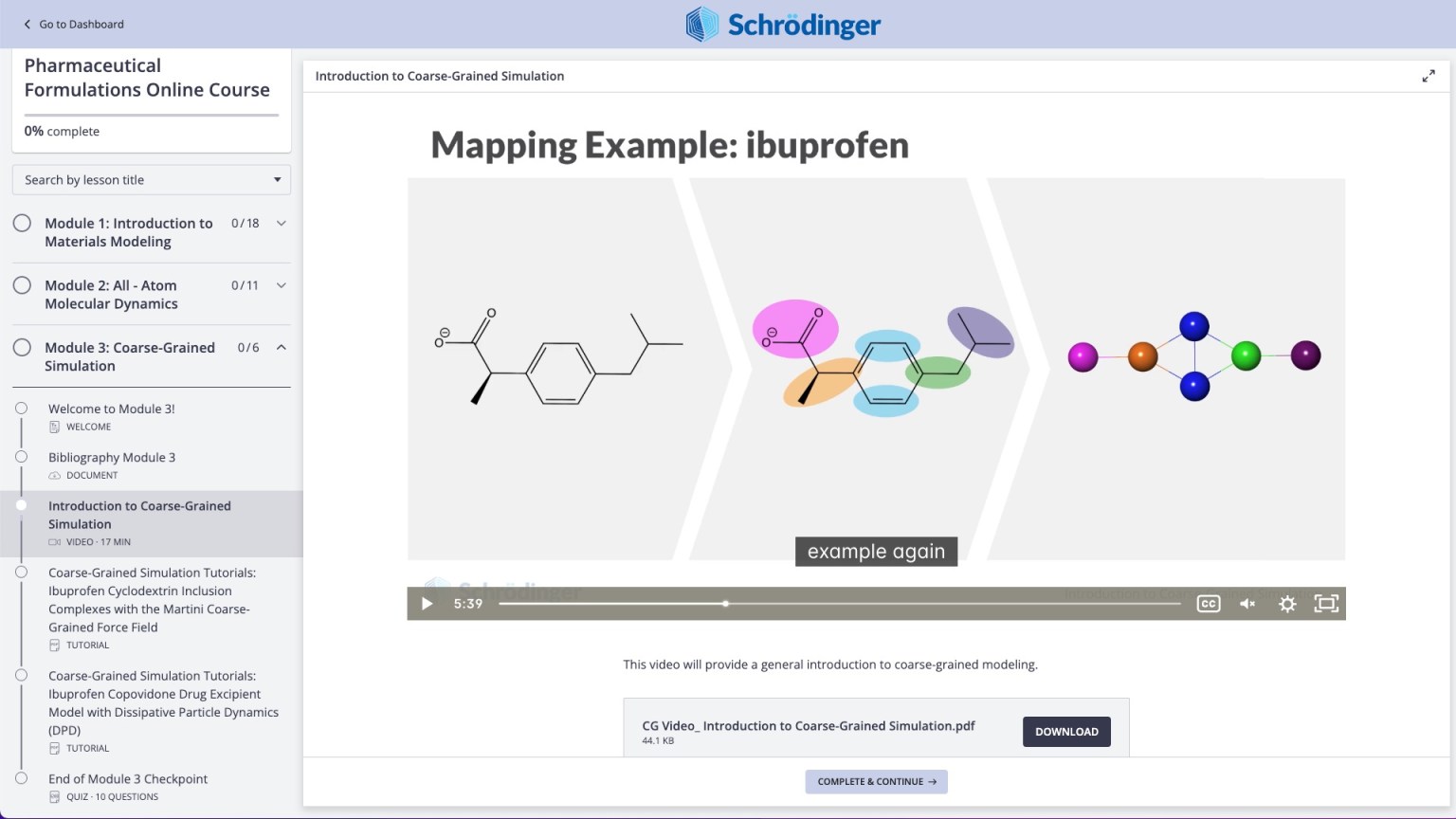
How do I install a PyMOL 3 license?

Download the license file. Save it on your workstation, and then navigate to it when PyMOL prompts you for a license. Follow the guidance here for more information:

What should I do if my Incentive PyMOL license has expired?

To become a sponsor and obtain your Incentive PyMOL 3 license for commercial or site-wide license renewals, please reach out to sales@schrodinger.com.

How much scientific knowledge do I need to take this course?

This course focuses on visualizing science. An understanding of chemical and macromolecule structure, such as DNA structure, amino acid structure and protein structure, and some knowledge of chemical bonds and reactions, and electrostatic interactions will be beneficial, but the focus is how to use PyMOL 3. To learn more about the background science of many of the molecules, targets, and workflows, check out our other Schrödinger Online Certification course offerings for Life Science courses, and Materials Science courses. We encourage users to do their science with the Schrödinger platform, and show the findings to the world using PyMOL.

Why should I take this course?

This course is designed to enable both new and existing PyMOL users to gain hands-on experience with using PyMOL 3 for scientific visualization and movie making.

The benefit of taking this course via our course platform is that you will have access to: structured learning material, video tutorials, input files and example PyMOL session files, interactive checkpoint quizzes, and a final video creation assignment that a Schrödinger Scientist will review. Completion of all course components will enable you to earn a Visualizing Science with PyMOL 3 course certificate and virtual badge that can be displayed on your LinkedIn and Social Media profiles.

Schrödinger Online Course certifications and virtual badges are frequently used by our course alumni to demonstrate experience with and understanding of Schrödinger software and best practices. You can learn more about our online courses and see a selection of course participant testimonials below. Show off your new skills by listing your course certification on your resume, CV, or professional development achievements!

How do I earn a course certificate?

You will need to complete all course lessons, checkpoints and assignments (completion percentage: 100%) in order to be eligible for a course certificate and virtual badge. Checkpoint quizzes are autograded and you can retake these as many times as you like. The movie making assignment at the end of module 4 requires you to create a movie that tells a scientific story, using a structure or results of your choice, in PyMOL 3. Your uploaded movie will be manually reviewed by a Schrödinger Scientist, and once approved, this assignment will be “complete” and you will be eligible for a course certificate.

How long does my course enrollment last?

Your enrollment in this course, meaning your access to the learning material through the courses.schrodinger.com platform, will be active for three weeks from the date you received your registration confirmation email and credentials for the course platform. Although the course should take no longer than 15 hours to complete, please plan your time accordingly, and be sure to work through and revisit any material that you wish to review before your enrollment expires. If you need more time there will be an option to request an extension within the course platform.

Related courses

Introduction to Molecular Modeling for Drug Discovery Life Science Life Science
Introduction to molecular modeling in drug discovery

Protein preparation, ligand docking, collaborative design, and other fundamentals of small molecule drug discovery with Maestro and LiveDesign

Introduction to Computational Antibody Engineering Course Life Science Life Science
Introduction to computational antibody engineering

Structure-based workflows for assessing and improving the developability, stability, affinity, and ‘humanness’ of antibody therapeutics with BioLuminate

Molecular Modeling for Materials Science: Pharmaceutical Formulations Life Science Life Science
Pharmaceutical formulations

Molecular and periodic quantum mechanics, all atom molecular dynamics, and coarse-grained approaches for studying active pharmaceutical ingredients and their formulations

Visualizing science with PyMOL 3

aspirin molecule background image for PyMOL course

Visualizing science with PyMOL 3

Details
Available Languages
Chinese, English, Japanese, Korean
Duration
Up to 15 hours over 3 weeks
Level
Introductory
Cost
This course is free for anyone with a working PyMOL 3 installation and a valid license
Course Timeframe
Self guided over three weeks
When registering for the course you will select the start date for your three-week course session. Once your session begins you will have asynchronous access to the course content so you can complete the hands-on tutorials, checkpoints, and the movie-creation assignment when best suits your schedule within the three-week period.

Overview

Help bring your biochemistry to life and learn how to unlock the power of movie making in PyMOL with our Visualizing Science with PyMOL 3 Online Certification Course.

In our Visualizing Science with PyMOL 3 Schrödinger Online Course you will be on track to learn how to navigate the updated PyMOL 3 molecular visualization system, create high quality images and captivating movies, and even bring your science from the Schrödinger platform directly into PyMOL 3.

This self-guided 3-week course is designed to introduce both new and experienced PyMOL users to PyMOL 3.

Requirements
This course requires that you use your own PyMOL 3 installation and that you have a valid license.

Click here for PyMOL 3 installation and licensing.

Recommendations
  • For the best hands-on experience a three-button mouse and a large or additional monitor are recommended. This will make it easier for you to watch the course video tutorials while following along using your own PyMOL 3 installation.
  • An understanding of chemical and macromolecule structure–such as DNA structure, amino acid structure, and protein structure–and some knowledge of chemical bonds and reactions will be beneficial, but not essential.
Certification
  • A certificate signed by the Schrödinger course lead to add to your CV or resume
  • A badge that can be posted to social media, such as LinkedIn
background pattern

What you will learn

Learn the basics of navigating the PyMOL 3 interface

Introducing PyMOL 3 for both new and experienced PyMOL users: from importing structures and saving session files through to creating and interacting with selections and objects, customizing presets, and ray tracing publication-worthy images

Create quick and easy scenes-based movies in PyMOL 3

Bring results from the Schrodinger suite directly into PyMOL to communicate your findings visually. Learn how to save workspace views and interpolate between them to tell captivating scientific stories in just a few clicks

Get hands-on with advanced movie making features

Transform structural objects, get creative with camera views, and alter style settings with multiple tracks on the new PyMOL 3 Timeline. Create engaging, motion-driven movies by combining dynamic camera programs and multi-state objects, such as NMR structures and molecular dynamics (MD) trajectories

Use course workflows to tell a captivating visual scientific story of your own

Apply your PyMOL 3 skills and course best practices to communicate your science in a creative movie making assignment using a structure and stylings of your choosing

Modules

Module 1
1 Hours

Introduction to the visualizing science with PyMOL 3 course

Video
Video
  • Course scope certification and honor code
  • Introducing PyMOL 3
Assignment
Guidance
  • PyMOL 3 and Maestro installation and licensing
  • Course help and frequently asked questions
End checkpoint
Honor code agreement and checkpoint
Module 2
5 Hours

The basics of navigating the PyMOL 3 interface

Video Tutorial
Video tutorial
  • Getting started with a PyMOL 3 session
  • Defining and styling objects and selections
  • Inspecting structures for scientific storytelling
  • Binding pocket selections, interactions, and labeling
  • Creating and editing presets
  • Saving views, images, and ray tracing
End checkpoint
End of module checkpoint
Module 3
3 Hours

Creating quick and easy movies in PyMOL 3

Video Tutorial
Video tutorials
  • Creating scenes in Maestro to tell a scientific story
  • Sending scenes from Maestro to PyMOL 3 to create a movie
  • Saving scenes in PyMOL 3 and adding them to the timeline to create a movie
End checkpoint
End of module checkpoint
Module 4
6 Hours

Advanced movie creation in PyMOL 3

Video Tutorial
Video tutorials
  • Transforming objects with the gizmo and saving camera views
  • Timeline programs and transparency subtracks
  • Creating multi-state movies
  • Making a movie using molecular dynamics trajectories
Course completion
Certification

Need help obtaining funding for a Schrödinger Online Course?

We proudly support the next generation of scientists and are committed to providing opportunities to those with limited resources. Learn about your funding options for our online certification courses as a student, post-doc, or industry scientist and enroll today!

What our alumni say

“Visualizing Science with PyMOL 3 had very engaging course work that I found enjoyable and the modules were very easy to follow and informative about the new additions in PyMOL 3.”
Joshua FernandezStudent at New York City College of Technology
“The course has been helpful to me, not only in developing my molecular visualization skills with PyMOL 3 but also in introducing me to additional tools that I can leverage in my research. The quality of the output videos and images produced by PyMOL 3 is impressive, hence I will be using PyMOL 3 regularly for my work.”
Anh-Min TranPostdoctoral Researcher, BOKU Wien
“Excellent crash course on movie making that really can benefit both PyMOL beginners and experts.”
Reilly Osadchey BrownGraduate Student, Boston University
“During the course, I noticed significant advancements in PyMOL 3. The new ‘Scenes’ and ‘Timeline’ tabs make it much easier to create high-quality images and videos.”
Haci Aslan Onur İşcilStudent at Akdeniz University
“The course is very useful. I have learnt so many options in PyMOL and how to make movies using MD trajectories”
Sindhu ThangarajSenior Research Scientist, Jubilant Biosys

Show off your newly acquired skills with a course badge and certificate

When you complete a course with us in molecular modeling and are ready to share what you learned with your colleagues and employers, you can share your certificate and badge on your LinkedIn profile.

Frequently asked questions

How much does the PyMOL online course cost?

The course is free for PyMOL license holders. You are required to have your own PyMOL 3 installation and license in order to take this course, complete the assignment, and receive a certificate.

How do I install PyMOL 3?

See instructions here:

Why do I need a PyMOL 3 license and how can I get one?

PyMOL is a user-sponsored molecular visualization system with an open-source foundation, and is maintained and distributed by Schrödinger. It is a commercial product (often referred to as Incentive PyMOL), but Schrödinger makes most of the PyMOL source code freely available under a permissive license (known as Open Source PyMOL).

The open source project is maintained by Schrödinger and is ultimately funded by everyone who purchases a PyMOL license. By becoming a sponsor, subscribers have access to software upgrades for the duration of the subscription term, technical support in English, and access to official online documentation. PyMOL 3 has been recently developed and is the newest release, so many of its new features are only accessible to Incentive subscribers for the time being. For example, the Timeline (used for movie making) in PyMOL 3 will only function if a valid license is detected. To become a sponsor and obtain your Incentive PyMOL license:

How do I install a PyMOL 3 license?

Download the license file. Save it on your workstation, and then navigate to it when PyMOL prompts you for a license. Follow the guidance here for more information:

What should I do if my Incentive PyMOL license has expired?

To become a sponsor and obtain your Incentive PyMOL 3 license for commercial or site-wide license renewals, please reach out to sales@schrodinger.com.

How much scientific knowledge do I need to take this course?

This course focuses on visualizing science. An understanding of chemical and macromolecule structure, such as DNA structure, amino acid structure and protein structure, and some knowledge of chemical bonds and reactions, and electrostatic interactions will be beneficial, but the focus is how to use PyMOL 3. To learn more about the background science of many of the molecules, targets, and workflows, check out our other Schrödinger Online Certification course offerings for Life Science courses, and Materials Science courses. We encourage users to do their science with the Schrödinger platform, and show the findings to the world using PyMOL.

Why should I take this course?

This course is designed to enable both new and existing PyMOL users to gain hands-on experience with using PyMOL 3 for scientific visualization and movie making.

The benefit of taking this course via our course platform is that you will have access to: structured learning material, video tutorials, input files and example PyMOL session files, interactive checkpoint quizzes, and a final video creation assignment that a Schrödinger Scientist will review. Completion of all course components will enable you to earn a Visualizing Science with PyMOL 3 course certificate and virtual badge that can be displayed on your LinkedIn and Social Media profiles.

Schrödinger Online Course certifications and virtual badges are frequently used by our course alumni to demonstrate experience with and understanding of Schrödinger software and best practices. You can learn more about our online courses and see a selection of course participant testimonials below. Show off your new skills by listing your course certification on your resume, CV, or professional development achievements!

How do I earn a course certificate?

You will need to complete all course lessons, checkpoints and assignments (completion percentage: 100%) in order to be eligible for a course certificate and virtual badge. Checkpoint quizzes are autograded and you can retake these as many times as you like. The movie making assignment at the end of module 4 requires you to create a movie that tells a scientific story, using a structure or results of your choice, in PyMOL 3. Your uploaded movie will be manually reviewed by a Schrödinger Scientist, and once approved, this assignment will be “complete” and you will be eligible for a course certificate.

How long does my course enrollment last?

Your enrollment in this course, meaning your access to the learning material through the courses.schrodinger.com platform, will be active for three weeks from the date you received your registration confirmation email and credentials for the course platform. Although the course should take no longer than 15 hours to complete, please plan your time accordingly, and be sure to work through and revisit any material that you wish to review before your enrollment expires. If you need more time there will be an option to request an extension within the course platform.

Related courses

Introduction to Molecular Modeling for Drug Discovery Life Science Life Science
Introduction to molecular modeling in drug discovery

Protein preparation, ligand docking, collaborative design, and other fundamentals of small molecule drug discovery with Maestro and LiveDesign

Introduction to Computational Antibody Engineering Course Life Science Life Science
Introduction to computational antibody engineering

Structure-based workflows for assessing and improving the developability, stability, affinity, and ‘humanness’ of antibody therapeutics with BioLuminate

Molecular Modeling for Materials Science: Pharmaceutical Formulations Life Science Life Science
Pharmaceutical formulations

Molecular and periodic quantum mechanics, all atom molecular dynamics, and coarse-grained approaches for studying active pharmaceutical ingredients and their formulations

Pharmaceutical formulations

Pharmaceutical formulations

Pharmaceutical formulations


Molecular and periodic quantum mechanics, all- atom molecular dynamics, and coarse-grained approaches for studying active pharmaceutical ingredients and their formulations

Details
Available Languages
Chinese, English, Japanese, Korean
Duration
6 weeks / ~25 hours to complete
Level
Introductory
Cost
$600 for non-student users
$160 for student / post-doc
Course Timeframe
When registering for the course, you will be able to choose your preferred start and end date. Within those dates, you will have asynchronous access to the course to work on your preferred schedule

Overview

Computational molecular modeling tools have proven effective in materials science research and development. Chemists, physicists and engineers working in materials science will increasingly encounter molecular modeling throughout their careers, making it critical to have a foundational understanding of the cutting edge tools and methods. These courses are ideal for those who wish to develop professionally and expand their CV by earning certification and a badge.

These computational chemistry courses offer an effective and efficient approach to learn practical computational chemistry for materials science:

  • Work hands-on with Schrödinger’s industry-leading Materials Science Maestro software
  • Jump start your research program by learning methods that can be directly applied to ongoing projects
  • Learn topics ranging from density functional theory (DFT) to molecular dynamics to machine learning for materials design
  • Perform a completely independent case study to demonstrate mastery of the course content
  • Benefit from review and feedback from Schrödinger Education Team experts for course assignments and course-related queries
  • Work on the course materials on your own schedule whenever convenient for you


This course comes with access to a web-based version of Schrödinger software with the necessary licenses and compute resources for the course:

Requirements
  • A computer with reliable high speed internet access (8 Mbps or better)
  • A mouse and/or external monitor (recommended but not required)
  • Working knowledge of general chemistry
Certification
  • A certificate signed by the Schrödinger course lead
  • A badge that can be posted to social media, such as LinkedIn
background pattern

What you will learn

MS Maestro interface

Learn how to use an industry-leading interface for materials science modeling. No coding or scripting required to run modeling workflows

Molecular and periodic quantum mechanics

Learn to apply molecular and periodic density functional theory (DFT) for automated property prediction for amorphous and crystalline active pharmaceutical ingredients

Molecular dynamics

Learn to leverage all-atom MD simulations for simulating properties of complete formulations including miscibility and hygroscopicity

Coarse-grained modeling

Access larger length scale and longer time scales by employing coarse-grained methods to study formulations

Modules

Module 1
2 Hours

Introduction to materials modeling

Video
Video

Introduction to Materials modeling & this online course

Video Tutorial
Video tutorial

Introduction to materials science (MS) Maestro

Video
Video

Modeling for pharmaceutical formulations

End checkpoint
Honor code agreement and checkpoint
Module 2
6 Hours + Compute Time

Molecular & periodic quantum mechanics

Video
Video

Introduction to quantum mechanics (mQM & pQM)

Tutorial
Tutorials
  • Quantum mechanical workflows and properties
  • API degradation
  • pKa predictions
  • Spectroscopy (molecular)
  • Building and Manipulating Crystals
  • Properties of Bulk Molecular Crystals
  • Spectroscopy (solid-state)
End checkpoint
End of module checkpoint
Module 3
5 Hours + Compute Time

All-atom molecular dynamics

Video
Video

Introduction to molecular dynamics (MD)

Tutorial
Tutorials
  • Disordered system building and MD multistage workflows
  • Molecular dynamics simulations for API (active pharmaceutical ingredient) miscibility
  • Glass transition temperature for APIs
  • Hygroscopicity
  • Crystal morphology
End checkpoint
End of module checkpoint
Module 4
5 Hours + Compute Time

Coarse-grained simulation

Video
Video

Introduction to coarse-graining (CG)

Tutorial
Tutorials
  • Ibuprofen cyclodextrin inclusion complexes with the martini coarse-grained force field
  • Ibuprofen copovidone drug excipient model with dissipative particle dynamics (DPD)
End checkpoint
End of module checkpoint
Module 5
2 Hours + Compute Time

Machine learning

Video
Video

Introduction to machine learning (ML)

Tutorial
Tutorials
  • Machine learning for materials science
  • Machine learning for formulations
End checkpoint
End of module checkpoint
Module 6
2 Hours + Compute Time

Guided case study

Tutorial
Case studies
  • Nanoemulsions with automated DPD parameterization
  • Building pH dependent systems of Diclofenac
End checkpoint
End of module checkpoint
Module 7
4 hours + Compute Time

Independent case study

Assignment
Assignment

API property prediction

Course completion
Course completion and certification
Self-paced video lessons on materials modeling

Self-paced video lessons on materials modeling

Videos on practical theory break down complex scientific concepts (e.g. Molecular Quantum Mechanics)

Videos on practical theory break down complex scientific concepts (e.g. Molecular Quantum Mechanics)

Access cloud-based computing resources to perform calculations yourself

Access cloud-based computing resources to perform calculations yourself

Hands-on step-by-step tutorials (e.g. Pharmaceutical Formulations course, pKa prediction)

Hands-on step-by-step tutorials (e.g. Pharmaceutical Formulations course, pKa prediction)

Hands-on modeling in the web-based graphical user interface (e.g. Polymeric Materials course, Diffusion tutorial)

Hands-on modeling in the web-based graphical user interface (e.g. Polymeric Materials course, Diffusion tutorial)

Videos on practical theory break down complex scientific concepts (e.g. Molecular Dynamics)

Videos on practical theory break down complex scientific concepts (e.g. Molecular Dynamics)

On-demand video lessons on materials modeling

On-demand video lessons on materials modeling

Access cloud-based computing resources to perform calculations yourself

Access cloud-based computing resources to perform calculations yourself

Perform case studies with expert feedback (e.g. Organic Electronic Course, Independent Case Study)

Perform case studies with expert feedback (e.g. Organic Electronic Course, Independent Case Study)

Video on practical theory break down complex scientific concepts (e.g. Machine Learning for Chemistry)

Video on practical theory break down complex scientific concepts (e.g. Machine Learning for Chemistry)

Videos on practical theory break down complex scientific concepts (e.g. Periodic Quantum Mechanics)

Videos on practical theory break down complex scientific concepts (e.g. Periodic Quantum Mechanics)

Videos on practical theory break down complex scientific concepts (e.g. Coarse-Graining)

Videos on practical theory break down complex scientific concepts (e.g. Coarse-Graining)

Self-paced video lessons on materials modeling
Videos on practical theory break down complex scientific concepts (e.g. Molecular Quantum Mechanics)
Access cloud-based computing resources to perform calculations yourself
Hands-on step-by-step tutorials (e.g. Pharmaceutical Formulations course, pKa prediction)
Hands-on modeling in the web-based graphical user interface (e.g. Polymeric Materials course, Diffusion tutorial)
Videos on practical theory break down complex scientific concepts (e.g. Molecular Dynamics)
On-demand video lessons on materials modeling
Access cloud-based computing resources to perform calculations yourself
Perform case studies with expert feedback (e.g. Organic Electronic Course, Independent Case Study)
Video on practical theory break down complex scientific concepts (e.g. Machine Learning for Chemistry)
Videos on practical theory break down complex scientific concepts (e.g. Periodic Quantum Mechanics)
Videos on practical theory break down complex scientific concepts (e.g. Coarse-Graining)

Need help obtaining funding for a Schrödinger Online Course?

We proudly support the next generation of scientists and are committed to providing opportunities to those with limited resources. Learn about your funding options for our online certification courses as a student, post-doc, or industry scientist and enroll today!

What our alumni say

“Clear instructions with a well-designed interface allowed me to run some of my own first molecular dynamics simulations. The information from the course felt much more secure than the information from YouTube because I knew it was developed by experts”
Graduate Student
“The course let me talk confidentially about molecular modeling and what it can do. For me, this was a nice experience which left me with many ideas for applying molecular modeling in the research area of our department, not only for me but also for my colleagues.”
Graduate Student
“As always, the course is very well designed. Formulation is quite outside my comfort zone in terms of theory and modeling but this course provided me with knowledge of evaluating what modeling can facilitate in the real world. Really great design and education process.”
Senior DirectorTherapeutic Protein Design

Show off your newly acquired skills with a course badge and certificate

When you complete a course with us in molecular modeling and are ready to share what you learned with your colleagues and employers, you can share your certificate and badge on your LinkedIn profile.

Frequently asked questions

How much do the online courses cost?

Pricing varies by each course and by the participant type. For students wishing to take these courses, we offer a student price of $150 for introductory courses, $305 for the Materials Science bundle, and $870 for advanced courses. For commercial participants, the course price is $575 for introductory courses and $1435 for advanced courses and bundles.

When does the course start?

The courses run on sessions, which range from 3-6 week periods during which the course and access to software are available to participants. You can find the course session and start dates on each course page.

What time are the lectures?

Once the course session begins, all lectures are asynchronous and you can view the self-paced videos, tutorials, and assignments at your convenience.

How could I pay for this course?

Interested participants can pay for the course by completing their registration and using the credit card portal for an instant sign up. Please note that a credit card is required as we do not accept debit cards. Additionally, we can provide a purchase order upon request, please email online-learning@schrodinger.com if you are interested in this option. If you have any questions regarding how to pay for the course, please visit our funding options page.

How can I preview the course before registering?
Are there any scholarship opportunities available for students?

Schrödinger is committed to supporting students with limited resources. Schrödinger’s mission is to improve human health and quality of life by transforming the way therapeutics and materials are discovered. Schrödinger proudly supports the next generation of scientists. We have created a scholarship program that is open to full-time students or post-docs to students who can demonstrate financial need, and have a statement of support from the academic advisor. Please complete the application form if you qualify for our scholarship program!

Will material still be available after a course ends?

While access to the software will end when the course closes, some of the material within the course (slides, papers, and tutorials) are available for download so that you can refer back to it after the course. Other materials, such as videos, quizzes, and access to the software, will only be available for the duration of the course.

Do I need access to the software to be able to do the course? Do I have to purchase the software separately?

For the duration of the course, you will have access to a web-based version of Maestro, Bioluminate, Materials Science Maestro and/or LiveDesign (depending on the course). You do not have to separately purchase access to any software. While access to the software will end when the course closes, some of the material within the course (slides, papers, and tutorials) are available for download so that you can refer back to it after the course. Other materials, such as videos, quizzes, and access to the software, will only be available for the duration of the course. Please note that Schrödinger software is only to be used for course-related purposes.

Related Courses

Online certification course: Level-up your skill set in catalysis modeling Materials Science Materials Science
Homogeneous catalysis & reactivity

Molecular quantum mechanics and machine learning approaches for studying reactivity and mechanism at the molecular level

Molecular modeling for materials science applications: course bundle Materials Science Materials Science
Course bundle

Access all materials science courses with a single, discounted registration

Molecular modeling for materials science applications: Polymeric materials course Materials Science Materials Science
Polymeric materials

All-atom molecular dynamics and machine learning approaches for studying polymeric materials and their properties under various conditions

Supporting Associations

nanoHUB

Homogeneous catalysis & reactivity

Catalysis_Hero

Homogeneous catalysis & reactivity


Molecular quantum mechanics and machine learning approaches for studying reactivity and mechanism at the molecular level

Details
Available Languages
Chinese, English, Japanese, Korean
Duration
6 weeks / ~25 hours to complete
Level
Introductory
Cost
$600 for non-student users
$160 for student / post-doc
Course Timeframe
When registering for the course, you will be able to choose your preferred start and end date. Within those dates, you will have asynchronous access to the course to work on your preferred schedule

Overview

Computational molecular modeling tools have proven effective in materials science research and development. Chemists, physicists and engineers working in materials science will increasingly encounter molecular modeling throughout their careers, making it critical to have a foundational understanding of the cutting edge tools and methods. These courses are ideal for those who wish to develop professionally and expand their CV by earning certification and a badge.

These computational chemistry courses offer an effective and efficient approach to learn practical computational chemistry for materials science:

  • Work hands-on with Schrödinger’s industry-leading Materials Science Maestro software
  • Jump start your research program by learning methods that can be directly applied to ongoing projects
  • Learn topics ranging from density functional theory (DFT) to molecular dynamics to machine learning for materials design
  • Perform a completely independent case study to demonstrate mastery of the course content
  • Benefit from review and feedback from Schrödinger Education Team experts for course assignments and course-related queries
  • Work on the course materials on your own schedule whenever convenient for you


This course comes with access to a web-based version of Schrödinger software with the necessary licenses and compute resources for the course:

Requirements
  • A computer with reliable high speed internet access (8 Mbps or better)
  • A mouse and/or external monitor (recommended but not required)
  • Working knowledge of general chemistry
Certification
  • A certificate signed by the Schrödinger course lead
  • A badge that can be posted to social media, such as LinkedIn
background pattern

What you will learn

MS Maestro interface

Learn how to use an industry-leading interface for materials science modeling. No coding or scripting required to run modeling workflows

Density functional theory

Learn to apply DFT for automated property prediction for organic and inorganic molecules

Reaction mechanism elucidation

Learn to leverage quantum mechanical workflows to predict reaction pathways and energetics

Machine learning

Learn to apply machine learning for rapid and accurate property prediction of organic molecules and catalytically active complexes

Modules

Module 1
2 Hours

Introduction to materials modeling

Video
Video

Introduction to materials modeling and this online course

Video Tutorial
Video Tutorial

Introduction to materials science (MS) Maestro

Video
Video

Modeling for Homogeneous Catalysis and Reactivity

End checkpoint
Honor code agreement and checkpoint
Module 2
7 Hours + Compute Time

Molecular quantum mechanics

Video
Video

Introduction to molecular quantum mechanics (mQM)

Tutorial
Tutorials
  • Functionals, basis sets and geometry optimizations
  • R-group enumeration
  • QM multistage workflows
  • Rigid and relaxed coordinate scans
  • Energies of reactions
  • Organometallic complexes
End checkpoint
End of module checkpoint
Module 3
6 Hours + Compute Time

Molecular quantum mechanics

Tutorial
Tutorials
  • Bond and ligand dissociation energy
  • Beta elimination reactions
  • Locating transition states: Part 1
  • Locating transition states: Part 2
  • Reaction workflow for polyethylene insertion
  • Nanoreactor
  • Design of asymmetric catalysts with Automated Reaction Workflow
End checkpoint
End of module checkpoint
Module 4
3 Hours + Compute Time

Machine learning

Video
Video

Introduction to machine learning (ML)

Tutorial
Tutorials
  • Machine learning for materials science
  • Machine learning for homogeneous catalysis
End checkpoint
End of module checkpoint
Module 5
2 Hours + Compute Time

Guided case studies

Tutorial
Case studies
  • Fundamental organometallic reactivity
  • Combining AutoTS and reaction workflow
End checkpoint
End of Module Checkpoint
Module 6
4 Hours + Compute Time

Independent case study

Assignment
Assignment

Predicting regioselectivity of hydroboration

Course completion
Course completion and certification
Self-paced video lessons on materials modeling

Self-paced video lessons on materials modeling

Videos on practical theory break down complex scientific concepts (e.g. Molecular Quantum Mechanics)

Videos on practical theory break down complex scientific concepts (e.g. Molecular Quantum Mechanics)

Access cloud-based computing resources to perform calculations yourself

Access cloud-based computing resources to perform calculations yourself

Hands-on step-by-step tutorials (e.g. Pharmaceutical Formulations course, pKa prediction)

Hands-on step-by-step tutorials (e.g. Pharmaceutical Formulations course, pKa prediction)

Hands-on modeling in the web-based graphical user interface (e.g. Polymeric Materials course, Diffusion tutorial)

Hands-on modeling in the web-based graphical user interface (e.g. Polymeric Materials course, Diffusion tutorial)

Videos on practical theory break down complex scientific concepts (e.g. Molecular Dynamics)

Videos on practical theory break down complex scientific concepts (e.g. Molecular Dynamics)

On-demand video lessons on materials modeling

On-demand video lessons on materials modeling

Access cloud-based computing resources to perform calculations yourself

Access cloud-based computing resources to perform calculations yourself

Perform case studies with expert feedback (e.g. Organic Electronic Course, Independent Case Study)

Perform case studies with expert feedback (e.g. Organic Electronic Course, Independent Case Study)

Video on practical theory break down complex scientific concepts (e.g. Machine Learning for Chemistry)

Video on practical theory break down complex scientific concepts (e.g. Machine Learning for Chemistry)

Videos on practical theory break down complex scientific concepts (e.g. Periodic Quantum Mechanics)

Videos on practical theory break down complex scientific concepts (e.g. Periodic Quantum Mechanics)

Videos on practical theory break down complex scientific concepts (e.g. Coarse-Graining)

Videos on practical theory break down complex scientific concepts (e.g. Coarse-Graining)

Self-paced video lessons on materials modeling
Videos on practical theory break down complex scientific concepts (e.g. Molecular Quantum Mechanics)
Access cloud-based computing resources to perform calculations yourself
Hands-on step-by-step tutorials (e.g. Pharmaceutical Formulations course, pKa prediction)
Hands-on modeling in the web-based graphical user interface (e.g. Polymeric Materials course, Diffusion tutorial)
Videos on practical theory break down complex scientific concepts (e.g. Molecular Dynamics)
On-demand video lessons on materials modeling
Access cloud-based computing resources to perform calculations yourself
Perform case studies with expert feedback (e.g. Organic Electronic Course, Independent Case Study)
Video on practical theory break down complex scientific concepts (e.g. Machine Learning for Chemistry)
Videos on practical theory break down complex scientific concepts (e.g. Periodic Quantum Mechanics)
Videos on practical theory break down complex scientific concepts (e.g. Coarse-Graining)

Need help obtaining funding for a Schrödinger Online Course?

We proudly support the next generation of scientists and are committed to providing opportunities to those with limited resources. Learn about your funding options for our online certification courses as a student, post-doc, or industry scientist and enroll today!

What our alumni say

“Clear instructions with a well-designed interface allowed me to run some of my own first molecular dynamics simulations. The information from the course felt much more secure than the information from YouTube because I knew it was developed by experts”
Graduate Student
“The course let me talk confidentially about molecular modeling and what it can do. For me, this was a nice experience which left me with many ideas for applying molecular modeling in the research area of our department, not only for me but also for my colleagues.”
Graduate Student
“As always, the course is very well designed. Formulation is quite outside my comfort zone in terms of theory and modeling but this course provided me with knowledge of evaluating what modeling can facilitate in the real world. Really great design and education process.”
Senior DirectorTherapeutic Protein Design

Show off your newly acquired skills with a course badge and certificate

When you complete a course with us in molecular modeling and are ready to share what you learned with your colleagues and employers, you can share your certificate and badge on your LinkedIn profile.

Frequently asked questions

How much do the online courses cost?

Pricing varies by each course and by the participant type. For students wishing to take these courses, we offer a student price of $150 for introductory courses, $305 for the Materials Science bundle, and $870 for advanced courses. For commercial participants, the course price is $575 for introductory courses and $1435 for advanced courses and bundles.

When does the course start?

The courses run on sessions, which range from 3-6 week periods during which the course and access to software are available to participants. You can find the course session and start dates on each course page.

What time are the lectures?

Once the course session begins, all lectures are asynchronous and you can view the self-paced videos, tutorials, and assignments at your convenience.

How could I pay for this course?

Interested participants can pay for the course by completing their registration and using the credit card portal for an instant sign up. Please note that a credit card is required as we do not accept debit cards. Additionally, we can provide a purchase order upon request, please email online-learning@schrodinger.com if you are interested in this option. If you have any questions regarding how to pay for the course, please visit our funding options page.

How can I preview the course before registering?
Are there any scholarship opportunities available for students?

Schrödinger is committed to supporting students with limited resources. Schrödinger’s mission is to improve human health and quality of life by transforming the way therapeutics and materials are discovered. Schrödinger proudly supports the next generation of scientists. We have created a scholarship program that is open to full-time students or post-docs to students who can demonstrate financial need, and have a statement of support from the academic advisor. Please complete the application form if you qualify for our scholarship program!

Will material still be available after a course ends?

While access to the software will end when the course closes, some of the material within the course (slides, papers, and tutorials) are available for download so that you can refer back to it after the course. Other materials, such as videos, quizzes, and access to the software, will only be available for the duration of the course.

Do I need access to the software to be able to do the course? Do I have to purchase the software separately?

For the duration of the course, you will have access to a web-based version of Maestro, Bioluminate, Materials Science Maestro and/or LiveDesign (depending on the course). You do not have to separately purchase access to any software. While access to the software will end when the course closes, some of the material within the course (slides, papers, and tutorials) are available for download so that you can refer back to it after the course. Other materials, such as videos, quizzes, and access to the software, will only be available for the duration of the course. Please note that Schrödinger software is only to be used for course-related purposes.

Related Courses

Molecular modeling for materials science applications: Polymeric materials course Materials Science Materials Science
Polymeric materials

All-atom molecular dynamics and machine learning approaches for studying polymeric materials and their properties under various conditions

Molecular modeling for materials science applications: course bundle Materials Science Materials Science
Course bundle

Access all materials science courses with a single, discounted registration

Molecular Modeling for Materials Science: Pharmaceutical Formulations Materials Science Materials Science
Pharmaceutical formulations

Molecular and periodic quantum mechanics, all atom molecular dynamics, and coarse-grained approaches for studying active pharmaceutical ingredients and their formulations

Supporting Associations

nanoHUB

Consumer packaged goods

CPG_Hero

Consumer packaged goods


All-atom molecular dynamics, coarse-grained, and machine learning approaches for studying materials integral to the formulation of CPG

Details
Available Languages
Chinese, English, Japanese, Korean
Duration
6 weeks / ~25 hours to complete
Level
Introductory
Cost
$600 for non-student users
$160 for student / post-doc
Course Timeframe
When registering for the course, you will be able to choose your preferred start and end date. Within those dates, you will have asynchronous access to the course to work on your preferred schedule

Overview

Computational molecular modeling tools have proven effective in materials science research and development. Chemists, physicists and engineers working in materials science will increasingly encounter molecular modeling throughout their careers, making it critical to have a foundational understanding of the cutting edge tools and methods. These courses are ideal for those who wish to develop professionally and expand their CV by earning certification and a badge.

These computational chemistry courses offer an effective and efficient approach to learn practical computational chemistry for materials science:

  • Work hands-on with Schrödinger’s industry-leading Materials Science Maestro software
  • Jump start your research program by learning methods that can be directly applied to ongoing projects
  • Learn topics ranging from density functional theory (DFT) to molecular dynamics to machine learning for materials design
  • Perform a completely independent case study to demonstrate mastery of the course content
  • Benefit from review and feedback from Schrödinger Education Team experts for course assignments and course-related queries
  • Work on the course materials on your own schedule whenever convenient for you


This course comes with access to a web-based version of Schrödinger software with the necessary licenses and compute resources for the course:

Requirements
  • A computer with reliable high speed internet access (8 Mbps or better)
  • A mouse and/or external monitor (recommended but not required)
  • Working knowledge of general chemistry
Certification
  • A certificate signed by the Schrödinger course lead
  • A badge that can be posted to social media, such as LinkedIn
background pattern

What you will learn

MS Maestro interface

Learn how to use an industry-leading interface for materials science modeling. No coding or scripting required to run modeling workflows

Molecular dynamics

Learn to leverage all-atom MD simulations for simulating complex formulations and their properties

Coarse-grained simulation

Accessing larger length scale and longer time scales by employing coarse-grained methods to study formulations

Machine learning

Learn to apply machine learning for rapid and accurate property prediction of organic molecules and polymers

Modules

Module 1
2 Hours

Introduction to materials modeling

Video
Video

Introduction to materials modeling

Video Tutorial
Video tutorial

Introduction to materials science (MS) Maestro

Video
Video

Modeling for consumer packaged goods

End checkpoint
Honor code agreement and checkpoint
Module 2
6 Hours + Compute Time

All-atom molecular dynamics

Video
Video

Introduction to molecular dynamics (MD)

Tutorial
Tutorials
  • Disordered system building and MD multistage workflows
  • Building, equilibrating and analyzing polymers
  • Building a carbohydrate polymer
  • Building polymer-polymer interfaces
  • Surfactant tilt and electrostatic potential
  • Starch moisture uptake and plasticization
  • Adsorption of Panthenol on skin with all-atom molecular dynamics
End checkpoint
End of module checkpoint
Module 3
2 Hours + Compute Time

Coarse-grained simulation

Video
Video

Introduction to coarse-graining (CG)

Tutorial
Tutorials
  • Building a coarse-grained surfactant model
  • Building a coarse-grained skin model
End checkpoint
End of module checkpoint
Module 4
4 Hours + Compute Time

Machine learning

Video
Video

Introduction to machine learning (ML)

Tutorial
Tutorials
  • Machine learning for materials science
  • Polymer descriptors for machine learning
  • Machine learning for sweetness
  • Training and evaluating ADMET models with DeepAutoQSAR
End checkpoint
End of module checkpoint
Module 5
4 hours + Comp Time

Molecular quantum mechanics

Video
Video

Introduction to quantum mechanics (mQM)

Tutorial
Tutorials
  • Functionals, basis sets and geometry optimizations
  • QM multistage workflows
  • Energies of reactions
  • Locating transition states
  • Nanoreactor
End checkpoint
End of Module Checkpoint
Module 6
2 Hours + Compute Time

Guided case studies

Tutorial
Case studies
  • Coarse-grained modeling of SLES
  • Modeling the formation and decomposition of nitrosamines
End checkpoint
End of module checkpoint
Module 7
4 Hours + Compute Time

Independent case study

Assignment
Assignment

Self-aggregation of DDM and DPC molecules

Course completion
Course completion and certification
Self-paced video lessons on materials modeling

Self-paced video lessons on materials modeling

Videos on practical theory break down complex scientific concepts (e.g. Molecular Quantum Mechanics)

Videos on practical theory break down complex scientific concepts (e.g. Molecular Quantum Mechanics)

Access cloud-based computing resources to perform calculations yourself

Access cloud-based computing resources to perform calculations yourself

Hands-on step-by-step tutorials (e.g. Pharmaceutical Formulations course, pKa prediction)

Hands-on step-by-step tutorials (e.g. Pharmaceutical Formulations course, pKa prediction)

Hands-on modeling in the web-based graphical user interface (e.g. Polymeric Materials course, Diffusion tutorial)

Hands-on modeling in the web-based graphical user interface (e.g. Polymeric Materials course, Diffusion tutorial)

Videos on practical theory break down complex scientific concepts (e.g. Molecular Dynamics)

Videos on practical theory break down complex scientific concepts (e.g. Molecular Dynamics)

On-demand video lessons on materials modeling

On-demand video lessons on materials modeling

Access cloud-based computing resources to perform calculations yourself

Access cloud-based computing resources to perform calculations yourself

Perform case studies with expert feedback (e.g. Organic Electronic Course, Independent Case Study)

Perform case studies with expert feedback (e.g. Organic Electronic Course, Independent Case Study)

Video on practical theory break down complex scientific concepts (e.g. Machine Learning for Chemistry)

Video on practical theory break down complex scientific concepts (e.g. Machine Learning for Chemistry)

Videos on practical theory break down complex scientific concepts (e.g. Periodic Quantum Mechanics)

Videos on practical theory break down complex scientific concepts (e.g. Periodic Quantum Mechanics)

Videos on practical theory break down complex scientific concepts (e.g. Coarse-Graining)

Videos on practical theory break down complex scientific concepts (e.g. Coarse-Graining)

Self-paced video lessons on materials modeling
Videos on practical theory break down complex scientific concepts (e.g. Molecular Quantum Mechanics)
Access cloud-based computing resources to perform calculations yourself
Hands-on step-by-step tutorials (e.g. Pharmaceutical Formulations course, pKa prediction)
Hands-on modeling in the web-based graphical user interface (e.g. Polymeric Materials course, Diffusion tutorial)
Videos on practical theory break down complex scientific concepts (e.g. Molecular Dynamics)
On-demand video lessons on materials modeling
Access cloud-based computing resources to perform calculations yourself
Perform case studies with expert feedback (e.g. Organic Electronic Course, Independent Case Study)
Video on practical theory break down complex scientific concepts (e.g. Machine Learning for Chemistry)
Videos on practical theory break down complex scientific concepts (e.g. Periodic Quantum Mechanics)
Videos on practical theory break down complex scientific concepts (e.g. Coarse-Graining)

Need help obtaining funding for a Schrödinger Online Course?

We proudly support the next generation of scientists and are committed to providing opportunities to those with limited resources. Learn about your funding options for our online certification courses as a student, post-doc, or industry scientist and enroll today!

What our alumni say

“Clear instructions with a well-designed interface allowed me to run some of my own first molecular dynamics simulations. The information from the course felt much more secure than the information from YouTube because I knew it was developed by experts”
Graduate Student
“The course let me talk confidentially about molecular modeling and what it can do. For me, this was a nice experience which left me with many ideas for applying molecular modeling in the research area of our department, not only for me but also for my colleagues.”
Graduate Student
“As always, the course is very well designed. Formulation is quite outside my comfort zone in terms of theory and modeling but this course provided me with knowledge of evaluating what modeling can facilitate in the real world. Really great design and education process.”
Senior DirectorTherapeutic Protein Design

Show off your newly acquired skills with a course badge and certificate

When you complete a course with us in molecular modeling and are ready to share what you learned with your colleagues and employers, you can share your certificate and badge on your LinkedIn profile.

Frequently asked questions

How much do the online courses cost?

Pricing varies by each course and by the participant type. For students wishing to take these courses, we offer a student price of $150 for introductory courses, $305 for the Materials Science bundle, and $870 for advanced courses. For commercial participants, the course price is $575 for introductory courses and $1435 for advanced courses and bundles.

When does the course start?

The courses run on sessions, which range from 3-6 week periods during which the course and access to software are available to participants. You can find the course session and start dates on each course page.

What time are the lectures?

Once the course session begins, all lectures are asynchronous and you can view the self-paced videos, tutorials, and assignments at your convenience.

How could I pay for this course?

Interested participants can pay for the course by completing their registration and using the credit card portal for an instant sign up. Please note that a credit card is required as we do not accept debit cards. Additionally, we can provide a purchase order upon request, please email online-learning@schrodinger.com if you are interested in this option. If you have any questions regarding how to pay for the course, please visit our funding options page.

How can I preview the course before registering?
Are there any scholarship opportunities available for students?

Schrödinger is committed to supporting students with limited resources. Schrödinger’s mission is to improve human health and quality of life by transforming the way therapeutics and materials are discovered. Schrödinger proudly supports the next generation of scientists. We have created a scholarship program that is open to full-time students or post-docs to students who can demonstrate financial need, and have a statement of support from the academic advisor. Please complete the application form if you qualify for our scholarship program!

Will material still be available after a course ends?

While access to the software will end when the course closes, some of the material within the course (slides, papers, and tutorials) are available for download so that you can refer back to it after the course. Other materials, such as videos, quizzes, and access to the software, will only be available for the duration of the course.

Do I need access to the software to be able to do the course? Do I have to purchase the software separately?

For the duration of the course, you will have access to a web-based version of Maestro, Bioluminate, Materials Science Maestro and/or LiveDesign (depending on the course). You do not have to separately purchase access to any software. While access to the software will end when the course closes, some of the material within the course (slides, papers, and tutorials) are available for download so that you can refer back to it after the course. Other materials, such as videos, quizzes, and access to the software, will only be available for the duration of the course. Please note that Schrödinger software is only to be used for course-related purposes.

Related Courses

Molecular modeling for materials science applications: Polymeric materials course Materials Science Materials Science
Polymeric materials

All-atom molecular dynamics and machine learning approaches for studying polymeric materials and their properties under various conditions

Molecular modeling for materials science applications: course bundle Materials Science Materials Science
Course bundle

Access all materials science courses with a single, discounted registration

Molecular Modeling for Materials Science: Pharmaceutical Formulations Materials Science Materials Science
Pharmaceutical formulations

Molecular and periodic quantum mechanics, all atom molecular dynamics, and coarse-grained approaches for studying active pharmaceutical ingredients and their formulations

Supporting Associations

nanoHUB