European Pharmaceutical Summit 2025

Summit

European Pharmaceutical Summit 2025

CalendarDate & Time
  • June 26th, 2025
LocationLocation
  • London, United Kingdom

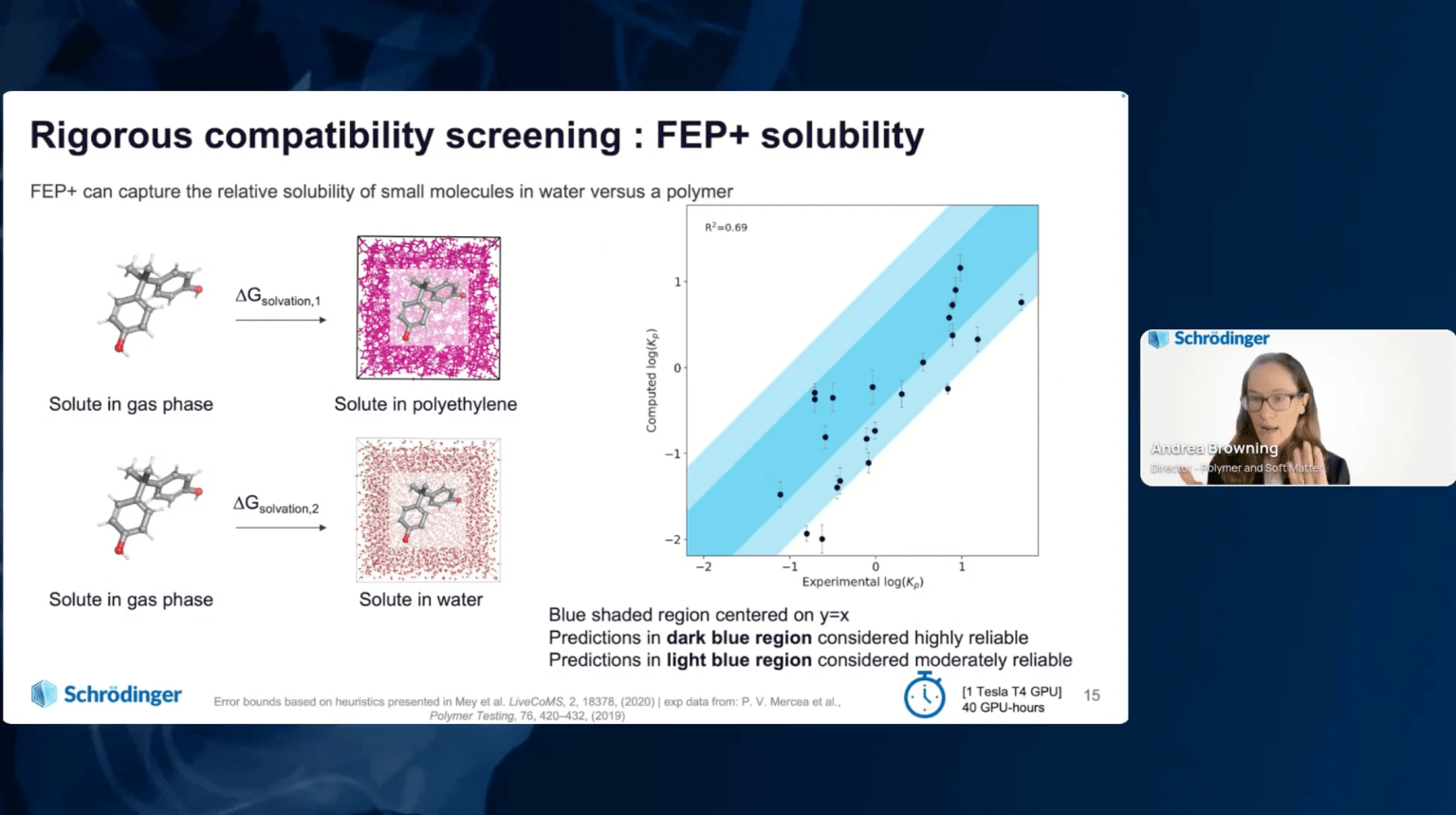
Schrödinger is excited to be participating in the European Pharmaceutical Summit 2025 conference taking place on June 26th in London, United Kingdom. Join us for a presentation by Andrea Browning, Senior Director at Schrödinger, titled “Accelerating drug formulation through molecular dynamics simulations and machine learning approaches.”

icon time 11:50 AM
Accelerating drug formulation through molecular dynamics simulations and machine learning approaches

Speaker:
Andrea Browning, Senior Director, Schrödinger

Abstract:
Given the competitive market and inherent challenges in small molecule drug projects, selecting and combining the right ingredients, such as solvents, excipients, and polymers for drug formulation is a critical step. A smart, strategic drug formulation approach aided by a robust computational modeling platform can advance drug productization projects and inform downstream processes. Recent developments in molecular modeling techniques and machine learning methods not only enable the screening of large numbers of candidate materials in quick time, but also offer atomistic-level insights into formulation experiments and mitigate challenges in drug formulation. In this talk, I will present select examples where physics-based computational modeling tools and workflows are used to accelerate pharmaceutical formulation processes; including selection of excipients and dissolution of the final formulation product.

The NSMMS & CRASTE Symposium

Conference

The NSMMS & CRASTE Symposium

CalendarDate & Time
  • June 23rd-26th, 2025
LocationLocation
  • Norfolk, Virginia

Schrödinger is excited to be participating in The NSMMS & CRASTE Symposium taking place on June 23rd – 26th in Norfolk, Virginia. Join us for a presentation by David Nicholson, Principal Scientist I at Schrödinger, titled “Optimizing energetic binder formulations for additive manufacturing using physics-based modeling and machine learning.”

icon time
Optimizing energetic binder formulations for additive manufacturing using physics-based modeling and machine learning

Speaker:
David Nicholson, Principal Scientist I, Schrödinger

Abstract:
Plasticizers are critical components of energetic binder formulations, lending processability and flexibility to materials that would be otherwise inadequate. The identification of a good pairing between polymer and plasticizer is a formulation design problem that is challenging to solve via brute-force experimentation. Computational approaches, including ML and physics-based modeling, provide a more direct pathway to the desired material characteristics. This type of approach is especially valuable in designing materials for novel applications where identification of suitable materials is less mature and the design space is broad. In this study, we started from a design space consisting of 10 acrylate-terminated polymers and 10 energetic plasticizers and identified an optimal two-component formulation for additive manufacturing applications based on criteria for compatibility and thermomechanical properties. We utilized molecular dynamics (MD) simulations to perform an initial screening for solubility parameter differences to eliminate over half of the plasticizer-polymer pairs. For the remaining pairs, as well as the pure components, we used additional MD simulations to characterize low-temperature modulus and glass transition temperature. These simulation results were subsequently used to train formulation machine learning models for these two properties, and further utilized to identify a set of top-performing formulations using optimization. The properties of top formulations were verified using MD simulations.

AI/ML-Powered Formulation Design: Accelerating Innovation

AI/ML-Powered Formulation Design: Accelerating Innovation

Overview:

Machine learning (ML) is revolutionizing formulation design by enabling data-driven predictions of critical performance indicators, such as solubility, viscosity, stability, and even sensory properties. Chemistry-informed AI/ML models provide a powerful framework for accelerating innovation across a wide range of formulations — from personal care and food, to pharma and battery electrolytes. By analyzing large, diverse datasets, ML can predict the behavior of new formulations, including complex mixtures and ingredients that are combinations of multiple mixtures, dramatically reducing reliance on trial-and-error approaches and speeding time-to-market.

Automated solutions can integrate ingredient composition and molecular structure to generate predictive models that optimize formulation performance. This empowers R&D teams to explore complex formulation spaces, reduce development cycles, and innovate more effectively. In this webinar, we will demonstrate how Schrödinger’s integrated ML- and physics-based approaches are transforming formulation design, with an emphasis on applications relevant to consumer packaged goods (CPG).

Key Learning Objectives:

  • How physics-based models can help generate meaningful data for enhancing ML models in projects with limited data inputs
  • How an automated ML solution, incorporating chemistry and composition, can predict solubility in multi-component systems
  • How ML models that are enhanced with physics-based descriptors can improve viscosity predictions
  • How formulation ML tools enable non-computational experts to design novel CPG products that meet multiple target criteria—a case study with shampoo formulations

Who Should Attend:

  • R&D Leaders
  • Innovation Managers
  • Digitization Managers
  • Synthetic Chemists
  • Materials Scientists
  • Chemical Engineers
  • Materials Research Engineers
  • Computational Chemists
  • Computational Materials Scientists

Our Speaker

Jeffrey Sanders

Product Manager and Technical Lead for Consumer Packaged Goods, Schrödinger

Jeff Sanders received his B.S. in applied physics from Worcester Polytechnic Institute and then his Ph.D. in biophysics and molecular pharmacology from Thomas Jefferson Medical College. Since joining Schrödinger in 2013, he has served several roles. Jeff is currently the product manager and technical lead for the consumer packaged goods applications group. Additionally, he is a managing board member of the Food Engineering, Expansion, and Development (FEED) Institute, and also holds a faculty position in the Food Science Department at UMass Amherst.

Discovery & Development Europe 2025

Conference

Discovery & Development Europe

CalendarDate & Time
  • June 23rd-24th, 2025
LocationLocation
  • Basel, Switzerland

Schrödinger is excited to be participating in the Discovery & Development Europe conference taking place on June 23rd – 24th in Basel, Switzerland. Join us for a presentation by John Shelley, Fellow at Schrödinger, titled “Harnessing Computer Simulation for Drug Formulation: LNP/mRNA as a Case Study.” Stop by booth #21 to speak with Schrödinger scientists.

icon time JUN 23 | 12:35PM
Harnessing Computer Simulation for Drug Formulation: LNP/mRNA as a Case Study

Speaker:
John Shelley, Fellow, Schrödinger

Abstract:
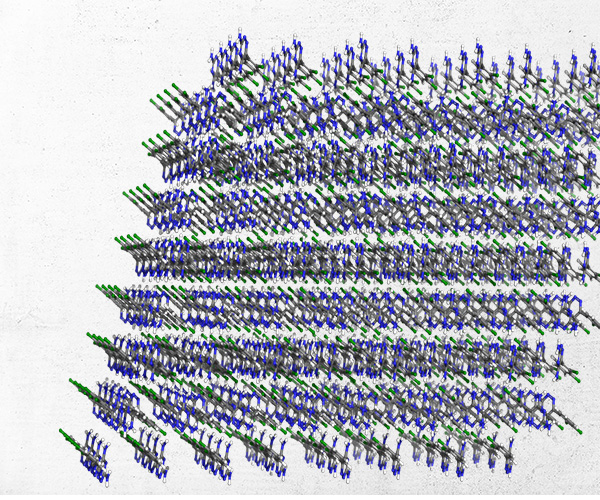
We showcase the application of computer simulations to address key challenges in drug formulation, with a particular emphasis on LNP/mRNA vaccines. Simulations offer unique structural information that can be difficult to obtain experimentally.  While briefly touching upon amorphous solid dispersion dissolution, small-molecule crystal structure prediction, and cyclodextrin binding of small molecule drugs, the primary focus will be on modeling LNP/mRNA formulations consistent with the Pfizer/BioNTech Comirnaty COVID-19 vaccine. Our simulations accurately reproduce the formation LNPs and pH-triggered bleb formation.   Furthermore, we will share preliminary findings from exploratory simulations of mRNA endosomal escape. This talk will conclude by outlining how this technology can enhance the rational design of next-generation LNP-based therapeutics.

AABC Europe 2025

Conference

AABC Europe 2025

CalendarDate & Time
  • June 23rd-26th, 2025
LocationLocation
  • Mainz, Germany

Schrödinger is excited to be participating in the AABC Europe 2025 conference taking place on June 23rd – 26th in Mainz, Germany. Stop by booth #1208 to speak with Schrödinger scientists.

Computational insights into polymer excipient selection for amorphous solid dispersions

Computational insights into polymer excipient selection for amorphous solid dispersions

As drug candidates trend towards higher lipophilicity and lower water solubility, amorphous solid dispersions (ASDs) are growing in popularity as a formulation platform. Although heuristics exist which help to identify effective delivery methods and choice of accompanying excipients, the novelty of each new drug frequently comes with unexpected formulation challenges.

In this webinar, we will highlight how molecular models can aid our ability to screen through standard polymer excipients for target lists to push into lab testing. Additionally, we will discuss how these solutions can be executed by modelers or experimentalists alike using the Schrödinger Materials Science software suite.

Webinar Highlights:

  • Introduction to Schrödinger’s Materials Science software suite and services for drug formulation
  • Review of solutions for rank ordering drug interactions with standard ASD polymers like hydroxypropyl methylcellulose acetate succinate (HPMCAS) and copovidone
  • Detailed analysis of drug-excipients associations for identifying drivers of favorable ASD formation

Our Speakers

Andrea Browning

Senior Director for Polymers, Schrödinger

Dr. Andrea Browning, Senior Director for Polymers, is responsible for leading efforts related to polymeric materials simulation at Schrödinger. Prior to joining Schrödinger in 2017, she was a lead research engineer and project manager at The Boeing Company. She brings over a decade of experience in connecting industrial, engineering problems to root materials issues, and use of simulations to inform industrial decisions. She was a NSF Graduate Research Fellow at the University of California, Santa Barbara and received her Doctorate in Chemical Engineering from that institution.

Shiva Sekharan

Senior Director, Formulations Business Development, Schrödinger

Shiva Sekharan, Ph.D., is the Senior Director of Formulations Business Development at Schrödinger and is responsible for driving the business development efforts in the formulations space. Shiva is an experienced business development executive in the CRO and AI-based services and software solutions industry and has several years of experience in managing business accounts, customer relationships, and expectations with clients in the pharmaceutical, agrichemical, and academic industries across the US, Europe, and Asia territories. His expertise lies in identifying new business opportunities among existing customers, devising sales and collaboration strategies for customer expansion, and ensuring top-tier services, products, and knowledge-driven solutions are available 24/7 to customers across the globe. Before joining Schrödinger in 2023, Shiva held a BD role at XtalPi Inc., where he led the US solid-state services unit, worked with departmental heads to establish effective goals, sales targets, outline procedures and best practices, and provide strategic directions to increase revenue. Shiva earned his Ph.D. in Theoretical Chemistry from the University of Duisburg-Essen, Germany, followed by postdoctoral stints at the Max-Planck Institute for Polymer Science, Emory University, Fukui Institute for Fundamental Chemistry, and Yale University. Shiva is an accomplished computational chemist, with strong research expertise in the areas of quantum chemistry and drug discovery (>40 publications, >1100 citations, H-index = 20).

US User Group Meeting 2025

User Group Meeting
CalendarDate & Time
  • September 15th-17th, 2025
LocationLocation
  • Newport, Rhode Island

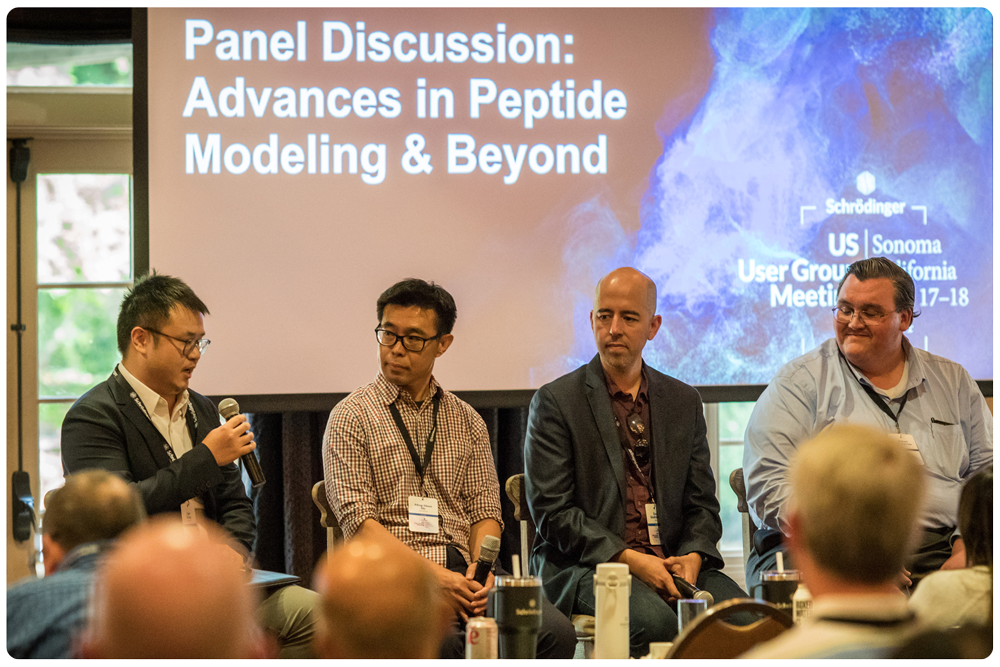
Schrödinger is excited to host the US User Group Meeting at the Newport Harbor Island Resort in Newport, Rhode Island, from September 15-17, 2025.

This in-person event will bring together a dedicated group of Schrödinger users and team members from across the United States. The agenda will feature scientific presentations, hands-on workshops, panel discussions, and networking opportunities.

Meeting Details

Monday, September 15th
The event will begin with a happy hour reception at 6:00 PM.

Tuesday, September 16th
Sessions will run throughout the day. On the evening, all attendees are invited to a networking dinner.

Wednesday, September 17th
Sessions will run throughout the day. Departures will take place in the late afternoon.

Scientific Topics

  • Computationally-driven drug discovery case studies
  • Scaling predictive models for real-world impact
  • Designing safer molecules by predicting and preventing liabilities
  • Enabling challenging targets for structure-based design
  • Modeling of new and alternative modalities
  • Practical applications of AI/ML in discovery and formulation workflows
  • Schrödinger platform scientific roadmap

Agenda

Venue

Newport Harbor Island Resort
1 Goat Island Road,
Newport, RI 02840, USA

Getting There

By Air

Rhode Island T.G. Green International Airport (PVD): Newport Harbor Island Hotel is a 33 minute drive from PVD airport. Regular flights are available via American Airlines, Breeze Airways, Delta, JetBlue, Southwest Airlines, Sun Country Airlines, and United.

By Train

Providence Station: Newport Harbor Island Hotel is a 45 minute drive from Providence Train Station, which is serviced by Amtrak and MBTA Commuter Rail.

By Car

Newport, RI is easily accessible by car. It is a 45 min drive from Downtown Providence or a 1 hour and 30 min drive from Boston, MA. Overnight Self-Parking is $35 per night and Overnight Valet Parking is $45 per night at the Newport Harbor Island Hotel.

IRI 2025

Conference

IRI 2025

CalendarDate & Time
  • May 19th-21st, 2025
LocationLocation
  • Chicago, Illinois

Schrödinger is excited to be participating in the IRI 2025 conference taking place on May 19th – 21st in Chicago, Illinois. Join us for a presentation by Jeffrey Sanders, Product Manager and Scientific Lead, Consumer Goods at Schrödinger, titled “Accelerating Design through Formulations Modeling at the Molecular Level.” Stop by our booth to speak with Schrödinger scientists.

icon time MAY 20 | 1:30PM
Accelerating Design through Formulations Modeling at the Molecular Level

Speaker:
Jeffrey Sanders, Product Manager and Scientific Lead, Consumer Goods, Schrödinger

Abstract:
The journey to develop and reformulate products to become more sustainable presents many challenges. Research and development in these areas often demand substantial time, resources, and new raw materials. To accelerate this process, predictive modeling offers the potential to identify promising ingredients, formulations, and even new packaging materials that meet the required standards. Virtual testing of cosmetic and personal care ingredients and formulations using computational methods can provide a mechanistic understanding at the molecular level. This allows for a better understanding of how individual ingredients behave, the morphology and stability of formulations, and their interaction with the target biological surface. Additionally, interactions between products and packaging materials, which are key drivers of shelf-life, can also be explored. Case studies in these areas will highlight the utility of computational chemistry methods in understanding products in development, in their packaging, and in action.

Supplier’s Day 2025

Conference

Supplier’s Day 2025

CalendarDate & Time
  • June 3rd-4th, 2025
LocationLocation
  • New York, New York

Schrödinger is excited to be participating in the Supplier’s Day 2025 conference taking place on June 3rd – 4th in New York, New York. Join us for a presentation by Jeff Sanders, Research Leader at Schrödinger, titled “Multiscale Modeling for Skin Innovation: Virtual Testing of Formulations and Tyrosinase Inhibitors for Barrier Repair and Hyperpigmentation.” Stop by booth 2405 to speak with Schrödinger scientists.

icon time JUN 4 | 10:35AM
icon location 3D02
Multiscale Modeling for Skin Innovation: Virtual Testing of Formulations and Tyrosinase Inhibitors for Barrier Repair and Hyperpigmentation

Speaker:
Research Leader, Schrödinger

Abstract:
The development of next-generation cosmeceuticals—such as tyrosinase inhibitors for skin-whitening or anti-aging—requires innovation in efficacy, safety, and sustainability. To meet these demands, computational chemistry and machine learning are transforming how ingredients and formulations are designed, tested, and optimized. These tools enable virtual screening of bioactives, mechanistic insights into enzyme interactions, and predictions of formulation stability and skin permeation—all before lab work begins.
Key methods include molecular docking, molecular dynamics, and free energy perturbation (FEP+), which together help identify and rank potent inhibitors targeting tyrosinase’s active site with high precision. In parallel, machine learning accelerates formulation development by predicting critical properties such as solubility, viscosity, and shelf-life performance. Simulations also support the evaluation of interactions between formulations and packaging materials, helping to anticipate product stability over time.
Together, these approaches reduce trial-and-error in R&D, enabling faster, data-driven decisions and the creation of safer, more effective, and more sustainable cosmeceutical products.

NAM29

Conference

NAM29

CalendarDate & Time
  • June 8th-13th, 2025
LocationLocation
  • Atlanta, Georgia

Schrödinger is excited to be participating in the NAM29 conference taking place on June 8th – 13th in Atlanta, Georgia. Join us for a poster presentation by Croix J. Laconsay, Senior Scientist I at Schrödinger, titled “Molecular Catalysts Design with Massively Parallel Physics-Based Computational Workflow.” Stop by our booth 123 to speak with Schrödinger scientists.

icon time
Molecular Catalysts Design with Massively Parallel Physics-Based Computational Workflow

Speaker:
Croix J. Laconsay, Senior Scientist I, Schrödinger

Abstract:

Introduction
Molecular catalysts have traditionally been designed through experimental trial-and-error methods, which are resource-intensive, time-consuming, laborious, and costly. Historically, computational chemistry, particularly quantum chemical studies combined with domain expertise, has contributed indirectly to molecular catalyst design by elucidating reaction mechanisms. However, with the advent of advanced hardware architectures, improved theoretical methods, sophisticated algorithms, and increased automation, computational chemistry now offers the possibility for the direct design of molecular catalysts.

Materials and Methods
The results presented here were obtained using the Reaction Network Enumeration Profiler (RxnEnumProfiler)—previously Automated Reaction Workflow—panel of the Schrödinger Material Science Suite (Versions 24-3,4).1 The RxnEnumProfiler module is designed with a user-friendly graphics-user interface (GUI) or can be accessed through a command line interface (CLI). It can be used by either advanced computational catalysis researchers, students of all levels, or experimental homogeneous catalysis scientists with no prior background in atomic scale modeling.

Results and Discussion
We introduce an automated digital approach for predicting two key catalytic performance metrics for dynamically generated library of virtual molecular catalysts, leveraging quantum mechanics directly. Our workflow integrates three main components: 1) knowledge of the mechanism of the reference catalytic reaction; 2) a predefined in silico library for catalyst and/or substrate functionalization; and 3) a specified quantum-mechanical method. Proof-of-concept demonstration is presented across two representative homogeneous reactions, organocatalyzed asymmetric hydrogenation and Ni-catalyzed C-C cross-coupling.

Advancing lipid nanoparticle development with structure-based modeling platform and services

Advancing lipid nanoparticle development with structure-based modeling platform and services

Overview

Lipid nanoparticle (LNP) technology has become the basis for many types of therapeutics. A detailed understanding of LNP structures and their behaviors will aid in implementing and optimizing many therapeutics. Schrödinger offers a computational modeling platform that enables structure-based modeling of LNPs to address challenges in composition-driven LNP structural and behavioral variations.

Bleb formation is an active area of LNP research that is believed to affect mRNA expression levels. Schrödinger can simulate the transition from mRNA dispersed within the LNP at low pH (left) to its localization in a bleb at high pH (right). Light blue: Water; Dark blue: Positively charged ionizable lipid; Green: Neutral ionizable lipid; Orange: Pegylated lipid; Red: mRNA.

Key Capabilities

Characterize LNPs as a function of composition1

  • Internal and surface structures
  • pH dependence
  • Water content
  • mRNA-lipid interactions

Predict apparent pKa values of ionizable lipids2

  • Key property for LNP performance
  • Structure based
  • Formulation dependent

Simulate features relevant for passive LNP targeting

  • Nature of LNP surface as a function of LNP composition
  • Association with endogenous proteins as a function of LNP composition

Elucidate active LNP targeting

  • Characterize key ligand-LNP behaviors, including: ligand attachment during production; effectiveness of tethering to LNP surface; and exposure targeting entities beyond the PEG layer
  • Quantify ligand-target engagement

Model endosomal escape to support the improvement of translation efficiency

  • Simulate the escape process
  • Identify trends in mRNA release as a function of LNP composition

References

  1. Coarse-grained simulation of mRNA-loaded lipid nanoparticle self-assembly.

    Grzetic DJ, Hamilton NB, and Shelley JC. Molecular Pharmaceutics. 2024, 21, 4747-4753.

  2. Calculating apparent pKa values of ionizable lipids in lipid nanoparticles.

    Hamilton NB, Arns S, Shelley M, Bechis I, and Shelley JC. Molecular Pharmaceutics. 2025, 22, 588-593.