BIO 2025

Conference

BIO 2025

CalendarDate & Time
  • June 16th-19th, 2025
LocationLocation
  • Boston, Massachusetts

Schrödinger is excited to be participating in the BIO 2025 conference taking place on June 16th – 19th in Boston, Massachusetts. Join us for a panel discussion with Jenny Chambers, Senior Director of Education at Schrödinger, titled “We Still Need the People: AI/ML Drug Discovery is Here to Stay, but we Could be its Rate Limiting Factor.”

icon time JUN 18 | 2:30PM
We Still Need the People: AI/ML Drug Discovery is Here to Stay, but we Could be its Rate Limiting Factor

Panel Participant:
Jenny Chambers, Senior Director of Education, Schrödinger

Abstract:
Computational methods including AI/machine learning have the potential to be transformational in biopharma by accelerating and enhancing many aspects of drug discovery to bring better drug candidates with a higher likelihood of success to the clinic. Robust data sets are often cited as the limiting factor for this technology. However, less discussed but crucial to the success of computational drug discovery is fostering a new generation of drug hunters with multi-disciplinary training needed to make the best use of these advancements. There may be a shortage of computational chemists and molecular modelers needed to explore the vast array of opportunities that can benefit from computational drug discovery. Hear from a panel of academic and industry leaders that are developing this next-generation, what is most important for them and what the broader ecosystem can do to help fill in the pipeline gaps and ensure we have the people in place to match the technology. This session will focus on the benefits of computational methods, including AI/machine learning, to advance drug discovery, as well as the importance of fostering the next generation of scientists leveraging these vast datasets.

4th RSC Anglo-Nordic Medicinal Chemistry Symposium

Conference

4th RSC Anglo-Nordic Medicinal Chemistry Symposium

CalendarDate & Time
  • June 10th-13th, 2025
LocationLocation
  • Snekkersten, Denmark

Schrödinger is excited to be participating in the 4th RSC Anglo-Nordic Medicinal Chemistry Symposium  taking place on June 10th – 13th in Snekkersten, Denmark. Join us for a presentation and a workshop. Stop by booth 8 to speak with Schrödinger scientists.

icon time JUN 11 | 12:00
Presentation: Structure-based Discovery and Development of Highly Potent Dihydroorotate Dehydrogenase Inhibitors for Malaria Chemoprevention

Speaker:
Zhe Nie, Executive Director, Medicinal Chemistry, Schrödinger

icon time JUN 11 | 14:30
Workshop: Prioritizing DLK Inhibitors for Potency, Selectivity, and Brain-penetration: A Digital Chemistry Design Challenge

Speaker:
Áine Henley, SDM II, Schrödinger

Abstract:
In this hands-on workshop, we will use Schrödinger’s LiveDesign platform to design and triage DLK inhibitors using a series of predictive models. We will highlight how LiveDesign can be used to identify and address program challenges as well as predict the various different endpoints to allow for informed synthesis decisions. The workshop will feature the following capabilities:
Interactive 2D/3D design with Ligand Designer
Substructure filtering and structurally-aware formulas for labeling subseries
Use of forms view and plotting to identify correlations between calculated and experimental data points
Integration of advanced computational methods like E-sol for predicting Kpu,u and FEP+ for predicting binding affinity
Development of MPO scores for prioritizing synthesis decisions
The workshop will be concluded with a design challenge that is aimed to identify selective and potent inhibitors that match the developed MPO.

EPF European Polymer Congress 2025

Conference

EPF European Polymer Congress 2025

CalendarDate & Time
  • June 22nd-27th, 2025
LocationLocation
  • Groningen, Netherlands

Schrödinger is excited to be participating in the EPF European Polymer Congress 2025 conference taking place on June 22nd – 27th in Groningen, Netherlands. Join us for a presentation by Jacob Gavartin, Research Leader MS at Schrödinger, titled “Molecular simulation of contaminants in packaging polymers and migration into model food systems.” Stop by booth #9 to speak with Schrödinger scientists.

icon time JUN 23 | 14:00
Molecular simulation of contaminants in packaging polymers and migration into model food systems

Speaker:
Jacob Gavartin, Research Leader MS, Schrödinger

Abstract:
Polymers are essential in consumer goods packaging materials, yet their use raises concerns about environmental safety due to potential migration of harmful contaminants. [1] This study utilizes atomistic molecular dynamics simulations to analyze monomer migration from three common packaging polymers—polyamide-6, polycarbonate, and poly(methyl methacrylate)—into various food simulant solvents. By modeling both bulk diffusion and interfacial transport, we investigated how factors such as polymer-monomer interactions, solvent compatibility, and free volume within the polymer matrix affect contaminant migration. Key findings include the identification of dual transport mechanisms—continuous and hopping diffusion [2,3] —within polymer bulk, influenced by the physical properties of both the monomer and the polymer. Interfacial studies revealed food simulant solvent type as a critical factor, with polar solvents enhancing migration by disrupting polymer cohesion. For instance, ethanol significantly facilitated migration compared to other solvents. Notably, larger molecules such as triglycerides exhibited unique interfacial behavior preventing contaminant migration, highlighting the complexity of solvent-polymer interactions. Our results align well with experimental trends and underscore the power of molecular simulations in predicting leaching behavior, offering insights for designing safer packaging materials. This research advances understanding of molecular-scale migration processes and supports the development of regulatory frameworks and industrial innovations to mitigate contamination risks in consumer products.

Spring Pharmaceutical Synchrotron X-ray Powder Diffraction Workshop

Workshop

Spring Pharmaceutical Synchrotron X-ray Powder Diffraction Workshop

CalendarDate & Time
  • May 12th-13th, 2025
LocationLocation
  • Lemont, Illinois

Schrödinger is excited to be participating in the Spring Pharmaceutical Synchrotron X-Ray Powder Diffraction workshop taking place on May 12th – 13th in Lemont, Illinois. Join us for a presentation by Shiva Sekharan, Senior Director at Schrödinger, titled “Crystal Structure Prediction and Modeling of Pair Distribution Functions: Synergy with Synchrotron XRPD Data.”

icon time 2:30 PM
Crystal Structure Prediction and Modeling of Pair Distribution Functions: Synergy with Synchrotron XRPD Data

Speaker:
Shiva Sekharan, Senior Director, Schrödinger

Abstract:
Early assessment of crystal polymorphism and thermodynamic solubility continues to be elusive for drug discovery and development despite its critical importance, especially for the ever-increasing fraction of poorly soluble drug candidates. We have developed a crystal structure prediction (CSP) method that combines a novel systematic crystal packing search algorithm and a hierarchical energy ranking protocol to predict crystal polymorphs. This is complemented by a free energy perturbation (FEP+) approach for computing thermodynamic aqueous solubility. The high accuracy, reliability, and efficiency of our CSP and FEP+ methods with large scale validations is designed to support polymorph screening and solubility prediction in drug substance and drug product development processes. Schrödinger’s modelling capabilities can support the understanding of the local structure of poorly crystalline or amorphous compounds by providing a starting model for pair distribution function (PDF) refinements and contributing to the interpretation of the local structure.

Applied Pharmaceutical Chemistry 2025

Conference

Applied Pharmaceutical Chemistry 2025

CalendarDate & Time
  • April 10th, 2025
LocationLocation
  • Waltham, Massachusetts

Schrödinger is excited to be participating in the Applied Pharmaceutical Chemistry 2025 conference taking place on April 10th in Waltham, Massachusetts. Join us for a presentation by Abba Leffler, Senior Principal Scientist at Schrödinger, titled “Exploiting Solvent-Exposed Salt-Bridge Interactions for the Discovery of Potent Inhibitors of SOS1 Using Free Energy Perturbation Simulations.” Stop by booth #1 to speak with Schrödinger scientists.

icon time 1:55PM
Exploiting Solvent-Exposed Salt-Bridge Interactions for the Discovery of Potent Inhibitors of SOS1 Using Free Energy Perturbation Simulations

Speaker:
Abba Leffler, Senior Principal Scientist, Schrödinger

Abstract:
Small molecules that bind the Son of Sevenless 1 protein (SOS1), thereby preventing activation of RAS, have been widely pursued as a means for cell proliferation inhibition and anti-tumor activity. Guided by free energy perturbation simulations, we discovered that two acidic residues on the perimeter of a known small molecule binding site on SOS1, E906, and 909, constitute a potency handle that can improve inhibitor affinity by as much as 750-fold when targeted with basic groups to form salt bridges, despite being solvent exposed. Structure-activity relationship (SAR) and X-ray crystallographic studies demonstrate that this effect is attributable to the electrostatic interaction between the protein and ligand. This interaction could be repurposed to create new SOS1 inhibitors, documenting its general utility for core exploration. This short talk will focus on these SAR efforts and also provide recent examples in the literature that suggest that this phenomenon may be applicable to a number of target classes.

Festival of Biologics 2025

Conference

Festival of Biologics 2025

CalendarDate & Time
  • April 23rd-24th, 2025
LocationLocation
  • San Diego, California

Schrödinger is excited to be participating in the Festival of Biologics 2025 conference taking place on April 23rd – 24th in San Diego, California. Join us for a poster presentation by Zhe Mei, Senior Scientist I at Schrödinger, titled “Antibody Optimization with Physics based and Machine Learning based modeling.” Stop by booth #835 to speak with Schrödinger scientists.

icon time 6:10 PM
Antibody Optimization with Physics based and Machine Learning based modeling

Speaker:
Zhe Mei, Senior Scientist I, Schrödinger

Abstract:
Optimizing antibody properties, such as binding affinity, stability and aggregation is crucial for developing safe and effective biotherapeutics. This work presents an integrated approach leveraging physics-based modeling and machine learning to address these challenges. We use both methods to predict 3D structures and calculate a rich set of sequence-based, structure-based and surface patch-based protein descriptors that can be used to train machine learning models. Further, we can identify hotspots for targeted optimization of stability and affinity and apply physics-based methods like free energy perturbation (FEP+) to design improved and developable variants.

Schrödinger User Group Meeting – Materials Science Japan 2025 Part 2

User Group Meeting
CalendarDate & Time
  • June 11th, 2025
  • 10:00 – 17:30
LocationLocation
  • Tokyo, Japan

Schrödinger User Group Meeting – Materials Science Japan 2025 Part 2

Electronic Materialsをテーマに、弊社サイエンティストや各製品の開発責任者から、最新機能、応用事例、今後の展望などを、セミナー形式でご紹介いたします。

発表要旨はこちらからご覧いただけます。

icon time 10:00 – 10:05
ご挨拶

icon time 10:05 – 10:45
機械学習を用いた有機EL用発光材料の分子デザイン

九州大学 最先端有機光エレクトロニクス研究センター 特任准教授 土屋 陽 一様

icon time 10:45 – 11:25
Advancing Materials Science with Schrödinger: Latest Innovations, Future Roadmap, and Key Applications Impacting Electronics Applications

Mathew D. Halls, Senior Vice President, Materials Science

icon time 11:25 – 12:05
Digital Solutions for Display Technology: From Materials to Devices

Hadi Abroshan, Principal Scientist

icon time 13:05 – 13:45
Innovating Polymers for Advanced Electronic Packaging Using Schrödinger Materials Science Suite

Andrea Browning, Senior Director, Polymers and Soft Matter

icon time 13:45 – 14:25
高速分子動力学計算と量子力学計算の組み合わせによるGHz以上の高周波数における誘電率と誘電正接の計算方法

マテリアルズ サイエンス シニア ディレクター 森里 嗣生

icon time 14:35 – 15:15
New Developments in Schrödinger Machine Learning Force Fields for Liquid and Solid Phase Materials: Accurate and Efficient Long Range Electrostatics using MPNICE

Jack Weber, Senior Scientist

icon time 15:15 – 15:55
New Surface Modelling Tools and Their Application in Thin Film Processing

Simon Elliott, Director of Atomic Level Process Simulation

icon time 16:05 – 16:45
Schrödinger Reactivity and Catalysis Tools for Electronic Materials Simulation

Pavel A. Dub, Product Manager Catalysis and Reactivity

icon time 16:45 – 17:25
強化学習を使用したSurface Walking法による遷移状態探索

シニア サイエンティスト 大塚 勇起

icon time 17:25 –
懇親会

【開催形式と会場】
・現地開催です。オンライン配信はございません。
会場
トラストシティ カンファレンス・丸の内
〒100-0005 東京都千代田区丸の内1-8-1 丸の内トラストタワーN館11階

※登録受付は6月3日(火)23:59までといたします。
※会場の収容可能人数には限りがあり、登録受付期日前であっても、上限に達し次第締め切りとなります。お早めにお申し込みください。
※参加者様へは、別途メールにて詳細をご案内いたします。

【参加費】
無料

【お申込みにあたって】
所属企業または所属機関のメールアドレスにて、登録をお願いします。
フリーメールや個⼈メールアドレスでご登録の場合などは、出席をご遠慮いただく場合がございます。
同業他社さまには参加をご遠慮頂いております。ご理解のほど宜しくお願い致します。

※ご質問、ご不明な点がございましたら下記までお問い合わせください。
シュレーディンガー株式会社 UGM2事務局
E-mail: info-japan@schrodinger.com

Schrödinger Japan Life Sciences User Group Meeting 2025

User Group Meeting
CalendarDate & Time
  • June 24th, 2025
LocationLocation
  • Tokyo, Japan

本会は、6月24日(火)、会場で開催します。
新規テクノロジーの開発状況を始め、実際の創薬プロジェクトでの活用事例を、国内のユーザー様からのご発表を含めてご紹介いたします。
多くの皆様のご参加を心よりお待ちしております。

発表要旨はこちらからご覧いただけます。

icon time 10:00AM – 10:10AM
Opening

シュレーディンガー株式会社 カントリーマネージャー・ジャパン ヴァイスプレジデント 営業・マーケティング統括部長 佐々野 裕輔

icon time 10:10AM – 11:10AM
R&D Roadmap: Computational Methods Development at Schrödinger

Robert Abel, Executive Vice President, Chief Scientific Officer, Platform, Schrödinger

icon time 11:10AM – 11:55AM
Rapid Binding Site Similarityを活用したキノン結合部位の比較
―農薬分野への応用―

三井化学クロップ&ライフソリューション株式会社 研究開発本部 農業化学研究所 番場 伸一様

icon time 1:00PM – 1:45PM
MDシミュレーションによる化合物の膜透過性の予測

シュレーディンガー株式会社 プリンシパルサイエンティスト 井上 鑑孝

icon time 1:45PM – 2:30PM
Predict-firstのDMTAサイクル実現に向けた取り組み

日本たばこ産業株式会社 医薬総合研究所 i2i-Labo. 瀧本 征佑様

icon time 2:30PM – 3:15PM
VHHはどこまで見えるか?構造予測手法の徹底比較Predicting VHH:
How Far Have Structure Prediction Methods Come?

京都大学大学院 理学研究科 生物科学専攻 生物物理学教室 Anupap Chauyjaroensuk様
シュレーディンガー株式会社 シニア プリンシパルサイエンティスト 市原 収

icon time 3:40PM – 4:25PM
Computational advances powering the design of cyclic peptide therapeutics

Goran Krilov, Senior Director, Schrödinger

icon time 4:25PM –5:10PM
PEPのライセンスを活用したFEP+駆動型創薬

小野薬品工業株式会社 創薬ケミストリー研究部 計算化学G 梅村 周平様、柴田 果奈様

icon time 5:10PM –5:20PM
Closing

Matt Repasky, Senior Vice President, Schrödinger

icon time 5:45PM – 7:45PM
懇親会

【開催形式と会場】
・現地開催です。オンライン配信はございません。
会場
鉃鋼エグゼクティブラウンジ&カンファレンスルーム
〒100-0005 東京都千代田区丸の内1丁目8-2, 鉃鋼ビルディング 南館, 4階

※登録受付は6月16日(月)23:59までといたします。
※会場の収容可能人数には限りがあり、登録受付期日前であっても、上限に達し次第締め切りとなります。お早めにお申し込みください。
※参加者様へは、別途メールにて詳細をご案内いたします。

【参加費】
無料

【お申込み方法】
▼参加のお申し込みはこちらから▼
https://form.run/@schrodinger-20250624

所属企業または所属機関のメールアドレスにて、登録をお願いします。
フリーメールや個⼈メールアドレスでご登録の場合などは、出席をご遠慮いただく場合がございます。
同業他社さまには参加をご遠慮頂いております。ご理解のほど宜しくお願い致します。

※ご質問、ご不明な点がございましたら下記までお問い合わせください。
シュレーディンガー株式会社 LS UGM事務局
E-mail: info-japan@schrodinger.com

Schrödinger デジタル創薬セミナー: Into the Clinic~計算化学がもたらす創薬プロセスの変貌~第16回

Schrödinger デジタル創薬セミナー 16:
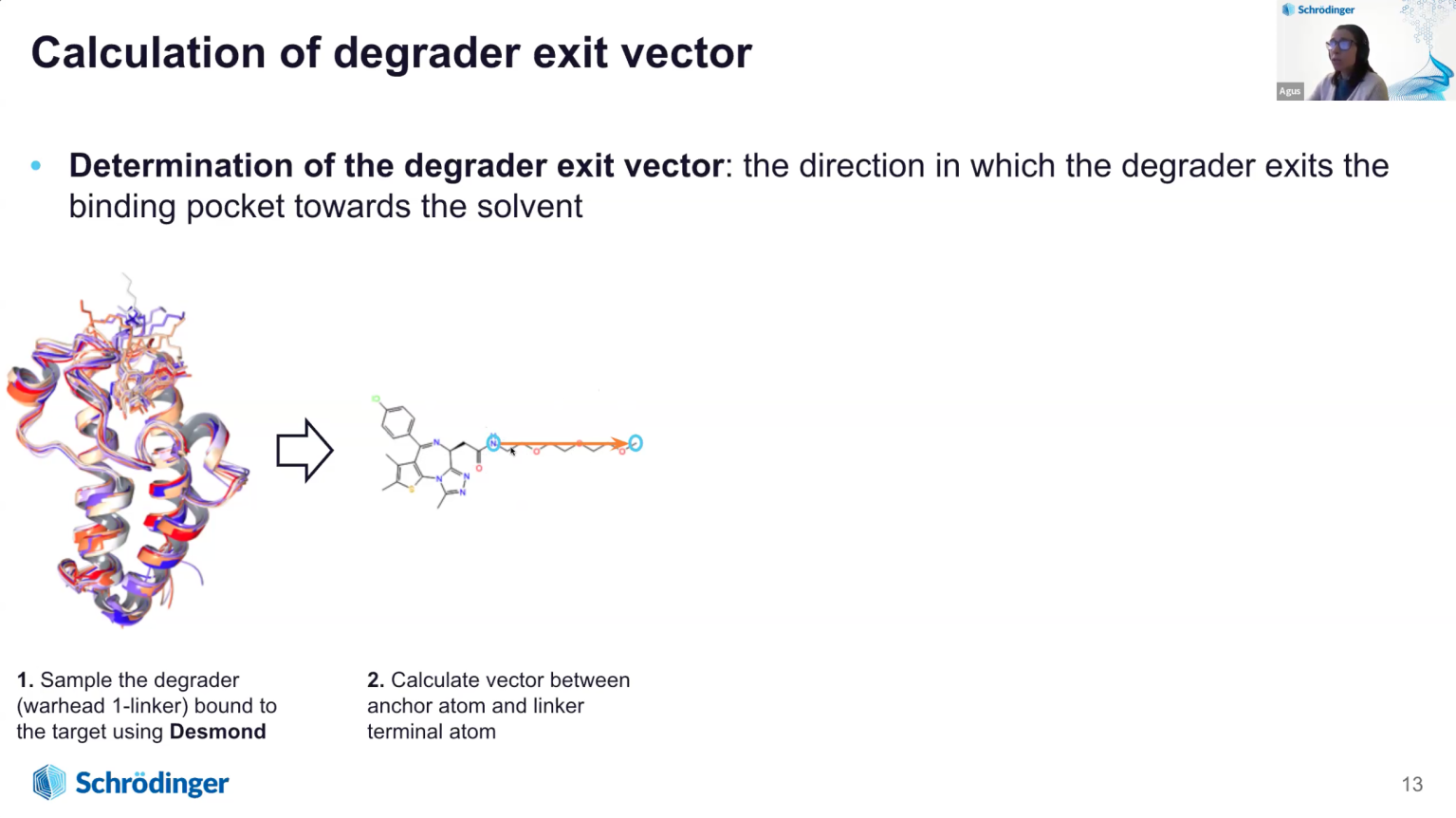
Accelerating protein degrader discovery: Computational strategies for degrader design and optimization

APRIL 16, 2025

プロテインデグレーダー(標的タンパク質分解誘導剤)は、細胞の自然な分解経路を利用してタンパク質機能を制御する革新的な創薬モダリティとして注目されています。しかし、その二官能性構造ゆえに、複数の要素を最適化する必要があり、設計は非常に複雑です。
Schrödingerは、企業の研究者と連携し、二つのタンパク質と二官能性分子から成る三者複合体の構造を正確に予測できる計算ワークフローを開発しました。

このウェビナーでは、タンパク質間ドッキングやリンカーサンプリング、メタダイナミクス、自由エネルギー摂動計算(FEP+)を活用したツールキットを紹介し、複合体の構造予測から活性最適化まで、プロテインデグレーダー設計を加速する方法を解説します。また、LiveDesignプラットフォームによるリアルタイムの共同研究の可能性についても紹介します。

Webinar Highlights

  • プロテインデグレーダーのモデリングにおける最新の動向と課題の概要
  • Schrödingerの計算ソリューションのご紹介:出口ベクターサンプリング、HDX-MSなどの実験データを活用した三者複合体のアンサンブル予測とフィルタリング、複合体のスコアリング、FEP+を用いたリンカー最適化
  • プロテインデグレーダー設計プロセスを効率化するLiveDesignでのワークフローのデモ
  • プロテインデグレーダーモデリング向けのMaestroの新パネルをいち早くご紹介

Our Speakers

Agus Rodriguez-Granillo, Ph.D.

Director, Application Science

テキサス州ヒューストンにあるライス大学で生化学の博士号を取得。マサチューセッツ州ケンブリッジのApplication Scienceチームのリーダーで、米国北東部地域の顧客サポートを担当しています。さらに、新たな治療モダリティとしての二官能性デグレーダーの分野の研究も行っています。

Sonia Nicolaou, Ph.D.

Senior Scientist II, Application Science

イギリスのマンチェスター大学で化学の博士号を取得しました。Schrödinger入社後は、顧客への科学的サポートを行うとともに、LiveDesignにおける新しいモデリング機能の開発にも携わってきました。最近では、LiveDesignへのPROTACsワークフローの実装に注力しています。

ALD/ALE 2025

Conference

ALD/ALE 2025

CalendarDate & Time
  • June 22nd-25th, 2025
LocationLocation
  • Jeju Island, Korea

Schrödinger is excited to be participating in the ALD/ALE 2025 conference taking place on June 22nd – 25th in Jeju Island, Korea. Join us for a joint presentation with Lam Research by Simon Elliott, Director of Atomic Level Process Simulation at Schrödinger, titled “The Mechanism of Thermal ALD of Silicon Carbonitride from Chloroalkylsilanes and Ammonia – Theory Meets Experiment.” Stop by booth 50 to speak with Schrödinger scientists.

icon time JUN 24 | 8:00AM
icon location Halla Hall AB
The Mechanism of Thermal ALD of Silicon Carbonitride from Chloroalkylsilanes and Ammonia – Theory Meets Experiment

Speaker:
Simon Elliott, Director of Atomic Level Process Simulation, Schrödinger

Abstract:
Carbon-doping of silicon nitride or silicon oxide results in a lowering of the dielectric constant and etch rate. The C-doped derivatives are therefore being used to replace the parent films in many applications in FEOL semiconductor manufacturing, such as for spacers and gap fill. Traditionally these C-doped films are deposited by CVD methods, but recently ALD methods have been formulated using silicon precursors with Si-CHx bonds. Maintaining the Si-CHx bond has been challenging due to its propensity to cleave under plasma conditions or at high temperatures. For these reasons, precursors that can be used in a low temperature thermal ALD process are highly desired.In this work we investigate whether ammonia is viable as a thermal ALD co-reagent for this application and what mixture of chloro and alkyl ligands are most favorable in the silicon precursor.

We use density functional theory (DFT) to compute the atomic-scale structure of surface intermediates and the mechanism of potential ALD reactions and complement this with detailed characterization during substrate exposure experiments.

Looking first at the co-reagent, we investigate the kinetics of proton transfer from ammonia to a model silyl fragment on an aminated surface. Four proton transfer pathways are obtained for HCl elimination, all with high barriers (>1.2 eV) that are indicative of low Bronsted acidity and suggest that side-reactions will compete with the ALD process. Three pathways are obtained for CH4 elimination with even higher barriers (>2.5 eV). Therefore, up to moderate temperatures, terminal-CH3 is likely to survive ammonia treatment and be incorporated into the film, and this could be a route to C-doping. Residual gas analysis (RGA) and quartz crystal microbalance is used to monitor whether HCl or CH4 is in fact evolved during each half reaction.

The second part of the study looks at the effect of various combinations of chloro and methyl ligands in candidate Si precursors, both monomers (SiCl4, SiHCl3, SiCl3Me, SiH2Cl2, SiHCl2Me, SiCl2Me2) and dimers (Si2Cl6, Si2Cl4Me2). Structural models are generated efficiently of the >100 surface intermediates that can potentially occur through physisorption, chemisorption via ligand elimination and etching by exchange with surface amines. For each precursor, DFT-based thermodynamics reveal that the most favorable intermediate is surf-SiCl3 up to about 250C, surf-Cl2 up to 450C and surf-Cl at higher temperatures, with associated predictions of ALD growth rate. Film composition and growth rate is then validated experimentally by ellipsometry (SE) and infrared red spectroscopy (ATR-FTIR), ex-situ but with an inert atmosphere glove box.

The Future of Food: Molecular Simulations and AI/ML Reshaping Product Development

The Future of Food: Molecular Simulations and AI/ML Reshaping Product Development

In today’s rapidly evolving food industry, innovation is essential. As consumer demand shifts toward safer, healthier, and more sustainable products, companies need cutting-edge technologies to stay ahead. Schrödinger’s platform is fundamentally changing food formulation development by leveraging physics-powered AI to enable researchers to predict ingredient interactions, refine formulations, and accelerate product development with unmatched precision that delivers real business impact. This data-driven approach not only enhances efficiency but also uncovers molecular-level insights that drive breakthrough innovations in food science.

Key Areas of Innovation

Protein Structure and Functionality

Understanding protein behavior at the molecular level is crucial for optimizing texture, stability, and functionality in food formulations. Schrödinger’s simulation platform offers profound insights into protein structures, rheology, and interactions. A notable application involves the study of zein, a corn-derived protein, as a potential structuring agent in food products, especially meat alternatives. By employing molecular level simulations, researchers can examine zein’s self-assembly, gelation, and binding characteristics—facilitating the creation of plant-based products with enhanced texture and stability.

Recent studies have demonstrated the effectiveness of such simulations in predicting protein behavior under various conditions, thereby streamlining the development process and reducing reliance on empirical testing. This approach not only accelerates innovation but also leads to more sustainable and consumer-aligned food products.

Sustainable Alternatives for Food Additives

As the food industry moves toward clean-label formulations, the need for natural ingredient alternatives is more urgent than ever. Regulatory bodies worldwide are tightening restrictions on synthetic additives, while consumers increasingly demand healthier, more transparent ingredient lists. Schrödinger’s physics-powered AI/ML platform is accelerating this transition by enabling the discovery and optimization of natural alternatives through molecular modeling.

One key focus is phycocyanin, a blue pigment from spirulina, which holds promise as a substitute for synthetic colorants that may face future bans. Using a combination of Schrödinger tools, researchers can predict its stability, solubility, and interactions with other ingredients—helping to overcome common formulation challenges. Recent studies highlight the sensitivity of phycocyanin to pH and temperature, reinforcing the need for advanced modeling to ensure its viability in food and beverage applications.

By integrating these insights, Schrödinger’s platform provides a proactive approach to formulation, helping companies stay ahead of regulatory changes and evolving consumer expectations. This enables the development of more stable, high-performing natural ingredients, paving the way for a future of cleaner, more sustainable food products.

Enhancing Food Packaging Safety and Shelf-Life

Food packaging is more than just a protective barrier—it directly impacts consumer safety, product integrity, and environmental sustainability. As concerns over chemical leaching, toxicity exposure, and contamination grow, manufacturers must ensure that packaging materials do not introduce harmful substances into food. At the same time, the pressure to reduce plastic waste and environmental harm is driving the need for safer, sustainable alternatives. Schrödinger’s physics-powered AI/ML tools provide an accelerated approach to safety and risk assessment, enabling companies to predict and mitigate the migration of chemicals, potential toxicity, and long-term ecological impact before products reach the market.

With increasing scrutiny from regulators and growing consumer demand for transparency, companies must move beyond traditional materials and explore biodegradable polymers, bio-based alternatives, and recyclable packaging solutions. Schrödinger’s simulations help manufacturers optimize the stability, safety, and performance of these sustainable materials, ensuring they meet food safety standards while reducing reliance on harmful plastics. By integrating these advanced digital tools, companies can stay ahead of regulatory shifts, minimize the risk of recalls, and build greater consumer trust—all while developing safer, more environmentally responsible packaging solutions that align with the future of food sustainability. Read more

Computational strategies for discovering and optimizing RNA- and DNA-targeting molecules

APRIL 23, 2025

Computational strategies for discovering and optimizing RNA- and DNA-targeting molecules

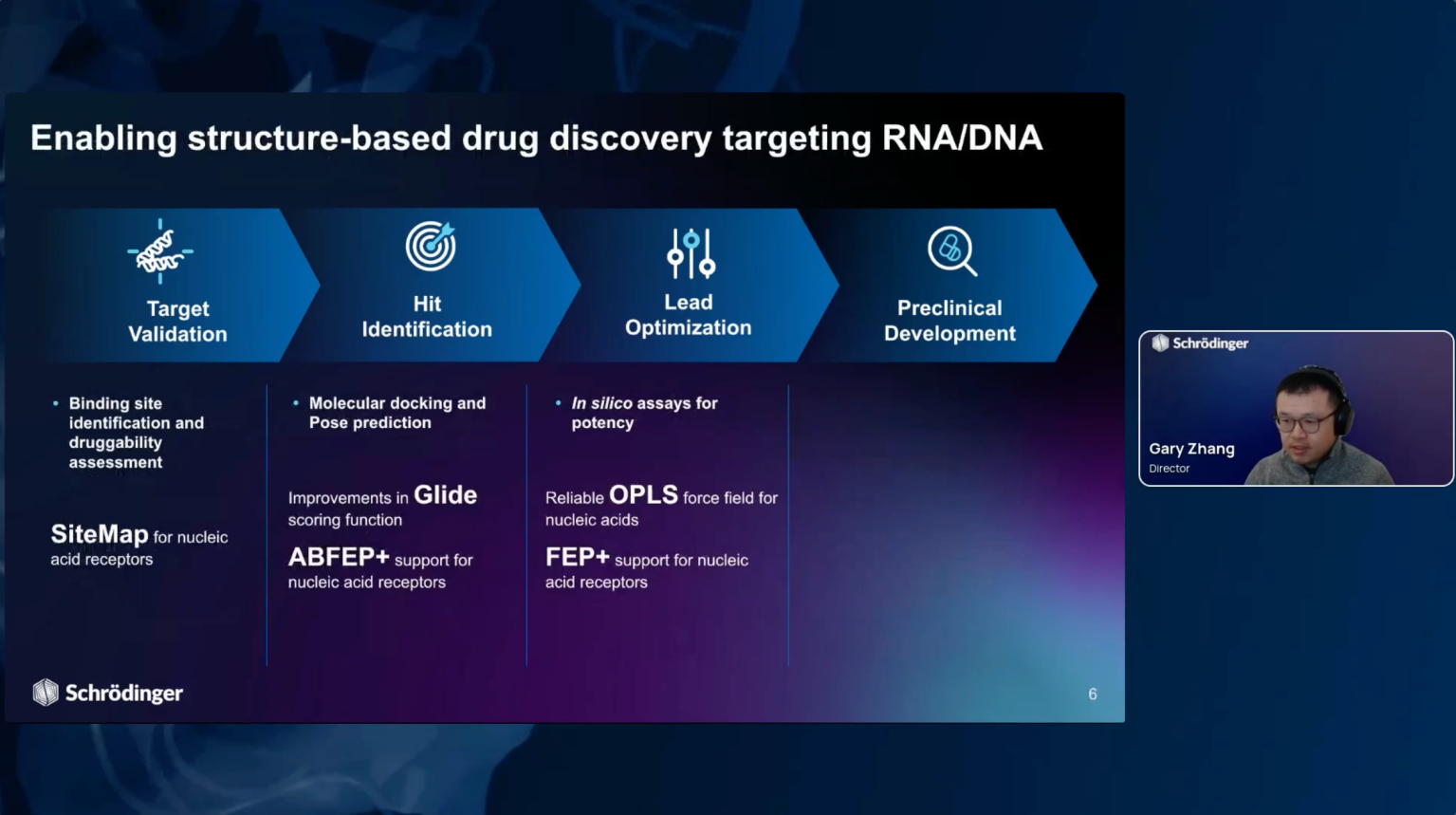
Accurate nucleic acid-ligand binding prediction remains a significant challenge for current computational methods. This limitation has constrained the application of in silico approaches in developing small molecule drugs that modulate RNA and DNA activity, including those with anticancer, antiviral, and antibacterial potential.

In this webinar, we will showcase how Schrödinger’s advanced computational solutions are enabling accurate and efficient targeting of RNA and DNA systems by small molecules. We will demonstrate recent improvements made to in silico hit discovery workflows that can enable structure-based drug discovery into RNA receptors. Additionally, we will highlight a separate study leveraging relative binding free energy perturbation to reliably guide lead optimization in drug discovery programs targeting RNA and DNA. This study will illustrate the systematic retrospective assessment of diverse ligand and receptor classes as well as various ligand-nucleic acid binding modes.

Webinar Highlights

  • Gain an understanding of methods and review recent results on docking small molecules to RNA and DNA with Glide, SiteMap, and absolute binding FEP+
  • Explore strategies for optimizing RNA- and DNA-targeting molecules with relative binding FEP+

Our Speakers

Ara Abramyan

Principal Scientist I, Application Science, Schrödinger

Ara Abramyan is in the Application Science group, helping customers use Schrödinger’s drug discovery suite in their drug discovery endeavors. Outside of customer support, Ara leads external and internal collaborative projects involving nucleic acid- and membrane transporter-based systems using IFD-MD, Desmond, and FEP+ among other workflows. Prior to joining Schrödinger, Ara was a postdoc at the NIH where he led projects on compounds binding to neurotransmitter transporter systems using MD simulations and Markov state models. Before that he obtained his PhD at the University of the Sciences in Philadelphia working on foldamer- and foldamer-DNA-systems using MD and metadynamics simulations while parametrizing the force field for an accurate description of foldamers.

Gary Zhang

Director, Hit Discovery, Schrödinger

Gary Zhang, Ph.D. is the product manager of Schrödinger docking technologies. Gary leads the team improving the performance and expanding the domain of applicability of Schrödinger docking tools. He received his Ph.D. from Duke University working on engineering charge transfer pathways in biological systems and followed by postdoctoral training at Scripps Research working on improving peptide docking performance.