Educator’s Month 2025

Event

Educator’s Month 2025

CalendarDate & Time
  • June 3rd-27th, 2025
Register

Bring Educational Technology Into the Science Classroom

Schrödinger is proud to host Educator’s Month 2025 from June 3-27. Throughout the month, join us for webinars, in-person workshops, and an undergraduate student virtual science fair that will highlight the role of computational tools in the classroom and connect you with educators from all over the world. The event will feature:

  • Presentations from educators at global academic institutions
  • Networking with like-minded educators
  • Ideas for best practices for developing academic curriculum that integrate educational tools
  • The inaugural “Molecules & models – A virtual science fair” open to all U.S. undergraduate students

Check out the calendar below for a list of events and hands-on workshops:

icon time JUN 3 | 12:00PM ET
icon location Virtual
Webinar

Speaker:
Toni-Marie Achilli, Brown University

Register

icon time JUN 4 | 9:00AM ET
icon location Virtual
Webinar

Speaker:
Benjamin Pölloth, Freie Universität Berlin

Register

icon time JUN 5 | 12:00PM ET
icon location Virtual
Webinar

Speaker:
Dinadayalane Tandabany, Clark Atlanta University

Register

icon time JUN 5 | 12:30PM ET
icon location Virtual
Webinar

Speaker:
Arthur Sikora, Nova Southeastern University

Register

icon time JUN 6 | 10:00AM ET
icon location Harvard University
Workshop

Speaker:
Schrödinger Education Team

Register

icon time JUN 9 | 4:00PM ET
icon location Virtual
Webinar

Speaker:
Kari Stone, Lewis University

Register

icon time JUN 11 | 9:30AM ET
Webinar

Speaker:
Natalia A. Szulc, International Institute of Molecular and Cell Biology in Warsaw, Poland

icon time JUN 12 | 9:00AM
icon location Virtual
Science Fair

Speaker:
Emma Kuczkowski and Katherine Bay, Schrödinger

Register

icon time JUN 18 | 10:00AM CT
icon location University of
Illinois, Chicago
Workshop

Speaker:
Schrödinger Education Team

Register

icon time JUN 20 | 10:00AM PT
icon location University of
California, Los Angeles
Workshop

Speaker:
Schrödinger Education Team

Register

icon time JUN 24 | 12:00PM ET
icon location Virtual
Webinar

Speaker:
Kevin Range, Commonwealth University – Lock Haven

Register

icon time JUN 27 | 10:00AM
icon location University of
Strasbourg, France
Workshop

Speaker:
Schrödinger Education Team

Register

Our Speakers

Toni-Marie Achilli

Associate Dean of Biology Undergraduate Education, Brown University
Benjamin Pölloth

Professor of Chemistry Education, Freie Universität Berlin

Natalia Szulc

Scientist, International Institute of Molecular and Cell Biology

Dinadayalane Tandabany

Professor of Chemistry, Clark Atlanta University

Arthur Sikora

Assistant Professor, Nova Southeastern University

Kari Stone

Associate Professor, Lewis University

Kevin Range

Professor, Commonwealth University – Lock Haven

Matt Repasky

Senior Vice President, Life Sciences Products, Schrödinger

Educator’s Month: Integrating Computational Molecular Modeling into Science Curricula

Workshop

Educator’s Month: Integrating computational molecular modeling into science curricula

CalendarDate & Time
  • June 27th, 2025
LocationLocation
  • University of Strasbourg, France
Register

This in-person event will bring together chemistry and biology educators from Western Europe. The event will be hosted at the University of Strasbourg. This workshop will highlight how educators can collaborate to create interdisciplinary lessons using computational molecular modeling.

Attendees will be guided through designing lesson plans that merge chemistry, biology, and physics concepts through computational molecular visualization, modeling, and simulation.

There will also be free lunch and a networking hour with like-minded science educators from various Western Europe schools and universities.

Workshop Details

Who should attend:

  • Chemistry and biology professors or teaching faculty (undergraduate, graduate)
  • High school chemistry and biology teachers (college prep, honors, AP/IB level)
  • Chemistry and biology postdoctoral scholars who are interested in teaching

Registration:

Registration is free and includes lunch and refreshments.

Participants must bring their own laptop to access the software, and an external mouse is recommended.

Spots are limited, so please register early to secure your spot.

Registration will close on Friday, June 20th, 2025.

When & Where:

Friday, June 27th from 10:00 AM to 2:00 PM

University of Strasbourg

TBD

Please see the Agenda for more workshop details and our FAQs for information regarding what to bring, getting to the venue, and accessibility.

Event Highlights

– Demo and walkthrough of interdisciplinary lessons that incorporate web-based computational molecular modeling tools, such as (but not limited to) exploring the molecular structure of biomaterials, understanding protein structure in the context of drug discovery, or simulating chemical reactions in biological systems.

– Learn how to use computational tools to create virtual experiments for your students that could be used across subjects (e.g., modeling polymerization in materials science and organic chemistry).

  • – Group discussions on educational tools that educators have used in a teaching capacity.

What you will walk away with

  • An outline of a custom lesson plan where molecular visualization and simulation could be applied to a course you teach
  • Fundamental molecular modeling skills that can be applied to teaching students scientific concepts with real-world applications in drug discovery, materials design, and more
  • Pedagogical ideas to connect commonly taught scientific concepts to topics in human health through molecular visualization

If you have any questions, please reach out to the Schrödinger Education Team at teaching@schrodinger.com for assistance.

Agenda

Register

Frequently Asked Questions

Registration

How do I register for the event?

To register for the event, simply complete the registration form on the homepage. Once submitted, you will receive a confirmation email. Space is limited so we encourage early registration.

Is there a registration fee?

No, registration is completely free to attend the workshop. We will also be providing food and refreshments throughout the day.

Can I join the session virtually / remotely?

As we want to give the attendees help and guidance during the workshop we currently have no intention of running this workshop online. Please reach out if you are interested but are unable to travel to the event location.

Can I cancel my registration if I am unable to attend?

Yes. Please contact us directly at teaching@schrodinger.com.

Event information

When and where is the event taking place?

The “Integrating Computational Molecular Modeling into Science Curricula” Workshop will be held on June 27th, 2025 from 10:00 AM – 2:00 PM, at the University of Strasbourg – main campus. Exact classroom location details will be emailed directly to registered participants.
4 Rue Blaise Pascal, 67081 Strasbourg, France

What can I expect at the workshop?

This workshop will highlight how educators can collaborate to create interdisciplinary lessons using computational molecular modeling. Attendees will be guided through designing lesson plans that merge chemistry, biology, and physics concepts through computational molecular visualization, modeling, and simulation.

What do I need to bring?

  • A laptop is required for this workshop. We will not be providing any on the day, so please ensure that you bring one. We also recommend that you bring a personal laptop to avoid any firewall restrictions.
  • An external mouse is not required, but we do recommend that you bring one as our software makes full use of the 3 buttons.
  • We will be utilizing the Schrödinger Virtual Computer for a hands-on demo. A suitable web browser is required for accessing this (Chrome, Edge, Firefox).

Will lunch be provided during the event?

Yes, lunch will be provided during designated breaks throughout the workshop. Please specify any dietary restrictions or special accommodations needed during registration.

Is there parking available at the event venue?

Yes, parking facilities will be available. Specific parking garage details will be emailed to registered participants.

Educator’s Month: Integrating Computational Molecular Modeling into Science Curricula

Workshop

Educator’s Month: Integrating computational molecular modeling into science curricula

CalendarDate & Time
  • June 20th, 2025
LocationLocation
  • University of California, Los Angeles, California
Register

This in-person event will bring together chemistry and biology educators from the Los Angeles area. The event will be hosted at the University of California, Los Angeles (UCLA) – Department of Chemistry. This workshop will highlight how educators can collaborate to create interdisciplinary lessons using computational molecular modeling.

Attendees will be guided through designing lesson plans that merge chemistry, biology, and physics concepts through computational molecular visualization, modeling, and simulation.

There will also be free lunch and a networking hour with like-minded science educators from various Southern California-based schools and universities.

Workshop Details

Who should attend:

  • Chemistry and biology professors or teaching faculty (undergraduate, graduate)
  • High school chemistry and biology teachers (college prep, honors, AP/IB level)
  • Chemistry and biology postdoctoral scholars who are interested in teaching

Registration:

Registration is free and includes lunch and refreshments.

Participants must bring their own laptop to access the software, and an external mouse is recommended.

Spots are limited, so please register early to secure your spot.

Registration will close on Friday, June 13th, 2025.

When & Where:

Friday, June 20th from 10:00 AM to 2:00 PM

University of Los Angeles, California (UCLA) – Chemistry Department

607 Charles E Young Dr E, Los Angeles, CA 90024

Please see the Agenda for more workshop details and our FAQs for information regarding what to bring, getting to the venue, and accessibility.

Event Highlights

– Demo and walkthrough of interdisciplinary lessons that incorporate web-based computational molecular modeling tools, such as (but not limited to) exploring the molecular structure of biomaterials, understanding protein structure in the context of drug discovery, or simulating chemical reactions in biological systems.

– Learn how to use computational tools to create virtual experiments for your students that could be used across subjects (e.g., modeling polymerization in materials science and organic chemistry).

  • – Group discussions on educational tools that educators have used in a teaching capacity.

What you will walk away with

  • An outline of a custom lesson plan where molecular visualization and simulation could be applied to a course you teach
  • Fundamental molecular modeling skills that can be applied to teaching students scientific concepts with real-world applications in drug discovery, materials design, and more
  • Pedagogical ideas to connect commonly taught scientific concepts to topics in human health through molecular visualization

If you have any questions, please reach out to the Schrödinger Education Team at teaching@schrodinger.com for assistance.

Agenda

Register

Frequently Asked Questions

Registration

How do I register for the event?

To register for the event, simply complete the registration form on the homepage. Once submitted, you will receive a confirmation email. Space is limited so we encourage early registration.

Is there a registration fee?

No, registration is completely free to attend the workshop. We will also be providing food and refreshments throughout the day.

Can I join the session virtually / remotely?

As we want to give the attendees help and guidance during the workshop we currently have no intention of running this workshop online. Please reach out if you are interested but are unable to travel to the event location.

Can I cancel my registration if I am unable to attend?

Yes. Please contact us directly at teaching@schrodinger.com.

Event information

When and where is the event taking place?

The “Integrating Computational Molecular Modeling into Science Curricula” Workshop will be held on June 20th, 2025 from 10:00 AM – 2:00 PM, at the University of California, Los Angeles – Department of Chemistry. Exact classroom location details will be emailed directly to registered participants.
607 Charles E Young Dr E, Los Angeles, CA 90095

What can I expect at the workshop?

This workshop will highlight how educators can collaborate to create interdisciplinary lessons using computational molecular modeling. Attendees will be guided through designing lesson plans that merge chemistry, biology, and physics concepts through computational molecular visualization, modeling, and simulation.

What do I need to bring?

  • A laptop is required for this workshop. We will not be providing any on the day, so please ensure that you bring one. We also recommend that you bring a personal laptop to avoid any firewall restrictions.
  • An external mouse is not required, but we do recommend that you bring one as our software makes full use of the 3 buttons.
  • We will be utilizing the Schrödinger Virtual Computer for a hands-on demo. A suitable web browser is required for accessing this (Chrome, Edge, Firefox).

Will lunch be provided during the event?

Yes, lunch will be provided during designated breaks throughout the workshop. Please specify any dietary restrictions or special accommodations needed during registration.

Is there parking available at the event venue?

Yes, parking facilities will be available. Specific parking garage details will be emailed to registered participants.

Educator’s Month: Integrating Computational Molecular Modeling into Science Curricula

Workshop

Educator’s Month: Integrating computational molecular modeling into science curricula

CalendarDate & Time
  • June 18th, 2025
LocationLocation
  • University of Illinois, Chicago, Illinois
Register

This in-person event will bring together chemistry and biology educators from the Chicago area. The event will be hosted at the University of Illinois, Chicago Department of Chemistry. This workshop will highlight how educators can collaborate to create interdisciplinary lessons using computational molecular modeling.

Attendees will be guided through designing lesson plans that merge chemistry, biology, and physics concepts through computational molecular visualization, modeling, and simulation.

There will also be free lunch and a networking hour with like-minded science educators from various Chicago-based schools and universities.

Workshop Details

Who should attend:

  • Chemistry and biology professors or teaching faculty (undergraduate, graduate)
  • High school chemistry and biology teachers (college prep, honors, AP/IB level)
  • Chemistry and biology postdoctoral scholars who are interested in teaching

Registration:

Registration is free and includes lunch and refreshments.

Participants must bring their own laptop to access the software, and an external mouse is recommended.

Spots are limited, so please register early to secure your spot.

Registration will close on Wednesday, June 11th, 2025.

When & Where:

Wednesday, June 18th from 10:00 AM to 2:00 PM

University of Illinois, Chicago – Chemistry Department

845 W Taylor St, Chicago, IL 60607

Please see the Agenda for more workshop details and our FAQs for information regarding what to bring, getting to the venue, and accessibility.

Event Highlights

– Demo and walkthrough of interdisciplinary lessons that incorporate web-based computational molecular modeling tools, such as (but not limited to) exploring the molecular structure of biomaterials, understanding protein structure in the context of drug discovery, or simulating chemical reactions in biological systems.

– Learn how to use computational tools to create virtual experiments for your students that could be used across subjects (e.g., modeling polymerization in materials science and organic chemistry).

  • – Group discussions on educational tools that educators have used in a teaching capacity.

What you will walk away with

  • An outline of a custom lesson plan where molecular visualization and simulation could be applied to a course you teach
  • Fundamental molecular modeling skills that can be applied to teaching students scientific concepts with real-world applications in drug discovery, materials design, and more
  • Pedagogical ideas to connect commonly taught scientific concepts to topics in human health through molecular visualization

If you have any questions, please reach out to the Schrödinger Education Team at teaching@schrodinger.com for assistance.

Agenda

Register

Frequently Asked Questions

Registration

How do I register for the event?

To register for the event, simply complete the registration form on the homepage. Once submitted, you will receive a confirmation email. Space is limited so we encourage early registration.

Is there a registration fee?

No, registration is completely free to attend the workshop. We will also be providing food and refreshments throughout the day.

Can I join the session virtually / remotely?

As we want to give the attendees help and guidance during the workshop we currently have no intention of running this workshop online. Please reach out if you are interested but are unable to travel to the event location.

Can I cancel my registration if I am unable to attend?

Yes. Please contact us directly at teaching@schrodinger.com.

Event information

When and where is the event taking place?

The “Integrating Computational Molecular Modeling into Science Curricula” Workshop will be held on June 18th, 2025 from 10:00 AM – 2:00 PM, at the University of Illinois, Chicago – Department of Chemistry. Exact classroom location details will be emailed directly to registered participants.
845 W Taylor St, Chicago, IL 60607

What can I expect at the workshop?

This workshop will highlight how educators can collaborate to create interdisciplinary lessons using computational molecular modeling. Attendees will be guided through designing lesson plans that merge chemistry, biology, and physics concepts through computational molecular visualization, modeling, and simulation.

What do I need to bring?

  • A laptop is required for this workshop. We will not be providing any on the day, so please ensure that you bring one. We also recommend that you bring a personal laptop to avoid any firewall restrictions.
  • An external mouse is not required, but we do recommend that you bring one as our software makes full use of the 3 buttons.
  • We will be utilizing the Schrödinger Virtual Computer for a hands-on demo. A suitable web browser is required for accessing this (Chrome, Edge, Firefox).

Will lunch be provided during the event?

Yes, lunch will be provided during designated breaks throughout the workshop. Please specify any dietary restrictions or special accommodations needed during registration.

Is there parking available at the event venue?

Yes, parking facilities will be available. Specific parking garage details will be emailed to registered participants.

Educator’s Month: Integrating Computational Molecular Modeling into Science Curricula

Workshop

Educator’s Month: Integrating computational molecular modeling into science curricula

CalendarDate & Time
  • June 6th, 2025
LocationLocation
  • Harvard University, Boston, Massachusetts
Register

This in-person event will bring together chemistry and biology educators from the Boston area. The event will be hosted at Harvard University. This workshop will highlight how educators can collaborate to create interdisciplinary lessons using computational molecular modeling.

Attendees will be guided through designing lesson plans that merge chemistry, biology, and physics concepts through computational molecular visualization, modeling, and simulation.

There will also be free lunch and a networking hour with like-minded science educators from various Boston-based schools and universities.

Workshop Details

Who should attend:

  • Chemistry and biology professors or teaching faculty (undergraduate, graduate)
  • High school chemistry and biology teachers (college prep, honors, AP/IB level)
  • Chemistry and biology postdoctoral scholars who are interested in teaching

Registration:

Registration is free and includes lunch and refreshments.

Participants must bring their own laptop to access the software, and an external mouse is recommended.

Spots are limited, so please register early to secure your spot.

Registration will close on Friday, May 30th, 2025.

When & Where:

Friday, June 6th from 10:00 AM to 2:00 PM

Harvard University

TBD

Please see the Agenda for more workshop details and our FAQs for information regarding what to bring, getting to the venue, and accessibility.

Event Highlights

– Demo and walkthrough of interdisciplinary lessons that incorporate web-based computational molecular modeling tools, such as (but not limited to) exploring the molecular structure of biomaterials, understanding protein structure in the context of drug discovery, or simulating chemical reactions in biological systems.

– Learn how to use computational tools to create virtual experiments for your students that could be used across subjects (e.g., modeling polymerization in materials science and organic chemistry).

  • – Group discussions on educational tools that educators have used in a teaching capacity.

What you will walk away with

  • An outline of a custom lesson plan where molecular visualization and simulation could be applied to a course you teach
  • Fundamental molecular modeling skills that can be applied to teaching students scientific concepts with real-world applications in drug discovery, materials design, and more
  • Pedagogical ideas to connect commonly taught scientific concepts to topics in human health through molecular visualization

If you have any questions, please reach out to the Schrödinger Education Team at teaching@schrodinger.com for assistance.

Agenda

Register

Frequently Asked Questions

Registration

How do I register for the event?

To register for the event, simply complete the registration form on the homepage. Once submitted, you will receive a confirmation email. Space is limited so we encourage early registration.

Is there a registration fee?

No, registration is completely free to attend the workshop. We will also be providing food and refreshments throughout the day.

Can I join the session virtually / remotely?

As we want to give the attendees help and guidance during the workshop we currently have no intention of running this workshop online. Please reach out if you are interested but are unable to travel to the event location.

Can I cancel my registration if I am unable to attend?

Yes. Please contact us directly at teaching@schrodinger.com.

Event information

When and where is the event taking place?

The “Integrating Computational Molecular Modeling into Science Curricula” Workshop will be held on June 6th, 2025 from 10:00 AM – 2:00 PM, at Harvard University’s Science Center. Exact classroom location details will be emailed directly to registered participants.
1 Oxford St, Cambridge, MA 02138

What can I expect at the workshop?

This workshop will highlight how educators can collaborate to create interdisciplinary lessons using computational molecular modeling. Attendees will be guided through designing lesson plans that merge chemistry, biology, and physics concepts through computational molecular visualization, modeling, and simulation.

What do I need to bring?

  • A laptop is required for this workshop. We will not be providing any on the day, so please ensure that you bring one. We also recommend that you bring a personal laptop to avoid any firewall restrictions.
  • An external mouse is not required, but we do recommend that you bring one as our software makes full use of the 3 buttons.
  • We will be utilizing the Schrödinger Virtual Computer for a hands-on demo. A suitable web browser is required for accessing this (Chrome, Edge, Firefox).

Will lunch be provided during the event?

Yes, lunch will be provided during designated breaks throughout the workshop. Please specify any dietary restrictions or special accommodations needed during registration.

Is there parking available at the event venue?

Yes, parking facilities will be available. Specific parking garage details will be emailed to registered participants.

Educator’s Month: Molecules & Models – A Virtual Science Fair

Virtual Science Fair

Educator’s Month – Molecules & models: A virtual science fair

CalendarDate & Time
  • June 12th, 2025
LocationLocation
  • Virtual

As part of Educator’s Month, Schrödinger hosted its first Virtual Science Fair on June 12, 2025. This free event invited undergraduate students from across the U.S. to showcase their research, engage in discussions with Schrödinger judges, and compete for awards recognizing their creativity, effort, and commitment.

The Virtual Science Fair was open to first-time undergraduate participants from a wide range of disciplines. All projects were required to include a computational component, such as artificial intelligence, experimental design, or molecular modeling in fields including drug discovery, agrochemicals, materials science, medicinal and organic chemistry, pharmaceuticals, polymers, catalysis, computational biology, biophysics, or theoretical chemistry.

Winners received a cash prize and one year of unlimited access to Schrödinger’s online certification courses – supporting both their research and ongoing computational skill development.

Presentation Recordings

  • Computational Design of de novo Transcription Factors for Targeted Genetic Repression
    Speaker:
    Beau Lonnquist, University of Washington, (science fair winner)
    Watch now
  • Modeling Molecular Scale Dynamics of Kinetically Gated Carbon Dioxide Capture Using Photoswitch Functionality in Metal Organic Frameworks
    Speaker:
    Ryan Miller, Pacific University, (science fair winner)
    Watch now
  • Molecular Basis of Adenylyl Cyclase 1 Activation Revealed by MD Simulations
    Speaker:
    Shreya Krishnan, Purdue University, (science fair winner)
    Watch now
     
  • Repurposing L-Type Calcium Channel Blockers as Respiratory Virus Therapeutics: A Computational Modeling Approach
    Speaker:
    Aiden T. Day, Saint Joseph’s College of Maine
    Watch now
  • Discovery of FabG Inhibitors for Yersinia pestis Using Computational and Biochemical Approaches
    Speaker:
    Catalina Colling, University of Texas at Austin
    Watch now
     
  • Analyzing the Value of Machine Learning in Improving the Acceptance Rate for Metropolis Monte Carlos
    Speaker:
    Enoch Woldu, University of Chicago
    Watch now
  • Comparative Molecular Drug Docking to hERG and CaV1.2- Channels to Understand Drug-Induced Cardiac Risks
    Speaker:
    Ensley Jang, University of California, Davis
    Watch now
     
  • Computational Development of a Hydrolase with Increased Degradation Capabilities Against Crystalline PET
    Speaker:
    Mena Boggs, NCSSM/NC State University
    Watch now
  • Protein and Solvent Dynamics Simulations to Understand Cancer Mutations
    Speaker:
    Michael Sarullo, Yale University
    Watch now
     
  • Dynamic Docking: A Scalable Computational Framework for Conformational Profiling of Small Molecule/RNA Binding
    Speaker:
    Nakul Balaji, Florida Atlantic University
    Watch now
  • Discovery of Aza-stilbene as a Scaffold for a Histamine Receptor H2 Antagonist for the Treatment of Gastroesophageal Reflux Disease
    Speaker:
    Nihar Kummetha, North Carolina School of Science and Mathematics
    Watch now
     
  • Analyzing Quantum Exceptional Point Invisibility for Experimentally Realizable Triple-Gaussian Potentials
    Speaker:
    Shrikar Dulam, University of Illinois, Urbana-Champaign
    Watch now
  • Deep Learning–Based Structural Modeling of YscF Mutants Reveals Determinants of Type III Secretion System Architecture in Yersinia pestis
    Speaker:
    Stephanie Bellido, Nova Southeastern University
    Watch now
     
  • Extending the Functionality of the Excel-to-SBOL Converter for Broader Synthetic Biology Applications
    Speaker:
    Taisiia Sherstiukova, University of Colorado Boulder
    Watch now
  • BitBIRCH: Efficiently Clustering 1 Billion Molecules
    Speaker:
    Vicky Jung, University of Florida
    Watch now

Educator’s Month Webinars 2025

Webinar Series

Educator’s Month Webinars 2025

CalendarDate & Time
  • June 1st-30th, 2025
LocationLocation
  • Virtual
Register

Bring education technology into the science classroom

  • June 3, 2025
    Keynote Address – Intelligence Amplified: Human-Centered Education in the Age of AI
    Speakers:
    Matt Repasky, Senior Vice President, Life Sciences Products, Schrödinger
    Toni-Marie Achilli, Associate Dean of Biology Undergraduate Education, Brown University
    Watch now
     
  • June 4, 2025
    How can high school students use computational chemistry for scientific inquiry? Insights from the development of the Comp-Chem Lab
    Speaker: Benjamin Pölloth, Professor of Chemistry Education, Freie Universität Berlin
    Watch now
     
  • June 5, 2025
    Molecular visualization and teaching with Schrodinger for sophomore organic chemistry courses
    Speaker: Dinadayalane Tandabany, Professor of Chemistry, Clark Atlanta University
    Watch now
     
  • June 5, 2025
    Powerful computational tools to help bring proteins to life for students
    Speaker: Arthur Sikora, Assistant Professor, Nova Southeastern University
    Watch now
     
  • June 9, 2025
    Drug discovery in the classroom
    Speaker: Kari Stone, Associate Professor, Lewis University
    Watch now
     
  • June 11, 2025
    Targeted Protein Degradation Goes to School: From Bench to Browser with DEGRADATOR
    Speaker: Natalia Szulc, Scientist, International Institute of Molecular and Cell Biology
    Watch now
  • June 24, 2025
    Visualizing atomic and molecular orbitals and calculations exploring protonation of nitrogen versus oxygen
    Speaker: Kevin Range, Professor, Commonwealth University – Lock Haven
    Watch now

Our Speakers

Toni-Marie Achilli

Associate Dean of Biology Undergraduate Education, Brown University

Benjamin Pölloth

Professor of Chemistry Education, Freie Universität Berlin

Natalia Szulc

Scientist, International Institute of Molecular and Cell Biology

Dinadayalane Tandabany

Professor of Chemistry, Clark Atlanta University

Arthur Sikora

Assistant Professor, Nova Southeastern University

Kari Stone

Associate Professor, Lewis University

Kevin Range

Professor, Commonwealth University – Lock Haven

Matt Repasky

Senior Vice President, Life Sciences Products, Schrödinger

Frequently Asked Questions

How do I join a session?

In order for you to join and watch any of the virtual sessions, you need to register for the event and have a ticket. To view the live broadcast, please go to the agenda tab and login with your personal details (used at the time of registration): https://events.bizzabo.com/educators_month_2025

Which browser should I use?

For optimal performance, please use Google Chrome, Firefox, or Microsoft Edge. The Safari browser is not currently supported.

How do I contact the event organizers?

For any questions, please email teaching@schrodinger.com.

Will the presentations be available on-demand after the event?

Yes, the presentations will be available after the event in an on-demand capacity.

I am interested in attending the in-person workshops. How do I sign up?

For the Boston, MA, USA workshop, sign up here.
For the Chicago, IL, USA workshop, sign up here.
For the Los Angeles, CA, USA workshop, sign up here.
For the Strasbourg, France workshop, sign up here.

I know an undergraduate student interested in competing in the Schrödinger Science Fair. Where can they get more information?

You can find more information on the Schrödinger Virtual Science Fair, happening on June 12th, here.

SAMPE 2025

Conference

SAMPE 2025

CalendarDate & Time
  • May 19th-22nd, 2025
LocationLocation
  • Indianapolis, Indiana

Schrödinger is excited to be participating in the SAMPE 2025 conference taking place on May 19th – 22nd in Indianapolis, Indiana. Join us for a presentation by Andrea Browning, Director of Polymers and Soft Matter at Schrödinger, titled “Aiding Sustainable Composites Development with Simulation of Natural Fibers.” Stop by booth U15 to speak with Schrödinger scientists.

icon time MAY 20 | 10:30AM
Accelerating innovation in advanced composites with a digital chemistry platform

Speaker:
Andrea Browning, Director of Polymers and Soft Matter, Schrödinger

Abstract:
Demands for advanced materials and processes have grown as various industries search for improved and lower cost solutions. Their development has traditionally relied on experimental exploration of candidate chemistries, which is time-consuming, expensive and limited in scope. Optimizing key properties of advanced composites, coatings and energy storage requires understanding of their chemistry and microstructure at atomic level. Physics-based modeling and chemistry-informed machine learning (ML) can significantly accelerate the development process from material selection to processing and lifetime analysis, ensuring that target performance is met. In this presentation, we will show how Schrödinger’s digital chemistry technology can catalyze formulation development through efficient screening of candidate mixtures and increase fundamental understanding of structure-property relationships. We will showcase how our AI/ML and physics-based tools can be applied to the screening of polymer chemistries for target thermomechanical properties for thermosets, efficient additive selection for complex coatings and reactivity at interfaces.

icon time MAY 21 | 3:00PM
icon location Room 126
Aiding Sustainable Composites Development with Simulation of Natural Fibers

Speaker:
Andrea Browning, Director of Polymers and Soft Matter, Schrödinger

Abstract:
Natural fibers have gained interest as potential components to improve the overall sustainability of composite materials. However, natural fibers have unique challenges and cannot be simply substituted for carbon or glass fibers. Better understanding of how natural fibers behave with standard and new resins, along with how they can degrade can help to reduce the risk in transitioning to these new materials. Molecular scale simulation is a powerful tool to provide that understanding. The interaction between resin and natural fibers as well as the impact of compatibilizers are important in designing a composite formulation for use with natural fibers. The degradation of natural fiber chemistry, cellulose, is also insightful as part of the recycling potential for natural fiber composites. This study will present molecular level simulations that address both the natural fiber composite mechanical properties, as well as degradation of cellulose. These findings highlight the impact of molecular simulations to bridge the connection between molecular level interactions and design considerations in natural fiber composites, aiding in the design of more sustainable composites.

Accelerating OLED innovation with multi-scale, multi-physics simulations

APRIL 16, 2025

Accelerating OLED innovation with multi-scale, multi-physics simulations

OLED technology is widely used in mobile devices, AR/VR systems, and automotive displays, with its flexibility enabling foldable devices and enhanced user interactions. However, advancing OLEDs requires overcoming challenges such as improving efficiency, extending lifetime, ensuring color stability, and optimizing scalable manufacturing. Since device performance depends on both material properties and fabrication methods, a deeper understanding of OLED materials and device architectures is essential for innovation.

Traditional trial-and-error approaches to materials discovery are costly and time-consuming. To address this, we present the synergistic application of Ansys and Schrödinger predictive technologies to accelerate OLED development through a multi-scale, multi-physics simulation approach. This framework integrates:

  • Molecular modeling to predict materials properties at atomistic scale
  • Nanoscale simulations to examine photonic responses and light-matter interactions
  • Macroscale modeling to assess human perception of displays in real-world conditions

By combining Schrödinger’s expertise in molecular simulations with Ansys’s advanced device modeling, this approach enables faster, cost-effective OLED innovation. Join us to explore how integrated digital workflows drive the design of next-generation, high-performance OLEDs.

Our Speakers

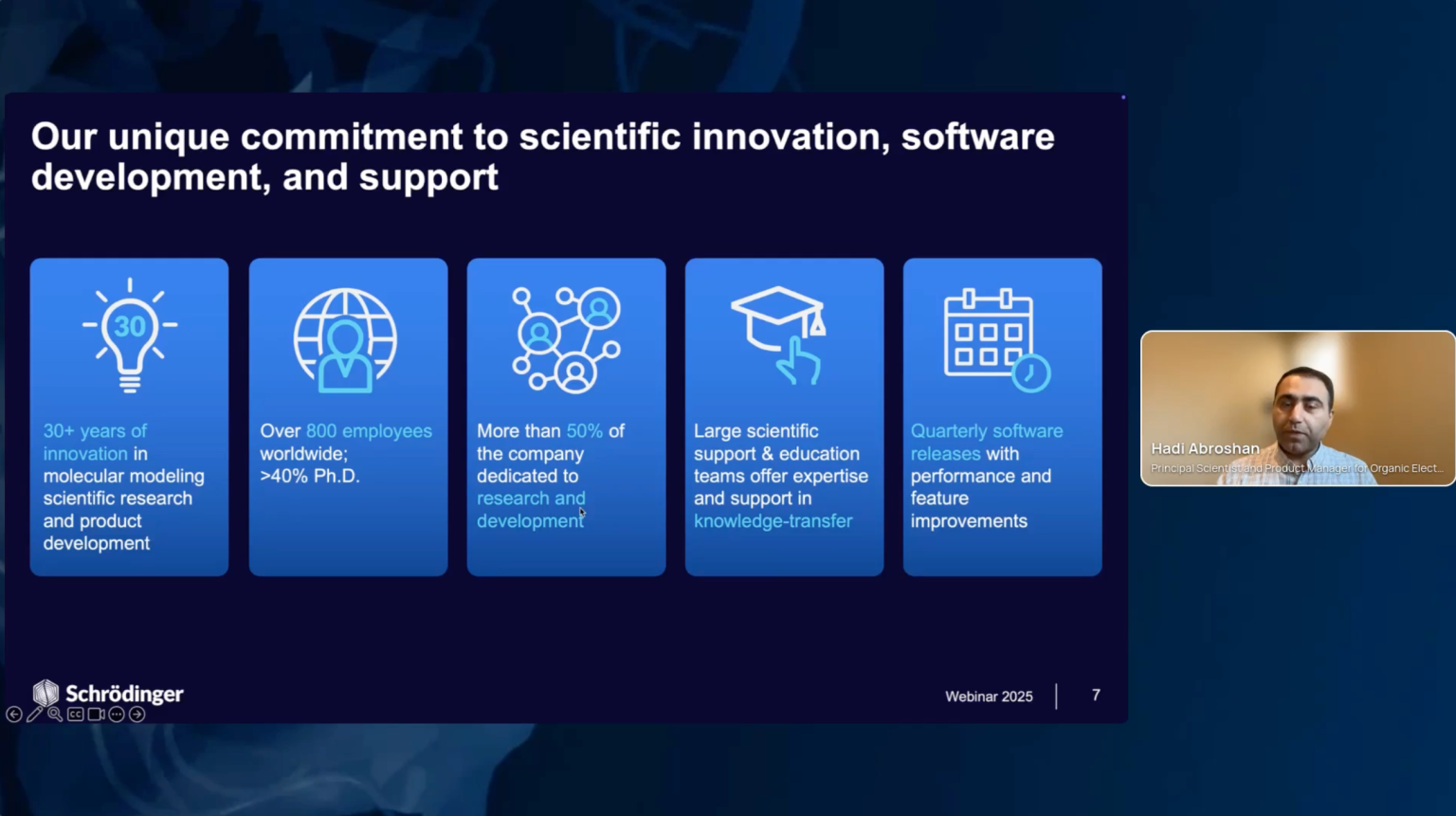
Hadi Abroshan

Principal Scientist I, Schrödinger

Hadi Abroshan is the Product Manager for Organic Electronics at Schrödinger. He holds a Ph.D. from Carnegie Mellon University and has conducted research at Stanford University and Georgia Tech. Hadi specializes in multiscale simulations, leading projects to design cost-effective multifunctional materials for optoelectronics. His expertise lies in developing computational strategies that bridge atomistic structures to multilayered device scales, using a blend of physics-based methodologies and machine learning techniques. His work has led to the discovery of novel, environmentally friendly materials and processes with superior efficiencies.

Thibault Leportier

Senior R&D Engineer, Ansys

Thibault Leportier is an optical scientist with expertise in geometrical and Fourier optics, lasers, and metrology. Holding a Ph.D. in 3D display technologies and digital holography, Thibault has worked extensively on waveguide design for smart glasses and eye-tracking applications. Currently, his focus is on developing innovative solutions to bridge nanoscale simulations with macroscale optical systems, including advancements in metalens and grating models.

Accelerating pharmaceutical formulations using machine learning approaches

APRIL 8, 2025

Accelerating pharmaceutical formulations using machine learning approaches

Machine learning (ML) is revolutionizing pharmaceutical formulation design by enabling data-driven predictions of critical properties such as solubility, viscosity, and stability. Chemistry-informed AI/ML models provide a powerful framework for accelerating materials innovation beyond active pharmaceutical ingredients (APIs) to complex drug formulations. The ability of machine learning to analyze large amounts of data and make predictions about new formulations allows for rapid exploration of vast chemical spaces, significantly reducing the need for traditional trial-and-error experimentation. Automated workflows can integrate chemical composition and molecular structure to generate predictive models, optimizing formulation properties with greater speed and efficiency.

In this webinar, we will demonstrate how Schrödinger’s integrated ML- and physics-based approaches are transforming pharmaceutical formulation design, including:

  • How an automated ML workflow, incorporating chemistry and composition, can predict API solubility in binary solvents
  • How ML models, augmented with physics-based descriptors, can be used to optimize viscosity predictions of organic molecules for better formulation performance
  • How formulation ML tools empower non-experts to design novel drug formulations that satisfy multiple target criteria simultaneously

Our Speakers

Anand Chandrasekaran

Senior Principal Scientist, Schrödinger

Anand Chandrasekaran joined Schrödinger in 2019 and currently serves as the Product Manager for MS Informatics. His expertise lies in applying machine learning across various domains within materials science and computational modeling. He earned his Ph.D. in Materials Science under Prof. Nicola Marzari at the Swiss Federal Institute of Technology, Lausanne. Prior to joining Schrödinger, Anand worked with Prof. Rampi Ramprasad, focusing on polymer informatics, machine learning force fields, and machine learning for electronic structure calculations.

Shiva Sekharan

Senior Director, Schrödinger

Shiva Sekharan, Ph.D., is the Senior Director of Formulations Business Development at Schrödinger and is responsible for driving the business development efforts in the formulations space. Shiva is an experienced business development executive in the CRO and AI-based services and software solutions industry and has several years of experience in managing business accounts, customer relationships, and expectations with clients in the pharmaceutical, agrichemical, and academic industries across the US, Europe, and Asia territories. His expertise lies in identifying new business opportunities among existing customers, devising sales and collaboration strategies for customer expansion,and ensuring top-tier services, products, and knowledge-driven solutions are available 24/7 to customers across the globe. Before joining Schrödinger in 2023, Shiva held a BD role at XtalPi Inc., where he led the US solid-state services unit, worked with departmental heads to establish effective goals, sales targets, outline procedures and best practices, and provide strategic directions to increase revenue. Shiva earned his Ph.D. in Theoretical Chemistry from the University of Duisburg-Essen, Germany, followed by postdoctoral stints at the Max-Planck Institute for Polymer Science, Emory University, Fukui Institute for Fundamental Chemistry, and Yale University. Shiva is an accomplished computational chemist, with strong research expertise in the areas of quantum chemistry and drug discovery (>40 publications, >1100 citations, H-index = 20).

Innovate big, think “small”: Optimizing formulations at the molecular level with physics-powered AI

Workshop

Innovate big, think “small”: Optimizing formulations at the molecular level with physics-powered AI

CalendarDate & Time
  • April 27th, 2025
LocationLocation
  • AOCS Annual Meeting 2025 – Portland, Oregon
Register

In today’s rapidly evolving consumer industry, innovation is no longer optional – it’s essential. As demand shifts toward safer, healthier, and more sustainable products, scientists can’t afford to miss out on cutting-edge computational technologies to stay ahead.

Join us for this two-hour workshop at the AOCS Annual Meeting & Expo on the practical applications of molecular scale, physics-informed AI for research scientists. This workshop is designed for researchers who are developing diverse products – from foods to detergents. Learn how computational approaches can leverage even limited available experimental data to predict ingredient and formulation behaviors at the atomic scale, with the goal to optimize product stability, solubility, and performance. This approach streamlines formulation development, minimizes trial-and-error, and reveals key mechanisms behind complex behaviors – such as emulsion stability and the effects of processing conditions on ingredients.

Participants will leave with a deeper understanding of how these technologies can improve decision-making, reduce costs, and enhance sustainability.

The workshop will cover:

  1. Overview of Schrödinger’s molecular simulation and AI/ML platform
  2. Case studies showcasing successful industry applications
  3. Demos of physics-powered AI for formulation modeling
  4. Q&A session
  5. Opportunities for hands-on work with Schrödinger’s software

Date & Time:

Sunday, April 27, 2025

Workshop from 10:00 AM – 12:00 PM, followed by lunch reception and networking from 12:30 PM – 2:00 PM (provided to registered attendees).

Location:

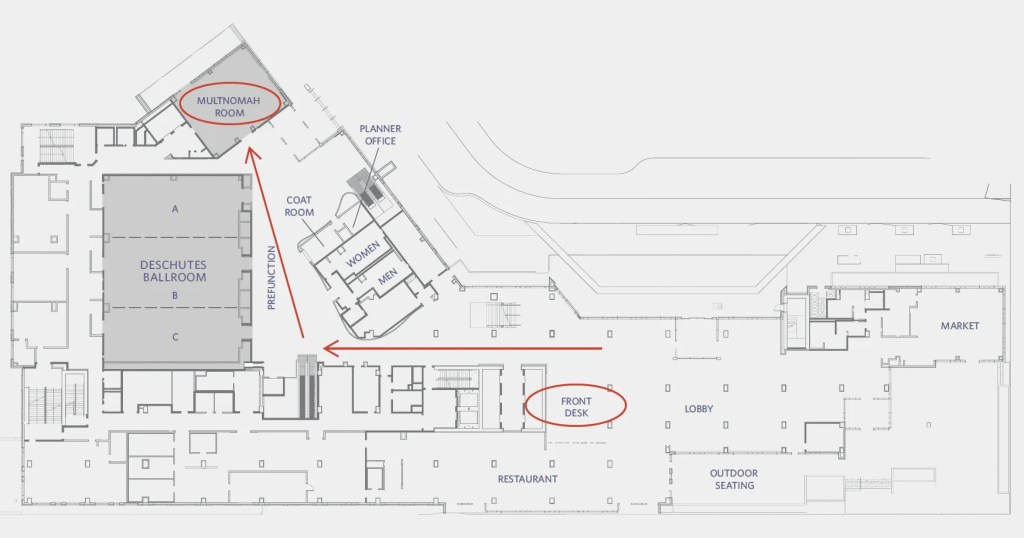
The Multnomah Room at the Hyatt Regency Portland
375 NE Holladay St, Portland, OR 97232

Our Speakers

Jeffrey Sanders

Product Manager and Technical Lead for CPG, Schrödinger

Jeff Sanders received his B.S. in applied physics from Worcester Polytechnic Institute and then his Ph.D. in biophysics and molecular pharmacology from Thomas Jefferson Medical College. Since joining Schrödinger in 2013, he has served several roles. Jeff is currently the product manager and technical lead for the consumer packaged goods applications group. Additionally, he is a managing board member of the Food Engineering, Expansion, and Development (FEED) Institute, and also holds a faculty position in the Food Science Department at UMass Amherst.

Katie Dahlquist

Senior Scientist, Schrödinger

Katie Dahlquist received her B.S. in chemistry from Indiana University and then her Ph.D. in chemistry from University of Iowa. Katie is a Senior Scientist leading the materials science education efforts at Schrödinger. Since joining the company in 2022, she has played a role in developing and delivering our molecular modeling for materials science online certification courses, contributing to our collection of over 90 materials science tutorials, and leading workshops and customer training sessions.

Register

Venue Information

The workshop will be hosted at the Multnomah Room, Hyatt Regency Portland, located at 375 NE Holladay St, Portland, OR 97232. Please refer to the map above for directions.

Digital Formulation: Shaping the Future of Sustainable Medicines Manufacturing

Symposium

Digital Formulation: Shaping the Future of Sustainable Medicines Manufacturing

CalendarDate & Time
  • May 2nd, 2025
  • 9:00 AM – 5:00 PM GMT+1
LocationLocation
  • Birmingham, United Kingdom

Schrödinger is excited to be participating in the Mesox Symposium taking place on May 2nd in Birmingham, United Kingdom. Join us for a presentation by John Shelley, Fellow at Schrödinger, titled “Digital Formulation: Shaping the Future of Sustainable Medicines Manufacturing.”

Our Speaker

John C. Shelley, MSc, Ph.D.

Fellow, Schrödinger

John earned a MSc from the University of Waterloo in theoretical chemistry and a PhD from the University of Pennsylvania in computational chemistry.  Following post-doctoral research in computational chemistry at the University of British Columbia, he worked for Procter & Gamble studying surfactant structures in solution.  For the last 23 years, John has worked for Schrödinger, LLC, as a scientific software developer and a research scientist, managing a number of products including the Materials Science Coarse-Grained product.  John has focused on computer modeling of drug formulations for much of the last 8 years.