Accelerating protein degrader discovery: Computational strategies for degrader design and optimization

MAR 26, 2025

Accelerating protein degrader discovery: Computational strategies for degrader design and optimization

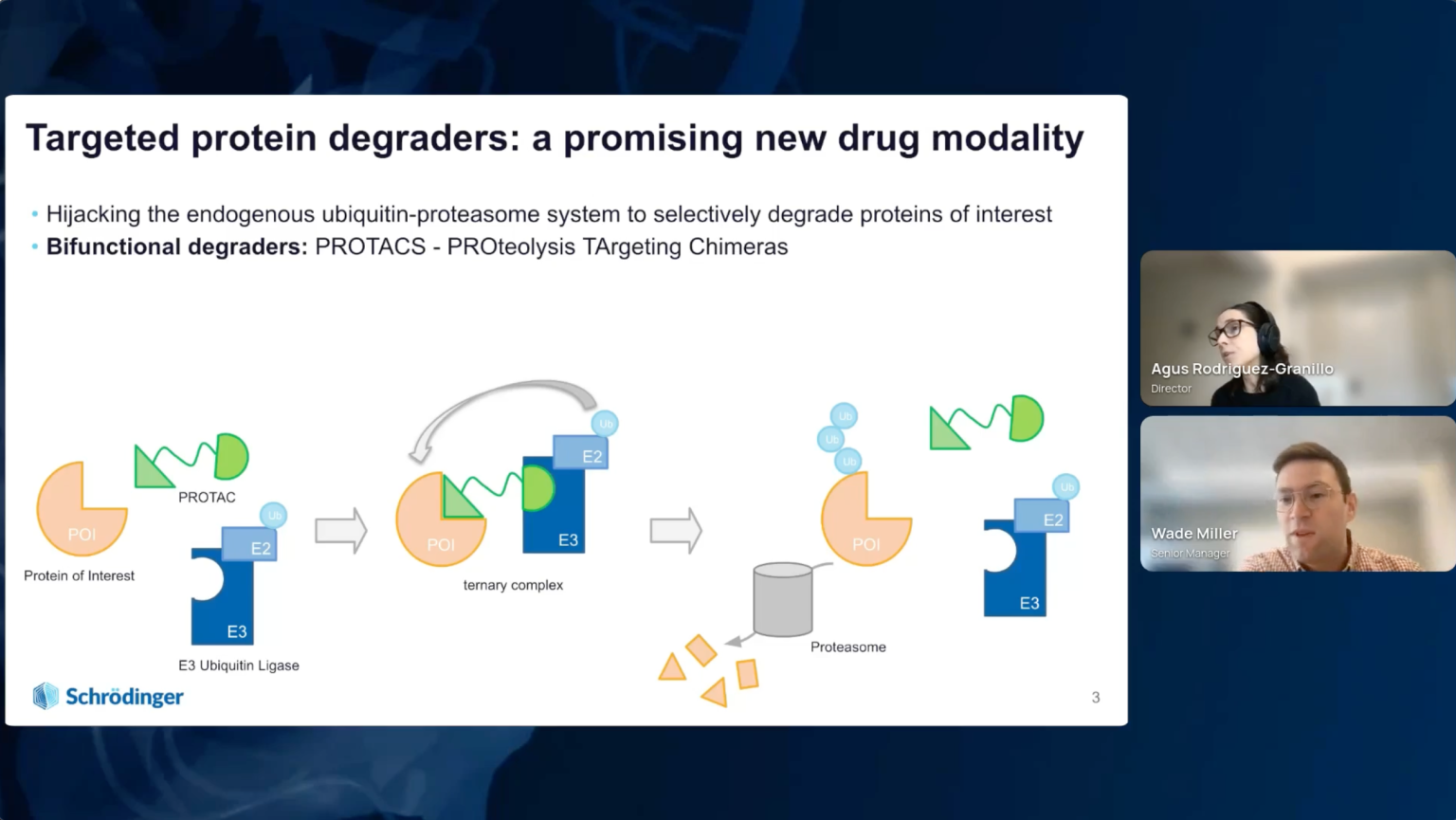
Protein degraders have emerged as a promising modality in drug discovery, offering a novel mechanism for modulating protein function by leveraging the cell’s natural degradation pathways. However, designing protein degraders presents unique challenges due to their bifunctional nature, requiring complex optimization across multiple parameters.

Schrödinger has engaged in collaborative research projects with industry scientists to develop computational workflows that can accurately predict the structure of ternary complexes between two protein partners and a bifunctional molecule. In this webinar, we will showcase Schrödinger’s advanced computational toolkit, which integrates protein-protein docking and linker sampling to generate an ensemble of possible complexes, metadynamics to accurately score these complexes, and free energy perturbation (FEP+) calculations to optimize degrader potency.

Join us to explore how these workflows can accelerate the design of protein degraders—from predicting ternary complexes to optimizing linker properties—and can empower real-time collaboration through Schrödinger’s LiveDesign platform.

Webinar Highlights:

  • Summary of current trends and challenges in the modeling of protein degraders
  • Overview of Schrödinger computational solutions, including exit vector sampling, ternary complex ensemble prediction and filtering using experimental information like HDX-MS, ternary complex scoring, and linker optimization using FEP+
  • Demo of workflows in LiveDesign to streamline the degrader design process
  • Sneak peak of upcoming Maestro panels for protein degrader modeling

Our Speakers

Agus Rodriguez-Granillo

Director, Application Science, Schrödinger

Agus leads the Application Science team in Cambridge, MA, supporting customers in the Northeastern region of the U.S. In addition to customer support, Agus has a strong interest in bifunctional degraders as a new therapeutic modality and has been actively working in this area. Agus is originally from Argentina and earned her Ph.D. in Biochemistry at Rice University in Houston, TX.

Sonia Nicolaou

Senior Scientist II, Application Science, Schrödinger

Sonia Nicolaou is an All Access Application Scientist at Schrödinger based in Cambridge, MA. She received her PhD in Chemistry from the University of Manchester, UK. Since joining Schrödinger she has been providing scientific support to customers and has been involved in the development of new models in LiveDesign. Her more recent efforts have been focused on the implementation of PROTACs workflows in LiveDesign.

23rd Schrödinger European User Group Meeting 2025

User Group Meeting
CalendarDate & Time
  • June 3rd-5th, 2025
LocationLocation
  • Budapest, Hungary

We are pleased to invite you to the 23rd Schrödinger European User Group Meeting

This in-person event will bring together a dedicated group of Schrödinger team members and customers from across Europe. The event will be held at the Hotel Hilton, located within the historic Fisherman’s Bastion.

We are preparing an interactive program including scientific presentations, workshops, and panel discussions, as well as ample opportunities for networking during breaks and evening social events. You will have the chance to enjoy a historic city renowned for its stunning architecture, vibrant culture, and scenic beauty along the Danube River.

Event Highlights

  • User talks highlighting applications of computational molecular design methods for drug discovery
  • Schrödinger presentations and hands-on workshops outlining the latest developments of our molecular design platform
  • Interactive panel discussions
  • Opportunities for 1:1 meetings
  • Networking dinners and receptions

Meeting Details

The event begins on Tuesday, June 3rd at 9:30 AM CET and ends in the afternoon on Thursday, June 5th. To ensure that you don’t miss the opening morning talks, we recommend arriving on Monday, June 2nd.

This year’s meeting will feature sessions on:

  • Scaling predictive models for real-world impact
  • Designing safer molecules by predicting and preventing liabilities
  • Flexible workflows to leverage project insights
  • Target-specific strategies for physics-based modeling
  • Schrödinger’s platform and scientific roadmap

Registration Details

REGISTRATION & HOTEL PACKAGES

We are pleased to offer a specially negotiated conference package at the Hotel Hilton Budapest, available when you register for the event (subject to availability). This comprehensive package includes accommodation, lunches, and dinners (dinners on June 3rd and 4th) to enhance your experience.

Hotel Hilton Package

Stay dates: June 2 – 5, 2025

This conference package includes:

  • Conference registration
  • Three nights of accommodation
  • Daily breakfast
  • Daily lunch
  • Dinner on June 3rd and 4th

Regular rate: EUR 1.150

Conference Only – Registration

This option includes:

  • Conference registration
  • Daily lunch
  • Dinner on June 3rd and 4th

Regular rate: EUR 450

Agenda

FAQs

EVENT INFORMATION

Who should come to the event?

This event is ideal for professionals and experts working in drug discovery. Attendees can include scientists, researchers, product development specialists, R&D managers, executives, and anyone interested in exploring the potential of digital chemistry, molecular modeling, and machine learning to drive innovation in pharmaceutical and biotech industries.

Will the content be available on demand after the event? 

No, the content will most likely not be available on demand after the event. It is essential to attend the live event to benefit from the valuable insights, case studies, and panel discussions shared during the user group meeting.


REGISTRATION

What does the ticket include?

Please see the Registration Details section on the event homepage for details of what is included in each registration package, here: Registration Packages.

What is the cancellation policy?

For cancellation requests, please contact us at europe_ugm@schrodinger.com. Cancellation details vary by conference package, as described below:

Hotel  Packages
Cancellation requests made before April 1, 2025 will be eligible for a full 100% refund.

Conference Only
Cancellation requests made before May 5, 2025 for conference only tickets will be eligible for a full 100% refund.

Are attendee substitutions permitted?

Yes, attendee substitutions are permitted. If you are unable to attend the event, you can request a substitution by contacting us at europe_ugm@schrodinger.com. Please provide the name and contact information of the person who will attend as your substitute.

Whom should I contact if I have special needs?

If you have special needs, please inform us during the registration process. You can also contact us at europe_ugm@schrodinger.com to discuss your requirements.


ACCOMMODATIONS

Please see the Registration Details section on the event homepage for details of hotel conference packages negotiated by Schrödinger, here: Registration Packages.

ACS Spring 2025

ACS Spring 2025

CalendarDate & Time
  • March 23rd-27th, 2025
LocationLocation
  • San Diego, California

Schrödinger is excited to be participating in the ACS Spring 2025 conference taking place on March 23rd – 27th in San Diego California. Stop by booth #3532 to speak with Schrödinger scientists or join us for happy hour on March 26th. Full event details below.

icon time MAR 23 | 8:00AM
icon location Ballroom 20D
Unlocking a New Era: How AI is Transforming Drug Discovery and Development

Speaker:
Yefen Zou, Senior Principal Scientist, Schrödinger

Abstract:
We are seeing an unprecedented growth on AI-driven research towards the development of new medicines. Nowadays, AI can impact all aspects of drug development: from enabling generative chemistry, to analysis of large datasets to accelerate hit finding, reduce timelines in the design of drug-like lead compounds, to structure-based drug design with AlphaFold to applications to green and sustainable drug development synthesis. This exponential growth covers AI-biotechs to large pharma, pioneer academic researchers and AI-technology organizations, effectively unlocking a new era to bring new medicines to patients in need. This symposium will showcase examples of how AI is impacting drug development from early discovery, to drug development, from industry to academic research and teams comprising members of MEDI, ORGN, COMP, I&EC, CINF Divisions.

icon time MAR 23 | 3:45PM
icon location Pacific Ballroom: Section 23
Transforming Polymer Design for Industrial Applications Using Experiment Data, Machine Learning, and Physics-Based Modeling

Speaker:
Atif Afzal, Principal Scientist II, Schrödinger

Abstract:
Designing industrially relevant polymers is challenging due to the need to simultaneously optimize multiple material properties, making traditional trial-and-error methods costly and inefficient. A promising alternative is the integration of machine learning (ML) and physics-based approaches to explore the polymer design space and identify candidates that meet specific industrial criteria. This work presents a workflow combining ML and molecular modeling techniques, demonstrated through two case studies in polymer design. The first case is an internal study focused on elastomers with target thermophysical and mechanical properties. Using curated datasets of experimental property values from the literature, we developed ML models that accurately predict the properties of new elastomers. These models screened over 100,000 copolymers, identifying top candidates with superior glass transition temperatures and elastic moduli suitable for elastomer applications. The second case presents results from a collaboration with SABIC Specialties involving polycarbonate design*, targeting key polymer properties, including glass transition temperature, optical properties, and mechanical strength. Using an experimental dataset, we trained ML models to predict these polymer properties based on structure and monomer composition. We subsequently screened several thousands of polycarbonate structures generated via R-group enumeration and identified the top candidates. These candidates were validated through molecular dynamics simulations and density functional theory, demonstrating strong correlations between ML predictions and physics-based approaches. Experimental validation further confirmed the accuracy of our models. This workflow demonstrates the power of integrating data-driven and physics-based methods in polymer design, offering an efficient strategy for material scientists working with limited experimental data. *Collaboration with SABIC Specialties is gratefully acknowledged.

icon time MAR 24 | 11:35AM
Combined Physics-Based and Machine Learning Approaches in the Design of Complex Materials

Speaker:
Anand Chandrasekaran, Senior Principal Scientist, Schrödinger

Abstract:
The simulation of materials properties using physics-based approaches, such as density functional theory (DFT) and molecular dynamics (MD), has long been successful in providing insights into structure-property relationships and subsequently aiding in the design of novel materials. More recently, machine learning (ML) has been used extensively in conjunction with physics-based modeling techniques to greatly accelerate materials innovation. The accuracy and generalizability of physics-based modeling improves the performance of ML models and enables them to be used effectively even in small-data regimes. Conversely, the speed and flexibility of ML help bridge the time- and spatial- scale limitations of physics-based models, creating a synergistic approach that optimizes both predictive accuracy and computational efficiency. In this talk, we demonstrate the application of this combined approach in designing materials and formulations across diverse applications, from battery electrolytes and fuel mixtures to thermoplastics and OLED devices. For instance, we demonstrate how DFT descriptors greatly improve the accuracy of ML models for optoelectronic molecules and battery electrolytes while descriptors from MD simulations can lead to better models for viscosity of organic molecules. We use Schrodinger’s automated Formulation ML solution, which takes into account both chemistry and composition, to train ML models for solubility of APIs in binary solvents and for the prediction of motor octane number of hydrocarbons. Additionally, we showcase recent advancements in our machine learning force field technology (MPQRNN), which has been trained on a vast chemical space encompassing over 86 elements, and demonstrate its application in accurately modeling the bulk properties of inorganic cathode coating materials.

icon time MAR 25 | 10:30AM
icon location Room 25C
Leveraging Cloud Computing to Efficiently Identify the Most Promising Compounds in Ultra-Large Chemical Spaces for In-Silico Hit Discovery

Speaker:
Steven Jerome, Executive Director, Schrödinger

Abstract:
By screening ultra-large libraries in the cloud with a per-target tailored, hierarchical screening approach, the dream of achieving double-digit hit rates and diverse starting chemical matter in virtual screening has been achieved for multiple drug discovery projects. Virtual libraries for in-silico hit finding can be thought of as curated subsets of larger chemical spaces defined by a set of reactions and matching reagent libraries. While many commercial vendors provide such “ready to screen” virtual libraries, advances in cloud computing make it possible to tailor custom libraries on a per-project basis by exploring the full vendor space. At Schrödinger, project teams begin all virtual screening campaigns by searching an internal cloud database built on Google’s BigQuery comprising more than 145 billion purchasable compounds representing 50 vendors, including fully enumerated ultra-large vendor spaces such as Enamine Real. In order to identify the most promising compounds for virtual screening, we have developed a screening methodology called QuickShape based on a custom 1D fingerprint which aims to capture pharmacophore-like features. This compact representation is well-suited for representing ultra-large chemical spaces and is incorporated into our cloud database. In this talk, we present our cloud-native approach for the generation of target-specific libraries for virtual screening together with a pair of prospective studies inside active drug discovery programs, covering both fragment and druglike molecule virtual screening.

icon time MAR 25 | 12:00PM
icon location Room 1A
20+ years of AI in Drug Discovery: From Promise to Impact

Panelist:
H. Rachel Lagiakos, Director, Medicinal Chemistry, Schrödinger

Abstract:
Talk followed by a panel discussion.

icon time MAR 26 | 9:00AM
icon location Room 28A/B
MEDI First Time Disclosures

Host:
H. Rachel Lagiakos, Director, Medicinal Chemistry, Schrödinger

Abstract:
The highly anticipated session that chronicles the journey of a molecule from its discovery on the bench to its progression into clinical trials. This session emphasizes the challenges and successes that medicinal chemists face every day, and reminds us of the tremendous impact our efforts can bring!

icon time MAR 26 | 6:00PM
MEDI First Time Disclosures Networking Reception

Hosted by Schrödinger
Join other medicinal chemists at this happy hour event for networking and drinks. Hosted outside room 28A/B in the San Diego Convention Center

2025 AOCS Annual Meeting & Expo

Conference

2025 AOCS Annual Meeting & Expo

CalendarDate & Time
  • April 27th-30th, 2025
LocationLocation
  • Portland, Oregon

Schrödinger is excited to be participating in the 2025 AOCS Annual Meeting & Expo conference taking place on April 27th – 30th in Portland, Oregon. Stop by booth #2393 to speak with us. Join us for a presentation and a Schrödinger-hosted workshop, followed by lunch and networking on April 27th.


icon time APR 27 | 10:00AM
icon location The Multnomah Room
Innovate big, think “small”: Optimizing formulations at the molecular level with physics-powered AI

Speakers:
Jeffrey Sanders, Product Manager and Technical Lead for CPG, Schrödinger
Katie Dahlquist, Senior Scientist, Schrödinger

Abstract:
In today’s rapidly evolving consumer industry, innovation is no longer optional – it’s essential. As demand shifts toward safer, healthier, and more sustainable products, scientists can’t afford to miss out on cutting-edge computational technologies to stay ahead. Join us for this two-hour workshop on the practical applications of molecular scale, physics-informed AI for research scientists. This workshop is designed for researchers who are developing diverse products – from foods to detergents. Learn how computational approaches can leverage even limited available experimental data to predict ingredient and formulation behaviors at the atomic scale, with the goal to optimize product stability, solubility, and performance. This approach streamlines formulation development, minimizes trial-and-error, and reveals key mechanisms behind complex behaviors – such as emulsion stability and the effects of processing conditions on ingredients. Participants will leave with a deeper understanding of how these technologies can improve decision-making, reduce costs, and enhance sustainability.

icon time APR 30 | 11:35AM
icon location Room B110-112
Understand the mechanism of fabric cleaning by molecular modeling the complex interactions at water-fabric interface

Speaker:
Haidong Liu, Application Scientist, Schrödinger

Abstract:
The demand for eco-friendly fabric care solutions necessitates rapid and efficient development of sustainable cleaning formulations. Traditional stain removal testing, relying heavily on experimental methods like spectrophotometry, can be time-consuming and resource-intensive due to the variables involved (e.g., water temperature, hardness, pH). This study leverages molecular modeling as an alternative to accelerate the development of sustainable fabric care products. By employing molecular dynamics simulations, we investigate the microscopic interactions between water, fabric materials, and stains and cleaning ingredients, which include fats, surfactants, and fragrance, at the molecular level. Our interfacial simulations mimic the washing process, providing insights into the cleaning mechanisms under different conditions. The goal of the study is to improve the fundamental understanding of interactions driving stain removal, including the role of surfactants, water properties, and fabric surface characteristics. The insights from the simulations would accelerate the development of novel, eco-friendly cleaning agents by enabling rapid screening of potential candidates and minimizing the need for extensive experimental trials. This approach offers a powerful tool for designing sustainable fabric care products that are both effective and environmentally conscious.

In-Cosmetics Global 2025

Conference

In-Cosmetics Global 2025

CalendarDate & Time
  • April 8th-10th, 2025
LocationLocation
  • Amsterdam, Netherlands

Schrödinger is excited to be participating in the In-Cosmetics Global conference taking place on April 8th – 10th in Amsterdam, Netherlands. Join us for a presentation by Jeffrey Sanders, Product Manager and Scientific Lead of Consumer Goods at Schrödinger, titled “Accelerating cosmetics design through formulations modeling at the molecular level.” Stop by booth 11F21 to speak with Schrödinger scientists.

icon time APR 8 | 17:30
icon location Sustainability Zone Theatre, Hall 11, 11B50
Accelerating cosmetics design through formulations modeling at the molecular level

Speaker:
Jeffrey Sanders, Product Manager and Scientific Lead, Consumer Goods

Abstract:
The journey to develop and reformulate products to become more sustainable presents many challenges. Research and development in these areas often demand substantial time, resources, and new raw materials. To accelerate this process, predictive modeling offers the potential to identify promising ingredients, formulations, and even new packaging materials that meet the required standards. Virtual testing of cosmetic and personal care ingredients and formulations using computational methods can provide a mechanistic understanding at the molecular level. This allows for a better understanding of how individual ingredients behave, the morphology and stability of formulations, and their interaction with the target biological surface. Additionally, interactions between products and packaging materials, which are key drivers of shelf-life, can also be explored. Case studies in these areas will highlight the utility of computational chemistry methods in understanding products in development, in their packaging, and in action.

Jeffrey Sanders

Product Manager and Scientific Lead, Consumer Goods, Schrödinger

Jeffrey M. Sanders received his B.S. in applied physics from Worcester Polytechnic Institute and then his Ph.D. in biophysics and molecular pharmacology from Thomas Jefferson Medical College. Since joining Schrodinger in 2013, Jeff has served several roles in both the scientific and technical aspects of computational chemistry software. He is currently the technical lead and product manager for consumer goods.

Catalyzing Gender Equity & Inclusivity 2025

Event

Catalyzing Gender Equity & Inclusivity 2025

CalendarDate & Time
  • June 10th-11th, 2025
LocationLocation
  • Schrödinger, 1540 Broadway, 21st Floor, New York, NY


Schrödinger is excited to host our third Catalyzing Gender Equity & Inclusivity event in support of women and non-binary computational scientists on June 10 & 11, 2025. Our two-day symposium will include an overview of research and development projects at Schrödinger, an interactive molecular modeling workshop led by our Education team, an employee panel with some of our female scientists and software developers, and resume workshop sessions.

This event is open to PhD students and postdocs of all genders conducting computational research in STEM fields. We are particularly eager to hear from scientists with a passion for coding and an interest in learning more about the careers of scientific software developers.

Please only apply if you are authorized to travel to the US at the time of the event, and such travel authorization permits you to attend this event.

What’s in it for you?

Develop New Skills

  • Gain hands-on experience with our software under the expert guidance of our Education team

Boost Your Career Readiness

  • Add attendance to this highly-selective event to your resume
  • Get tips on applying for jobs in scientific software development
  • Receive constructive career advice from Schrödinger employees
  • Develop your CV with onsite resume reviews by recruiting specialists
  • Learn how to excel at interviews

Expand Your Community

  • Meet accomplished professionals (including women and non-binary scientists), share expertise, and learn from each other
  • Network with industry experts, including scientists and scientific developers at Schrödinger

Agenda

FAQs

How many people will be selected to attend?

To foster a friendly environment that encourages fruitful discussions and the building of new connections, we will limit the event to 25 applicants.


Will Schrödinger cover my travel and accommodation costs?

Schrödinger will cover all travel costs, and other expenses. The company will arrange accommodation in a nearby hotel for all attendees. We will provide 2-3 nights’ accommodation, depending on how far you travel.


When will the symposium begin and end?

Proceedings will begin at 10am with the first talk at 10:30am. The event will end around 3:15pm on the following day.


Will attendees be expected to prepare any materials for the event?

Attendees are expected to present a poster of their research. This will be a great opportunity for them to mix with scientists and developers at Schrödinger and gain constructive feedback on their work.


When will I hear whether my application has been successful?

You will hear from us in early May.


For any other questions, please contact annabel.cook@schrodinger.com.

BioIT World 2025

Conference

Bio-IT World 2025

CalendarDate & Time
  • April 2nd-4th, 2025
LocationLocation
  • Boston, Massachusetts

Schrödinger is excited to be participating in the Bio-IT World conference taking place on April 2nd – 4th in Boston, Massachusetts. Join us for a poster presentation by Hansen Han, Developer II at Schrödinger, titled “BioInsight, a customized application for biomarker exploration and discovery.” Stop by booth 509 to speak with Schrödinger scientists.

icon time APR 2 – APR 4
icon location Outside Exhibit Hall
Poster: BioInsight, a customized application for biomarker exploration and discovery

Presenter:
Hansen Han, Developer II, Schrödinger

Introduction:
Cell lines and other preclinical models are routinely used for drug screening studies. Genomic profiles are largely available for these models. Genomic features derived from multi-omic profiles are often associated with the screening results to identify therapeutic biomarkers. These features include gene-level genomic data related to gene expression, mutation, copy number, protein expression, and gene dependency. There is also a growing body of knowledge on composite genomic features that could serve as candidate biomarkers. These include pathway activities, gene signatures, tumor mutation burden (TMB), chromosomal instability (CIN) status, MSI status, tumor subtypes. Although information on these genomic features are available in public portals or in publications, there is currently no central repository that integrates these genomic features with pharmacogenomic screening studies across model types or internal and external resources, making it challenging to explore and discover biomarkers in a comprehensive and unified manner.

icon time APR 3 | 11:40AM
Panel Discussion: Demystifying AI—Real Examples in Drug Development

Panelist:
Patrick Lorton, CTO and COO, Software & Ops, Schrödinger

Introduction:
This discussion will explore how AI/ML is transforming drug development, highlighting tangible results from Schrödinger and beyond.

Schrödinger User Group Meeting  Materials Science Japan 2025 Part I

User Group Meeting
CalendarDate & Time
  • April 23rd, 2025
  • 13:00 – 17:00
LocationLocation
  • Tokyo, Japan

Schrödinger User Group Meeting – Materials Science Japan 2025 Part 1

本年のユーザー会は、専門分野別に3回の開催を予定しております。
弊社サイエンティストや各製品の開発責任者から、最新機能、応用事例、今後の展望などを、セミナー形式でご紹介いたします。

Part 1: 4月23日(水) 13時~17時
テーマ Automobile related materials & functional materials
発表要旨はこちらからご覧いただけます。

Part 2: 6月11日(水) 10時~17時
テーマ Electronic materials
詳細および参加登録は今しばらくお待ちください。

Part 3: 7月23日(水) 13時~17時
テーマ Formulation & cosmetics
詳細および参加登録は今しばらくお待ちください。

icon time 13:00 – 13:05

ご挨拶

icon time 13:05 – 13:45
Advancing Materials Science with Schrödinger: Latest Innovations, Future Roadmap, and Key Applications Impacting the Automotive Industry

Mathew D. Halls, Senior Vice President, Materials Science

icon time 13:45 – 14:25
Harnessing Molecular Simulation and Machine Learning for Rapid Advancements in Battery Materials for Automotive Applications

Garvit Agarwal, Scientific Lead, Energy Storage Materials Science Group

icon time 14:25 – 15:05
Innovating Polymers for Functional Materials using Schrödinger Materials Science Suite

Andrea Browning, Senior Director, Polymers and Soft Matter

icon time 15:20 – 16:00
Schrödinger Reactivity and Catalysis Tools for Automotive-Related and Functional Materials Simulation

Pavel A. Dub, Product Manager Catalysis and Reactivity

icon time 16:00 – 16:40
全固体リチウムイオン電池における負極―電解質の界面構造およびLi拡散について

シニア サイエンティスト 井本 文裕

icon time 16:40 – 16:50

閉会

icon time 17:00 –

懇親会

【開催形式と会場】
・現地開催です。オンライン配信はございません。
会場
トラストシティ カンファレンス・丸の内
〒100-0005 東京都千代田区丸の内1-8-1 丸の内トラストタワーN館11階

※登録受付は4月15日(火)23:59までといたします。
※会場の収容可能人数には限りがあり、登録受付期日前であっても、上限に達し次第締め切りとなります。お早めにお申し込みください。
※参加者様へは、別途メールにて詳細をご案内いたします。

【参加費】
無料

【お申込み方法】
▼参加のお申し込みはこちらから▼
https://form.run/@schrodinger-20250423

所属企業または所属機関のメールアドレスにて、登録をお願いします。
フリーメールや個⼈メールアドレスでご登録の場合などは、出席をご遠慮いただく場合がございます。
同業他社さまには参加をご遠慮頂いております。ご理解のほど宜しくお願い致します。

※ご質問、ご不明な点がございましたら下記までお問い合わせください。
シュレーディンガー株式会社 UGM事務局
E-mail: info-japan@schrodinger.com

Pharmaceutical Formulations Workshop 2025

Workshop

Pharmaceutical Formulations Workshop 2025

CalendarDate & Time
  • March 19th, 2025
  • 10:00AM CET
LocationLocation
  • Mannheim, Germany
Register

Using Schrödinger’s Materials Science Suite for molecular modeling and machine learning in the area of pharmaceutical formulation and delivery

Schrödinger invites you to a one-day in-person workshop in Mannheim, Germany to gain hands-on training in the use of our Materials Science Suite for drug development.

Participants will get practical experience and in-person guidance in using our Materials Science Suite and the tools involved in building molecules, polymers, and complex mixtures for use in molecular dynamics simulations. Leveraging automated property prediction workflows as well as analysis tools will play an important role. Another aspect will be the application of machine learning.

Examples of how molecular-scale simulations can inform drug delivery and formulation research will be included through-out the day.

When & Where:

Wednesday 19th March 2025, 10:00AM CET
Glücksteinallee 25
68163 Mannheim, Germany
(5 minutes walk from Mannheim Hauptbahnhof)

Please see the Agenda for more details about the content presented (Full agenda TBA).
Please see our FAQs for information regarding what to bring, getting to the venue, and accessibility.
If you need further information please contact Patrick Heasman: patrick.heasman@schrodinger.com
If you are interested but unable to attend in person, please reach out to the contact above.

Registration:

Registration is free and includes lunch and refreshments.

Participants must bring their own laptop to access the software, and an external mouse is recommended. We will be utilising our Virtual Computer, which is accessed via web browser – No software installation is required prior to the session.

Places are limited, so please ensure to register as soon as possible.

Registration will close at latest on Friday 14th March 2025

Who should attend:

Any researcher studying drug discovery, design, formulation, or interested generally in learning about computational materials science. No prior experience is required.

Instructional material can be reviewed before or after the workshop for free at:

https://www.schrodinger.com/sites/default/files/s3/release/current/Documentation/html/materials_science/tutorials_TOC.htm

Speakers and demonstrators:

Dr. Caroline Krauter
Dr. Irene Bechis
Dr. Patrick Heasman

Agenda

Register

FAQs

Where is the venue and how can I get there?

The workshop is being help at our offices in Mannheim, Germany. The building is accessible via car, and the train station is within a 5 minute walk.

What is included with my registration?

Registration is completely free to attend the workshop. We will also be providing food and refreshments throughout the day.

Can I join the session virtually / remotely?

As we want to give the attendees help and guidance during the workshop we currently have no intention of running this workshop online. Please reach out if you are interested but are unable to travel to the event location.

What do I need to bring?

A laptop is required for this workshop. We will not be providing any on the day, so please ensure that you bring one. We also recommend that you bring a personal laptop to avoid any firewall restrictions.

An external mouse is not required, but we do recommend that you bring one as our software makes full use of the 3 buttons.

No. We will be utilising the Schrödinger Virtual Computer for all hands-on sessions. A suitable web browser is required for accessing this (Chrome, Edge, Firefox).

How long is the workshop?

The workshop is an all day event to give you the best opportunity to learn about our tools and benefit from the practical sessions throughout. We will start at 10:00 am and finish at approximately 4:00 pm.

For accommodation and travel, we ask that attendees make their own arrangements. There are several hotels within walking distance to the venue, and the train station is situated close by.

Please contact Patrick Heasman (patrick.heasman@schrodinger.com) for any additional information about the event and the location.

Travel:

  • Via plane / train: Frankfurt / Frankfurt Airport – A direct train to Mannheim takes approximately 45 minutes.
  • Via car: There are several car parks located on Glücksteinallee.

Hotel recommendations:

  • Holiday Inn Mannheim City
  • LanzCarré Hotel Mannheim
  • Premier Inn Mannheim City Centre hotel
  • Hilton Garden Inn Mannheim

NextGen Biomed 2025

Conference

NextGen Biomed 2025

CalendarDate & Time
  • March 12th-14th, 2025
LocationLocation
  • London, United Kingdom

Schrödinger is excited to be participating in the NextGen Biomed 2025 conference taking place on March 12th – 14th in London, United Kingdom. Stop by booth 48 to speak with Schrödinger scientists and join us for a workshop on March 12, 12:05 pm GMT managed by Esam Abualrous, Principal Scientist, Ilaria Salutari, Senior Scientist and Dan Cannon, Principal Scientist at Schrödinger, titled “Accelerating Biologics Design through Computational Modelling and Collaborative Enterprise Informatics”. We are also participating in a panel discussion on Thursday, March 13, 14:15 pm GMT on: “What Is The Next Game Changer In Antibody Engineering?”

Abstract:

This Schrödinger workshop will explore how to use physics-based computational methods (BioLuminate, FEP+) and collaborative enterprise informatics (LiveDesign) to accelerate biologics design. Whether you’re new to computational tools or looking for a deeper dive into advanced methods, this session is designed to provide valuable insights for all experience levels.