38th ACS National Medicinal Chemistry Symposium

Conference
38th ACS National Medicinal Chemistry Symposium
 Date & Time
 - June 23rd-26th, 2024
 Location
 - Seattle, Washington


Schrödinger is excited to be participating in the 38th ACS National Medicinal Chemistry Symposium taking place on June 23rd – 26th in Seattle, Washington. Join us for a presentation and workshop by Jennifer Knight, Director at Schrödinger.
Presentation:
Driving Innovation with Machine Learning: Impact on a Pipeline of Drug Discovery Programs (IL27)
Speaker: Dr. Jennifer Knight, Director
Abstract:
Physics-based modeling and machine learning approaches are used widely in our drug discovery programs and collaborations to design new compounds and to model potency and ADMET properties. Here, we present several case studies of machine learning strategies employed in our active drug discovery programs including: using active learning with free energy predictions to efficiently profile large chemical spaces, leveraging experimental data for enhancing ADMET profiles in lead optimization using an interactive ML dashboard and applying de novo design workflows for intelligent molecular core design.
Workshop:
Prioritizing DLK inhibitors for potency, selectivity, and brain-penetration: A digital chemistry design challenge
Host: Wade Miller, Senior Manager
Abstract:
In this hands-on workshop, we will use Schrödinger’s LiveDesign platform to design and triage DLK inhibitors using a series of predictive models:
- Interactive 2D/3D design with Ligand Designer
- E-Sol for Kpu,u prediction https://pubs.acs.org/doi/10.1021/acs.jcim.3c00150
- Machine learning-based model for pKa https://pubs.acs.org/doi/10.1021/acs.jctc.3c00044
- Machine learning models trained on both experimental and physics-based data
The DLK program was driven by the models listed above, as well as FEP+ models for both on-target and off-target potency.
The participant who has the best design, as determined by the project MPO, will receive a free seat to one of Schrödinger Online Certification Courses.

Dr. Jennifer Knight
Director, Schrödinger
Dr. Jennifer Knight is a Director at Schrödinger, based in New York City. She received her Ph.D. in Chemistry & Chemical Biology with Ron Levy from Rutgers University and undertook postdoctoral training with Charles Brooks III at The Scripps Research Institute and the University of Michigan. Dr Knight joined the Scientific Development team at Schrödinger in 2012 and for the past seven years has been a member of the Schrödinger Therapeutics Group. She spearheads modeling teams employing the full spectrum of in silico strategies, including free energy calculations and machine learning approaches. She is a champion for workflow optimization and their implementation at-scale to help drive drug discovery projects forward.

Wade Miller
Senior Manager, Schrödinger
Wade Miller is a Senior Manager on the Schrödinger Education team. He received his BA in Chemistry from the University of Pennsylvania, where he performed research on the history and philosophy of chemistry. Since joining Schrödinger, Wade was involved in creating the Introduction to Molecular Modeling in Drug Discovery course and led the creation of the Introduction to Computational Antibody Engineering course. He has run over 100 workshops on molecular modeling for academic and industry audiences.
28th Annual Green Chemistry & Engineering Conference

Conference
28th Annual Green Chemistry & Engineering Conference
Date & Time - June 2nd-5th, 2024
Location - Atlanta, Georgia
Schrödinger is excited to be participating in the 28th Annual Green Chemistry & Engineering Conference taking place on June 2nd – 5th in Atlanta, Georgia. Join us for a presentation by Paul Winget, Principal Scientist at Schrödinger, titled “Characterizing permeability, flexibility, moisture uptake, and degradation in amorphous biopolymers and biopolymer blends using molecular simulations.”
 2:25 PM
 Characterizing permeability, flexibility, moisture uptake, and degradation in amorphous biopolymers and biopolymer blends using molecular simulations
Abstract:
Demand for biodegradable and renewable materials for packaging applications have increased to reduce environmental impact and petrochemical dependence. To address this problem, development of biodegradable polymers from renewable resources is of considerable interest. Amongst the materials directly obtained from biomass, starch is one of the most abundant and low-cost. However, starch films exhibit relatively low mechanical resistance properties and are particularly water sensitive, exhibiting relatively low mechanical resistance. Additionally, the high melting point and low thermal decomposition temperature of starch leads to poor thermal processability. Blends of starch with synthetic biopolymers, e.g. poly(lactic acid) (PLA), polycaprolactone (PCL), poly(hydroxyalkanoates) (PHA), poly(hydroxybutyrate) (PHB)) and common plasticizers, e.g. glycerol, and sorbitol are of significant interest. Molecular dynamics (MD) simulations of starch provide molecular-level detail in the morphology of pure and blended starch and their effect on key physical properties. For example, the plasticization effect of water on amorphous amylose starch can be calculated yielding Tg values that are in good agreement with experiment. Additionally, the elastic moduli of both polysaccharide materials and synthetic biopolymers are calculated in their pristine state as well as in blends. The values obtained from these studies are quantitatively in agreement with experimental values. Of particular interest is the effect of thermal and chemical, e.g. hydrolytic, degradation. We utilize these data to develop structure-property relationships to understand the morphology of complex amorphous and/or semi-crystalline starch formulations and how that morphology affects transport and thermomechanical properties.
CRS 2024 Annual Meeting & Exposition

Conference
CRS 2024 Annual Meeting & Exposition
Date & Time - July 8th-12th, 2024
Location - Bologna, Italy
Schrödinger is excited to be participating in the CRS 2024 Annual Meeting & Exposition conference taking place on July 8th – 12th in Bologna, Italy. Join us for a presentation by Irene Bechis, PhD, Senior Scientist at Schrödinger, and Dan Cannon, PhD, Principal Scientist at Schrödinger, titled “Molecular modeling and machine learning for small molecule and biologic drug formulation.”
2:30 PM – 3:30 PM CET Molecular modeling and machine learning for small molecule and biologic drug formulation
Given the competitive market and inherent challenges in drug formulation, selecting and combining the right ingredients in the appropriate manner is essential. With advances in machine learning, physics-based simulation and compute hardware, modeling is emerging as a valuable source of information and knowledge to complement experimental characterization.
In this talk, we showcase several case studies illustrating how the tools from the Schrödinger platform can be applied to modeling formulations of small molecule and biologic drugs. Starting from data-driven approaches, we demonstrate how our machine-learning tools can provide an efficient prediction of drug solubility and other important properties of multi-component mixtures. We then describe physics-based approaches to study those complex and evolving structures, often in fluid states, that play a crucial role in the pharmaceutical industry.
For both small molecule and biologics formulations, we have developed powerful simulation tools employing atomistic or coarse-grained models to enable the characterization of molecular interactions and nanoscale structuring. For example, we can address the dissolution of amorphous solid dispersions, the self-assembly of polymer-based structures and the viscosity and aggregation of protein-excipient mixtures. We also present recent work on simulating the self-assembly and calculating the apparent pKa values of lipid nanoparticles used in the delivery of mRNA.

Irene Bechis, PhD
Senior Scientist, Schrödinger

Dan Cannon, PhD
Principal Scientist, Schrödinger
2024 Middle Atlantic Regional Meeting

Conference
2024 Middle Atlantic Regional Meeting
Date & Time - June 5th-8th, 2024
Location - University Park, Pennsylvania
Schrödinger is excited to be participating in the 2024 Middle Atlantic Regional Meeting (MARM) conference taking place on June 5th – 8th at Pennsylvania State University in University Park, Pennsylvania. Stop by our booth to speak with Schrödinger scientists.
Schrödinger Pharmaceutical Formulation Day Japan 2024

Seminar
Schrödinger Pharmaceutical Formulation Day
Japan 2024
Date & Time - August 1st, 2024
- 1:30PM – 6:30PM
Location - Tokyo, Japan
シュレーディンガーは、創立以来、分子シミュレーションとインフォマティクスの活用に継続的に取り組み、様々なご研究の効率化と実用的なソリューションを提供して参りました。
この度、製剤関連分野に焦点を当て、弊社のソリューションと応用事例の紹介セミナーを初開催する運びとなりました。
製剤分野の弊社エキスパートが講師として来日いたします。また、セミナーの後には、歓談の場もご用意しておりますので、講師やご参加者様とのコミュニケーションもお楽しみください。
分子シミュレーションや機械学習のご経験がある方だけでなく、これから取り組みをお考えの方も、ぜひご参加ください。
テーマ
シュレーディンガーがもたらす次世代製剤開発 – 原薬・製剤開発プロセスの全段階で成功と一貫性を確保するための信頼性の高いソフトウェアツールの紹介、クラスターやミセルのような超分子構造シミュレーションに関する研究紹介
13:45 – 14:45 Schrödinger’s software and services capabilities to accelerate drug substance and drug product development processes
Shiva Sekharan, PhD, Senior Director, Formulations Business Development, Schrödinger
15:05 – 16:05 Applications of Coarse-Grained Simulations to Drug Formulation
John Shelley, MSc, PhD, Schrödinger Fellow, Schrödinger
※講演は英語での発表となります。
各発表のアブストラクトはこちらからご覧いただけます。
講演者紹介

Sivakumar (Shiva) Sekharan, PhD
Senior Director, Formulations Business Development, Schrödinger
ドイツのデュースブルク・エッセン大学で理論化学の博士号を取得し、その後、マックスプランク高分子研究所、エモリー大学、京都大学 福井謙一記念研究センター、イエール大学でポスドク研修を行いました。固体化学および創薬の分野で優れた研究経験を持つ有能な計算化学者です。

John Shelley, MSc, PhD
Fellow, Schrödinger
ウォータールー大学で理論化学の修士号、ペンシルベニア大学で計算化学の博士号を取得しました。ブリティッシュコロンビア大学でのポスドク研究後、プロクター・アンド・ギャンブルで界面活性剤の研究を行いました。シュレーディンガーでは23年に渡って、科学ソフトウェア開発者および研究科学者として勤務しています。近年は医薬品製剤のコンピュータモデリングにも取り組んでいます。
【セミナー形式】
会場開催
【セミナー会場】
弊社オフィス: 東京都千代田区丸の内1-8-1 丸の内トラストタワーN館 13階
アクセス
【参加費】無料
【ご留意事項】
所属企業または所属機関のメールアドレスにて、ご登録をお願いします。
所属が明らかでない、また、個⼈メールアドレスでご登録の場合などは、出席をご遠慮いただく場合がございますのであらかじめご了承ください。参加お⼀⼈様につき⼀登録をお願いします。
同業他社さまには参加をご遠慮頂いております。申し訳ございませんが、ご理解のほど宜しくお願い致します。
※ご質問、ご不明な点がございましたら下記までお問い合わせください。
シュレーディンガー株式会社 PFD事務局
E-mail: info-japan@schrodinger.com
Schrödinger デジタル創薬セミナー: Into the Clinic ~計算化学がもたらす創薬プロセスの変貌~ 第11回

JUN 18, 2024
Schrödinger デジタル創薬セミナー 11:
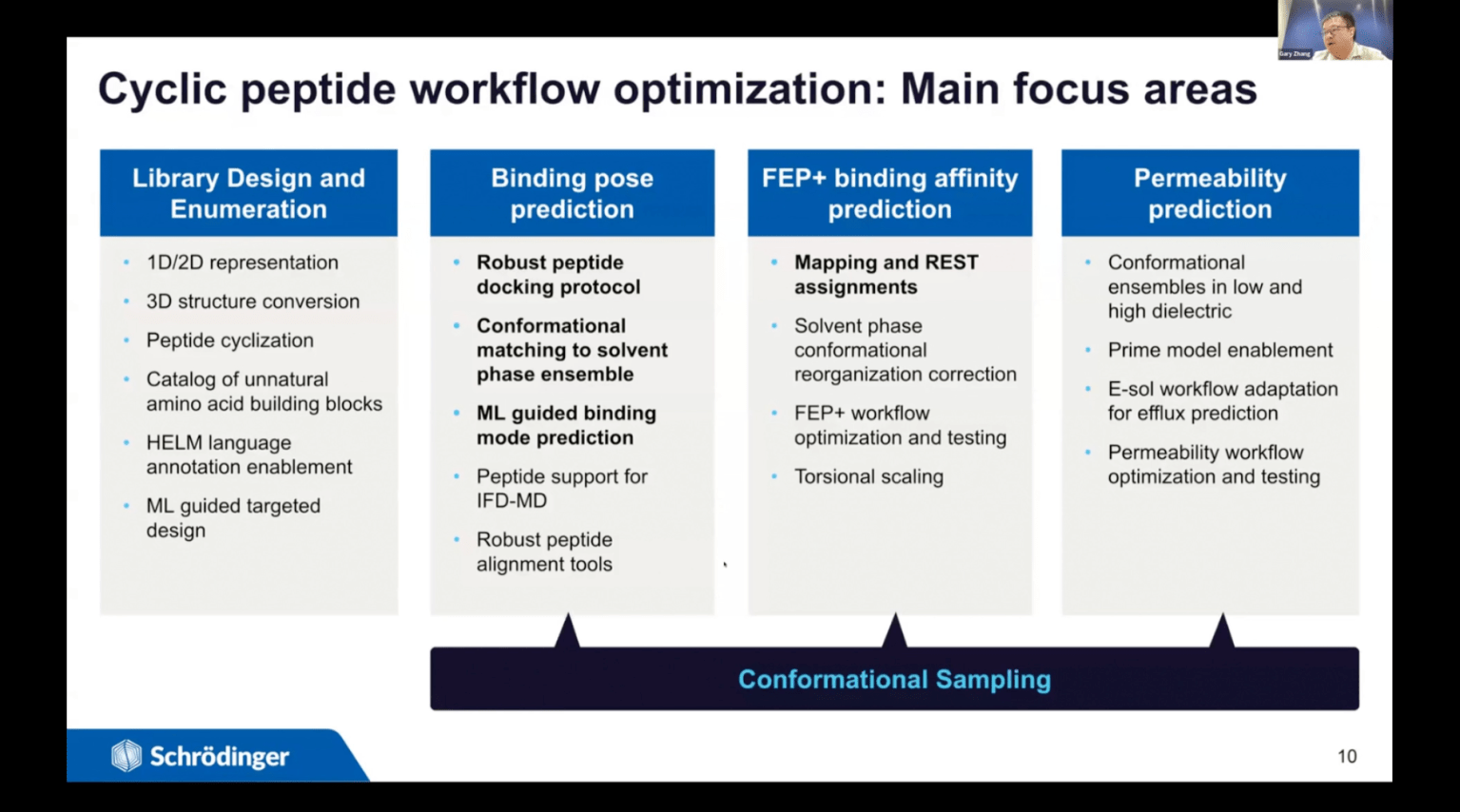
Modeling cyclic peptidic molecules with structure-based tools
ペプチド、特に環状ペプチドは、治療分野で有望な手段として浮上し、近年注目を集めています。しかし、小分子向けに設計された従来の計算ツールは、主にペプチドの柔軟性の高さから、ペプチドの正確なモデリングに困難を抱えています。
このギャップを解消するために、私たちはSchrodingerの構造ベースのツールを進化させ、正確な特性予測のための強固なコンフォメーションのアンサンブルを生成する能力を向上させました。さらに、受容体との相互作用を予測するための新しいドッキングワークフローを開発しました。加えて、FEP+の力を活用することで、親和性予測において合理的な精度を達成し、ペプチド薬開発における特性空間の微調整をさらに強化しました。
本ウェビナーでは、Schrödinger Therapeutics Groupの最近のケーススタディを紹介します。
Our Speaker

Gary “Yuqi” Zhang
Senior Principal Scientist, Schrödinger
Qiming Summer Event

Event
结合物理建模与机器学习:加速结构化药物发现
Date & Time - July 6th-7th, 2024
Location - Beijing, China & Shanghai, China
关于活动
薛定谔携手全球领先的创业投资机构启明创投,诚邀专注于小分子药物研发的生物技术公司参加我们在中国内地举办的首次线下活动。这将是一次绝佳的机会,让您深入了解如何运用领先的计算技术来加速药物发现,并与顶尖投资机构建立联系。
活动亮点
我们的活动涵盖以下内容:
- 阐述薛定谔基于物理建模和机器学习的小分子药物发现方法
- 揭秘薛定谔临床项目的历程
- 探索中国新药研发公司如何利用薛定谔技术开展项目
部分与会者还将获赠薛定谔的在线课程,深入了解分子建模在药物发现中的应用。
报名流程
本次活动对小分子药物研发企业免费开放,名额有限,请尽早报名。
提交注册后,我们将在6月30日前确认您的参会信息。
7月6日,周六上午9时至下午5时(线下)- 北京
- 活动期间提供免费午餐
7月7日,周日(线上&线下混合模式)- 上海
- 线上活动时间:上午10时30分至下午5时30分
- 线下活动时间:上午10时至晚上9时
- 线下活动将包括免费午晚餐
*活动举办地点将在确认邮件中通知,请勿空降,感谢您的理解和支持
谁应该参加?
我们欢迎所有从事小分子项目的公司参加。尤其是如果您从事以下职位:
- 研发团队负责人,您将了解如何将计算机辅助药物设计(CADD)应用到您的项目中。
- 高级管理人员,这是与业界领先的AI药物研发公司及顶尖投资机构交流的绝佳机会。
Expediting FEP+ model optimization for challenging systems with a fully automated, machine learning-driven workflow
JUN 25, 2024
Expediting FEP+ model optimization for challenging systems with a fully automated, machine learning-driven workflow
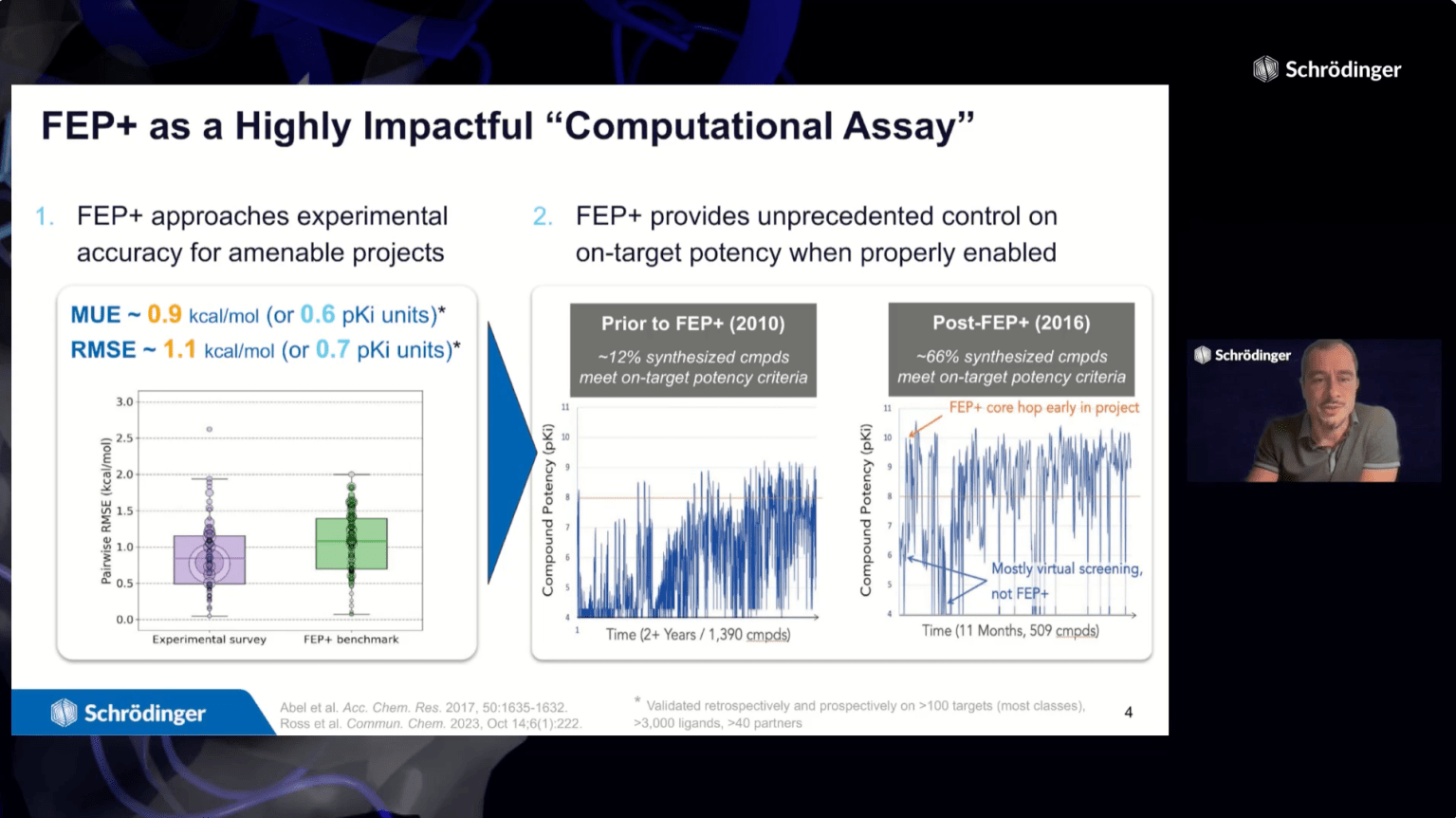
FEP+ is a powerful predictive technology in drug discovery – with applications from hit discovery through lead optimization. A critical first step in deploying FEP+ is to validate and optimize the model for the protein-ligand system of interest. While some systems perform well with out-of-the-box FEP+ settings, others require manual protocol refinement.
In this webinar, we will introduce Schrödinger’s FEP+ Protocol Builder, an automated machine learning workflow for FEP+ model optimization. This workflow is designed for systems with insufficient predictive accuracy using default settings or after initial manual protocol optimization attempts. FEP+ Protocol Builder saves researcher time and increases the chances of successfully enabling FEP+ by efficiently identifying an optimized predictive model for your system of interest.
Join us as we share key features of FEP+ Protocol Builder and highlight case studies that have shown success utilizing the technology to accelerate projects.
Highlights:
- Overview of FEP+ Protocol Builder technology, which uses an Active Learning workflow to iteratively search the protocol parameter space to develop accurate FEP+ protocols
- Case studies on effective prospective use of protocols generated by FEP+ Protocol Builder in drug discovery programs
- Comparison of time efficiency between manual and automated FEP+ optimization
- Details on requirements and services options to leverage the technology in your own program
- Overview of the different options to enable FEP+ at almost all levels of structural information for your protein-ligand system of interest
Our Speakers

Jeremie Vendome
Senior Director, Applications Science, Schrödinger
Dr. Jeremie Vendome, senior director of applications science, joined Schrödinger in 2015. He received his PhD from the Ecole Normale Superieure in France and completed his training at Columbia University in the lab of Prof. Barry Honig, where he worked on various problems related to protein-protein interaction energetics and specificity by combining computational approaches and experiments. Prior to joining Schrödinger, Jeremie acquired 10+ years of drug discovery experience both as a computational chemist in the industry and as the head of a CADD collaborative platform at Columbia Medical Center. At Schrödinger, he has held several roles of increasing responsibility and has continuously been at the interface between the company’s latest technological developments and their applications in active drug discovery projects. Most recently, Jeremie has been spearheading Schrödinger’s research enablement initiative, meant to advance drug discovery programs though key stages by providing access to our latest technologies and workflows at scale as a collaborative service.

Jordan Epstein
Product Manager, Schrödinger
Jordan Epstein joined Schrödinger in 2017 after studying Chemistry at New York University. Upon joining Schrödinger as a software developer, he worked on products such as FEP+, Desmond, and LiveDesign. More recently, he transitioned into his role as product manager where he has helped to see FEP+ Protocol Builder to its full release.

Sathesh Bhat
Executive Director, Therapeutics Group, Schrödinger
Sathesh Bhat, Ph.D., executive director in the therapeutics group, joined Schrödinger in 2011. He is responsible for overseeing computational chemistry efforts on internal and partnered drug discovery programs at Schrödinger. Previously, Sathesh worked at both Merck and Eli Lilly leading computational efforts in several drug discovery programs. He obtained his Ph.D. from McGill University, which involved developing structure-based methods to predict binding free energies. Sathesh has co-authored multiple patents and publications and continues to publish on a wide variety of topics in computational chemistry.
11th International Conference on Applied Hair Science

Conference
11th International Conference on Applied Hair Science
Date & Time - June 12th-13th, 2024
Location - Red Bank, New Jersey
Schrödinger is excited to be participating in the 11th International Conference on Applied Hair Science taking place on June 12th – 13th in Red Bank, New Jersey. Join us for a poster session by Haidong Liu, Senior Scientist at Schrödinger, titled “Molecular modeling of a hair fiber surface by coarse-grained simulation.”
TechConnect World

Conference
TechConnect World Innovation
Date & Time - June 17th-19th, 2024
Location - Washington, DC
Schrödinger is excited to be participating in the TechConnect World Innovation conference taking place on June 17th – 19th in Washington, DC. Join us for a presentation by Alex Chew, Principal Scientist at Schrödinger, titled “Leveraging Physics-Based Simulations and Machine Learning to Identify Promising Formulations for Materials Science Applications.” Stop by booth #730 to speak with Schrödinger scientists.
1:30 PM  Session AI Modeling & Simulation
 Leveraging Physics-Based Simulations and Machine Learning to Identify Promising Formulations for Materials Science Applications
Formulations – or a mixture of chemical ingredients – are ubiquitously found across material science applications, such as copolymer blends, consumer packaged goods, and energy storage devices. These mixtures consist of multiple chemical species with known compositional information, but their bulk properties are challenging to predict because they emerge from non-obvious intermolecular interactions arising between multiple species that heavily depend on both molecular structure and composition. Trial-and-error experimentation to optimize these formulations is cost-prohibitive because of the large chemical design space that is exacerbated by the tunability of their compositions. Computational approaches that could traverse the expansive design space offer a promising alternative solution to finding better formulations. Physics-based approaches, such as classical molecular dynamics simulations (MD), could accurately predict formulation properties by accounting for all possible interactions between multiple molecules. However, rapid screening with MD remains challenging due to its computational cost, which motivates the use of data-driven approaches to more efficiently screen the formulation design space. Given the lack of publicly available datasets, we generate a large formulation dataset from physics-based simulations consisting of more than 30,000 solvent mixtures that were selected based on experimental solubility tables. We then benchmark descriptor-based and graph-based molecular representations, as well as a variety of machine learning architectures, to identify accurate formulation-property relationships that could predict formulation properties given individual molecular structures and compositions as input. Given the large design space of chemistries and compositions, we leverage an active learning framework to iteratively suggest the next best compounds or compositions to test starting with a small dataset (~100 examples). Leveraging physics-based simulations to curate a formulation dataset and the development of accurate formulation-property relationships enables us to rapidly identify promising formulations for a wide range of materials applications, such as liquid electrolytes for batteries, copolymers for surface coating, solvent additives for perfumes or paints, and more.