Fine-Tuning Machine Learning Force Fields
Build a Residual LogD Machine Learning Model in LiveDesign
Machine Learning for Formulations Containing Proteins
Integrating AI and Machine Learning to Accelerate Composite Resin Formulation

MAY 13, 2026
Integrating AI and Machine Learning to Accelerate Composite Resin Formulation


Schrödinger is excited to be hosting a webinar in collaboration with Composites World, taking place on May 13th at 11:00AM EDT.
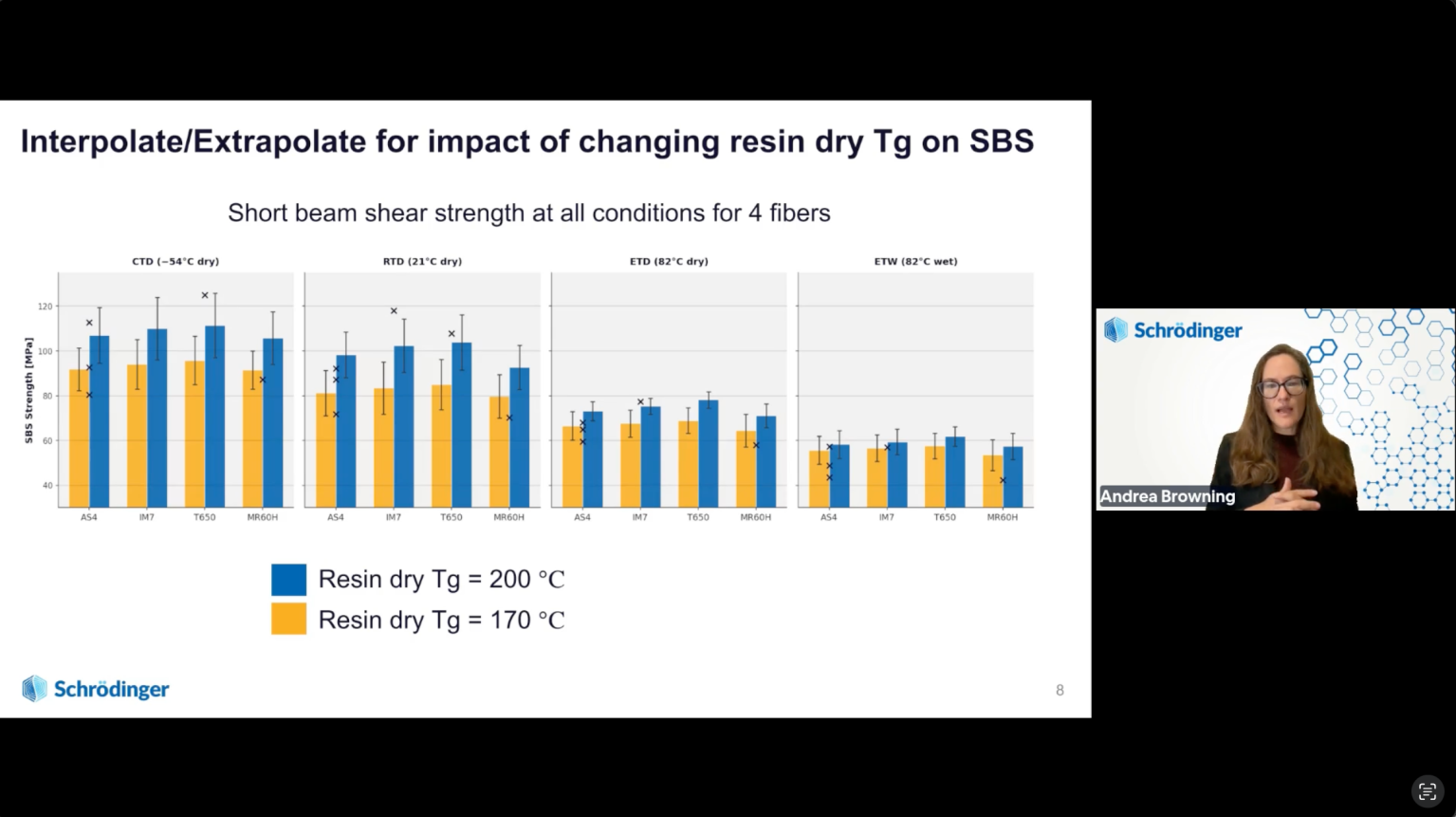
Artificial intelligence and machine learning have entered into everyday usage, but what impact can they have on polymer and ceramic matrix composites development?
Composite performance depends heavily on matrix properties that govern processability and operational stability. Increased digitization is providing clear value across industries, but successful application in composite resin formulations requires a clear understanding of the key questions and insight into the critical design factors. Combining expert know-how and atomic-level detail with powerful artificial intelligence and machine learning tools enables resin formulation teams to maximize successful design initiatives.
This webinar will demonstrate how integrating machine learning with molecular simulation enables faster, more informed development of next-generation resin formulations.
Agenda:
- Where AI and machine learning add value: Discover how these technologies aid in designing polymer and ceramic matrix composites, focusing on critical matrix properties.
- Digitization: Learn why successful resin formulation requires increased digitization for both experimentation and simulation.
- Integration: See how combining chemistry expertise with AI and machine learning tools leads to better decision-making and outcomes.
- Acceleration: Explore how machine learning and molecular simulation accelerate the development of new resin formulations.
Our Speaker

Andrea Browning
Senior Director of Polymers and Soft Matter, Schrödinger
Andrea Browning, senior director of polymers and soft matter at Schrödinger, leads initiatives in polymer and soft matter simulations. Before joining Schrödinger, Browning was a lead research engineer and project manager at Boeing, where she focused on translating engineering problems into fundamental materials insights. She brings more than a decade of experience in connecting industrial and engineering problems to root materials issues and how simulations can be used to inform industrial decisions. Browning earned her doctorate in chemical engineering from the University of California, Santa Barbara, where she was a National Science Foundation Graduate Research Fellow.
Large-scale Atomistic Simulations of Lithium Diffusion in a Graphite Anode with a Machine Learning Force Field
Efficient Long-Range Machine Learning Force Fields for Liquid and Materials Properties
Advancing efficiency in deep-blue OLEDs: Exploring a machine learning–driven multiresonance TADF molecular design
Band Gap and Reorganization Energy Prediction of Conducting Polymers by the Integration of Machine Learning and Density Functional Theory
Screening Antioxidant Ingredients Using Quantum Mechanics and Machine Learning
Accurate hydration free energy calculations for diverse organic molecules with a machine learning force field
Advancing battery materials innovation using charge-aware machine learning force fields

OCT 29, 2025
Advancing battery materials innovation using charge-aware machine learning force fields
Batteries are fundamental technology – powering everything from our personal electronics to electric vehicles, as well as large-scale grid storage systems for renewable energy integration. However, current battery technologies, primarily lithium-ion batteries, face significant limitations in performance, safety, cost, and reliance on scarce materials like cobalt. Therefore, innovation in battery materials is the key to unlocking the next generation of energy storage.
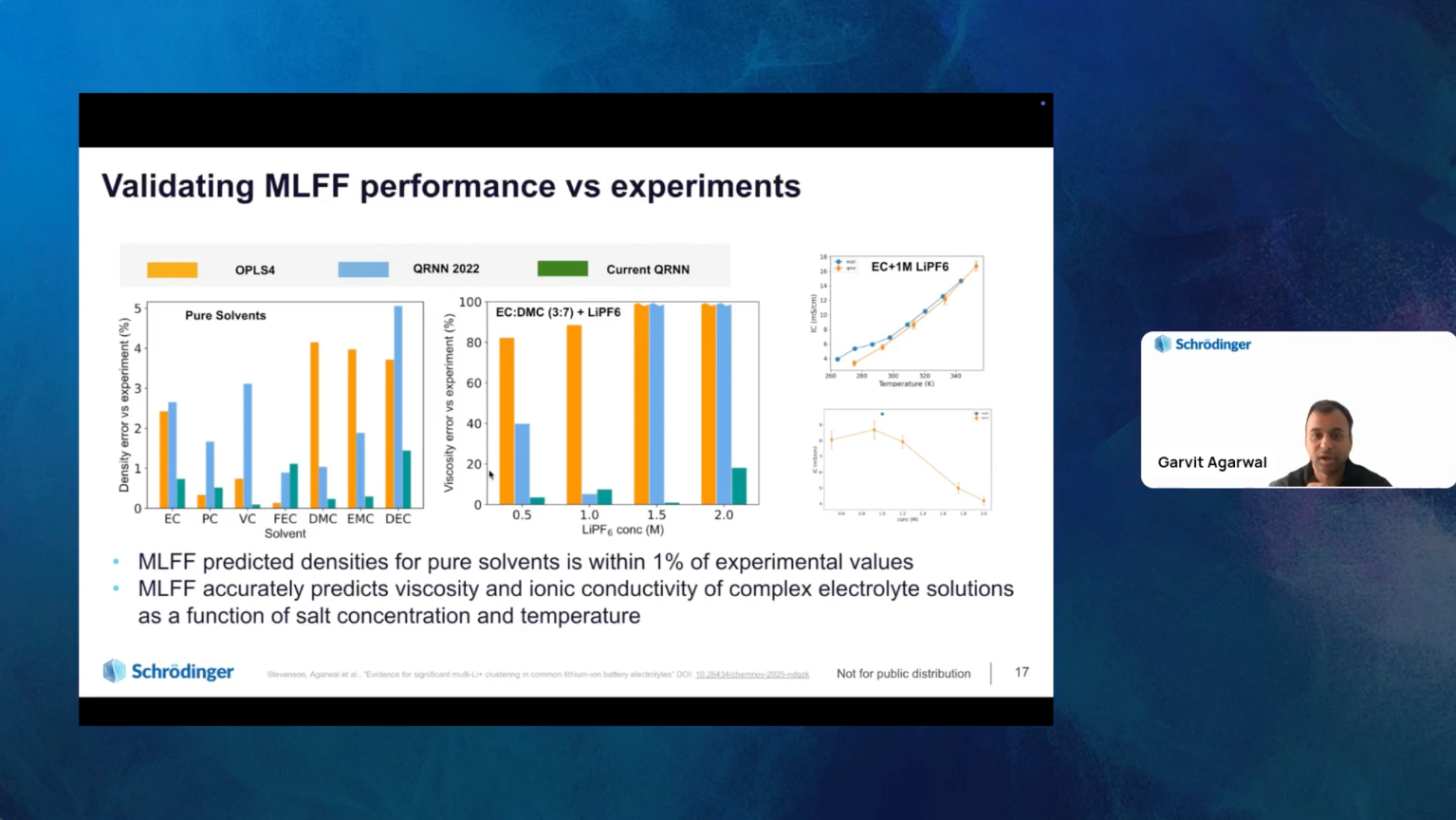
In this webinar, we will demonstrate how Schrödinger is utilizing an integrated computational approach combining physics-based molecular modeling with machine learning force fields (MLFFs) to address key challenges in battery materials design. We will introduce Schrödinger’s latest advancements in MLFFs, featuring charge recursive neural networks (QRNN) and the recently released Message Passing Network with Iterative Charge Equilibration (MPNICE) architectures, which incorporate explicit electrostatics for accurate charge representations.
Moreover, we will showcase several industry-relevant case studies highlighting the application of MLFFs to precisely model the structure and properties of electrolyte materials (liquid, polymer, and inorganic solid-state electrolytes), cathode coatings, and electrode materials. We will also explore how MLFFs facilitate large-scale simulations, allowing scientists to investigate the impact of defects and heterogeneities on crucial properties like Li-ion transport, paving the way for the efficient design of next-generation battery materials and chemistries.
Webinar Highlights:
- How Schrödinger combines physics-based modeling with machine learning force fields to drive battery materials discovery
- Schrödinger’s latest MLFF technologies, including QRNN and MPNICE
- Real-world case studies modeling electrolytes, cathode coatings, and electrode materials
- How MLFFs facilitate large-scale simulations, such as the investigation of Li-ion transport
Our Speaker

Garvit Agarwal
Principal Scientist, Schrödinger
Garvit Agarwal, Principal Scientist and Scientific Lead for Energy Storage at Schrödinger, works to extend and apply molecular modeling tools for the accelerated discovery of next-generation clean energy technologies. Garvit obtained his Ph.D. in Materials Science and Engineering from the University of Connecticut. He worked as a post-doctoral researcher in the Materials Science Division at Argonne National Laboratory prior to joining the Materials Science team at Schrödinger.