Designing the Next Generation of Polymers with Machine Learning and Physics-Based Models
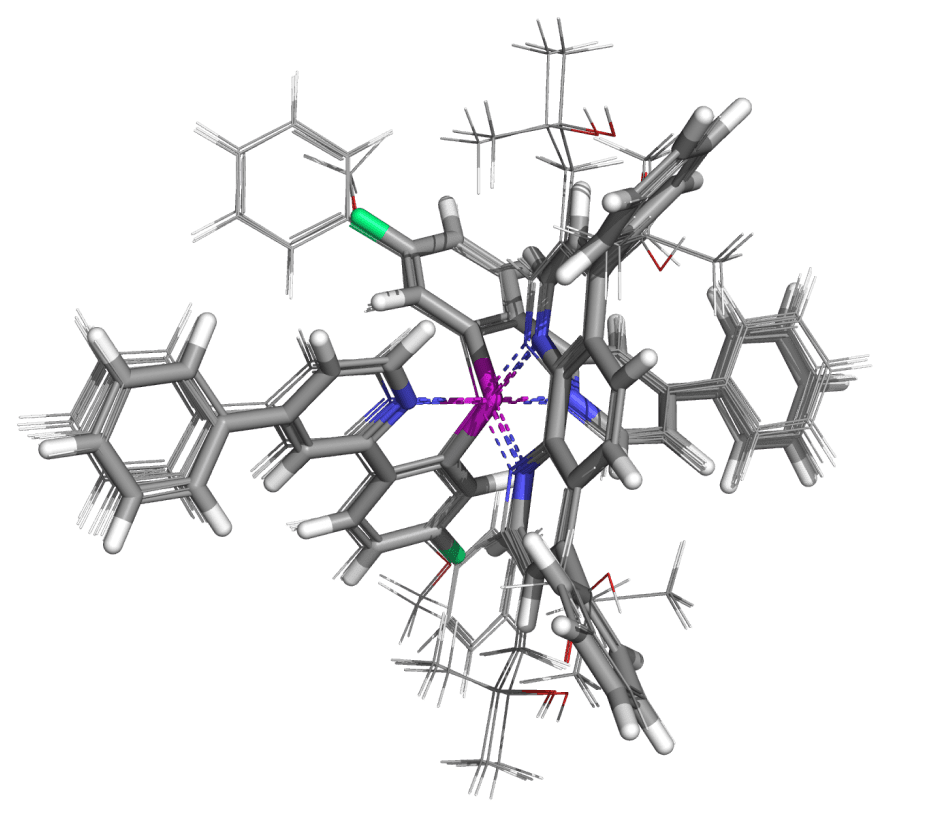
Machine learning-based design of pincer catalysts for polymerization reaction
Leveraging high-throughput molecular simulations and machine learning for the design of chemical mixtures
Machine learning for data-driven design of high-safety lithium metal anode
Computational and Machine Learning-Assisted Discovery and Experimental Validation of Conjugated Sulfonamide Cathodes for Lithium-Ion Batteries
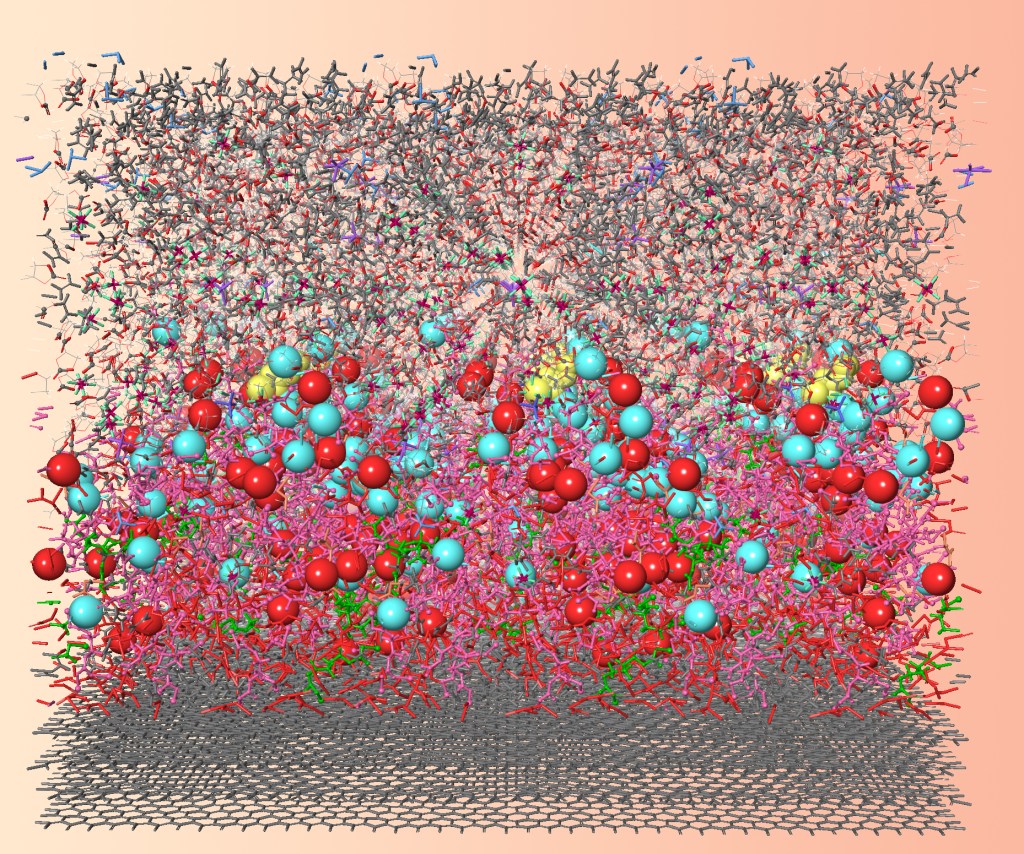
How Physics-based Modeling and Machine Learning Enable Accelerated Development of Battery Materials
OCT 1, 2024
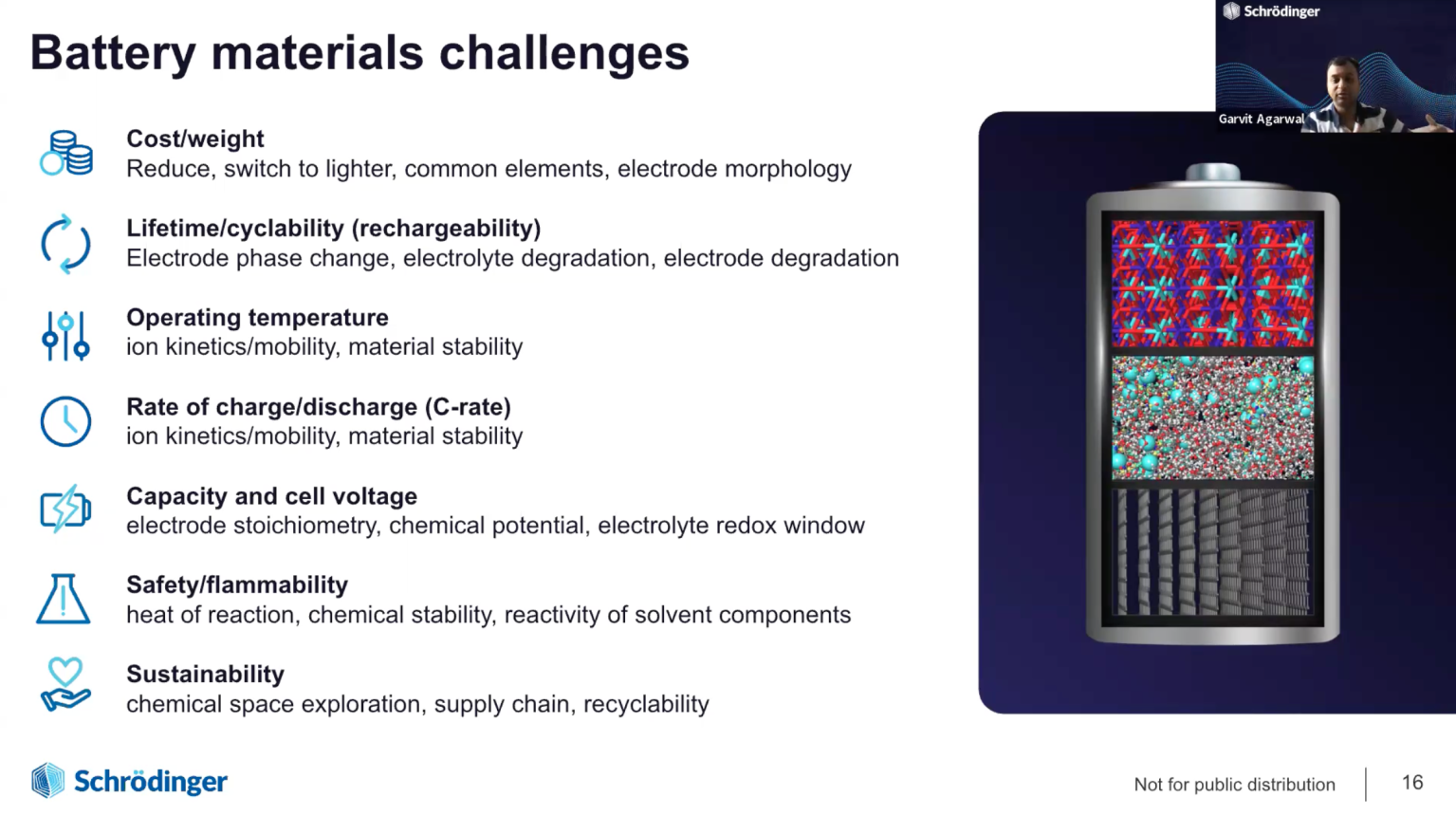
How Physics-based Modeling and Machine Learning Enable Accelerated Development of Battery Materials


Speaker:
Garvit Agarwal, Senior Scientist II, Schrödinger
Abstract:
The rapid advancements in rechargeable Li-ion battery (LIB) technology over the last decade has revolutionized several key industries such as transportation and consumer electronics. However, new battery chemistries are needed to meet the rapidly growing demand and to improve the power density, safety, reliability, and lifetime of LIBs. Molecular modeling has become an integral part of the design cycle of new battery chemistries. Accurate physics-based modeling enables rapid evaluation and screening of large chemical and material design space thereby, helping industries reduce the time required to bring the new technology to the market. In this webinar, we will introduce the latest technological innovations in Schrödinger’s digital chemistry platform for battery materials design. In particular, the webinar will focus on examples to demonstrate the application of automated solutions for accurate prediction of thermodynamic stability and voltage profile of cathode materials, ion diffusion pathways and kinetics in electrode materials, transport properties of liquid electrolytes and modeling the nucleation and growth of solid electrolyte interphase (SEI) layers using Schrödinger’s SEI simulator module. We will also introduce an automated generalized framework for the development of customized machine learning force fields for complex materials such as liquid electrolytes, inorganic cathode coatings and solid polymer electrolytes, paving the way for efficient design of novel materials for next generation batteries.
Machine Learning for Materials Science
Advanced Machine Learning and Molecular Simulations for Formulation Design
Advanced Machine Learning and Molecular Simulations for Formulation Design
Overview
Complex chemical mixtures — or formulations — are used in a wide range of applications, such as gasoline blends in oil & gas, daily care products in consumer goods, and drug delivery in pharmaceutics. Given the vast number of potential formulations, evolving regulatory requirements, and increasing consumer demand for eco-friendly and sustainable products, we need innovative and cost-effective solutions for designing enhanced formulations. The latest advancements in atomic-scale modeling and machine learning (ML) have enabled computer-aided screening of large numbers of formulation candidates — thus, accelerating the identification of promising formulations and reducing costly experiments.
Schrödinger’s Formulation Machine Learning tool uses data-driven methods to correlate ingredient structure and composition to formulation properties. This tool uses advanced cheminformatics descriptors and automatic hyperparameter tuning to find the best ML model, and allows external features (e.g., temperature, pressure) from experiments or high-throughput molecular dynamics (MD) calculations to be used as additional input to the ML model. The Formulation ML tool enables R&D teams to quickly train and deploy ML models to rapidly explore the broad design space of formulations by varying the chemical ingredients, compositions, and external features.

Advantages of Schrödinger Formulation Screening Technology
- Efficient ML model building and data generation: Leveraging deep learning technology to build accurate ML models to predict formulation properties, which can be coupled with MD simulations as a way to generate physically meaningful descriptors to improve ML model accuracy
- Scalable: ML can be trained and evaluated for mixtures with more than 100 components, extending the capabilities beyond simple mixtures to designing complex mixtures with enhanced properties
- Automated: Automatic hyperparameter tuning enables accurate ML model development using expert cheminformatic descriptors with minimal ML expertise required
- Rapid screening capabilities: ML can generate predictions in a fraction of a second, which can scale up to screening ~100K formulations in the order of minutes-hours
- Dedicated support: Dedicated support team consisting of scientific experts at Schrödinger are available to help users apply computational tools to their applications
- Multiple platform functionality: Can be used on laptops, desktops, and high performance clusters
Applications Across Industries
Consumer Products
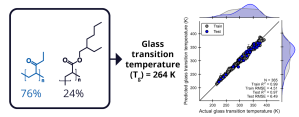
Random copolymer systems are often found in packaging materials, and glass transition temperature (Tg) is an important parameter that dictates the stability of the polymer as a function of temperature. Formulation ML can accurately predict Tg for 365 examples with a test set coefficient of determination (R2) of 0.97.2
Energy Storage
Liquid electrolytes are often used in batteries to facilitate the movement of electrical charge between an anode and cathode, and viscosity is an important parameter that dictates how easy ions can move through an electrolyte solution. Formulation ML can accurately predict temperature-dependent viscosity given ~34K examples with a test set R2 of 0.96.3

Pharmaceutical Formulation
Solubility of drug molecules in pure and binary mixture solutions is crucial for drug delivery applications for pharmaceutical formulations. Formulation ML can accurately predict temperature-dependent drug solubility for either pure or binary mixture solutions given ~27K examples, which achieves a test set R2 of 0.93.4

Oil and Gas
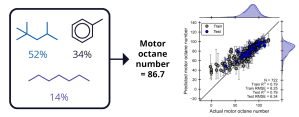
Mixtures of hydrocarbons are critical in gasoline blends, facilitating efficient combustion for automotive engines, and motor octane number (MON) is an important parameter that measures the fuel behavior under external pressure. Formulation ML can accurately predict MON given ~700 examples with the number of components ranging from pure (single) component systems to 120 components, which achieves a test set R2 of 0.79.5
Learn more in the tutorial (Note: you will need a web account to access tutorials)
References
-
Leveraging high-throughput molecular simulations and machine learning for the design of chemical mixtures
Alex, C., et al. npj Comput Mater 11, 72, 2025, https://doi.org/10.1038/s41524-025-01552-2.
-
The glass transition temperature of random copolymers: 1. Experimental data and the Gordon-Taylor equation
Penzel, E., et al. Polymer, 38.2, 1997, 325-337.
-
Machine learning for predicting the viscosity of binary liquid mixtures
Bilodeau, C., et al. Chemical Engineering Journal, 464, 2023, 142454.
-
Towards the prediction of drug solubility in binary solvent mixtures at various temperatures using machine learning
Bao, Z., et al. J Cheminform 16, 117, 2024, https://doi.org/10.1186/s13321-024-00911-3.
-
Artificial intelligence-driven design of fuel mixtures
Kuzhagaliyeva, N., et al. Communications Chemistry, 5.1, 2022, 111.
Software and services to meet your organizational needs
Software Platform
Deploy digital materials discovery workflows with a comprehensive and user-friendly platform grounded in physics-based molecular modeling, machine learning, and team collaboration.
Modeling Services
Leverage Schrödinger’s expert computational scientists to assist at key stages in your materials discovery and development process.
Support & Training
Access expert support, educational materials, and training resources designed for both novice and experienced users.
Advancing material property prediction: using physics-informed machine learning models for viscosity
Leveraging atomistic simulation, machine learning, and cloud-based collaborative ideation for display materials discovery
AUG 7, 2024
Leveraging atomistic simulation, machine learning, and cloud-based collaborative ideation for display materials discovery
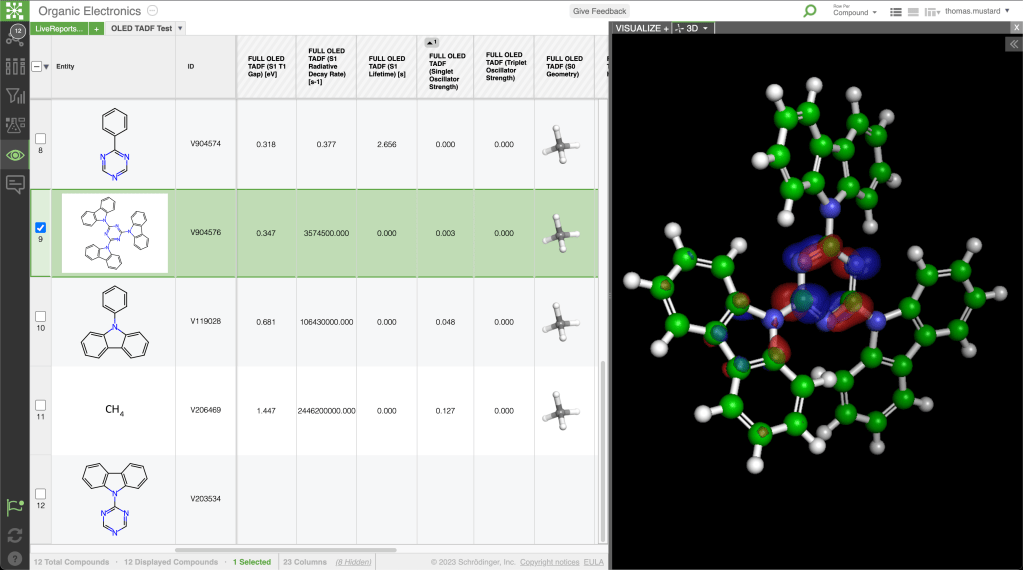
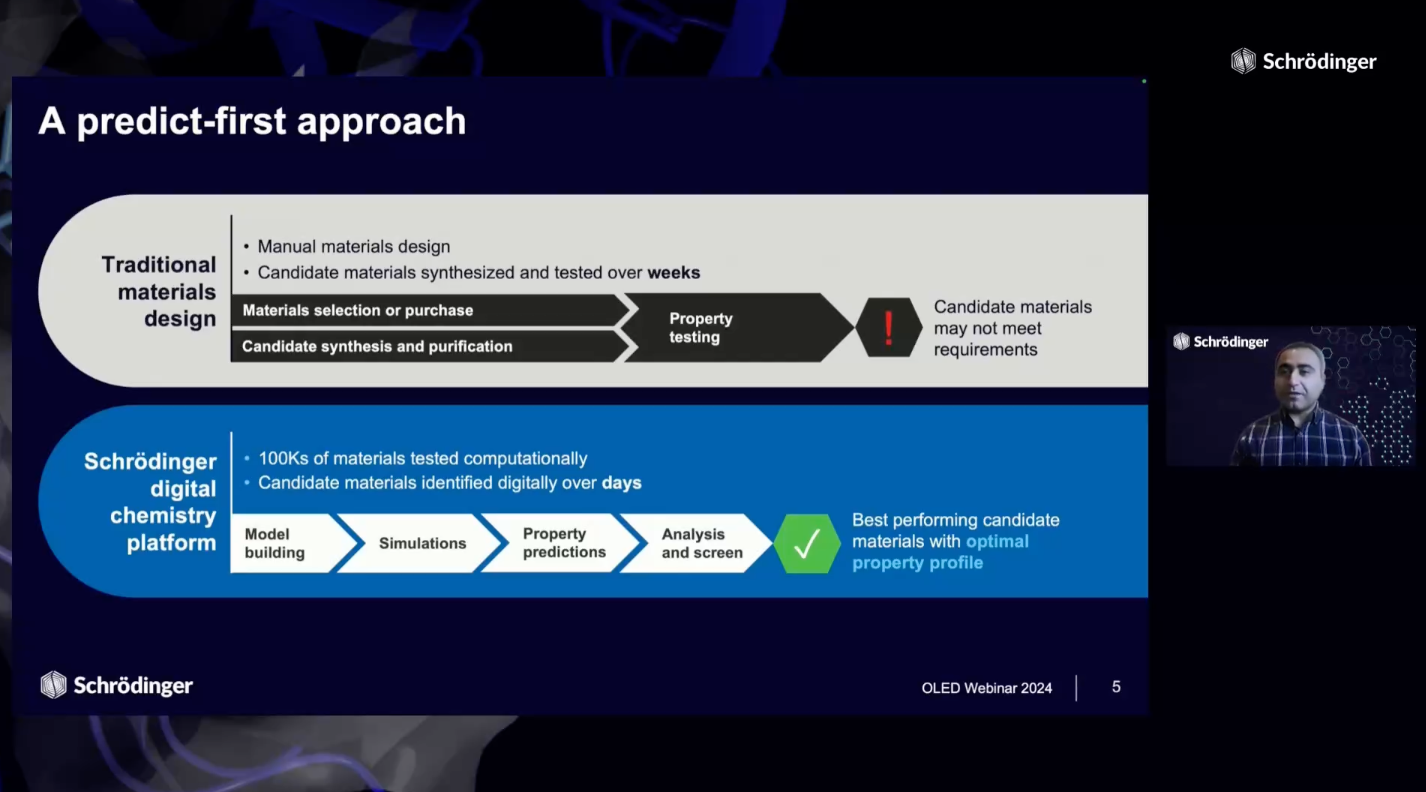
The rapid evolution of display technology requires the use of cutting-edge research methods to maintain progress. This webinar will explore the union of physics-based simulations, machine learning (ML), and cloud-native collaboration and informatics tools in revolutionizing R&D innovation for display materials.
We will delve into how physics-based simulations provide a robust foundation for understanding and predicting material behaviors, while ML modeling accelerates the discovery and optimization of new materials through data-driven insights. Furthermore, we will introduce Schrödinger’s LiveDesign, a cutting-edge web-based collaboration platform, designed to facilitate R&D in a modern, digital working environment. LiveDesign supports comprehensive functionalities, including modeling, data processing, data storage, and collaborative ideation, empowering teams to work seamlessly across diverse geographical locations.
Join us to gain a deeper understanding of:
- The principles and benefits of combining physics-based simulation and machine learning models
- Strategies for seamless integration of computational approaches in your R&D workflow
- Real-world examples illustrating the application and impact of integrated models in developing superior display materials
- How to leverage LiveDesign for collaborative ideation, advanced modeling, and project management
Our Speaker

Hadi Abroshan
Principal Scientist I, Schrödinger
Hadi Abroshan is the Product Manager for Organic Electronics at Schrödinger, Inc. He holds a Ph.D. from Carnegie Mellon University and has conducted research at Stanford University and Georgia Tech. Hadi specializes in multiscale simulations, leading projects to design cost-effective multifunctional materials for optoelectronics. His expertise lies in developing computational strategies that bridge atomistic structures to multilayered device scales, using a blend of physics-based methodologies and machine learning techniques. His work has led to the discovery of novel, environmentally friendly materials and processes with superior efficiencies.
Electrodes, electrolytes & interfaces: Harnessing molecular simulation and machine learning for rapid advancements in battery materials development
JUN 26, 2024
Electrodes, electrolytes & interfaces: Harnessing molecular simulation and machine learning for rapid advancements in battery materials development
Schrödinger is excited to be presenting in a webinar hosted by the Battery Technology Platform, taking place on June 26th. Join us for a presentation by Garvit Agarwal, Ph.D., Scientific Lead at Schrödinger, titled “Electrodes, electrolytes & interfaces: Harnessing molecular simulation and machine learning for rapid advancements in battery materials development.”
Abstract:
Li-ion battery (LIB) technology has revolutionized industries like transportation and consumer electronics. However, new battery chemistries are needed to address rapidly growing demand and to improve the power density, safety, reliability, and lifetime of LIBs.
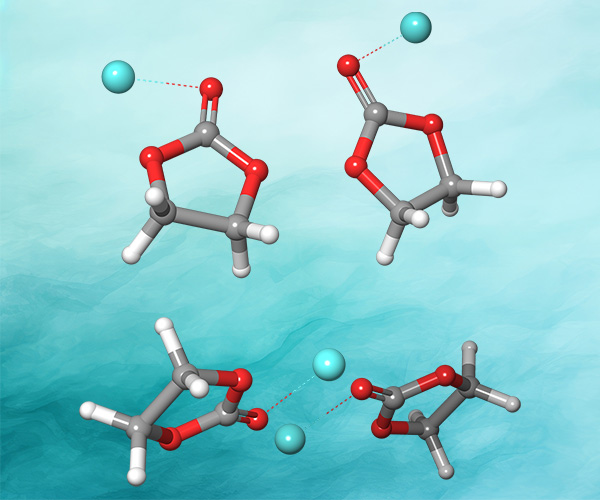
In this webinar we will explore the key materials challenges for improving battery performance and demonstrate how atomistic simulation and machine learning (ML) enable swift evaluation and screening of vast design spaces, accelerating the introduction of innovative technology to market.
We will introduce the latest technological innovations in Schrödinger’s digital chemistry platform for battery materials design. In particular, the webinar will focus on examples to demonstrate the application of automated solutions for accurate prediction of thermodynamic stability and voltage profile of cathode, ion diffusion pathways and kinetics in electrode materials, transport properties of liquid electrolytes and modeling the nucleation and growth of solid electrolyte interphase (SEI) layers using Schrödinger’s SEI simulator module. We will also introduce an automated generalized framework for the development of customized machine learning force fields for complex materials such as liquid electrolytes, inorganic cathode coatings and solid polymer electrolytes, paving the way for efficient design of novel materials for next generation batteries.
Key Learning Objectives:
- Gain insight into how a digital chemistry approach reduces development cycle time for new battery materials
- Learn how Schrödinger’s automated high throughput simulation workflows and ML models enable rapid screening of battery materials candidates
- Learn how to leverage automated solutions for accurate prediction of key battery properties: thermodynamic stability and voltage profile of electrodes, ion diffusion pathways and kinetics in electrodes, transport properties of liquid electrolytes, and the nucleation and growth of solid electrolyte interphase (SEI) layers
- Hear applications of advanced machine learning force fields for accurate modeling of electrolyte materials, cathode coatings and interfaces

Garvit Agarwal, Ph.D.
Scientific Lead, Energy Storage Materials Science Group, Schrödinger
Garvit Agarwal is Senior Scientist and Scientific Lead for Energy Storage at Schrödinger, working to extend and apply molecular modeling tools for the accelerated discovery of next-generation clean energy technologies. Garvit obtained his Ph.D. in Materials Science and Engineering from the University of Connecticut. He worked as a post-doctoral researcher in the Materials Science Division at Argonne National Laboratory prior to joining the Materials Science team at Schrödinger.