A chemist’s view on R&D digitalization

MAY 11, 2021

A chemist’s view on R&D digitalization

Speaker:
Dr. Laura Scarbath-Evers, Senior Scientist

Abstract:
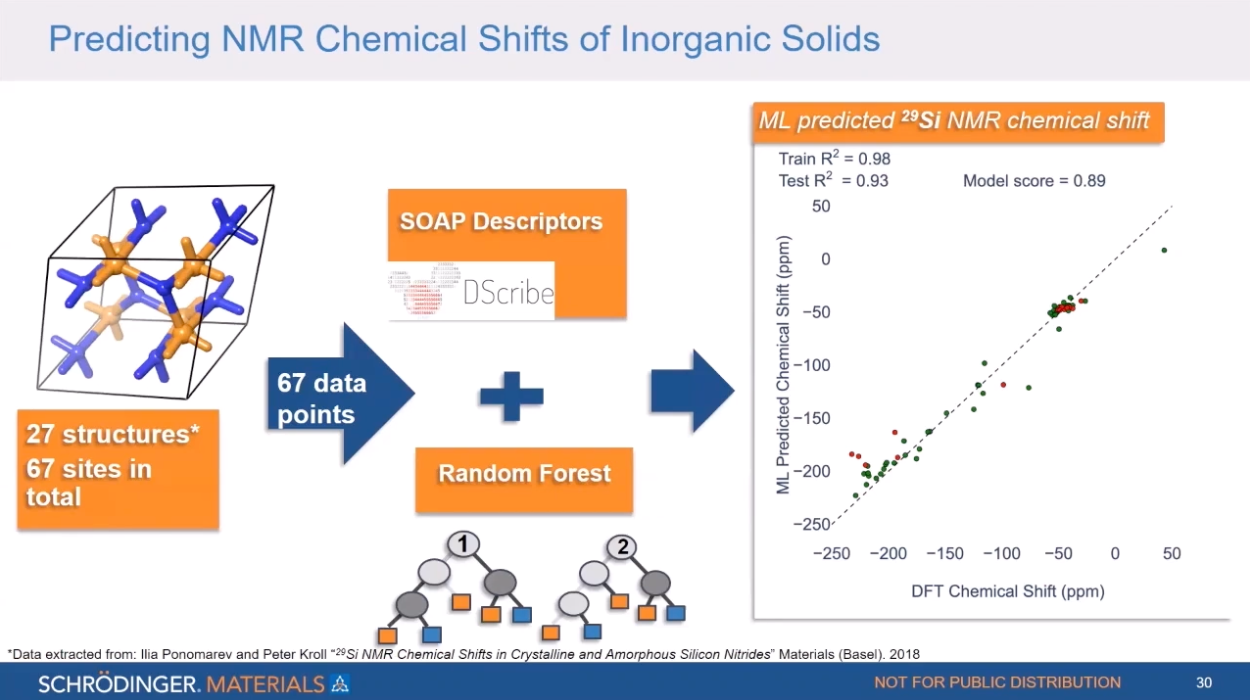
How the integration of machine learning with physics based modelling and enterprise informatics transforms materials discovery.

Global challenges, like a clean energy future or circular economy, have increased the demand for new materials. Typically, the performance of materials depends on a multitude of parameters which makes traditional research approaches, relying on experiments solely, slow, inefficient, and prohibitively expensive. Data driven approaches can significantly speed up the discovery process and shorten the time from idea to market.

In this presentation, we will illustrate how the integration of Schrödinger’s machine learning technologies with physics based modelling can be utilized to predict properties of new materials. Use cases from important materials science areas, like polymers and opto-electronic materials, will illustrate how data generated from experiment as well as physics-based modelling can be used to build machine learning models to predict physical properties and even suggest new compounds. Finally, we demonstrate how the integration of machine learning approaches into collaborative design schemes can maximize their usability and accessibility to non-expert users.

Accessible and automated computational catalyst discovery and reactivity optimization

Webinar

Accessible and automated computational catalyst discovery and reactivity optimization

CalendarDate & Time
    • May 7, 2026,   10:00 AM PDT | 1:00 PM EDT
    • May 13, 2026,   15:00 CEST | 14:00 BST
LocationLocation
  • Virtual

Designing high-performing homogeneous catalysts and optimizing non-catalytic transformations often relies on trial-and-error iteration. On the other hand, computational tools often remain inaccessible to those without specialized expertise.

In this webinar, we will demonstrate how an end-user physics–AI platform removes barriers to entry, making this process accessible to both experts and non-experts while enabling seamless scalability. By integrating quantum chemistry, fast semiempirical tight-binding methods, and machine learning interatomic potentials, the platform enables automated exploration of reaction networks and simultaneous optimization of multiple performance metrics. Using real-world catalytic and non-catalytic examples, we will show how mechanistic insight can be translated into actionable design decisions—quickly, accurately, and without coding.

Key highlights:

  • Lower the barrier to catalyst design
    Discover how a Physics–AI end-user platform enables both experts and non-experts to perform advanced in silico catalyst design and reactions optimization
  • Multi-level modeling at scale
    Leverage quantum chemistry, semiempirical tight-binding methods, and machine learning interatomic potentials (MLIPs) within a single, scalable framework
  • No coding required
    Intuitive, GUI-driven environment designed for accessibility and productivity

Who should attend: Anyone interested in non-catalytic and catalytic reactivity optimization, or homogeneous catalyst design

Register – May 7, 10:00AM PDT (AMER)
Register – May 13, 14:00 BST (EMEA)

Our Speaker

Pavel Dub

Research Leader and Product Manager, Catalysis & Reactivity, Schrödinger

Pavel A. Dub earned a Ph.D. in Physical Chemistry from the A. N. Nesmeyanov Institute of Organoelement Compounds and a second Ph.D. from the Université de Toulouse. He subsequently completed postdoctoral appointments at the Tokyo Institute of Technology and Los Alamos National Laboratory, where he later served as a Staff Scientist. In 2022, he joined Schrödinger. His research focuses on computational chemistry and materials science across both classical and quantum computing architectures.

17th Global Drug Delivery & Formulation Summit

Conference

17th Global Drug Delivery & Formulation Summit

CalendarDate & Time
  • May 18th-20th, 2026
LocationLocation
  • Berlin, Germany

Schrödinger is excited to be participating in the 17th Global Drug Delivery & Formulation Summit taking place on May 18th – 20th in Berlin, Germany. Join us for a presentation by John Shelley, Fellow at Schrödinger, titled “Molecular Modeling and Machine Learning for Small Molecule and Biologic Drug Formulation.” Stop by booth #4 to speak with Schrödinger scientists.

icon time MAY 18 | 15:35
icon location Room 3
Molecular Modeling and Machine Learning for Small Molecule and Biologic Drug Formulation

Speaker:
John Shelley, Fellow at Schrödinger

Abstract:
Selecting and combining the right ingredients in the appropriate manner is essential for successful drug formulation given the inherent challenges and competitive market. With advances in modern machine learning, physics-based simulation techniques and computer hardware, modelling is emerging as a valuable source of information that complements experimental characterization.  We showcase a cross-section of capabilities within Schrödinger’s Suite for modeling related to formulations of small-molecule or biologic drugs.  For small-molecule drugs workflows have been created for characterizing crystal polymorphs, crystal morphology and degradation risks as well as calculating elastic constants (bulk modulus, shear modulus, etc.), powder diffraction patterns, glass transition temperatures (Tg), diffusion constants, pKa values, melting points, water adsorption and various solubilities. For biologics our toolset supports homology modeling, and the calculation of aggregation propensity, titration curves, isoelectric points and viscosity among other things.  Complex and evolving structures, often in fluid states, play a crucial role in the pharmaceutical industry.   For both small-molecule and biologics formulations powerful simulation tools employing atomistic or coarse-grained models to permit the characterization of molecular interactions and nanoscale structuring, sometimes within otherwise disordered bulk systems (e.g., LNP formation, self-assembly of polymer-based structures, dissolving amorphous solid dispersions, liposomes and protein-excipient interactions).

2026 Annual Spring Meeting of the Polymer Society of Korea

Conference

2026 Annual Spring Meeting of the Polymer Society of Korea

CalendarDate & Time
  • April 8th-10th, 2026
LocationLocation
  • Daejeon, Korea

Schrödinger is excited to be participating in the 2026 Annual Spring Meeting of the Polymer Society of Korea conference taking place on April 8th – 10th in Daejeon, Korea. Join us for a presentation by Shaun Kwak, Senior Director of Materials Science Applications Science at Schrödinger, titled “Digital chemistry calling for a paradigm shift in polymer materials innovation.” Stop by booth #33 to speak with Schrödinger scientists.

icon time APR 9 | 16:45
Digital chemistry calling for a paradigm shift in polymer materials innovation

Speaker:
Shaun Kwak, Senior Director of Materials Science Applications Science, Schrödinger

Abstract:
Recent advances in molecular simulation and machine learning technologies are fundamentally reshaping the framework of the discovery and optimization of polymeric materials, quickly replacing the traditional concept of iterative experimentation guided by chemical intuition. Here, we showcase an advanced digital platform technology that combines physics-based molecular simulations with machine learning algorithms to develop novel polymer materials, effectively navigating the vast macromolecular design spaces. Case studies will include, but are not limited to, designing copolymers for semiconductor packaging, optimizing thermochemistry of acrylate-based coating, and assessment of thermal oxidation in thermoset resins. The work demonstrates a major shift of paradigm in the usage of information technology in materials research with broad implications in product lifecycle management, positioning digital chemistry as a cornerstone of the next-generation polymer industry.

Formulation ML and Optimization: Making advanced property prediction and experimental design fast and accessible

Webinar

Formulation ML and Optimization: Making advanced property prediction and experimental design fast and accessible

CalendarDate & Time
  • April 22nd, 2026
  • 8:00 AM PDT | 11:00 AM EDT | 4:00 PM BST | 5:00 PM CEST
LocationLocation
  • Virtual
Register

AI-driven materials discovery is no longer experimental, it is the new national standard. With the recent launch of the Genesis Mission, the United States has committed to accelerating materials discovery through AI, high-performance computing, and integrated scientific data infrastructure. For teams at the forefront of materials innovation, now is the ideal opportunity to integrate computational workflows into your R&D pipeline.

Many R&D teams are hindered from adopting AI/ML due to the complexity of software tools, steep learning curves, and limited data science support. Schrödinger’s Materials Science Suite is designed to address these challenges by providing a unified and easy-to-use AI/ML platform, powered by state-of-the-art ML technology and backed by a dedicated scientific support team.

Join our upcoming webinar to learn how your R&D organization can remove adoption barriers, accelerate discovery cycles, and align with national AI initiatives. In this webinar, we will demonstrate how MS Informatics, Formulation ML, and Formulation Optimization make advanced property prediction, model building, and ML-driven design of experiments simple, fast, and accessible – even for non-experts. We will showcase how easy it is to apply these tools using experimental datasets across broad MS applications, including formulations, consumer goods, batteries, pharmaceuticals, and beyond.

Join us and see demos on:

  • Training accurate viscosity ML models for binary liquids that can be applied to a variety of material applications
  • Scaling up to complex shampoo formulations, where ML models can be predictive of complicated multicomponent systems and provide suggestions of next best experiments

Who should attend:

  • R&D leaders
  • Innovation managers
  • Digitization managers
  • Synthetic chemists
  • Materials scientists
  • Formulation scientists
  • Computational materials scientists

Our Speaker

Anand Chandrasekaran

Senior Principal Scientist, Materials Science Product and Discovery, Schrödinger

Anand Chandrasekaran joined Schrödinger in 2019 and he is currently the Product Manager of MS-Informatics. His expertise is in applying machine learning to different areas in Materials Science and computational modeling. He graduated from the group of Prof.Nicola Marzari in the Swiss Federal Institute of Technology, Lausanne with a PhD in Materials Science. Before joining Schrödinger, Anand also worked in the group of Prof. Rampi Ramprasad on a number of topics including polymer informatics, machine-learning force-fields, and machine-learning for electronic structure calculations.

Register

Battery Seminar 2026

Conference

Battery Seminar 2026

CalendarDate & Time
  • July 14th-16th, 2026
LocationLocation
  • San Jose, California

Schrödinger is excited to be participating in the Battery Seminar 2026 conference taking place on July 14th – 16th in San Jose, California. Join us for a presentation by Garvit Agarwal, Principal Scientist II, Materials Science Applications Science at Schrödinger, titled “Integrating Physics-Based Simulations and Machine Learning to Fast-Track Battery Materials Innovation.”

icon time JUL 14 | 2:30PM
Integrating Physics-Based Simulations and Machine Learning to Fast-Track Battery Materials Innovation

Speaker:
Garvit Agarwal, Ph.D. Scientific Lead, Energy Storage Materials Science Group, Schrödinger

Abstract:
Developing next-generation batteries requires deep insight into complex phenomena like ion transport and the SEI. Integrated physics-based modeling and machine learning approaches are revolutionizing the development of next-generation battery chemistries. We demonstrate how ML Force Fields and advanced ML models can rapidly predict material properties, significantly reducing R&D timelines for high-performance energy storage systems.

BioTechX 2026

Conference

BioTechX 2026

CalendarDate & Time
  • October 6th-8th, 2026
LocationLocation
  • Basel, Switzerland

Schrödinger is excited to be participating in the BioTechX conference taking place on October 6th – 8th in Basel, Switzerland. Join us for a presentation by Steven Jerome, Executive Director, Life Science Software at Schrödinger, titled “Predictive Toxicology: Rational Digital Toxicology in the Cloud with a New AI-Accelerated Physics-Based Workflow.”

icon time
Predictive Toxicology: Rational Digital Toxicology in the Cloud with a New AI-Accelerated Physics-Based Workflow

Speaker:
Steven Jerome, Executive Director, Life Science Software, Schrödinger

Abstract:
By one estimate, unmanaged toxicity is responsible for roughly 30%1 of all drug discovery project failures. The adoption of experimental screening panels have contributed to the overall improved safety profile of drugs on the market. However, the high cost and latency associated with performing these screens means that such panels are run later in the pre-clinical discovery process and cannot be effectively incorporated into hit finding and lead-optimization stages of the project. To meet the demand for off-target screening during the design process, many teams deploy digital toxicology screening in the form of ligand-based machine learning models. These models, which are fast and inexpensive to operate are typically limited by poor generalizability to ligand matter dissimilar from data used to train the models and are missing the protein context to help designers dial-out liabilities rationally. We present a novel in-silico, physics-based solution for the identification and mitigation of off-target liabilities that constructs a full 3D, atomistic, representation of the ligand interacting with the target and leverages free energy calculations to model off-target binding. Molecules can be evaluated against a single off-target or a panel of representative targets in a screening mode. Calculations are run in the cloud, eliminating any need for local hardware. AI and ML models trained to the physics-based predictions have significant potential to enable high-throughput application in the near future. Already, this workflow has been successfully applied to a wide range of relevant targets across many protein classes. Here, we present both retrospective validation from literature data and prospective application to internal drug discovery projects, where the workflow has seen significant impact throughout our internal drug discovery pipeline, emphasizing the efficient resolution of tox-related liabilities in CYP3A4 and hERG.

Frontiers in Digital Chemistry: Industry Summit

Summit
CalendarDate & Time
  • June 9th-10th, 2026
LocationLocation
  • Schrödinger NYC Office
Register

Schrödinger is pleased to host the inaugural Frontiers in Digital Chemistry: Industry Summit, an in-person gathering for industry professionals in the materials-science digital-chemistry community.

This two-day event convenes scientists, technical leaders, and R&D decision-makers from across industries — including polymers, consumer packaged goods (CPG), specialty chemicals, energy, petrochemicals, thin film processing and advanced materials. Together, we will explore how the integration of AI, physics-based modeling, and computational workflows is reshaping materials innovation and accelerating discovery.

Hosted at our New York City headquarters overlooking Times Square, the event brings digital chemistry discussions to the heart of Manhattan.

The event will begin on June 9 at 1:30 PM, with afternoon sessions followed by an evening dinner. Sessions will continue on June 10 with a full day of programming, concluding at 5:15 PM.

Agenda

Tuesday, June 9th

1:30 – 2:00 Welcome & Opening Remarks

2:00 – 5:15 Industrial and Schrödinger Presentations

6:00 – 9:00 Networking & Dinner

Wednesday, June 10th

9:00 – 11:15 Industrial and Schrödinger Presentations

11:15 – 12:00 Panel Discussion

12:00 – 1:15 Lunch

1:30 – 4:00 Industrial and Schrödinger Presentations

4:00 – 5:15 Concluding Reception: Informal Chats with Schrödinger Technical Experts, Product Teams, and Leadership

What to Expect

The summit is designed as an interactive and forward-looking forum that blends technical depth with strategic discussion. The agenda will feature:

  • Presentations from Schrödinger scientists and leadership
  • Perspectives from industry practitioners
  • A moderated panel discussion
  • Structured and informal peer-to-peer exchange
  • Select interactive or workshop-style sessions

Beyond formal sessions, the event is intentionally structured to encourage meaningful dialogue. Attendees will engage directly with fellow practitioners and Schrödinger’s scientific and product leadership to exchange insights and help shape future directions in digital chemistry.

Who Should Attend

Both Schrödinger users and non-users are welcome.  This event is intended for industry professionals involved in:

  • Materials research and development
  • Computational chemistry and molecular modeling
  • AI and machine learning applied to materials science
  • Digital transformation of industrial R&D
  • Innovation across polymers, CPG, chemicals, energy, and related sectors

The summit aims to foster open, cross-industry dialogue — uniting diverse perspectives around a shared goal: advancing materials innovation through digital chemistry.

Register

Venue Location

Schrödinger, NYC office,
1540 Broadway 21st floor,
New York, NY, USA

ICDT 2026

Conference

ICDT 2026

CalendarDate & Time
  • March 31st – April 3rd, 2026
LocationLocation
  • Chongqing, China

Schrödinger is excited to be participating in the International Conference on Display Technology, ICDT 2026  taking place on March 31st – April 3rd in Chongqing, China. Stop by Booth 3A4 and catch Hadi Abroshan, Principal Scientist II, Materials Science Product and Discovery presenting in Session 43: OLED – Simulations 1 on April 2, 15:40–16:00.

icon time APR 2 | 15:40
icon location Session 43: OLED – Simulations 1
Accelerating OLED Design: Integrating Machine Learning and Physics-based Simulation

Speaker:
Hadi Abroshan, Principal Scientist II, Materials Science Product and Discovery

Abstract:
The experimental development of innovative OLED device architectures and material compositions is time-consuming, labor-intensive, and resource-heavy due to the complexity and cost associated with fabrication, characterization, and analysis. Predictive modeling offers a powerful alternative, enabling efficient and targeted evaluation of devices across broad design spaces.

CRS 2026

Conference

CRS 2026

CalendarDate & Time
  • July 6th-9th, 2026
LocationLocation
  • Lisbon, Portugal

Schrödinger is excited to be participating in the CRS 2026 conference taking place on July 6th – 9th in Lisbon, Portugal. Join us for a presentation by Irene Bechis, Principal Scientist I, Materials Science Applications Science at Schrödinger, titled “Combining physics-based and machine learning approaches to accelerate pharmaceutical formulations design and development.” Stop by booth #38 to speak with Schrödinger scientists.

icon time
Combining physics-based and machine learning approaches to accelerate pharmaceutical formulations design and development

Speaker:
Irene Bechis, Principal Scientist I, Materials Science Applications Science, Schrödinger

Abstract:
The successful translation of an active pharmaceutical ingredient (API) into a viable clinical therapy hinges critically on the development of an optimal drug formulation. Engineering a formulation that balances bioavailability, stability, and targeted delivery often presents a complex physicochemical challenge. With advances in machine learning, physics-based simulation and compute hardware, modeling is emerging as a valuable source of information to complement experimental characterization and guide decisions in formulation development.

In this talk, we showcase how the tools from the Schrödinger platform can be applied to modeling formulations across a diverse set of therapeutic modalities, ranging from small molecules to peptides to biologics.

The talk will feature case studies on crystalline solid formulations, demonstrating the use of crystal structure prediction to map polymorph landscapes and machine learning approaches for optimal co-former selection for co-crystals. Furthermore, we will explore amorphous solid dispersions, showcasing how physics-based simulations can help predict formulation stability and understand the drug release mechanism. Finally, we will discuss methods to analyze those complex, dynamic structures that are typical of formulations in the fluid state, such as lipid-based formulations for nucleic acid delivery and excipient-protein interactions in injectables.

Lab of the Future 2026

Conference

Lab of the Future 2026

CalendarDate & Time
  • March 2nd-3rd, 2026
LocationLocation
  • Boston, Massachusetts

Schrödinger is excited to be participating in the Lab of the Future 2026 conference taking place on March 2nd – 3rd in Boston, Massachusetts. Join us for a presentation by Karl Leswing, Vice President, Machine Learning at Schrödinger, titled, “Integrated Intelligence: Scaling Collaborative AI with Live Design ML and Retrosynthesis.” Stop by booth #20 to speak with Schrödinger scientists.

icon time 1:50 PM
icon location Grand Ballroom
Integrated Intelligence: Scaling Collaborative AI with Live Design ML and Retrosynthesis

Speaker:
Karl Leswing, Vice President, Machine Learning, Schrödinger

ACS Spring 2026

Conference

ACS Spring 2026

CalendarDate & Time
  • March 22nd-26th, 2026
LocationLocation
  • Atlanta, Georgia

Schrödinger is excited to be participating in the ACS Spring 2026 conference taking place on March 22nd – 26th in Atlanta, Georgia. Join us for presentations by Atif Afzal, Principal Scientist II, Materials Science Modeling Services at Schrödinger. Stop by our booth to speak with Schrödinger scientists.

icon time MAR 23 | 8:45 AM
icon location Room C207
Multi-objective copolymer design: Integrating physics-based simulation and machine learning

Speaker: Atif Afzal, Principal Scientist II, Materials Science Modeling Services, Schrödinger

Division: I&EC: Division of Industrial and Engineering Chemistry

Session: Data Analytics and AI For Chemistry, Manufacturing, and Healthcare

icon time MAR 23 | 2:55 PM
icon location Room B401
AI and physics-based modeling for complex materials and formulations

Speaker: Atif Afzal, Principal Scientist II, Materials Science Modeling Services, Schrödinger

Division: COMSCI: Committee on Science

Session: AI for Chemistry: From Algorithms to Applications