Digital forum on atomic layer deposition: Bridging theory and experiment to design a process for silicon carbonitride

NOV 18, 2025

Digital forum on atomic layer deposition: Bridging theory and experiment to design a process for silicon carbonitride

Future semiconductor devices demand new dielectric materials with precisely controlled properties, such as a lower dielectric constant and lower etch rate, which can be achieved by doping carbon into commonly-used silicon nitride and silicon oxide. While CVD techniques have traditionally been used to introduce carbon, new atomic layer deposition (ALD) techniques using silicon precursors can offer greater precision. However, to achieve this, new precursors that can be used at low temperatures are desired, which remains a key challenge for high-tech industries – highlighting the need for innovative approaches to accelerate discovery.

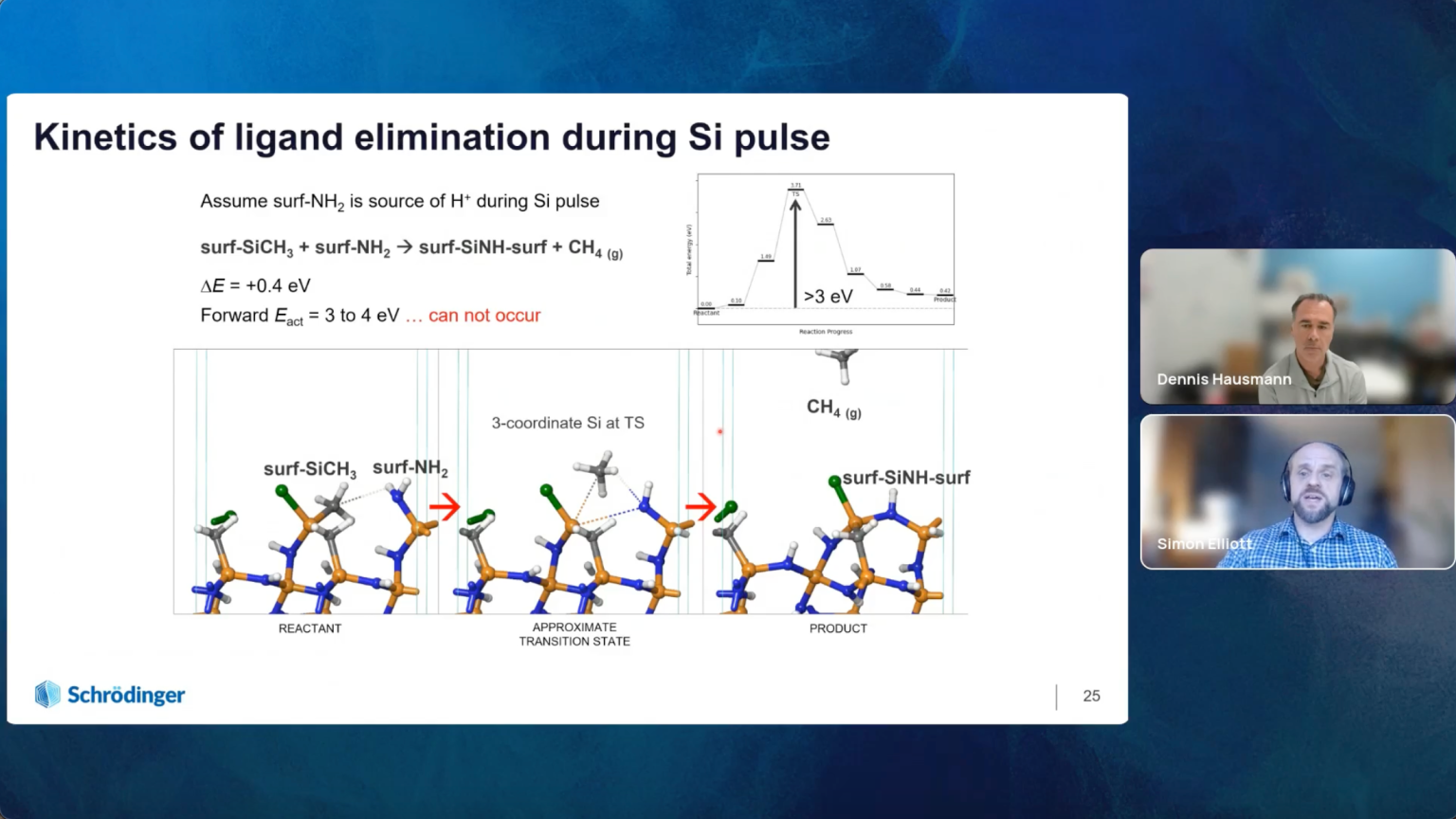
In this digital forum, Schrödinger and Lam Research will showcase a powerful R&D approach that bridges state-of-the-art Density Functional Theory (DFT) with complementary experiments using RGA and FTIR. The team assessed eight potential alkylchlorosilanes to see which one showed most promise for retaining carbon when used along with ammonia for deposition of silicon nitride. This example illustrates how individual techniques can only deliver partial information about a real-life process. Addressing the full complexity of a process requires close interplay between theory and experiment. Therefore, each piece of theoretical evidence is validated against experiment and builds into a comprehensive understanding of how the chemistry changes under processing conditions. 

Join us as we discuss how effectively theory and experiment are working together to solve the R&D challenges facing high-tech industries.

Our Speakers

Dennis Hausmann

Senior Director of the Chemistry Pathfinding Group, Lam Research

Dr. Dennis Hausmann has been developing chemical precursors for atomic layer deposition (ALD) and other applications since 1999. Before joining Lam Research in 2002, he studied the chemistry of metal oxide ALD precursors in the laboratory of Professor Roy Gordon at Harvard University where he earned his Ph.D. He has coauthored more than 200 patents and printed publications and currently leads the Chemistry Pathfinding Team at Lam Research.

Simon Elliott

Director of Atomic Level Process Simulation, Schrödinger

Dr. Simon Elliott is a pioneer in applying atomic-scale models to the surface chemistry of materials deposition and etch. Before joining Schrödinger, he studied chemistry in Ireland and Germany, and led a research group at Tyndall National Institute in Ireland. He was the 2023 recipient of the ALD Innovator Award.

ChemAI 2025

Conference

ChemAI 2025

CalendarDate & Time
  • November 21st, 2025
LocationLocation
  • Amsterdam, Netherlands

Schrödinger is excited to be participating in the ChemAI 2025 conference taking place on November 21st in Amsterdam, Netherlands. Join us for a presentation by Anand Chandrasekaran, Senior Principal Scientist at Schrödinger, titled “Revolutionizing Materials R&D with Combined Physics-Based and Machine-Learning Approaches.”

icon time 11:25 – 11:40
Revolutionizing Materials R&D with Combined Physics-Based and Machine-Learning Approaches

Speaker:
Anand Chandrasekaran, Senior Principal Scientist at Schrödinger

Abstract:
Advances in materials discovery increasingly rely on merging the predictive power of physics-based simulation with the speed and adaptability of machine learning. At Schrödinger, we integrate molecular dynamics (MD), quantum mechanics, and data-driven models to accelerate property prediction and design.

In collaboration with SABIC, machine-learning models augmented with MD simulations accurately predicted polymer glass-transition temperatures, dielectric constants, and refractive indices, guiding the selection of next-generation polycarbonates. With Panasonic, large-scale MD and reinforcement learning were combined to design and experimentally validate ultra–low-viscosity solvents for advanced electrolytes.

Extending these principles, our Formulation ML solution predicts the properties of complex mixtures by linking molecular structure, composition, and simulation-derived descriptors to target physical properties. Together, these efforts show how integrating physics-based insight with machine learning accelerates innovation, improves interpretability, and delivers experimentally validated materials far faster than traditional R&D.

高機能素材Week 出展 @幕張メッセ

Event

【11月12日(水)~14日(金)】高機能素材Week 出展

CalendarDate & Time
  • November 12th-14th, 2025
LocationLocation
  • Chiba, Japan

分子シミュレーション技術の進化により、原子・分子レベルの現象をコンピュータ上で再現・解析できる時代が到来しています。さらに、機械学習と組み合わせることで、実験データが限られていても、高精度な材料予測・設計が可能になってきました。シュレーディンガーは、最先端の分子シミュレーションとAI/ML技術、そしてそれらを融合した独自のデジタルプラットフォームにより、お客様の解析力向上と研究開発の効率化を強力に支援します。

本展示ブースでは、これらの技術の概要や活用事例について、専門スタッフがわかりやすくご紹介し、ご質問にもお答えします。

※会期中、弊社展示ブースにてセミナーを開催いたします。
場所: 弊社展示ブース
テーマ: 機械学習と原子レベルシミュレーションで加速する!次世代ポリマー材料開発

さらに、各ソフトウェアを実機体験いただけます。ぜひお立ち寄りください。

【展示会情報】
展示会名:高機能素材Week内 第14回高機能プラスチック展
会期:2025年11月12日(水)~14日(金)10:00 ~ 18:00(最終日のみ17:00終了)
会場:幕張メッセ 1~3号館
小間番号:15-10

Schrödinger デジタル創薬セミナー: Into the Clinic ~計算化学がもたらす創薬プロセスの変貌~ 第20回

OCT 31, 2025

Schrödinger デジタル創薬セミナー 20:
In silico cryptic binding site detection and prioritization
インシリコ手法を活用した潜在的結合部位の探索と評価

クリプティック結合部位探索の新戦略 ― MxMD×SiteMap による革新的ワークフロー

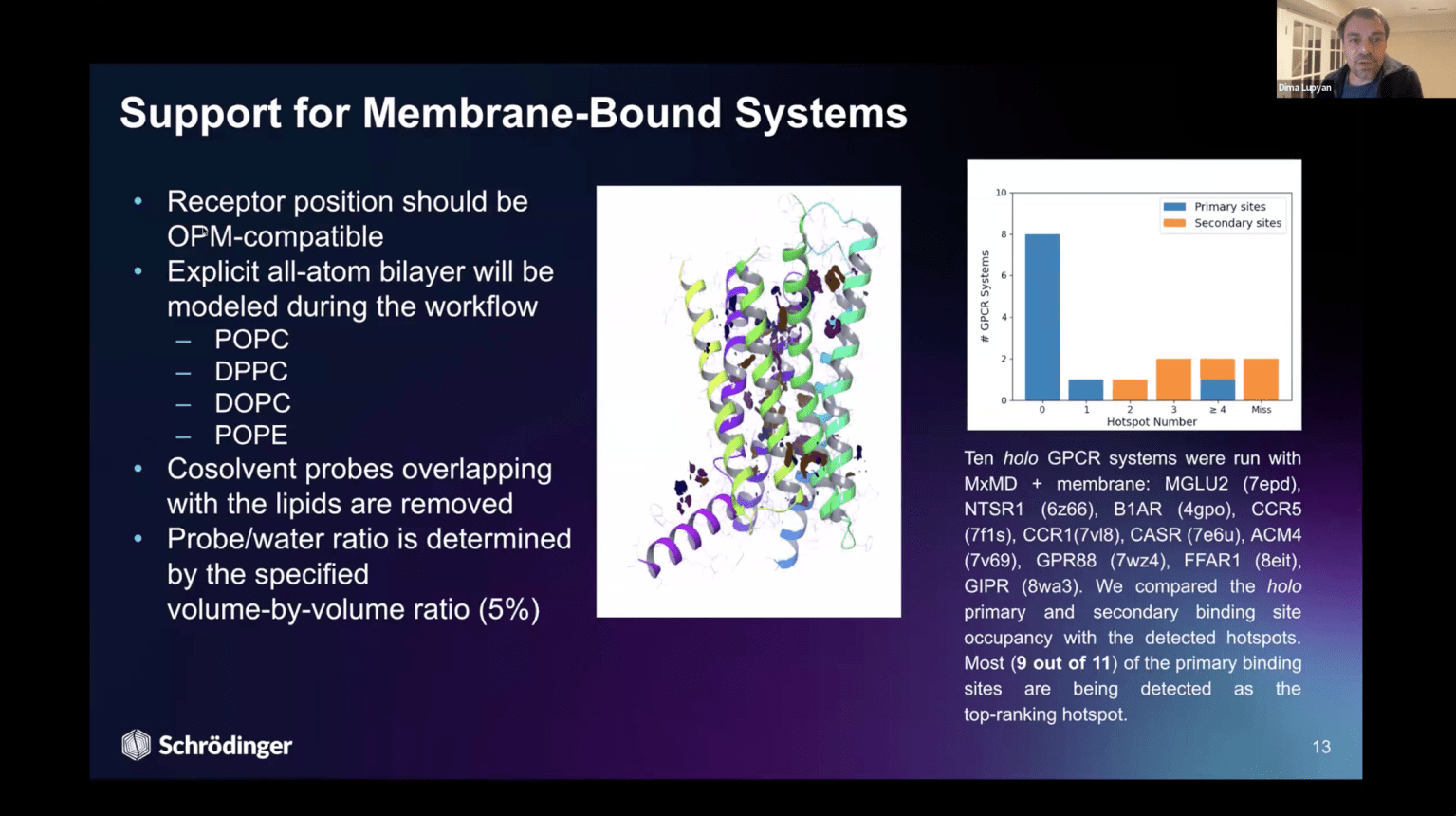
従来のオルソステリックアプローチでは、選択性や耐性、開発適合性などの問題から攻略が難しい創薬ターゲットに対し、クリプティック結合部位(通常の構造では見えない潜在的部位)を狙う戦略が注目を集めています。しかし特に、アポ構造からは観測できないクリプティック部位の検出と評価は、初期創薬における大きな課題のひとつです。

本ウェビナーでは、混合溶媒分子動力学法(MxMD)とSiteMapを組み合わせた新しい計算ワークフローをご紹介します。この統合的アプローチにより、61ターゲットからなるベンチマークセットにおいて、83%という高い成功率でクリプティック結合部位を検出することに成功しました。新しいワークフローが、クリプティック結合部位の同定を支援し、新規ターゲットに対する構造ベース創薬をどのように加速させるのか、ぜひご参加のうえご確認ください。

ウェビナーハイライト

  • MxMD法の概要
  • MxMD+SiteMapワークフローによるクリプティック結合部位の同定
  • 機械学習手法やSiteMap標準検出モードとの性能比較

Our Speakers

Da Shi

Principal Scientist I, Life Science Software, Schrödinger

Hit Discoveryチームで、難解な結合部位の同定とFEPリガンドポーズ生成に関するワークフローの開発に取り組んでいます。

Dima Lupyan

Senior Principal Scientist, Life Science Software, Schrödinger

DesmondおよびFEP解析ツールの開発を主導し、分子動力学分野における専門知識を発揮しています。特に、Schrödinger社のMD、MxMD、FEP+製品群の基盤となるシミュレーション解析用Python APIの開発に携わっています。