Advancing battery materials innovation using charge-aware machine learning force fields

OCT 29, 2025

Advancing battery materials innovation using charge-aware machine learning force fields

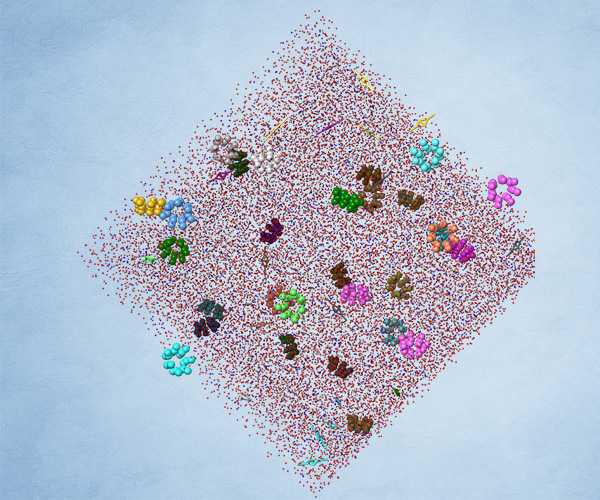
Batteries are fundamental technology – powering everything from our personal electronics to electric vehicles, as well as large-scale grid storage systems for renewable energy integration. However, current battery technologies, primarily lithium-ion batteries, face significant limitations in performance, safety, cost, and reliance on scarce materials like cobalt. Therefore, innovation in battery materials is the key to unlocking the next generation of energy storage.

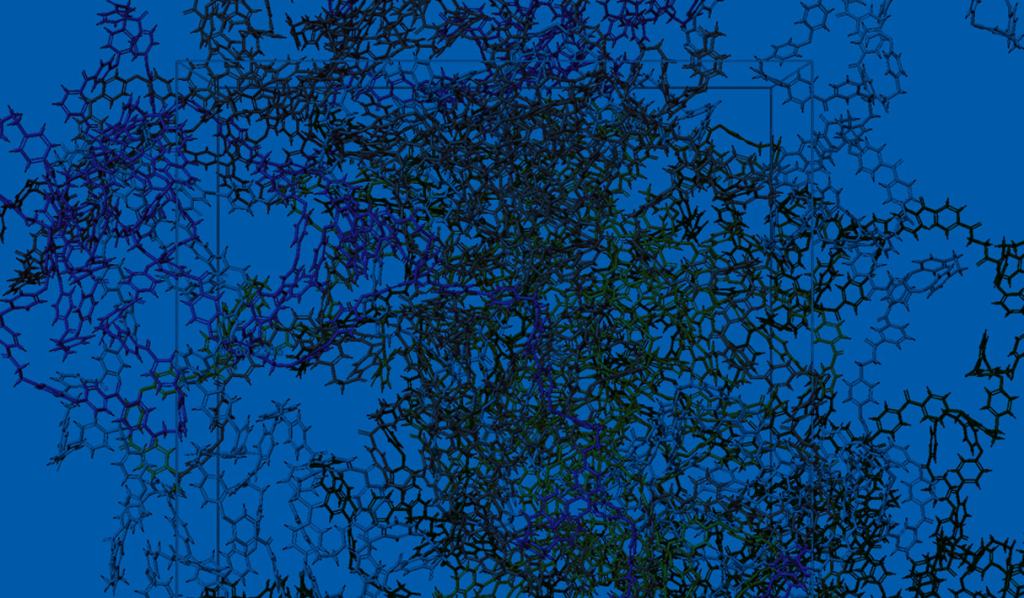
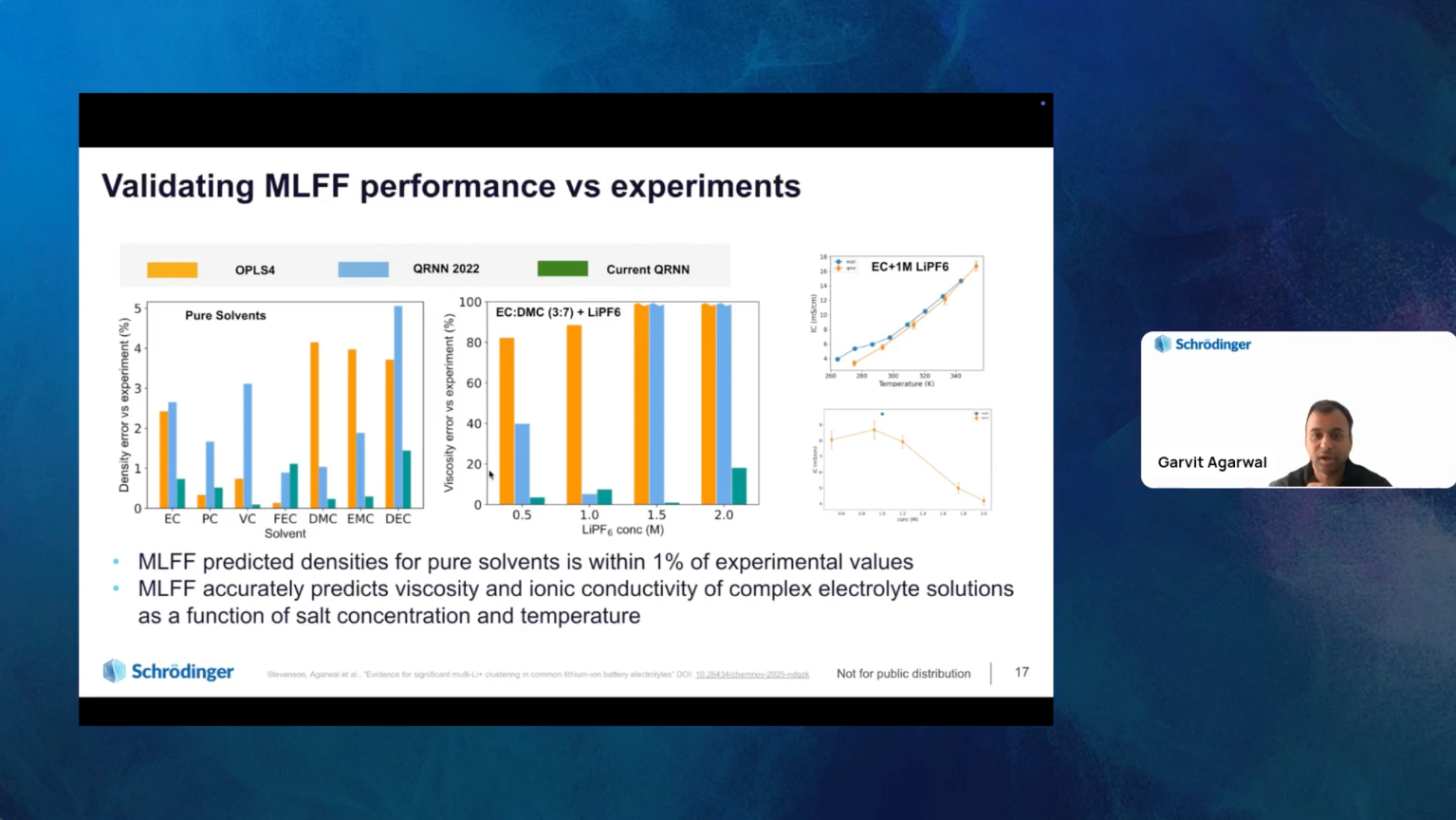
In this webinar, we will demonstrate how Schrödinger is utilizing an integrated computational approach combining physics-based molecular modeling with machine learning force fields (MLFFs) to address key challenges in battery materials design. We will introduce Schrödinger’s latest advancements in MLFFs, featuring charge recursive neural networks (QRNN) and the recently released Message Passing Network with Iterative Charge Equilibration (MPNICE) architectures, which incorporate explicit electrostatics for accurate charge representations.

Moreover, we will showcase several industry-relevant case studies highlighting the application of MLFFs to precisely model the structure and properties of electrolyte materials (liquid, polymer, and inorganic solid-state electrolytes), cathode coatings, and electrode materials. We will also explore how MLFFs facilitate large-scale simulations, allowing scientists to investigate the impact of defects and heterogeneities on crucial properties like Li-ion transport, paving the way for the efficient design of next-generation battery materials and chemistries.

Webinar Highlights:

  • How Schrödinger combines physics-based modeling with machine learning force fields to drive battery materials discovery
  • Schrödinger’s latest MLFF technologies, including QRNN and MPNICE
  • Real-world case studies modeling electrolytes, cathode coatings, and electrode materials
  • How MLFFs facilitate large-scale simulations, such as the investigation of Li-ion transport

Our Speaker

Garvit Agarwal

Principal Scientist, Schrödinger

Garvit Agarwal, Principal Scientist and Scientific Lead for Energy Storage at Schrödinger, works to extend and apply molecular modeling tools for the accelerated discovery of next-generation clean energy technologies. Garvit obtained his Ph.D. in Materials Science and Engineering from the University of Connecticut. He worked as a post-doctoral researcher in the Materials Science Division at Argonne National Laboratory prior to joining the Materials Science team at Schrödinger.
難溶性薬物の放出メカニズムを解明する – ASD研究の新たなアプローチModelling amorphous solid dispersion (ASD) release mechanisms

OCT 15, 2025

難溶性薬物の放出メカニズムを解明する – ASD研究の新たなアプローチ
Modelling amorphous solid dispersion (ASD) release mechanisms

水に溶けにくい、あるいはバイオアベイラビリティが低い医薬品は、臨床開発において大きな課題となります。その解決策として注目されているのが、薬物を高分子マトリックスに非晶質として分散させる 非晶質固体分散体(Amorphous Solid Dispersion, ASD) です。

本ウェビナーでは、AbbVie と Schrödinger のエキスパートが、ASDにおける薬物放出や「Loss of Release (LoR:放出消失)」のメカニズムを、熱力学モデリング・分子シミュレーション・実験研究 を組み合わせた最新の研究成果を基に解説します。

特に、リトナビルを有効成分とするASD製剤を題材に、薬物負荷量や水との表面相互作用といった要因がどのように放出挙動を変化させるのかを掘り下げます。

こんな方におすすめです

  • 難溶性医薬品の製剤開発に携わる方
  • ASD研究やシミュレーション活用に関心のある方
  • 熱力学モデルや分子シミュレーションの実務応用に関心のある方

ASD製剤の理解と成功率向上に役立つ実践的なインサイトをぜひご覧ください。

Our Speakers

Samuel Kyeremateng

Principal Scientist, AbbVie Deutschland GmbH & Co. KG

製剤の性能や安定性を理解・設計・予測するため、インシリコの物理ベース手法を活用した研究をリードしています。

Irene Bechis

Senior Scientist II, Schrödinger GmbH

ポリマーや製薬フォーミュレーションを中心に、粒子スケールのシミュレーション技術を材料科学の幅広い課題に応用しています。

Computational tools for PROTAC design and optimization

Computational tools for PROTAC design and optimization

Speaker:

Koushik Kasavajhala, Senior Scientist II, Schrödinger

Abstract:

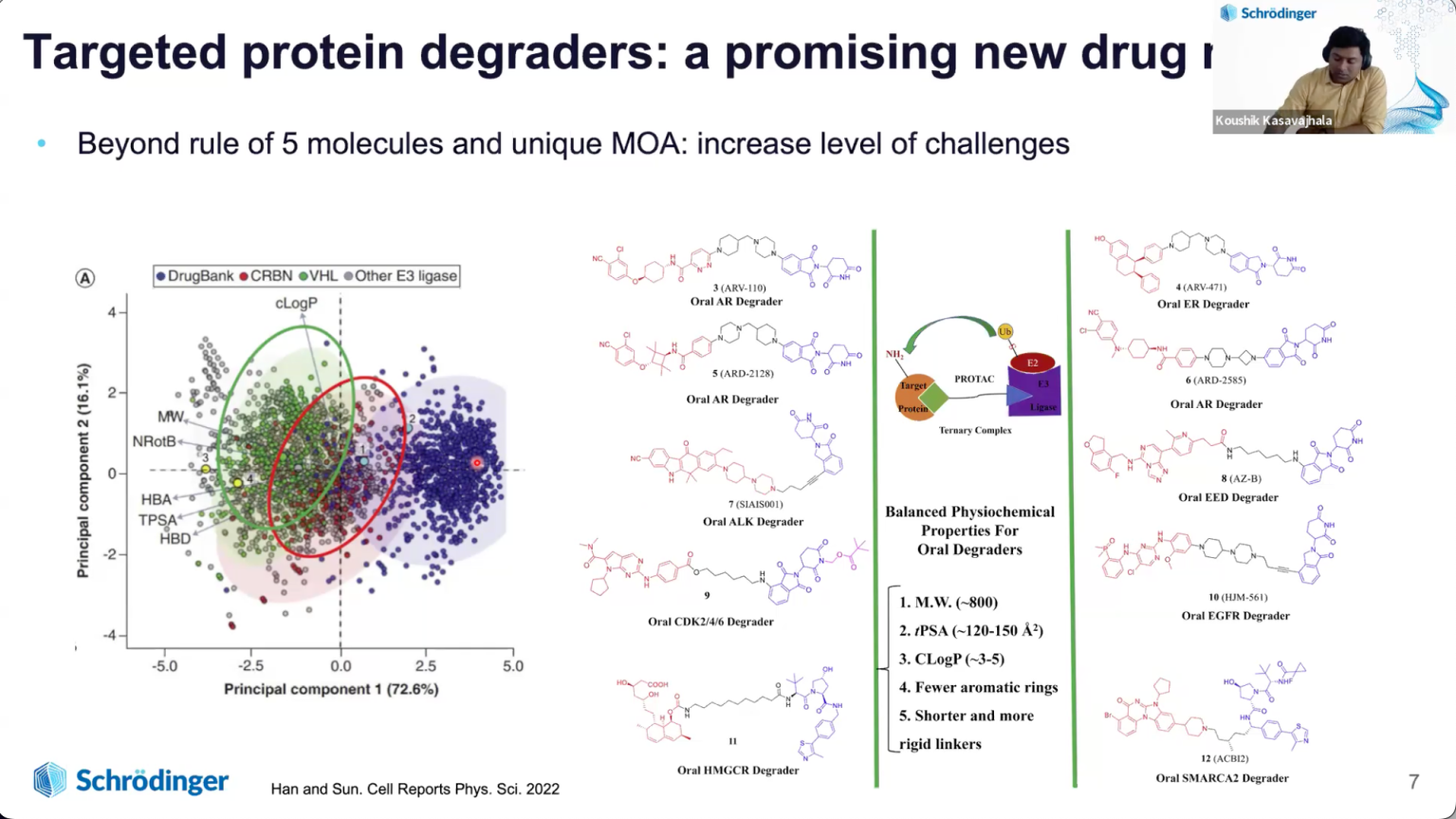
Proteolysis-targeting chimeras (PROTACs) are an emerging area of drug discovery. Unlike traditional small-molecule inhibitors that block protein activity, PROTACs modulate protein function by inducing protein degradation. They bring the target protein and an E3 ubiquitin ligase into proximity, leading to the target protein’s ubiquitination and subsequent degradation by the proteasome. Designing a PROTAC involves optimization of the individual binding domains (also known as warheads) that bind to the target protein and the ligase, the linker connecting the two warheads, and the formation of a ternary complex (target protein + ligase + PROTAC). In this webinar, we will present Schrodinger’s advanced computational toolkit to generate and score potential ternary complexes, and to optimize warheads and linkers. The toolkit uses a combination of protein-protein docking, linker sampling, enhanced sampling methods, and free energy perturbation (FEP+) calculations to design PROTACs with improved degrader potency.

Transforming small molecule drug discovery: The computational chemistry paradigm

Transforming small molecule drug discovery: The computational chemistry paradigm

Speaker:

Pritesh Bhat, Principal Scientist II, Schrödinger

Abstract:

Discover how cutting-edge computational methods are revolutionizing drug discovery. This webinar will focus on Schrödinger’s latest developments and illustrate using case studies how these techniques effectively narrow down ultra-large molecular libraries to just a few hundred candidates. Additionally, virtual combinatorial methods enable a broadening of chemical space, growing a handful of molecules to millions of promising analogs. In this webinar, we will discuss how free energy calculations are revolutionizing early-stage drug discovery campaigns. Thanks to advancements in force fields, GPU technology, and user-friendliness, these methods, particularly the approach implemented in FEP+, now significantly accelerate drug discovery programs. Robust free energy methods can rapidly provide on-target and off-target potency predictions to identify promising molecules, inspiring further rounds of ideation and optimization. Designs with optimal potency and selectivity profiles can be rapidly identified and prioritized for synthesis, thereby accelerating drug discovery timelines.

Integrating physics-based insights to accelerate biologics design

Integrating physics-based insights to accelerate biologics design

Speaker:

Abhijit Kayal, Senior Scientist II, Schrödinger

Abstract:

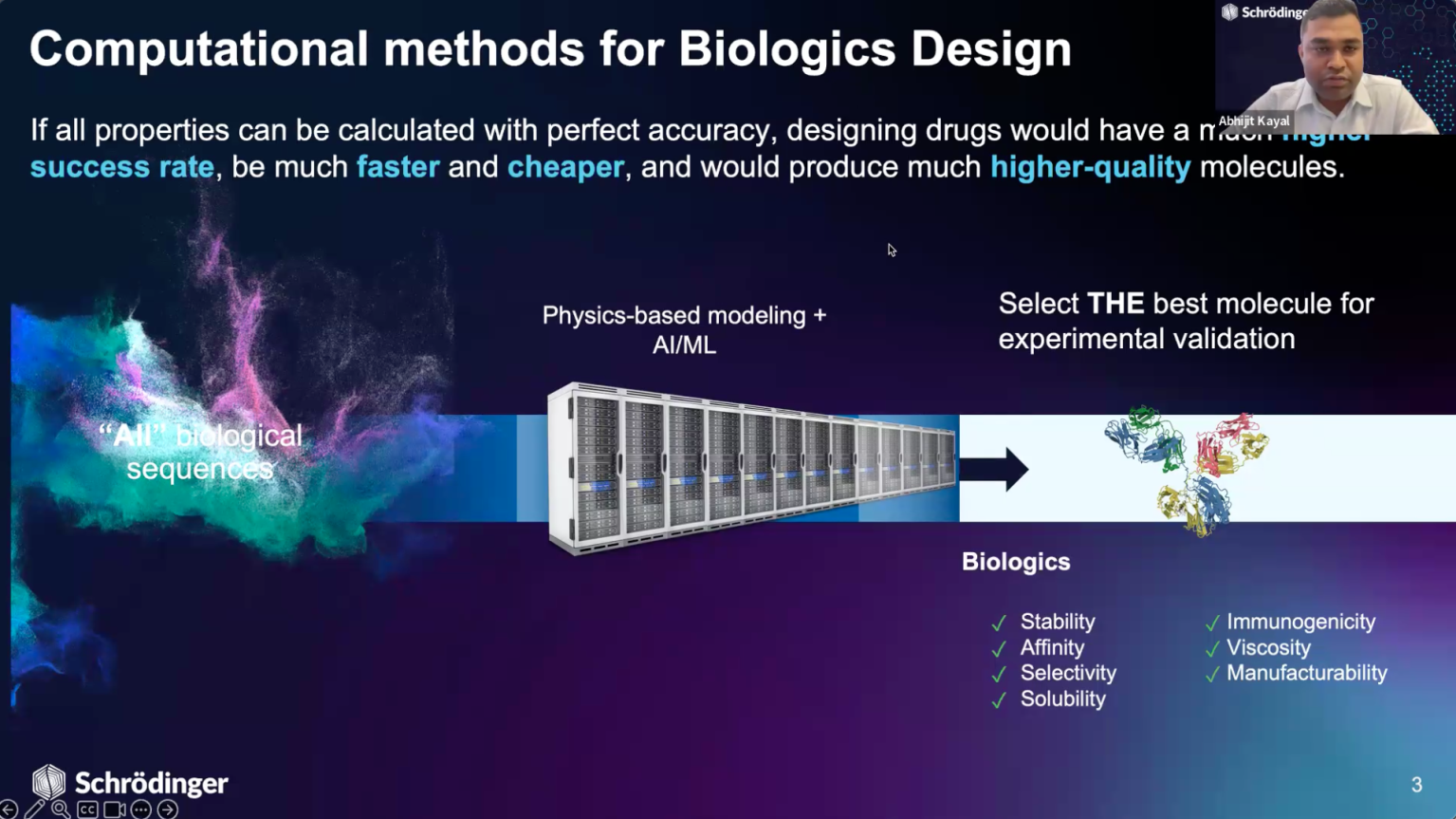
Rational design of biologics, including antibodies and engineered proteins, presents a significant challenge due to the complex interplay of multiple parameters such as stability, binding affinity, selectivity, immunogenicity, and more. Each mutation can differentially influence these properties, making biologics development a high-dimensional, multi-objective optimization problem. In this webinar, we will highlight advanced computational approaches, integrating physics-based simulations to systematically accelerate and streamline the biologics design process. Particular emphasis will be given on strategies for predicting and enhancing protein stability and binding affinity, which are critical determinants of therapeutic efficacy and developability.

Accelerating materials discovery with physics-informed AI/ML

Accelerating materials discovery with physics-informed AI/ML

Speaker:

Saientan Bag, Senior Scientist I, Schrödinger

Abstract:

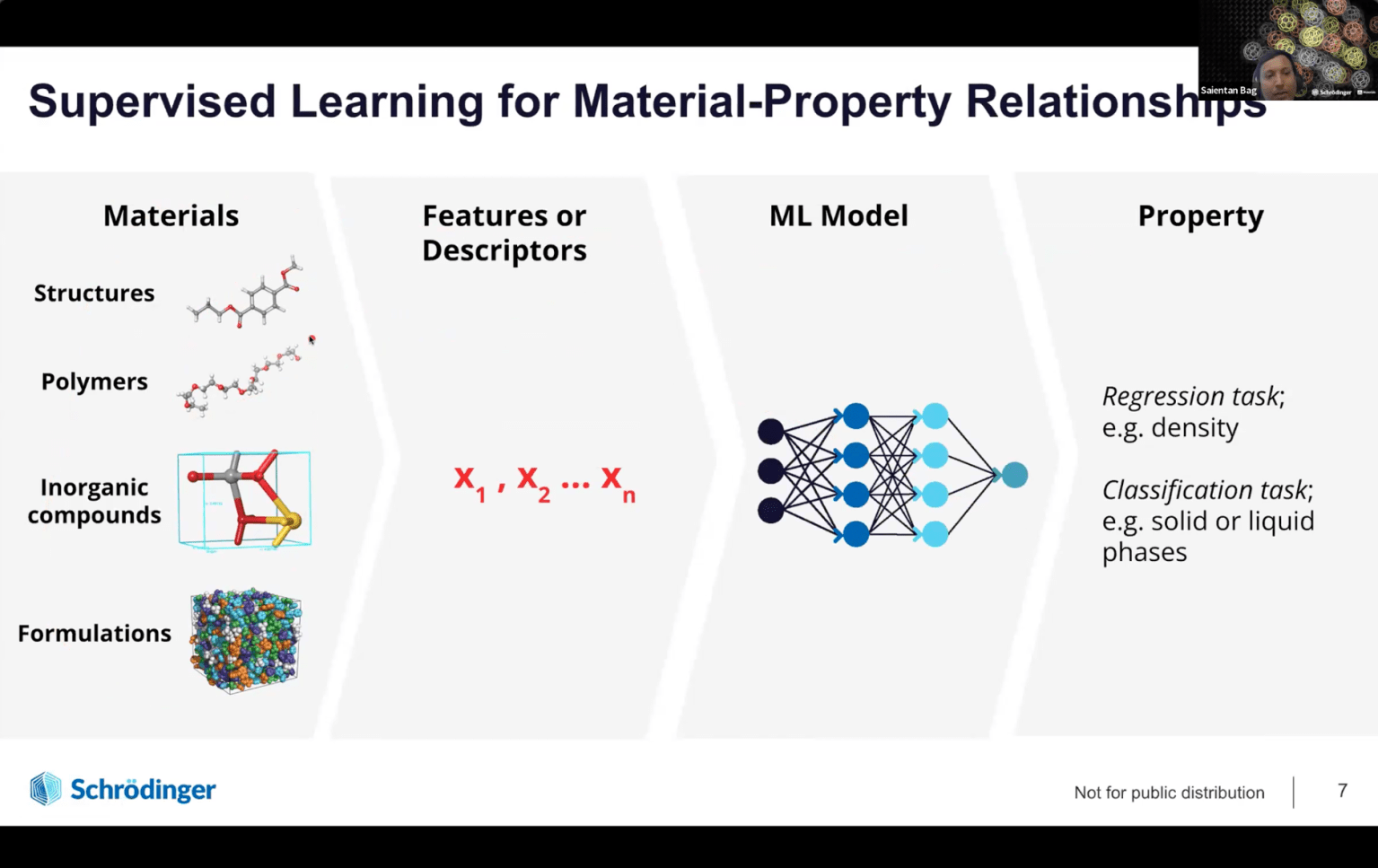
Artificial Intelligence (AI) and machine learning (ML) are reshaping materials science, accelerating the discovery of novel materials and optimizing formulations with unprecedented speed and precision. From polymers to catalysts, these tools unlock design possibilities once thought unattainable. But can AI/ML succeed without a foundation in physics and chemistry? Can we overlook decades of scientific understanding in favor of purely data-driven approaches? At Schrödinger, we combine physics-based simulations with ML built on chemically meaningful representations. This synergy improves accuracy, reduces experimental costs, and delivers insights even in data-limited scenarios. In this webinar, we will explore how Schrödinger’s AI/ML approach is transforming materials R&D through real-world case studies. Our innovation operates on two levels: first, by improving the accuracy-efficiency trade-off in atomistic simulations through the development of machine learning force fields (MLFFs) for high-throughput, accurate modeling; and second, by directly applying AI/ML techniques to predict and optimize material properties in applications such as consumer goods, battery electrolytes, polymers, and catalysts.

Accelerating pharmaceutical formulations development: A computational approach

Accelerating pharmaceutical formulations development: A computational approach

Speaker:

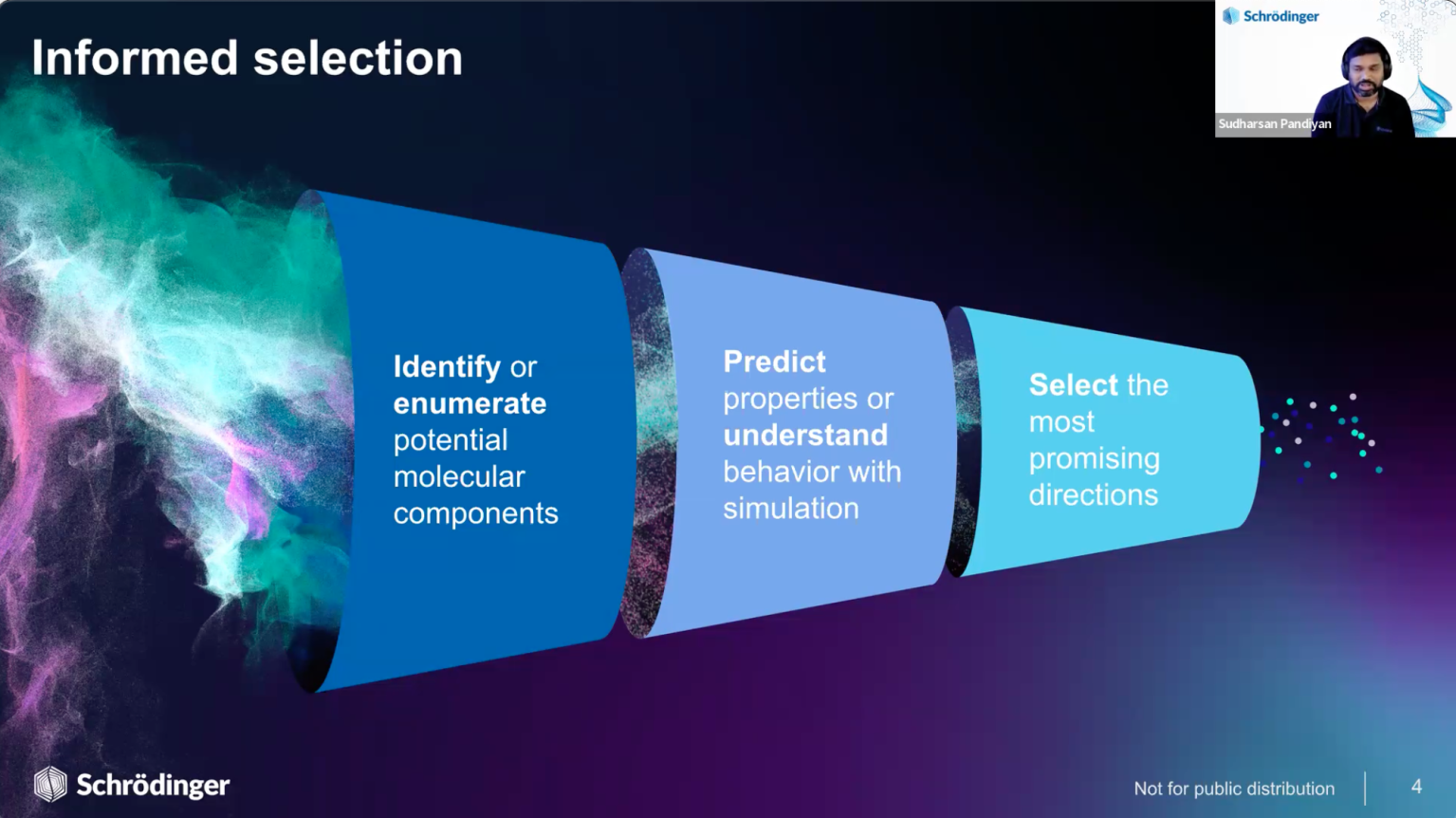
Sudharsan Pandiyan, Principal Scientist II, Schrödinger

Abstract:

Late-stage pharmaceutical formulation failures can be catastrophic with respect to both time and budget. For example, poor solubility, unexpected polymorphism, or nitrosamine impurities have been shown to plague many otherwise highly promising small molecule drugs. Early molecular-level assessment of chemical stability, reactivity, degradation pathways, impurity profiles, solubility, excipient compatibility, and polymorphism is essential for mitigating these risks. Gaining atomistic insights in silico enables informed decision-making, reduces late-stage failure probability, and accelerates development while lowering costs. Schrödinger’s Materials Science platform enables a predict-first methodology, empowering researchers to identify and mitigate formulation challenges before they become consequential problems. Computational analysis minimizes trial-and-error approaches and reduces dependency on costly physical screening. In this webinar, we will highlight case studies demonstrating Schrödinger Materials Science applications for a variety of small molecule drug formulation challenges, including nitrosamine impurity profiling for proactive regulatory risk mitigation, excipient/polymer screening for ASDs with virtual compatibility assessment, and API solubility prediction for early bioavailability optimization. These applications transform pharmaceutical development from reactive, high-risk processes to proactive, data-driven approaches.

Lunch & Learn: Informatics for Medicinal Chemists

Lunch and Learn
CalendarDate & Time
  • October 13th, 2025
  • 10:30 – 15:30 BST
LocationLocation
  • Cambridge, United Kingdom

Informatics for Medicinal Chemists

Register

Dear Medicinal Chemists,

Ever feel your DMTA cycles are not advancing as quickly as you’d like? Is it a challenge to bring all your data from in silico predictions to experimental results into one central view to quickly decide what to design next? Effectively sharing hypotheses with your team and securely tracking data with CRO partners present their own sets of challenges.

Schrödinger therefore invites you to a specialized and free-of-charge “Lunch & Learn” workshop on Monday, October 13th at the Clayton Hotel Cambridge, designed to tackle these exact workflows and collaboration challenges.

We’ll be diving deep into our informatics platform, LiveDesign, to show you how all members of a drug design team can work together to solve these challenges. At this event, Schrödinger will host a hands-on CDK2 inhibitor design challenge where you’ll be able to use LiveDesign.

Date & Time: 

Monday, October 13, 2025
From 10:30 to 15:30 BST

Program: 

Part 1: Welcome Coffee and Introductory Talk about the Platform and Success Stories

10:30 – 12:00 BST

Olivia Lynes, Senior Strategic Deployment Manager II, Enterprise Informatics

+ Lunch
12:00 – 13:00 BST

Part 2: Workshop and Design Challenge on CDK2 Inhibitor with LiveDesign

13:00 – 14:30 BST

Olivia Lynes, Senior Strategic Deployment Manager II, Enterprise Informatics

Hands-on CDK2 inhibitor design challenge where you’ll be able to use LiveDesign on:

  • Predicted physicochemical properties.
  • Machine learning models.
  • Ligand Designer: a validated docking and design model.
  • A tool which searches ChEMBL and vendor databases (with over 1 billion total compounds) at rapid speeds to estimate the novelty of designed compounds.
  • A Target Product Profile MPO.

Part 3: Interactive Q&A and Networking Session

14:30 – 15:30 BST

The afternoon session will feature a Q&A and networking session, providing an opportunity to present your questions and challenges, which the Schrödinger team will endeavor to address.

You can either join for the whole event or solely for the presentation session. All you need to bring is a laptop – no software installation is required. During the workshop, lunch will be served. The afternoon will feature an interactive Q&A and networking session, providing an opportunity to present your questions and challenges, which the Schrödinger team will endeavor to address.

We look forward to seeing you in Cambridge!

Register today to secure your seat!

The workshop is free to attend but preregistration is required as seats are limited. Previous-experience with the Schrödinger suite is not required.

Register

Lunch & Learn: Advanced Solutions for Medicinal Chemistry

Lunch and Learn
CalendarDate & Time
  • November 19th, 2025
LocationLocation
  • Basel, Switzerland

Advanced Solutions for Medicinal Chemistry

Register

Dear Medicinal Chemists,

Ever found yourself struggling to predict brain permeation (Kp,uu), efflux, hERG inhibition, or CYP3A4 TDI in your projects? Take a break from your other obligations and let’s talk!

We are inviting you to join us in an interactive and free-of-charge session on Wednesday, November 19th at the Radisson Blu Hotel, Basel for an extended version of our Lunch and Learn series where Schrödinger scientists will be diving deep into these crucial areas, bringing your practical solutions and expert insights, and demonstrating how modeling approaches can significantly help medicinal chemists make their projects more efficient and successful. You can either join for the whole event or solely for the presentation session.

Date & Time: 

Wednesday, November 19th, 2025
From 10:00 to 13:30 CET

Program: 

+ Welcome Coffee
09:30 – 10:00

Interactive Session on Advanced Modeling Approaches in Medicinal Chemistry

10:00 – 12:00

David Papin, Principal Scientist II, Applications Science
Zeineb Si Chaib, Senior Scientist II, Applications Science

  • Brain Penetration with Kp,uu: Strategy for predicting central nervous system (CNS) drug delivery.
  • Efflux: Overcoming drug efflux mechanisms.
  • Cyp3A4 TDI: Understanding and addressing CYP3A4 time-dependent inhibition.
  • hERG: Mitigating hERG liability by using a quantum mechanics-based pKa calculation and a structure-based approach.

Our seminar will use the DLK story as a framework to explore the topics in detail throughout our session. Afterwards, lunch is served.

+ Lunch
12:00 – 13:30

Discussion & Networking

13:30 – open end

Join us in the afternoon for a Q&A and networking session with our Scientists and Account Managers, providing an opportunity to present your questions and challenges, which the Schrödinger team will endeavor to address.

Register today to secure your seat!

The seminar is free to attend but preregistration is required as seats are limited. Previous-experience with the Schrödinger suite is not required.

Register

6th EFMC² Tandem Talks

OCT 9, 2025

6th EFMC² Tandem Talks

Modern Computational Design Meets Late-Stage Functionalization: A New Class of RIPK1 Inhibitors

Speakers:

Hans Matter and Maria Méndez Pérez (Sanofi)
Tim Knehans (Schrödinger)

Abstract:

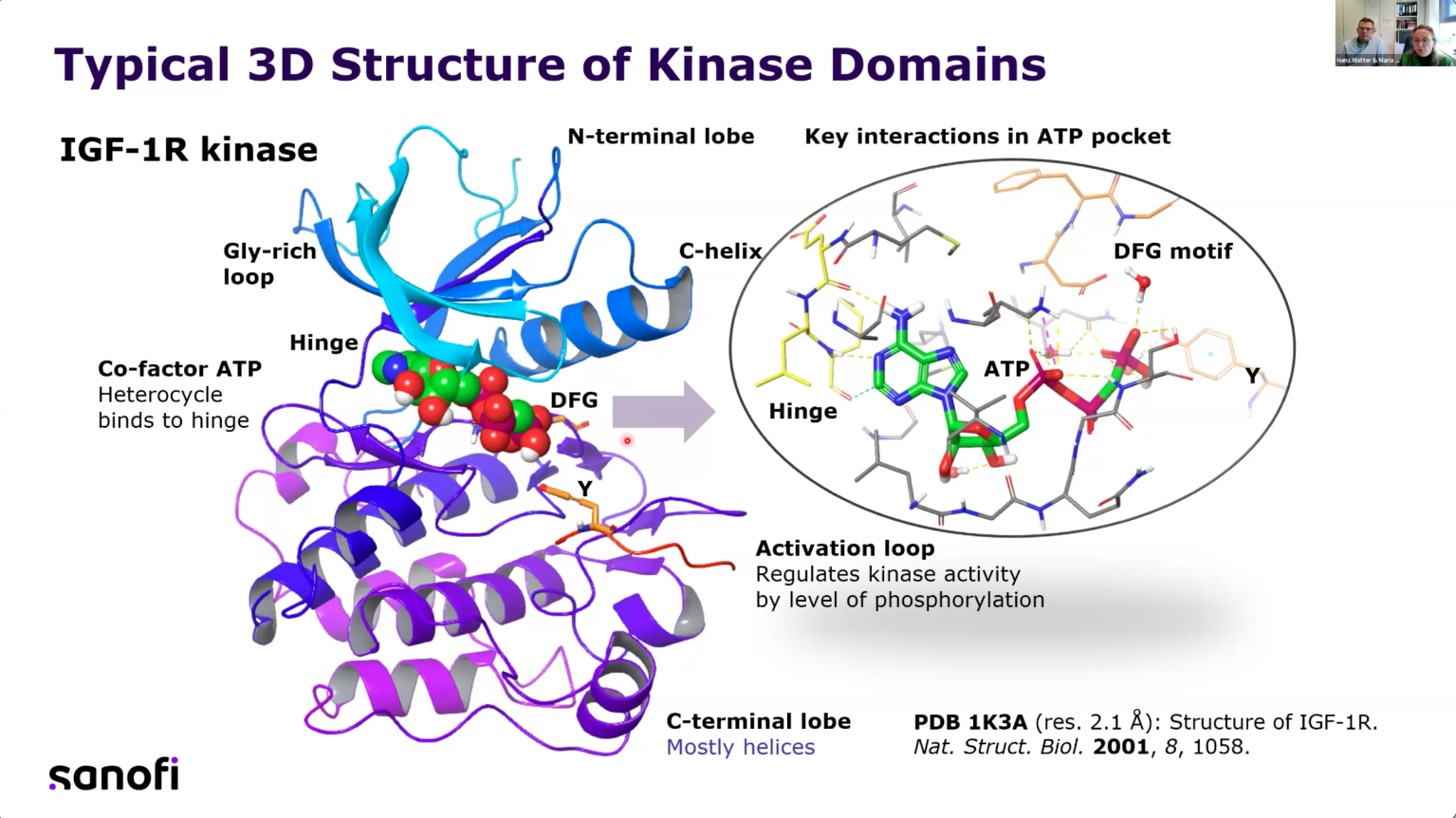
Receptor interacting protein kinase 1 (RIPK1) plays a crucial role in regulating cell homeostasis by integrating inflammatory and cell death signaling pathways.1,2 Given its central position in multiple disease-relevant cascades, selective RIPK1 inhibitors with optimized pharmacokinetic properties represent promising therapeutic agents. This work details our comprehensive approach to designing a novel series of potent and selective RIPK1 inhibitors. Our discovery journey began with a structure-based hit finding strategy that combined scaffold hopping techniques with free energy perturbation (FEP) calculations, yielding an initial novel chemical scaffold. Subsequent optimization employed generative artificial intelligence algorithms alongside traditional structure-based design principles to develop the distinctive aryl-cyclobutyl motif. Detailed analysis of multiple X-ray co-crystals structures informed a second strategic rescaffolding effort specifically aimed at enhancing cellular activity, which successfully led to the innovative cyclobutyl-pyrazolopiperidinone series. To accelerate SAR exploration around the critical cyclobutyl group, we implemented late-stage photochemistry methods that efficiently identified high-potency aryl decorations. Further refinement utilized WaterMap technology and additional FEP calculations to optimize interactions within a secondary binding subpocket. Throughout the design process, we integrated predictions from an extensive panel of in-house in silico ADMET models to prioritize compounds with favorable overall profiles. The synergistic combination of these computational approaches with efficient synthetic chemistry ultimately delivered a compound with comprehensive candidate-like properties suitable for advanced development.

Literature: [1] Zhang. Y. et al. Eur. J. Med. Chem. 2024, 265, 116123. Lessene, G. et al. J. Med. Chem. 2023, 66, 2361. [2] He, S., Wang, X. RIP kinases as modulators of inflammation and immunity. Nat Immunol 2018, 19, 912.

Simulation World Detroit

Conference

Simulation World Detroit

CalendarDate & Time
  • October 1st-2nd, 2025
LocationLocation
  • Plymouth, Michigan

Schrödinger is excited to be participating in the Simulation World Detroit conference taking place on October 1st – 2nd in Plymouth, Michigan. Stop by our booth to speak with Schrödinger scientists.

BioJapan 出展 @パシフィコ横浜

Conference

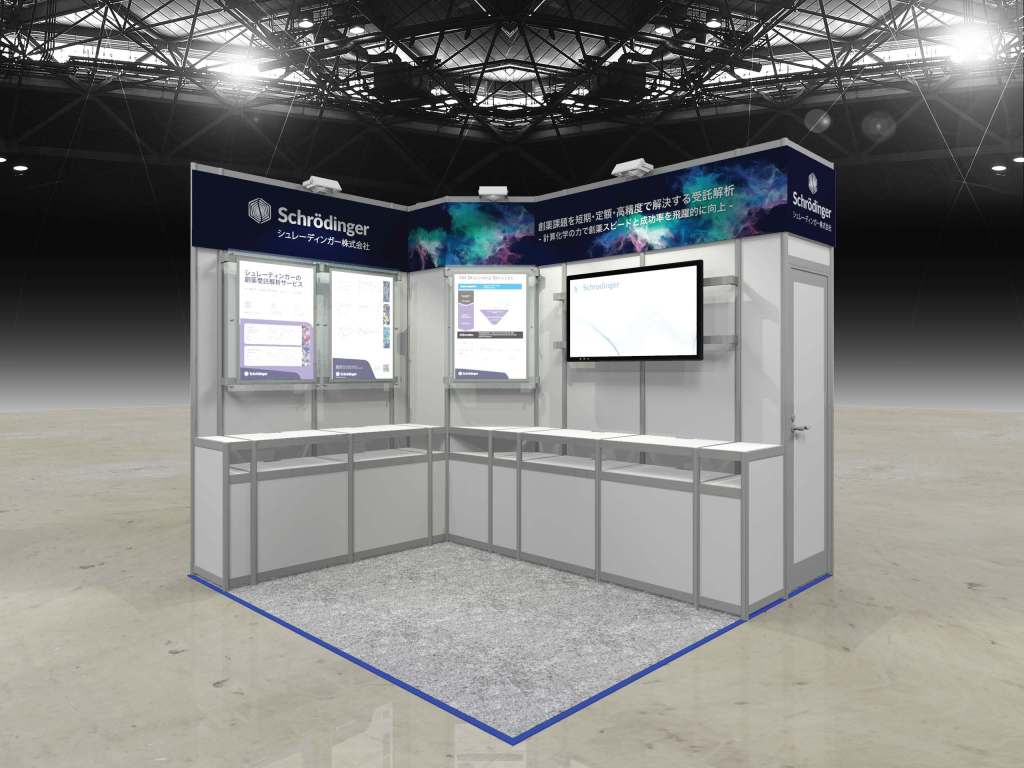
【10月8日(水)~10日(金)】BioJapan 出展

CalendarDate & Time
  • October 8th-10th, 2025
LocationLocation
  • Kanagawa, Japan

創薬課題を短期間・定額・高精度で解決する受託解析

―計算化学の力で創薬のスピードと成功率を飛躍的に向上

シュレーディンガーの創薬受託解析サービスは、実験並みの精度を誇るFEP+やGlideなど最先端の計算化学技術を駆使し、短期間・定額で成果を提供します。仮想スクリーニング、リード最適化、ADMET予測など、創薬研究の各段階を効率化。30年以上の研究開発実績と豊富なノウハウを活かし、貴社の創薬課題解決と研究スピードアップを強力にサポートします。

【特徴】

  • 短期間・定額で高精度な成果
    実験並みの精度を誇るFEP+やGlideを活用し、効率的かつコストを抑えた解析を提供。
  • 創薬研究を加速する多彩な解析メニュー
    仮想スクリーニング、リード最適化、ADMET予測など、創薬プロセス全体を支援。
  • 30年以上の実績と知識移転
    蓄積された計算化学ノウハウを活かし、解析結果だけでなく技術活用の経験値も提供。

ブースでは、当社のエキスパートがデモ機を使用してご紹介します。ぜひお立ち寄りください。

【展示会情報】

展示会名:BioJapan
会期:2025年10月8日(水) -10日(金)
会場:パシフィコ横浜
小間番号:C-19