248th ECS Meeting

Conference

248th ECS Meeting

CalendarDate & Time
  • October 12th-16th, 2025
LocationLocation
  • Chicago, Illinois

Schrödinger is excited to be participating in the 248th ECS Meeting taking place on October 12th – 16th in Chicago, Illinois. Join us for presentations by Schrödinger scientists.

icon time OCT 14 | 11:00AM
Schrödinger’s Atomistic Simulation Workflow to Model Solid Electrolyte Interphase in Lithium-Ion Batteries

Speaker:
Manav Bhati, Senior Scientist II, Materials Science Modeling Services, Schrödinger

Abstract:
Lithium-ion batteries (LiBs) are ubiquitous, powering applications from portable electronics to electric vehicles. Atomic-level computational simulations play a critical role in exploring and optimizing battery materials. This work expands the application of our physics-based simulation workflow to model the solid electrolyte interphase (SEI), which is a crucial yet poorly understood component of batteries. Our approach utilizes a reaction-template-based method with the OPLS4 force field and a high-speed GPU-based molecular dynamics engine (Desmond) within Schrödinger’s Materials Science suite to simulate SEI nucleation and growth. The SEI simulator provides detailed atomistic insights into SEI morphology and product distribution. In particular, we investigate how changing the chemistry of electrolytes affects SEI composition and properties.   Lithium hexafluorophosphate in ethylene carbonate (LiPF6/EC) is a widely used Li-ion battery electrolyte. Our atomistic simulations of 1 M LiPF6/EC on a graphite electrode closely match experiments, revealing a thin inorganic layer (Li2CO3, LiF) near the electrode, a porous organic layer (Li2EDC, Li2BDC), and gaseous species (C2H4, PF3) diffusing away. Comparing different electrolyte chemistries, we find that 1 M LiPF6/EC forms a denser, more compact SEI than 1 M LiPF6/PC, suggesting superior mechanical stability and explaining EC’s dominance in commercial batteries. Adding ethyl methyl carbonate (EMC, a common linear cosolvent) to EC further enhances SEI density, particularly in the inorganic layer, leading to reduced electrolyte degradation, lower irreversible losses, and improved mechanical stability, ultimately boosting battery performance.   Schrödinger’s SEI simulation workflow enables modeling across diverse electrolyte chemistries (from cyclic to linear electrolyte solvents and mixtures), offering comprehensive atomistic insights that accelerate the development of optimized materials for next-generation batteries.

icon time OCT 15 | 12:20PM
Scalable and Generalizable Machine Learning Force Fields for Modeling Complex Battery Materials

Speaker:
Garvit Agarwal, Principal Scientist I, Materials Science Applications Science

Abstract:
The rapid advancements in rechargeable Li-ion battery (LIB) technology has revolutionized several key industries such as automotive and consumer electronics. However, new battery chemistries are needed to improve the power density, safety, reliability, and lifetime of LIBs. Existing classical force fields are not accurate enough to predict bulk properties of LIB materials without time-consuming and customized parametrization. To move towards accurate and reliable modeling of battery chemistries, we developed a machine-learned force field (MLFF) using a charge recursive neural network (QRNN) architecture, which includes both long-range interactions and global charge redistribution. The MLFF is trained to model a large chemical space of industrially relevant liquid electrolyte chemistries and enables large scale molecular dynamics (MD) simulations of realistic electrolyte formulations. In this presentation, I will demonstrate our generalized active learning framework and sampling workflow used to generate accurate training data for liquid and amorphous systems. I will discuss large scale benchmarks carried out to evaluate the performance of MLFF against experimental data for key physical and transport properties of liquid electrolytes including density, viscosity and ionic conductivity. Our results indicate that MLFF outperforms the classical force fields in terms of quantitative agreement with experimental data across a broad range of electrolyte chemistries. I will also discuss the novel molecular level insights into the unique Li+ cation solvation structures predicted by MLFF and their validation using experimental nuclear magnetic resonance (NMR) spectroscopy. Finally, I will briefly discuss our recent work to develop a message passing neural network architecture to train universal MLFF for inorganic materials covering up to 94 elements from the periodic table allowing for efficient design of materials for cathodes, coatings and and solid-state electrolytes for applications in next-generation batteries. 

Designing better biologics: A blueprint for leveraging in silico methods in biologics R&D

SEP 25, 2025

PROTEIN DESIGN SERVICES

Designing better biologics: A blueprint for leveraging in silico methods in biologics R&D

The development of biologics is a complex, high-risk process, often slowed by challenges in protein stability, selectivity, and affinity. Join us for a detailed look into how Schrödinger’s advanced computational protein design platform can help you navigate these hurdles and accelerate your pipeline.

In this exclusive webinar, our experts will provide a technical overview of our unique, physics-based approach to protein engineering and customizable in silico workflow, and discuss several relevant examples. We’ll then dive into a case study, showcasing a recent collaboration where we successfully implemented this rational, structure-based approach to guide the design of a protein cage that assembles stably at neutral pH and disassembles at low pH for controlled payload delivery. By incorporating our computational workflow, the customer was able to dramatically reduce the number of variants tested experimentally, saving valuable time and resources.

Finally, we will provide a clear guide on how to engage with us – from small-scale pilot projects to full-scale collaborations – and show you how our platform can become a powerful extension of your R&D team. Discover how to leverage cutting-edge technology to bring your next biologic to the clinic faster and with a higher probability of success.

Webinar Highlights

  • Overview of Schrödinger’s biologics capabilities and offerings for rational antibody design
  • Introduction to Schrödinger’s biologics services and how to get started
  • Case study: Collaboration in which a structure-based approach successfully guided the design of a pH-controlled protein cage

Our Speakers

Dan Cannon

Director, Head of Biologics Modeling, Schrödinger

Dr. Dan Cannon is the Director, Head of Biologics Modeling, as well as the lead for biologics services in Europe. Prior to joining Schrödinger, Dan received his Ph.D. from the University of Strathclyde in Glasgow, UK and in 2016 began working at MedImmune (now AstraZeneca) in Cambridge, UK, using computational approaches for therapeutic protein design. Since joining Schrödinger in 2018, Dan has leveraged his extensive biologics expertise to enable Schrödinger customers to create and deploy cutting-edge computational workflows and design better molecules, faster.

Jared Sampson

Senior Scientist II, Life Science Software, Schrödinger

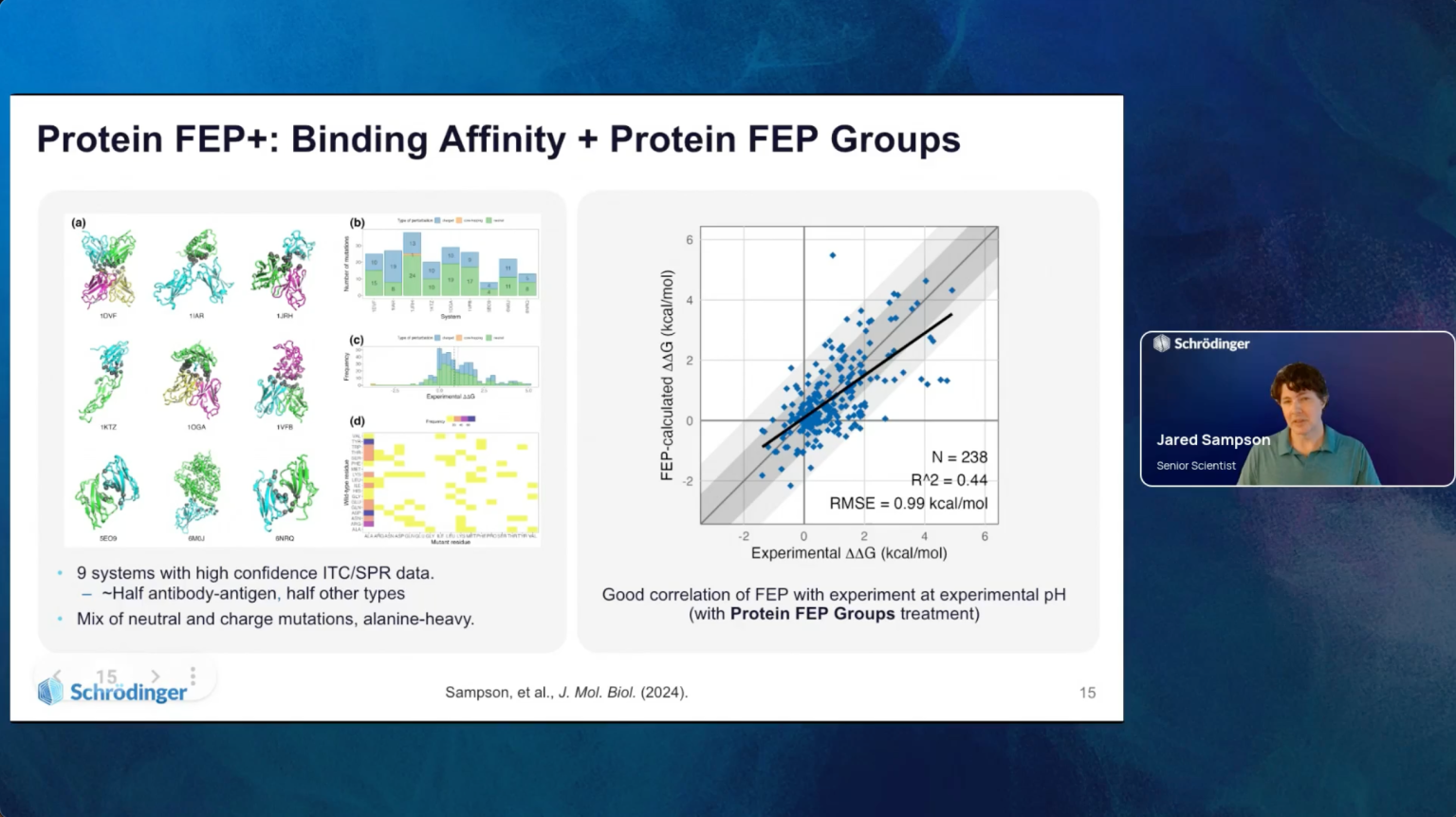
Jared Sampson joined Schrödinger in 2020, working primarily on analysis of and development of improved workflows for Protein FEP+ calculations. He received a Ph.D. from Columbia University, training in computational molecular biophysics and experimental structural biology and biophysics under Rich Friesner and Larry Shapiro, respectively. With 17 years of experience in the field, his prior work and research interests include host-pathogen, antibody-antigen, and antibody-receptor interactions; protein engineering; and pH-dependent binding.

Accelerating product development with computational materials engineering

Accelerating product development with computational materials engineering

CalendarDate & Time
  • November 13th, 2025
  • 8:00 AM PDT | 11:00 AM EDT | 4:00 PM BST
LocationLocation
  • Virtual

**Please note, this event has been rescheduled from October 2nd to November 13th.

Overview

Ansys and Schrödinger are transforming product design and development through integrated computational materials engineering (ICME).

Materials properties and materials engineering used to be treated as separate domains—molecular-level behavior was disconnected from product-level design and performance, with limited insight into how material choices influence outcomes. The ICME approach bridges this gap by connecting molecular-scale insights with continuum-level simulations and enables engineers and scientists to design not only the structure but also the material itself. This integrated approach accelerates innovation and leads to more efficient, high-performance solutions across industries like consumer goods, automotive, and electronics.

This powerful partnership enables a holistic approach to materials and product development, allowing R&D teams to:

  • Identify key material requirements: Use continuum simulation to evaluate the performance-specific material properties and help guide the material development process (top-down approach)
  • Accelerate material discovery: Screen across chemical libraries and inform continuum simulations with precise molecular data (bottom-up approach)
  • Optimize performance: Evaluate variations in product performance originating from uncertainties in synthesized material and design variables to perform robust material and design optimization loops

Discover how companies are leveraging ICME to enhance outcomes in consumer goods, fluids manufacturing, optics, and polymer development.

Learn how your R&D team can accelerate the process from materials design to product design and manufacturing.


What Attendees Will Learn

  • Integrated Computational Materials Engineering (ICME) in action
  • Speeding up materials discovery using molecular simulation
  • Linking molecular properties to product performance
  • Smarter, faster materials selection for R&D
  • Real-world applications in consumer goods, optics, polymers, and manufacturing


Who Should Attend and Why

  • Chemists, Engineers, Simulation Engineers, R&D Managers, Executives
  • Bridge the Gap Between Molecular and Engineering Design: Learn how Ansys and Schrödinger’s ICME approach connects molecular-level insights with continuum simulations to unlock breakthrough innovations.
  • Accelerate Material Innovation: See how R&D teams are reducing time and cost in material discovery by integrating computational chemistry with simulation-driven design.
  • Improve Product Performance: Understand how to optimize both materials and product design together to achieve superior performance and reliability in real-world conditions.
  • Explore Real-World Applications: Discover how leading companies are applying ICME in areas like consumer goods, fluids manufacturing, optics, and polymer development to gain a competitive edge.
  • Enable Smarter Materials Decisions: Learn how to identify performance-critical material properties early in the design cycle to guide development and reduce downstream risks.


Speakers

  • Adarsh Chaurasia – Ansys/Synopsys
  • David Nicholson – Schrödinger

SEPAWA CONGRESS 2025

Conference

SEPAWA CONGRESS 2025

CalendarDate & Time
  • October 15th-17th, 2025
LocationLocation
  • Berlin, Germany

Schrödinger is excited to be participating in the SEPAWA CONGRESS 2025 conference taking place on October 15th – 17th in Berlin, Germany. Join us for a poster session and presentation by Jeff Sanders, Research Leader of Materials Science Product Discovery at Schrödinger. Stop by booth D564 & 565 to speak with Schrödinger scientists.

icon time OCT 16 | 11:15
icon location Room 12 + 13
Lecture: Molecular modeling of a hair fiber surface by coarse-grained simulation

Speaker:
Jeff Sanders, Research Leader of Materials Science Product Discovery, Schrödinger

Abstract:
Further understanding of the physical properties of the hair surface and its interactions with commonly used ingredients would help to drive new development for hair care products. Molecular simulation can provide an accurate predictive model on the outer layer of the hair to help researchers and engineers understand the fundamental physics at molecular level.1,2 In this study, we have built a MARTINI coarse-grained (CG) model focusing on the description of 18-methyl eicosanoic acid (18-MEA). The CG model was derived from an all-atom model but it overcomes the size limits of the all-atom model.3 We first used the model to characterize the hair surface to understand the distribution of 18-MEA patches. Then the model was used to virtual test the interaction of ingredients on the hair surface. Through modeling of grease molecules and shampoo surfactants on the F-layer of the hair surface, the in-situ cleaning and conditioning process are revealed at molecular scale resolution, which can be correlated to the processes of cleaning and conditioning when washing macroscopically.The MARTINI CG model provides an opportunity to understand the hair surface under different conditions. The unique mechanistic insight of these simulations can help enrich the knowledge of the functioning of the products and help optimize the product performance.

icon time OCT 16 | 14:30
icon location Hall Europa
Poster: Beyond AI: Leveraging physics-based modeling and machine learning to develop new cosmetic products

Speaker:
Jeff Sanders, Research Leader of Materials Science Product Discovery, Schrödinger

Abstract:
In today’s dynamic market, businesses are spearheading a sustainability revolution, propelling the exploration of biomaterials to the forefront. Harnessing the power of cutting-edge data-driven multi-scale physics simulations and machine learning, researchers are meeting demand with unprecedented speed and precision. Join us for a dive into how these simulations are transforming cosmetics R&D, with illustrative real-world case studies from industrial collaborations. Experience the fusion of science and sustainability, shaping a vibrant, eco-conscious future.

Structure-based discovery of highly potent dihydroorotate dehydrogenase inhibitors for once-monthly malaria chemoprevention

Oct 8, 2025

Structure-based discovery of highly potent dihydroorotate dehydrogenase inhibitors for once-monthly malaria chemoprevention

We are delighted to bring you another webinar in our series Stories of Drug Hunting in a Digital Age – featuring conversations with veteran drug hunters who share their unique drug discovery stories, from idea to development candidate. You’ll hear about the teams and tools used to progress programs and have an opportunity to ask questions.

Malaria remains a serious global health challenge, yet treatment and control programs are threatened by drug resistance. Dihydroorotate dehydrogenase (DHODH) was clinically validated as a target for treatment and prevention of malaria through human studies with DSM265 (Phase 2), but currently no drugs against this target are in clinical use.

In this webinar, Zhe Nie, medicinal chemist and project leader at Schrödinger, and Margaret Phillips, professor at UT Southwestern Medical School, Dallas, share in conversation how their teams worked collaboratively towards the discovery of novel DHODH inhibitors. They will explore how structure-based computational tools including free energy perturbation (FEP+) were used to discover highly ligand efficient, potent, and selective pyrazole-based Plasmodium DHODH inhibitors through a scaffold hop from a pyrrole-based series. Optimized pyrazole-based compounds were identified with low nM-to-pM Plasmodium falciparum cell potency and oral activity in a humanized SCID mouse malaria infection model. The lead compound DSM1465 is more potent and has improved ADME/PK properties compared to DSM265. This compound meets Medicines for Malaria Venture’s objective of identifying compounds with potential to be used for once-monthly chemoprevention in Africa to support malaria elimination efforts.

Webinar Highlights

  • Discover how in silico techniques combined with traditional medicinal chemistry approaches are applied in a structure-based drug discovery program
  • See how the team overcome DMPK challenges to discover a pre-clinical candidate, DSM1465, with a long predicted human half life at a low dose
  • Learn how free energy perturbation methods (FEP+) were used to prioritize compounds and drive programs forward efficiently
  • Ask questions to gain further insight from the speakers to apply to your work

Publication

Our Speakers

Zhe Nie

Executive Director, Medicinal Chemistry, Therapeutics Group, Schrödinger

Dr. Zhe Nie is the Executive Director of Medicinal Chemistry, Therapeutics Group, at Schrödinger. She has been leading multiple wholly owned and partnered drug discovery programs. Most recently, she led Schrödinger’s MALT1 discovery project team, successfully developed the small molecule drug SGR-1505 (Schrödinger’s first internal clinical asset currently in Ph1) by applying Schrödinger’s computational platform. It took less than two years from the start of the project to the selection of the clinical candidate. In collaboration with Dr. Philips from Southwestern Medical Center and other academic collaborators, Dr. Nie also played a key role in discovering  a highly potent DHODH inhibitor as a potential once-monthly chemopreventive antimalaria treatment. She has extensive experiences applying advanced computational tools to assist in the design of small molecule drug candidates. She previously worked at Takeda, Celgene, and Quanticel Pharmaceuticals (acquired by Celgene), where she led and contributed to the advancement of multiple small molecule drugs to the clinics including TAK-960, TAK-659 and CC-90011.

Margaret A. Phillips

Professor and Chair, Dept of Biochemistry, UT Southwestern Medical School, Dallas

Meg Phillips is a parasitologist recognized for her work on exploiting metabolic pathways in protozoan parasites for drug discovery. Her work on the pyrimidine biosynthetic pathway in the malaria parasite led to the identification of an inhibitor of dihydroorotate dehydrogenase that reached clinical development for the treatment of malaria, for which she received the Medicines for Malaria Venture (MMV) Project of the Year Award for this work in 2010. She has identified additional inhibitors against this target with the potential to advance for chemoprevention and has also advanced efforts to target other key enzymes in the malaria parasite, including the proteasome. She has made multiple discoveries focused on the polyamine metabolic pathway in Trypanosoma brucei, the causative agent of sleeping sickness. She identified novel regulatory mechanisms for two enzymes in the pathway, S-adenosylmethionine decarboxylase and deoxyhypusine synthase, finding that both enzymes require oligomerization with inactive paralogs for activity. Phillips graduated from the University of California, Davis with a B.S. in Biochemistry in 1981, and with a Ph.D. in Pharmaceutical Chemistry in 1988 from the University of California, San Francisco, where she was also a postdoctoral fellow in the Department of Biochemistry. She joined the faculty of UT Southwestern in the Department of Pharmacology as an assistant professor in 1992, was promoted to tenured associate professor in 1997, and to full professor in 2002. She became Chair of the Department of Biochemistry at UT Southwestern in 2016 and holds the Sam G. Winstead and F. Andrew Bell Distinguished Chair in Biochemistry. She was elected to the National Academy of Sciences in 2021, elected as a fellow of the American Society for Biochemistry and Molecular Biology and elected to the fellowship of the American Academy of Microbiology in 2022. She won the 2024 ASBMB Herbert Tabor Research Award and the 2026 ASBMB Alice and CC Wang Award in Molecular Parasitology.

The Battery Show 2025

Conference

The Battery Show 2025

CalendarDate & Time
  • October 6th-9th, 2025
LocationLocation
  • Detroit, Michigan

Schrödinger is excited to be participating in the Battery Show 2025 conference taking place on October 6th – 9th in Detroit, Michigan. Stop by booth 3534 to speak with Schrödinger scientists.

SAMPE Europe 2025

SAMPE Europe 2025

CalendarDate & Time
  • October 6th-7th, 2025
LocationLocation
  • Amsterdam, Netherlands

Schrödinger is excited to be participating in the SAMPE Europe 2025 conference taking place on October 6th – 7th in Amsterdam, Netherlands. Join us for a presentation by Irene Bechis, Senior Scientist II at Schrödinger, titled “Insights into the thermal oxidation process of epoxy resin systems using a multiscale modelling approach.”

icon time OCT 6 | 15:10-15:30 CEST
icon location Room 4
Insights into the thermal oxidation process of epoxy resin systems using a multiscale modelling approach

Speaker:
Irene Bechis, Senior Scientist II, Schrödinger

Abstract:
Understanding and controlling the risk of degradation of polymers during their service life is crucial to the design of more durable materials. Indeed, exposure to temperature, oxygen or UV light is often responsible for the deterioration of some of the key properties of polymers such as adhesive strength, plasticity and toughness. However, mapping degradation pathways can be challenging, as they involve multistep reactions that are highly dependent on the polymer chemistry and are difficult to study in experiments. Molecular simulations can provide atomic-level insights into degradation processes, especially in their early stages, not easily captured in experiments. Modelling allows us to identify where degradation is most likely to occur, isolate and explore specific degradation pathways, linking changes in properties to degradation-induced chemical modifications.

In this study, we leverage a multiscale computational approach to investigate the response to thermal oxidation of model epoxy amine systems. We show how a hybrid molecular-dynamics and Monte Carlo approach combined with quantum mechanical calculations can help shed light on a complex degradation behaviour, complementing the information coming from experiments. This study enhances our understanding of the oxidative process of epoxy amine thermosets and demonstrates a workflow that, combined with experiments, can guide polymer formulation design.

EUROPIN Summer School on Drug Design 2025

EUROPIN Summer School on Drug Design 2025

CalendarDate & Time
  • September 14th-19th, 2025
LocationLocation
  • Vienna, Austria

Schrödinger is excited to be participating in the EUROPIN Summer School on Drug Design 2025 conference taking place on September 14th – 19th in Vienna, Austria. Join us for a presentation and workshops by Daniel Cappel, Senior Principal Scientist at Schrödinger.

icon time SEPT 16 | 14:00
A novel workflow for the in silico identification and prioritization of potential allosteric binding sites based on mixed solvent simulations and SiteMap

Speaker:
Daniel Cappel, Senior Principal Scientist, Schrödinger

Abstract:
Allosteric modulation is a promising strategy for developing drugs against difficult targets where traditional orthosteric site targeting faces challenges with selectivity, resistance, or developability. The increasing availability of high-resolution protein structures and advancements in computational power and in silico algorithms have expanded the potential of structure-based drug design (SBDD) for allosteric drug discovery. However, there remains a significant need for effective tools to identify and prioritize potential allosteric binding sites, particularly those not accessible in the apo protein structure. To address this, we have developed a novel workflow that leverages mixed solvent molecular dynamics (MxMD) simulations to reveal potential binding sites, coupled with an improved SiteMap for scoring the druggability of these sites. Our combined approach achieved a >80% top 5 found rate of known allosteric binding sites in apo structures from a set of 22 apo/holo PDBs, compared to only 63% with SiteMap alone and 54% with MxMD alone. We further evaluated our workflow on a curated set of five pharmaceutically relevant targets with multiple known allosteric binding sites, and our method outperformed popular machine learning methods, p2rank and DiffDock, as well as SiteMap, in all systems except one. Finally, we report the successful application of this workflow to an active drug discovery project within our therapeutics group. Our new workflow offers an improved method for characterizing binding sites in allosteric systems. Furthermore, efforts are underway to refine the predicted binding sites to enable virtual screening campaigns. This combined approach demonstrates a significant improvement over existing methods for identifying allosteric binding sites and has the potential to enable effective hit discovery campaigns for novel binding sites.

icon time SEPT 16 | 14:30
A beginner’s guide to system preparation, docking and designing ligands

Speaker:
Daniel Cappel, Senior Principal Scientist, Schrödinger

Abstract:
If you are interested in learning to navigate the Schrödinger suite and how to perform docking of small molecules, join us for a hands-on workshop designed for beginners. The main Maestro interface houses all the tools that are required to bring in your starting small molecules and protein system, so that they may be prepared correctly. Once you are comfortable with the fundamentals of preparing your raw materials, we will move on to understanding more about the binding site and its features, which will help us think about how a ligand might interact with it. This forms a fundamental basis for understanding our docking results, so we will start by setting up and running docking jobs and analyzing how the resulting docked compounds fulfill the basic criteria of shape and molecular interactions that lead to the final scoring term. Finally, we will explore ligand design in a more automated fashion using the Ligand Designer GUI which facilitates on-the-fly ideation through ‘build and dock’ workflows. Using embedded libraries of building-blocks, users can modify their initial idea in many intuitive ways: from attachment points on the bound ligand; the free and viable space in the binding site; through picking specific residues in the protein or specific waters in the binding cavity to guide the design process.

icon time SEPT 17 | 14:30
Efficient virtual screening: Combining ligand-based screening with QuickShape and advanced water-based scoring with WaterMap and GlideWS

Speaker:
Daniel Cappel, Senior Principal Scientist, Schrödinger

Abstract:
In this workshop, we will assemble a modern virtual screening pipeline from start to finish. We will curate a tailored screening library by simultaneously querying catalogs of many vendors. Using QuickShape screening, we will efficiently prioritize compounds for molecular docking, reducing computational cost and focusing on promising candidates. Then, we will perform compound selection leveraging chemical properties, pharmacophore features, and diversity analysis with the Hit Analyzer tool in Maestro to identify a diverse set of potential hits. Using GlideWS, we will rescore these compounds and use the advanced visualizer in Maestro to eliminate likely false positives by analyzing protein desolvation, improving the accuracy of your screening results. Finally, we will nominate a selection of top-ranking compounds for sophisticated AB-FEP+ rescoring.

Building stable and accurate FEP models for agonist affinity for GPCRs

Building stable and accurate FEP models for agonist affinity for GPCRs

Free energy perturbation (FEP) has become the gold standard in binding affinity prediction, and target enablement for the use of this physics-based approach is highly desirable in structure-based drug design. G protein-coupled receptors (GPCRs), which are the target of approximately 35% of approved drugs, represent complex systems for FEP simulations. The rich conformational space of these receptors or the absence of structural waters in many cryo-EM structures are just a few factors that complicate FEP enablement of GPCRs and result in highly sensitive models. Additionally, modeling agonism requires cost-effective solutions to incorporate the effects of G-proteins without resulting in computationally prohibitive simulations.

In this webinar, Ferran Planas, Ph.D., Research Scientist at Lundbeck, will discuss how his team routinely used FEP+ to predict binding affinities for GPCR agonists. He will describe how they built a stable system, which required a combination of careful manual work, the use of Schrödinger tools, and the application of solutions from the literature. The work at Lundbeck highlights the challenges in modeling GPCR agonism but demonstrates that creating a stable FEP+ model is achievable with limited resources.

Webinar Highlights

  • Overview of the challenges associated with enabling structure-based design for complex systems
  • Case study: Lundbeck’s application of FEP+ to predict binding affinities for GPCR agonists

Who Should Attend

  • Scientists looking to enable structure-based design on complex systems
  • Scientists looking for strategies to maximize their FEP+ resources

Our Speakers

Ferran Planas

Research Scientist, Molecular Modelling & Structural Biology, Lundbeck

Ferran Planas is a research scientist at Lundbeck in Denmark. He holds a Ph.D. in organic chemistry from Stockholm University, and his research has focused on molecular modeling of proteins. During his Ph.D., he investigated the reaction mechanisms of ThDP-dependent enzymes using DFT. After completing his dissertation, he moved to Denmark for a postdoctoral position at the Technical University of Denmark (DTU). In 2022, he joined the Molecular Modeling and Structural Biology team at Lundbeck, where he supports early- to late-stage pre-clinical pipeline activities. Ferran’s career has been driven by multidisciplinary research, and he has contributed to enabling molecular modeling for medicinal chemists.

Steven Jerome

Executive Director, Life Science Software, Schrödinger

Steven Jerome, Executive Director, Life Science Software at Schrödinger, earned his Ph.D. in Chemistry from Columbia University under the mentorship of Richard Friesner. During his time at Columbia, he contributed to the development of tools for molecular docking and protein structure refinement. Following his doctoral studies, he joined Schrödinger as a scientific developer on the Glide team. Over the years, he has progressed through several roles within the company and now serves as Executive Director. In his current role as the Scientific Lead of Hit Discovery, he oversees the development of a cutting-edge portfolio of computational tools for small molecule hit identification. Additionally, he leads the EU+ Application Science team, directing advanced scientific support for Schrödinger’s commercial customers across Europe.

Structure-Based Drug Design Conference 2025

Conference

Structure-Based Drug Design Conference 2025

CalendarDate & Time
  • October 1st-3rd, 2025
LocationLocation
  • Sestri Levante, Italy

Schrödinger is excited to be participating in the Structure-Based Drug Design Conference 2025 taking place on October 1st – 3rd in Sestri Levante, Italy. Join us for a presentation by Ilaria Salutari, Senior Scientist at Schrödinger, titled “Investigation of solvation effects in long MD and FEP simulations.”

icon time OCT 1 | 12:30 – 13:00
Investigation of solvation effects in long MD and FEP simulations

Speaker:
Ilaria Salutari, Senior Scientist, Schrödinger

Abstract:
Water has a crucial role in ligand binding to protein targets and thus needs accurate modelling for structure-based design challenges to be successful. Experimental methods might contain errors in the placement of water molecules or might not contain the information at all. We have started a benchmark study to analyse how the simulation protocols available, including WaterMap and GCMC, can improve the solvation of challenging targets. These targets are protein structures known to have water molecules buried in the binding pocket that impact ligand binding. The study involves running long MD simulations with different protocols to compare the stability of the bound ligand and the behaviour of water in the binding pocket. In this presentation we share an insight into a few selected targets, showing the precise behaviour of water molecules and the impact this might have in modelling tasks, including MD simulations and FEP predictions.