What Drug Hunters need to know about Computational Chemistry 2025

Conference

What Drug Hunters need to know about Computational Chemistry 2025

CalendarDate & Time
  • October 14th-15th, 2025
LocationLocation
  • London, United Kingdom

Schrödinger is excited to be participating in the What Drug Hunters need to know about Computational Chemistry 2025 conference taking place on October 14th – 15th in London, United Kingdom.

BIO Europe 2025

Conference

BIO Europe 2025

CalendarDate & Time
  • November 3rd-5th, 2025
LocationLocation
  • Vienna, Austria

Schrödinger is excited to be participating in the BIO Europe 2025 conference taking place on November 3rd – 5th in Vienna, Austria. Stop by booth #C57 to speak with Schrödinger scientists.

Accelerating Product Development: The Industrial Shift to AI/ML-Driven Formulation

Accelerating Product Development: The Industrial Shift to AI/ML-Driven Formulation

Schrödinger participated in a podcast hosted by Innovation Research Interchange on September 18th.

In this discussion, we explored the rapidly evolving role of modeling and machine learning in formulation design; from a supplementary tool to a driving force of innovation. Once considered a “nice to have,” computational modeling is now helping to replace costly and time-consuming physical experimentation, and accelerating product development across industries from CPG to aerospace to semiconductor.

We discussed how advances in AI/ML and physics-based simulations are enabling researchers to tackle the growing complexity of real-world formulations, bridging the gap between theory and commercial products. Whether you’re a formulation scientist, data enthusiast, or R&D leader, this discussion sheds light on how digital tools are transforming the lab and the future.

Our Speaker

Jeffrey Sanders

Product Manager and Scientific Lead, Consumer Goods, Schrödinger

Jeff Sanders received his B.S. in applied physics from Worcester Polytechnic Institute and then his Ph.D. in biophysics and molecular pharmacology from Thomas Jefferson Medical College. Since joining Schrödinger in 2013, he has served several roles. Jeff is currently the product manager and technical lead for the consumer packaged goods applications group. Additionally, he is a managing board member of the Food Engineering, Expansion, and Development (FEED) Institute, and also holds a faculty position in the Food Science Department at UMass Amherst.

Schrödinger デジタル創薬セミナー: Into the Clinic ~計算化学がもたらす創薬プロセスの変貌~ 第19回

Schrödinger デジタル創薬セミナー 19:
Computational strategies for discovering and optimizing RNA- and DNA-targeting molecules
RNAおよびDNAを標的とする分子の創薬と最適化に向けた計算化学的アプローチ

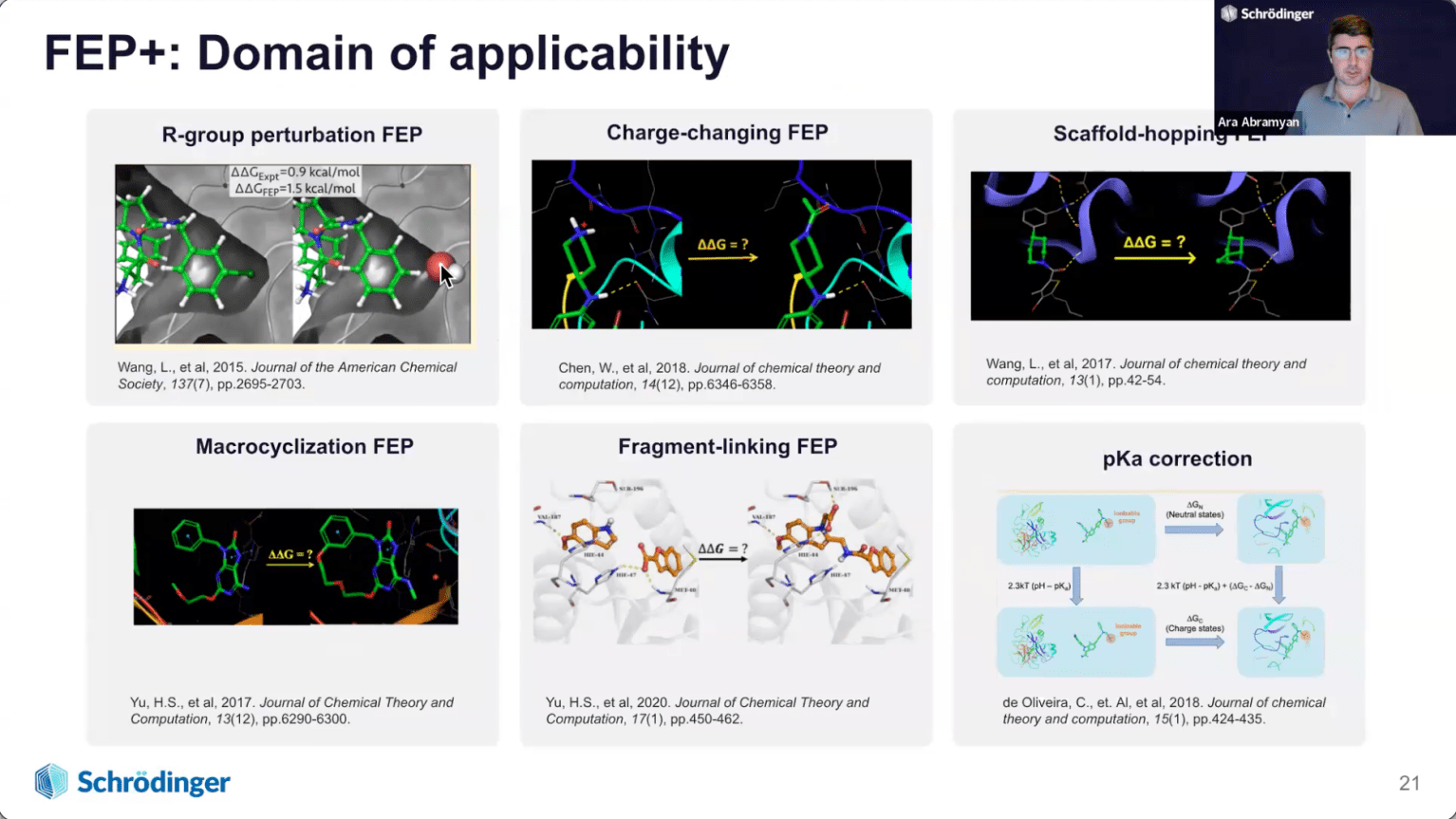
現在の計算手法では、核酸とリガンドの結合予測において依然として多くの課題が残されており、この制約が、抗がん剤、抗ウイルス剤、抗菌剤など、RNAやDNAの活性を制御する低分子薬のin silico開発の進展を妨げてきました。

本ウェビナーでは、シュレーディンガーの高度な計算手法が、RNAおよびDNAを標的とした低分子創薬において、いかに高精度かつ効率的なアプローチを可能にしているかをご紹介します。RNA受容体を対象とした構造ベース創薬を支援する、in silicoヒット探索ワークフローの最新の改良点について解説します。さらに、RNAおよびDNAを標的とした創薬プログラムにおいて、相対結合自由エネルギー摂動法(FEP)を活用してリード最適化を精度高く導いた別の研究事例もご紹介します。本研究では、多様なリガンドおよび受容体のクラス、ならびにさまざまなリガンド-核酸間の結合様式について、既存データに基づく体系的な評価を行っています。

ウェビナーハイライト

  • Glide、SiteMap、絶対結合FEP+を用いた、RNAおよびDNAへの低分子ドッキング手法と最新の適用事例を紹介
  • 相対結合FEP+を活用した、RNAおよびDNAを標的とする分子の最適化戦略を解説

Our Speakers

Ara Abramyan

Principal Scientist I, Application Science, Schrödinger

フィラデルフィアのUniversity of the Sciencesで博士号取得後、NIH(米国国立衛生研究所)で神経伝達物質輸送体に関する研究に従事。現在は、お客様の創薬支援や、核酸や膜輸送体を標的とした系を扱う社内外の共同研究プロジェクトを主導しています。

Gary Zhang

Director, Hit Discovery, Schrödinger

デューク大学で生物システムにおける電荷移動経路の設計に関する研究で博士号を取得し、スクリプス研究所でペプチドドッキング性能の向上に取り組むポスドク研修を行いました。現在は、ドッキング技術のプロダクトマネージャーとして、GlideやWScoreなどの性能向上と適用範囲の拡大を目指すチームを率いています。

13th Crystal Forms Convention

Conference

13th Crystal Forms Convention

CalendarDate & Time
  • September 7th-9th, 2025
LocationLocation
  • Bologna, Italy

Schrödinger is excited to be participating in the 13th Crystal Forms Convention conference taking place on September 7th – 9th in Bologna, Italy. Join us for a poster presentation by Shiva Sekharan, Senior Director of Formulations and CSP Software at Schrödinger, title “Schrödinger’s Modeling Platform and Solutions to Accelerate Drug Substance and Drug Product Formulation and Delivery Processes.”

icon time
Schrödinger’s Modeling Platform and Solutions to Accelerate Drug Substance and Drug Product Formulation and Delivery Processes

Speaker:
Shiva Sekharan, Senior Director, Formulations and CSP Software, Schrödinger

Abstract:
Early assessment of stereoconfiguration, degradation, reactivity, catalysis, polymorphism and solubility of active pharmaceutical ingredients (API) is critical for small molecule drug discovery and development processes. We have developed automated computational platform leveraging physics-based methods, chemistryinformed AI and ML models to efficiently predict 1) Boltzmann-averaged spectra of small molecules without crystallizing the molecule or using X-ray spectroscopy, 2) bond dissociation energies and decomposition products to elucidate reaction mechanisms, 3) crystal polymorphs to aid selection of a stable solid form, 4) solubility enhancement via organic cosolvents using free energy perturbation (FEP+) method, 5) polymer excipients that can interact strongly with the API and reduces the risk of recrystallization, and 6) apparent pKa values of ionizable lipids and simulate the self-assembly and structural properties of lipid nanoparticles.

RSC-BMCS / SCI 23rd Medicinal Chemistry Symposium

Conference

RSC-BMCS / SCI 23rd Medicinal Chemistry Symposium

CalendarDate & Time
  • September 14th-17th, 2025
LocationLocation
  • Churchill College, Cambridge, United Kingdom

Schrödinger is excited to be participating in the RSC-BMCS / SCI 23rd Medicinal Chemistry Symposium conference taking place on September 14th – 17th in Churchill College, Cambridge, United Kingdom. Join us for a presentation by Zhe Nie, Executive Director of Medicinal Chemistry at Schrödinger, titled “Structure-based discovery and development of highly potent dihydroorotate dehydrogenase inhibitors for malaria chemoprevention.”

icon time SEPT 16 | 9:30
Structure-based discovery and development of highly potent dihydroorotate dehydrogenase inhibitors for malaria chemoprevention

Speaker:
Zhe Nie, Executive Director, Medicinal Chemistry, Schrödinger

Abstract:
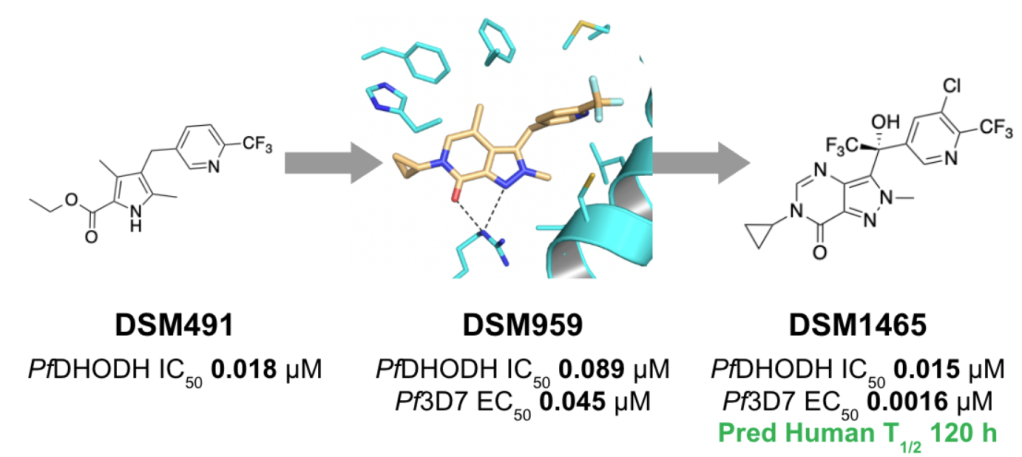
Malaria remains a serious global health challenge, yet treatment and control programs are threatened by drug resistance. Dihydroorotate dehydrogenase (DHODH) was clinically validated as a target for treatment and prevention of malaria through human studies with DSM265 (Phase 2), but currently no drugs against this target are in clinical use. We used structure-based computational tools including free energy perturbation (FEP+) to discover highly ligand efficient, potent and selective pyrazole-based Plasmodium DHODH inhibitors through a scaffold hop from a pyrrole-based series. Optimized pyrazole-based compounds were identified with low nM-to-pM Plasmodium falciparum cell potency and oral activity in a humanized SCID mouse malaria infection model. The lead compound DSM1465 is more potent and has improved ADME/PK properties compared to DSM265. This compound meets MMV’s objective of identifying compounds with potential to be used for once-monthly chemoprevention in Africa to support malaria elimination efforts.

Our Speaker

Zhe Nie

Executive Director, Medicinal Chemistry, Schrödinger

Dr. Zhe Nie is the Executive Director of Medicinal Chemistry at Schrödinger’s Therapeutic Group. She has been leading multiple wholly owned and partnered drug discovery programs at Schrödinger. Most recently, she led Schrödinger’s MALT1 discovery project team, successfully developed the small molecule drug SGR-1505 (Schrödinger’s first internal clinical asset currently in Ph1) applying Schrödinger’s computational platform. It took less than two years from the start of the project to the selection of the clinical candidate. She also led the DLK collaboration project with Takeda Pharmaceuticals which discovered a potent, selective, and brain-penetrate DLK inhibitor as a promising preclinical candidate for the treatment of neurodegenerative diseases using Schrödinger’s computational platform. She has extensive experiences in applying advanced computational tools to assist in the design of small molecule drug candidates. She previously worked at Takeda, Celgene and Quanticel Pharmaceuticals (acquired by Celgene), led and contributed to advancing multiple small molecule drugs to the clinics including TAK-960, TAK-659 and CC-90011.

Festival of Biologics Basel 2025

Conference

Festival of Biologics 2025

CalendarDate & Time
  • September 30th – October 2nd, 2025
LocationLocation
  • Basel, Switzerland

Schrödinger is excited to be participating in the Festival of Biologics 2025 conference taking place on September 30th – October 2nd in Basel, Switzerland. Join us for a presentation by Esam Abualrous, Principal Scientist I at Schrödinger, titled “Advances in Structure-Based Computational Modeling and Collaborative Enterprise Informatics for Biologics.” Stop by booth 501B to speak with Schrödinger scientists.

icon time OCT 1 | 14:40 CET
icon location Theatre 6
Advances in Structure-Based Computational Modeling and Collaborative Enterprise Informatics for Biologics

Speaker:
Esam Abualrous, Principal Scientist I, Schrödinger

Abstract:
Optimizing biologic drug candidates to enhance favorable traits or minimize liabilities often demands significant experimental effort. This presentation will showcase recent progress in our physics-based, structure-guided computational methods that help accelerate the optimization process. It will cover key challenges in antibody engineering—including predicting antibody-antigen binding affinity, improving structural stability, and addressing developability concerns. This talk will illustrate how these approaches can be integrated within a collaborative informatics platform for biologics discovery, which can merge machine learning (ML) results, experimental data and advanced modeling, execution, and analysis tools to streamline decision-making and centralize essential project information.

Advancing machine learning force fields for materials science applications 最新機能 MPNICEのご紹介

Advancing machine learning force fields for materials science applications
最新機能 MPNICEのご紹介

機械学習力場(MLFFs:Machine Learning Force Fields)は、「機械学習原子間ポテンシャル」とも呼ばれ、多様な化学系に対するコスト効率の高い原子レベルのシミュレーションを実現するための重要なツールとして登場しており、しばしば密度汎関数理論(DFT)に匹敵する精度を、はるかに低い計算コストで達成しています。
近年のメッセージパッシングネットワークの進歩により、従来のMLFFが抱えていた「対応できる元素の種類に制限がある」という課題が克服されました。さらに、電荷平衡法を用いた原子電荷および静電相互作用の導入により、複数の電荷状態、イオン系、電子応答特性の精密な再現が可能となり、長距離相互作用を明示的に考慮することで、さらに高い精度を実現しています。

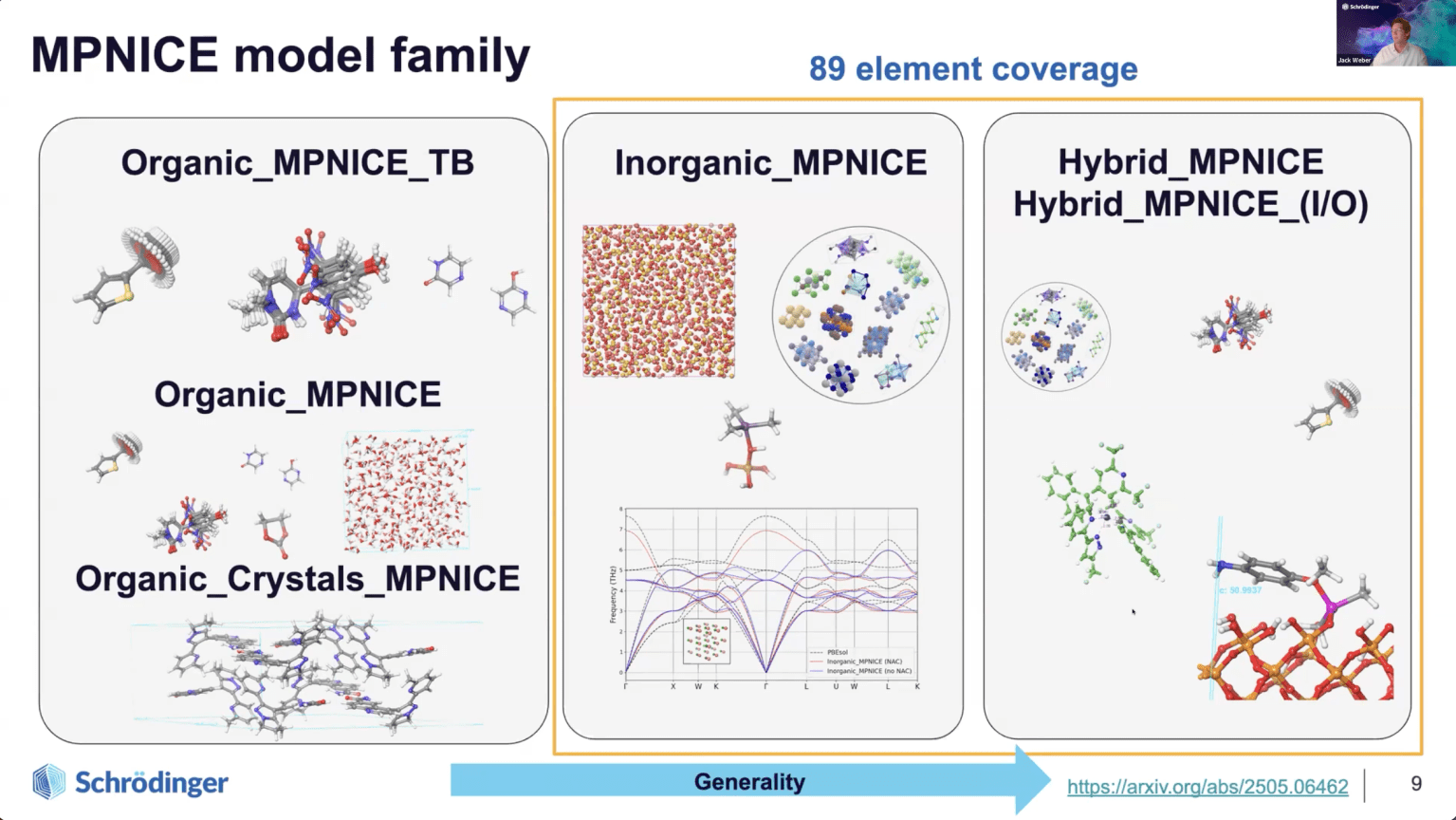
本ウェビナーでは、シュレーディンガーが開発した最先端のMLFFアーキテクチャ「MPNICE(Message Passing Network with Iterative Charge Equilibration)」をご紹介します。MPNICEは、正確な電荷表現のために明示的な静電気を組み込んでいます。周期表全体(89元素)を網羅する材料を対象に学習させた事前学習済みモデル群も提供しています。
MPNICEは高いスループット性能を重視しており、従来の手法では実現困難だった長時間・大規模な原子レベルのシミュレーションを、高精度を維持しながら可能にします。
ウェビナーでは、材料設計においてより大規模かつ複雑なシミュレーションを可能にするMLFF搭載ツール群の概要を紹介し、産業応用に即した事例を交えて解説します。

ハイライト:

  • MPNICEの概要:原子の部分電荷や長距離相互作用を取り入れながら、同等精度のモデルよりも1桁高速な計算を実現する、メッセージパッシング型機械学習力場(MLFF)アーキテクチャ
  • MPNICEの最新応用例の紹介:産業界のニーズに対応するために、有機材料、無機材料、そして有機・無機ハイブリッド材料に対する汎用モデルとして活用された事例を紹介

Our Speaker

Jack Weber

Senior Scientist, Schrödinger

コロンビア大学で化学物理学の博士号を取得。博士課程では、先端的な計算手法を駆使し、化学および材料科学における基礎的課題に取り組み、遷移金属錯体のような強相関系に対応するための電子構造計算手法(ab initio法)の改良や、三重項-三重項消滅(TTA)型アップコンバージョン光触媒の設計などを行いました。 現在は、創薬および材料科学分野における応用を目的とした機械学習力場(MLFF)の開発に取り組んでいます。

Global Polymer Summit 2025

Conference

Global Polymer Summit 2025

CalendarDate & Time
  • September 8th-11th, 2025
LocationLocation
  • Cleveland, Ohio

Schrödinger is excited to be participating in the Global Polymer Summit 2025 conference taking place on September 8th – 11th in Cleveland, Ohio. Join us for a presentation by Croix Laconsay, Senior Scientist I at Schrödinger, titled “Automated Discovery of Polymer Elementary Reaction Networks with the Nanoreactor.” Stop by booth 1314 to speak with Schrödinger scientists.

icon time SEPT 9 | 4:00PM
Automated Discovery of Polymer Elementary Reaction Networks with the Nanoreactor

Speaker:
Croix Laconsay, Senior Scientist I, Schrödinger

Abstract:
In molecular modeling of polymer materials, autonomous reaction network exploration algorithms offer a systematic framework for uncovering genuine mechanisms of chemical reactions. Understanding elementary reaction networks of filled polymer composites in tires, for example, can be of great importance in optimizing these materials. At the core of these networks are elementary reaction steps, which could serve as the fundamental building blocks in this endeavor. Various automated methods have been proposed to discover elementary reaction steps. Graph-based approaches efficiently generate elementary reaction pathways but suMer from exponential computational scaling as system size increases, often producing many reactions irrelevant to the conditions of interest. Alternatively, first-principles enhanced-sampling molecular dynamics can capture relevant reactions but demands thousands to millions of energy and force evaluations, making largescale applications computationally prohibitive. Inspired by the work of Jensen, we introduce a fully automated approach for Elementary Reaction Network exploration. Nanoreactor utilizes GFN2-xTB-based metadynamics within a confined reaction sphere to efficiently sample elementary reaction steps. Subsequent AutoTS computations—an automated transition-state search workflow—further refines the process through automated transition state optimization. While conceptually like the method of Jensen, our approach differs fundamentally at the algorithmic level, offering a unique strategy for efficient elementary reaction network generation and subsequent iterative growths towards large reaction networks. Nanoreactor accelerates the chemical network exploration of molecular degradation mechanisms. In this talk, I will demonstrate use cases that showcase the value of the Nanoreactor in polymer and carbon black materials development.

Future Food Tech 2025

Conference

Future Food-Tech 2025

CalendarDate & Time
  • September 24th-25th, 2025
LocationLocation
  • London, United Kingdom

Schrödinger is excited to be participating in the Future Food Tech 2025 conference taking place on September 24th – 25th in London, United Kingdom. Join us for a roundtable discussion by Jeff Sanders, Research Leader of Materials Science Product and Discovery at Schrödinger, titled “The state of AI in Food product development.” Stop by our booth to speak with Schrödinger scientists.

icon time SEPT 24 | 14:45
The state of AI in Food product development

Host:
Jeff Sanders, Research Leader Materials Science Product and Discovery, Schrödinger

Abstract:
This session will discuss the current role of AI in ingredient to food and beverage product development, and challenges associated model building. A focus will be on the hurdles to successful application of AI in organizations of all sizes, and how potential solutions may require outside-the-box thinking.

Innovations in Digital Chemistry: Computational Approaches for Drug & Materials Discovery

Webinar Series

Innovations in Digital Chemistry: Computational Approaches for Drug & Materials Discovery

CalendarDate & Time
  • September 2nd-16th, 2025
  • 12:30 PM IST | 3:00 PM SGT
LocationLocation
  • Virtual

We are proud to present our 2025 Southeast Asia Webinar Series – this year the series will explore how cutting-edge computational methods are revolutionizing the design and optimization of pharmaceutical drugs, biologics, and advanced materials. Attendees will learn about Schrödinger’s latest developments in computational chemistry, physics-based simulations, and AI/ML applications. The five webinars will cover a variety of applications, including protein engineering, PROTAC design, pharmaceutical formulations, and more. Schrödinger scientists and experts will showcase real-world case studies – offering insights into how these techniques can help reduce costs, mitigate risks, and streamline development across R&D programs.

Learn more about the webinar topics and speakers below, then register once to attend all five of the upcoming webinars.

  • September 2, 2025
    Accelerating pharmaceutical formulations development: A computational approach
    Speaker: Sudharsan Pandiyan, Principal Scientist II, Schrödinger
    Watch now
  • September 4, 2025
    Accelerating materials discovery with physics-informed AI/ML
    Speaker: Saientan Bag, Senior Scientist I, Schrödinger
    Watch now
  • September 9, 2025
    Integrating physics-based insights to accelerate biologics design
    Speaker: Abhijit Kayal, Senior Scientist II, Schrödinger
    Watch now
  • September 11, 2025
    Transforming small molecule drug discovery: The computational chemistry paradigm
    Speaker: Pritesh Bhat, Principal Scientist II, Schrödinger
    Watch now
  • September 16, 2025
    Computational tools for PROTAC design and optimization
    Speaker: Koushik Kasavajhala, Senior Scientist II, Schrödinger
    Watch now

Target-Based Antibiotic Discovery in the Undergraduate Laboratory Empowered by Virtual Screening with Teaching with Schrödinger

MAY 28, 2024

Target-Based Antibiotic Discovery in the Undergraduate Laboratory Empowered by Virtual Screening with Teaching with Schrödinger

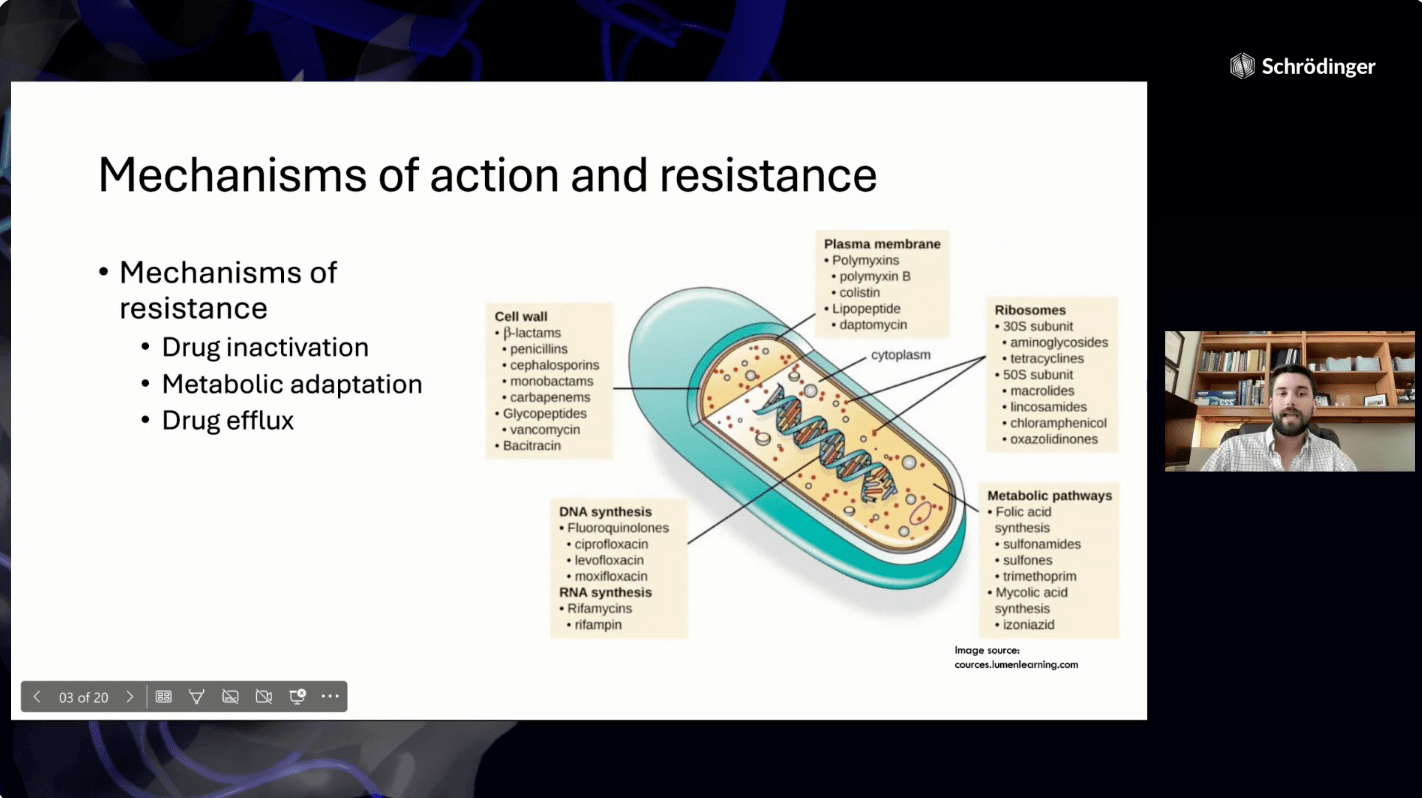
The antibiotic resistance crisis is one of the fastest growing public health concerns today. The development of and propagation of resistance genes is rapidly outpacing antibiotic development. As such, there is a critical need not only for the development of new drugs, but of new compounds that target novel pathways for the treatment of bacterial infections. Course-based undergraduate research experiences (CUREs) have been of tremendous influence in laboratory education over the past decade. These courses give students the opportunity to address real research problems rather than just repeat well-known standard experiments. Antibiotic discovery presents and excellent opportunity for the development of a CURE curriculum, as it gives students the opportunity to engage in a truly critical area of need. While exciting, progress in a CURE course such as this is often hampered by time and budgetary constraints, greatly limiting the throughput of any screening program. The use of computational tools such as Schrödinger software allows students to evaluate much larger numbers of compounds to prioritize candidates for experimental testing. Herein is presented a CURE curriculum that encompasses a high throughput screening platform for two distinct antibiotic targets. The use of Teaching with Schrödinger at several areas of the discovery pipeline such as high throughput and lead optimization with ligand designer will be discussed.

Our Speaker

Nicholas Clanton

University of Texas at San Antonio

Dr. Nicholas Clanton received his B.S. degree in biochemistry from Samford University in 2016 and his Ph.D. in Chemistry from the University of Texas at San Antonio in 2021 with a research focus on anticancer drug discovery based on natural product scaffolds. He is currently the assistant director of the Voelcker Preclinical Pharmacology Core at the University of Texas at San Antonio, which specializes in early-stage ADME screening, rodent pharmacokinetics, and quantitative bioanalysis of xenobiotics and natural metabolites. Dr. Clanton also teaches the biochemistry II laboratory course in the department of chemistry where he works with students on target-based antibiotic drug discovery employing high throughput screening and computer aided drug design.