Accessible and automated computational catalyst discovery and reactivity optimization

Webinar

Accessible and automated computational catalyst discovery and reactivity optimization

CalendarDate & Time
    • May 7, 2026,   10:00 AM PDT | 1:00 PM EDT
    • May 13, 2026,   15:00 CEST | 14:00 BST
LocationLocation
  • Virtual

Designing high-performing homogeneous catalysts and optimizing non-catalytic transformations often relies on trial-and-error iteration. On the other hand, computational tools often remain inaccessible to those without specialized expertise.

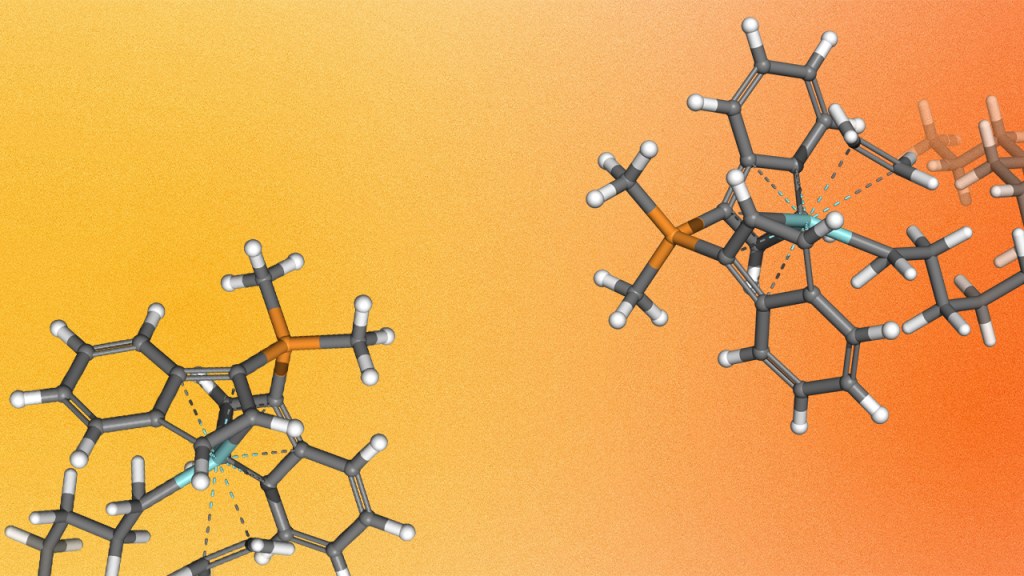
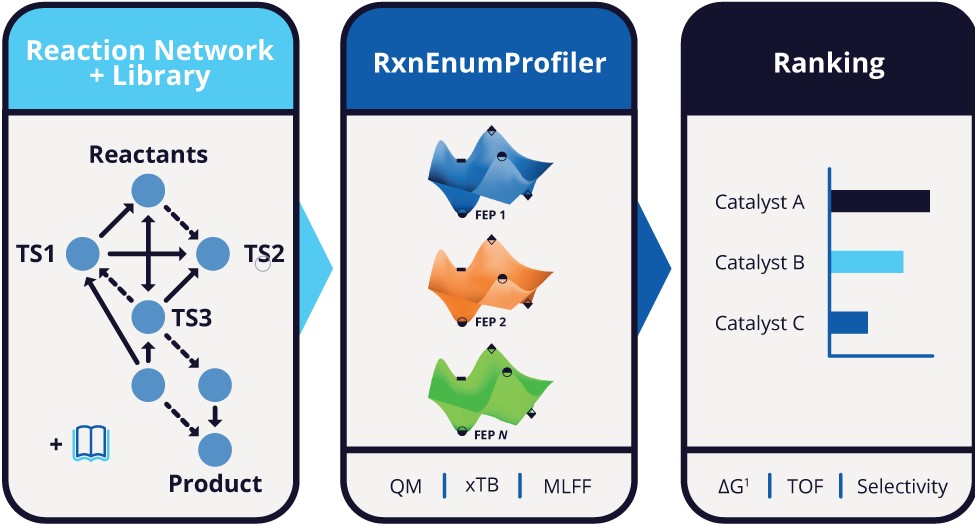
In this webinar, we will demonstrate how an end-user physics–AI platform removes barriers to entry, making this process accessible to both experts and non-experts while enabling seamless scalability. By integrating quantum chemistry, fast semiempirical tight-binding methods, and machine learning interatomic potentials, the platform enables automated exploration of reaction networks and simultaneous optimization of multiple performance metrics. Using real-world catalytic and non-catalytic examples, we will show how mechanistic insight can be translated into actionable design decisions—quickly, accurately, and without coding.

Key highlights:

  • Lower the barrier to catalyst design
    Discover how a Physics–AI end-user platform enables both experts and non-experts to perform advanced in silico catalyst design and reactions optimization
  • Multi-level modeling at scale
    Leverage quantum chemistry, semiempirical tight-binding methods, and machine learning interatomic potentials (MLIPs) within a single, scalable framework
  • No coding required
    Intuitive, GUI-driven environment designed for accessibility and productivity

Who should attend: Anyone interested in non-catalytic and catalytic reactivity optimization, or homogeneous catalyst design
Register – May 7, 10:00AM PDT (AMER)
Register – May 13, 14:00 BST (EMEA)

Our Speaker

Pavel Dub

Research Leader and Product Manager, Catalysis & Reactivity, Schrödinger

Pavel A. Dub earned a Ph.D. in Physical Chemistry from the A. N. Nesmeyanov Institute of Organoelement Compounds and a second Ph.D. from the Université de Toulouse. He subsequently completed postdoctoral appointments at the Tokyo Institute of Technology and Los Alamos National Laboratory, where he later served as a Staff Scientist. In 2022, he joined Schrödinger. His research focuses on computational chemistry and materials science across both classical and quantum computing architectures.

The unified antibody workbench: Optimizing antibody candidate selection through centralized team collaboration recording

APR 21, 2026

The unified antibody workbench: Optimizing antibody candidate selection through centralized team collaboration

Antibody discovery is a high-stakes race often slowed down by fragmented data. When experimental results, 3D structures, and sequence alignments live in separate silos, teams lose critical time manually merging spreadsheets and chasing missing metadata. This “information gap” leads to delayed decision-making and missed opportunities in candidate selection.

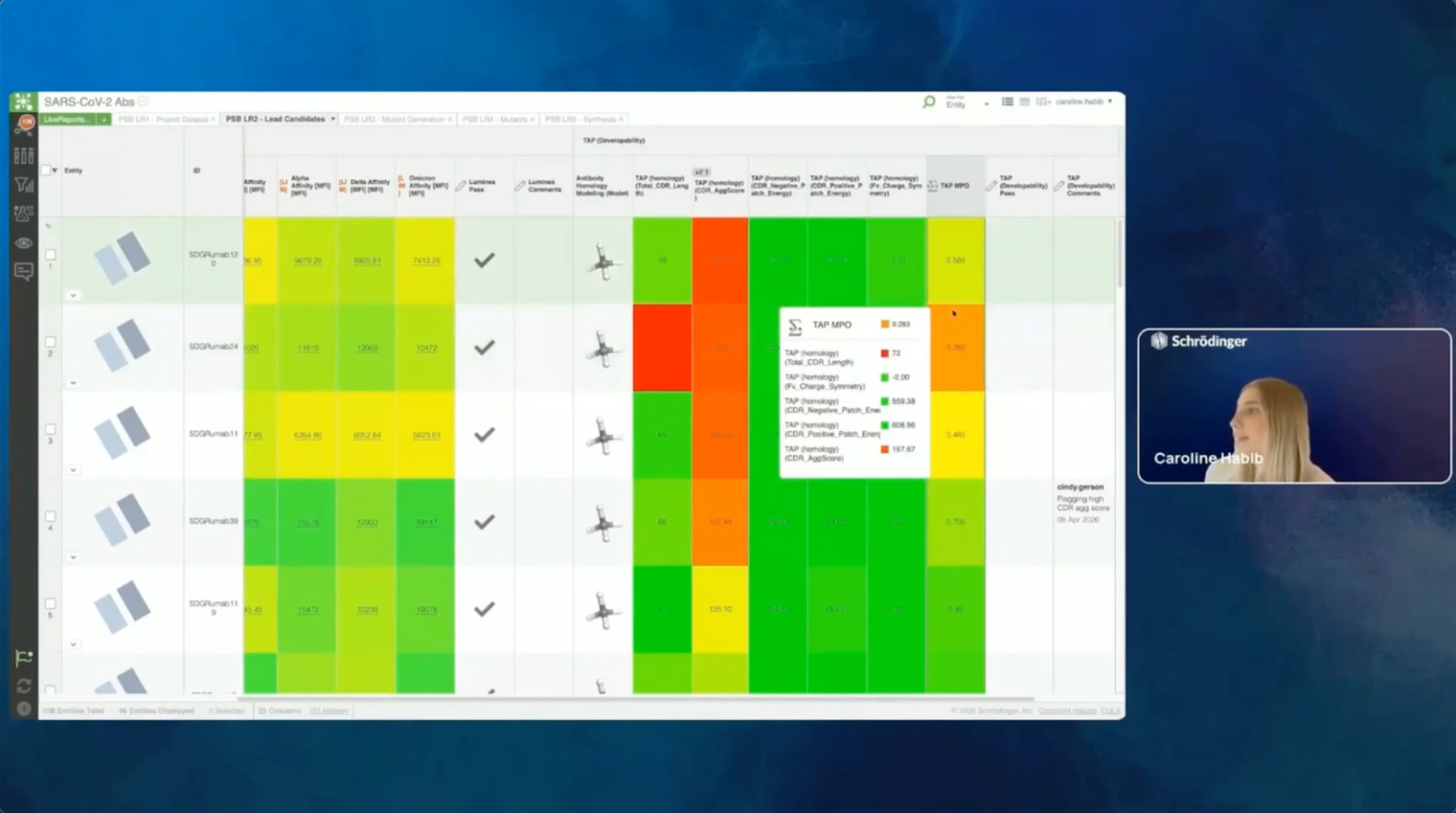
LiveDesign for Biologics is a web-based, centralized project management hub designed to unite the entire discovery team. By democratizing expert modeling tools, bench scientists can visualize 3D complexes and predict developability parameters alongside their actual lab results with ease.

Join us for an interactive webinar where we showcase the power of LiveDesign for Biologics in a live demo and walk you through how you can quickly start benefiting from this powerful enterprise informatics platform today!

Highlights:

  • Centralized Triage: Learn how to unite all experimental assay data (Biacore, Luminex) with in silico predictions in one live report
  • 3D Visualization for the Bench: Discover how to assess reactive residues and structural liabilities directly in-platform without being a computational expert
  • Real-Time Collaboration: Explore how auto-updating live reports and shared dashboards keep entire teams aligned on the most promising leads no matter where they are
  • See the Platform in Action: Live demo to walk you through how you can conduct your antibody discovery workflow in LiveDesign for Biologics

Who should attend:

Bench scientists, antibody engineers, and R&D project leads who are looking to move away from disconnected data tools and toward a collaborative, model-aware discovery ecosystem

Our Speakers

Caroline Habib

Senior Strategic Deployment Manager, Schrödinger

Caroline Habib joined Schrödinger in 2024 and partners with Pharma and Biotech organizations to maximize the impact of LiveDesign for Biologics, ensuring technical requirements are seamlessly aligned with real-world discovery and development workflows. Prior to joining Schrödinger, Caroline spent years as a bench scientist in drug discovery before transitioning into a Program Manager role. In that capacity, she integrated computational techniques with traditional laboratory methods to lead and accelerate partner-led discovery programs. She completed her BS in Human Biology and her MS in Drug Development at UC San Diego.

Cindy Gerson

Senior Director, Enterprise Product Management, Schrödinger

Cindy Gerson, senior lead product manager, enterprise informatics, joined Schrödinger in 2022. In her role, she leads the LiveDesign for Biologics development efforts – using her extensive knowledge and years of first-hand experience at the lab bench to design software tools that expedite and improve biologics discovery workflows. Prior to joining Schrödinger, Cindy worked at Regeneron Pharmaceuticals in the field of monoclonal antibody-based therapeutics discovery, where she developed, optimized, and executed platforms for the isolation of target-specific antibodies. She completed her BS in Biomedical Engineering at Columbia University and her MS in Bioengineering at Georgia Tech.

Alchemistry Workshop in Free Energy Methods for Drug Design 2026

Workshop

Alchemistry Workshop in Free Energy Methods for Drug Design 2026

CalendarDate & Time
  • May 4th-6th, 2026
LocationLocation
  • Barcelona, Spain

Schrödinger is excited to be participating in the Alchemistry Workshop in Free Energy Methods for Drug Design taking place on May 4th – 6th in Barcelona, Spain. Join us for a presentation and a Schrödinger-hosted happy hour! Stop by our booth to speak with Schrödinger scientists.

icon time MAY 4 | 16:20
No Structure? No Problem: Just Have Some TEA with FEP!

Speaker:
Marton Vass, Senior Principal Scientist, Applications Science

Abstract:
Obtaining accurate FEP models for experimentally determined protein-ligand complexes is generally easily achievable, however, when there are no available structures with the chemical series of interest, or even no structures of the protein and its homologs, this task is markedly more difficult. Schrödinger’s Target Enablement Accelerator (TEA) provides significant speedups to such novel target enablement workflows. First it automatically collects compound SAR and protein homologs, and builds template protein-ligand complexes using automated homology modelling, ML protein folding, docking, and ML co-folding methods. Then it refines the templates using induced fit docking with MD simulations (IFD-MD) and creates ready-to-run FEP maps. Finally it runs automated FEP model selection using various relative and absolute binding FEP methods. Our approach provides users expert tools to rationalise the construction of accurate ligand potency models, rather than relying on a black box model. This streamlined approach allows researchers to rapidly establish predictive models for previously undrugged or uncharacterised targets. So you have time for a cup of tea while running TEA!

icon time MAY 5 | 17:20
Advancing Candidate Optimization via Rigorous Free Energy Calculations: From Kinome-Wide Selectivity to Solid-State Properties

Speaker:
Robert Abel, Executive Vice President, Chief Science Officer, Platform

Abstract:
The efficient identification of high-quality development candidates remains hindered by late-stage failures due to unforeseen toxicity or suboptimal physicochemical properties. To address this, we are integrating a suite of advanced modeling tools designed to accelerate the design-make-test-analyze cycle by centering free energy calculations as the primary engine for property prediction.

icon time MAY 5 | 19:00
icon location Blue Terrace
Schrödinger Happy Hour

Address:
Sofitel Barcelona Skipper
Av del Litoral 10, HB004318
08005 BARCELONA
Spain

AOCS Annual Meeting & Expo 2026

Conference

AOCS Annual Meeting & Expo 2026

CalendarDate & Time
  • May 3rd-6th, 2026
LocationLocation
  • New Orleans, Louisiana

Schrödinger is excited to be participating in the AOCS Annual Meeting & Expo 2026 conference taking place on May 3rd – 6th in New Orleans, Louisiana. Join us for a presentation by Croix Laconsay, Senior Scientist at Schrödinger, titled “Automated Discovery of Acrylamide Formation from the Maillard reaction with the Nanoreactor.” Stop by booth 219 to speak with Schrödinger scientists.

icon time MAY 6 | 11:15 AM
Automated Discovery of Acrylamide Formation from the Maillard reaction with the Nanoreactor

Speaker:
Croix Laconsay, Senior Scientist at Schrödinger

Abstract:
The Maillard reaction is a fundamental chemical reaction in food chemistry and occurs naturally between amino acids and reducing sugars during thermal processing. Understanding the molecular mechanisms underlying the formation of toxic byproducts from the Maillard reaction is essential for reducing exposure. Molecular modeling provides a means of understanding the energetically-accessible chemical pathways by which these toxins are created. One important example is the formation of acrylamide, a toxic compound, in foods heated above 120 °C. Experimental studies have shown that acrylamide can form from asparagine under Maillard reaction conditions.1 Examples of computational studies on this particular mechanism are rare,2 and, to the best of our knowledge, theoretical studies of acrylamide formation from asparagine have not been reported. Computational studies of chemical degradation usually involve the manual investigation of complex multistep reaction networks. These networks are explored in laborious manual efforts that involve a mix of chemical intuition and density functional theory (DFT) calculations. Various automated methods have been proposed to discover the chemically relevant elementary reaction steps.3
Inspired by the work of Jensen,4 we introduce a fully automated approach for reaction network exploration called Elementary Reaction Network. This process uses Nanoreactor, a method which utilizes a metadynamics-based simulation within a confined reaction sphere to efficiently sample elementary reaction steps. Subsequent AutoTS computations, Schrödinger’s automated DFT-based transition-state search workflow, further refine the results by locating and optimizing the transition states that connect reactants and products discovered by Nanoreactor. Our Nanoreactor-AutoTS workflow accelerates the chemical network exploration of molecular degradation mechanisms and allows unbiased exploration of the potential energy surface. In this talk, I will demonstrate the utility of this workflow in exploring degradation mechanisms relevant to the Maillard reaction.

17th Global Drug Delivery & Formulation Summit

Conference

17th Global Drug Delivery & Formulation Summit

CalendarDate & Time
  • May 18th-20th, 2026
LocationLocation
  • Berlin, Germany

Schrödinger is excited to be participating in the 17th Global Drug Delivery & Formulation Summit taking place on May 18th – 20th in Berlin, Germany. Join us for a presentation by John Shelley, Fellow at Schrödinger, titled “Molecular Modeling and Machine Learning for Small Molecule and Biologic Drug Formulation.” Stop by booth #4 to speak with Schrödinger scientists.

icon time MAY 18 | 15:35
icon location Room 3
Molecular Modeling and Machine Learning for Small Molecule and Biologic Drug Formulation

Speaker:
John Shelley, Fellow at Schrödinger

Abstract:
Selecting and combining the right ingredients in the appropriate manner is essential for successful drug formulation given the inherent challenges and competitive market. With advances in modern machine learning, physics-based simulation techniques and computer hardware, modelling is emerging as a valuable source of information that complements experimental characterization.  We showcase a cross-section of capabilities within Schrödinger’s Suite for modeling related to formulations of small-molecule or biologic drugs.  For small-molecule drugs workflows have been created for characterizing crystal polymorphs, crystal morphology and degradation risks as well as calculating elastic constants (bulk modulus, shear modulus, etc.), powder diffraction patterns, glass transition temperatures (Tg), diffusion constants, pKa values, melting points, water adsorption and various solubilities. For biologics our toolset supports homology modeling, and the calculation of aggregation propensity, titration curves, isoelectric points and viscosity among other things.  Complex and evolving structures, often in fluid states, play a crucial role in the pharmaceutical industry.   For both small-molecule and biologics formulations powerful simulation tools employing atomistic or coarse-grained models to permit the characterization of molecular interactions and nanoscale structuring, sometimes within otherwise disordered bulk systems (e.g., LNP formation, self-assembly of polymer-based structures, dissolving amorphous solid dispersions, liposomes and protein-excipient interactions).

2026 Annual Spring Meeting of the Polymer Society of Korea

Conference

2026 Annual Spring Meeting of the Polymer Society of Korea

CalendarDate & Time
  • April 8th-10th, 2026
LocationLocation
  • Daejeon, Korea

Schrödinger is excited to be participating in the 2026 Annual Spring Meeting of the Polymer Society of Korea conference taking place on April 8th – 10th in Daejeon, Korea. Join us for a presentation by Shaun Kwak, Senior Director of Materials Science Applications Science at Schrödinger, titled “Digital chemistry calling for a paradigm shift in polymer materials innovation.” Stop by booth #33 to speak with Schrödinger scientists.

icon time APR 9 | 16:45
Digital chemistry calling for a paradigm shift in polymer materials innovation

Speaker:
Shaun Kwak, Senior Director of Materials Science Applications Science, Schrödinger

Abstract:
Recent advances in molecular simulation and machine learning technologies are fundamentally reshaping the framework of the discovery and optimization of polymeric materials, quickly replacing the traditional concept of iterative experimentation guided by chemical intuition. Here, we showcase an advanced digital platform technology that combines physics-based molecular simulations with machine learning algorithms to develop novel polymer materials, effectively navigating the vast macromolecular design spaces. Case studies will include, but are not limited to, designing copolymers for semiconductor packaging, optimizing thermochemistry of acrylate-based coating, and assessment of thermal oxidation in thermoset resins. The work demonstrates a major shift of paradigm in the usage of information technology in materials research with broad implications in product lifecycle management, positioning digital chemistry as a cornerstone of the next-generation polymer industry.

Computational and Medicinal Chemistry by the Lake 2026

Conference

Computational and Medicinal Chemistry by the Lake 2026

CalendarDate & Time
  • June 2nd-4th, 2026
LocationLocation
  • Kuopio, Finland

Schrödinger is excited to be participating in the Computational and Medicinal Chemistry by the Lake 2026 conference taking place on June 2nd – 4th in Kuopio, Finland. Join us for a presentation by Márton Vass, Senior Principal Scientist at Schrödinger, titled “Towards a Comprehensive De Novo Design Approach: The Discovery of p38:MK2 Molecular Glues.”

icon time JUN 4 | 15:30
Towards a Comprehensive De Novo Design Approach: The Discovery of p38:MK2 Molecular Glues

Speaker:
Márton Vass, Senior Principal Scientist, Schrödinger

Abstract:
Modern drug discovery must still contend with many challenges including a fast-moving competitive landscape, high development costs, and low project success rates. Schrödigner’s computational platform addresses these challenges, leveraging physics-based methods and AI/ML workflows to accelerate DMTA cycles. Schrödinger’s de novo design approach utilizes AutoDesigner [1,2] for ultra-large scale chemical space exploration, generating and prioritizing billions of novel structures. This is combined with rigorous free energy calculations using FEP+ [3] in an iterative fashion (Active Learning FEP+) to rapidly score libraries and prioritize design ideas with optimal potency. Here, we show the successful application of this integrated workflow in the discovery of p38:MK2 molecular glues, enabling systematic scaffold and R-group exploration and leading to potent and selective hits that showed pronounced TNFα reduction in in vivo models. The integrated use of Generative ML is also effectively shown on the same project where, combined with Autodesigner and the predictive power of Active Learning FEP+, rapidly leads to the generation of novel molecules that are optimized not only for potency but also for other project endpoints. To promote the design of molecules that can be easily synthesized, we describe a novel retrosynthesis method, RetroSynth, that deconstructs complex target molecules into commercially available starting materials, prioritizing cost-efficient synthetic routes and leveraging existing project chemistry. Internal validation shows RetroSynth significantly outperforms alternative solutions in terms of accuracy and real-world drug discovery projects feasibility. Altogether, the presented tools compose a fully-integrated, comprehensive de novo design workflow that efficiently generates synthetically tractable ideas that satisfy project requirements, ultimately accelerating lead optimization.

Integrating AI and Machine Learning to Accelerate Composite Resin Formulation

Webinar

Integrating AI and Machine Learning to Accelerate Composite Resin Formulation

CalendarDate & Time
  • May 13th, 2026
  • 8:00 AM PDT | 11:00 AM EDT | 4:00 PM BST | 5:00 PM CEST
LocationLocation
  • Virtual

Schrödinger is excited to be hosting a webinar in collaboration with Composites World, taking place on May 13th at 11:00AM EDT.

Artificial intelligence and machine learning have entered into everyday usage, but what impact can they have on polymer and ceramic matrix composites development?

Composite performance depends heavily on matrix properties that govern processability and operational stability. Increased digitization is providing clear value across industries, but successful application in composite resin formulations requires a clear understanding of the key questions and insight into the critical design factors. Combining expert know-how and atomic-level detail with powerful artificial intelligence and machine learning tools enables resin formulation teams to maximize successful design initiatives.

This webinar will demonstrate how integrating machine learning with molecular simulation enables faster, more informed development of next-generation resin formulations.

Agenda:

  • Where AI and machine learning add value: Discover how these technologies aid in designing polymer and ceramic matrix composites, focusing on critical matrix properties.
  • Digitization: Learn why successful resin formulation requires increased digitization for both experimentation and simulation.
  • Integration: See how combining chemistry expertise with AI and machine learning tools leads to better decision-making and outcomes.
  • Acceleration: Explore how machine learning and molecular simulation accelerate the development of new resin formulations.

Our Speaker

Andrea Browning

Senior Director of Polymers and Soft Matter, Schrödinger

Andrea Browning, senior director of polymers and soft matter at Schrödinger, leads initiatives in polymer and soft matter simulations. Before joining Schrödinger, Browning was a lead research engineer and project manager at Boeing, where she focused on translating engineering problems into fundamental materials insights. She brings more than a decade of experience in connecting industrial and engineering problems to root materials issues and how simulations can be used to inform industrial decisions. Browning earned her doctorate in chemical engineering from the University of California, Santa Barbara, where she was a National Science Foundation Graduate Research Fellow.

Formulation ML and Optimization: Making advanced property prediction and experimental design fast and accessible

Webinar

Formulation ML and Optimization: Making advanced property prediction and experimental design fast and accessible

CalendarDate & Time
  • April 22nd, 2026
  • 8:00 AM PDT | 11:00 AM EDT | 4:00 PM BST | 5:00 PM CEST
LocationLocation
  • Virtual
Register

AI-driven materials discovery is no longer experimental, it is the new national standard. With the recent launch of the Genesis Mission, the United States has committed to accelerating materials discovery through AI, high-performance computing, and integrated scientific data infrastructure. For teams at the forefront of materials innovation, now is the ideal opportunity to integrate computational workflows into your R&D pipeline.

Many R&D teams are hindered from adopting AI/ML due to the complexity of software tools, steep learning curves, and limited data science support. Schrödinger’s Materials Science Suite is designed to address these challenges by providing a unified and easy-to-use AI/ML platform, powered by state-of-the-art ML technology and backed by a dedicated scientific support team.

Join our upcoming webinar to learn how your R&D organization can remove adoption barriers, accelerate discovery cycles, and align with national AI initiatives. In this webinar, we will demonstrate how MS Informatics, Formulation ML, and Formulation Optimization make advanced property prediction, model building, and ML-driven design of experiments simple, fast, and accessible – even for non-experts. We will showcase how easy it is to apply these tools using experimental datasets across broad MS applications, including formulations, consumer goods, batteries, pharmaceuticals, and beyond.

Join us and see demos on:

  • Training accurate viscosity ML models for binary liquids that can be applied to a variety of material applications
  • Scaling up to complex shampoo formulations, where ML models can be predictive of complicated multicomponent systems and provide suggestions of next best experiments

Who should attend:

  • R&D leaders
  • Innovation managers
  • Digitization managers
  • Synthetic chemists
  • Materials scientists
  • Formulation scientists
  • Computational materials scientists

Our Speaker

Anand Chandrasekaran

Senior Principal Scientist, Materials Science Product and Discovery, Schrödinger

Anand Chandrasekaran joined Schrödinger in 2019 and he is currently the Product Manager of MS-Informatics. His expertise is in applying machine learning to different areas in Materials Science and computational modeling. He graduated from the group of Prof.Nicola Marzari in the Swiss Federal Institute of Technology, Lausanne with a PhD in Materials Science. Before joining Schrödinger, Anand also worked in the group of Prof. Rampi Ramprasad on a number of topics including polymer informatics, machine-learning force-fields, and machine-learning for electronic structure calculations.

Register

Amplifying medicinal chemist impact with large-scale ideation, FEP+, machine learning, and retrosynthesis through LiveDesign recording

APR 16, 2026

Amplifying medicinal chemist impact with large-scale ideation, FEP+, machine learning, and retrosynthesis through LiveDesign

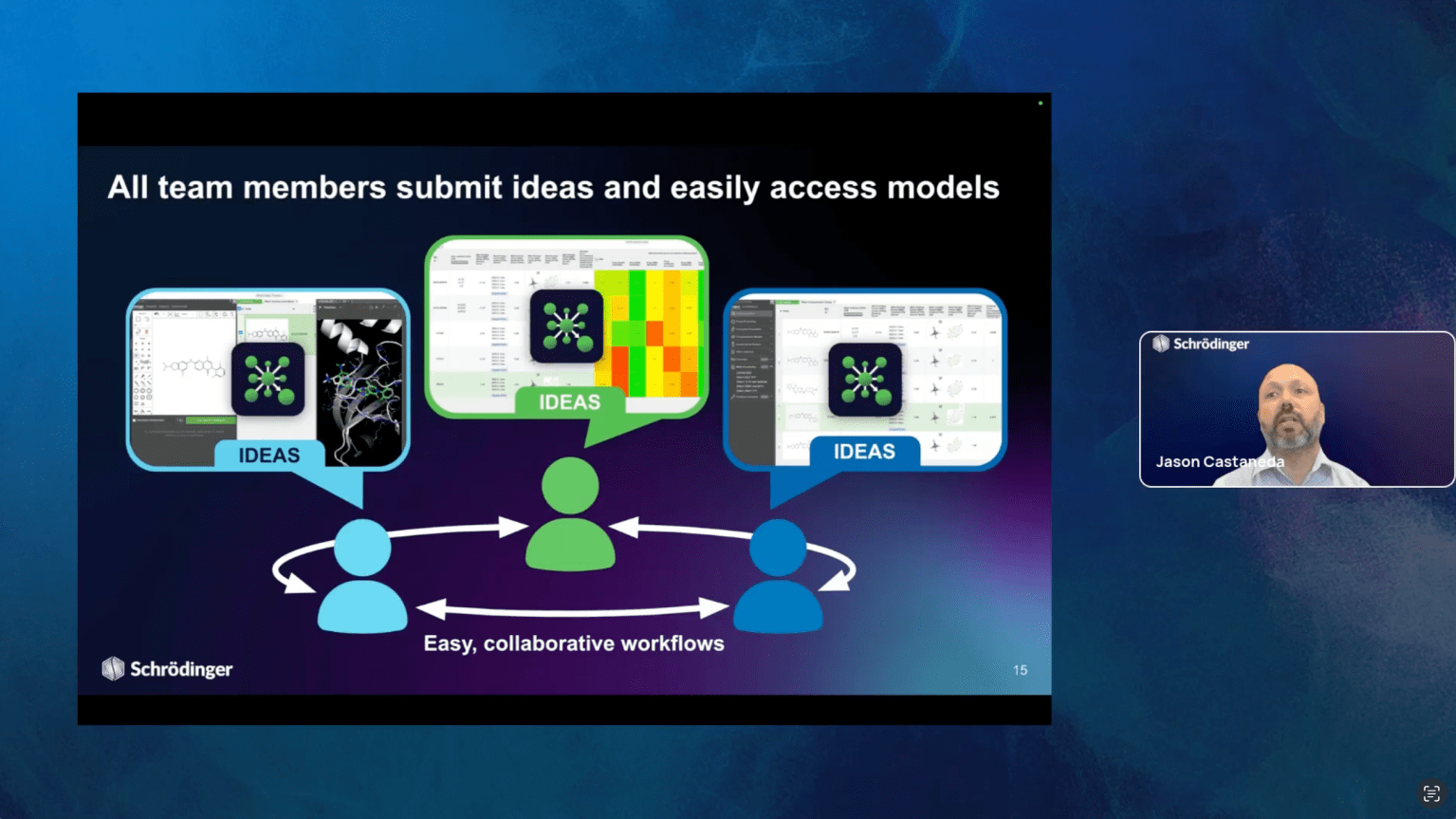
Medicinal chemistry is an increasingly complex orchestration of high-stakes tasks – interpreting project SAR, ideating compounds that satisfy both affinity and ADMET profiles, and managing the logistics of synthesis and assay reporting. When computational tools are siloed from the medicinal chemist’s primary workspace, the impact of advanced modeling is diluted, and the path to a development candidate (DC) becomes uncertain.

Join us to see how Schrödinger’s Enterprise Informatics Platform, LiveDesign, serves as the single terminal to bridge this gap. By integrating the complete computational pipeline, LiveDesign enables medicinal chemists to adopt a fully “predict-first” paradigm. This approach amplifies the impact of the entire project team, from modelers to leadership, by centralizing decision making and collaboration. By equipping your team with predictive insights throughout the discovery process, you can make MPO optimization more efficient, reduce the total number of synthesized compounds, and significantly shorten DMTA cycles and the journey to a DC.

Key Highlights:

  • Strategic DMTA Acceleration: How to utilize AutoDesigner and Active Learning FEP+ to vet thousands of ideas before committing to synthesis
  • Seamless MPO Workflows: Balancing potency and ADMET profiles simultaneously within the LiveDesign interface to avoid late-stage failures
  • Synthetic Reality Checks: Utilizing RetroSynth to bridge the gap between high-scoring digital designs and practical bench-top feasibility
  • LiveDesign in Action: A live walkthrough of a “lead-to-DC” scenario, demonstrating how the LiveDesign Assistant and integrated modeling tools allow a chemist to move from a raw SAR table to a prioritized, tractable synthesis list in a single session

Who Should Attend:

  • Medicinal Chemists looking to leverage the industry’s most accurate potency predictions and ML models within their daily design workflow
  • Project Team Leads seeking to maximize budget efficiency and eliminate the technical silos that delay candidate selection
  • Computational Chemists aiming to scale their impact by deploying validated, gold-standard models for organization-wide use

Our Speakers

Jason Castaneda

Executive Director, Account Management, Schrödinger

Márton Vass

Senior Principal Applications Scientist, Schrödinger

Márton Vass is the Global Lead of the All Access Applications Science team at Schrödinger. He works on the development and deployment of scientific workflows in LiveDesign, with special focus on FEP+ and Desmond MD in LiveDesign, and his research is focussed on automating the use of ML protein folding and cofolding methods for drug discovery applications. Before joining Schrödinger Márton received his PhD at the Budapest University of Technology and Economics while working at Gedeon Richer Plc mid-sized pharmaceutical company. He also held a postdoctoral position at the Vrije Universiteit Amsterdam implementing cheminformatics algorithms for GPCR drug discovery in Knime, after which he joined BenevolentAI in London to apply machine learning augmented drug discovery methodologies, and to lead the development of protein structure-based machine learning tools in the company.

Beyond the bench: Getting started with molecular dynamics simulations recording

APR 9, 2026

Beyond the bench: Getting started with molecular dynamics simulations recording

Materials science R&D is entering a new era where experiment and computation work together to accelerate discovery. Molecular Dynamics (MD), especially when used in tandem with Machine Learning (ML), is transforming how scientists understand structure–property relationships, predict performance, and reduce costly trial-and-error. Experimentalists can now simulate interfaces, defects, polymers, and electrolytes before stepping into the lab.

Modern MD engines, like Desmond from Schrödinger, makes scalable, high-performance simulations accessible, linking atomic insight to real-world materials challenges. By integrating ML with physics-based MD, researchers can screen candidates faster and make smarter decisions.

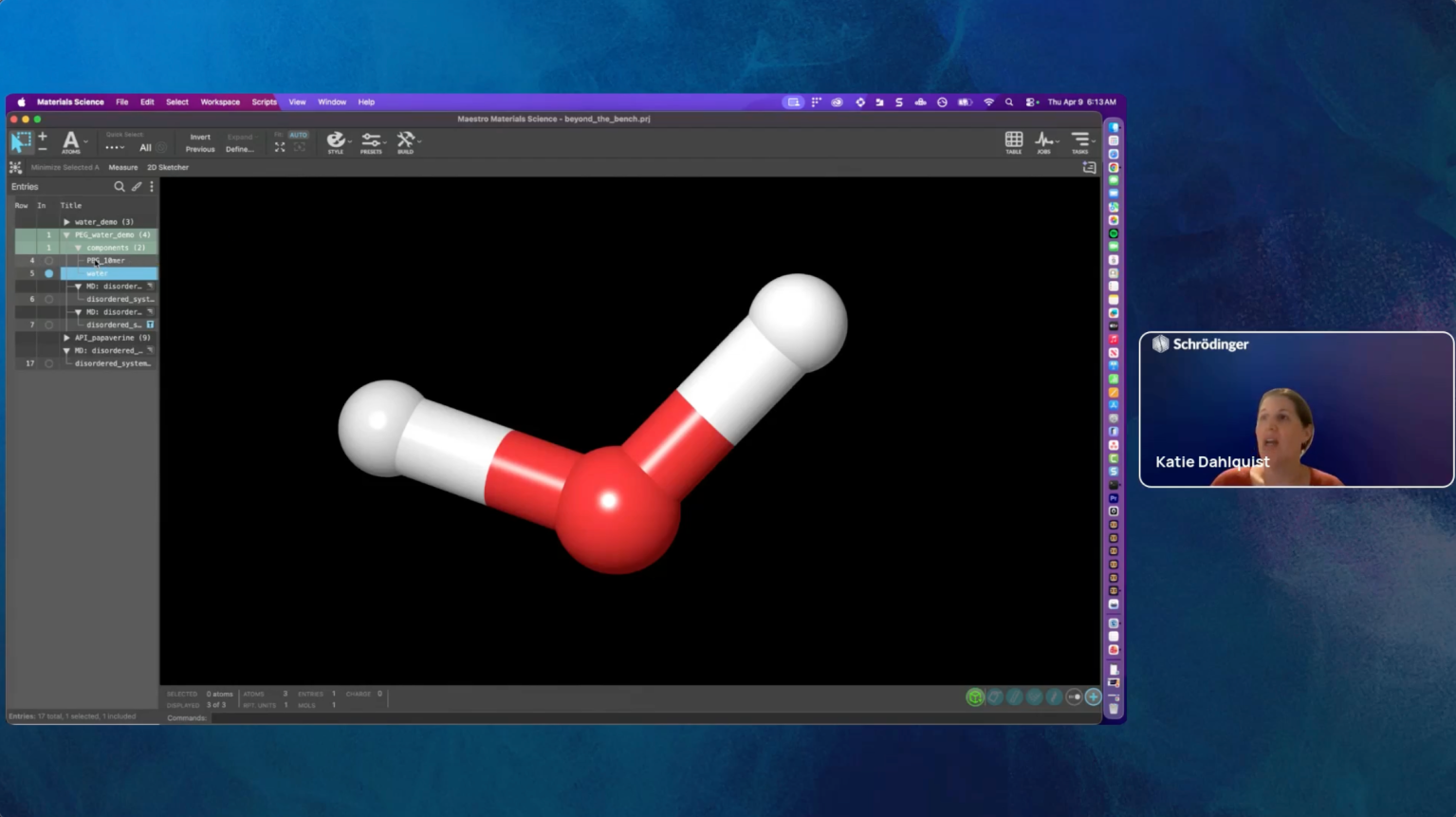
Join Schrödinger’s Katie Dahlquist, as she’ll show you how Desmond can be used to improve your development. Learn from live demos for materials formulations and predictive workflow. During the webinar, you will be able to ask questions and leave with an understanding of how to start incorporating MD into your R&D strategy.

Webinar Highlights:

  • Discover an accessible, intuitive platform for starting MD simulations
  • Learn how Desmond adds value to experimental studies
  • See digital compatibility screening in action
  • Get started with molecular dynamics simulations using Materials Science Maestro

Our Speaker

Katie Dahlquist

Principal Scientist I, Schrödinger

Katie Dahlquist is a Principal Scientist leading the materials science education efforts at Schrödinger. Since joining the company, she has played a role in developing and delivering our molecular modeling for materials science online certification courses, contributing to our collection of materials science tutorials, and leading workshops and customer training sessions. Katie’s expertise lies in density functional theory calculations and molecular dynamics simulations.

Embracing a new era of toxicity screening: Atomic-resolution modeling to mitigate off-target liabilities recording

MAR 31, 2026

Embracing a new era of toxicity screening: Atomic-resolution modeling to mitigate off-target liabilities

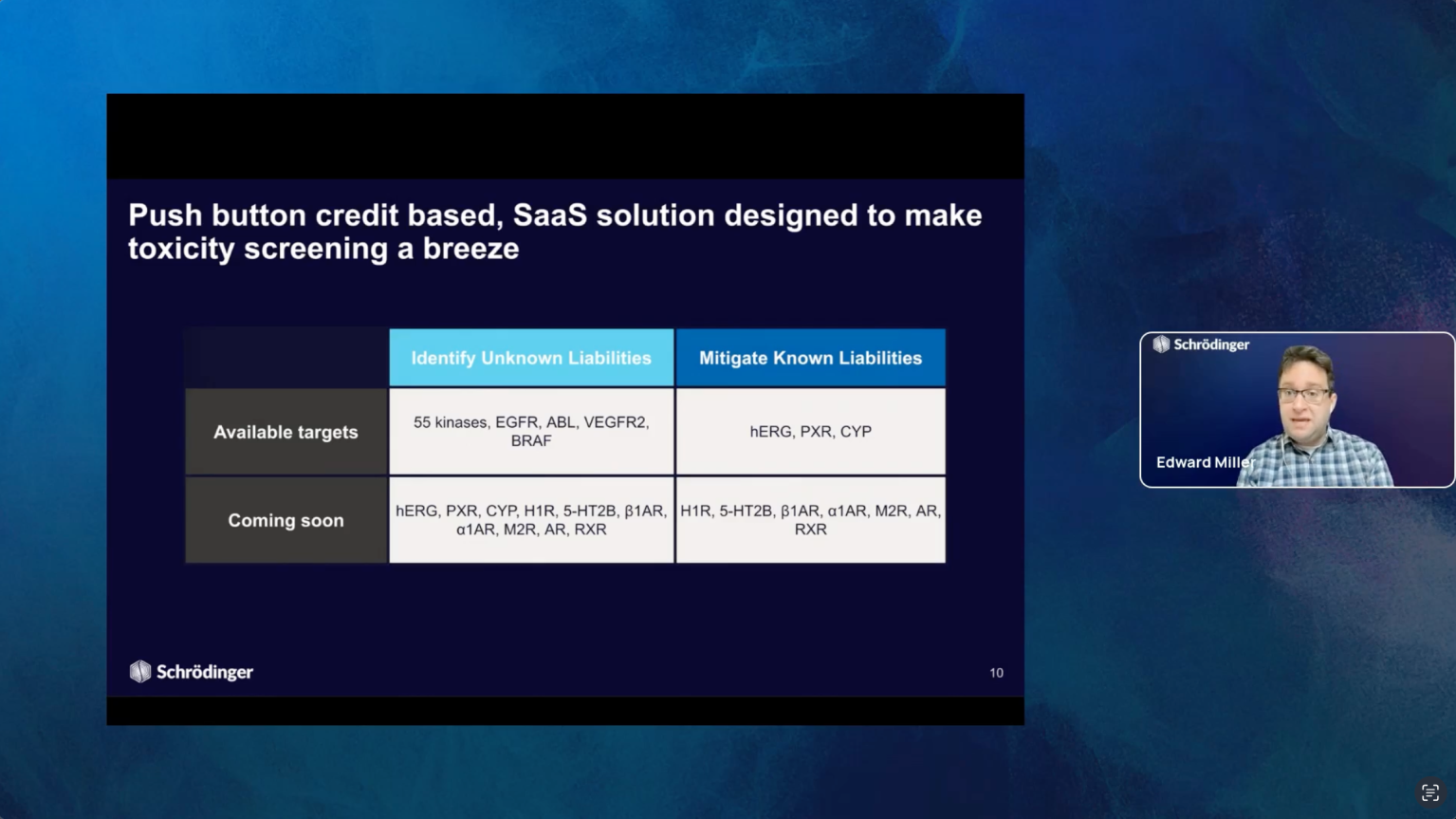
Late-stage discovery failures due to off-target liabilities, particularly hERG, CYP, and nuclear receptor interactions, remain a primary driver of project delays and sunk costs. Traditional predictive methods often act as “black boxes,” providing binary pass/fail flags without the mechanistic context needed to guide chemical synthesis. Without an atomically accurate understanding of why a molecule is hitting an anti-target, medicinal chemistry teams are often forced into blind “guess-and-check” cycles, risking both potency and safety.

Join us for a technical overview of Schrödinger’s Predictive Toxicology solution. This session will demonstrate how physics-based, atomic-resolution modeling transforms toxicology from a reactive “filter” into a proactive “design tool.” We will explore how to move beyond simple predictions to generate actionable binding hypotheses, allowing teams to surgically engineer out liabilities while maintaining primary activity. By integrating these insights directly into the DMTA cycle, discovery teams can significantly reduce synthesis costs and accelerate the path to a clean lead.

Key Highlights:

  • Mechanistic Attribution: Learn how to move from binary toxicity “flags” to atom-level structural rationales
  • Accelerated DMTA Cycles: See how predictive structural models can reduce experimental timelines by >10X
  • Structural SAR: Strategies for performing surgical chemical modifications to mitigate hERG and CYP risk without sacrificing potency
  • Live Demo: See the platform in action, showcasing how quickly you can go from a toxic prediction to a viable design modification

Who Should Attend:

  • Medicinal Chemists looking to rationalize and design around off-target SAR
  • Toxicologists interested in mechanistic, structural-based risk assessment
  • Computational Chemists & Modelers seeking to integrate high-fidelity tox predictions into their design workflows
  • Discovery Leads focused on reducing late-stage attrition and optimizing project budgets

Our Speakers

Ed Miller

Vice President, Life Science Software, Schrödinger

Edward Miller, Senior Director of Protein Structure Modeling, joined Schrödinger in 2014, and is responsible for advancing the domain of applicability of structure-based drug discovery into challenging targets and off-targets. Dr. Miller obtained his PhD from Columbia University, where he was awarded a DOE research fellowship. His thesis work with Professor Richard Friesner involved developing methods to accurately model loop conformations across a broad array of protein families. His recent work has been focused on methods development for induced fit docking and protein structure refinement.

Steven Albanese

Research Leader, Computational Chemistry, Therapeutics Group, Schrödinger

Steven Albanese joined Schrödinger in 2019 as a Computational Chemist in the Therapeutics group, with a focus on the application of Schrödinger’s computational platform to small molecule drug discovery projects. Dr. Albanese received his PhD from Gerstner Sloan Kettering at Memorial Sloan Kettering Cancer Center, where he studied with Dr. John Chodera. His thesis work focused on the application of free energy calculations to predict resistance and selectivity for small molecule kinase inhibitors. He has continued his research on predicting drug resistance, and is an inventor on a number of small molecule patents as well.