EFMC Medicinal Chemistry 2026

Conference

EFMC Medicinal Chemistry 2026

CalendarDate & Time
  • September 6th-10th, 2026
LocationLocation
  • Basel, Switzerland

Schrödinger is excited to be participating in the EFMC Medicinal Chemistry 2026 conference taking place on September 6th – 10th in Basel, Switzerland. Join us for a workshop by David Rinaldo, Senior Principal Scientist, Applications Science at Schrödinger, titled “Accelerating Drug Discovery with Integrated AI/ML Modeling.”

icon time SEPT 7 | 12:25
Accelerating Drug Discovery with Integrated AI/ML Modeling

Speaker:
David Rinaldo, Senior Principal Scientist, Applications Science at Schrödinger

Abstract:
AI/ML models are now indispensable in modern drug discovery, offering powerful capabilities ranging from protein structures predictions to ligand property prediction and including 3D protein-ligand binding pose prediction or de novo molecular design. However, effectively deploying and managing these models requires a centralized, collaborative platform.

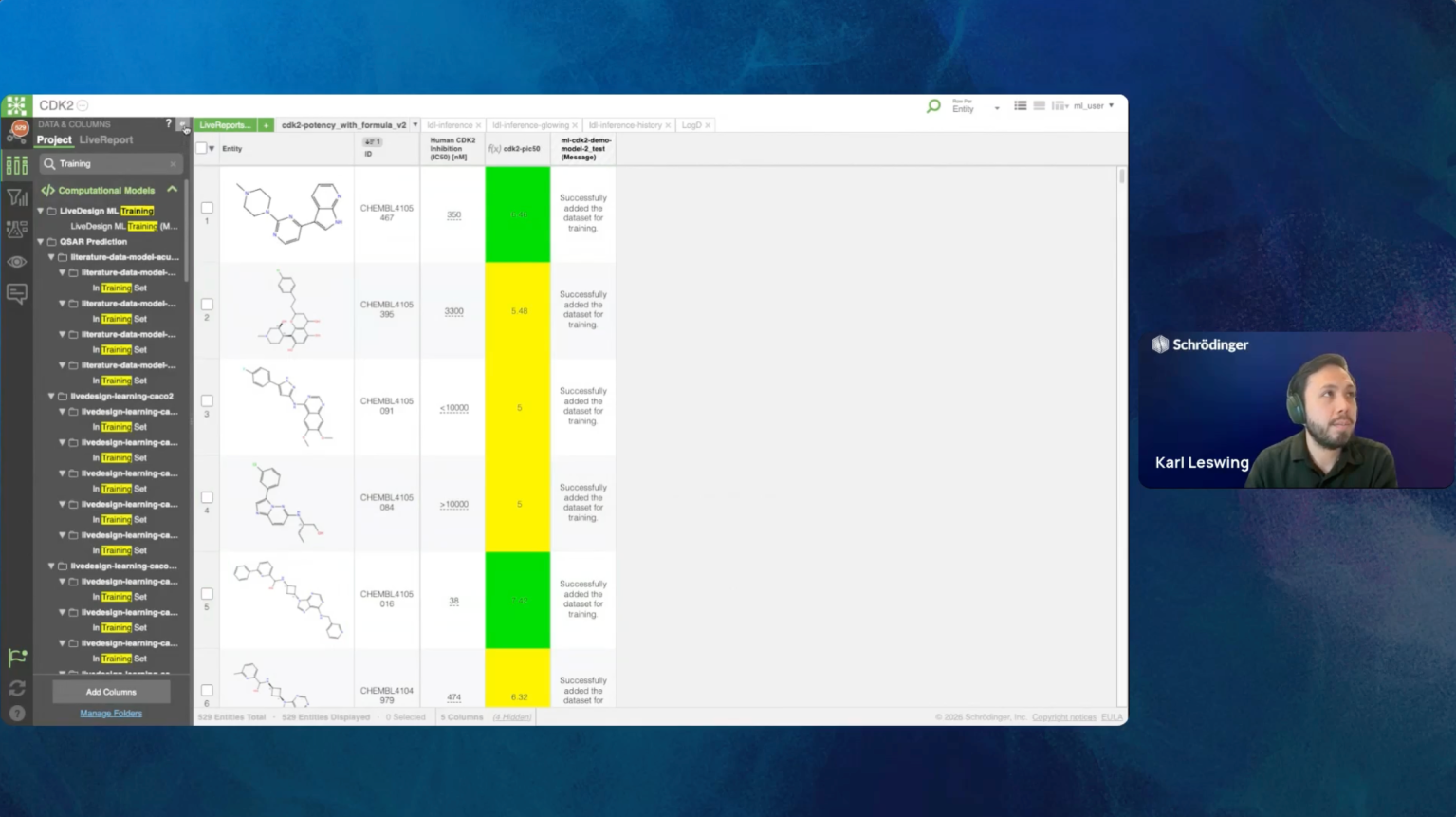
LiveDesign-ML is the module within the LiveDesign platform that empowers scientists to generate, validate, and deploy state-of-the-art AI/ML models with minimal manual intervention. We will demonstrate its capability for molecular property predictions, which are crucial for triaging newly designed ideas and enabling the screening of hundreds of thousands of compound ideas in minutes. By treating datasets as dynamic information feeds, LiveDesign ML ensures models are always optimized and reliable for your evolving chemistry.

We will also introduce RetroSynth, Schrödinger’s AI-driven synthesis planning platform. Engineered to accelerate and scale conventional retrosynthesis, RetroSynth uses advanced deep learning and a cloud-native Monte Carlo tree search (MCTS) architecture to predict and score optimal, accurate, and cost-efficient synthetic pathways. Learn how the integration of real-time building block data with AI and physics-based modeling in RetroSynth unlocks accurate retrosynthetic analysis, leading to massive project acceleration and significant cost savings in hit identification and lead optimization.

Medicinal chemists, computational chemists, and R&D leaders are welcome to join this workshop. We will showcase how Schrödinger’s LiveDesign-ML and RetroSynth are integrated to tackle critical challenges in the design and synthesis workflow. It will also be the opportunity to see the full potential of integrated AI/ML and physics-based modeling to overcome bottlenecks and advance your drug discovery programs.

Schrödinger デジタル創薬セミナー ~計算化学がもたらす創薬プロセスの変貌~ 第24回

Webinar

Schrödinger デジタル創薬セミナー
~計算化学がもたらす創薬プロセスの変貌~
第24回

CalendarDate & Time
  • April 24th, 2026
  • 11:00AM
LocationLocation
  • Virtual

Diverse computational strategies enable the discovery of p38α-MK2 molecular glues
多様な計算化学アプローチによる p38α–MK2 分子接着剤の創出

分子接着剤(Molecular Glues)は、タンパク質間相互作用を制御することで従来の創薬では困難であった標的に対する新たなアプローチを可能にするモダリティです。シュレーディンガーの研究では、p38α–MK2複合体を対象に、従来のオーソステリック阻害剤を上回る特性を有する分子接着剤の設計に成功し、in vivoにおけるTNFα低減効果を実証しています。本ウェビナーでは、FEP+を中核とした物理ベース計算に加え、AutoDesignerによる大規模化合物列挙、さらにAL-FEPや生成系AI/MLを組み合わせた多角的な設計戦略により、広大な化学空間を探索しつつ、多パラメータ最適化(活性・選択性・物性)を同時に達成したワークフローをご紹介します。本アプローチは、複雑なタンパク質間相互作用系や高難度ターゲットに対する分子設計の指針として、創薬研究における実践的な基盤を提供します。

Key Highlights

  • FEP+を活用した分子接着剤設計と自由エネルギー評価
  • 列挙手法×物理計算×AI/MLによる多目的最適化戦略
  • 高難度ターゲットに対する実践的な計算創薬ワークフロー

Speaker

井川 英之

Senior Director, Schrödinger

京都大学にて化学の修士号を取得後、名古屋市立大学にて薬学の博士号を取得。武田薬品工業およびTri-Institutional Therapeutics Discovery Instituteにおいて、複数の低分子医薬品候補の創出に貢献しました。現在は、シュレーディンガーのプラットフォームを活用した創薬研究の推進に従事しています。

【セミナー形式】
Zoom webinarを使用したオンライン形式

【お申込みにあたって】
職場・学校で使用されるメールアドレスをご入力ください。Gmail、キャリアメール等は利用できません。
参加お一人様につき一登録をお願いします。アクセスリンクの共有はご遠慮ください。
当日は、お申し込みの際に登録いただいた氏名・メールアドレスにてご参加ください。
同業他社さまにはご参加をご遠慮頂いております。ご理解のほど宜しくお願い致します。

※ご質問、ご不明な点がございましたら下記までお問い合わせください。
シュレーディンガー株式会社
E-mail: info-japan@schrodinger.com

Battery Seminar 2026

Conference

Battery Seminar 2026

CalendarDate & Time
  • July 14th-16th, 2026
LocationLocation
  • San Jose, California

Schrödinger is excited to be participating in the Battery Seminar 2026 conference taking place on July 14th – 16th in San Jose, California. Join us for a presentation by Garvit Agarwal, Principal Scientist II, Materials Science Applications Science at Schrödinger, titled “Integrating Physics-Based Simulations and Machine Learning to Fast-Track Battery Materials Innovation.”

icon time JUL 14 | 2:30PM
Integrating Physics-Based Simulations and Machine Learning to Fast-Track Battery Materials Innovation

Speaker:
Garvit Agarwal, Ph.D. Scientific Lead, Energy Storage Materials Science Group, Schrödinger

Abstract:
Developing next-generation batteries requires deep insight into complex phenomena like ion transport and the SEI. Integrated physics-based modeling and machine learning approaches are revolutionizing the development of next-generation battery chemistries. We demonstrate how ML Force Fields and advanced ML models can rapidly predict material properties, significantly reducing R&D timelines for high-performance energy storage systems.

From silos to synthesis: Fostering collaborative AI through platform integration with LiveDesign ML Japan

アーカイブ配信
日本語字幕付
「データサイロからの脱却と知見の統合:
LiveDesign MLを通じた協働型AIの推進」

AI技術の導入効果を最大化するためには、高い予測精度はもちろんのこと、構築したモデルをシームレスに実運用(デプロイ)できるプラットフォームが不可欠です。しかし、多くの研究現場では、機械学習(ML)インフラの分断やデータの不連続性が課題となり、モデルの社内定着やMLOpsにおいて大きな障壁が生じています。

この度ご紹介する「LiveDesign ML」は、拡張性とコラボレーションを念頭に設計された一元的なMLプラットフォームであり、AIを創薬研究における真の「戦略的基盤」へと昇華させます。

本プラットフォームは、散在するデータソースと計算ツールを単一のワークフローに統合し、データサイロを解消します。これにより、モデル、特徴量、実験結果のリアルタイムな共有が可能となり、計算科学者、データサイエンティスト、そして各領域の専門家(ドメインエキスパート)が協働してMLソリューションを構築し、反復的に改善できる環境を提供します。

さらに、LiveDesign MLの最大の強みは、業界標準として広くご活用いただいているSchrödingerの物理シミュレーションから得られる、高品質なトレーニングデータを活用できる点にあります。これにより、優れたモデル品質とプロスペクティブな予測における高い信頼性を実現します。また、学習・検証から実運用に至るMLOpsのライフサイクル全体を自動化することで、高性能なモデルをプロジェクトチームがリアルタイムで確実に利用できるようになります。

本ウェビナーでは、以下の内容について詳しく解説いたします。

AI投資対効果(ROI)の最大化: 当社の自動化プラットフォームにより、モデル展開における障壁を排除し、手作業によるMLOpsを最小限に抑えるアプローチ。

  • 物理ベースデータによる高精度モデルの構築: 物理法則に基づき検証されたシミュレーションデータで学習された、信頼性の高いモデルの活用方法。
  • 拡張と統合のロードマップ: 逆合成解析(Retrosynth)や化学特性予測といった現行機能の実機動作に加え、Generative ML(生成ML)、Co-folding(複合体構造予測)、LD Assistant等の今後の戦略的ロードマップのご紹介。
  • ライブデモンストレーション: 当社の製品エキスパートが、LiveDesign MLを通じた探索サイクルの加速と、ML投資に対するリターンの最大化について実演を交えてご紹介します。

■ 対象となるお客様
本ウェビナーは、高度な計算科学とAIを活用し、創薬における効率と精度の向上を牽引するリーダーおよび実務担当者の皆様に最適です。

  • 計算化学、AI/ML、および研究開発(R&D)部門の責任者様
  • ケモインフォマティクスおよびMLOpsのリード担当者様
  • 計算化学者および計算生物学者の皆様
  • インフォマティクスおよびデータサイエンスの戦略立案者様

■本動画の視聴にあたり、以下の点にご留意ください。

  • 自動翻訳字幕の制限: 本動画の字幕は自動翻訳を用いて生成されています。 専門用語等、不自然な表現や、不正確な訳出が含まれる可能性がございます。
  • 詳細情報の参照: 厳密な背景や詳細については、直接弊社までお問い合わせください。

Our Speaker

Karl Leswing

Vice President, Machine Learning, Schrödinger

Karl Leswing is the Vice President for Machine Learning at Schrödinger. In this role he oversees the research and execution of machine learning applications for Schrödinger’s digital chemistry platform. In 2017 he was a visiting researcher at the Pande Lab working on using deep learning techniques for drug discovery. During that time he co-authored MoleculeNet, a benchmarking paper analyzing machine learning techniques for chemoinformatics. Karl received his undergraduate degree from the University of Virginia, and a Master’s in machine learning from Georgia Tech.

【留意点】

  • 予告なく動画の配信を中止することがあります。ご了承をお願いいたします。
  • 本動画は、ご登録いただいた方向けの機密性の高い技術情報を含んでおります。トラブル防止のため、以下の事項を遵守いただけますようお願い申し上げます。
  • 撮影・録画の禁止: 動画内のスライド、データのスクリーンショット撮影および録画・録音はご遠慮ください。

【お申込みにあたって】

職場・学校で使用されるメールアドレスをご入力ください。Gmail、キャリアメール等は利用できません。
参加お一人様につき一登録をお願いします。アクセスリンクの共有はご遠慮ください。
同業他社さまにはご参加をご遠慮頂いております。ご理解のほど宜しくお願い致します。

※ご質問、ご不明な点がございましたら下記までお問い合わせください。
シュレーディンガー株式会社
E-mail: info-japan@schrodinger.com

Suppliers’ Day 2026

Conference

Suppliers’ Day 2026

CalendarDate & Time
  • May 19th-20th, 2026
LocationLocation
  • New York, New York

Schrödinger is excited to be participating in the Supplier’s Day 2026 conference taking place on May 19th – 20th in New York, New York. Stop by our booth to speak with Schrödinger scientists.

Bio-IT 2026

Conference

Bio-IT 2026

CalendarDate & Time
  • May 19th-21st, 2026
LocationLocation
  • Boston, Massachusetts

Schrödinger is excited to be participating in the Bio-IT 2026 conference taking place on May 19th – 21st in Boston, Massachusetts. Stop by our booth to speak with Schrödinger scientists.

PEGS 2026

Conference

PEGS 2026

CalendarDate & Time
  • May 11th-15th, 2026
LocationLocation
  • Boston, Massachusetts

Schrödinger is excited to be participating in the PEGS 2026 conference taking place on May 11th – 15th in Boston, Massachusetts. Stop by our booth to speak with Schrödinger scientists.

Lunch & Learn: Structure Prediction, Target Enablement & Rational Predictive Tox

Lunch and Learn
CalendarDate & Time
  • April 14th, 2026
  • 10:00 – 14:30 CET
LocationLocation
  • Basel, Switzerland

Structure Prediction, Target Enablement & Rational Predictive Tox

Register

Dear Colleague,

Join us for an interactive, free-of-charge session on Tuesday, April 14th at the Radisson Blu Hotel, Basel, as we explore how to overcome the critical bottlenecks of static crystal structures and “black box” toxicology in modern drug discovery.

In this Lunch & Learn, Schrödinger Scientists will demonstrate a physics-based workflow to bypass the “Rigid-Receptor” problem (Session I) and refine AI-generated global folds into actionable, modeling-ready 3D blueprints (Session II). Finally, we demonstrate how to transform off-target liabilities (hERG, CYP, Nuclear Receptors) into manageable design parameters, allowing you to generate structural hypotheses from as few as 10 assayed compounds and surgically engineer out safety risks while maintaining primary potency (Session III).

Induced-Fit Modeling | De Novo Structure Prediction | Rational Predictive Toxicology | Lead Optimization |Structural Enablement | Physics-based ML

Program:

+09:30 – 10:00 Welcome Coffee 

10:00 – 11:00 Session I: Achieving Structural Enablement for Novel Chemotypes

  • Challenge: Existing structures or close homologs are rarely enough; a single misplaced side chain can render a structure useless for a new chemical series.
  • Solution: Bypass the “Rigid-Receptor” problem using physics-based induced-fit modeling to characterize protein-ligand binding modes without waiting for new crystallography.

11:00 – 12:00 Session II: De Novo Structure Prediction for Rational Design

  • Challenge: AI models like AlphaFold lack the atomic-level pocket precision required for reliable lead optimization.
  • Solution: We introduce an automated pipeline that integrates AI folds with physics-based refinement to unlock precise structural modeling.

+12:00 – 13:30 Lunch Buffet & Networking

13:30 – 14:30 Session III: Transforming Toxicology into a Design Tool

  • Challenge: Off-target liabilities (hERG, CYP) are typically “black box” failures, forcing teams into expensive “guess-and-check” cycles.
  • Solution: Use atomic-resolution modeling to visualize interactions driving toxicity. Generate structural hypotheses from as few as 10 compounds to mitigate safety risks while maintaining primary potency.

14:30 – open end Discussion & Networking

Join us in the afternoon for a Q&A and networking session with our Scientists and Account Managers, providing an opportunity to present your questions and challenges, which the Schrödinger team will endeavor to address.

Register today to secure your seat!

The seminar is free to attend but preregistration is required as seats are limited. Previous-experience with the Schrödinger suite is not required.

Our Speaker

Ed Miller

Vice President, Life Science Software

Edward Miller, Senior Director of Protein Structure Modeling, joined Schrödinger in 2014, and is responsible for advancing the domain of applicability of structure-based drug discovery into challenging targets and off-targets. Dr. Miller obtained his PhD from Columbia University, where he was awarded a DOE research fellowship. His thesis work with Professor Richard Friesner involved developing methods to accurately model loop conformations across a broad array of protein families. His recent work has been focused on methods development for induced fit docking and protein structure refinement.

Register

NERDG 2026

Event

NERDG 2026

CalendarDate & Time
  • March 30th, 2026
LocationLocation
  • Groton, Connecticut

Schrödinger is excited to be participating in the NERDG 2026 conference taking place on March 30th in Groton, Connecticut. Join us for a presentation by Shiva Sekharan, Global Portfolio Leader of Formulations/CSP at Schrödinger, titled “A predictive modeling platform for accelerating drug substance, drug product, formulation development and delivery timelines.” Stop by booth #2 to speak with Schrödinger scientists.

icon time MAR 30 | 1:45PM
A predictive modeling platform for accelerating drug substance, drug product, formulation development and delivery timelines

Speaker:
Shiva Sekharan, Global Portfolio Leader of Formulations/CSP, Schrödinger

Abstract:
Early assessment of degradation, reactivity, catalysis, polymorphism and solubility of active pharmaceutical ingredients (API) is critical for small molecule drug substance and drug product development processes. We have developed an automated computational platform leveraging physics-based methods, chemistry-informed AI and ML models to efficiently 1) predict bond dissociation energies and decomposition products to elucidate reaction mechanisms, 2) screen crystal polymorphs to derisk selection of a stable solid form using the crystal structure prediction (CSP) method, 3) compute the thermodynamic solubility of diverse chemical structures and solubility enhancement via organic cosolvents using free energy perturbation (FEP+) method, 4) screen polymer excipients that can interact strongly with the API and reduces the risk of recrystallization, and 5) calculate apparent pKa values of ionizable lipids and simulate the self-assembly and structural properties of lipid nanoparticles.

Transforming Clean Label Innovation in FMCG via Physics-Powered AI and Predictive Modeling

Webinar

Transforming Clean Label Innovation in FMCG via Physics-Powered AI and Predictive Modeling

CalendarDate & Time
  • April 16th, 2026
  • 9:00 AM PDT | 12:00 PM EDT | 5:00 PM BST | 6:00 PM CEST
LocationLocation
  • Virtual

The Fast-Moving Consumer Goods (FMCG) sector is currently navigating a significant transition driven by a global consumer shift toward clean label” products and high-transparency ingredient lists. However, replacing functional synthetic additives with natural, sustainable alternatives often introduces complex formulation challenges regarding stability, shelf-life, and performance.This webinar explores how a “predict-first” digital chemistry platform can mitigate these risks by shifting the discovery from the laboratory alone to a high-throughput computational environment. Central to this digital transformation is the synergy between physics-based simulations and formulation machine learning (ML). While traditional ML often struggles with the “data sparsity” typical of novel natural ingredients, physics-based methods generate high-fidelity, molecular-level descriptors that provide the “ground truth” for ingredient interactions. These simulations allow R&D teams to characterize key properties, such as solubility, phase stability, and chemical stability, of complex, multi-component systems before a single physical sample is synthesized.

Key Highlights:

  • A Scalable Foundation for R&D: Bridge the gap between molecular-level physics and macro-scale performance to improve R&D velocity, protect margins, and meet evolving regulatory and consumer demands in an increasingly volatile global market
  • Rapid Formulation Screening: See how this integrated approach enables screening of tens of thousands of candidate formulations to identify the most robust “clean label” architectures
  • Predicting Product-Packaging Compatibility: Ensure that novel formulations do not compromise material integrity or lead to chemical migration

Our Speaker

Jeffrey Sanders

Global Portfolio Leader for CPG, Schrödinger

Jeff Sanders received his B.S. in applied physics from Worcester Polytechnic Institute and then his Ph.D. in biophysics and molecular pharmacology from Thomas Jefferson Medical College. Since joining Schrödinger in 2013, he has served several roles. Jeff is currently the global portfolio leader for the consumer packaged goods applications. Additionally, he is a managing board member of the Food Engineering, Expansion, and Development (FEED) Institute, and also holds a faculty position in the Food Science Department at UMass Amherst

Introducing RetroSynth: Breaking the synthesis bottleneck with AI and physics-based modeling recording

MAR 19, 2026

Introducing RetroSynth: Breaking the synthesis bottleneck with AI and physics-based modeling recording

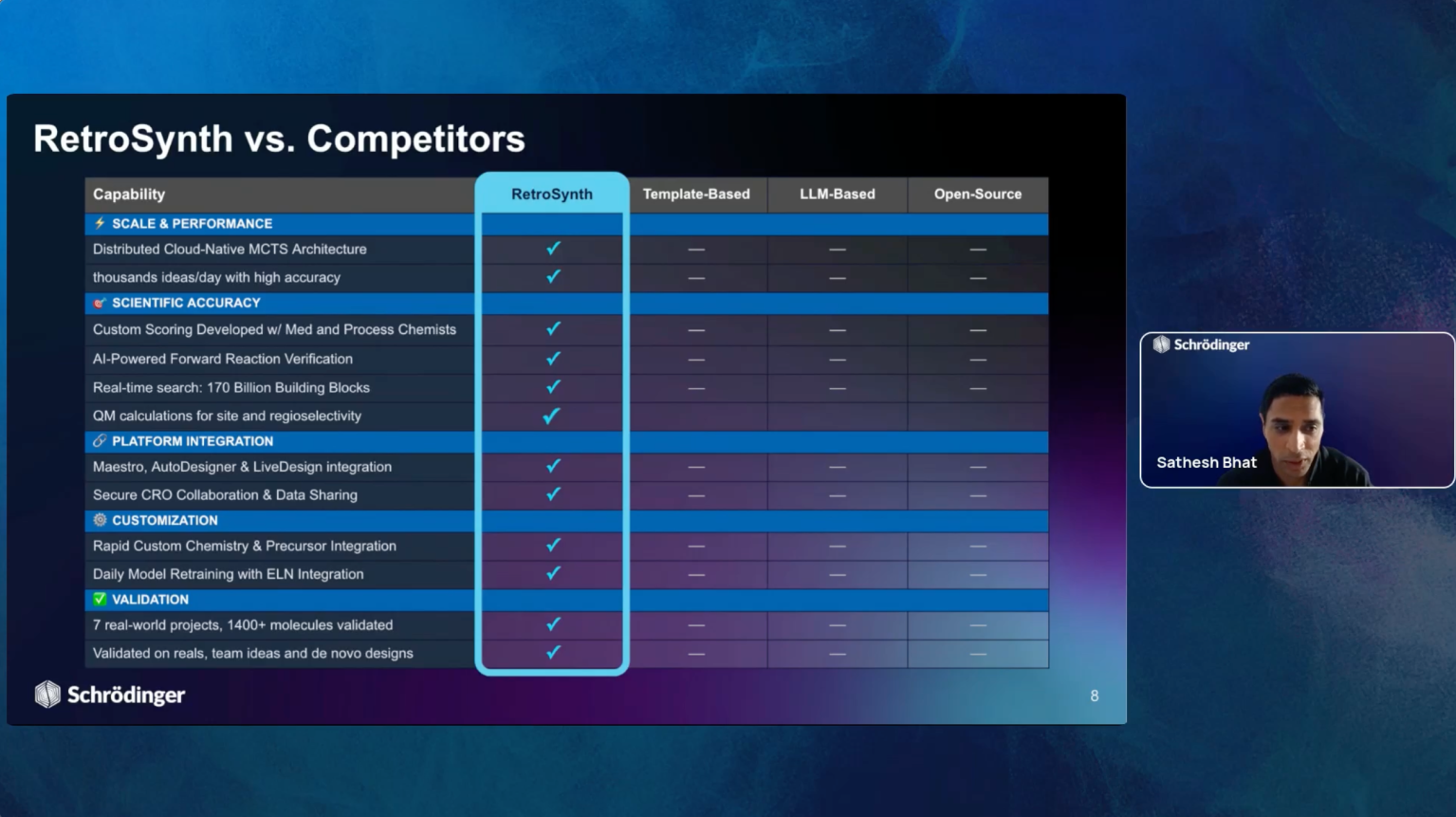
Join us for the introduction of RetroSynth, Schrödinger’s AI-driven synthesis planning platform. RetroSynth is engineered to accelerate and scale conventional retrosynthesis by harnessing advanced deep learning algorithms. RetroSynth uses a distributed cloud-native Monte Carlo tree search (MCTS) architecture to perform highly exhaustive searches to predict and score optimal, accurate, and cost-efficient synthetic pathways. RetroSynth helps you move from complex chemical targets to actionable synthesis plans accurately and efficiently. By integrating real-time building block data with AI and physics-based modeling, RetroSynth unlocks accurate retrosynthetic analysis across millions of de novo designed molecules, leading to massive project acceleration and cost savings in hit identification and lead optimization.

Key Highlights:

  • Introduction to RetroSynth: Schrödinger’s product manager will give a detailed description of how RetroSynth works and its advantages over conventional retrosynthesis solutions

  • Live Demo: See how RetroSynth performs in action

  • Ask questions: Direct technical discussion with our experts

Who Should Attend:

  • Medicinal Chemists: Looking to accelerate lead optimization and SAR exploration

  • Process Chemists: Focused on identifying scalable and cost-effective synthetic routes early in development

  • Computational Chemists: Interested in the integration of ML/AI frameworks into standard R&D workflows

  • R&D IT Directors: Evaluating enterprise-grade cheminformatics solutions for chemical synthesis

Our Speakers

Aditya Kaushik

Principal Scientist I, Schrödinger

Aditya Kaushik is an ML Research Scientist and the lead developer for the generative design and retrosynthesis technologies at Schrödinger. His primary focus is on the research, development, and integration of machine learning approaches to accelerate and optimize Design-Make-Test-Analyze (DMTA) cycles in active drug discovery programs. He received his B.S. from Johns Hopkins University, where he double majored in Computer Science and Chemical & Biomolecular Engineering.

Sathesh Bhat

Executive Director, Therapeutics Group, Schrödinger

Sathesh Bhat, Ph.D., executive director in the therapeutics group, joined Schrödinger in 2011. He is responsible for overseeing computational chemistry efforts on internal and partnered drug discovery programs at Schrödinger. Previously, Sathesh worked at both Merck and Eli Lilly leading computational efforts in several drug discovery programs. He obtained his Ph.D. from McGill University, which involved developing structure-based methods to predict binding free energies. Sathesh has co-authored multiple patents and publications and continues to publish on a wide variety of topics in computational chemistry.