A density functional theory study of keto-enol tautomerism in 1,2-cyclodiones: Substituent effects on reactivity and thermodynamic stability
Electrochemical Sensing of Phenylalanine using Polyaniline-Based Molecularly Imprinted Polymers
Towards the 4 V-class n-type organic lithium-ion positive electrode materials: the case of conjugated triflimides and cyanamides
Polymer Vesicles with Integrated Photothermal Responsiveness
Virtual screening of organic quinones as cathode materials for sodium-ion batteries
Discovery of lead quinone cathode materials for Li-ion batteries
SID Display Week 2026

Conference
SID Display Week 2026
 Date & Time
 - May 3rd-8th, 2026
 Location
 - Los Angeles, California


Schrödinger is excited to be participating in the SID Display Week 2026 conference taking place on May 3rd – 8th in Los Angeles, California. Join us for a presentation by Hadi Abroshan, Principal Scientist at Schrödinger, titled “Accelerating Optoelectronic Innovation via Integrating Machine Learning and Physics-Based Modeling.”
 MAY 7 | 4:00 PM
  Room 408A
 Accelerating Optoelectronic Innovation via Integrating Machine Learning and Physics-Based Modeling
Speaker:
Hadi Abroshan, Principal Scientist, Schrödinger
Abstract:
We present Schrödinger’s digital platform integrating physics-based simulations and machine learning modeling to accelerate the design of novel display materials and devices. Spanning atomic-scale modeling to device-level insights, it enables predictive, high-throughput exploration, bridging the gap “from atoms to devices” for next-generation optoelectronic solutions.
Eurocoat 2026

Conference
Eurocoat 2026
Date & Time - March 24th-26th, 2026
Location - Paris, France
Schrödinger is excited to be participating in the Eurocoat 2026 conference taking place on March 24th – 26th in Paris, France. Join us for a presentation by Irene Bechis, Senior Scientist II at Schrödinger, titled “Digital chemistry approach to accelerate polymer development for coatings.” Stop by booth C30 to speak with Schrödinger scientists.
MAR 26 | 11:30 AM
Congress Area Digital chemistry approach to accelerate polymer development for coatings
Speaker:
Irene Bechis, Senior Scientist II, Schrödinger
Abstract:
Coatings are indispensable in modern life, offering protection and unique functionalities to materials across diverse industries such as construction, automotive, and aerospace.
Developing new and improved materials for coating applications is a challenging process driven by the need to optimize the candidates towards superior performance, cost-effectiveness, and sustainability. This often requires several rounds of experimental exploration of candidate chemistries, considering material responses to various substrates but also different process and environmental conditions.
Adoption of digital design in polymers has gained in both visibility and impact as more industries see the value in computer-based analysis of materials. Molecular modelling approaches can accelerate material selection and characterization, ensuring that target properties are met, leveraging the description and understanding of the material chemistry and microstructure with atomistic resolution.
In this talk, we will showcase how Schrödinger’s digital chemistry platform can accelerate acrylate development for self-healing applications. We will show how chemistry-informed machine learning can be used for efficient screening of monomer chemistries for target copolymer properties and how physics-based modeling can provide fundamental understanding by connecting key thermomechanical properties to molecular interactions between polymer chains and other components of the formulations.
Our suite combines the possibility to create and automate custom workflows to build, simulate and analyze complex systems with fast simulation engines covering different time and length scales. The platform is intuitive and versatile, maximizing collaborations across teams and accessibility to both expert and non-expert modelers.
Building a biotech: Enabling a successful digital drug discovery program with a connected platform
FEB 26, 2026
Building a biotech: Enabling a successful digital drug discovery program with a connected platform
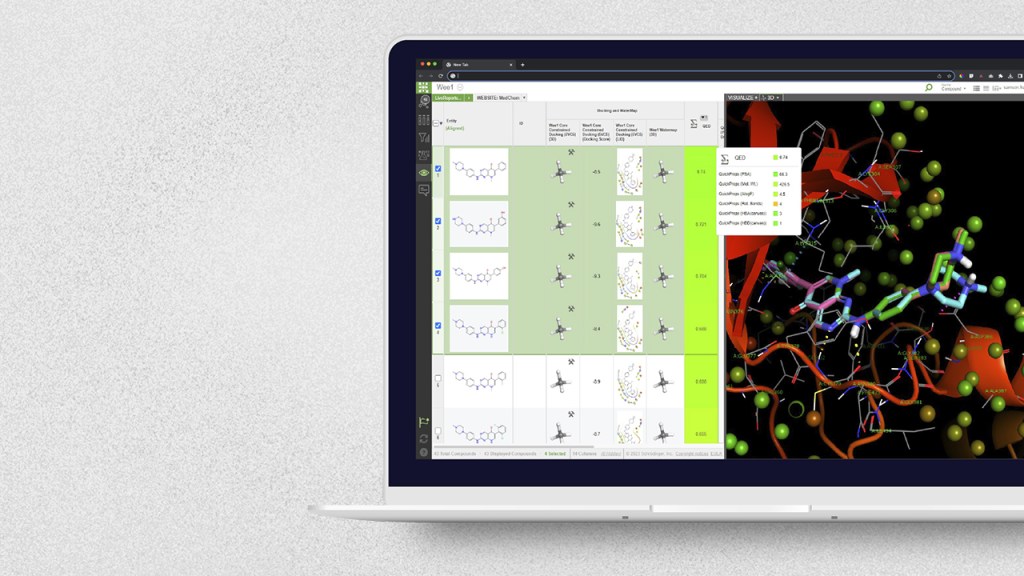
Translating your scientific hypotheses into promising lead compounds is complex and time-sensitive. In order to design better compounds and make faster decisions, your team needs to be able to confidently move ideas through the design-make-test-analyze (DMTA) cycle – from building accurate 3D models to iterating together on new designs to analyzing in silico and experimental data in real time.
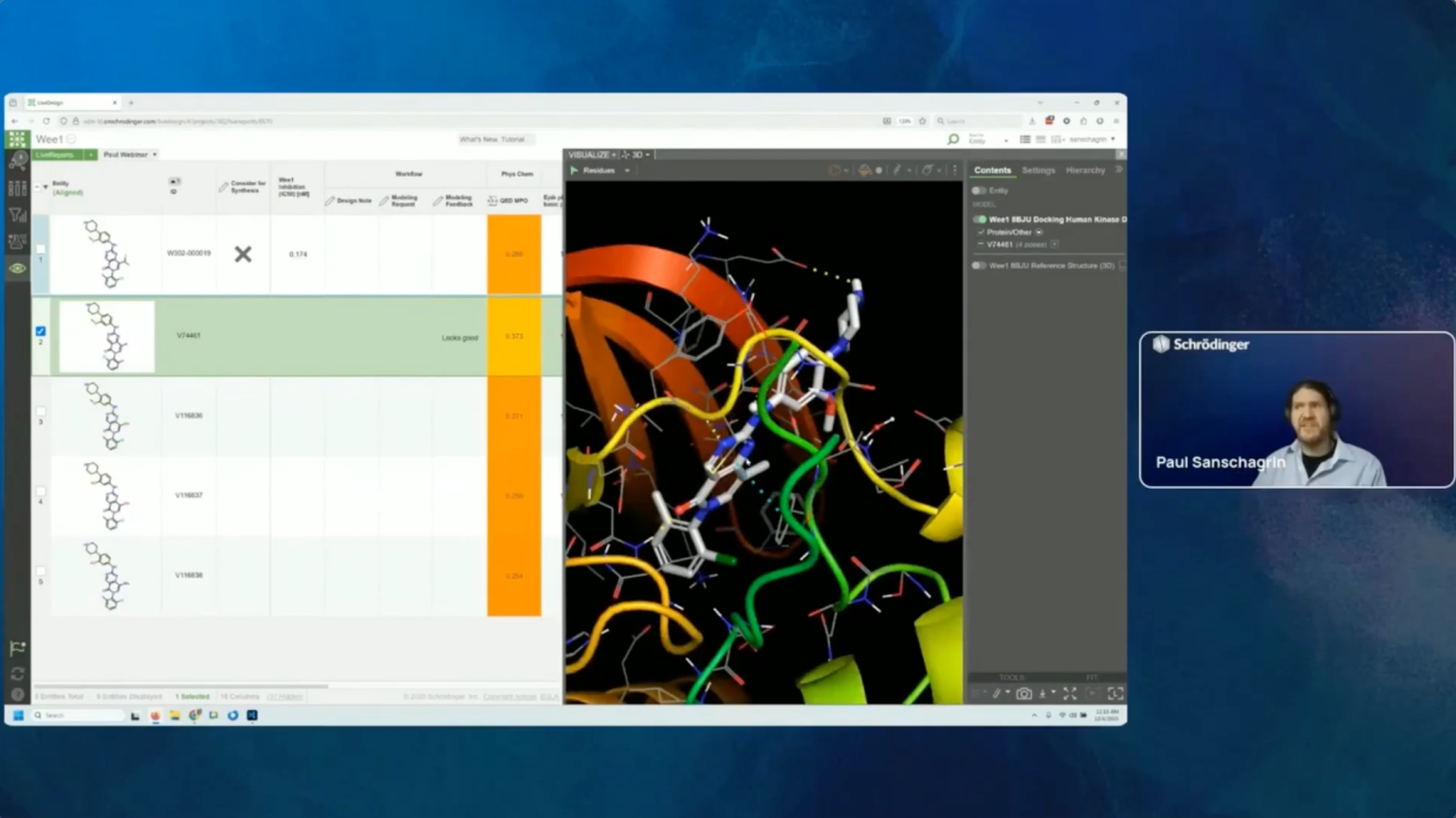
It’s time to transform your drug discovery process. In this exclusive webinar, we will go beyond theory to provide a live demonstration of how Schrödinger’s flagship platforms, Maestro and LiveDesign, work together to create a unified, collaborative discovery workflow made available to the entire project team, from modelers to medicinal chemists.
We will show you how to leverage the power of Maestro to construct robust predictive models with precise 3D structural data. Then, we’ll demonstrate the seamless deployment of these models directly into the LiveDesign environment. You’ll see firsthand how computational and medicinal chemists can use these models to quickly test new ideas, evaluate designs, and collaborate with their team in a single, integrated platform.
Join us to see how this powerful solution can accelerate your DMTA cycles and enable your teams – this isn’t about complex simulations, it’s about giving your team the tools they need to make better decisions, faster.
Webinar Highlights:
- Maximize the value of your data: We’ll show you how to create predictive models using Maestro and integrate these in silico results with your experimental data in LiveDesign for real-time, centralized analysis
- Empower collaboration across teams and CROs: We’ll demonstrate how the LiveDesign platform facilitates sharing and tracking of data for improved collaboration
- Get started: We’ll show you how Schrödinger’s world-class support team makes implementation and training easy to enable your success
- Ask questions: Schrödinger experts will be on hand to answer any questions you may have
Our Speakers

Kevin Halligan
Vice President, Schrödinger
Kevin Halligan joined Schrödinger in 2014, and currently serves as a Vice President, Sales, where he is responsible for the growth and management of the company’s life science software and drug discovery services business in the US and Canada. He completed his MS in Biological and Pharmaceutical Biotechnology at St. John’s University and holds a BA in Communication and Media Studies from Fordham University. He has extensive experience in scientific sales and business development and a proven track record of growing the Schrödinger Platform. Kevin’s tenure at Schrödinger has afforded him a comprehensive understanding of the preclinical drug discovery process and the opportunity to directly impact the computational drug discovery revolution.
Paul Sanschagrin
Lead Strategic Deployment Manager, Schrödinger
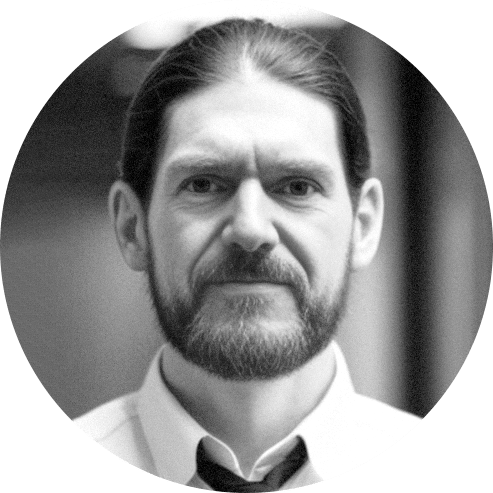
Paul Sanschagrin joined Schrödinger in 2018 and serves as a Lead Strategic Deployment Manager supporting LiveDesign and the Schrodinger platform across diverse customers, including major global pharma customers and several biotech customers. Paul received his BS in Biochemistry and PhD in Biochemistry from Michigan State University with a postdoctoral position at Philipps-Universität Marburg, Germany. Paul’s background in computational chemistry and drug discovery alongside his past experience in technical roles including software support and systems administration enable him to bridge the gap between the scientists’ needs and the technical possibilities to effectively deliver the Schrödinger Platform.
Lunch & Learn: Ligand-Based Screening in the Age of Ultra-Large Chemical Libraries

Lunch and Learn
Date & Time
- April 23rd, 2026
Location
- Basel, Switzerland


Ligand-Based Screening in the Age of Ultra-Large Chemical Libraries
Dear Scientists,
Readily available chemicals keep increasing rapidly in number while the need for novel chemical matter for drug targets remains at an all time high. Recently, tera-scale virtual libraries have become available enabling trillions of compounds for purchase and deployment in hit discovery projects.
To support the ever-growing access to vast chemical space Schrödinger has developed a plethora of ligand-based tools facilitating efficient and locally-deployable screening campaigns for pharmacophores, ligand shape, and fingerprint methodologies at increasing library sizes, from enumerated to virtual spaces.
We invite you to join us for an interactive, free-of-charge session on Thursday, April 23rd at the Radisson Blu Hotel, Basel. In this extended version of our Lunch & Learn series, Schrödinger scientist will provide an overview of ligand-based tools for different chemical spaces and show the fast turnaround/throughput.
Date & Time:
Thursday, April 23rd, 2026
From 10:00 to 13:30 CET
Program:
+ Welcome Coffee
09:30 – 10:00
+ Presentation on Ligand-based offers at different Chemical Spaces
Tim Knehans, Principal Scientist, Applications Science & Product Management
10:00 – 11:00
Presentation:
- Chemical Spaces: An Overlap Analysis
- Ultra-large Library Screening via QuickShape
- Virtual Space Screenings via Combinatorial Explorer
- Synthesis assessments via Pathfinder & RetroSynth
11:00 – 12:00
Interactive session on Ligand-based tools for Ultra-large libraries
+ Lunch
12:00 – 13:30
+ Discussion & Networking
13:30 – open end
Join us in the afternoon for a Q&A and networking session with our Scientists and Account Managers, providing an opportunity to present your questions and challenges, which the Schrödinger team will endeavor to address.
Register today to secure your seat!
The seminar is free to attend but preregistration is required as seats are limited. Previous-experience with the Schrödinger suite is not required.
Our Speaker

Tim Knehans
Principal Scientist, Applications Science & Product Management, Schrödinger
Tim Knehans joined Schrödinger in 2019 where he works as an Applications Scientist in Europe as well as a Product Manager for Schrödinger’s Cheminformatics Software, overseeing the utilization of ultra-large chemical spaces. Tim obtained his Dr. sc. nat. from the University of Zurich under Amedeo Caflisch before joining professors Didier Rognan & Esther Kellenberger at the University of Strasbourg for a PostDoc. He then joined the Computational Chemistry Department of Merck KGaA working in Drug Discovery & ultra-large libraries as well as a Cheminformatics Team Lead for the SYNTHIA retrosynthesis project.
International Battery Seminar & Exhibit 2026

Conference
International Battery Seminar & Exhibit 2026
Date & Time - March 23rd-26th, 2026
Location - Orlando, Florida
Schrödinger is excited to be participating in the International Battery Seminar & Exhibit 2026 taking place on March 23rd – 26th in Orlando, Florida. Stop by booth #531 to speak with Schrödinger scientists.