2026 CMC Conference

Conference

2026 CMC Conference

CalendarDate & Time
  • April 14th-16th, 2026
LocationLocation
  • Portland, Oregon

Schrödinger is excited to be participating in the 2026 CMC Conference conference taking place on April 14th – 16th in Portland, Oregon. Join us for a presentation by Simon Elliott, Director, Atomic Level Process Simulation at Schrödinger, titled “Winding Road Ahead: Challenges for the Semiconductor Industry in AI-Enabled Materials Discovery.”

Peter O. Stahl Advanced Design Forum 2026

Conference

Peter O. Stahl Advanced Design Forum 2026

CalendarDate & Time
  • May 14th-15th, 2026
LocationLocation
  • Wayzata, Minnesota

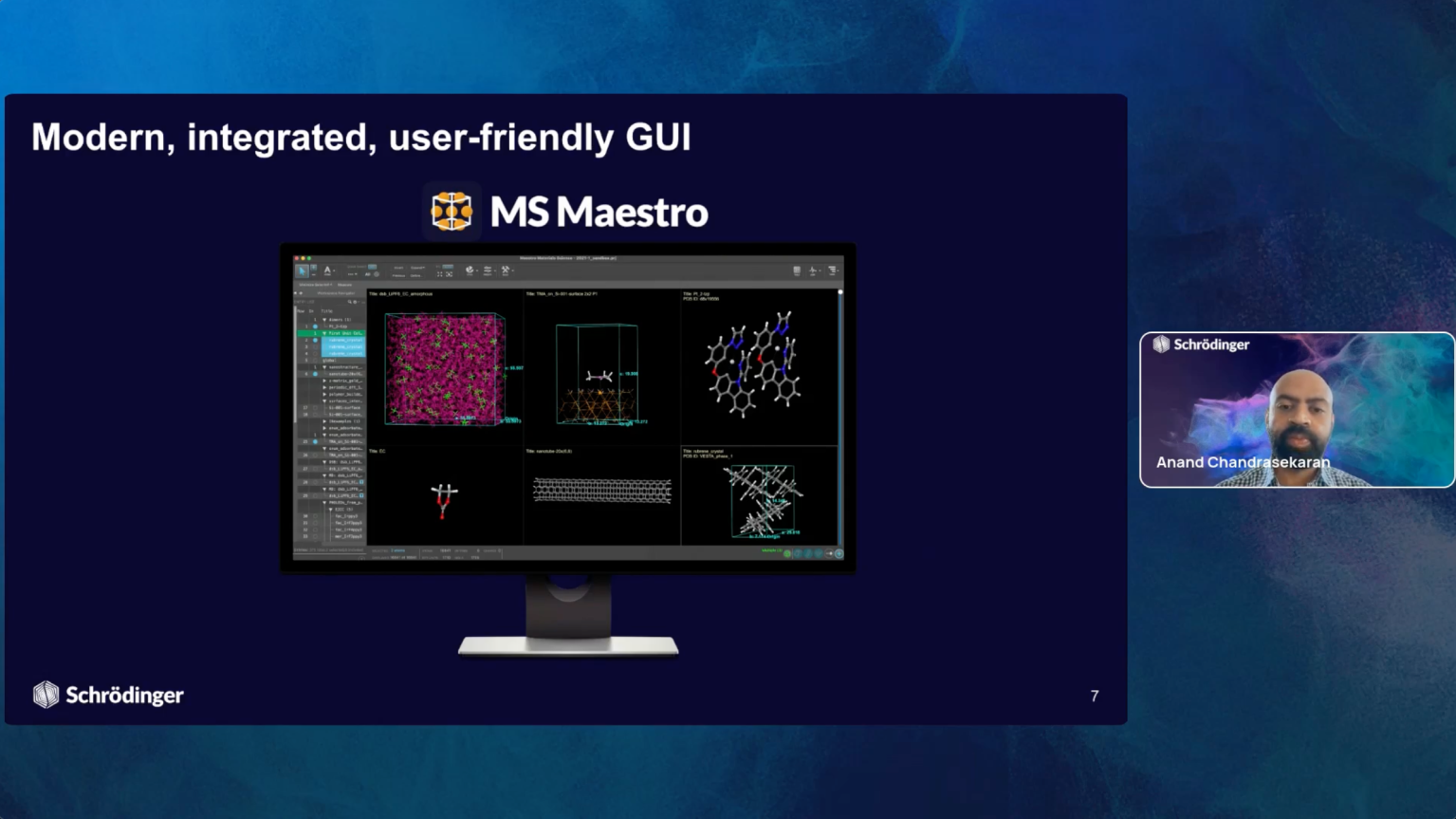
Schrödinger is excited to be participating in the Peter O. Stahl Advanced Design Forum taking place on May 14th – 15th in Wayzata, Minnesota. Join us for a presentation by Anand Chandrasekaran, Product Manager, Materials Science Informatics at Schrödinger, titled “Generative AI for Materials.”

icon time MAY 14 | 1:30 PM
Generative AI for Materials

Speaker:
Anand Chandrasekaran, Product Manager, Materials Science Informatics at Schrödinger

ACS Spring 2026

Conference

ACS Spring 2026

CalendarDate & Time
  • March 22nd-26th, 2026
LocationLocation
  • Atlanta, Georgia

Schrödinger is excited to be participating in the ACS Spring 2026 conference taking place on March 22nd – 26th in Atlanta, Georgia. Join us for presentations by Atif Afzal, Principal Scientist II, Materials Science Modeling Services at Schrödinger. Stop by our booth to speak with Schrödinger scientists.

icon time MAR 23 | 8:45 AM
icon location Room C207
Multi-objective copolymer design: Integrating physics-based simulation and machine learning

Speaker: Atif Afzal, Principal Scientist II, Materials Science Modeling Services, Schrödinger

Division: I&EC: Division of Industrial and Engineering Chemistry

Session: Data Analytics and AI For Chemistry, Manufacturing, and Healthcare

icon time MAR 23 | 2:55 PM
icon location Room B401
AI and physics-based modeling for complex materials and formulations

Speaker: Atif Afzal, Principal Scientist II, Materials Science Modeling Services, Schrödinger

Division: COMSCI: Committee on Science

Session: AI for Chemistry: From Algorithms to Applications

38th Molecular Modeling Workshop 2026

Conference

38th Molecular Modeling Workshop 2026

CalendarDate & Time
  • March 9th-10th, 2026
LocationLocation
  • Erlangen, Germany

Schrödinger is excited to be participating in the 38th Molecular Modeling Workshop 2026 conference taking place on March 9th – 10th in Erlangen, Germany. Join us for a presentation and workshop by Jonas Kaindl, Principal Scientist I at Schrödinger.

Workshop: More than moving pictures: Molecular Dynamics with Desmond

Speaker: Jonas Kaindl, Principal Scientist I at Schrödinger

Abstract: If you’re interested in running molecular dynamics simulations in your research, in this workshop you can learn how to run MD simulations with the Schrödinger suite. We’ll use two examples, a small molecule ligand in water and a protein-ligand complex, and look at how to prepare the structures and set up the simulation. Once the simulation is completed, we’ll go through different methods to analyze trajectories in Maestro, including analyzing RMSDs, occupations, solution phase conformers, solvation patterns and other interesting properties.

Preparation:

Every participant is required to download the Schrödinger license and bring their own laptop with the Schrödinger suite installed. Since we will not go through the basic functionalities of Maestro, we strongly encourage participants to go through our “Getting going with Maestro” section on our website to learn the basics (requires a free website account): Getting going with Maestro

Should you wish to prepare further, here are additional resources:
Learning Paths for Small Molecule Drug Discovery
Introduction to Structure Preparation and Visualization

Presentation: Let it go: exploring and learning from unbinding pathways

Speaker: Jonas Kaindl, Principal Scientist I at Schrödinger

Abstract: The estimation of drug-target residence time has been widely adopted in drug discovery and lead optimization campaigns as a metric to control and modulate in vivo drug efficacy. Over the years, several computational approaches have been developed to simulate unbinding kinetics and calculate dissociation rates. In addition to accurately predicting residence time, understanding the molecular basis of the unbinding event is crucial to support and drive the design of drugs with optimized kinetic profiles. Here, we present the application of the unbinding kinetics workflow developed by Schrödinger to accurately predict the residence time and to study the unbinding mechanism of a set of drug-target systems [1]. We applied the presented approach to different target classes and modalities, looking at the details of the dissociation process and understanding the determinants of such an event. Overall, the results demonstrate the applicability of the workflow in assisting drug design with minimal human intervention and a computational cost compatible with drug design cycle timeline.

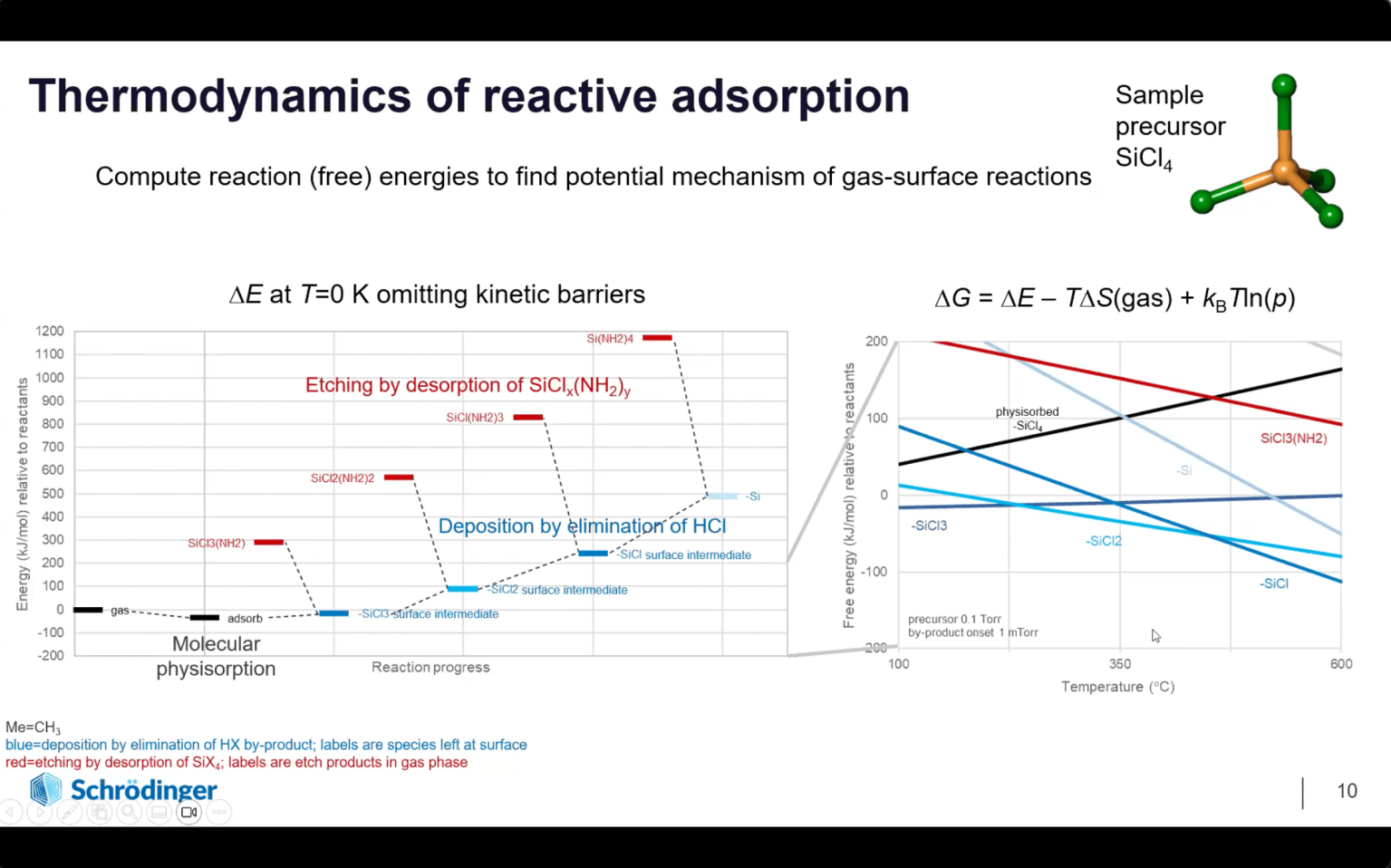
Atomic layer deposition: Bridging theory and experiment to design a process for silicon carbonitride

MAR 19, 2026

Atomic layer deposition: Bridging theory and experiment to design a process for silicon carbonitride
原子層堆積(ALD)における理論と実験の融合 ― シリコンカーボナイトライド成膜プロセス設計

次世代半導体デバイスでは、低誘電率や低エッチングレートを実現する新しい誘電材料の開発が求められています。その有力な手法の一つが、シリコンナイトライドへの炭素導入を可能にする原子層堆積(ALD)プロセスです。

本ウェビナーでは、SchrödingerとLam Researchのコラボレーション事例を通じて、計算科学(DFT)と実験(RGA、FTIR)を組み合わせ、最適な前駆体を効率的に選定するアプローチをご紹介します。

理論と実験を連携させることで、プロセス理解を深め、材料開発を加速する具体的な方法を分かりやすく解説します。

こんな方におすすめです

  • 半導体向け薄膜材料(SiN、SiCN など)の開発やALD/CVDプロセスに携わる研究者・プロセスエンジニアの方
  • 新規前駆体の選定や低温成膜プロセスの最適化に課題を感じている材料開発担当者の方
  • 計算科学と実験を組み合わせたR&Dアプローチに関心があり、開発効率を高めたいと考えている方

Our Speaker

Simon Elliott

Director of Atomic Level Process Simulation, Schrödinger

材料の成膜およびエッチングにおける表面化学へ原子スケールモデルを応用する分野の第一人者です。2023年にはALD Innovator Awardを受賞しています。

The Importance of Human Know-How in AI Execution for Materials R&D

MAR 18, 2026

The Importance of Human Know-How in AI Execution for Materials R&D

AI and machine learning (ML) are often sold as push-button solutions for materials design and discovery, but they lack value without a rigorous foundation. While the current AI revolution provides unprecedented speed and possibilities, human know-how is a key ingredient for ensuring complex methods lead to high impact outcomes. True innovation happens at the intersection of physics-based simulation, AI/ML, and human expertise. Join us to explore how Schrödinger’s domain experts integrate these three pillars to streamline material optimization. 

We’ll discuss how to move beyond the hype and apply digital chemistry strategies that deliver meaningful business results. We will introduce Schrödinger’s Materials Science platform, and share high-impact case studies from a variety of industries and applications, ranging from small molecules to formulations and electronics to industrials. Recent advancements, such as device level ML and cutting-edge machine learning force field (MLFF) architectures will be presented. 

Key Learning Objectives:

  • Why physics-based modeling is essential to complement AI/ML predictions
  • Real-world applications where digital chemistry has reduced discovery timelines from years to months across industries
  • How our expert-led support ensures project success for modeling novices and veterans alike

Who Should Attend:

  • R&D Leaders 
  • Innovation Managers 
  • Digitization Managers
  • Synthetic Chemists
  • Materials Scientists
  • Chemical Engineers
  • Materials Research Engineers
  • Computational Chemists
  • Computational Materials Scientists

Our Speaker

Michael Rauch

Director of Materials Science, Schrödinger

Michael Rauch is a Director at Schrödinger specializing in materials science and education. Michael earned his Ph.D. from Columbia University in synthetic organometallic chemistry as an NSF Graduate Research Fellow before pursuing a postdoctoral role in organic chemistry at the Weizmann Institute of Science as a Zuckerman Postdoctoral Scholar. Michael is particularly interested in green, sustainable chemistry and transforming the way that synthetic chemists utilize molecular modeling via practical education.

Lunch & Learn: Advanced Solutions for Medicinal Chemistry Brussels

Lunch and Learn
CalendarDate & Time
  • March 26th, 2026
LocationLocation
  • Brussels, Belgium

Advanced Solutions for Medicinal Chemistry

Register

Dear Medicinal Chemists,

Ever found yourself struggling to predict brain permeation (Kp,uu), efflux, hERG inhibition, or CYP3A4 TDI in your projects? Take a break from your other obligations and let’s talk!

We are inviting you to join us in an interactive and free-of-charge session on Thursday, March 26th at the Radisson Collection Hotel, Grand Place Brussels for an extended version of our Lunch and Learn series where Schrödinger scientists will be diving deep into these crucial areas, bringing your practical solutions and expert insights, and demonstrating how modeling approaches can significantly help medicinal chemists make their projects more efficient and successful. You can either join for the whole event or solely for the presentation session.

Date & Time:

Thursday, March 26th, 2026

From 10:00 to 14:00 CET

Program:

+ Welcome Coffee
09:30 – 10:00

Interactive Session on Advanced Modeling Approaches in Medicinal Chemistry

10:00 – 12:30

David Papin, Principal Scientist II, Applications Science

Zeineb Si Chaib, Principal Scientist II, Applications Science

  • Brain Penetration with Kp,uu: Strategy for predicting central nervous system (CNS) drug delivery.
  • Efflux: Overcoming drug efflux mechanisms.
  • Cyp3A4 TDI: Understanding and addressing CYP3A4 time-dependent inhibition.
  • hERG: Mitigating hERG liability by using a quantum mechanics-based pKa calculation and a structure-based approach.

Our seminar will use the DLK story as a framework to explore the topics in detail throughout our session. Afterwards, lunch is served.

+ Lunch
12:30 – 14:00

Discussion & Networking

14:00 – open end

Join us in the afternoon for a Q&A and networking session with our Scientists and Account Managers, providing an opportunity to present your questions and challenges, which the Schrödinger team will endeavor to address.

Register today to secure your seat!

The seminar is free to attend but preregistration is required as seats are limited. Previous-experience with the Schrödinger suite is not required.

Our Speakers

David Papin

Principal Scientist, Schrödinger

Zeineb Si Chaib

Senior Scientist II, Applications Science, Schrödinger

Register

Future Food Tech 2026

Conference

Future Food Tech 2026

CalendarDate & Time
  • March 19th-20th, 2026
LocationLocation
  • San Francisco, California

Schrödinger is excited to be participating in the Future Food Tech 2026 conference taking place on March 19th – 20th in San Francisco, California. Join us for a panel discussion, titled “AI Innovation Lab“. Stop by our booth to speak with Schrödinger scientists.

icon time MAR 20 | 13:30
AI Innovation Lab

Speakers:
Federico Fontanella, Head of Strategic
Innovation and Product Partnerships, Trace One
Jeff Sanders, Product Manager, Schrödinger
Jay Gilbert, Director, Co-Developer & Digital Products, IFT
Eric Hamborg, Chief Commercial Officer – PIPA
Elizabeth Crawford, Senior Editor – Food Navigator USA

Abstract:
AI is rapidly transforming how food companies innovate, operate, and compete – how are you putting it to work?

This immersive session shows how AI is driving real impact across the food system, from faster product development to smarter operations.

Collaborate with forward-thinking peers through:
• Unpacking real-world AI success stories across product development, operations, and supply chains
• Live AI product demos showcasing tools accelerating formulation, insight generation, and decision-making
• Campfire-style breakout sessions where groups develop and present practical AI use cases, including benefits and risks.

Whether you’re starting out or scaling, this session will give you practical insights and actionable AI ideas to take back to your business.

デジタル創薬セミナー ~計算化学がもたらす創薬プロセスの変貌~ 第23回

MAR 18, 2026

Schrödinger デジタル創薬セミナー 23:
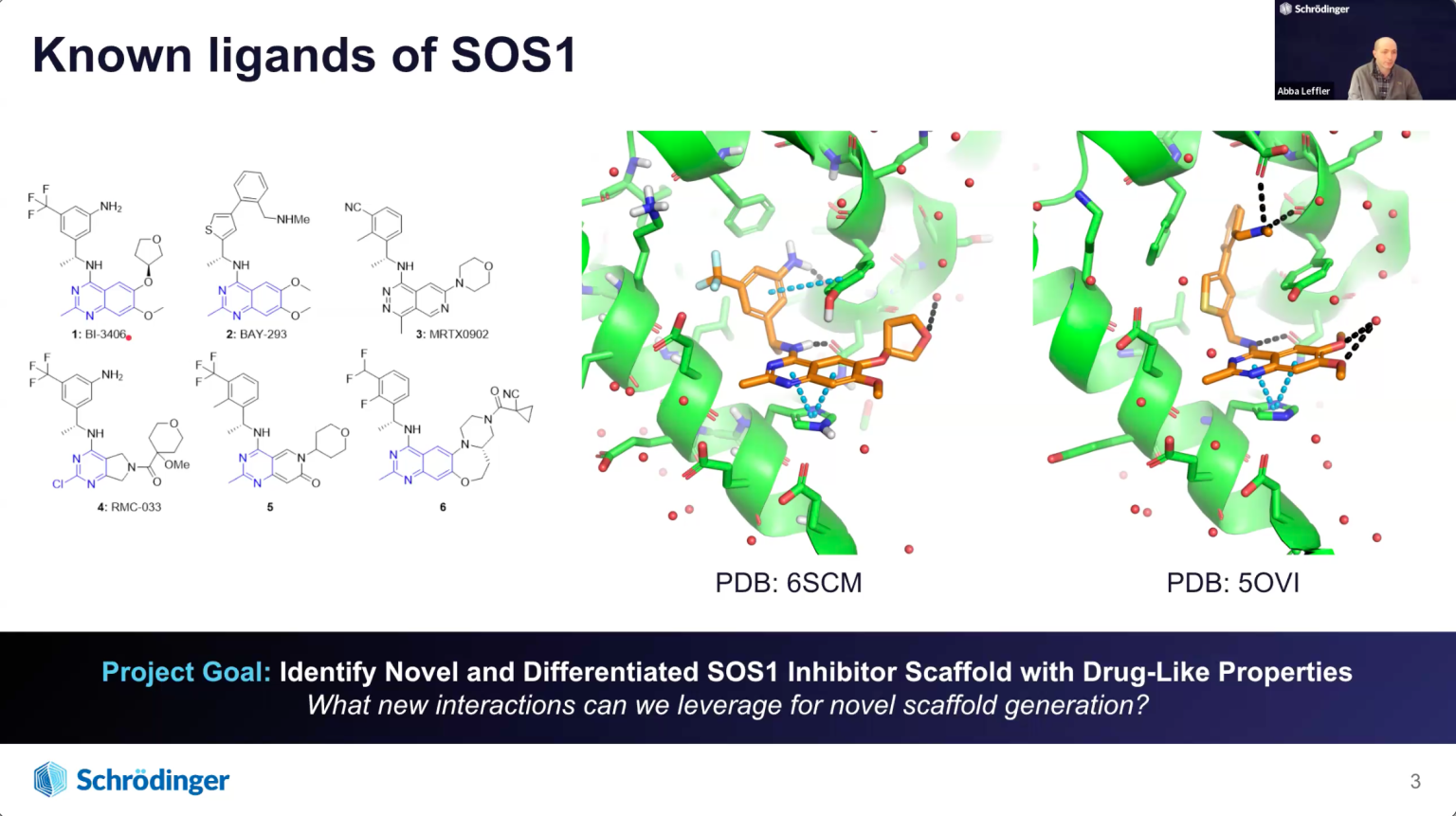
Rethinking the rules: Exploiting solvent exposed salt-bridge interactions with free energy perturbation simulations for the discovery of potent inhibitors of SOS1
創薬の常識を覆す: 溶媒露出型ソルトブリッジを活用したFEP解析によるSOS1高活性阻害剤の創出

従来のメディシナルケミストリーの“ルール”だけでは十分な活性向上が得られない場合、どのように設計戦略を再構築すべきでしょうか。

本セミナーでは、自由エネルギー摂動(FEP+)を活用した “predict-first” アプローチにより、SOS1 阻害剤創製において新たな設計指針を見出した事例をご紹介します。FEP+ シミュレーションを通じて、結合ポケット周辺に位置する溶媒露出型の酸性残基 (E906、E909)とのソルトブリッジ形成が、最大 750 倍の活性向上につながる重要な相互作用であることを明らかにしました。

本事例は、従来は設計対象とされにくかった領域を戦略的に活用することでポテンシーを大幅に向上できる可能性を示すものであり、他の創薬ターゲットへの応用も期待されます。SOS1 プログラムの具体的な検討プロセスとともに、溶媒露出型ソルトブリッジ相互作用を活用した新たな創薬戦略について解説します。

Key Highlights

  • 結合ポケットの非従来領域を探索し、ポテンシー向上につなげる新たな in silico 戦略を学びます。
  • FEP+ を活用した “predict-first” アプローチにより、溶媒露出型ソルトブリッジという設計要素を特定したプロセスを理解します。
  • この知見を他の創薬ターゲットへ展開した事例を紹介します。

Speaker

Abba Leffler

Senior Principal Scientist, Computational Chemistry, Therapeutics Group, Schrödinger

プリンストン大学で化学学士号を取得し、ニューヨーク大学メディカルスクールで神経科学の博士号を取得。 現在は、主任科学者として、低分子創薬プロジェクトをリードしている。

Formulation ML and Optimization: Making advanced property prediction and experimental design fast and accessible

MAR 10, 2026

Formulation ML and Optimization: Making advanced property prediction and experimental design fast and accessible

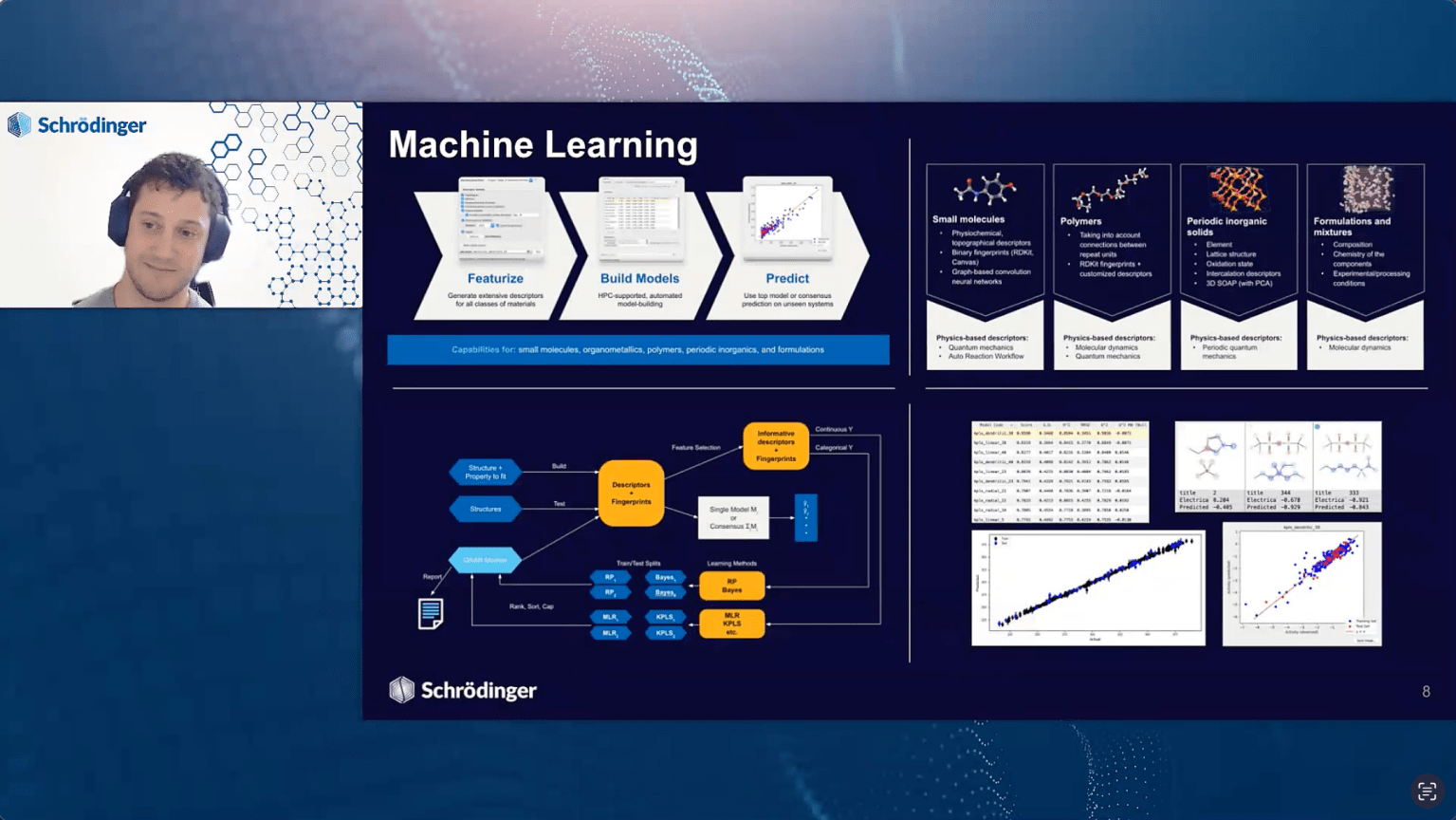
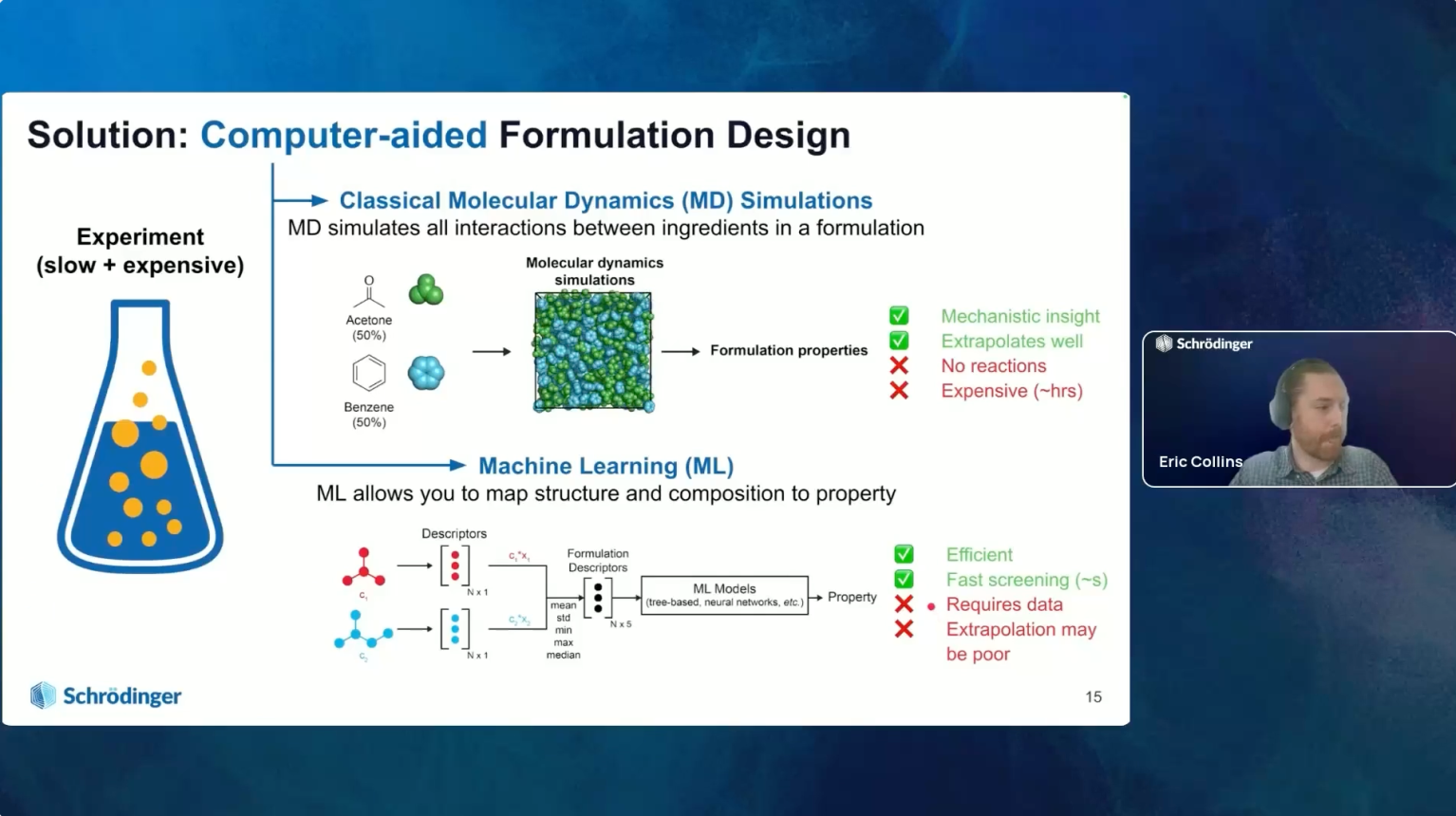
Many R&D teams are hindered from adopting AI/ML due to the complexity of software tools, steep learning curves, and limited data science support. Schrödinger’s Materials Science Suite is designed to address these challenges by providing a unified and easy-to-use AI/ML platform, powered by state-of-the-art ML technology and backed by a dedicated scientific support team.

Join our upcoming webinar to learn how your R&D organization can remove adoption barriers, accelerate discovery cycles, and align with national AI initiatives. In this webinar, we will demonstrate how MS Informatics, Formulation ML, and Formulation Optimization make advanced property prediction, model building, and ML-driven design of experiments simple, fast, and accessible – even for non-experts. We will showcase how easy it is to apply these tools using experimental datasets across broad MS applications, including formulations, consumer goods, batteries, pharmaceuticals, and beyond.

Join us and see live demos on:

  • Training accurate viscosity ML models for binary liquids that can be applied to a variety of material applications
  • Scaling up to complex shampoo formulations, where ML models can be predictive of complicated multicomponent systems and provide suggestions of next best experiments

Who should attend:

  • R&D leaders
  • Innovation managers
  • Digitization managers
  • Synthetic chemists
  • Materials scientists
  • Formulation scientists
  • Computational materials scientists

Our Speaker

Anand Chandrasekaran

Senior Principal Scientist, Materials Science Product and Discovery, Schrödinger

Anand Chandrasekaran joined Schrödinger in 2019 and he is currently the Product Manager of MS-Informatics. His expertise is in applying machine learning to different areas in Materials Science and computational modeling. He graduated from the group of Prof.Nicola Marzari in the Swiss Federal Institute of Technology, Lausanne with a PhD in Materials Science. Before joining Schrödinger, Anand also worked in the group of Prof. Rampi Ramprasad on a number of topics including polymer informatics, machine-learning force-fields, and machine-learning for electronic structure calculations.

「Formulation MLとFormulation ML Optimization:高度な物性予測と実験計画を高速かつ身近なものに ーAI駆動型マテリアルズ・ディスカバリーの加速」

JAN 21, 2026

「Formulation MLとFormulation ML Optimization:高度な物性予測と実験計画を高速かつ身近なものに ーAI駆動型マテリアルズ・ディスカバリーの加速」

AIを活用したマテリアルズ・ディスカバリー(材料探索)は、もはや実験的な取り組みではなく、国家レベルの新たなスタンダードとして定着しつつあります。

先般の米国における「Genesis Mission」の始動により、AI、ハイパフォーマンス・コンピューティング(HPC)、そして統合された科学データインフラを通じた材料探索の加速が、国家的なコミットメントとして打ち出されました。材料イノベーションの最前線に立つR&Dチームにとって、今はまさに計算科学のアプローチ(Computational Workflows)をご自身のパイプラインに統合する絶好の好機と言えます。

しかしながら、多くのR&D現場では、ソフトウェアの複雑さ、習得にかかる学習コストの高さ、そしてデータサイエンス面でのサポート不足といった課題により、AI/MLの本格的な導入が阻まれているのが現状です。

シュレーディンガーの Materials Science Suite は、最先端の機械学習(ML)技術を搭載した、統合型かつユーザーフレンドリーなAI/MLプラットフォームを提供することで、これらの課題を解決します。さらに、専門のサイエンティフィック・サポートチームが皆様を強力にバックアップいたします。

本ウェビナーでは、組織におけるAI導入の障壁を取り除き、研究開発サイクルを加速させ、世界的なAI活用の潮流といかに足並みを揃えていくかについて解説します。

具体的には、MS Informatics、Formulation ML、そして Formulation Optimization を活用し、高度な物性予測、モデル構築、そしてML駆動型の実験計画法(DoE)を、データサイエンスの専門家でなくとも、いかに「シンプルかつ高速」に実行できるかをデモンストレーションします。 また、配合(処方)、消費財、バッテリー、医薬品など、幅広い材料科学分野の実験データセットに対し、これらのツールを容易に適用できることを実例を交えてご紹介します。

【主なデモンストレーション内容】

  • 二成分系液体(Binary liquids)の粘度予測: 高精度な粘度予測MLモデルをトレーニングし、様々な材料アプリケーションへ応用する手法
  • 複雑なシャンプー処方へのスケールアップ: 複雑な多成分系(Multicomponent systems)の挙動をMLモデルで予測し、推奨される「次に打つべき最適な実験(Next best experiments)」を提案するプロセス

※本動画の視聴にあたり、以下の点にご留意ください。

  • 自動翻訳字幕の制限: 本動画の字幕は自動翻訳を用いて生成されています。 専門用語等、不自然な表現や、不正確な訳出が含まれる可能性がございます。
  • 詳細情報の参照: 厳密な背景や詳細については、直接弊社までお問い合わせください。

Our Speaker

Eric M. Collins, Ph.D.

Senior Scientist, Schrödinger