Computationally-Guided Drug Formulation Webinar Series

Webinar

Computationally-Guided Drug Formulation Webinar Series

CalendarDate & Time
  • September 11th, 2024 – May 14th, 2025
LocationLocation
  • Virtual

A smart, strategic drug formulation can efficiently advance your drug development projects and inform downstream processes. Advances in molecular modeling and machine learning are enabling atomistic-level insights and the ability to evaluate large numbers of candidate materials and formulations prior to experiments.

Join us this fall for Computationally-Guided Drug Formulation Webinar Series – seven webinars in which we will explore how the latest computational modeling tools are impacting the various steps in the pharmaceutical formulation process. In each webinar we will feature an expert from Schrödinger sharing valuable insights and practical applications on a key topic. Register for the series to learn how to optimize your formulation process with structure-based insights and efficient parameter screening.

  • May 14, 2025
    Computational insights into polymer excipient selection for amorphous solid dispersions
    Speaker: Andrea Browning, Senior Director for Polymers
    Watch now
  • April 8, 2025
    Accelerating pharmaceutical formulations using machine learning approaches
    Speaker: Anand Chandrasekaran, Senior Principal Scientist
    Watch now
  • November 6, 2024
    Modeling lipid nanoparticles: Self-assembly and apparent pKa calculation
    Speaker: John Shelley, Fellow
    Watch now
  • October 23, 2024
    Crystal structure prediction workflow for small molecule drug formulation
    Speaker: Lingle Wang, Sr. Vice President, Scientific Development
    Watch now
  • October 9, 2024
    Molecular-level insight into solubility-enhancement via cosolvents and amorphous solid dispersions
    Speaker: Ben Coscia, Principal Scientist
    Watch now
  • September 25, 2024
    Computational reactivity and catalysis for drug synthesis
    Speaker: Michael Rauch, Associate Director, Materials Science
    Watch now
  • September 11, 2024
    Characterizing small drug-like molecules with automated computational spectra prediction
    Speaker: Art Bochevarov, Research Leader
    Watch now
Schrödinger デジタル創薬セミナー: Into the Clinic~計算化学がもたらす創薬プロセスの変貌~第12回

Schrödinger デジタル創薬セミナー 12:
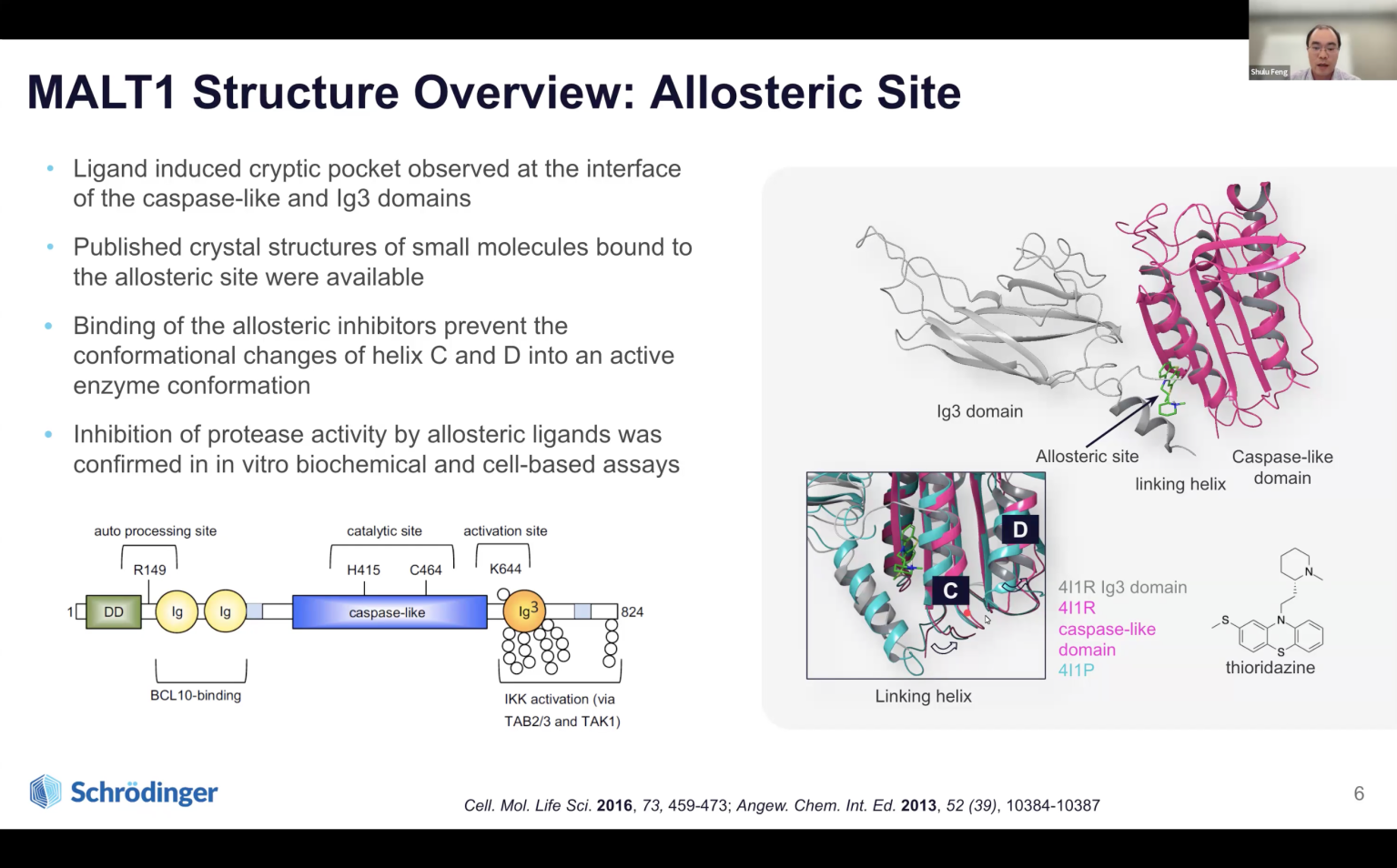
Accelerated In silico Discovery of SGR-1505: a Potent MALT1 Allosteric Inhibitor for the Treatment of Mature B-cell Malignancies

MALT1は、B細胞受容体シグナル伝達経路の重要な構成要素で、核因子カッパB(NF-κB)シグナル伝達を介して一部のB細胞リンパ腫を推進します。MALT1は非ホジキンB細胞リンパ腫や 慢性リンパ性白血病(CLL)の治療ターゲットとされ、特にBTK阻害剤(BTKi)耐性腫瘍に有望です。 シュレーディンガーは、高度な物理学に基づくモデリング技術と機械学習、多パラメータ最適化(MPO)を用いて、強力で経口投与可能なアロステリックMALT1阻害剤SGR-1505を発見しまし た。現在、成熟B細胞新生物を対象としたフェーズ1臨床試験が進行中です。

本ウェビナーでは、このプロジェクトの全容を、最新情報を交えて紹介します。

Our Speakers

Michael Trzoss

Senior Principal Scientist, Schrödinger

Shulu Feng

Principal Scientist II, Schrödinger

CAMX 2024

Conference

CAMX 2024

CalendarDate & Time
  • September 9th-12th, 2024
LocationLocation
  • San Diego, California

Schrödinger is excited to be participating in the CAMX 2024 taking place on September 9th – 12th in San Diego, California. Join us for presentations by Andrea Browning, Director at Schrödinger. Stop by booth G33 to speak with Schrödinger Scientists.

icon time Sept 10 | 2:30 – 2:55
icon location Room 1A
A multi-scale framework to determine effects of moisture and temperature on composite parts using molecular dynamics and finite-element methods

Speaker:
Andrea Browning

Abstract:
Computational approaches help to improve the efficiency of materials product design by understanding the viability of a candidate material without requiring experimentation or testing. Herein, we describe a multiscale simulation framework for understanding how a material’s properties change as a result of its environment using molecular-level models, and then utilizing those properties to determine how composite materials behave using finite-element models. We applied this framework to assess the effects of moisture and temperature and on a model system based on Hexcel Hexply 8552. Using molecular dynamics (MD), along with specialized tools to model crosslinking and moisture uptake, atomistic systems were created and simulated at varying temperatures (hot, room and cold) and varying moisture content at high temperature (dry and wet). At each condition, elastic moduli and coefficients of thermal expansion were determined using dedicated workflows. These condition-dependent moduli and CTEs were then incorporated into representative volume element (RVE) models for a unidirectional (UD) prepreg fabric. An uncertainty analysis was performed to account for microstructural variations in carbon fiber content and alignment. The uncertainty analysis revealed that we were able to predict orthotropic materials properties with an accuracy similar to systematic experimental characterization for Hexcel Hexply 8552 and they lie within the range of variation obtained at room temperature. In addition, a high sensitivity of the transverse and shear moduli to the matrix uncertainty was observed, as would be expected for lamina properties. Effective elastic properties were further upscaled through composite layup modeling into a sub-component level model of a racecar nose. The multiscale solution methodology revealed changes in the structural response of the part that are expected to occur at varying temperature and humidity conditions.

icon time Sept 10 | 4:00 – 5:00
icon location Room 6B
Panel: AI-Driven Innovations: Shaping the Future of Materials Development

Speaker:
Andrea Browning

icon time Sept 11 | 1:00
icon location Booth G33
Live Demo

Speaker:
Andrea Browning

Computational Catalysis at Schrödinger

AUG 6, 2024

Computational Catalysis at Schrödinger

The CSIR in South Africa hosts a national academic license to many of Schrödinger’s modeling software.  Use of these molecular modeling tools are free to registered academics in South Africa.  This webinar will highlight the digital simulation tools specifically for Catalysis & Reactivity.  The topics covered will include:

  • Homogeneous Catalysis

  • Heterogeneous Catalysis

The presentation will also explain how to gain access to these tools, what are the free training options, and details on certified intensive training options.

Our Speaker

Pavel Dub

Senior Principal Scientist, Schrödinger

Pavel A. Dub serves as a Senior Principal Scientist and Product Manager for Reactivity & Catalysis at Schrödinger, Inc. He holds a PhD in Chemistry from the A. N. Nesmeyanov Institute of Organoelement Compounds, as well as a second PhD from the Université de Toulouse. Following two postdoctoral fellowships at the Tokyo Institute of Technology and the Los Alamos National Laboratory, where he later held a position as Staff Scientist, Pavel A. Dub joined Schrödinger, Inc. in 2022. His research endeavors encompass computational chemistry across classical and quantum architectures.

2024 International Elastomer Conference

Conference

2024 International Elastomer Conference

CalendarDate & Time
  • September 9th-12th, 2024
LocationLocation
  • Pittsburgh, Pennsylvania

Schrödinger is excited to be participating in the 2024 International Elastomer Conference taking place on September 9th – 12th in Pittsburgh, Pennsylvania. Join us for a presentation by Manav Bhati, Senior Scientist II at Schrödinger, titled “Design of Elastomers with Tailored Thermal Properties Using Molecular Modeling and Machine Learning.” Stop by booth 918 to speak with Schrödinger scientists.

icon time Sept 11 | 4:30 PM
icon location Expo Hall C
Design of Elastomers with Tailored Thermal Properties Using Molecular Modeling and Machine Learning

Speaker:
Manav Bhati, Senior Scientist II, Schrödinger

Abstract:
Elastomers are integral to industrial applications because of their useful material properties, such as elasticity, durability, and versatility. Innovating new elastomers can lead to the development of superior products that are more durable and stable. A key thermal property of elastomers is the glass transition temperature (Tg), which indicates the temperature at which an elastomer transitions from a glassy/hard state to a soft/rubbery state. Tg is a critical parameter because it determines an elastomer’s operability and performance at various temperatures. Traditional experimental techniques for determining Tg are time-consuming and expensive, necessitating computational approaches to accelerate the design of new elastomers and minimize the failure rate of resource-intensive experimentation. This study focuses on using machine learning (ML) and classical molecular dynamics (MD) simulations to predict the Tg of elastomers. Using curated datasets of experimental Tg values for homopolymers and copolymers from literature, we developed predictive ML models that can accurately predict Tg for new elastomers that are outside of the dataset used to train the model. We then use these ML models to efficiently screen the design space of elastomers by enumerating a large library of copolymer systems. The Tg of the top-performing elastomers were then validated using MD simulations, which have been shown previously to accurately capture the experimental Tg trends of polymer systems. This computational modeling approach not only accelerates the development of new elastomers, but it also provides insights into the relationship between chemical structure and composition to thermal properties.

BIO Europe

Conference

BIO Europe

CalendarDate & Time
  • November 4th-6th, 2024
LocationLocation
  • Stockholm, Sweden

Schrödinger is excited to be participating in the BIO Europe conference taking place on November 4th – 6th in Stockholm, Sweden. Stop by booth 28 to speak with Schrödinger scientists.

European Colloquium on Inorganic Reaction Mechanisms

Conference

European Colloquium on Inorganic Reaction Mechanisms

CalendarDate & Time
  • September 8th-11th, 2024
LocationLocation
  • Toulouse, France

Schrödinger is excited to be participating in the European Colloquium on Inorganic Reaction Mechanisms conference taking place on September 8th – 11th in Toulouse, France. Join us for a presentation by Pavel Dub, Senior Principal Scientist at Schrödinger, titled “Molecular Catalysts Design with Massively Parallel Physics-Based Computational Workflow.”

icon time 14.50 – 15.20 PM CET
icon location Lecture Hall
Molecular Catalysts Design with Massively Parallel Physics-Based Computational Workflow

Speaker:
Pavel Dub, Senior Principal Scientist

Abstract:
The identification of molecular catalysts that offer both high selectivity and reaction rates poses a significant challenge in modern homogeneous catalysis. Traditionally, this process relies on a lengthy and costly trial-and-error approach. Here, we present a groundbreaking digital approach to molecular catalyst design, featuring a computational workflow that can automatically predict both selectivity and turnover frequencies directly from quantum mechanics.

NAMES 2024

Conference

NAMES 2024

CalendarDate & Time
  • August 8th-9th, 2024
LocationLocation
  • Ann Arbor, Michigan

Schrödinger is excited to be participating in the NAMES 2024 conference taking place on August 8th – 9th in Ann Arbor, Michigan. Join us for a workshop by Katie Dahlquist, Senior Scientist at Schrödinger, titled “Empowering Exploration: A Workshop on Molecular Modeling for Materials Science.”

Speaker:
Katie Dahlquist, Senior Scientist, Schrödinger

Date/Time:
Friday, August 9 | 1:30PM – 3:30PM

Abstract:
The Schrödinger Materials Science platform is a single interface with access to structure building, simulation, and analysis for atomic-scale simulation. With respect to simulation, the platform has extensive capabilities in molecular and periodic quantum mechanics (namely density functional theory calculations), molecular dynamics, and machine learning. This workshop will guide participants to work hands-on with the Schrödinger Materials Science platform. We will instruct attendees through parts of two of our online courses which are best-suited for the NAMES audience: Polymeric Materials and Battery Materials.