CRS 2024 Annual Meeting & Exposition

Conference

CRS 2024 Annual Meeting & Exposition

CalendarDate & Time
  • July 8th-12th, 2024
LocationLocation
  • Bologna, Italy

Schrödinger is excited to be participating in the CRS 2024 Annual Meeting & Exposition conference taking place on July 8th – 12th in Bologna, Italy. Join us for a presentation by Irene Bechis, PhD, Senior Scientist at Schrödinger, and Dan Cannon, PhD, Principal Scientist at Schrödinger, titled “Molecular modeling and machine learning for small molecule and biologic drug formulation.”

icon time 2:30 PM – 3:30 PM CET
Molecular modeling and machine learning for small molecule and biologic drug formulation

Given the competitive market and inherent challenges in drug formulation, selecting and combining the right ingredients in the appropriate manner is essential. With advances in machine learning, physics-based simulation and compute hardware, modeling is emerging as a valuable source of information and knowledge to complement experimental characterization.

In this talk, we showcase several case studies illustrating how the tools from the Schrödinger platform can be applied to modeling formulations of small molecule and biologic drugs. Starting from data-driven approaches, we demonstrate how our machine-learning tools can provide an efficient prediction of drug solubility and other important properties of multi-component mixtures. We then describe physics-based approaches to study those complex and evolving structures, often in fluid states, that play a crucial role in the pharmaceutical industry.

For both small molecule and biologics formulations, we have developed powerful simulation tools employing atomistic or coarse-grained models to enable the characterization of molecular interactions and nanoscale structuring. For example, we can address the dissolution of amorphous solid dispersions, the self-assembly of polymer-based structures and the viscosity and aggregation of protein-excipient mixtures. We also present recent work on simulating the self-assembly and calculating the apparent pKa values of lipid nanoparticles used in the delivery of mRNA.

Irene Bechis, PhD

Senior Scientist, Schrödinger

Dan Cannon, PhD

Principal Scientist, Schrödinger

TechConnect World

Conference

TechConnect World Innovation

CalendarDate & Time
  • June 17th-19th, 2024
LocationLocation
  • Washington, DC

Schrödinger is excited to be participating in the TechConnect World Innovation conference taking place on June 17th – 19th in Washington, DC. Join us for a presentation by Alex Chew, Principal Scientist at Schrödinger, titled “Leveraging Physics-Based Simulations and Machine Learning to Identify Promising Formulations for Materials Science Applications.” Stop by booth #730 to speak with Schrödinger scientists.

icon time 1:30 PM
icon location Session AI Modeling & Simulation
Leveraging Physics-Based Simulations and Machine Learning to Identify Promising Formulations for Materials Science Applications

Formulations – or a mixture of chemical ingredients – are ubiquitously found across material science applications, such as copolymer blends, consumer packaged goods, and energy storage devices. These mixtures consist of multiple chemical species with known compositional information, but their bulk properties are challenging to predict because they emerge from non-obvious intermolecular interactions arising between multiple species that heavily depend on both molecular structure and composition. Trial-and-error experimentation to optimize these formulations is cost-prohibitive because of the large chemical design space that is exacerbated by the tunability of their compositions. Computational approaches that could traverse the expansive design space offer a promising alternative solution to finding better formulations. Physics-based approaches, such as classical molecular dynamics simulations (MD), could accurately predict formulation properties by accounting for all possible interactions between multiple molecules. However, rapid screening with MD remains challenging due to its computational cost, which motivates the use of data-driven approaches to more efficiently screen the formulation design space. Given the lack of publicly available datasets, we generate a large formulation dataset from physics-based simulations consisting of more than 30,000 solvent mixtures that were selected based on experimental solubility tables. We then benchmark descriptor-based and graph-based molecular representations, as well as a variety of machine learning architectures, to identify accurate formulation-property relationships that could predict formulation properties given individual molecular structures and compositions as input. Given the large design space of chemistries and compositions, we leverage an active learning framework to iteratively suggest the next best compounds or compositions to test starting with a small dataset (~100 examples). Leveraging physics-based simulations to curate a formulation dataset and the development of accurate formulation-property relationships enables us to rapidly identify promising formulations for a wide range of materials applications, such as liquid electrolytes for batteries, copolymers for surface coating, solvent additives for perfumes or paints, and more.

 Japan Drug Discovery Summit 2024


Conference

Japan Drug Discovery Summit 2024

CalendarDate & Time
  • July 18th, 2024
LocationLocation
  • Tokyo, Japan

本会は、18日(金)、会場で開催します。
新規テクノロジーの開発状況を始め、実際の創薬プロジェクトでの活用事例を、国内外のユーザー様からのご発表を含めてご紹介いたします。
多くの皆様のご参加を心よりお待ちしております。

 各発表のアブストラクトはこちらからご覧いただけます。 

icon time 10:00AM – 10:10AM
ご挨拶

icon time 10:10AM – 11:10AM
The Predict-First paradigm: How Digital Chemistry is Shaping the Future of Drug Discovery

Aleksey Gerasyuto, Vice President, Drug Discovery, Head of Chemistry, Schrödinger

icon time 11:15AM – 0:00PM
創薬研究の初期における、タンパク質立体構造を核とした戦略的アプローチ

アステラス製薬株式会社 開発研究部門 ディスカバリーインテリジェンス 主管研究員 天野 靖士様

icon time 0:00PM – 1:00PM
ランチ

icon time 1:00PM – 1:45PM
Leveraging Physics-based Computational Approache s for the Discovery of Highly Novel and Potent NLRP3 Inhibitors

Andrew Placzek, Principal Scientist, Schrödinger

icon time 1:50PM – 2:35PM
Leveraging the Ongoing Revolutions in Machine Learning and Physics-Based Modeling to Expanded Impact in Small Molecule and Biologics Drug Discovery

Matt Repasky, Senior Vice President, Schrödinger

icon time 2:40PM – 3:25PM
In Silico Enabled Hit Identification with the Schrödinger Platform: Case Studies in EGFR and DLK Inhibitor Drug Discovery Programs

Hideyuki Igawa, Director, Therapeutic Group, Schrödinger

icon time 3:25PM – 3:50PM
休憩

icon time 3:50PM – 4:35PM
Exploiting Computational Tools in the Design of First-in-class Small-molecule Inhibitors of SARS-CoV-2 NSP14 Guanine-N7 RNA Cap Methyltransferase

David J. Huggins, Executive Director, Computational Biomedicine Sanders Tri-Institutional Therapeutics Discovery Institute, Bronk Laboratory

icon time 4:40PM – 5:25PM
武田薬品におけるAI/MLを利用した創薬化学研究の事例

武田薬品工業株式会社、リサーチ ニューロサイエンス創薬ユニット NCEプロダクション研究所 髙木 輝文様

icon time 5:25PM – 5:35PM
閉会

icon time 5:45PM – 7:45PM
懇親会

※海外からの講演者は英語での発表となります。
※Presentations by Japanese speakers are available in Japanese only. 

【開催形式と会場】
・現地開催です。オンライン配信はございません。
会場
18日 ドラッグディスカバリー サミット
〒104-0031 東京都中央区京橋2-1-3 京橋トラストタワー4階 トラストシティ カンファレンス・京橋

※会場参加の登録受付は7月10日(水)23:59までといたします。
※会場の収容可能人数には限りがあり、登録受付期日前であっても、上限に達し次第締め切りとなります。お早めにお申し込みください。
※会場参加者様へは、別途メールにて詳細をご案内いたします。 

【参加費】
無料 

【お申込み方法】
▼参加のお申し込みはこちらから▼
https://form.run/@schrodinger-202407DDS 

所属企業または所属機関のメールアドレスにて、ご登録をお願いします。
所属が明らかでない、また、個人メールアドレスでご登録の場合などは、出席をご遠慮いただく場合がございますのであらかじめご了承ください。参加お⼀人様につき⼀登録をお願いします。
同業他社さまには参加をご遠慮頂いております。申し訳ございませんが、ご理解のほど宜しくお願い致します。 

※ご質問、ご不明な点がございましたら下記までお問い合わせください。
シュレーディンガー株式会社
E-mail: info-japan@schrodinger.com 

The Battery Show Europe

Conference

The Battery Show Europe

CalendarDate & Time
  • June 18th-20th, 2024
LocationLocation
  • Stuttgart, Germany

Schrödinger is excited to be participating in The Battery Show Europe conference taking place on June 18th – 20th in Stuttgart, Germany. Join us for a presentation by Leonie Koch, Principal Application Scientist at Schrödinger, titled “A digital chemistry strategy to accelerate the design of novel battery technologies.”

icon time 10:30 AM – 10:45 AM
icon location Open Tech Forum
A digital chemistry strategy to accelerate the design of novel battery technologies

Leonie Koch, Principal Application Scientist, Schrödinger

Abstract: 
The battery market has become a critical economic sector within the automotive industry, demanding for improved, reliable, and lower cost solutions. Physics-based modeling and machine learning can significantly accelerate electrolyte selection and characterization, ensuring that target properties are met. In this presentation, we will show how Schrödinger’s  digital chemistry technology can catalyze selection processes by predicting key properties of battery electrolytes, using physically relevant descriptors, and the application of machine learned force fields to overcome the current limitations of ab-initio density functional theory calculations for getting insights into the nucleation and dynamic evolution of the complex solid electrolyte interphase (SEI) in next-generation battery technologies.

Maestro Viewer

Maestro Viewer

Maestro Viewer

A powerful molecular visualization tool offered free to academia

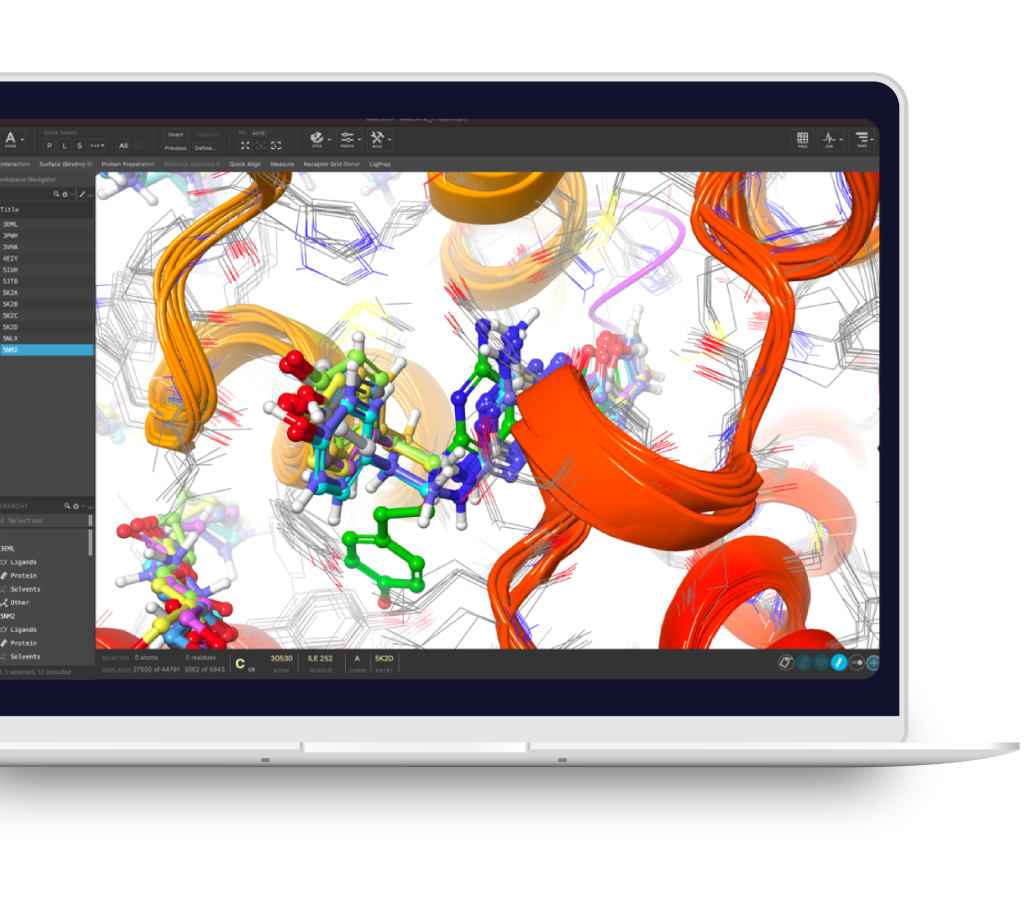
Maestro Viewer is an intuitive interface for academic users to visualize and manipulate 3D structures using Schrödinger’s powerful rendering capabilities and chemical building tools. Maestro Viewer provides academic users the opportunity to gain familiarity with the Maestro interface and its visualization capabilities.

Maestro Viewer does not include access to molecular property predictions or the ability to run molecular simulations and is only available with an academic account.

What you can do with Maestro Viewer

  • Visualize and manipulate 3D structures
  • Gain an introduction to the Maestro interface
  • Load and view most pre-run simulation results from Maestro
  • View applications and workflows available in Maestro
 

Ready to explore the full potential of Schrödinger tools?

Maestro is a powerful molecular modeling environment for accessing cutting-edge physics-based molecular simulation workflows, state-of-the-art machine learning, and advanced structure visualization. 

Academic Site License

Expand your access with large scale, university-wide access to Schrödinger software. Perform cutting edge research and train the next generation of scientists at your university with Schrödinger’s most comprehensive set of large-scale software licenses, spanning life science and materials science applications.

Schrödinger Materials Science Seminar Japan 2024 

Webinar

Schrödinger Materials Science Seminar Japan 2024

CalendarDate & Time
  • June 4th-7th, 2024
LocationLocation
  • Virtual

《無料Webセミナー》材料開発向けシミュレーション·ソフトウェアおよびマテリアルズ·インフォマティクスの活用事例を紹介

半導体や電子部品から日用品に至るまで、あらゆる材料開発において、計算化学は近年では欠かせない基盤技術の一つとしてその存在を確立しつつあります。

シュレーディンガーは、1990年の会社創立以来、分子設計向けソフトウェアとインフォマティクスの機能強化に継続的に取り組み、様々な材料開発の効率化への実用的なソリューションとして提供しています。

この度、これらのソフトウェアを活用した事例をご紹介するセミナーを開催します。

シミュレーションや機械学習のご経験がある方はもちろん、これから手掛けるという方にもご満足いただける内容になっております。

ご興味のあるセッションのみの聴講も大歓迎ですので、ぜひお気軽にご参加ください。

各発表のアブストラクトはこちらからご覧いただけます。

icon time ⽇本時間10:00AM – 11:00AM
Advancing Polymer Design and Analysis through Integrated Machine Learning and Molecular Modeling Techniques

Mohammad Atif Faiz Afzal, Ph.D., Principal Scientist, Schrödinger

icon time ⽇本時間11:00AM – 12:00AM
可視光応答型の水分解光触媒に向けた新規チタン酸窒化物化合物の探索

シュレーディンガー株式会社 シニア サイエンティスト 青木 祐太(博士(理学))

icon time ⽇本時間10:00AM – 11:00AM
Accelerating the innovation of next generation cosmetics and food products through computational chemistry

Haidong Liu, Ph.D., Senior Scientist II, Schrödinger

icon time ⽇本時間11:00AM – 12:00AM
Automated Digital Prediction of Chemical Degradation Products

Pavel A. DUB, Senior Principal Scientist, Schrödinger

icon time ⽇本時間5:00PM – 6:00PM
Efficient computation of process parameters for controlling the chemistry of deposition or etch – atomic-scale mechanism, thermodynamic competition and microkinetic modelling

Simon D. Elliott, Ph.D., Director – Atomic level process simulation, Schrödinger

icon time ⽇本時間10:00AM – 11:00AM
Leveraging Schrödinger’s Digital Chemistry Platform for Accelerated Development of Next-Generation Battery Materials

Garvit Agarwal, Ph.D., Scientific Lead, Energy Storage, Schrödinger

icon time ⽇本時間11:00AM – 12:00AM
全固体電池の負極保護膜についての解析

シュレーディンガー株式会社 シニア サイエンティスト 井本 文裕(博士(工学))

icon time ⽇本時間10:00AM – 11:00AM
データ駆動型材料研究のための計算プラットフォームLiveDesign

シュレーディンガー株式会社 ストラテジック デプロイメント マネージャー 石崎 貴志(博士(理学))・シニア ソリューション アーキテクト 山田 淳美

icon time ⽇本時間11:00AM – 12:00AM
Materials Science Suiteに含まれる有機EL材料開発のためのプログラム紹介

シュレーディンガー株式会社 シニア サイエンティスト 大塚 勇起(博士(工学))

【セミナー形式】
Zoom webinarを使⽤したオンライン形式
海外からの講演者は英語での発表となります。
※Presentations by Japanese speakers are available in Japanese only.

【お申込み⽅法】
参加のお申し込みはこちらから▼
https://schrodinger.zoom.us/webinar/register/WN_dbPy5O52RASAIqAp1xfJcQ#/registration

所属企業または所属機関のメールアドレスにて、ご登録をお願いします。
所属が明らかでない、また、個⼈メールアドレスでご登録の場合などは、出席をご遠慮いただく場合がございますのであらかじめご了承ください。参加お⼀⼈様につき⼀登録をお願いします。アクセスリンクの共有はご遠慮ください。
当⽇は、お申し込みの際に登録いただいた⽒名·メールアドレスにてご参加ください。
同業他社さまには参加をご遠慮頂いております。申し訳ございませんが、ご理解のほど宜しくお願い致します。

ご質問、ご不明な点がございましたら下記までお問い合わせください。
シュレーディンガー株式会社
E-mail: info-japan@schrodinger.com

DDF Summit 2024

Conference

DDF Summit 2024

CalendarDate & Time
  • May 21st-23rd, 2024
LocationLocation
  • Berlin, Germany

Schrödinger is excited to be participating in the DDF Summit taking place on May 21st – 23rd in Berlin, Germany. Join us for a presentation by John Shelley, Fellow at Schrödinger, titled “Molecular Modeling and Machine Learning for Small Molecule and Biologic Drug Formulation.”

Speaker

John Shelley

Fellow

John earned a MSc from the University of Waterloo in theoretical chemistry and a PhD from the University of Pennsylvania in computational chemistry.  Following post-doctoral research in computational chemistry at the University of British Columbia, he worked for Procter & Gamble studying surfactant structures in solution.  For the last 23 years, John has worked for Schrödinger, LLC, as a scientific software developer and a research scientist, managing a number of products including the Materials Science Coarse-Grained product.  John has focused on computer modeling of drug formulations for much of the last 8 years.

Abstract:

Selecting and combining the right ingredients in the appropriate manner is essential for successful drug formulation given the inherent challenges and competitive market. With advances in modern machine learning, physics-based simulation techniques and computer hardware, modelling is emerging as a valuable source of information that complements experimental characterization.  We showcase a cross-section of capabilities within Schrödinger’s Suite for modeling related to formulations of small-molecule or biologic drugs.
For small-molecule drugs workflows have been created for characterizing crystal polymorphs, crystal morphology and degradation risks as well as calculating elastic constants (bulk modulus, shear modulus, etc.), powder diffraction patterns, glass transition temperatures (Tg), diffusion constants, pKa values, melting points, water adsorption and various solubilities. For biologics our toolset supports homology modeling, and the calculation of aggregation propensity, titration curves, isoelectric points and viscosity among other things.
Complex and evolving structures, often in fluid states, play a crucial role in the pharmaceutical industry.   For both small-molecule and biologics formulations powerful simulation tools employing atomistic or coarse-grained models to permit the characterization of molecular interactions and nanoscale structuring, sometimes within otherwise disordered bulk systems (e.g., LNP formation, self-assembly of polymer-based structures, dissolving amorphous solid dispersions, liposomes and protein-excipient interactions).

Key Learning Objectives:

  • Advances in crystal structure prediction
  • API and excipient physical and chemical property prediction from molecular modeling and machine learning
  • Molecular modeling for lipid nanoparticles
  • Molecular modelling provides data and a basic understanding of the behaviour of drug formulations that compliments experimental data and machine learning to inform decision making

SID Display Week

Conference

SID Display Week

CalendarDate & Time
  • May 12th-17th, 2024
LocationLocation
  • San Jose, California

Schrödinger is excited to be participating in the SID Display Week conference taking place on May 12th – 17th in San Jose, California. Stop by booth 1634 to speak with Schrödinger scientists.

Join us for a free workshop day on May 15th in Meeting Room 213. Schrödinger experts will walk you through guided demos and help you gain hands-on experience using digital simulations to expedite your organic electronics R&D. Register for the workshop here.

icon time May 16 | 11:40 AM – 12:10 PM
icon location Exhibit Hall Center Stage
Revolutionizing Organic Electronics: Computational Insights and Innovations in OLED Materials Design

Speaker: Hadi Abroshan, Principal Scientist, Schrödinger

icon time May 17 | 10:00 AM – 10:20 AM
icon location San Jose Convention Center, LL21CD
Digital Chemistry, Data Processing, and Collaborative Ideation for Development of OLEDs

Speaker: Hadi Abroshan, Principal Scientist, Schrödinger

Abstract: Empowered by digital chemistry and informatics platforms, this study highlights the transformative impact of physics-based simulation, machine learning, and data management in display industry R&D. This technology integration accelerates ideation and decision-making, ensuring swift, accurate, and cost-effective development for next-generation display devices.

FEP+ Protocol Builder

FEP+ Protocol Builder

ML-powered optimization of FEP+ models for challenging targets

FEP+ Protocol Builder

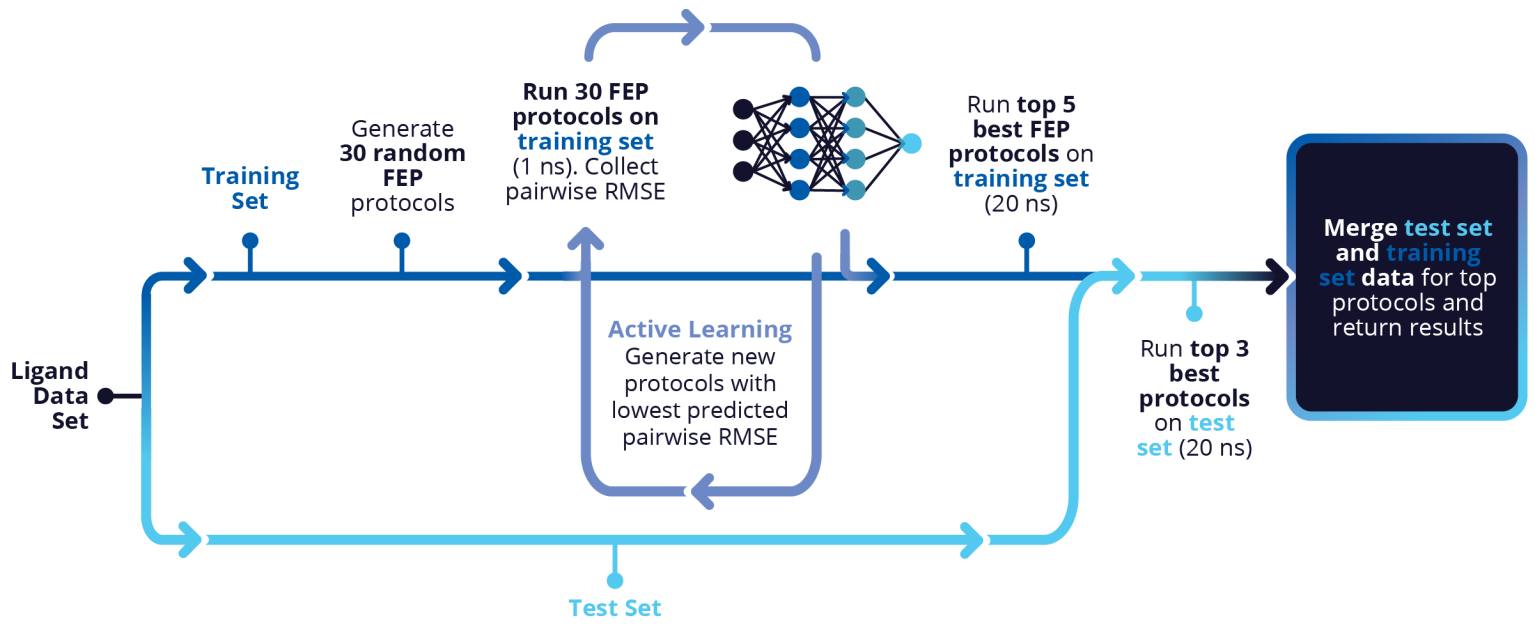
FEP+ Protocol Builder is an automated machine learning workflow for FEP+ model optimization. It saves scientists time and improves the chances of successfully enabling discovery with FEP+ by identifying an optimized predictive model for your target.

Improve FEP+ accuracy with physics-driven machine learning for the most challenging targets to confidently use FEP+ prospectively in your program

Reduce compute cost across the lifetime of your project with automated cost optimization of FEP+ models

Generate optimized FEP+ models 4x faster than manual optimization, saving weeks of researcher time across diverse disease areas through efficient exploration of parameter space

Expedite FEP+ use for challenging systems with a fully automated workflow

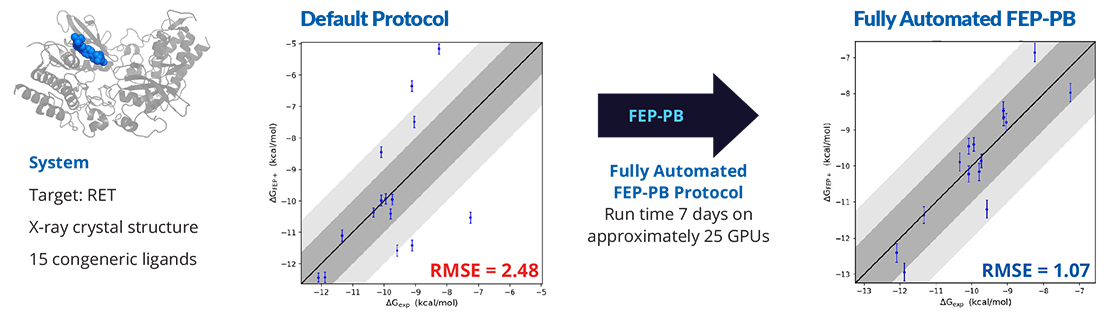
Fully automated FEP+ Protocol Builder generated optimized FEP+ protocol with improved pairwise RMSE compared to default model. All protocols were performed with the same 15 congeneric ligands with modifications at 2 R-groups with known affinity data from PDB ID: 2IVV. FEP+ Protocol Builder was applied to quickly and rigorously validate the amenability of the target to the Schrödinger platform.

Workflow Description Library Size Time to screen 4.0B (days) Time to screen 6.5B (days) Storage space for 6.5B (TB)
Quick Shape Combination of 1D-SIM* prefilter and Shape CPU Screening > 4.0 billion 5.2 5.5‡ 0.4
Shape GPU GPU-accelerated 3D screening < 5.0 billion 4.6 7.5‡ 33
Shape CPU CPU-based 3D screening < 10 million NA NA NA

FEP+ Protocol Builder models routinely outperform those from human experts across diverse protein targets

In a recent study, FEP+ Protocol Builder outperformed human experts in producing a predictive model across ten diverse targets where default FEP+ settings did not produce an appropriately accurate protocol (RMSE > 2.5 kcal/mol) and were able to generate FEP+ models for systems where experts failed.

FEP+ Protocol Builder was run in a completely automated fashion following a rigorous training/test set split. On average, the reduction in turnaround time for the final optimization model went from 27 days to 7 days, a 4x acceleration, saving on average 20 days per project.

Disease area Target class Target Expert Protocol RMSE (kcal/mol) FEP+ Protocol Builder RMSE (kcal/mol)
Oncology Bcl-2 MCL1 1.5

1.1

Neurology ATPase P97 1.3

1.0

Oncology Nuclear receptor ESR1 3.1

2.0

Pain, addiction, oncology GPCR mOR 2.4

2.2

Pain, addiction GPCR dOR 2.2

1.3

Hematology, oncology ADP-ribosyltransferase TNKS2 2.2

1.1

Pain, addiction, neurology GPCR KOR 2.1

1.7

Renal Aspartic protease Renin 1.8

1.6

Oncology and rheumatology Cysteine protease MALT1 2.5

1.5

Oncology Receptor tyrosine kinase RET 1.9

0.8

Webinar

Expediting FEP+ model optimization for challenging systems with a fully automated, machine learning-driven workflow

FEP+ is a powerful predictive technology in drug discovery – with applications from hit discovery through lead optimization. A critical first step in deploying FEP+ is to validate and optimize the model for the protein-ligand system of interest.

Watch Webinar

Machine learning driven FEP+ Protocol Builder workflow

Recommended inputs
  • One experimentally resolved protein-ligand structure or a computationally generated protein-ligand binding mode hypothesis
  • 10 or more congeneric ligands, ideally 20 for better statistics, are needed. The ligands should have known affinity data spanning at least two to three orders of magnitude
  • FEP+ Protocol Builder is bundled with FEP+ and requires a minimum of 20 licenses for optimal use
Available as software or a service
  • Leverage your internal resources or work with Schrödinger’s team of experts and large-scale computational resources to optimize your next FEP+ model.

Publications

  1. FEP+ Protocol Builder: Optimization of free energy perturbation protocols using active learning

    de Oliveira C, et al. J. Chem. Inf. Model. 2023, 63, 17, 5592–5603.

  2. Advancing drug discovery through enhanced free energy calculations

    Abel R, et al. Acc. Chem. Res. 2017, 50, 7, 1625–1632.

  3. Accurate and reliable prediction of relative ligand binding potency in prospective drug discovery by way of a modern free-energy calculation protocol and force field

    Abel R, et al. J. Am. Chem. Soc. 2015, 137, 7, 2695–2703. 

Release 2024-2

Library Background

Release Notes

Release 2024-2

Small Molecule Drug Discovery

Platform Environment

Maestro Graphical Interface

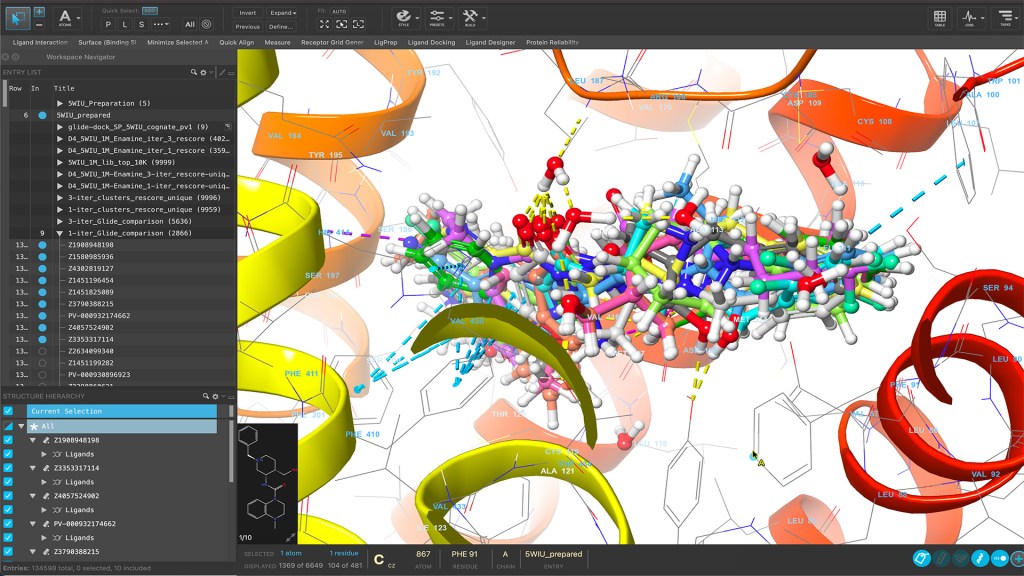
  • Dynamically display measurements based on selected atoms in the Status Bar
  • Copy fragments from existing molecules in the 3D Workspace and paste them onto selected atom(s) in another molecule
  • Export movies from the Trajectory Viewer with the Workspace resolution
  • Search in the Entry List using regular expressions for greater precision. Simultaneously search for multiple structures
  • Aligned pharmacophore label font with Maestro font preferences
  • Display T-cell receptor annotations in the Structure Hierarchy
  • Automatic synchronization of data point selection in scatter plots with Project Table selections and/or Workspace inclusion
  • Display data from different groups in a single scatter plot

Force Field

  • New OPLS5 Force Field (beta): Significant improvement in the accuracy of cation-pi and ionic group interactions via the addition of limited polarizability in relative binding-FEP+ and Desmond. Available as a new option alongside the default OPLS4

Workflows & Pipelining [KNIME Extensions]

  • Supports the latest version of KNIME (v5.2)
  • The Chemistry external tool node supports a new FEP+ column type that points to fmp files read by the FEP+ reader node

Binding Site & Structure Analysis

SiteMap

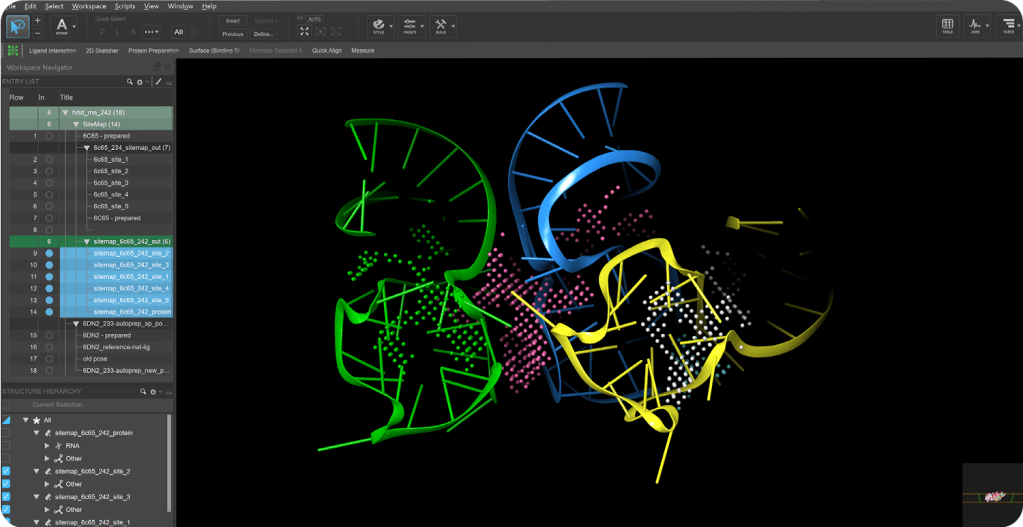
  • More accurate identification of RNA binding sites with 89% of RNA sites in HARIBOSS set now identified as the top-ranked binding site by SiteMap, up from 69% previously (beta)
  • New SiteMap parameters to separate large pockets that are bleeding into one another or across the protein surface and identify smaller distinct sites (command line only)

Mixed Solvent MD (MxMD)

  • Support for membrane systems

Hit Identification & Virtual Screening

Ligand Preparation

Active Learning Applications

  • Enhanced diversity selection in AL-Glide through consideration of up to 3x more compounds by horizontal scaling of diversity selection
  • Significantly improved LigandML prediction throughput in AL-Glide through use of ZMQ (command line only) (beta)
  • Much faster file uploading to the DriverNode in AL-Glide (command line only) (beta)

Ligand Docking

  • Improved pose-prediction and enrichment when docking small molecules into RNA receptors with Glide (beta)

Lead Optimization

FEP+

  • Support setting up Positional Restraints in RB-FEP via FEP+ panel
  • Ability to use OPLS5 for Increased RB-FEP Accuracy
  • Improved Trajectory Management allowing trajectories from multiple edges in PT

Protein FEP

  • Support of Multi-Site Mutations for Thermostability prediction

Constant pH Simulations

  • Support of Lys pKa Calculations with panel support

Solubility FEP

  • Improved Trajectory Visualization
  • Link to Best Practices document
  • Support of Force Field Builder from Web Service

FEP Protocol Builder

  • Use FEP Protocol Builder to quickly identify FEP+ model parameters that optimize FEP+ accuracy using an automated machine learning-driven workflow
    • Free researcher time by letting the FEP Protocol Builder explore parameter space to identify and visualize optimal parameters for FEP+ model performance
    • Find FEP models for challenging systems through efficient exploration of parameter space
    • Proceed with confidence to use FEP+ prospectively in your program
    • Interface to set up FEP protocol optimization calculations with automated assignment of ligands into test/training sets
    • Interface to analyze influence of parameters on FEP model performance and compare protocol performance via FEP+ correlation plots

Quantum Mechanics

  • Perform wave function stability analysis in Jaguar
  • Generate NMR chemical shifts and spectra of 19F isotope with Jaguar Spectroscopy
  • Set multiplicity automatically (multip=2) if an odd number of electrons are found in Jaguar
  • Search for atropisomers using the new rotation_barriers.py script (command line only)
  • More robust and performant E-sol workflow suitable for LiveDesign and command line execution 
  • Modify level of theory and basis sets of multiple entries with a right mouse click

Medical Chemistry Design

Ligand Designer

  • New Ring Swapping workflow to optimize lead compounds by exploring alternative ring scaffolds (beta)

Biologics Drug Discovery

  • Added 430 new non-natural amino acids to the library for use in peptide design
  • Interface improvements to speed analysis of protein mutation results produced by residue scanning
  • Analyze structural ensembles such as PIPER docking results and MD trajectories  with Protein-protein interaction analysis panel (open beta)
  • New option to specify one of five numbering schemes, Chothia, Kabat, IMGT, Enhanced Chothia or AHo, when performing antibody structure alignment using the align_antibody.py script

Materials Science

GUI for Quantum ESPRESSO

Product: Quantum ESPRESSO (QE) Interface

  • Input for magnetization from structure data (command line)
  • Results viewer for solid state NMR spectra
  • NEB Convergence Monitor: Display of relative / activation energies
  • Automatic shift of K-point grids for improved convergence
  • Option to compute and visualize potential surfaces in the workspace
  • Phonon Density of States Viewer: Support for dielectric constant
  • Speed-up of NEB calculations with smart management of wave function data

KMC Charge Mobility

Product: MS Mobility

  • Compute KMC Charge Mobility: Charge transfer computed based on center-of-mass distances

Materials Informatics  

Product: MS Informatics

  • Formulation ML: Support for input data with missing component names / SMILES
  • Formulation ML: Support for Set2Set and graph-based models and descriptors added
  • Formulation ML: Option to remove highly-correlated descriptors (command line)
  • Formulation ML: Option to control the training set size
  • Formulation ML: Support for classification mode
  • Formulation ML: Feature-importance analysis based on Shapley additive explanations (SHAP)
  • Machine Learning Property: Improvements in prediction models available for download
  • Machine Learning Property: Prediction of oxidation and reduction potentials
  • MD Descriptors: Support for formulations-focused descriptors

Coarse-Grained (CG) Molecular Dynamics

Product: MS CG

  • Coarse-Grained Force Field Builder: Automatically map atomistic systems to Martini particles (command line)
  • Coarse-Grained Force Field Builder: Fit Martini parameters (command line)

Reactivity

Product: MS Reactivity

  • Nanoreactor: Improved default settings
  • Nanoreactor: Speed-up of xTB frequency calculations
  • Nanoreactor: Improved deduplication algorithm for products
  • Nanoreactor: Improved parallelization algorithm
  • Nanoreactor: Option to remove high-energy products
  • Nanoreactor: xTB free energy used to rank-order products
  • Auto Reaction Workflow: Prevention of excessive equilibrium constant calculations from permutations

Microkinetics

Product: MS Microkinetics

  • Microkinetic Modeling: Support for the use of analytical Jacobian
  • Microkinetic Modeling: Option to specify collision factor
  • Microkinetic Modeling: Results returned for cases that did not reach a steady state
  • Microkinetic Modeling: Option to list chemical equations from the input reaction network

Reactive Interface Simulator

Product: MS RIS

  • Solid Electrolyte Interphase: Reaction-template based solution for dynamic simulations of materials systems near battery electrodes

MS Maestro Builders and Tools

  • Density Profile: Visualization of density isosurfaces
  • Complex Builders: Option to clean up geometry using xTB
  • Semicrystalline Polymer: Support for polyvinyl alcohol (PVA)
  • Solvate System: Protocol to manage output with more than 2M atoms
  • Structured Liquid: Protocol to manage output with more than 2M atoms
  • Structured Liquid: Improved and expanded built-in lipid library

Classical Mechanics

  • Thermal Conductivity: Solution to predict thermal conductivity of solids

Quantum Mechanics

  • Adsorption Enumeration: Improved algorithm to define surface atoms
  • Adsorption Enumeration: Heavy-atom filter for reactive atoms
  • Amorphous NMR: Isosurface data available from QM calculations


Education Content

Life Science

  • New Tutorial: Ligand Binding Pose Prediction for FEP+ using Core-Constrained Docking (NEW)
  • New Tutorial: Ligand-Based Virtual Screening Using Phase (large-scale rework from the ground up)

Materials Science

  • New Tutorial: NMR Spectra Prediction
  • New Tutorial: Thermal Conductivity
  • New Tutorial: Solid Electrolyte Interphase Calculations
  • New Tutorial: Building a Semicrystalline Polymer
  • Updated Tutorial: Machine Learning for Formulations
  • Updated Tutorial: Update tutorials for switch to RDKit (affects multiple tutorials)

LiveDesign

What’s New in 2024-2

  • Biologics Support
    • Upload peptides, monoclonal antibodies, bispecific antibodies, Fab, Fab2, Fv, DNA, and RNA
    • Biologics automatically get broken down into their component chains and can be visualized in composite rows
    • View and align sequences in a sequence viewer
    • Upload experimental data and metadata
    • View 3D model results and apply styling
    • View antibody hierarchy in 3D visualizer and select and style at full biologic, domain (ex: VH, CH1), subdomain (ex: HCDR3), or residue level
    • Full support within Models, MPOs, Formulas, Freeform columns, Forms, Tile View, Filters, and Search
    • Search and Filter for Biologics based on the properties of their chains
  • Updated User Management in the Admin Panel
    • See and update all Users’ ACL and details on single page
    • Quickly add and remove multiple users at once
    • Bulk update user roles, projects, license status
    • Create a project and add users, groups, admins to the project on single page
    • Project and Group details pages give clearer statistics on users and access control flow
    • Choose to send or resend a welcome email on updates
    • Sync users between LiveDesign and externally hosted, read-only LDAP, to pre-populate users before their first login
  • One-click to view 3D model results in Maestro: Click a link in a 3D model cell to automatically open Maestro and view the result. Note that this only works in Windows, using Maestro version 24-2; Mac and Linux support are forthcoming in Maestro’s 24-3 release
  • Structure Groupings for the 3D Visualizer
    • Group any number of 3D outputs in a single structure group, beyond the historic Ligand + Protein combination
    • Add custom group titles to change the displayed column title
    • View multiple ligand poses or protein poses in the 3D visualizer content panel
  • Control Display styles in Ligand Designer
    • Style selected atoms, resides, and chains from a new toolbar within the 3D canvas in Ligand Designer
    • Apply custom styling to Proteins and Ligands within a Ligand Designer session
    • Use 3D tools within Ligand Designer, such as export, zoom, and screenshot
  • Complex Filters: Combine filter conditions using AND or OR logical operators
  • Published Limited Assay Columns: Publish limited assay columns so they appear in the Data & Columns tree, and are available for use in published column-as-parameter models, MPOs, and published formulas
  • Pinned Rows: Click a button on a row or a Tile to “pin” the compound to the top of the LiveReport
  • UX Improvements
    • Forms
      • Toggle the number of tiles to show in each row in a Kanban widget
      • Freeform column cells now render larger editing areas in the Matrix Widget when the cells are small
    • Plots
      • Plot can’t be created or edited in read only LRs
      • Delete plots directly from the visualize panel, without opening them first
      • Search for columns in plot axis selection dropdowns
    • Spreadsheet interactions
      • Freeze multiple columns at once via the column menu
      • Double-click on a Freeform column cell to edit its value
      • The Run button for click-to-run models is now displayed as a solid color
      • Right-click on a LiveReport tab to reveal the LiveReport menu
    • 3D Visualizer
      • Downloaded files from the 3D visualizer now show the same labels in Desktop PyMOL instead of hashed values
      • Binding Site Interaction Map is turned off by default when opening a Ligand Designer session
    • Miscellaneous
      • The login page now allows submitting either Single sign-on or username + password credentials
      • Export the Tile View configuration to PPTX using LDClient
      • Archive a model without fixing errors in the model settings
      • The Job Manager gadget table now resizes as the tool is resized
      • Click Help icons in the Create Freeform Column dialog, Create Formula column dialog, and the Define New
      • Multi-Parameter Optimization dialogs to navigate directly to the user manual
      • Click an icon within the Data & Columns Tree LiveReport tab to scroll to the column in the LiveReport
      • Drag and add multiple scaffolds to the R-group enumeration scaffold sketcher
  • TaskEngine workers now scale up when the number of submitted jobs increases
  • The Schrodinger Suite python method “from schrodinger.structure import SDReader” has been deprecated, and scripts should instead call “from schrodinger.structure import StructureReader”

What’s Been Fixed

  • The Landing Page Overview would occasionally fail to show the most recently added compounds, and now correctly shows them
  • Columns that are added to LiveDesign via the Data Integrator are now set to the correct datatype
  • LiveReports no longer show duplicate rows for a Real and a Virtual after uploading experimental data via ACAS
  • LiveDesign now correctly opens the most recently opened Project and LiveReport after logging in
  • Users can now log out of LiveDesign when Single Sign-On is enabled
  • Freeform column picklist options order would previously change, and is now maintained according to the configuration set within the Edit Freeform Column dialog
  • Duplicating a LiveReport with many unpublished assay data points is now up to 6x faster (duplicating LiveReports with fewer unpublished assay data points will experience less of a speed up)
  • Pasting specific LiveReport URL into the browser would occasionally redirect to the Project Picker, and now correctly opens the LiveReport
  • Security
    • CVE-2023-44487 has been patched
    • Sessions cookies are now marked Secure
  • Admin Panel
    • Uploading a file in the Admin Panel now works correctly when the filename is identical to the file that is being replaced
    • The Last Modified Date shown in the Admin Panel’s Protocol page and Protocol List page now correctly updates for all changes to the Protocol
    • The “Last Login” date field within the Admin Panel’s User page now correctly updates
    • Parameterized models could not be modified in the Admin Panel after creation, and now can be modified (e.g., change the title or folder)
  • File Exports
    • Enhanced stereo labels now show in all images in PowerPoint exports
    • Exporting Tile View to PowerPoint now correctly warns the user when attempting to show more than 8 compounds per slide
    • Exporting LiveReports to SDF would sometimes fail if the LiveReport contained click-to-run model columns, and now no longer fails
  • Forms
    • Tiles now render correctly in Tile View widgets, when the Tile View widget is in the same container as another widget
    • Tooltips in Tile View would previously get frozen after displaying R-group decomposition results, and how correctly show data for each cell
    • Tile view tooltips now render correctly-sized R-groups when hovering over a R-group decomposition cell
    • The Forms Entity Image widget now correctly shows the ID of the entity
    • Forms drilldown from a row-per-compound widget to a row-per-pose widget now correctly shows the poses only for the selected compound(s)
    • The Forms Matrix widget now shows the entity image for Generic Entities
  • LDClient
    • A ‘parent_row_key’ has been added to the LDClient RowInfo object within LiveReportResultsMetadata, which identifies which rows are child composite rows in the LiveReport
    • LDClient ldclient.LDClient.refresh_db_constants method and the AboutInfo remaining_read_only_licenses_count field have been deprecated and removed
    • LDClient now correctly returns a LiveReport’s filters, when the filters include a substructure query
    • LDClient’s ModelTemplateVarType enum now includes LIST_INPUT and RDKIT_MOL
    • Scripts calling LDClient occasionally needed to execute a LiveReport, and include a manually programmed sleep to get results. LDClient now includes a method mutate_then_wait, which allows code to wait on actions to be completed before continuing (such as adding rows to a LiveReport)
  • Ligand Designer
    • Ligand name shows up correctly in Ligand Designer, when the LiveReport is in row-per-pose mode
    • Grid files can now be changed for existing Ligand Designer configurations in the Admin Panel
  • Maestro Export
    • LiveReport exports from LiveDesign to Maestro now work correctly when two Real compounds are linked to the same Virtual compound
    • Maestro exports to LiveDesign with published data are now faster
  • Matched Molecular Pairs
    • Previously calculated Matched Molecular Pair analyses have been deleted due to a backwards-incompatible Python library upgrade, and must be re-run
    • The Matched Molecular Pairs tool now shows an error message when large LiveReports fail to complete the matched pairs computation
  • Spreadsheet Interactions
    • Searching by substructure in the active LiveReport will now deselect existing row selections, and select the matching substructures
    • Compound orientations in the sketcher are now saved when adding the compound to a LiveReport, using a scaffold in R-group decompositions, using a scaffold for compound alignment, and using compounds in enumeration
    • The row-per-model toggle is no longer obscured when the visualizer panel is open
    • Searching a LiveReport via the magnifying glass now correctly navigates to the first matching string
    • Calculated properties that appear below the sketcher now truncate long column names to avoid an overlap with the calculated value
    • Attempting to recalculate an archived model would show flashing cells, as if the calculation has been started (despite no calculating being started), and will now show an error message
    • Searching for metadata within assay columns’ Edit Tooltip Content now correctly filters content that does not match the query
    • Copy and Paste coloring rules for R-group decomposition columns
    • Copying a compound into the sketcher via the row menu’s “Use in → Design/Search Sketcher” option will now correctly overwrite any compound within the sketcher
    • Importing a compound multiple times to the sketcher using its ID will now correctly show the compound’s structure
  • Plots
    • Box plots now show a border around selected outlier data points to make them more noticable
    • Scatter plot tooltips now show assay datapoint operators, such as ‘greater than’ and ‘less than’

Training & Resources

Online Certification Courses

Level up your skill set with hands-on, online molecular modeling courses. These self-paced courses cover a range of scientific topics and include access to Schrödinger software and support.

Tutorials

Learn how to deploy the technology and best practices of Schrödinger software for your project success. Find training resources, tutorials, quick start guides, videos, and more.

Other Resources

Schrödinger, L.L.C. End User License Agreement

Background Image

Schrödinger, L.L.C. End User License Agreement

PLEASE READ THE FOLLOWING TERMS CAREFULLY BEFORE ACCESSING, DOWNLOADING, INSTALLING, OR USING ANY SOFTWARE PROVIDED BY SCHRÖDINGER, L.L.C. (“SCHRÖDINGER”).

BY DOWNLOADING, INSTALLING, ACCESSING OR USING THE SOFTWARE OR BY ACCEPTING OR EXECUTING A PRICE QUOTATION, PURCHASE ORDER, CONFIRMATION OR SIMILAR DOCUMENT, YOU (“LICENSEE”) AGREE TO BE BOUND BY THE TERMS OF THIS DOCUMENT, THE PRICE QUOTATION AND THE ADDITIONAL DOCUMENTS INCORPORATED, REFERENCED AND ATTACHED HEREIN, INCLUDING: ATTACHMENT I: LICENSE GRANT (NON-HOSTED SOFTWARE), ATTACHMENT II: LICENSE GRANT (HOSTED SOFTWARE), AND EXHIBIT A: ADDITIONAL DEFINITIONS (TOGETHER, THE “AGREEMENT”). IN ADDITION, ANY PRICE QUOTATION WHICH LICENSEE SIGNS OR ACCEPTS ONLINE THROUGH SCHRÖDINGER’S ONLINE PROCESS OR OTHERWISE INDICATES ACCEPTANCE BY PROVIDING A PURCHASE ORDER SHALL BE DEEMED TO BE ACCEPTANCE OF THIS AGREEMENT. IF THIS AGREEMENT IS CONSIDERED AN OFFER, ACCEPTANCE IS EXPRESSLY LIMITED TO THE TERMS OF THIS AGREEMENT. TERMS OF ANY PURCHASE ORDER, CONFIRMATION OR SIMILAR DOCUMENT, PROVIDED BY LICENSEE TO SCHRÖDINGER WILL HAVE NO EFFECT AND SCHRÖDINGER DOES NOT AGREE TO ITS TERMS.

1. SOFTWARE

“Software” means the licensed software product identified on an applicable Price Quotation.

1.1     Licensee Responsibilities.  Licensee is responsible for Licensee’s Users’ compliance with this Agreement. Licensee is responsible for all of Licensee’s uses and accounts. Licensee will be responsible for maintaining the security of Licensee’s accounts, passwords and files. Licensee and Users cannot share Licensee’s accounts or passwords or allow any third party to use Licensee’s accounts or passwords. Licensee will exercise reasonable precautions to prevent unauthorized use of the Software.

1.2     Audit Right. During this Agreement and for three (3) years after expiration or termination, Licensee will keep complete and accurate records containing all the particulars that may be necessary to enable Schrödinger to verify that Licensee has complied with the terms of this Agreement, including, but  not limited to, the scope of the license granted hereunder, the limitations on use of the Software, and any applicable third-party hosting providers’ terms and conditions. Licensee shall permit such records to be inspected once a year during regular business hours, upon reasonable notice, by Schrödinger or its auditor. Such audits will be at Schrödinger’s expense unless an audit shows that Licensee has exceeded its permitted scope of use or is otherwise not in compliance with this Agreement for any period subject to audit, in which case Licensee shall promptly reimburse Schrödinger for the costs of the audit, including, but not limited to, independent auditor fees and costs.

1.3     License Management Software.  Schrödinger may use license management software to prohibit the software from being used beyond the scope of the license in this Agreement. Licensee consents to the incorporation of such mechanisms. Licensee shall not tamper or interfere with the license management software in any way. Licensee may be granted a password to the license management software and Licensee is solely responsible for protecting the confidentiality and security of the password.

2.  TERM AND TERMINATION

2.1.     Term. This Agreement shall commence as of the earlier of the last date of signature or upon Licensee’s access to the Software (the “Effective Date”), and will continue (unless earlier terminated) for three (3) years or until all Price Quotations subject to this Agreement have expired or terminated (the “Term”). Prior to the expiration of the then-current Term, the parties may extend or renew such Term upon mutual written agreement, such as through another accepted Price Quotation.

2.2.     Termination.  Schrödinger shall have the right to immediately terminate this Agreement with no refund: (a) for a material breach of this Agreement by Licensee if such breach remains uncured for thirty (30) days (or ten (10) days for nonpayment) after receiving notice from Schrödinger of such breach or (b) immediately if Licensee becomes the subject of a petition in bankruptcy or any other proceeding relating to insolvency, receivership, liquidation or assignment for the benefit of creditors. Schrödinger shall have the right to terminate this Agreement upon written notice to Licensee in the event of the termination of a third party license to code that is included in the Software or termination of third party hosting services used in connection with the Software, provided that, in the event of any such termination of this Agreement, Schrödinger shall refund any license fees paid by Licensee for such Software on a pro rata basis depending on the portion of the license period that has passed as of the date of termination of this Agreement. In the event of termination or expiration of this Agreement for any reason, Licensee shall promptly return the Software, and all copies, to Schrödinger and shall discontinue all usage. Upon expiration or termination of this Agreement, Sections titled Term and Termination, Ownership Rights, Warranties, Confidentiality, Indemnity, Limitation of Liability, Academic Restrictions (to the extent applicable) and General shall survive expiration or termination.

3. OWNERSHIP RIGHTS

3.1.     Software.  Schrödinger (and its licensors where applicable) owns the Software and any supporting documentation and materials and will retain all intellectual property rights relating to such Software and any supporting documentation and materials. Schrödinger will retain all intellectual property rights relating to any suggestions, ideas, enhancement requests, feedback, recommendations or other information provided by Licensee or any third party relating to the Software, which is hereby irrevocably assigned to Schrödinger by Licensee. This Agreement is not a sale of Software and does not convey to Licensee any rights of ownership in or related to the Software or any intellectual property rights. All rights not expressly granted by Schrödinger under this Agreement are reserved.

3.2.     Licensee Data.  Licensee retains all ownership and intellectual property rights in and to Licensee’s content, information and data (“Licensee Data”).

3.3.     Restrictions on AI/ML.

a. If any machine learning (“ML”) models or ML predictions are trained to, on, using, or based on any data of Schrödinger or generated from the Software (such as, but not limited to, data, simulations, or methodologies) (collectively, “ML Models”), Licensee (i) shall not directly or indirectly, itself or via its contractors, service providers, customers, or other third parties (including, but not limited to, open source libraries or repositories), disclose, incorporate, combine, or distribute any such ML Models to third parties, or (ii) shall use such ML Models only for Licensee’s internal projects. Violation of this Section 3.3(a) shall give rise to Schrödinger having the right to immediately terminate this Agreement by providing written notice to Licensee, and Licensee’s opportunity to cure pursuant to Section 2.2 shall not apply.

b. If any ML Model is disclosed (directly or indirectly) to any such third parties (as stated in Section 3.3(a) by Licensee), (i) Licensee shall, within seven (7) days of such disclosure, provide Schrödinger with a copy of the predictions contained in such disclosure, and (ii) Licensee shall delete or destroy all copies of any such disclosed ML Model in its possession or control and shall use best efforts to have all disclosed copies (and derivative works thereof) deleted, destroyed, taken down, and/or removed from access.

3.4.     Use of Marks and Names.

a.    Licensee shall not use Schrödinger’s names or marks or employee names, or adaptations, (“Marks”) in connection with any advertising, promotional or sales materials without Schrödinger’s prior written consent.
b.    If the Licensee uses the Software to obtain results that are published in a scientific or research publication, Licensee shall acknowledge its use of the Software with an appropriate citation referencing Schrödinger.
c.    Licensee agrees that Schrödinger may use Licensee’s name and logo to identify Licensee as a customer of Schrödinger as part of a general list of Schrödinger customers for use and reference in Schrödinger corporate, promotional, sales and marketing materials and press releases.

3.5.     Protection.  Licensee shall inform Schrödinger promptly in writing of any alleged or actual infringement of Schrödinger’s Software or Marks.

4. WARRANTIES

4.1.     Schrödinger Limited Warranty. Schrödinger warrants that the Software will perform substantially in accordance with the accompanying documentation for a period of thirty (30) days from the date of Schrödinger’s provision of the Software to Licensee (the “Warranty Period”). Schrödinger’s sole and exclusive obligation and liability for any breach of the foregoing warranty shall be, in Schrödinger’s sole discretion: (i) to use commercially reasonable efforts to repair or replace the Software; or (ii) to refund any license fees paid by Licensee for the Software. Schrödinger’s aforementioned obligation and liability is conditioned upon receipt of written notice from Licensee of non-performance within the Warranty Period. The warranty does not apply to : (i) to Software that has been modified from its standard form as provided by Schrödinger or that is not up to date with all updates, enhancements and new releases/new versions released by Schrödinger, (ii) to difficulties or defects that are not reproducible or that are due to Licensee’s computer hardware, third party software, environment (including hosting services), operating system or other causes external to the Software, or (iii) to use of the Software in a manner or purpose for which it was not intended.

4.2.     Disclaimer of Warranties.  EXCEPT FOR THE EXPRESS WARRANTIES SET FORTH IN THE SCHRÖDINGER LIMITED WARRANTY SECTION, THE SOFTWARE AND ANY SERVICES ARE PROVIDED “AS IS” AND “AS AVAILABLE” WITHOUT WARRANTY OF ANY KIND. SCHRÖDINGER DOES NOT WARRANT THAT THE SOFTWARE WILL MEET LICENSEE’S REQUIREMENTS; THE OPERATION OF THE SOFTWARE AND ANY SERVICES WILL BE UNINTERRUPTED OR ERROR-FREE. TO THE MAXIMUM EXTENT PERMITTED BY APPLICABLE LAW, SCHRÖDINGER AND ITS AFFILIATES AND LICENSORS DISCLAIM ALL OTHER WARRANTIES, WHETHER EXPRESS OR IMPLIED, ORAL OR WRITTEN, WITH RESPECT TO THE SOFTWARE OR SERVICES, INCLUDING, BUT NOT LIMITED TO, ANY AND ALL IMPLIED WARRANTIES OF ACCURACY, CORRECTNESS, USE OR APPLICATION, ADEQUACY AND SUITABILITY, AND ANY IMPLIED WARRANTIES OF MERCHANTABILITY, FITNESS FOR A PARTICULAR PURPOSE, TITLE, AND NON-INFRINGEMENT AND ALL WARRANTIES ARISING FROM ANY COURSE OF DEALING, COURSE OF PERFORMANCE, OR USAGE OF TRADE. LICENSEE ACKNOWLEDGES THAT SCHRÖDINGER DOES NOT CONTROL THE TRANSFER OF DATA OVER COMMUNICATIONS FACILITIES, INCLUDING THE INTERNET, AND THAT THE SOFTWARE MAY BE SUBJECT TO LIMITATIONS, DELAYS, AND OTHER PROBLEMS INHERENT IN THE USE OF SUCH COMMUNICATIONS FACILITIES. SCHRÖDINGER IS NOT RESPONSIBLE FOR ANY DELAYS, DELIVERY FAILURES, OR OTHER DAMAGE RESULTING FROM SUCH PROBLEMS.

4.3.     Licensee Warranty.  Licensee represents and warrants that it has the legal power and the authority to enter into this Agreement.

4.4     Trial Use of the Software. Licensee may order the Software for trial purposes subject to the terms and conditions of this Agreement. When provided on a trial basis the Software is provided “AS IS” and Schrödinger does not offer any warranties of any kind for such Software.

5. CONFIDENTIALITY 

5.1.     Confidential Information.

a.    Each party (the “Receiving Party”) understands that the other party (the “Disclosing Party”) has disclosed or may disclose certain non-public information (“Confidential Information”). In the case of Licensee, Confidential Information expressly includes Licensee Data. The Receiving Party agrees to: (i) keep Confidential Information in strict confidence, (ii) give access to such Confidential Information solely to those employees or agents with a need to have access thereto for purposes of this Agreement, and (iii) Receiving Party will exercise at least the same degree of care to safeguard the confidentiality of Disclosing Party’s Confidential Information that it exercises to safeguard its own confidential information (but no less than reasonable care).
b.     The Disclosing Party agrees that the foregoing will not apply with respect to any information that the Receiving Party can document: (i) is or becomes generally available to the public without any action by, or involvement of, the Receiving Party, or (ii) was in its possession or known by it prior to receipt from the Disclosing Party, or (iii) was rightfully disclosed to it without restriction by a third party, or (iv) was independently developed without use of any Confidential Information of the Disclosing Party.
c.     Nothing in this Agreement will prevent the Receiving Party from disclosing the Confidential Information pursuant to any judicial or governmental order, provided that the Receiving Party shall endeavor to provide Disclosing Party notice of such disclosure. Each party is responsible for any breaches of its confidentiality obligations by its respective employees and agents.

5.2.     Licensee Confidential Information.  Licensee acknowledges that Schrödinger may need to access Licensee’s Confidential Information for the purpose of providing support for Software or Technology Services.

6. INDEMNITY

6.1.     By Schrödinger.  Schrödinger agrees to defend Licensee against any third party claim that the Software infringes a valid United States: (a) patent (issued as of the Effective Date), (b) copyright, or (c) trade secret, of such third party. Schrödinger agrees to indemnify Licensee for settlement amounts or damages, liabilities, costs, and expenses (including reasonable attorneys’ fees) finally awarded and arising out of any such third party claim.

6.2.     Exclusions.  Schrödinger shall have no liability or obligation to Licensee with respect to any claim based upon (i) any use of the Software not strictly in accordance with this Agreement and all related documentation, (ii) use of any Software in an application or environment or on a platform or with devices for which it was not designed or contemplated, (iii) alterations, combinations or enhancements of the Software not created by Schrödinger, (iv) that portion of any Software which implements Licensee’s requirements, (v) Licensee’s continuing allegedly infringing activity after being notified or its continuing use of any version of the Software after being provided modifications that would have avoided the alleged infringement, (vi) Software combined or bundled with any non-Schrödinger products, processes or materials where the alleged infringement relates to such combination, (vii) the use of a version of the Software other than the version that was current at the time of such use, as long as Schrödinger provided Licensee with such non-infringing version, or (viii) any intellectual property rights in which Licensee or any of its affiliates has an interest.

6.3.     By Licensee.  Licensee agrees to (i) defend Schrödinger against any third party claim that results from Licensee’s use of the Software and (ii) indemnify Schrödinger for settlement amounts and damages, liabilities, penalties, costs, and expenses (including reasonable attorneys’ fees) finally awarded and arising out of such third party claim.

6.4.     Exclusions.  Licensee’s obligation to indemnify does not apply to the extent that a third party claim is caused by or based upon: (i) the gross negligence or willful misconduct of Schrödinger or (ii) a breach by Schrödinger of any applicable law.

6.5.     Conditions. The indemnifying party’s obligations are conditioned on the party seeking indemnification providing prompt written notice and reasonable cooperation, information, and assistance in connection therewith. No indemnifying party may settle or compromise any claim without the prior written consent of the indemnified party, except where such settlement or compromise is solely for monetary damages as to which the indemnified party is fully indemnified.

7.  LIMITATION OF LIABILITY

TO THE MAXIMUM EXTENT PERMITTED BY APPLICABLE LAW, IN NO EVENT SHALL SCHRÖDINGER OR ITS AFFILIATES OR LICENSORS BE LIABLE FOR ANY SPECIAL, INCIDENTAL, INDIRECT, CONSEQUENTIAL, PUNITIVE OR EXEMPLARY DAMAGES, INCLUDING WITHOUT LIMITATION DAMAGES FOR LOST BUSINESS OR PROFITS, LOSS OF GOODWILL, LOSS OF DATA OR COSTS OF PROCUREMENT OF SUBSTITUTE GOODS OR SERVICES, ARISING OUT OF THE USE OF OR INABILITY TO USE THE SOFTWARE, THE PROVISION OF OR FAILURE TO PROVIDE ANY SERVICES IN CONNECTION WITH THE SOFTWARE OR THE PROVISION OF OR FAILURE TO PROVIDE MAINTENANCE, EVEN IF ADVISED OF THE POSSIBILITY OF SUCH DAMAGES. SCHRÖDINGER’S AND ITS AFFILIATES’ ENTIRE AGGREGATE LIABILITY UNDER OR RELATING TO THIS AGREEMENT, FOR ANY REASON(S) AND UPON ANY CAUSE(S) OF ACTION WHATSOEVER, SHALL NOT EXCEED THE PRICE ACTUALLY PAID BY LICENSEE FOR THE USE OF THE SOFTWARE UNDER THE APPLICABLE PRICE QUOTATION GIVING RISE TO SUCH LIABILITY. NO LICENSOR OF SCHRÖDINGER SHALL HAVE ANY LIABILITY TO LICENSEE FOR LOSS OR DAMAGES ARISING OUT OF THIS AGREEMENT OR THE SOFTWARE.

8.  TECHNOLOGY SERVICES

Licensee may purchase certain Technology Services (as further described in the applicable Price Quotation and/or Statement of Work). In no event will Schrödinger’s licensors be obligated to provide any maintenance, installation, Technology Services or support services of any kind.

9.  MAINTENANCE

Maintenance means: (a) technical support by telephone and e-mail (during regular business hours, with no guaranteed response time) and (b) bug fixes and new releases/new versions (which shall be deemed part of the Software). Maintenance is included in the applicable license fees. Maintenance is only available for hardware and software environments configured as specified in the Software’s documentation. Maintenance will terminate upon termination or expiration of the Agreement. Schrödinger reserves the right to discontinue Maintenance for Licensee’s installed version of the Software. Licensee is solely responsible for backing up the Software and performing other basic maintenance as set forth in the Software’s documentation. Schrödinger does not represent or warrant that Maintenance will remedy any problem with the Software. Services provided by Schrödinger beyond Maintenance will be subject to additional fees.

10.  ACADEMIC RESTRICTIONS

10.1     If Licensee is a university, non-profit or other similar institution purchasing a License to the Software under a Non-Commercial License (as set forth in the Price Quotation), the License granted by Schrödinger is subject to the following usage limitations:  (i) only a Qualified Non-Commercial User may use the Software;  (ii) the Software may only be used for academic or research purposes and cannot be used, directly or indirectly, for any project that supports, or is supported by, commercial efforts or a commercial enterprise, provided that this restriction shall not apply to basic research projects supported by a commercial enterprise where such commercial enterprise has no commercial or proprietary interest or rights in the outcome of such basic research; and (iii) any results, inventions, or discoveries generated using the Software are to be publicly disclosed and may not be kept confidential or proprietary, and such results or discoveries should be made available in and dedicated to the public domain without restriction. Licensee shall not use the Software for commercial purposes, or maintain the confidentiality of results or discoveries, unless Licensee pays in advance for an upgrade of its Non-Commercial License to a full commercial license pursuant to the then-current pricing generally offered by Schrödinger to its customers. A “Qualified Non-Commercial User” is a student enrolled at an accredited higher education institution, a faculty or staff member employed by an accredited higher education institution, or an employee of a not-for-profit organization or government agency.

10.2     If Licensee or its licensee, sponsor, or affiliate (including, but not limited to a separate organization affiliated with Licensee for technology development and/or transfer) has a patent application filed (regardless of ownership or who files) which includes at least one claim to a composition of matter, article, method, process, or product-by-process, any of the foregoing of which is based on or contains data obtained from or generated by the Software, Licensee shall immediately after becoming aware of such filing notify Schrödinger in writing thereof. And, in the event of such filing Licensee agrees to pay Schrödinger within thirty (30) days thereof three times the difference between Schrödinger’s then-current standard fee for a Commercial License and Non-Commercial License.

11.  GENERAL

11.1.     Governing Law.  This Agreement and its enforcement shall be governed by, and construed in accordance with, the laws of the State of New York, without regard to conflicts-of-law principles. The exclusive venue for any action relating to this Agreement shall be the state and federal courts situated in the State of New York, County of New York, and each party expressly consents to the jurisdiction of such courts. The United Nations Convention on Contracts for the International Sale of Goods shall not apply to this Agreement.

11.2.     Compliance with Laws. Export Controls. The Software, the source code and related technology, are subject to the U.S. Export Administration Regulations (“EAR”) and the U.S. sanctions administered by the Office of Foreign Assets Control (“OFAC”), and to the extent used in performance of military or defense services, the International Traffic in Arms Regulations (“ITAR”). Licensee represents and warrants that: (a) Licensee is not a national, resident, or located in any country subject to U.S. export restrictions, including, but not limited to, Cuba, Iran, North Korea, Syria, and the Crimea Region of Ukraine; (b) Licensee is not an individual or entity on a Denied Party List (as the term is defined by the Department of Commerce’s Bureau of Industry and Security) maintained by the U.S. Government; (c) Licensee will comply with all applicable laws, rules or regulations, including, without limitation, EAR and ITAR; (d) Licensee will not directly or indirectly sell, provide, transfer, export, reexport, divert, loan, or otherwise dispose of the Software to (i) a foreign national, (ii) any country subject to U.S. export restrictions, or (iii) any individual or entity of Denied Party List maintained by the U.S. Government; and (e) Licensee will not use or allow others to use the Software, the source code and related technology for any end-use restricted by U.S. export controls (including, without limitation, the development, production or use of nuclear, chemical or biological weapons or missiles).

11.3.     Force Majeure.  Neither party shall be liable for failure to perform an obligation under this Agreement where such failure is due to fire, flood, labor dispute, disease, pandemic, natural calamity, acts of the government or other causes beyond its reasonable control.

11.4.     Relationship.  The parties are independent contractors. No agency, partnership, or joint venture is created by this Agreement.

11.5.     Entire Agreement; Modification; Severability; Waiver.  This Agreement constitutes the entire agreement between the parties and supersedes all prior agreements, written or oral, relating to the subject matter hereof. This Agreement may not be modified or altered except by a written instrument duly executed by both parties. If any provision of this Agreement is deemed to be unenforceable, that provision shall be enforced to the maximum extent permitted to affect the parties’ intentions hereunder, and the remainder of this Agreement shall continue in full force and effect. The failure of either party to exercise any right provided for herein shall not be deemed a waiver of any right hereunder. In the event of any inconsistency among the Price Quotation, the Statement of Work (if any), and the Agreement, the controlling provisions shall be determined by reference to the following order: (i) Statement of Work (if any), (ii) Price Quotation, and (iii) Agreement.

11.6.     Notices.  Any notices hereunder shall be in writing. Receiving Party’s address is as set forth on the applicable Price Quotation and if no address is set forth the headquarters identified on its website. Either party may change its address by giving written notice to the other party. Notices will be deemed to have been duly given: (i) if personally delivered, when received; (ii) if via email to legal@schrodinger.com, two (2) business days after sending; confirmation of receipt requested; (iii) if sent for next day delivery by recognized overnight delivery service; two (2) business days after sending; and (iv) if sent by certified or registered mail, upon receipt, return receipt requested.

11.7.     Counterparts.  This Agreement may be executed electronically in any number of counterparts each of which shall be deemed an original and all of which together shall constitute one instrument.

11.8.     Assignment.  Licensee may not assign or transfer this Agreement in whole or in part, including by operation of law, change of control, asset sale or merger without prior written consent of Schrödinger. Any assignment or transfer or attempt to assign or transfer this Agreement in violation of this provision is null and void and may constitute grounds for termination of the Agreement.

ATTACHMENT I: LICENSE GRANT (NON-HOSTED SOFTWARE)

LICENSE GRANT; RESTRICTIONS

1.     License Grant. Subject to the terms and conditions of this Agreement, Licensee’s payment of the applicable license fees, and any applicable User/use and period limitations, Schrödinger grants Licensee a limited, non-exclusive, non-transferable, non-assignable, non-sublicensable license and right to install and use internally, in object code form only the Software solely for Licensee’s own internal business purposes in accordance with the applicable Price Quotation. Schrödinger reserves all rights not expressly granted in this Agreement.

2.     Restrictions.Licensee may not make copies of the Software except as necessary for bona fide backup or archival purposes and ensure all proprietary rights notices on the Software are retained on such copies. Licensee will not (and will not permit any third party to) directly or indirectly: (i) modify, translate, adapt, create derivative works from or decompile the Software, or create or discern (or attempt to do so), by reverse engineering or otherwise, the source code from the object code supplied hereunder, (ii) rent, lease, loan, sell, transfer, publish, display, distribute, disclose or make the Software available to third parties or use the Software in a service bureau, time-sharing or outsourcing service or otherwise use the Software for the benefit of third parties, (iii) remove or alter any proprietary rights notices on the Software, (iv) disclose or otherwise make available any information or materials contained in or related to the Software or documentation (including license keys), or (v) disclose any analysis, performance benchmark or performance information of the Software or documentation to any entity (except to Licensee’s employees having a need to know for purposes of authorized use and who are informed in writing of the obligations of this section) or use any of the foregoing other than as expressly authorized. Licensee will notify Schrödinger immediately of any actual or imminent unauthorized access, use or disclosure of, any of the foregoing. Licensee recognizes that the unauthorized access, use or disclosure of any of the foregoing will give rise to irreparable injury to Schrödinger for which monetary damages may be an inadequate remedy; and Licensee agrees that Schrödinger may seek and obtain injunctive relief against the breach or threatened breach of Licensee’s obligations, in addition to any other legal and equitable remedies which may be available.

ATTACHMENT II: LICENSE GRANT (HOSTED SOFTWARE)

RIGHTS GRANTED; RESTRICTIONS.

1.     Grant of Rights. Subject to the terms and conditions of this Agreement, Licensee’s payment of the applicable license fees, and any applicable user/use and period limitations, Schrödinger grants Licensee a limited, non-exclusive, non-transferable, non-assignable right to access and use the Software solely for Licensee’s own internal business purposes in accordance with the applicable Price Quotation. Schrödinger reserves all rights not expressly granted in this Agreement.

2.     Restrictions. Licensee will not make copies of the Software. Licensee will not (and will not permit any third party to), directly or indirectly: (i) reverse engineer, decompile, disassemble or otherwise attempt to discover or obtain the source code, object code or underlying structure, ideas or algorithms of the Software, documentation or data related to the Software; (ii) modify, translate, or create derivative works based on the Software; (iii) use the Software for time-sharing or service bureau purposes or for any purpose other than its own internal use for its own internal benefit; (iv) use the Software other than in accordance with this Agreement and in compliance with all applicable laws, regulations and rights, (v) remove or alter any proprietary rights notices or markings in the Software, (vi) copy, rent, lease, distribute, pledge, assign, or otherwise transfer or encumber rights to the Software, (vii) interfere or attempt to interfere with the proper working of the Software, (viii) use the Software or permit use of the Software, for any illegal, harmful or offensive use, or to transmit, store, display, distribute or otherwise make available content that is illegal, harmful or offensive, (ix) upload content or use the Software to engage in activities that infringe or misappropriate the intellectual property or proprietary rights of others or activities that may damage, interfere with, intercept or expropriate any system, program, or data, (x) disclose or otherwise make available any information or materials contained in or related to the Software or documentation, or (xi) disclose any analysis, performance benchmark or performance information of the Software or documentation to any entity (except to Licensee’s employees having a need to know for purposes of authorized use and who are informed in writing of the obligations of this section) or use any of the foregoing other than as expressly authorized. Licensee shall notify Schrödinger immediately of any actual or imminent unauthorized access to, use or disclosure of, any of the foregoing. Licensee recognizes that the unauthorized access, use or disclosure of any of the foregoing will give rise to irreparable injury to Schrödinger for which monetary damages may be an inadequate remedy; and Licensee agrees that Schrödinger may seek and obtain injunctive relief against the breach or threatened breach of Licensee’s obligations, in addition to any other legal and equitable remedies which may be available.

3.     Third Party Hosting Provider. Schrödinger’s provision of the Software is subject to the terms and conditions of Schrödinger’s third party hosting provider, and such terms and conditions may change during the applicable Term. Licensee acknowledges and agrees that if such third party hosting provider terms change, modifications to Licensee’s Software and the terms of this Agreement may be necessary. Licensee also acknowledges and agrees that such third party hosting provider may perform scheduled or unscheduled repairs or maintenance, or Schrödinger may remotely patch or upgrade the Schrödinger Software installed on its systems, which may temporarily degrade the quality of the Software or result in partial or complete outage of the Schrödinger Software that is part of the Software. Any such degradation or interruption shall not give rise to a refund or credit of any fees paid by Licensee. Schrödinger will use commercially reasonable efforts to notify Licensee of any changes to the Software.

4.     Licensee Data. In connection with Schrödinger’s provision of the Software, it may be necessary for Schrödinger to obtain, receive, or collect Licensee Data. In such cases, Licensee grants Schrödinger a non-exclusive, worldwide, royalty-free, non-revocable license to use, compile, distribute, display, store, process, or reproduce Licensee’s Data solely to facilitate Schrödinger’s provision of the Software to Licensee. Licensee also grants Schrödinger the right to copy, monitor and maintain such Licensee Data during the Term for backup purposes and to facilitate providing Licensee with the Software. Additionally, Schrödinger may collect and store analytic data based on Licensee’s use of the Software (e.g., application response times, sequence of how Users interact with the Software, etc.) in an anonymous manner not attributable to Licensee specifically. Licensee also grants Schrödinger the right to monitor and to use such data in connection with its internal business purposes (including, without limitation, maintaining and improving the Software). Licensee represents and warrants that Licensee has obtained all rights, permissions, and consents necessary to use and transfer the Licensee Data within and outside of the country in which Licensee is located in conjunction with Schrödinger’s provision of the Software or Licensee’s use of the Software.

ADDITIONAL DEFINITIONS

1.     Types of Licenses 

Casual User License A Casual User License means a License to use Software under a Seat License except that support inquiries are to be coordinated with a Power User License.
Department License A Department License means a license for all users within a single academic department.
Floating License A Floating License means a concurrent license that allows use of the applicable Software to run a number of Jobs equivalent to the number of Floating Licenses purchased for the applicable Software.
GPU Core License 1 GPU Core License allows for 5120 GPU Cores to run with the licenses corresponding to the Desmond GPU, FEP+ or WaterMap Utilities products.
Job or Instance A Job or Instance means a single incident of Software executing on a single processor core. Despite the foregoing, each Floating License to Jaguar allows for a Job to run on an unlimited number of processor cores simultaneously. Each Floating License to WaterMap Core allows simultaneous execution of 1 WaterMap Core Job. GPU-enabled products are licensed under GPU Core Licenses.
Laboratory & Classroom License A Laboratory & Classroom License means a license for one researcher/instructor and his/her students.
On Demand License An On Demand License means a license to run the applicable Software (a) for up to a specified quantity of CPU Hours or GPGPU Hours or (b) on up to a specified quantity of Compounds, in each case as specified in the applicable Price Quotation QUOTATION. Licensee shall not be given any refund or credit if Licensee uses less than the purchased quantity of CPU Hours, GPGPU Hours or Compounds during the Term specified in the applicable Price Quotation. Licensee is required to access Schrödinger’s cloud license server for purposes of usage monitoring. Provision and maintenance of such a server shall be at Schrödinger’s sole cost and expense. As used in this Agreement, a single “Compound” is defined as any distinct chemical entity. For example, each tautomer, ionization state and stereoisomer are a separate compound and counted as one (1) Compound. A maximum of two (2) perturbations is permitted per Compound. A “GPGPU Hour” is defined as one (1) hour of compute time on one (1) GPGPU. A “CPU Hour” is defined as one (1) hour of compute time on one (1) CPU.
Node-locked License A Node-locked License means a license to use the Software on a specified computer.
Perpetual License For any pro-rata refunds due under a Perpetual license, refunds will be calculated as a portion of a five-year period. Maintenance for one (1) year is included in the applicable license fees for perpetual licenses and new releases/new versions will be at an additional charge.
Professional License A Professional License means a Seat License for Licensees of PyMOL.
Power User License A Power User License means a license in which the User is empowered to act on behalf of itself and those with Casual User Licenses for support inquiries.
Seat License A Seat License means the ability for one (1) authorized user of Licensee to use the Software under the terms and conditions of the End User License Agreement and the applicable Price Quotation for the Term set forth in this Agreement. A License may not be shared or used concurrently among different users.
Server License A Server License means that Licensee may install Software on one (1) license server at one (1) site for use by an unlimited number of end users.
Site License A Site License means a license to run unlimited instances of the Software at a single specified customer site.
Subnet License A Subnet License means a license to use the Software on computers in a specified IP subdomain.
Token A Token is a measure used to describe Licensee’s use of any Instance of the Software at a given time. Each use or running of a Job using Software at a given time shall count as a certain number of Tokens, as determined, measured and administered by license management program mechanisms provided as part of the Software. Within a Token Library, a Token is interchangeable and permits usage and access to and among Software.

The following number of Tokens are required to run a Job within various elements of the Software:
MS Transport (1), MS Penetrant Loading (1), Quantum Espresso Interface (1), Canvas (1), ConfGen (3), Core Hopping (5), Desmond GPU (variable to GPU size), Field-based QSAR (5), Epik (1), Glide (5), Jaguar (2), Jaguar pKa (3), LigPrep (1), MacroModel (2), (1), Membrane Permeability (8), MS Combi (5), OPLS3e (1), QikProp (2), QSite (4), P450 SOM Prediction (8), Phase (5), PIPER (1), Prime (8), PrimeX (8), Shape Screening (1), SiteMap (1), Strike (1), XP Visualizer (1), GA Optoelectronics (1) AutoQSAR (2), BioLuminate (1), MS CG (1), MS Jaguar (2), WaterMap GPU (variable to GPU size)

Token Library A Token Library means a collection of Software accessible to a User by the User’s application of the Tokens attributable to any particular Software program in the Library.
User An individual within Licensee’s organization who is authorized to use the Software on Licensee’s behalf.
User License A User License means a single individual authorized to access Software and to use the results generated in another interactive software application (which does not include, by way of example, static electronic documents or printed material or scientific or technical publications). If one User accesses Software and a different User uses the results generated from that User in another interactive software application, two (2) User Licenses are required. Only one User may be assigned to each User seat, and no User log-in and password to the Software may be shared.


2.     BioLuminate Restrictions. With respect only to the licenses granted by Schrödinger to the BioLuminate software, the following additional terms and conditions apply:

2.1    If a license(s) to PIPER is granted, one (1) PIPER license may allow distribution across CPUs within the same device to execute jobs.

November 2025.

2024 Peter O. Stahl advanced design forum

Conference

2024 Peter O. Stahl advanced design forum

CalendarDate & Time
  • April 19th, 2024
LocationLocation
  • Minneapolis, Minnesota

Schrödinger is excited to be participating in the 2024 Peter O. Stahl advanced design forum taking place on April 19th in Minneapolis, Minnesota. Join us for a presentation by Andrea Browning, Director of Polymer Simulations at Schrödinger, titled “Digital Innovation Across Sectors: Lessons Learned.”

This forum is a thought leadership event, aims to bring together industry leaders, government stakeholders, and academic researchers, to foster collaboration and sharing of data science, artificial intelligence, and machine learning best practices, to transform the ways in which chemicals and materials are designed, developed, and produced.

Speaker:
Andrea Browning, Director

Date/Time:
April 19 | 1:30-3:10 PM CDT

Andrea will be joining other leaders in materials innovation from across multiple industries to discuss how lessons learned from early challenges in the application of model based design have enabled the current platform for digital design. Examples from multiple industries will be shared to illustrate how physics-based and machine learning is now being applied to add value in product development.