ACS Spring 2025

ACS Spring 2025

CalendarDate & Time
  • March 23rd-27th, 2025
LocationLocation
  • San Diego, California

Schrödinger is excited to be participating in the ACS Spring 2025 conference taking place on March 23rd – 27th in San Diego California. Stop by booth #3532 to speak with Schrödinger scientists or join us for happy hour on March 26th. Full event details below.

icon time MAR 23 | 8:00AM
icon location Ballroom 20D
Unlocking a New Era: How AI is Transforming Drug Discovery and Development

Speaker:
Yefen Zou, Senior Principal Scientist, Schrödinger

Abstract:
We are seeing an unprecedented growth on AI-driven research towards the development of new medicines. Nowadays, AI can impact all aspects of drug development: from enabling generative chemistry, to analysis of large datasets to accelerate hit finding, reduce timelines in the design of drug-like lead compounds, to structure-based drug design with AlphaFold to applications to green and sustainable drug development synthesis. This exponential growth covers AI-biotechs to large pharma, pioneer academic researchers and AI-technology organizations, effectively unlocking a new era to bring new medicines to patients in need. This symposium will showcase examples of how AI is impacting drug development from early discovery, to drug development, from industry to academic research and teams comprising members of MEDI, ORGN, COMP, I&EC, CINF Divisions.

icon time MAR 23 | 3:45PM
icon location Pacific Ballroom: Section 23
Transforming Polymer Design for Industrial Applications Using Experiment Data, Machine Learning, and Physics-Based Modeling

Speaker:
Atif Afzal, Principal Scientist II, Schrödinger

Abstract:
Designing industrially relevant polymers is challenging due to the need to simultaneously optimize multiple material properties, making traditional trial-and-error methods costly and inefficient. A promising alternative is the integration of machine learning (ML) and physics-based approaches to explore the polymer design space and identify candidates that meet specific industrial criteria. This work presents a workflow combining ML and molecular modeling techniques, demonstrated through two case studies in polymer design. The first case is an internal study focused on elastomers with target thermophysical and mechanical properties. Using curated datasets of experimental property values from the literature, we developed ML models that accurately predict the properties of new elastomers. These models screened over 100,000 copolymers, identifying top candidates with superior glass transition temperatures and elastic moduli suitable for elastomer applications. The second case presents results from a collaboration with SABIC Specialties involving polycarbonate design*, targeting key polymer properties, including glass transition temperature, optical properties, and mechanical strength. Using an experimental dataset, we trained ML models to predict these polymer properties based on structure and monomer composition. We subsequently screened several thousands of polycarbonate structures generated via R-group enumeration and identified the top candidates. These candidates were validated through molecular dynamics simulations and density functional theory, demonstrating strong correlations between ML predictions and physics-based approaches. Experimental validation further confirmed the accuracy of our models. This workflow demonstrates the power of integrating data-driven and physics-based methods in polymer design, offering an efficient strategy for material scientists working with limited experimental data. *Collaboration with SABIC Specialties is gratefully acknowledged.

icon time MAR 24 | 11:35AM
Combined Physics-Based and Machine Learning Approaches in the Design of Complex Materials

Speaker:
Anand Chandrasekaran, Senior Principal Scientist, Schrödinger

Abstract:
The simulation of materials properties using physics-based approaches, such as density functional theory (DFT) and molecular dynamics (MD), has long been successful in providing insights into structure-property relationships and subsequently aiding in the design of novel materials. More recently, machine learning (ML) has been used extensively in conjunction with physics-based modeling techniques to greatly accelerate materials innovation. The accuracy and generalizability of physics-based modeling improves the performance of ML models and enables them to be used effectively even in small-data regimes. Conversely, the speed and flexibility of ML help bridge the time- and spatial- scale limitations of physics-based models, creating a synergistic approach that optimizes both predictive accuracy and computational efficiency. In this talk, we demonstrate the application of this combined approach in designing materials and formulations across diverse applications, from battery electrolytes and fuel mixtures to thermoplastics and OLED devices. For instance, we demonstrate how DFT descriptors greatly improve the accuracy of ML models for optoelectronic molecules and battery electrolytes while descriptors from MD simulations can lead to better models for viscosity of organic molecules. We use Schrodinger’s automated Formulation ML solution, which takes into account both chemistry and composition, to train ML models for solubility of APIs in binary solvents and for the prediction of motor octane number of hydrocarbons. Additionally, we showcase recent advancements in our machine learning force field technology (MPQRNN), which has been trained on a vast chemical space encompassing over 86 elements, and demonstrate its application in accurately modeling the bulk properties of inorganic cathode coating materials.

icon time MAR 25 | 10:30AM
icon location Room 25C
Leveraging Cloud Computing to Efficiently Identify the Most Promising Compounds in Ultra-Large Chemical Spaces for In-Silico Hit Discovery

Speaker:
Steven Jerome, Executive Director, Schrödinger

Abstract:
By screening ultra-large libraries in the cloud with a per-target tailored, hierarchical screening approach, the dream of achieving double-digit hit rates and diverse starting chemical matter in virtual screening has been achieved for multiple drug discovery projects. Virtual libraries for in-silico hit finding can be thought of as curated subsets of larger chemical spaces defined by a set of reactions and matching reagent libraries. While many commercial vendors provide such “ready to screen” virtual libraries, advances in cloud computing make it possible to tailor custom libraries on a per-project basis by exploring the full vendor space. At Schrödinger, project teams begin all virtual screening campaigns by searching an internal cloud database built on Google’s BigQuery comprising more than 145 billion purchasable compounds representing 50 vendors, including fully enumerated ultra-large vendor spaces such as Enamine Real. In order to identify the most promising compounds for virtual screening, we have developed a screening methodology called QuickShape based on a custom 1D fingerprint which aims to capture pharmacophore-like features. This compact representation is well-suited for representing ultra-large chemical spaces and is incorporated into our cloud database. In this talk, we present our cloud-native approach for the generation of target-specific libraries for virtual screening together with a pair of prospective studies inside active drug discovery programs, covering both fragment and druglike molecule virtual screening.

icon time MAR 25 | 12:00PM
icon location Room 1A
20+ years of AI in Drug Discovery: From Promise to Impact

Panelist:
H. Rachel Lagiakos, Director, Medicinal Chemistry, Schrödinger

Abstract:
Talk followed by a panel discussion.

icon time MAR 26 | 9:00AM
icon location Room 28A/B
MEDI First Time Disclosures

Host:
H. Rachel Lagiakos, Director, Medicinal Chemistry, Schrödinger

Abstract:
The highly anticipated session that chronicles the journey of a molecule from its discovery on the bench to its progression into clinical trials. This session emphasizes the challenges and successes that medicinal chemists face every day, and reminds us of the tremendous impact our efforts can bring!

icon time MAR 26 | 6:00PM
MEDI First Time Disclosures Networking Reception

Hosted by Schrödinger
Join other medicinal chemists at this happy hour event for networking and drinks. Hosted outside room 28A/B in the San Diego Convention Center

Schrödinger User Group Meeting  Materials Science Japan 2025 Part I

User Group Meeting
CalendarDate & Time
  • April 23rd, 2025
  • 13:00 – 17:00
LocationLocation
  • Tokyo, Japan

Schrödinger User Group Meeting – Materials Science Japan 2025 Part 1

本年のユーザー会は、専門分野別に3回の開催を予定しております。
弊社サイエンティストや各製品の開発責任者から、最新機能、応用事例、今後の展望などを、セミナー形式でご紹介いたします。

Part 1: 4月23日(水) 13時~17時
テーマ Automobile related materials & functional materials
発表要旨はこちらからご覧いただけます。

Part 2: 6月11日(水) 10時~17時
テーマ Electronic materials
詳細および参加登録は今しばらくお待ちください。

Part 3: 7月23日(水) 13時~17時
テーマ Formulation & cosmetics
詳細および参加登録は今しばらくお待ちください。

icon time 13:00 – 13:05

ご挨拶

icon time 13:05 – 13:45
Advancing Materials Science with Schrödinger: Latest Innovations, Future Roadmap, and Key Applications Impacting the Automotive Industry

Mathew D. Halls, Senior Vice President, Materials Science

icon time 13:45 – 14:25
Harnessing Molecular Simulation and Machine Learning for Rapid Advancements in Battery Materials for Automotive Applications

Garvit Agarwal, Scientific Lead, Energy Storage Materials Science Group

icon time 14:25 – 15:05
Innovating Polymers for Functional Materials using Schrödinger Materials Science Suite

Andrea Browning, Senior Director, Polymers and Soft Matter

icon time 15:20 – 16:00
Schrödinger Reactivity and Catalysis Tools for Automotive-Related and Functional Materials Simulation

Pavel A. Dub, Product Manager Catalysis and Reactivity

icon time 16:00 – 16:40
全固体リチウムイオン電池における負極―電解質の界面構造およびLi拡散について

シニア サイエンティスト 井本 文裕

icon time 16:40 – 16:50

閉会

icon time 17:00 –

懇親会

【開催形式と会場】
・現地開催です。オンライン配信はございません。
会場
トラストシティ カンファレンス・丸の内
〒100-0005 東京都千代田区丸の内1-8-1 丸の内トラストタワーN館11階

※登録受付は4月15日(火)23:59までといたします。
※会場の収容可能人数には限りがあり、登録受付期日前であっても、上限に達し次第締め切りとなります。お早めにお申し込みください。
※参加者様へは、別途メールにて詳細をご案内いたします。

【参加費】
無料

【お申込み方法】
▼参加のお申し込みはこちらから▼
https://form.run/@schrodinger-20250423

所属企業または所属機関のメールアドレスにて、登録をお願いします。
フリーメールや個⼈メールアドレスでご登録の場合などは、出席をご遠慮いただく場合がございます。
同業他社さまには参加をご遠慮頂いております。ご理解のほど宜しくお願い致します。

※ご質問、ご不明な点がございましたら下記までお問い合わせください。
シュレーディンガー株式会社 UGM事務局
E-mail: info-japan@schrodinger.com

Pharmaceutical Formulations Workshop 2025

Workshop

Pharmaceutical Formulations Workshop 2025

CalendarDate & Time
  • March 19th, 2025
  • 10:00AM CET
LocationLocation
  • Mannheim, Germany
Register

Using Schrödinger’s Materials Science Suite for molecular modeling and machine learning in the area of pharmaceutical formulation and delivery

Schrödinger invites you to a one-day in-person workshop in Mannheim, Germany to gain hands-on training in the use of our Materials Science Suite for drug development.

Participants will get practical experience and in-person guidance in using our Materials Science Suite and the tools involved in building molecules, polymers, and complex mixtures for use in molecular dynamics simulations. Leveraging automated property prediction workflows as well as analysis tools will play an important role. Another aspect will be the application of machine learning.

Examples of how molecular-scale simulations can inform drug delivery and formulation research will be included through-out the day.

When & Where:

Wednesday 19th March 2025, 10:00AM CET
Glücksteinallee 25
68163 Mannheim, Germany
(5 minutes walk from Mannheim Hauptbahnhof)

Please see the Agenda for more details about the content presented (Full agenda TBA).
Please see our FAQs for information regarding what to bring, getting to the venue, and accessibility.
If you need further information please contact Patrick Heasman: patrick.heasman@schrodinger.com
If you are interested but unable to attend in person, please reach out to the contact above.

Registration:

Registration is free and includes lunch and refreshments.

Participants must bring their own laptop to access the software, and an external mouse is recommended. We will be utilising our Virtual Computer, which is accessed via web browser – No software installation is required prior to the session.

Places are limited, so please ensure to register as soon as possible.

Registration will close at latest on Friday 14th March 2025

Who should attend:

Any researcher studying drug discovery, design, formulation, or interested generally in learning about computational materials science. No prior experience is required.

Instructional material can be reviewed before or after the workshop for free at:

https://www.schrodinger.com/sites/default/files/s3/release/current/Documentation/html/materials_science/tutorials_TOC.htm

Speakers and demonstrators:

Dr. Caroline Krauter
Dr. Irene Bechis
Dr. Patrick Heasman

Agenda

Register

FAQs

Where is the venue and how can I get there?

The workshop is being help at our offices in Mannheim, Germany. The building is accessible via car, and the train station is within a 5 minute walk.

What is included with my registration?

Registration is completely free to attend the workshop. We will also be providing food and refreshments throughout the day.

Can I join the session virtually / remotely?

As we want to give the attendees help and guidance during the workshop we currently have no intention of running this workshop online. Please reach out if you are interested but are unable to travel to the event location.

What do I need to bring?

A laptop is required for this workshop. We will not be providing any on the day, so please ensure that you bring one. We also recommend that you bring a personal laptop to avoid any firewall restrictions.

An external mouse is not required, but we do recommend that you bring one as our software makes full use of the 3 buttons.

No. We will be utilising the Schrödinger Virtual Computer for all hands-on sessions. A suitable web browser is required for accessing this (Chrome, Edge, Firefox).

How long is the workshop?

The workshop is an all day event to give you the best opportunity to learn about our tools and benefit from the practical sessions throughout. We will start at 10:00 am and finish at approximately 4:00 pm.

For accommodation and travel, we ask that attendees make their own arrangements. There are several hotels within walking distance to the venue, and the train station is situated close by.

Please contact Patrick Heasman (patrick.heasman@schrodinger.com) for any additional information about the event and the location.

Travel:

  • Via plane / train: Frankfurt / Frankfurt Airport – A direct train to Mannheim takes approximately 45 minutes.
  • Via car: There are several car parks located on Glücksteinallee.

Hotel recommendations:

  • Holiday Inn Mannheim City
  • LanzCarré Hotel Mannheim
  • Premier Inn Mannheim City Centre hotel
  • Hilton Garden Inn Mannheim

Release 2025-1

Library Background

Release Notes

Release 2025-1

Small Molecule Drug Discovery

Target Validation & Structure Enablement

Protein Preparation

  • Improved peptide bond connectivity by better integration of sequence information in the Protein Preparation Workflow (PPW)

Protein X-Ray Refinement

  • Phenix/OPLS can now run from CIF files containing reflections

Cryo-EM Model Refinement

  • Improved support of macrocycles in GlideEM/GlideXtal

Binding Site & Structure Analysis

Binding Site Characterization

  • Rationalize kinase selectivity challenges using the Kinase Conservation Analysis Interface that combines sequence and complex structural information: Identify promising selectivity handle residues to modulate ligand kinase selectivity that can be tested with FEP+ Residue Scan

Desmond Molecular Dynamics

  • Optimize the unbinding kinetics of protein-ligand complexes using dissolution rate predictions based on unbinding pathways identified by enhanced sampling methods

Mixed Solvent MD (MxMD)

  • Identify potential binding sites and assess drugability of competitive and allosteric binding sites with the full release of a Mixed Solvent Molecular Dynamics Interface to setup and analyze MxMD simulations

Hit Identification & Virtual Screening

Active Learning Applications

  • Improved diversity of top scoring ligands in Active Learning ABFEP by using 3D features extracted from Glide poses in ML model building
  • Researchers can now specify different batch sizes and selection rules to exploit or explore for each iteration in Active Learning simulations

Lead Optimization

Protein FEP

  • View trajectories and structural output from FEP+ Residue Scans in the FEP+ interface
  • Rationalize key interactions in ligand binding using per-contact residue interaction energy analysis which is new for ABFEP
  • Easily identify disconnected sub-maps in a busy FEP map

Spectroscopy

  • More accurate NMR spectra predictions by identifying magnetically inequivalent nuclei

Macrocycles

  • Automatically enumerate and cyclize peptide sequences from FASTA files with the new cyclize_peptide.py script
  • Ring template generation for Glide macrocycle docking with bespoke parameters is now automated by the macrocycle_template_gen.py script
  • An updated macrocycle_sample.py script with greater control of sampling options and a new receptor-aware macrocycle sampling algorithm that includes surrounding receptor atoms to restrict conformational search space
    • Updated macrocycle_sample.py script replaces macro_sample.py
  • Improved handling of ring nitrogen atom substituents during ring template conformation generation
  • tug_align.py now supports 2D ligand files as inputs
  • tug_align.py exposes several new command-line options that allow finer control of the alignment convergence criteria which are useful in reducing convergence times for large molecules such as cyclic peptides

Medical Chemistry Design

Ligand Designer

  • Enable user-specificed or automatically generated ligand protonation and tautomeric states from the 2D/3D editing workflow for MCS Docking

Biologics Drug Discovery

  • Completely rewritten MMGBSA Residue Scanning backend that is more reliable and has improved support for a wider variety of non-standard amino acids and mutation of DNA/RNA
  • New high-throughput, machine learning-based antibody and nanobody structure prediction with ImmuneBuilder. With throughput of about one minute per structure, it is suitable for batch modeling of thousands of structures
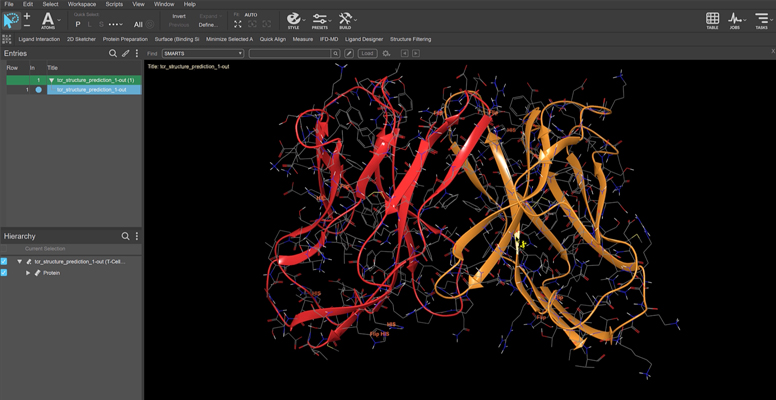
  • Automatically identify and annotate for visualization TCR alpha and beta chains from a FASTA file (commandline run_tcr_modeling.py)
  • Updated N-glycosylation PROSITE pattern that is less restrictive

Materials Science

GUI for Quantum ESPRESSO

Product: Quantum ESPRESSO (QE) Interface

  • Workflow solution to calculate the defect energy
  • Workflow action menu (WAM) for output from periodic DFT convergence test
  • Support for setting total magnetization/charge for each structure
  • Support for computing thermodynamic properties via dynmat.x (command line)
  • Support for stopping an NEB calculation and returning intermediate structures

Materials Informatics

Product: MS Informatics

  • Formulation ML: Option to control advanced settings
  • Machine Learning Property: Skip structures outside the model scope
  • Machine Learning Property: Prediction of singlet (S0) to triplet (T1) energy
  • Machine Learning Property: Prediction of hole / electron reorganization energy
  • Machine Learning Property: Prediction of orbital (HOMO / LUMO) energy
  • Machine Learning Property: Updates to existing models

Coarse-Grained (CG) Molecular Dynamics

Product: MS CG

  • Automated CG Mapping: Mapping MARTINI for speciality chemicals / polymers
  • CG FF Builder: Support for exporting atomistic reference data

Dielectric properties

Product: MS Dielectric

  • Complex Permittivity: Linear fitting parameter retained during exponential fitting

Reactivity

Product: MS Reactivity

  • Nanoreactor: Control over thermostat bath temperature
  • Nanoreactor: Support for parallelization of xTB dynamics simulations
  • Reaction Workflow: Support for the use of the xTB Hessian for transition states
  • Reaction Workflow: Use of input conformers when conformation search fails
  • Reaction Workflow: Improved SCF convergence for energy calculations

Microkinetics

Product: MS Microkinetics

  • Microkinetic Modeling: Improved speed/scalability by up to 2 orders of magnitude
  • Microkinetic Modeling: Improved model for multiple catalysts / catalyst site types
  • Microkinetic Modeling: Improved data visualization in the viewer
  • Microkinetic Modeling: Job name shown in the viewer

Reactive Interface Simulator

Product: MS RIS

  • Solid Electrolyte Interphase: Improved subjob queuing coordination
  • Solid Electrolyte Interphase: Support for constant pressure (NpT) simulations (command-line)

MS Maestro Builders and Tools

  • GUI panel to digitally design, manage, and visualize OLED devices
  • Single Complex: Improved UI for better usability
  • Solvate System: Support for generating multiple configurations by random seeds

Classical Mechanics

  • Workflow solution to compute thin plane shear friction
  • Barrier Potential for MD: Support for reading barrier information from entry
  • Evaporation: Option to plot total number of molecules removed from the system
  • Evaporation: Information tied to barriers (when applied) logged in the output
  • Polymer Crosslink: Improved speed by efficient checking for ring spears
  • Trajectory Density Analysis: Option to display multiple density depths
  • Trajectory Density Analysis: Export option for 2D heat-map plot

Quantum Mechanics

  • Workflow solution to plot phase diagrams based on energy
  • Workflow solution to compute and analyze computational ellipsometry data
  • QM Convergence Monitor: Easy access to the structure from the last step

Education Content

Life Science

  • New tutorial: Refining crystallographic protein-ligand structures using GlideXtal and Phenix/OPLS

Materials Science

  • New tutorial: Automated Martini Fitting for Coarse-Grained Simulations
  • New tutorial: Thin Shear
  • New tutorial: Defect Energy Calculation
  • New tutorial: Optoelectronics Device Designer
  • New tutorial: Computational Ellipsometry
  • New tutorial: Phase Diagrams
  • New tutorial: Ab initio Molecular Dynamics Simulations of Li-ion Diffusion in Solid State Electrolytes
  • Updated tutorial: Microkinetic Modeling
  • Updated tutorial: Organometallic Complexes

LiveDesign

What’s New in 2025-1

  • Biologics
    • Forms view now require the Sequence Viewer to drilldown from another widget
    • Performing a sequence alignment now shows an alert indicating the type of Alignment, and provides a “Try Again” button if the alignment fails
    • Forms views that contain both a Sequence Viewer and 3D Visualizer permit a synchronized selection of amino acid residues, such that selecting an amino acid in the Sequence Viewer will highlight the amino acid in the 3D Visualizer, and vice versa
    • Sequence search options now permit searching the Database, Active LiveReports, and Other LiveReports
    • View non-natural amino acid molecular structure in a tooltip by hovering over residues in the sequence viewer
    • Toggle monomers’ display format in the sequence viewer to view either single-letter FASTA format, or a custom symbol for non-natural monomers (up to 6 characters)
    • Reset Gap Penalties, Numbering Scheme, and Scoring Metrics to their default values for each alignment method
    • Substructures searches in Advanced search panel support a “Match by Child” option, which enables searching against an entity’s subcomponents
  • Performance Improvements
    • Small Molecules uploaded from file imports, enumeration, and Maestro uploads appear in the LiveReport more quickly
  • Landing Page: View all of a compound’s experimental data on the Compound’s detail page
  • Data and Columns Tree:
    • Group Multi-Parameter Optimization columns and Formulas columns into folders
    • The button text to create new Formulas, MPOs and FFCs has been changed from “NEW” to “CREATE”
    • Published Limited Assay Columns now show the [LIM] prefix in the Data & Columns Tree
  • A new MAE-FILE macro for Protocols in the Admin Panel allows Protocol and Models to access compounds and biologics using a Maestro file format. The Maestro file format includes residue information for Biologics
  • Configure LiveDesign to send an email on usage statistics, including: the number of unique logins over the last month, total number of active users, Number of compounds added last week, total number of compounds, total number of LiveReports updated last week, total number of active LiveReports and number of active LiveReports. For each user, the following information is reported: username, date of first login, date of last login, number of owned LiveReports
  • Configure a server-wide search setting to set the default searching behavior in the search panel to the Database, the Active LiveReport, or Other LiveReports
  • A new LDClient method, get_all_compounds(), enables retrieving all compounds within a specified list of projects
  • Sketched reactions within the Reaction Enumeration tool can now use atom queries to add greater specificity to the reaction definition

What’s Been Fixed

  • Updating a LiveReport template would create a duplicate template, and now correctly updates the template
  • Model columns that were used as inputs to more than 65,536 columns would fail to calculate values for new compounds, and now correctly calculate and display the predicted values
  • Pasting into the sketcher would fail on Windows when touchscreen was enabled, and now correctly pastes structures
  • LiveReports with hundreds of formula columns would show flashing cells, and slow down other LiveReports, but now correctly calculate and do not affect other LiveReports’ performance
  • Formulas that used the combine() function could not be used as input to subsequent formulas, and the formula would fail to calculate. Formulas using the combine() function now correctly calculate when they are input to other formulas
  • Selecting rows in the main spreadsheet would not show the 3D structure in the 3D Visualizer, and now correctly shows the 3D structure
  • LiveReports would show red error bars when multiple input values to a parameterized model changed simultaneously in the spreadsheet, and now the LiveReport loads correctly
  • The tautomer deduplication logic previously deduplicated keto-enol tautomers, but caused an unintended side effect of deduplicating compounds that were not tautomers. The updated tautomer deduplication logic has been reverted to the old behavior found in LiveDesign version 2024-4 and earlier
  • Popping out a model column’s cell that contained and image would open two tabs in the browser (one tab with the image, and one blank tab), and now only opens a tab with the image
  • Previously, changes to gap penalties were not persisting when saved in the Forms view, and now gap penalty values will persist correctly upon modification and saving
  • The “Batch Create Limited Assay Columns” option previously was unavailable in the column menu, if the column was within a column group, and now the option always appears
  • The residue synchronization between the 3D Visualizer and Sequence Viewer now remains functional even after changing the numbering scheme in Sequence Viewer
  • Model results would occasionally appear as Failed in the LiveReport, when in fact the model ran successfully, and now model results correctly show results in the LiveReport
  • The Assay Viewer Tool would occasionally change the date filter to 0 days and would not show data, and now defaults to showing data that was uploaded within the previous day.
  • Model results would occasionally appear as Failed in the LiveReport, when in fact the model ran successfully, and now model results correctly show results in the LiveReport
  • Ligand Designer’s deleted poses would occasionally reappear, and now no longer reappear
  • Protocols and Models showed their created date as one day earlier than their actual created date, and now show the correct date
  • LiveReport filters did not support filtering for Real or Virtual Biologics, and now provide quick toggles to apply those filters
  • Opening a model attachment from the main spreadsheet (e.g., a LID from a Glide model) would fail to show the image, and now correctly shows the image
  • Plot tooltips could not be dragged and moved after pinning to the screen, and now can be dragged to a new position after pinning
  • Importing a biologic entity would occasionally not show its subcomponents in the main spreadsheet, and now will correctly show its subcomponents
  • LiveDesign would occasionally fail to open LiveReports due to a database lock, and now no longer will freeze
  • Filtering out a frozen row would show flashing squares in the first row in the main spreadsheet, and now correctly shows that row’s data
  • The sequence viewer would show all entities in the LiveReport, even when only one entity was selected, and now correctly shows only the selected entities
  • Horizontally scrolling the sequence viewer would reset the ruler, and show the wrong residue numbers at the top, and now shows the correct residue numbers
  • Opening the Project Picker would occasionally take several seconds to show the list of projects, and now shows the list of projects immediately
  • LiveDesign would occasionally fail to open LiveReports due to a database lock, and now no longer will freeze
  • Filtering out a frozen row would show flashing squares in the first row in the main spreadsheet, and now correctly shows that row’s data
  • Exporting a LiveReport defaulted to exporting a subset of columns, and now defaults to exporting all of the columns
  • Syncing LiveDesign users with external authentication systems would fail because LiveDesign counted unlicensed users against the total license count, and now permits syncing users as long as there are available licenses
  • License files would occasionally fail to upload in the Admin Panel UI, and now correctly upload
  • User email addresses would not save in LiveDesign when using Single Sign-on, and LiveReport notifications would not be emailed to users. Email addresses and are now correctly saved
  • LiveReport tabs would disappear after logging out and logging in, and now correctly appear after logging back in
  • Duplicating a LiveReport defaulted to copying a subset of columns, and now defaults to copying all of the columns

Training & Resources

Online Certification Courses

Level up your skill set with hands-on, online molecular modeling courses. These self-paced courses cover a range of scientific topics and include access to Schrödinger software and support.

Tutorials

Learn how to deploy the technology and best practices of Schrödinger software for your project success. Find training resources, tutorials, quick start guides, videos, and more.

Other Resources

17th Winter Conference on Medicinal & Bioorganic Chemistry

Conference

17th Winter Conference on Medicinal & Bioorganic Chemistry

CalendarDate & Time
  • February 2nd-6th, 2025
LocationLocation
  • Steamboat Springs, Colorado

Schrödinger is excited to be participating in the 17th Winter Conference on Medicinal & Bioorganic Chemistry taking place on February 2nd – 6th in Steamboat Springs, Colorado. Join us for a poster presentation by Gang Wang, Principal Scientist II at Schrödinger, titled “Pairing machine learning and FEP+ enables the discovery of P38-MK2 molecular glues.”

icon time FEB 4 | 7:00PM
Pairing machine learning and FEP+ enables the discovery of P38-MK2 molecular glues

Speaker:
Gang Wang, Principal Scientist II, Schrödinger

Abstract:
Mitogen activating protein kinases (MAPK)-activated kinase MK2 phosphorylates AU-rich element binding proteins (AUBPs) that modulate the stability of cytokine mRNA. An emerging class of inhibitors create a ternary complex with upstream kinase p38 and MK2. These molecular glues demonstrate superior properties relative to orthosteric inhibitors of either p38 or MK2 but their mechanism of action presents challenges to computationally driven design. Herein we describe our computational design strategy, including the use of FEP+ coupled with Machine Learning (e.g., AutoDesigner and AL-FEP+), to discover multiple structurally diverse, potent, and highly selective molecular glues. Compounds 1 and 2 demonstrate pronounced reduction in TNFα levels after PO dosing in LPS mouse models and represent the validation of our modeling workflow for challenging molecular glues.

Schrödinger advances materials informatics for faster development of next-gen composites

Schrödinger advances materials informatics for faster development of next-gen composites

Overview

Cutting time to market by multiple orders of magnitude, machine learning and physics-based approaches are combined to open new possibilities for innovations in biomaterials, fire-resistant composites, space applications, hydrogen tanks and more.

Read full article

High-performance materials discovery: A decade of cloud-enabled breakthroughs

FEB 26, 2025

High-performance materials discovery: A decade of cloud-enabled breakthroughs

Schrödinger is excited to be hosting a webinar in collaboration with C&EN on February 26th. Join us for a presentation by Mathew D. Halls, Senior Vice President of Materials Science at Schrödinger, titled “High-performance materials discovery: A decade of cloud-enabled breakthroughs.”

Speaker:

Mathew D. Halls, Ph.D. Senior Vice President, Materials Science

Abstract:

Computational approaches combining physics-based molecular modeling with machine learning have revolutionized materials discovery at scale. But challenges still exist when it comes to large-scale and mega-scale simulations in terms of knowledge, infrastructure, speed, and resources.

This talk will showcase how Schrödinger’s integrated materials science platform enables massive parallel screening and de novo design campaigns across diverse applications. Through real-world case studies, we will demonstrate automated solutions that have successfully impacted R&D efforts across industries, including designing novel polymers, identifying promising hole-transport materials for organic electronics, and accelerating the discovery of organometallic precursors for thin film processing. We will describe how cloud computing infrastructure in tandem with Schrödinger’s 10+ years of experience executing and supporting large-scale projects facilitates unprecedented throughput in materials screening. Attendees will gain actionable strategies for implementing large-scale computational screening in their own materials research programs, along with best practices for integrating simulation with experiment.

Key Learning Objectives:

  • Learn to leverage advanced cloud computing infrastructure to meet the needs of large-scale materials simulations for industry applications
  • Hear case studies and customer success stories across industries including organic electronics, catalysis, energy capture and storage, polymeric materials, consumer packaged goods, pharmaceutical formulations, and thin film processing
  • Learn how Schrödinger can ensure a smooth implementation of a cloud-based materials modeling platform for your organization to maximize the value of digital simulations

Who Should Attend:

R&D Leaders
Innovation Managers
Digitization Managers
Synthetic Chemists
Materials Scientists
Chemical Engineers
Materials Research Engineers
Computational Chemists
Computational Materials Scientists

Our Speaker

Mathew D. Halls, Ph.D.

Senior Vice President, Materials Science, Schrödinger

Mathew D. Halls is responsible for leading the materials science program at Schrödinger. Mat received his Ph.D. in 2001 from Wayne State University in Detroit, MI, under the supervision of Professor H. Bernhard Schlegel. Over the past 20 years, Mat has worked with Fortune 500 companies to advance the adoption of atomic-scale materials simulation and machine learning in diverse industries including aerospace, electronics and specialty chemicals. He has made significant research contributions in areas such as computational spectroscopy, organic optoelectronic materials, nanocarbon-polymer interfaces, thin-film precursors and deposition processes and battery electrolyte additives; with his work being cited more than 7500 times.

AI in Drug Discovery 2025

Conference

AI in Drug Discovery 2025

CalendarDate & Time
  • March 10th-11th, 2025
LocationLocation
  • London, United Kingdom

Schrödinger is excited to be participating in the AI in Drug Discovery 2025 conference taking place on March 10th – 11th in London, United Kingdom. Join us for a presentation by Sathesh Bhat, Executive Director of Schrödinger Therapeutics Group, titled “Advancing drug discovery programs with machine learning-enhanced in silico design.” Stop by our booth to speak with Schrödinger scientists.

icon time MAR 10 | 11:00AM CET
Advancing drug discovery programs with machine learning-enhanced in silico design

Speaker:
Sathesh Bhat, Executive Director, Schrödinger Therapeutics Group

Abstract:
Recent advances in integrating machine learning and physics-based calculations have transformed pre-clinical drug discovery. In this presentation, we demonstrate how large-scale de novo design workflows dramatically accelerated an EGFR discovery project, enabling the exploration of 23 billion designs and identification of four novel scaffolds with favorable potency and property profiles in just six days. We also showcase the application of de novo core design strategies to develop selective scaffolds targeting WEE1, where our automated approaches generated novel chemotypes achieving >10,000x selectivity over PLK1 while maintaining potent target inhibition. Finally, we introduce FEP+ Protocol Builder, representing a new paradigm in combining machine learning with physics-based methods. This system uses active learning to systematically optimize free energy perturbation protocols, automating what has traditionally been a manual, expertise-driven process. Integrating machine learning with rigorous physics-based calculations exemplifies how hybrid computational approaches can provide both speed and accuracy in modern drug discovery.

Display Week 2025

Conference

Display Week 2025

CalendarDate & Time
  • May 11th-16th, 2025
LocationLocation
  • San Jose, California

Schrödinger is excited to be participating in the Display Week 2025 conference taking place on May 11th – 16th in San Jose, California. Join us for a presentation in the Exhibitor Forum by Hadi Abroshan, Product Manager of Organic Electronics at Schrödinger titled, “Revolutionizing Display Technology: Digital Solutions from Materials to Devices.” Stop by booth 1532 to speak with Schrödinger scientists.

icon time MAY 14 | 9:15AM
Revolutionizing Display Technology: Digital Solutions from Materials to Devices

Speaker:
Hadi Abroshan, Product Manager of Organic Electronics, Schrödinger

Abstract:
Digital solutions are transforming display technology by accelerating materials discovery and device optimization. Advanced simulations, AI/machine learning, and cloud-based tools drive faster innovation in OLEDs, MicroLEDs, and beyond—enhancing efficiency and lifetime while reducing costs from materials to final devices. We will present the latest computational technologies and also showcase a synergistic application of Ansys and Schrödinger predictive technologies to accelerate OLED development through a multi-scale, multi-physics simulation approach.

Device Packaging 2025

Conference

Device Packaging 2025

CalendarDate & Time
  • March 3rd-6th, 2025
LocationLocation
  • Phoenix, Arizona

Schrödinger is excited to be participating in the Device Packaging 2025 conference taking place on March 3rd – 6th in Phoenix, Arizona. Join our poster and collaborated talk with Samsung. Stop by booth #704 to speak with us.

icon time MAR 5 | 5:30 PM
Poster: Materials innovation for advanced electronic packaging using digital chemistry

Speaker:
Atif Afzal, Principal Scientist II, Schrödinger

Abstract:
The push for ever-improving characteristics of electronic devices demands packaging materials with superior thermal stability, mechanical strength, water repellency, and interfacial properties. Traditional material selection methods, often reliant on extensive empirical testing, are time-consuming and costly, limiting the ability for researchers to push beyond what they already know. To address these challenges, we propose a new approach that integrates physics-based modeling with machine learning (ML) to accurately model and predict the properties of advanced materials for electronic packaging. Our physics-based modeling, molecular dynamics (MD) simulations, offer detailed atomistic insights into material behavior under various conditions, providing essential data on thermal properties, mechanical resilience, adhesion, and more. To accelerate the material evaluation process and to navigate new chemical domains more efficiently, we integrate ML in our workflows. By training ML models using both experiment and simulation data, we can rapidly predict the properties of new materials, enabling efficient screening and selection. We demonstrate the efficacy of this approach through a case study focused on designing copolymers with targeted properties. Our integrated MD-ML framework allows us to quickly identify polymers that meet specific performance criteria, such as enhanced glass transition and superior dielectric properties, while significantly reducing the time and resources required for material discovery. This work highlights the transformative potential of combining physics-based simulations with machine learning in the field of electronic packaging. By streamlining the material development process, our approach not only accelerates innovation but also enables the creation of materials that meet the stringent demands of next-generation electronic devices.

icon time MAR 5 | 2:00 PM
Talk: Material property simulation for advanced packaging

Speaker:
Seo Young, Samsung; Atif Afzal, Schrödinger

Abstract:
Advanced packaging allows chiplet integration and maximizes device performance with faster product development cycle, lower cost, and higher yield. As the package size becomes bigger and the device is getting more complicated, there is growing motivation to employ manufacturing process simulation, Artificial Intelligence (AI) assisted process optimization, yield and reliability prediction, rather than conventional methods, to ramp the yield and to ensure the reliability of a new product. The key for an accurate process simulation model is to input precise material properties, such as modulus, Coefficient of Thermal Expansion (CTE), dielectric constant, glass transition temperature, etc., which could change non-linearly with temperature, moisture, as well as other environmental factors and process conditions. Molecular modeling and molecular dynamics can provide insights into post chemical reactions or physical transformations via atomic and molecular simulations. Lithography Techniques for Redistribution Layer (RDL) fabrication are the foundation of Advanced Packaging techniques, such as Fan Out Wafer Level Packaging (FOWLP), Fan Out Panel Level Packaging (FOPLP), 2.5D, 3D, and 3.5D packaging with RDL interposers. The continuous scaling-down of critical dimensions (CDs) in advanced packages, including via diameters, routing line and space (L/S), to a few microns, or submicron level, as well as the increasing number of RDL layers at panel scale pose significant challenges in RDL lithography techniques. For example, the Photo Imageable Dielectric (PID) or other build-up dielectric materials used in multilayer RDL fabrication are polymers, having low Young’s modulus, high CTE, and big volume shrinkage after curing. These material properties could cause fabrication process induced warpage and surface topography deformations, such as non-planarity, roughness, contamination, defects, and dimensional variations, which could potentially lead to massive yield loss when forming fine features during the multilayer RDL patterning. This paper presents material simulation methodologies based on quantum mechanics (QM), molecular dynamics (MD), and Machine Learning (ML), which are adopted to predict the material properties of a PID material, including glass transition temperature (Tg), CTE, mechanical properties, dielectric properties, as well as volume shrinkage after curing. Comparison between the simulation results and the experimental data is performed to validate the methodology. Similar methodology could be used to predict material properties of other organic packaging materials, which is crucial for building up accurate process, yield, and reliability simulation or digital twin of advanced packaging.

JEC World 2025

Conference

JEC World 2025

CalendarDate & Time
  • March 4th-6th, 2025
LocationLocation
  • Paris, France

Schrödinger is excited to be participating in the JEC World 2025 conference taking place on March 4th – 6th in Paris, France. Join us for a presentation by Andrea Browning, Director at Schrödinger, titled, “Implementing AI along the Composites Value Chain.” Stop by booth #5K132 to speak with us.

icon time MAR 6 | 12:00
icon location Agora 5
Implementing AI along the Composites Value Chain

Speaker:
Andrea Browning, Director, Schrödinger

Abstract:
The composites industry is poised for a groundbreaking transformation fueled by the recent surge in material data and computational power. This session dives deep into the exciting possibilities of Artificial Intelligence and Machine Learning (AI/ML) along the entire composites value chain. We’ll explore how AI can revolutionize every step, from the development of innovative composite materials to optimizing their design, selection, and certification. Discover how AI can streamline manufacturing processes, boost production efficiency, and even monitor the structural health of composites in real-time. Witness how this powerful technology is paving the way for a new era of intelligent composites manufacturing.

LOPEC 2025

Conference

LOPEC 2025

CalendarDate & Time
  • February 25th-27th, 2025
LocationLocation
  • Munich, Germany

Schrödinger is excited to be participating in the LOPEC 2025 taking place on February 25th – 27th in Munich, Germany. Join us for a presentation by Hadi Abroshan, Principal Scientist at Schrödinger, titled “Integrating Atomistic Simulations, Machine Learning, and Cloud-Based Collaboration for Next-Generation Electronic Materials.” Stop by booth #B0313 to speak with Schrödinger scientists.

Click here to learn how Schrödinger’s digital chemistry platform empowers you to discover novel optoelectronics materials.

icon time FEB 26 | 15:20 CET
icon location Room 2
Integrating Atomistic Simulations, Machine Learning, and Cloud-Based Collaboration for Next-Generation Electronic Materials

Speaker:
Hadi Abroshan, Principal Scientist, Schrödinger

Abstract:
The creation of next-generation display technologies hinges on innovative research strategies and collaborative tools. This presentation highlights how the integration of physics-based simulations, machine learning (ML), and a cloud-enabled platform accelerates the discovery and refinement of advanced optoelectronic materials. We introduce the Schrödinger digital chemistry platform, which facilitates advanced simulations of optoelectronic materials, spanning from individual molecules to thin films developed via vacuum deposition or solution processing. This platform’s automated capabilities predict key material properties such as electronic transitions, hyperfluorescence, charge carrier mobility, refractive index, thermophysics, interfacial mixing, and molecular orientation. We then explore the synergy between physics-based simulations and ML, which significantly streamlines the materials discovery process. By analyzing large datasets and identifying trends, ML allows for faster predictions of material properties. An active learning screening process efficiently pinpoints promising candidates based on multiple properties, all while reducing computational cost. Further, we discuss genetic optimization algorithms that drive the development of new materials for electroluminescent devices. These algorithms emulate natural selection, refining material properties iteratively to uncover high-performance compounds tailored to specific targets. When combined with high-throughput screening, this approach accelerates the exploration of chemical space, leading to rapid material advancement. Lastly, we introduce Schrödinger’s LiveDesign, a web-based collaboration platform that enhances modern R&D by integrating advanced modeling, data management, and ideation. LiveDesign empowers research teams to collaborate effectively, regardless of geographic location, supporting a seamless end-to-end research workflow.