OLEDs: Innovations, Manufacturing, Markets

Virtual event

OLEDs: Innovations, Manufacturing, Markets

CalendarDate & Time
  • April 10th-11th, 2024
  • 8:00am PDT
LocationLocation
  • Virtual

Schrödinger is excited to be participating in OLEDs: Innovations, Manufacturing, Markets taking place on April 10th – 11th online. Join us for a presentation by Hadi Abroshan, Principal Scientist and Product Manager at Schrödinger, titled “Revolutionizing Organic Electronics: Computational Insights and Innovations in OLED Materials Design.”

Speaker:
Hadi Abroshan, Principal Scientist and Product Manager

Date/Time:
April 11 | 8:00am PDT

Abstract:
The rapidly evolving landscape of organic electronics demands innovative approaches for the design and development of materials, particularly for display applications. This presentation showcases the integration of machine learning and physics-based simulations for OLED material design and development. We explore the synergies between these computational techniques, unraveling the intricate thin-film morphology and electronic properties that underpin the performance of organic electronic materials. Viewed through a multidisciplinary lens, we navigate the complexities of OLEDs, uncovering key insights that drive the next generation of efficient and high-performance devices.

From understanding electronic transitions at the quantum level, morphology at the molecular level, to harnessing machine learning for accelerated material discovery, this presentation highlights the transformative impact of leveraging multiscale computational methodologies. We delve into several case studies, demonstrating how these computational tools empower researchers to predict, optimize, and tailor OLED materials for higher performance.

Addressing the challenge of managing extensive data in OLED design, we highlight Schrödinger’s informatics and collaboration tool, LiveDesign. This dynamic, cloud-native environment democratizes digital design processes, providing R&D teams with unified access to diverse tools such as physics-based modeling, advanced cheminformatics, and machine learning. LiveDesign streamlines collaboration and efficiency, overcoming limitations in expert availability and promoting innovation.

This presentation serves as a guide for researchers and industry professionals, pointing towards a future where computational insights drive the design and development of next-generation OLED materials.

Jaguar Datasheet

Jaguar Datasheet

Overview

Ever since its inception, Jaguar was designed with one goal in mind — to help researchers solve practical, real-world problems. To meet this goal, Jaguar’s development has focused on performance and scientific accuracy. Furthermore, Jaguar is easy to use — with a world-class graphical interface and automated workflows that guide new users through complex ab initio quantum mechanics (QM) analyses for a vast range of chemical systems. Jaguar is fully integrated into Schrödinger’s suites of scientific solutions, making interoperability with other programs seamless.


Key Advantages

Jaguar specializes in fast electronic structure predictions for molecular systems of medium and large size via the use of the pseudospectral (PS) method1 and computational strategies that scale reasonably as system size grows, in particular density functional theory (DFT). Jaguar supports parallel computation through OpenMP to further take advantage of modern hardware improvements. 

Significant ongoing efforts have been devoted to improving the accuracy of predictions including the transition metal initial guess wavefunction algorithm, recent advances in pKa predictions, and enabling access to machine learning potentials (MLP). 

Schrödinger has devoted and continues to devote development resources to enhance Jaguar’s feature set and to improve Jaguar’s robustness and performance. To date, Jaguar has made significant contributions in both life and materials science research, and we invite you to learn more about Jaguar in a published review article in the International Journal of Quantum Chemistry.2


Software and services to meet your organizational needs

Software Platform

Deploy digital materials discovery workflows with a comprehensive and user-friendly platform grounded in physics-based molecular modeling, machine learning, and team collaboration.

Research Services

Leverage Schrödinger’s expert computational scientists to assist at key stages in your materials discovery and development process.

Support & Training

Access expert support, educational materials, and training resources designed for both novice and experienced users.

Jaguar Datasheet

Jaguar Datasheet

Overview

Ever since its inception, Jaguar was designed with one goal in mind — to help researchers solve practical, real-world problems. To meet this goal, Jaguar’s development has focused on performance and scientific accuracy. Furthermore, Jaguar is easy to use — with a world-class graphical interface and automated workflows that guide new users through complex ab initio quantum mechanics (QM) analyses for a vast range of chemical systems. Jaguar is fully integrated into Schrödinger’s suites of scientific solutions, making interoperability with other programs seamless.


Key Advantages

 Jaguar specializes in fast electronic structure predictions for molecular systems of medium and large size via the use of the pseudospectral (PS) method1 and computational strategies that scale reasonably as system size grows, in particular density functional theory (DFT). Jaguar supports parallel computation through OpenMP to further take advantage of modern hardware improvements. 

Significant ongoing efforts have been devoted to improving the accuracy of predictions including the transition metal initial guess wavefunction algorithm, recent advances in pKa predictions, and enabling access to machine learning potentials (MLP). 

Schrödinger has devoted and continues to devote development resources to enhance Jaguar’s feature set and to improve Jaguar’s robustness and performance. To date, Jaguar has made significant contributions in both life and materials science research, and we invite you to learn more about Jaguar in a published review article in the International Journal of Quantum Chemistry.2


Jaguar for Materials Science

Jaguar is a powerful tool for studying the chemical reactions and properties that are implicated in the assembly, operation or failure of materials, or for the discovery and optimization of new materials solutions. Jaguar’s speed and accuracy make it an efficient and robust tool for the routine treatment of realistic chemical models. 

An exciting application of Jaguar is for the ab initio design or high throughput virtual screening for new materials with novel or enhanced properties — made possible by taking advantage of Jaguar’s industry-leading efficiency and robustness and Schrödinger Materials Science Suite’s combinatorial chemistry solutions to rapidly enumerate compound libraries. 

Below are some example applications of Jaguar for a diverse range of technologically important chemical systems. 

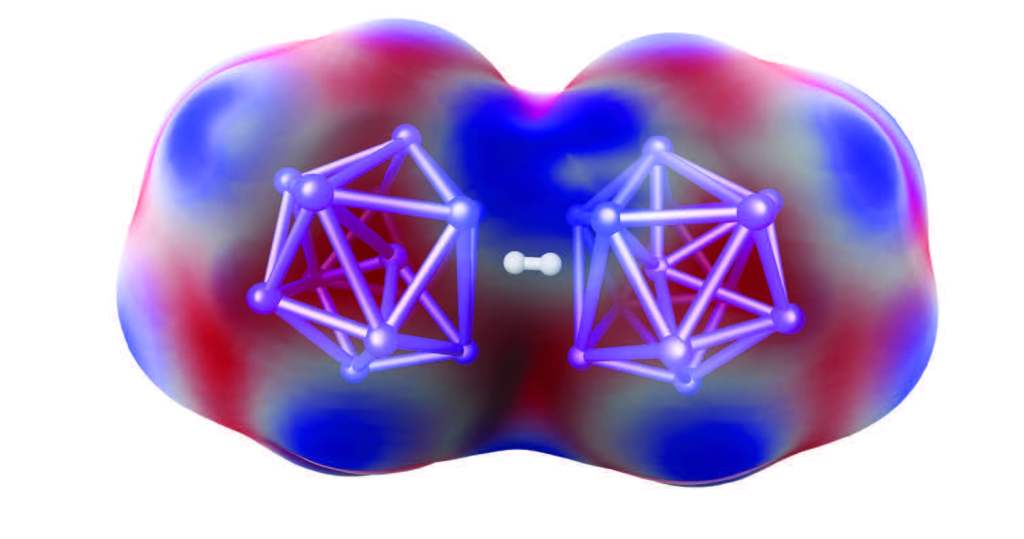
Cluster-based materials are being investigated for a variety of materials applications. Here the electronic charge distribution at the dimer is shown mapped onto the electron density. An H2 molecule is shown trapped within the dimer.


Molecular Catalysis

Jaguar has been used extensively to provide insight to enable the rational design of improved catalysts. Geometric effects and orbital/electrostatic interactions that provide the basis for catalyst stability, selectivity, and activity are difficult or impossible to gain by experiment alone, but can be efficiently computed and analyzed using Jaguar.

Optoelectronics & Photovoltaics

Molecular properties such as electronic energies, multipole moments, linear and higher order polarizabilities, ionization and reduction potentials, and charge reorganization energies can be evaluated computationally to aid in the selection or design of organic optoelectronic materials. Jaguar has been used to analyze a variety of organic semiconductors including derivatized oligothiophenes, cyanated tetracenes, and N-heteropentacenes, and other materials for dye sensitized solar cells (DSSC).

Molecular Electronics

Jaguar has been used to investigate the mechanism of carbon nanotube growth, the conformation dependence of molecular conduction, the electronic structure of molecular rectifiers, switching in mechanically interlocked molecules, and interference effects in conduction through arene molecular wires.

Energy Capture & Storage

First-principles simulations using Jaguar have been used to analyze the chemical mechanisms and controlling energetics for the operation and failure modes for candidate energy storage materials such as Li-air batteries.

Thin Film Processing

The geometric and electronic structure of organometallic precursor chemicals can be rapidly and efficiently computed with Jaguar, so as to quantify their gas-phase thermal stability, dimerization and reactivity at surfaces during thin film deposition or etch. Complementing this are tools for easily building organometallic complexes and establishing their spin state.

Software and services to meet your organizational needs

Software Platform

Deploy digital materials discovery workflows with a comprehensive and user-friendly platform grounded in physics-based molecular modeling, machine learning, and team collaboration.

Research Services

Leverage Schrödinger’s expert computational scientists to assist at key stages in your materials discovery and development process.

Support & Training

Access expert support, educational materials, and training resources designed for both novice and experienced users.

Schrödinger デジタル創薬セミナー:  Free Energy Calculations beyond Small Molecule Binding: Predicting Antibody Affinity, pH Sensing, Receptor Functional Response and More

MAR 19, 2024

Schrödinger デジタル創薬セミナー: Free Energy Calculations beyond Small Molecule Binding: Predicting Antibody Affinity, pH Sensing, Receptor Functional Response and More

錬金術的な自由エネルギー計算は、タンパク質リガンドの結合自由エネルギー計算において前例のないレベルの精度と信頼性を示し、新規で有力な化学物質を迅速に特定することを 通じて小分子薬物探索プロジェトにポジティブな影響を与えています。

タンパク質リガンドの結合に加えて、自由エネルギー計算はタンパク質タンパク質の結合親和性、pHセンシング、受容体の機能的応答、溶解度など、多くの高価値な薬物探索関連 エンドポイントを正確にモデル化することができます。

この講演では、FEP+メソッドの最近の拡張により、小分子結合以外の高付加価値のアプリケーションが能になった事例を紹介します

Our Speaker

Lingle Wang, Ph.D.

Senior Vice President, Schrödinger

Lingle Wang, senior vice president, scientific development, joined Schrödinger in 2012. He is responsible for advancing Schrödinger’s physics-based computational drug discovery platform. He obtained his Ph.D. from Columbia University working with Professors Richard Friesner and Bruce Berne on methods to quantify the role of water molecules in protein-ligand binding, enhanced sampling in biomolecular simulations and free energy calculations. Lingle has published extensively in the areas of free energy methods development and applications in drug discovery.

Chemical innovation for regulatory changes: Leveraging digital simulations for efficient molecular design

FEB 28, 2024

Chemical innovation for regulatory changes: Leveraging digital simulations for efficient molecular design

Regulations in chemical and materials manufacturing continue to evolve as our understanding of the impact of man-made materials on the environment and human health improves. Together with the increased focus on improved sustainability to help ensure the long-term safety of products, these concerns have caused substitute chemistry activities to grow across nearly all industries.

Given the need to change core chemistries in more and more cases, how can scientists and engineers be more effective in their search?

In this webinar we will explore:

  • How digital simulations and molecular modeling tools can be leveraged to better screen substitute chemistry
  • How digital workflows can help build understanding of the critical performance characteristics of existing and substitute chemistry
  • Examples of how the computational technologies in Schrödinger’s Materials Science Suite have been applied to respond to regulatory changes in the consumer products, specialty chemicals, and plastics industries

Our Speaker

Andrea Browning

Director – Polymers and Soft Matter Schrödinger

Andrea Browning is responsible for leading efforts related to polymer and soft matter simulation. Prior to joining Schrödinger in 2017, she was a lead research engineer and project manager at The Boeing Company. She brings over a decade of experience in connecting simulations to industrial decisions.

Accurate modeling of receptor functional response: GPCRs and beyond

FEB 28, 2024

Accurate modeling of receptor functional response: GPCRs and beyond

For a drug to be effective, potent binding to the target protein is a prerequisite, but it is not sufficient. Rather, in order to produce the desired functional response, the drug must either inhibit the function of the protein or modulate the activity of the protein, most typically by modifying its conformational equilibrium. The long timescales for such protein conformational changes prohibit them from being directly modeled via physics-based simulations. However, our recent work has demonstrated that the consequences of these long-timescale processes can be accurately modeled with alchemical free energy calculations using FEP+.

In this webinar, we present a tractable and computationally efficient protocol that can accurately and reliably predict the functional response of a receptor to ligand binding, including:

  • The use of Absolute Binding Free Energy Perturbation (ABFEP) to score the difference of the ligand bound to active and inactive states of the receptor and accurately predict the functional response of ligand binding
  • Validation on a large set of systems including eight G protein-coupled receptors (GPCRs) and one nuclear receptor
  • How this FEP-based workflow can be used to achieve unprecedented performance in classifying ligands as agonists or antagonists in drug discovery programs
  • Best practices for applying this approach to your own research projects

Our Speakers

Lingle Wang, PhD

Senior Vice President, Schrödinger

Lingle Wang, senior vice president, scientific development, joined Schrödinger in 2012. He is responsible for advancing Schrödinger’s physics-based computational drug discovery platform. He obtained his Ph.D. from Columbia University working with Professors Richard Friesner and Bruce Berne on methods to quantify the role of water molecules in protein-ligand binding, enhanced sampling in biomolecular simulations and free energy calculations. Lingle has published extensively in the areas of free energy methods development and applications in drug discovery.

Martin Vögele, PhD

Senior Scientist I, Schrödinger

Martin Vögele is a senior scientist in the life science software department at Schrödinger, Inc. in New York City. Previously, he was a postdoc in computer science at Stanford University where he worked on simulations of G-protein-coupled receptors and on machine learning for structural biology and drug discovery. Before moving to the United States, he obtained a PhD for work on diffusion and self-organization in lipid membranes at the Max Planck Institute of Biophysics in Frankfurt, Germany.

LiveDesign for Organic Electronics

LiveDesign for Organic Electronics

Combining Molecular Modeling, Machine Learning, and Enterprise Informatics to Accelerate R&D

Schrödinger’s LiveDesign is a flexible, cloud-native working environment to democratize digital design processes for new materials and improved formulations across R&D teams. From a single web-based platform, teams can access physics-based modeling, advanced cheminformatics, chemistry-informed machine learning, virtual design and analysis technologies, and project data. With features designed specifically for organic electronics, scientists can leverage the power of LiveDesign at every stage of the OLED materials R&D process: ideation, execution, data analysis and processing, data storage, and project management.

Overview

One-click access to powerful molecular and thin film simulations and machine learning workflows

  • Accurately predict optoelectronic properties of materials with just one click using automated workflows
  • Explore vast chemical space with large-scale screening of properties using integrated machine learning technologies

Plug-and-play with 3rd party data and scripts for efficient data management and processing

  • Automatically import experimental data from ELN/database
  • Complement any 3rd party/in-house programs/ scripts e.g. python, bash, perl, etc.
  • Enable flexible visualization of complex datasets through forms view

Real-time collaborative management of materials chemistry and device data

  • Securely and instantly share large-scale chemistry data across teams and partners to foster collaboration, empower innovation, and facilitate improved decision-making

Intuitive visualization of materials chemistry and device performance

  • Visualize device configuration using experimental or computer-simulated data
  • Gain insights into device architecture and performance to speed up decision-making processes and accelerate R&D timelines


CASE STUDY: LEVERAGING LIVEDESIGN TO DESIGN BETTER ORGANIC ELECTRONICS, FASTER

High-throughput screening of hole transport materials for QLEDs with easy-to-use, automated workflows

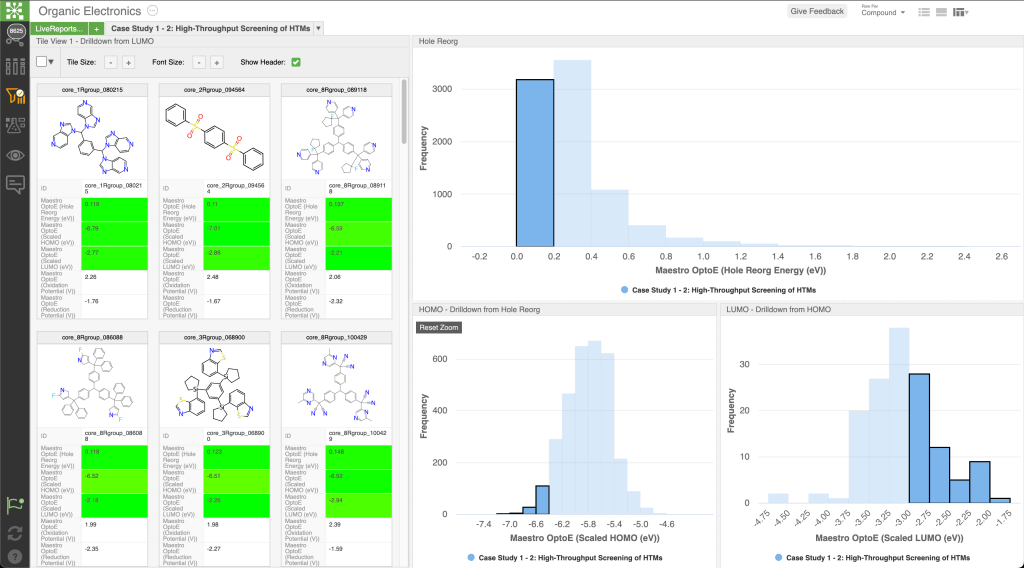
Solution-processed colloidal quantum dot light-emitting diodes (QLEDs) have garnered significant attention for optoelectronic applications. Nevertheless, the widespread adoption of QLED devices faces significant hurdles. The energy level mismatch between commonly used quantum dots (QDs) and traditional hole transport materials (HTMs) leads to an imbalance in charge carriers within the lightemitting layer (EML) and thus lower efficiency of OLED devices. In this study, we utilize high-throughput density functional theory (DFT) calculations on an extensive materials library comprising approximately 9,000 candidates to identify potential materials characterized by deep HOMO levels.

Schrödinger’s LiveDesign enables high-throughput quantum mechanical calculations for materials libraries of any size to predict their optoelectronic properties. One-click simulation execution allows an automated physics-based estimation of key electronic properties such as orbital energies and reorganization energies. The HOMO energies from DFT predictions as compared to experimental measurements for a set of known molecular compounds aligned well (R2=0.93), validating the DFT method, ensuring robust and accurate predictions of the orbital energies.

For high-throughput screening of the 9,000 compound library, we employed an automated workflow available in LiveDesign. First, we selected the compounds with hole reorganization energies less than 0.2 eV, see upper-right plot in Figure 1. Next, LiveDesign enables narrowing down our materials search further to those with a deep HOMO level (< -6.4 eV), and high LUMO level (> -3.0 eV), see lower-right plot in Figure 1. We search for materials with LUMO levels higher than -3.0 eV to ensure a significant energy mismatch with the conduction band of QDs (−4.0 eV), blocking electron injection from the light-emitting layer to the HTM. The chemical structures and properties of the top candidates are shown in the left panel in Figure 1.

Flexible visualization of complex datasets enables fast processing of big data, accelerating characterization and selection of promising candidates for post-processing investigation and further experimentation. LiveDesign empowers you with multi-parameter analysis, swiftly sorting through top candidates to discover those with precisely tailored properties.


Figure 1. Intuitive visualization of HTL materials candidates for QLED.

CASE STUDY: LEVERAGING LIVEDESIGN TO DESIGN BETTER ORGANIC ELECTRONICS, FASTER

Machine learning for fast screening of thermally activated delayed fluorescence (TADF) emitters

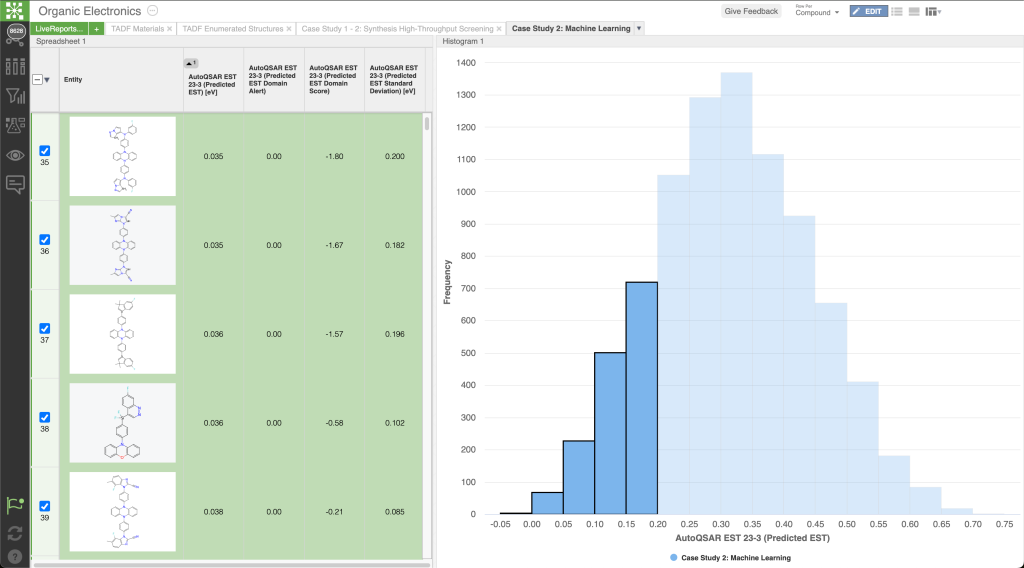
TADF emitters are a promising class of molecules for achieving high quantum efficiencies in OLEDs. In such emitters, the energetic separation between the S1 and T1 excited states (ΔEST) needs to be small (< 0.2 eV), which allows reverse intersystem crossing to up-convert the T1 state to the emissive S1 state. Tuning ΔEST allows for higher efficiency light emission in the form of delayed fluorescence.

We imported experimental data of a set of TADF molecules to LiveDesign and employed integrated machine learning workflows to develop quantitative structure-property relationships (QSPR) models. The machine learning models were then used to predict ΔEST for the library of 9,000 molecules used in the above case study.

After plotting the distribution of predicted ΔEST for the compounds (Figure 2, right plot), we selected the ones with ΔEST < 0.2. The corresponding material structures and properties are shown on the left side.

While this case study provides a focused exploration of leveraging ML models for the swift estimation of ΔEST, it serves as just one illustrative example. The platform stands ready to be seamlessly tailored for diverse material classes and a spectrum of applications, showcasing its adaptability and versatility in addressing a multitude of scientific and industrial challenges.


Figure 2. Flexible visualization of complex dataset for TADF emitter candidates in LiveDesign.

CASE STUDY: LEVERAGING LIVEDESIGN TO DESIGN BETTER ORGANIC ELECTRONICS, FASTER

Visualization of OLED device structure for ideation

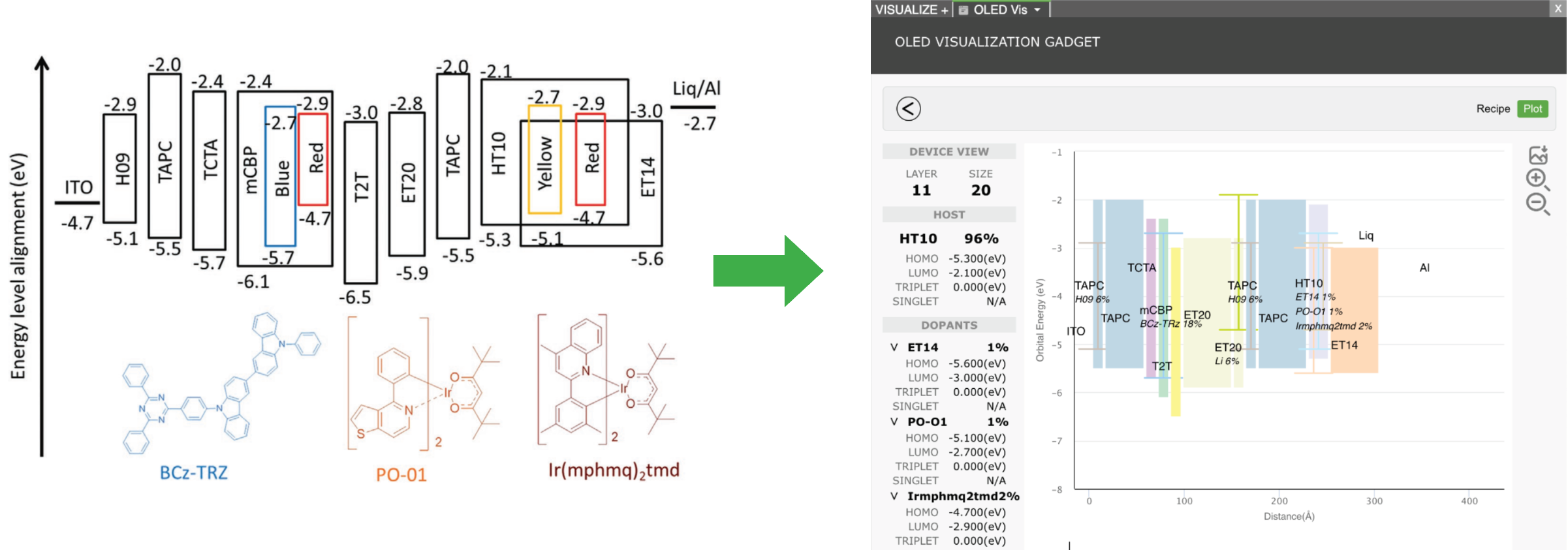
Efficiency and overall performance of electronic devices are influenced by various factors, including carrier injection, charge mobility, and device architecture. Specifically, for high-efficiency OLEDs, a multilayer device structure is employed, comprising a hole-injection/transport layer (HIL/ HTL), an emissive layer (EML), and an electron-injection/ transport layer (EIL/ETL). Such multilayer devices pose a serious challenge, requiring the use of materials with appropriate molecular orbital energy levels and excited states energies, with a key criterion being the minimization of carrier-injection barriers across the layers.

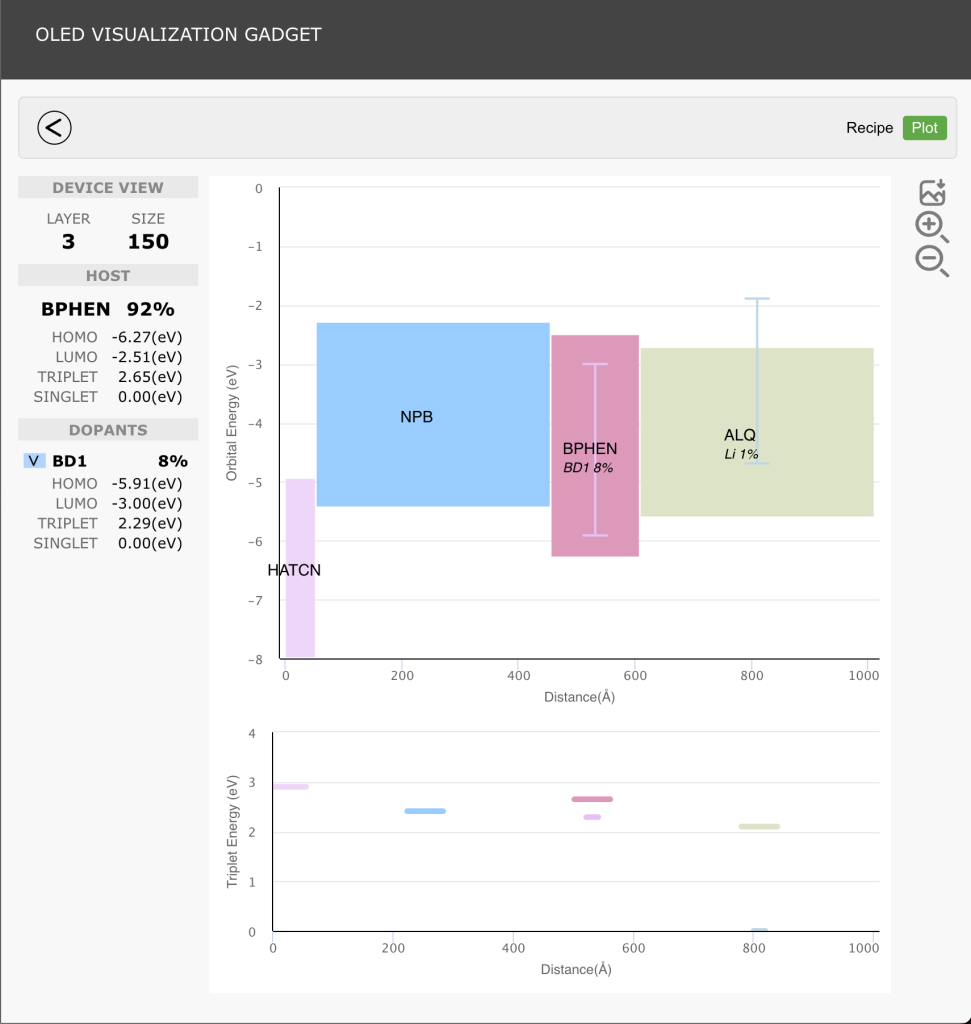
Schrödinger’s LiveDesign enables employing state-of-theart simulation methods to investigate the configuration of potential devices by considering layer thickness, orbital levels, dopant concentration, and excited state energies. As shown in Figure 3, we used data from different OLED materials (experimental or simulated properties) to visualize possible OLED device structures for quick screening of interlayer energy mismatch. The energy level mismatch is a key in OLED devices, impacting charge recombination in emissive layers along with excited state energies of components to determine device color and possibility of intermolecular energy transfer. This approach in LiveDesign allows scientists to quickly share and discuss efficiently towards the next step of designing next-generation OLEDs with higher performance.


Figure 3. Construct and visualize structures of prototype devices in LiveDesign using experimental or simulated properties of individual material.

Summary

Schrödinger’s LiveDesign offers a complete solution for the design of organic electronics across R&D teams. Integrated with physics-based simulations and machine learning, LiveDesign serves as an easy-to-use portal for efficient simulations for property prediction and largescale screening of organic electronic materials.

Meanwhile, LiveDesign is an efficient tool for teams to share, manage and process data, speeding up collaboration and innovation timelines. Moreover, with modules designed for organic electronics, scientists are able to visualize organic electronic devices, gaining insights on device performance.

Software and services to meet your organizational needs

Software Platform

Deploy digital materials discovery workflows with a comprehensive and user-friendly platform grounded in physics-based molecular modeling, machine learning, and team collaboration.

Research Services

Leverage Schrödinger’s expert computational scientists to assist at key stages in your materials discovery and development process.

Support & Training

Access expert support, educational materials, and training resources designed for both novice and experienced users.

Advancing the design and optimization of drug formulations with coarse-grained molecular simulations 

Advancing the design and optimization of drug formulations with coarse-grained molecular simulations

Scientists from AbbVie and Schrödinger gain a deep understanding of the mechanisms behind amorphous solid dispersion (ASD) dissolution behavior at the molecular level.

Executive Summary

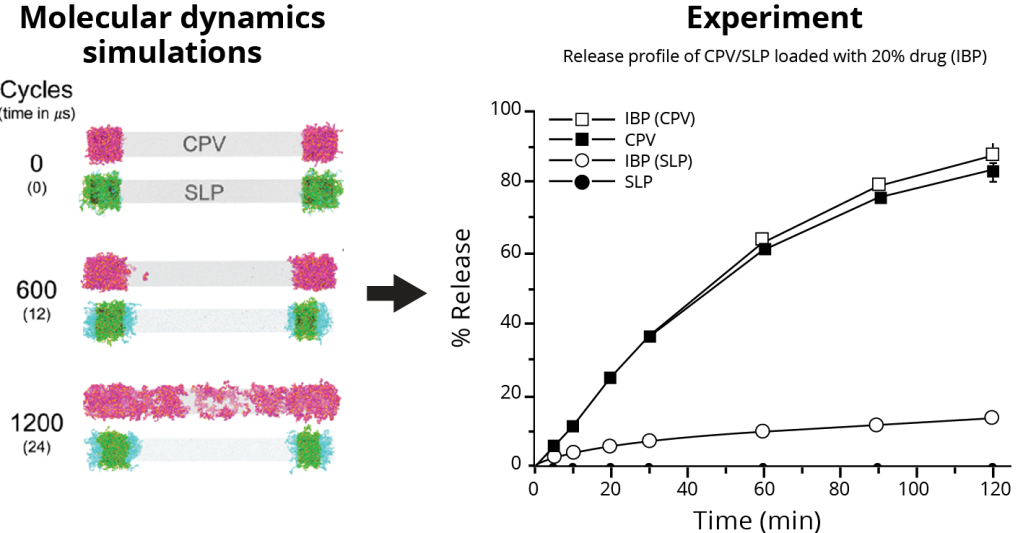
  • Evaluated dissolution profiles of different drug and polymer combinations at specified conditions
  • Identified interactions that are responsible for delayed release in certain formulations
  • Aligned with and complemented experimental data with visual and numeric insights at the molecular level
  • Gained insights into new excipients for drug formulations to achieve targeted dissolution behavior


*CPV, Copovidone; SLP, Soluplus; IBP, ibuprofen


Challenges

Formulating small molecule drugs with low aqueous solubility in a hydrophilic polymer matrix, also known as amorphous solid dispersion (ASD), is one of the most common approaches to achieve effective drug delivery and, thus, bioavailability. Producing a high-performance ASD depends on various factors, such as the physical stability of the drug-excipient matrix, its interaction with polymers during dissolution, and the rate of drug release in an aqueous medium. Often, researchers perform numerous design and experimental iterations to achieve this goal. While hypotheses about drug release behaviors may be drawn from experimental data, a comprehensive understanding of the fundamental mechanisms and insights into molecular-level occurrences remains elusive. It’s challenging to obtain detailed drug/polymers/water interactions through experiments alone. Therefore, a more effective approach is needed to inform the selection of suitable excipients, including polymers, for specific drugs.


Approach

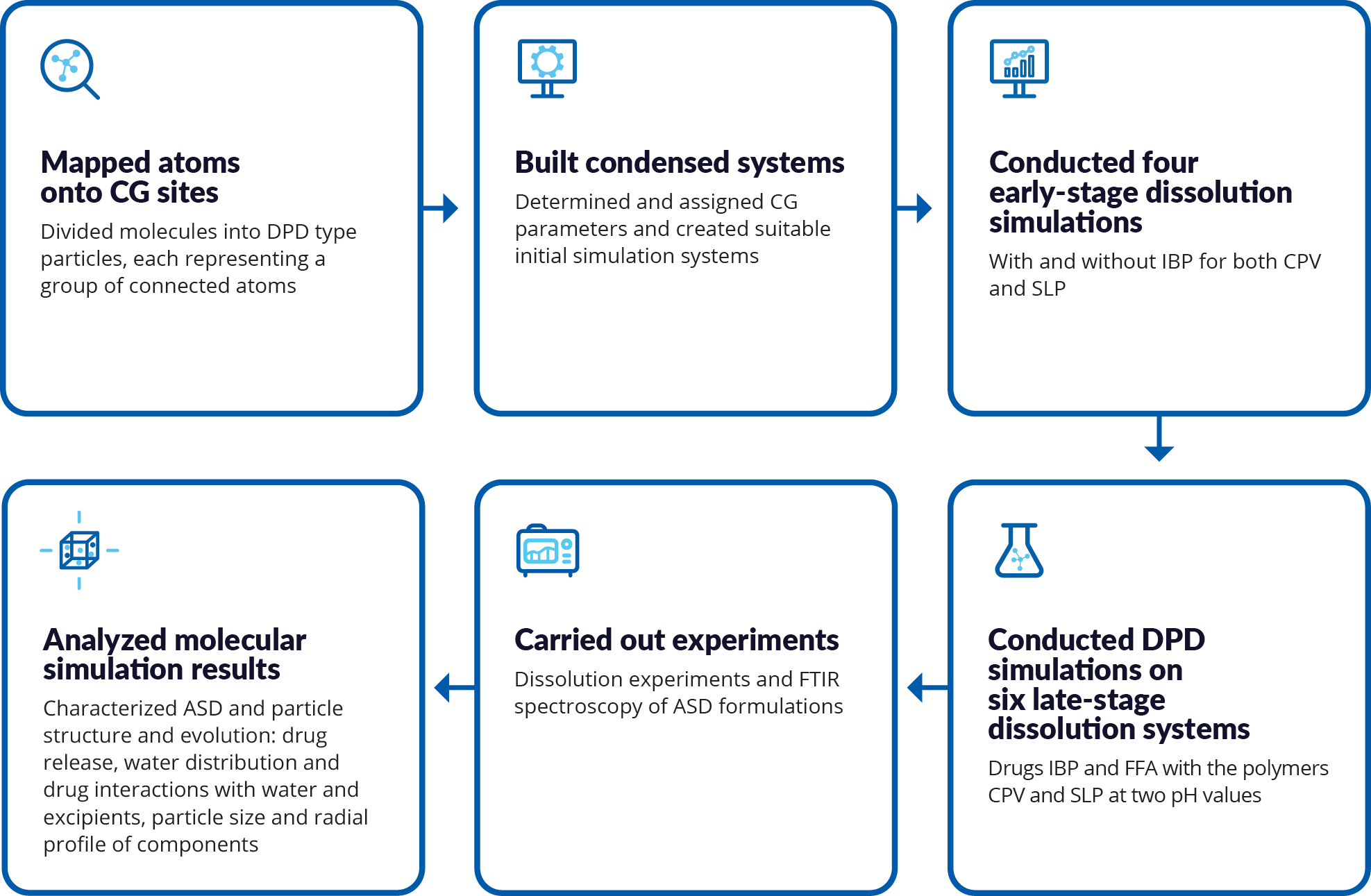
Scientists from AbbVie and Schrödinger worked together to use molecular simulations to provide insights needed to streamline time-consuming development cycles of drug formulations. A mesoscopic simulation method, dissipative particle dynamics (DPD), was employed to effectively model ASD dissolution on relatively long lengths and time scales. Two stages of the dissolution process were studied and compared with experimental investigations: the early-stage of the dissolution process, which focuses on the breakup and dissolution of the tablet at the ASD/water interface with the potential for the formation of drug-excipient particles, and the late-stage of the dissolution process where the aqueous medium contains more mature drug-excipient particles which are important for sustained supersaturation of the drug. All models and simulations were performed using the Schrödinger’s Materials Science platform and the Desmond engine for molecular dynamics (MD) and coarse-grained (CG) simulations.

*CPV, Copovidone; SLP, Soluplus; FFA, fenofibric acid; IBP, ibuprofen; PEG, polyethylene glycol


Results

  • Molecular simulation results were consistent and provided visual explanations for experiments from current and previous studies:
    • IBP/FFA interacts more with vinylcaprolactam in SLP than with vinylpyrrolidone in CPV
    • Water interacts more with vinylpyrrolidone in CPV than with vinylcaprolactam in SLP
    • Pure CPV dissolves faster than SLP, with water rapidly penetrating into CPV
    • Inclusion of IBP in CPV slows down the dissolution process
    • Release of IBP from SLP is slower than release from CPV
  • Molecular simulations provided additional insights:
    • CPV matrix showed more rapid hydration and breakup irrespective of drug presence, compared to the SLP matrix
    • Surfactant-like structures at the SLP ASD−water interface slow down water penetration into the formulation and thereby the drug release
    • Coherence of ASD degrades rapidly for low IBP/CPV ratios
    • Water distribution within the ASDs differs significantly between the two polymers
    • Within SLP, the PEG chain interacts more with water and less with drug molecules
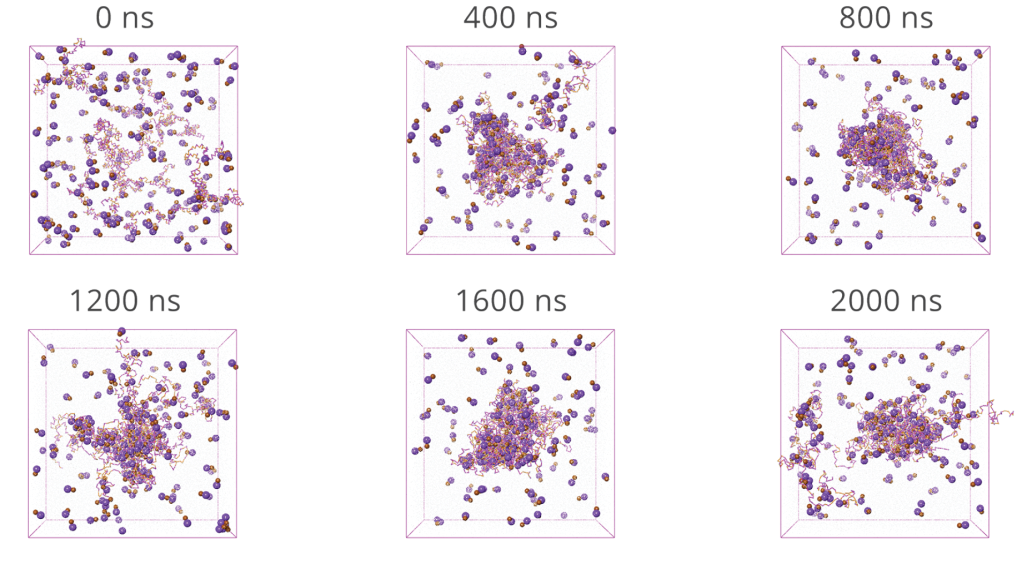
Figure 1: Snapshots at different times from the late-stage dissolution simulation of the IBP/SLP system in water at pH 6.8. The empty space in the box is occupied by water. It’s rendered transparent for better visibility of the polymer and drug molecules.


References

  1. Molecular-Level Examination of Amorphous Solid Dispersion Dissolution

    Mohammad Atif Faiz Afzal, Kristin Lehmkemper, Ekaterina Sobich, Thomas F. Hughes, David J. Giesen, Teng Zhang, Caroline M. Krauter, Paul Winget, Matthias Degenhardt, Samuel O. Kyeremateng*, Andrea R. Browning, and John C. Shelley* Mol. Pharmaceutics  2021, 18(11), 3999–4014


Learn more about our collaboration with AbbVie

Advancing the design and optimization of drug formulations with combined computational and experimental approaches

Scientists from AbbVie and Schrödinger collaborated to systematically investigate amorphous solid dispersion (ASD) dissolution behaviors by combining thermodynamic modeling, molecular simulation, and experimental research.

Read the case study

Software and services to meet your organizational needs

Software Platform

Deploy digital materials discovery workflows with a comprehensive and user-friendly platform grounded in physics-based molecular modeling, machine learning, and team collaboration.

Research Services

Leverage Schrödinger’s expert computational scientists to assist at key stages in your materials discovery and development process.

Support & Training

Access expert support, educational materials, and training resources designed for both novice and experienced users.

Schrödinger デジタル創薬セミナー: Impacting drug discovery programs with large-scale de novo design

FEB 21, 2024

Schrödinger デジタル創薬セミナー: Impacting drug discovery programs with large-scale de novo design

Impacting drug discovery programs with large-scale de novo design

高品質な化学物質の創製をより包括的かつ効果的に可能にする技術の開発は、薬物探索の長年の目標でした。

シュレーディンガーは近年、大規模な合成に注意を払ったde novoデザイン手法(AutoDesigner)と厳密な自由エネルギーに基づくスコアリング手法(Active Learning FEP+)を組み合わせ、小分子の効力と選択性を最適化するためのワークフローの開発を主導しています。この技術の最新の進展では、R-グループの設計を超えてコアの探索に進化し、初期のヒット同定の取り組みや代替系列の発見に拡張されました。

本セミナーでは、重要なデザインの課題を克服し、プログラムを加速させた、 de novoデザイン技術の最新事例を紹介します。


Highlights

  • AutoDesignerと他の一般的なデザイン手法の実際の比較。化学的なスペースの探索、費やされた時間、デザインの目標の達成能力の評価を含む。
  • AutoDesignerを使用したヒット同定中の新しいコアの設計。
  • AutoDesignerを使用したhit-to-leadおよびリード最適化におけるR-グループの設計。
  • 分子接着剤の効力と選択性の向上の例、およびde novoデザインを使用して知的財産権を強化する例。
  • 技術を薬物探索プログラムに適用するための要件とベストプラクティス。

Our Speakers

Pieter Bos, PhD

Principal Scientist II, Schrödinger

Pieter Bos is a principal scientist and product manager of AutoDesigner and De Novo Design workflows. At Schrödinger, his main focus is the research, development and optimization of automated compound design algorithms. Lead scientist for the design and execution of enumerated drug molecule libraries for internal and collaborative drug design projects. He received his Ph.D. in Synthetic Organic Chemistry from the University of Groningen in the laboratory of Prof. Ben Feringa. Prior to joining Schrödinger, he worked as a postdoctoral researcher in synthetic methodology development at Boston University (Prof. John Porco and Prof. Corey Stephenson) and small molecule drug discovery at Columbia University (Prof. Brent Stockwell.).

Sathesh Bhat, PhD

Executive Director, Schrödinger

Sathesh Bhat, Ph.D., executive director in the therapeutics group, joined Schrödinger in 2011. He is responsible for overseeing computational chemistry efforts on internal and partnered drug discovery programs at Schrödinger. Previously, Sathesh worked at both Merck and Eli Lilly leading computational efforts in several drug discovery programs. He obtained his Ph.D. from McGill University, which involved developing structure-based methods to predict binding free energies. Sathesh has co-authored multiple patents and publications and continues to publish on a wide variety of topics in computational chemistry.

Gang Wang, PhD

Principal Scientist II, Schrödinger

Gang Wang is a principal scientist in the therapeutics group at Schrödinger where he is responsible for drug discovery project execution as a medicinal chemist. Prior to Schrodinger, Gang worked at Revolution Medicines and PTC Therapeutics. He received his Ph.D. from University of Texas at Austin.