DeepAutoQSAR
Automated, scalable solution for the training and application of predictive machine learning models

Create high-performing machine learning models using state-of-the-art methods
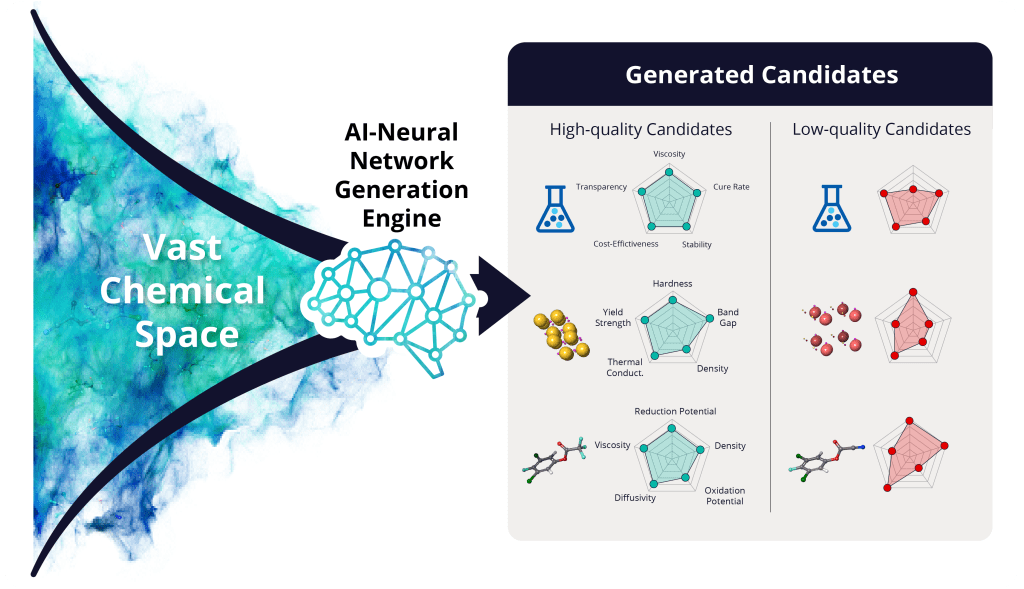
DeepAutoQSAR is a machine learning (ML) solution that allows users to predict molecular properties based on chemical structure. The automated, supervised learning pipeline enables both novice and experienced users to train and inference best-in-class quantitative structure activity/property relationship (QSAR/QSPR) models.
Key Capabilities
Streamline model building with fully automated workflows
Automatically compute descriptors and fingerprints, create models with multiple machine learning architectures, and evaluate model performance.
Customize models to your project with unique project-specific descriptors
Provide your own descriptors in CSV format to be used in addition to or instead of those generated by DeepAutoQSAR for a wide range of applications beyond small molecules, such as polymers, organic electronics, catalysis, and more.
Ensure model optimization using best practices
Employ QSAR/QSPR best practices to minimize the likelihood of overfitting or misrepresenting a model’s performance while ensuring maximum predictive model performance.
Understand the domain of applicability using model confidence estimates
DeepAutoQSAR provides uncertainty estimates alongside model predictions to help determine how much confidence should be placed on predictions generated for candidate molecules which may lie beyond the model’s training set.
Visualize and analyze results to gain further insights
Visualize color-coded atomic contributions towards target property facilitating ideation of novel chemistry. Visualize and analyze DeepAutoQSAR metrics reports and plots in Maestro to enable further experiments — quickly learn what model architectures are most effective and how models generalize on holdout sets.
Scalable training to support small or large datasets
Use classical ML methods like boosted trees on smaller datasets while also supporting the largest scale QSAR/QSPR models using graph neural networks and other modern deep learning approaches.

Case studies & webinars
Discover how Schrödinger technology is being used to solve real-world research challenges.
Documentation & Tutorials
Get answers to common questions and learn best practices for using Schrödinger’s software.
Related Products
Learn more about the related computational technologies available to progress your research projects.
Virtual Cluster
Secure, scalable environment for running simulations on the cloud
De Novo Design Workflow
Fully-integrated, cloud-based design system for ultra-large scale chemical space exploration and refinement
Jaguar
Quantum mechanics solution for rapid and accurate prediction of molecular structures and properties
MS Informatics
Automated machine learning tools for materials science applications
Quantum ESPRESSO Interface
Integrated graphical user interface for nanoscale quantum mechanical simulations
Publications
Browse the list of peer-reviewed publications using Schrödinger technology in related application areas.
Training & Resources
Online certification courses
Level up your skill set with hands-on, online molecular modeling courses. These self-paced courses cover a range of scientific topics and include access to Schrödinger software and support.
Tutorials
Learn how to deploy the technology and best practices of Schrödinger software for your project success. Find training resources, tutorials, quick start guides, videos, and more.






 Date & Time
  Location