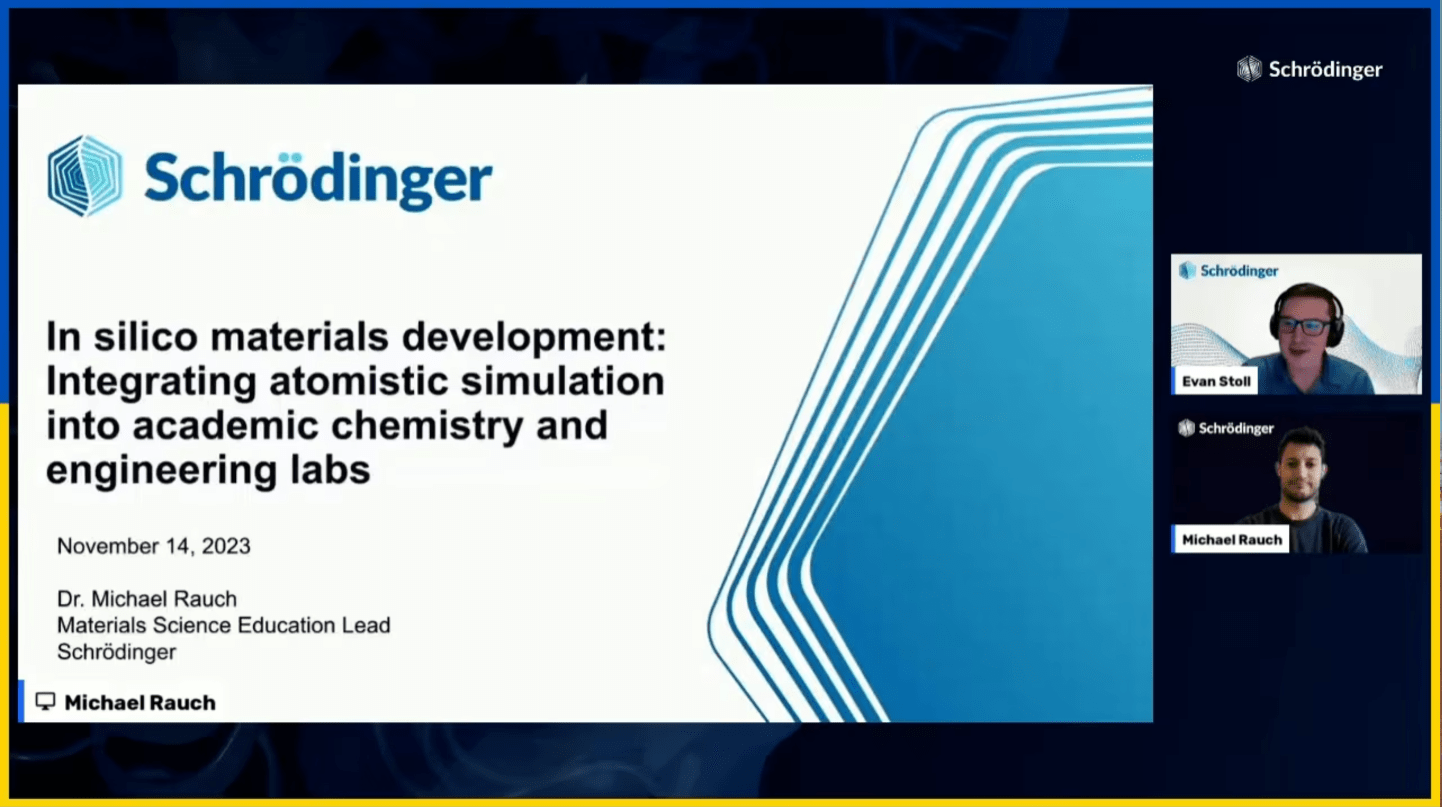
In silico materials development: Integrating atomistic simulation into academic chemistry and engineering labs

DEC 12, 2023

In silico materials development: Integrating atomistic simulation into academic chemistry and engineering labs

Speakers

Michael Rauch
Principal Scientist I

Abstract

Computational chemistry is ubiquitous in academic research in chemistry, materials science, and engineering. Applied molecular modeling can drive or supplement a research project – accelerating discovery processes, minimizing the need for extensive experimental testing, and providing atomic scale insights.

In this webinar, we explore Schrödinger’s leading physics-based and machine learning computational technologies and provide a comprehensive introduction to the capabilities of computational modeling in chemistry, materials science, and engineering.

We will discuss workflows and applications for polymeric materials, electronics, aerospace, renewable energy, catalysis, and formulations.

  • Molecular and periodic quantum mechanics (DFT) for property prediction and reaction mechanism elucidation
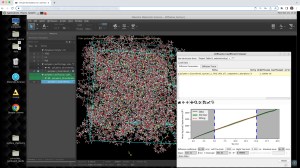
  • Accelerated polymer modeling with all-atom molecular dynamics
  • Coarse-grained methods to explore larger systems and longer timescales
  • Advanced machine learning models for new material discovery
  • Educational and training resources, such as Schrödinger’s seven online materials science certification courses

Following the webinar, the speaker will also be available to answer questions. Whether you are a student, an early career researcher, or an established expert seeking to expand your field of knowledge, this webinar promises to be a valuable resource for all levels of expertise interested in staying at the forefront of computational modeling in materials science.

Computational Chemistry

Computational Chemistry

Computational Chemistry

Maximize your impact on discovery programs with the industry-leading molecular modeling platform

As drug discovery increasingly shifts from computer-aided to computer-driven, computational chemists are in the position to have a larger impact than ever before. With Schrodinger’s platform for molecular design and discovery, you can access cutting-edge physics-based molecular modeling tools and machine learning technologies from a single modeling environment. Benefit from validated workflows with proven impact to drive your projects forward.

bg-circle

Integrated solution for molecular design and discovery

Streamline your work with diverse, powerful technologies in a single modeling environment

  • Access physics-based molecular simulation, machine learning capabilities, and advanced visualization through a single intuitive interface
  • Leverage workflows for diverse drug modalities – from small molecules and macrocycles to polypeptides, antibodies, enzymes, and targeted protein degraders
> Maestro

Amplify the impact of molecular modeling across project teams using a centralized collaboration platform

  • Empower medicinal chemists by deploying validated models for easy push-button access and results
  • Outsource routine tasks, enabling you to spend more of your time solving challenging modeling problems
  • Build rich dashboards capable of analyzing whole project data or individual molecules with customized views and drill-down dashboards
> LiveDesign

Advantages of the Schrödinger platform for computational chemists

Decades of innovation at your fingertips

Benefit from technology backed by 30+ years of scientific R&D and validated by thousands of customers across industries, with constant software improvement according to user feedback.

Speed, accuracy, and performance with GPU acceleration

Ensure you can deliver results and meet project timelines — with accelerated GPU-performance delivering speed, accuracy, and functionality.

Digital assays approaching experimental accuracy

Confidently pursue novel chemistry and prioritize compounds for synthesis using highly accurate, physics-based free energy calculations.

Flexible workflow automation capabilities

Leverage Schrödinger’s Python API to automate modeling capabilities using a universal scripting language.

Supported by a team of experts

Work with Schrödinger’s team of experts to access dedicated technical and scientific support and personalized training.

Large collection of resources for online learning 

Access vast online education resources, such as tutorials and online courses — facilitating rapid upskilling of your team, including experimentalists who are new to computational chemistry.

background image

You’re in good company

“A platform that fosters a ‘predict-first’ mindset and enables the full project team to collaborate on a crowdsourced design is key to drive decisions about the next best molecules to make. In Schrödinger’s LiveDesign we could consolidate best-of-breed scientific capabilities in a single interface, so that chemists can run standard modeling workflows in just a few clicks.”

Miriam Lopez-Ramos

Computational Chemistry Group Leader, Galapagos
Miriam Lopez-Ramos - Computational Chemistry Group Leader, Galapagos

Software and services to meet your organizational needs

Software Platform

Deploy digital drug discovery workflows using a comprehensive and user-friendly platform for molecular modeling, design, and collaboration.

Research Services

Leverage Schrödinger’s computational expertise and technology at scale to advance your projects through key stages in the drug discovery process.

Support & Training

Access expert support, educational materials, and training resources designed for both novice and experienced users.

MS Informatics

MS Informatics

Automated machine learning tools for materials science applications

Materials Science Informatics

Overview

MS Informatics provides molecular featurization and machine learning (ML) tools for organic, organometallic, polymer, chemical mixture (i.e., formulation), and inorganic solid materials to help design new materials through data driven approaches. By combining physics-based featurization, customized pretrained ML models, and automated workflows to train and evaluate ML models, users can take advantage of the computationally efficient data-driven approaches to screen and down select promising materials.

Key Capabilities

Build accurate material-property relationships using computationally efficient machine learning models for organic molecules, polymers, formulations, and more
Enhance model predicability with advanced, physics-informed descriptors for organic, inorganic, and polymer materials using cheminformatics, semi-empirical approaches, quantum mechanics (QM), and molecular dynamics (MD)
Use pre-trained ML models to predict properties such as polymer glass transition temperature, viscosity, density, and a variety of optoelectronic properties for molecules
Interact through an intuitive GUI to perform single-point and geometry optimization using Schrödinger’s universal machine learning force field (MPNICE) for both periodic and gas-phase systems

Case studies & webinars

Discover how Schrödinger technology is being used to solve real-world research challenges.

Materials Science Webinar

Formulation machine learning and optimization for accelerated materials discovery recording

Join our upcoming webinar to learn how your R&D team can leverage automated data driven solutions to guide the design of versatile chemical solutions.

Materials Science Webinar

Formulation machine learning and optimization for accelerated materials discovery

Join our upcoming webinar to learn how your R&D team can leverage automated data driven solutions to guide the design of versatile chemical solutions.

Materials Science Webinar

Formulation ML and Optimization: Making advanced property prediction and experimental design fast and accessible recording

We will showcase how easy it is to apply these tools using experimental datasets across broad MS applications, including formulations, consumer goods, batteries, pharmaceuticals, and beyond.

Materials Science Webinar

Formulation ML and Optimization: Making advanced property prediction and experimental design fast and accessible

We will showcase how easy it is to apply these tools using experimental datasets across broad MS applications, including formulations, consumer goods, batteries, pharmaceuticals, and beyond.

Materials Science Webinar

Formulation ML and Optimization: Making advanced property prediction and experimental design fast and accessible

We will showcase how easy it is to apply these tools using experimental datasets across broad MS applications, including formulations, consumer goods, batteries, pharmaceuticals, and beyond.

Materials Science Webinar

Accelerating OLED innovation with multi-scale, multi-physics simulations

Join us to explore how integrated digital workflows drive the design of next-generation, high-performance OLEDs.

Materials Science Case Study

The Future of Food: Molecular Simulations and AI/ML Reshaping Product Development

Materials Science Webinar

AI/ML meets physics-based simulations: A new era in complex materials design

In this webinar, we demonstrate the application of this combined approach in designing materials and formulations across diverse materials science applications, from battery electrolytes and fuel mixtures to thermoplastics and OLED devices. 

Materials Science Webinar

Electrodes, electrolytes & interfaces: Harnessing molecular simulation and machine learning for rapid advancements in battery materials development

In this webinar, we demonstrate the application of automated solutions for accurate prediction of electrode materials.

Materials Science Webinar

Schrödinger Materials Science Seminar Japan 2024 

《無料Webセミナー》材料開発向けシミュレーション・ソフトウェアおよびマテリアルズ・インフォマティクスの活用事例を紹介。

Includes pretrained machine learning models to predict a diverse range of properties

Boiling point and vapor pressure of organic and organometallic compounds
Glass transition temperature of polymers
Frequency-dependent polymer dielectric constant and dielectric loss
Density of small molecules
Viscosity of small molecules
Aqueous solubility of organic molecules
Non-aqueous solubility
Melting point
HOMO/LUMO
Optoelectronic properties

Absorption and emission peak position and bandwidth (FWHM)
Extinction coefficient
Emission lifetime
Photoluminescence quantum yield (PLQY)
Singlet-triplet energy gap (S1-T1)
Oxidation and reduction potentials

Broad applications across materials science research areas

Get more from your ideas by harnessing the power of large-scale chemical exploration and accurate in silico molecular prediction.

Catalysis & Reactivity
Energy Capture & Storage
Organic Electronics
Polymeric Materials
Pharmaceutical Formulations & Delivery
Consumer Packaged Goods

Documentation & Tutorials

Get answers to common questions and learn best practices for using Schrödinger’s software.

Materials Science Tutorial

De Novo Design of Novel Compounds with REINVENT

Learn to train a generative ML model with REINVENT to design new compounds with property constraints.

Materials Science Tutorial

Machine Learning for Formulations Containing Proteins

Learn to build machine learning models for formulations including proteins.

Materials Science Documentation

MS Informatics

Automated machine learning tools for materials science applications

Materials Science Documentation

Materials Science Panel Explorer

Quickly learn which Schrödinger tools are the best fit for your research.

Materials Science Tutorial

Machine Learning for Formulations

Learn to build and apply machine learning models to predict the density of multicomponent mixtures.

Materials Science Tutorial

Periodic Descriptors for Inorganic Solids

Generate descriptors for inorganic periodic crystal systems which can be used to build machine learning models.

Materials Science Tutorial

Polymer Descriptors for Machine Learning

Generate descriptors for polymers which can be used to build machine learning models.

Materials Science Tutorial

Molecular Dynamics Descriptors for Machine Learning

Generate descriptors using molecular dynamics simulation, which can be used to build machine learning models.

Materials Science Tutorial

Machine Learning for Ionic Conductivity

Generate descriptors for ionic liquids which can be used to build machine learning models.

Materials Science Tutorial

Machine Learning for Sweetness

Learn to use the DeepAutoQSAR panel to predict whether a molecule is sweet by machine learning methods.

Related Products

Learn more about the related computational technologies available to progress your research projects.

MS Formulation ML

Automated machine learning solution to generate accurate formulation-property relationships and screen new formulations with desired properties

MS Force Field Applications

Cutting-edge force field technologies for accurate property predictions

Jaguar

Quantum mechanics solution for rapid and accurate prediction of molecular structures and properties

OLED Device ML

Machine learning solution to investigate relationships between the architecture and performance of OLED devices for accelerated screening

MS Maestro

Complete modeling environment for your materials discovery

DeepAutoQSAR

Automated, scalable solution for the training and application of predictive machine learning models

AutoTS

Automatic workflow for locating transition states for elementary reactions

Quantum ESPRESSO Interface

Integrated graphical user interface for nanoscale quantum mechanical simulations

Publications

Browse the list of peer-reviewed publications using Schrödinger technology in related application areas.

Materials Science Publication

Data-Driven Design of Organic Semiconductors Exhibiting Low Reorganization Energy via Hierarchical Variational Autoencoders, Gaussian Mixture Regression, and Bayesian Optimization

Materials Science Publication

Multiobjective Design of Electrolyte Solvents via Physics-Based Modeling and Reinforcement Learning

Materials Science Publication

Screening Antioxidant Ingredients Using Quantum Mechanics and Machine Learning

Materials Science Publication

RedCat, an automated discovery workflow for aqueous organic electrolytes

Materials Science Publication

Band Gap and Reorganization Energy Prediction of Conducting Polymers by the Integration of Machine Learning and Density Functional Theory

Materials Science Publication

Leveraging high-throughput molecular simulations and machine learning for the design of chemical mixtures

Materials Science Publication

Designing polymersomes with surface-integrated nanoparticles through hierarchical phase separation

Materials Science Publication

Synthesis, optical and electrochemical properties of thiophene and thieno [3, 2-b] thiophene linked with structurally modified rhodanine based copolymers

Materials Science Publication

Stability enhancement of Amphotericin B using 3D printed biomimetic polymeric corneal patch to treat fungal infections

Materials Science Publication

Advancing efficiency in deep-blue OLEDs: Exploring a machine learning–driven multiresonance TADF molecular design

Training & Resources

Online certification courses

Level up your skill set with hands-on, online molecular modeling courses. These self-paced courses cover a range of scientific topics and include access to Schrödinger software and support.

Tutorials

Learn how to deploy the technology and best practices of Schrödinger software for your project success. Find training resources, tutorials, quick start guides, videos, and more.

Homogeneous catalysis & reactivity

Catalysis_Hero

Homogeneous catalysis & reactivity


Molecular quantum mechanics and machine learning approaches for studying reactivity and mechanism at the molecular level

Details
Available Languages
Chinese, English, Japanese, Korean
Duration
6 weeks / ~25 hours to complete
Level
Introductory
Cost
$600 for non-student users
$160 for student / post-doc
Course Timeframe
When registering for the course, you will be able to choose your preferred start and end date. Within those dates, you will have asynchronous access to the course to work on your preferred schedule

Overview

Computational molecular modeling tools have proven effective in materials science research and development. Chemists, physicists and engineers working in materials science will increasingly encounter molecular modeling throughout their careers, making it critical to have a foundational understanding of the cutting edge tools and methods. These courses are ideal for those who wish to develop professionally and expand their CV by earning certification and a badge.

These computational chemistry courses offer an effective and efficient approach to learn practical computational chemistry for materials science:

  • Work hands-on with Schrödinger’s industry-leading Materials Science Maestro software
  • Jump start your research program by learning methods that can be directly applied to ongoing projects
  • Learn topics ranging from density functional theory (DFT) to molecular dynamics to machine learning for materials design
  • Perform a completely independent case study to demonstrate mastery of the course content
  • Benefit from review and feedback from Schrödinger Education Team experts for course assignments and course-related queries
  • Work on the course materials on your own schedule whenever convenient for you


This course comes with access to a web-based version of Schrödinger software with the necessary licenses and compute resources for the course:

Requirements
  • A computer with reliable high speed internet access (8 Mbps or better)
  • A mouse and/or external monitor (recommended but not required)
  • Working knowledge of general chemistry
Certification
  • A certificate signed by the Schrödinger course lead
  • A badge that can be posted to social media, such as LinkedIn
background pattern

What you will learn

MS Maestro interface

Learn how to use an industry-leading interface for materials science modeling. No coding or scripting required to run modeling workflows

Density functional theory

Learn to apply DFT for automated property prediction for organic and inorganic molecules

Reaction mechanism elucidation

Learn to leverage quantum mechanical workflows to predict reaction pathways and energetics

Machine learning

Learn to apply machine learning for rapid and accurate property prediction of organic molecules and catalytically active complexes

Modules

Module 1
2 Hours

Introduction to materials modeling

Video
Video

Introduction to materials modeling and this online course

Video Tutorial
Video Tutorial

Introduction to materials science (MS) Maestro

Video
Video

Modeling for Homogeneous Catalysis and Reactivity

End checkpoint
Honor code agreement and checkpoint
Module 2
7 Hours + Compute Time

Molecular quantum mechanics

Video
Video

Introduction to molecular quantum mechanics (mQM)

Tutorial
Tutorials
  • Functionals, basis sets and geometry optimizations
  • R-group enumeration
  • QM multistage workflows
  • Rigid and relaxed coordinate scans
  • Energies of reactions
  • Organometallic complexes
End checkpoint
End of module checkpoint
Module 3
6 Hours + Compute Time

Molecular quantum mechanics

Tutorial
Tutorials
  • Bond and ligand dissociation energy
  • Beta elimination reactions
  • Locating transition states: Part 1
  • Locating transition states: Part 2
  • Reaction workflow for polyethylene insertion
  • Nanoreactor
  • Design of asymmetric catalysts with Automated Reaction Workflow
End checkpoint
End of module checkpoint
Module 4
3 Hours + Compute Time

Machine learning

Video
Video

Introduction to machine learning (ML)

Tutorial
Tutorials
  • Machine learning for materials science
  • Machine learning for homogeneous catalysis
End checkpoint
End of module checkpoint
Module 5
2 Hours + Compute Time

Guided case studies

Tutorial
Case studies
  • Fundamental organometallic reactivity
  • Combining AutoTS and reaction workflow
End checkpoint
End of Module Checkpoint
Module 6
4 Hours + Compute Time

Independent case study

Assignment
Assignment

Predicting regioselectivity of hydroboration

Course completion
Course completion and certification
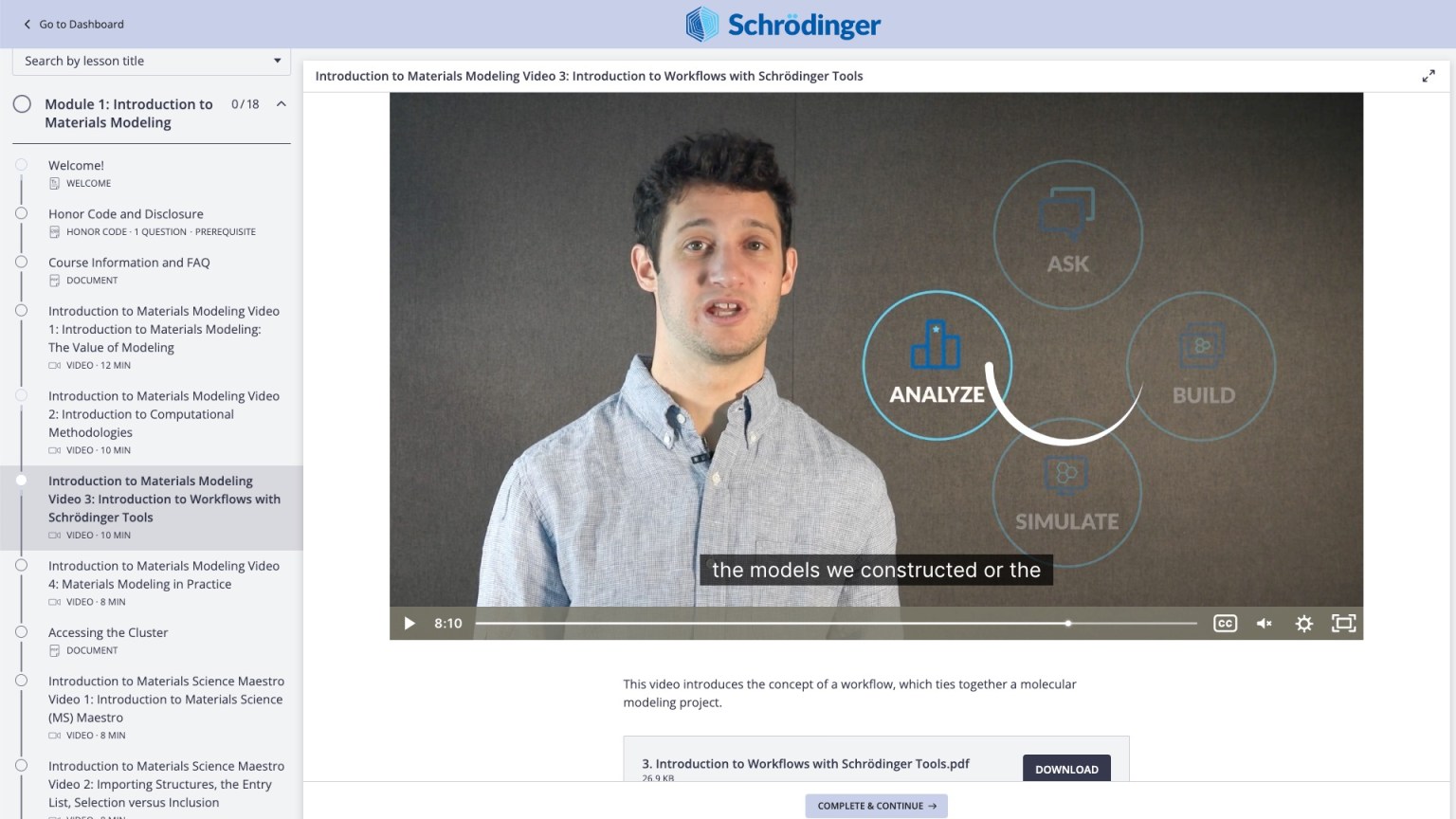
Self-paced video lessons on materials modeling

Self-paced video lessons on materials modeling

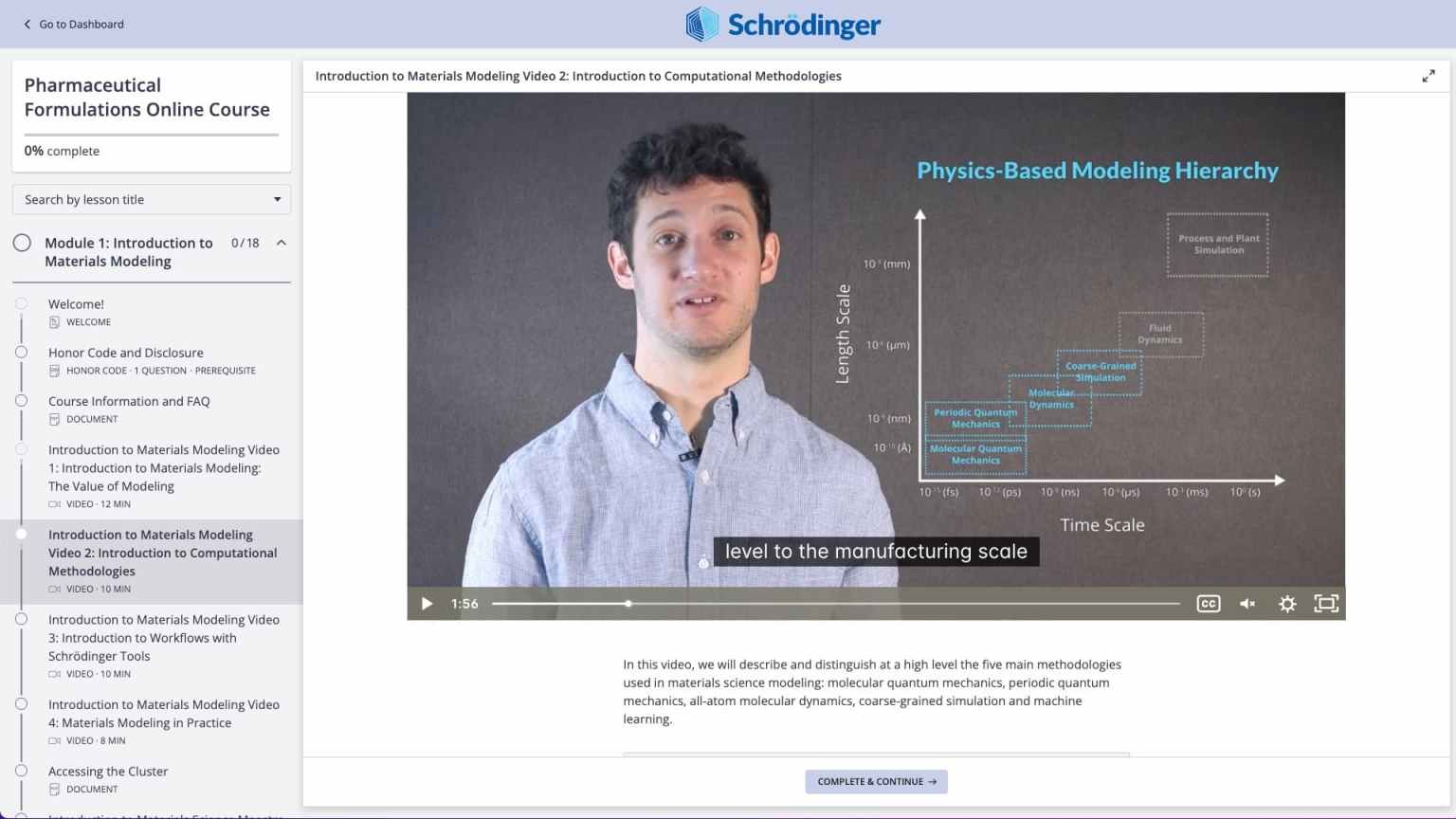
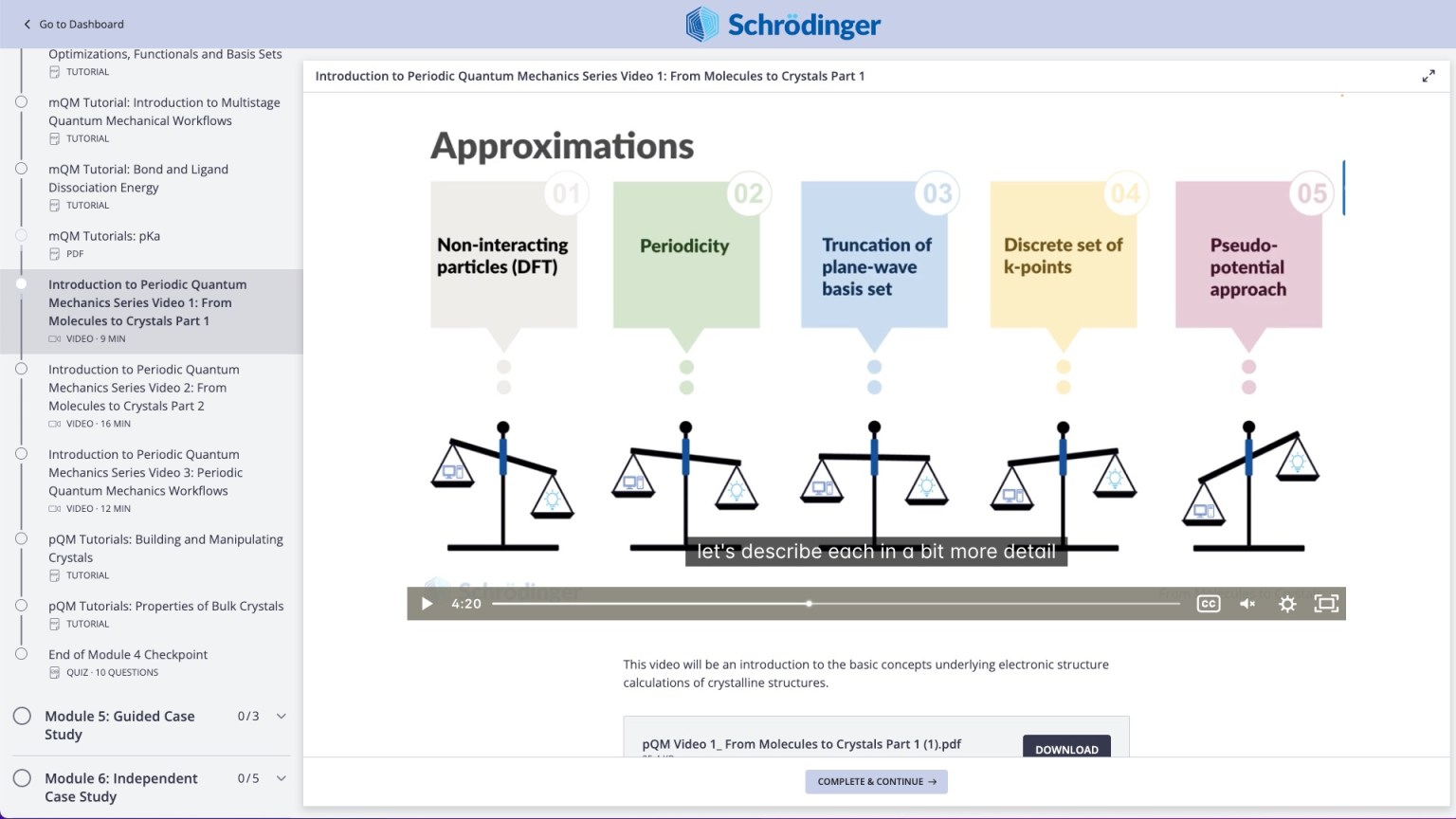
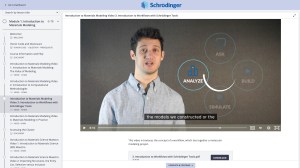
Videos on practical theory break down complex scientific concepts (e.g. Molecular Quantum Mechanics)

Videos on practical theory break down complex scientific concepts (e.g. Molecular Quantum Mechanics)

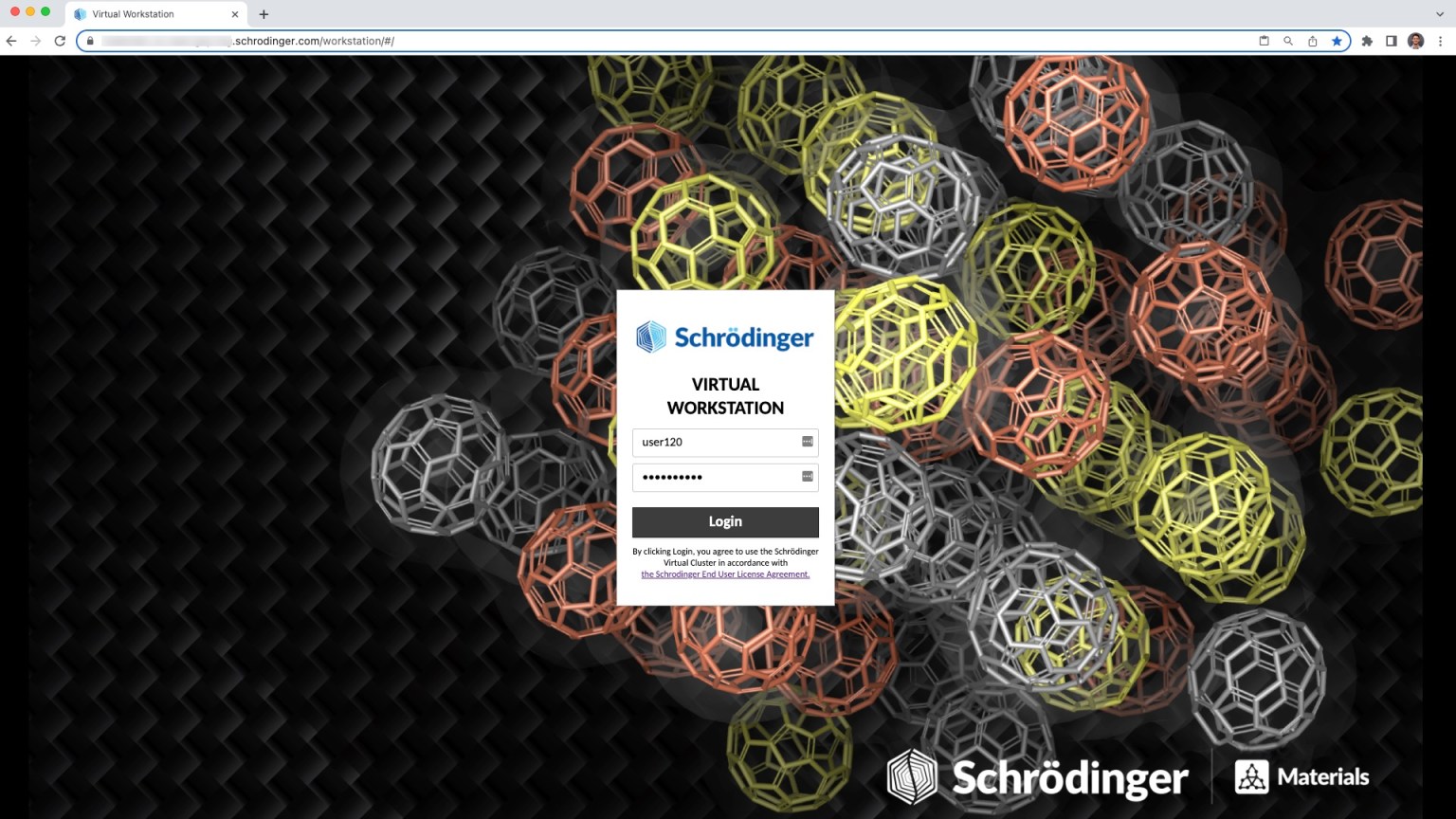
Access cloud-based computing resources to perform calculations yourself

Access cloud-based computing resources to perform calculations yourself

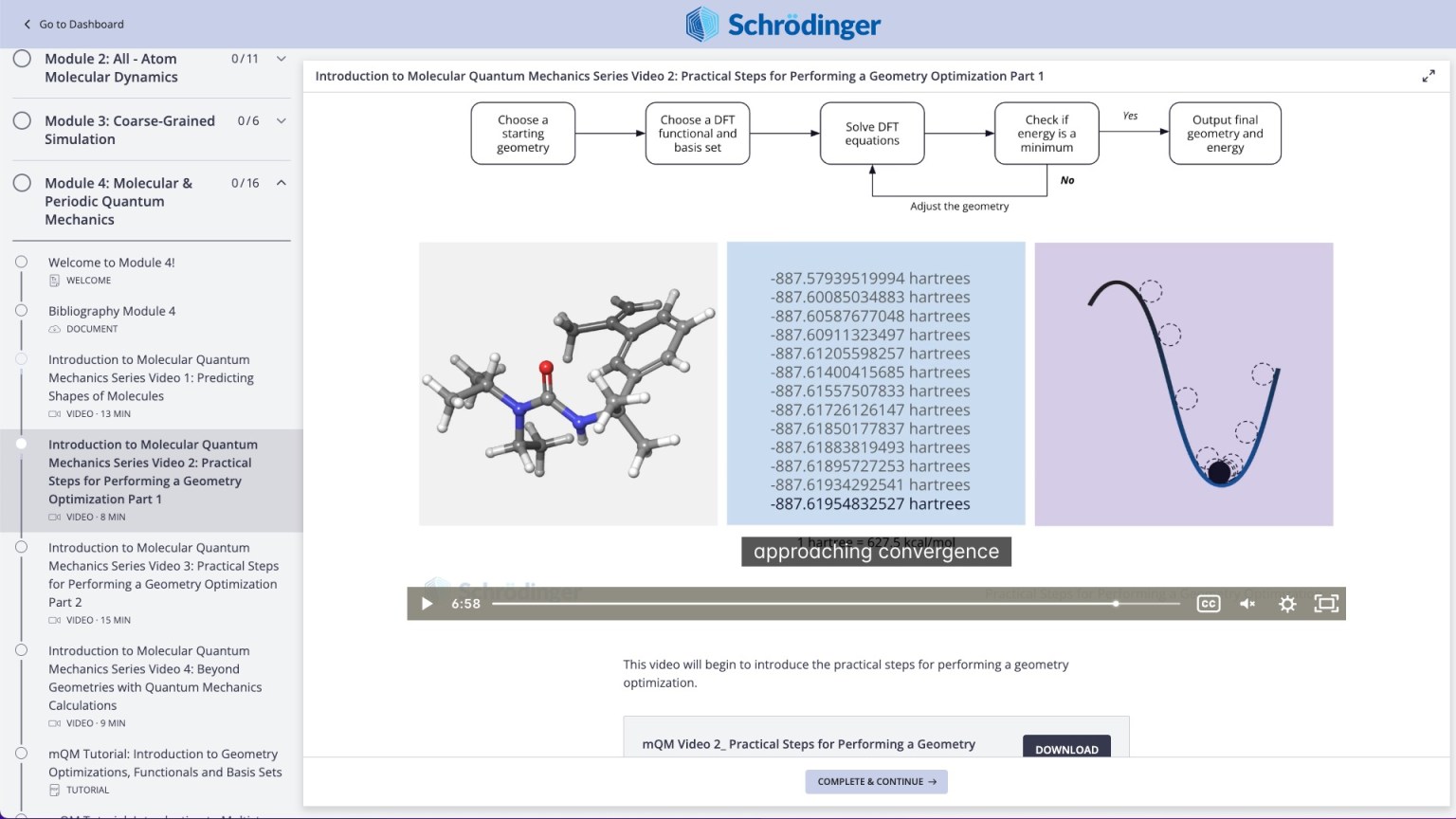
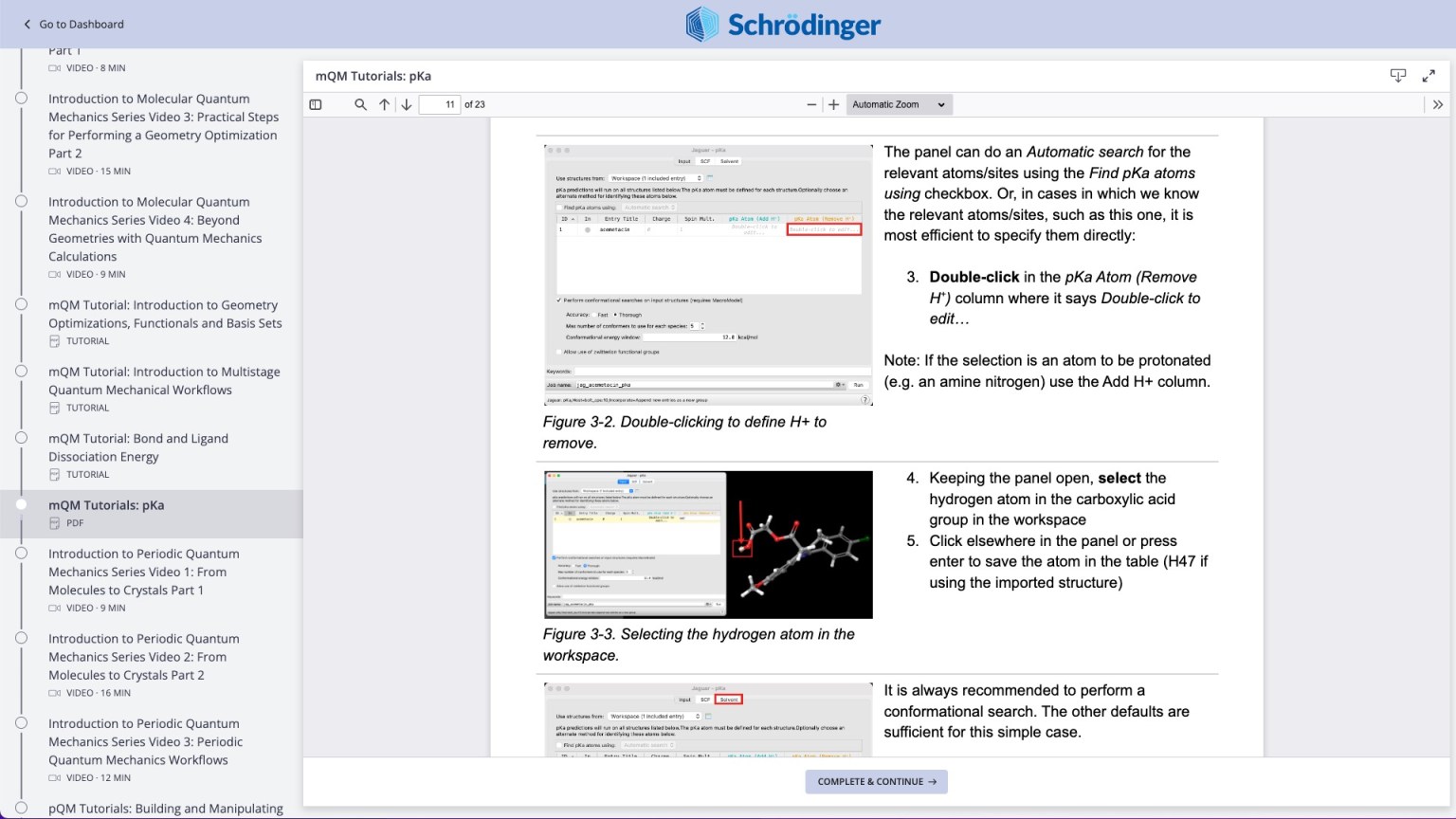
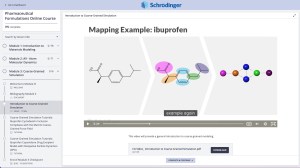
Hands-on step-by-step tutorials (e.g. Pharmaceutical Formulations course, pKa prediction)

Hands-on step-by-step tutorials (e.g. Pharmaceutical Formulations course, pKa prediction)

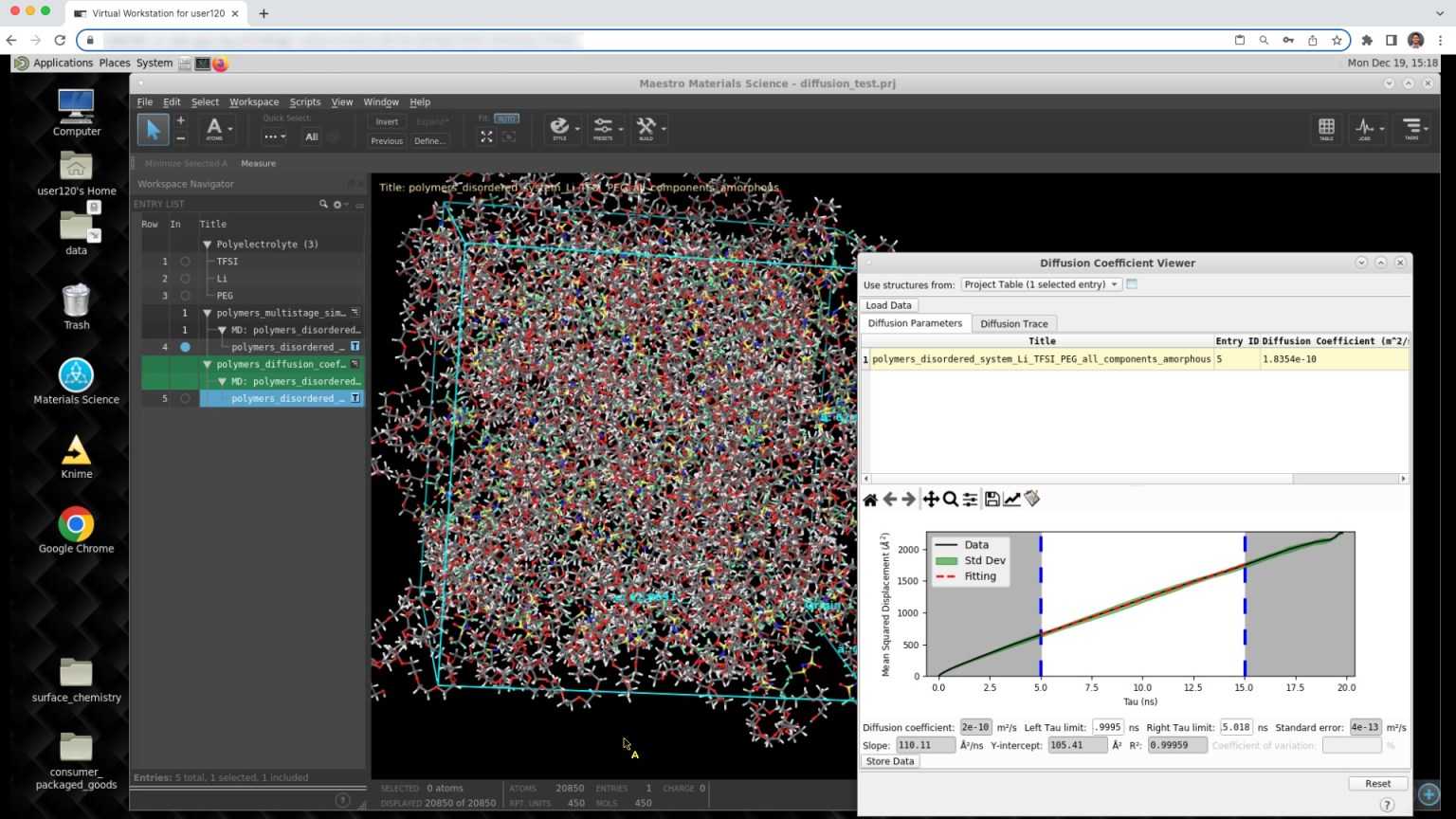
Hands-on modeling in the web-based graphical user interface (e.g. Polymeric Materials course, Diffusion tutorial)

Hands-on modeling in the web-based graphical user interface (e.g. Polymeric Materials course, Diffusion tutorial)

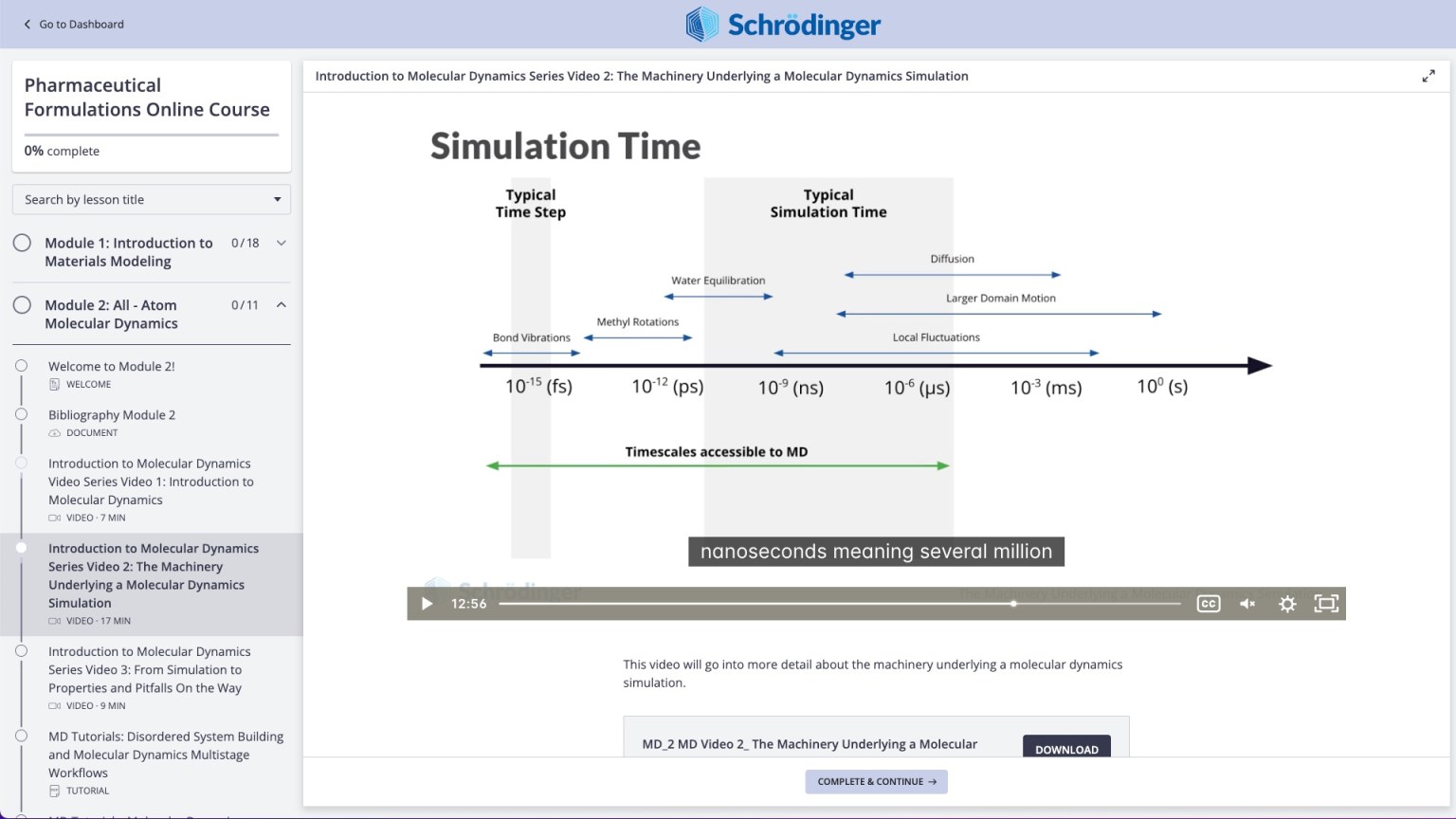
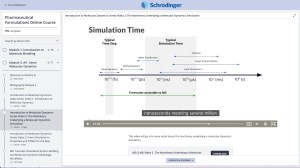
Videos on practical theory break down complex scientific concepts (e.g. Molecular Dynamics)

Videos on practical theory break down complex scientific concepts (e.g. Molecular Dynamics)

On-demand video lessons on materials modeling

On-demand video lessons on materials modeling

Access cloud-based computing resources to perform calculations yourself

Access cloud-based computing resources to perform calculations yourself

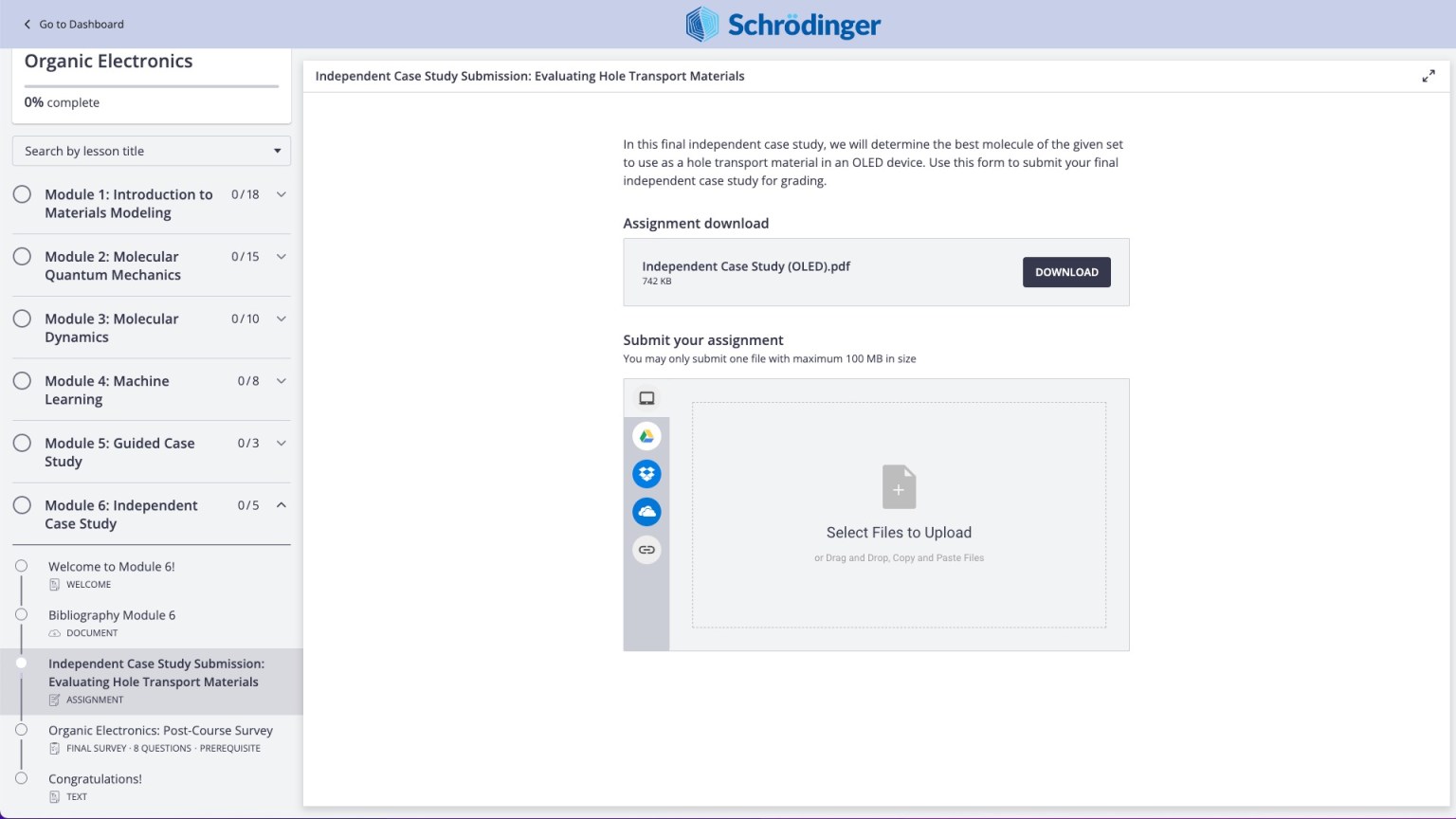
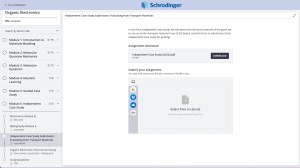
Perform case studies with expert feedback (e.g. Organic Electronic Course, Independent Case Study)

Perform case studies with expert feedback (e.g. Organic Electronic Course, Independent Case Study)

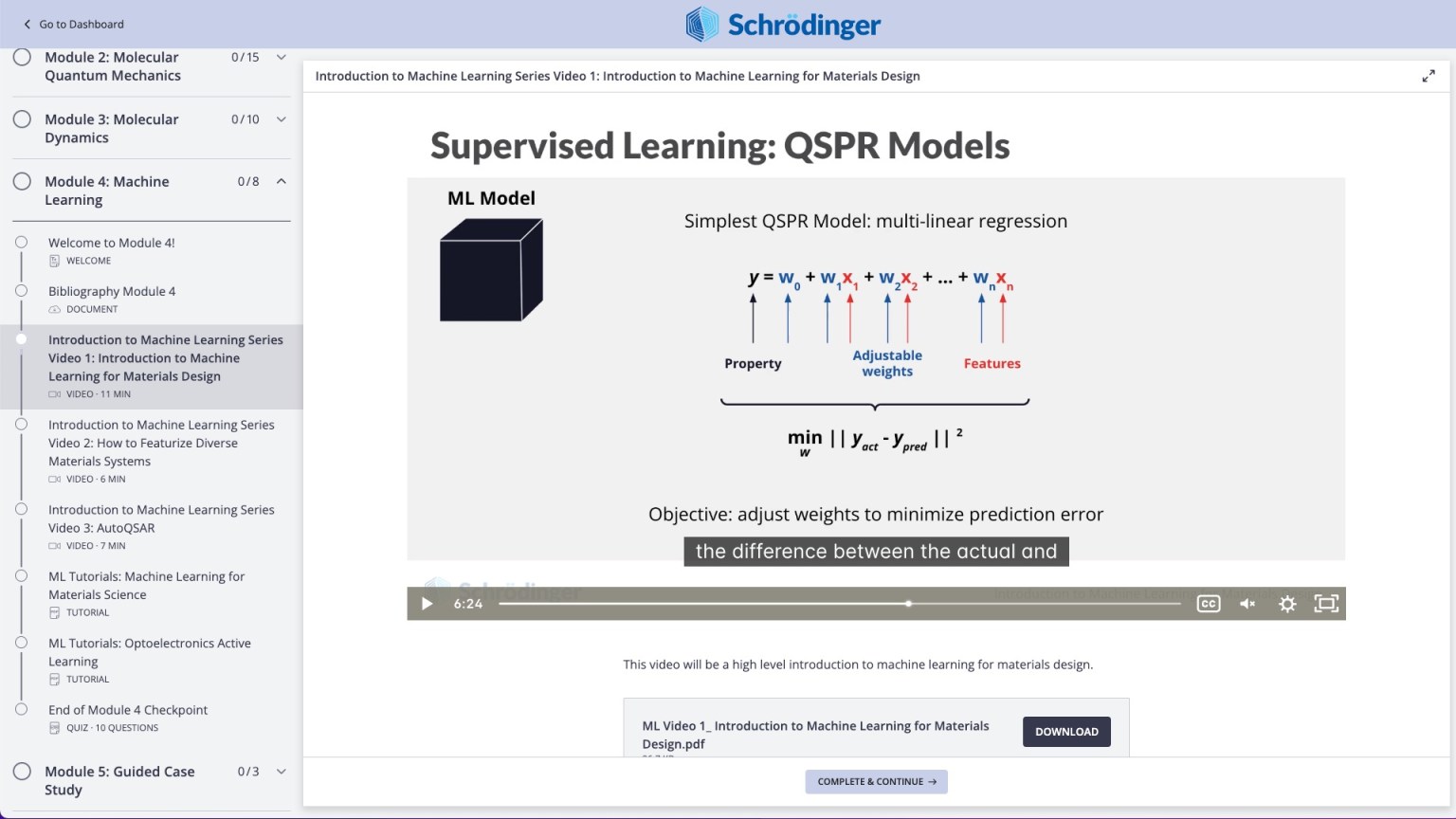
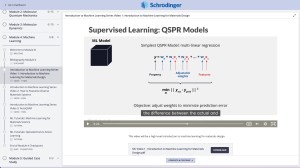
Video on practical theory break down complex scientific concepts (e.g. Machine Learning for Chemistry)

Video on practical theory break down complex scientific concepts (e.g. Machine Learning for Chemistry)

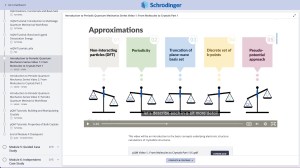
Videos on practical theory break down complex scientific concepts (e.g. Periodic Quantum Mechanics)

Videos on practical theory break down complex scientific concepts (e.g. Periodic Quantum Mechanics)

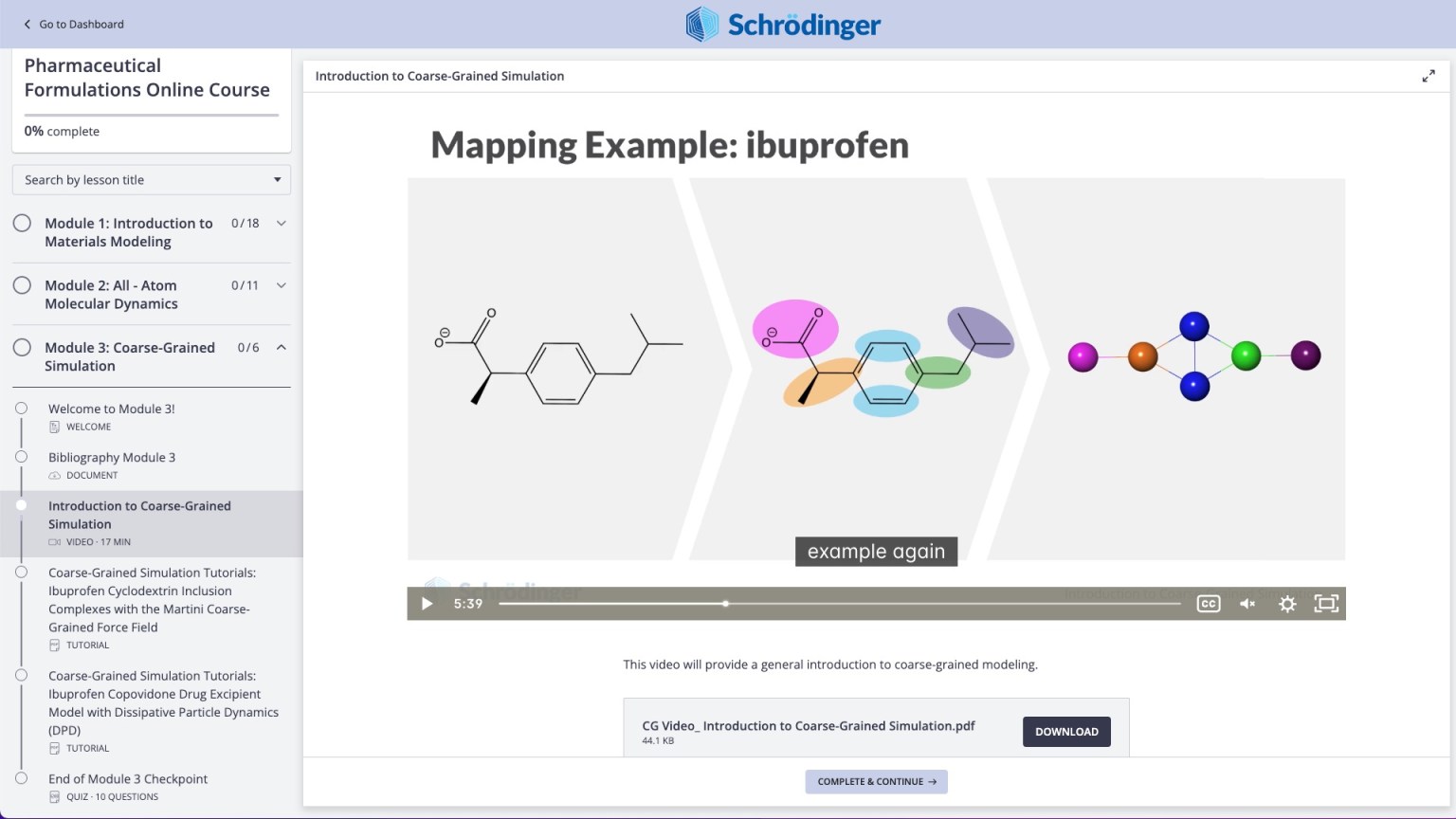
Videos on practical theory break down complex scientific concepts (e.g. Coarse-Graining)

Videos on practical theory break down complex scientific concepts (e.g. Coarse-Graining)

Self-paced video lessons on materials modeling
Videos on practical theory break down complex scientific concepts (e.g. Molecular Quantum Mechanics)
Access cloud-based computing resources to perform calculations yourself
Hands-on step-by-step tutorials (e.g. Pharmaceutical Formulations course, pKa prediction)
Hands-on modeling in the web-based graphical user interface (e.g. Polymeric Materials course, Diffusion tutorial)
Videos on practical theory break down complex scientific concepts (e.g. Molecular Dynamics)
On-demand video lessons on materials modeling
Access cloud-based computing resources to perform calculations yourself
Perform case studies with expert feedback (e.g. Organic Electronic Course, Independent Case Study)
Video on practical theory break down complex scientific concepts (e.g. Machine Learning for Chemistry)
Videos on practical theory break down complex scientific concepts (e.g. Periodic Quantum Mechanics)
Videos on practical theory break down complex scientific concepts (e.g. Coarse-Graining)

Need help obtaining funding for a Schrödinger Online Course?

We proudly support the next generation of scientists and are committed to providing opportunities to those with limited resources. Learn about your funding options for our online certification courses as a student, post-doc, or industry scientist and enroll today!

What our alumni say

“Clear instructions with a well-designed interface allowed me to run some of my own first molecular dynamics simulations. The information from the course felt much more secure than the information from YouTube because I knew it was developed by experts”
Graduate Student
“The course let me talk confidentially about molecular modeling and what it can do. For me, this was a nice experience which left me with many ideas for applying molecular modeling in the research area of our department, not only for me but also for my colleagues.”
Graduate Student
“As always, the course is very well designed. Formulation is quite outside my comfort zone in terms of theory and modeling but this course provided me with knowledge of evaluating what modeling can facilitate in the real world. Really great design and education process.”
Senior DirectorTherapeutic Protein Design

Show off your newly acquired skills with a course badge and certificate

When you complete a course with us in molecular modeling and are ready to share what you learned with your colleagues and employers, you can share your certificate and badge on your LinkedIn profile.

Frequently asked questions

How much do the online courses cost?

Pricing varies by each course and by the participant type. For students wishing to take these courses, we offer a student price of $150 for introductory courses, $305 for the Materials Science bundle, and $870 for advanced courses. For commercial participants, the course price is $575 for introductory courses and $1435 for advanced courses and bundles.

When does the course start?

The courses run on sessions, which range from 3-6 week periods during which the course and access to software are available to participants. You can find the course session and start dates on each course page.

What time are the lectures?

Once the course session begins, all lectures are asynchronous and you can view the self-paced videos, tutorials, and assignments at your convenience.

How could I pay for this course?

Interested participants can pay for the course by completing their registration and using the credit card portal for an instant sign up. Please note that a credit card is required as we do not accept debit cards. Additionally, we can provide a purchase order upon request, please email online-learning@schrodinger.com if you are interested in this option. If you have any questions regarding how to pay for the course, please visit our funding options page.

How can I preview the course before registering?
Are there any scholarship opportunities available for students?

Schrödinger is committed to supporting students with limited resources. Schrödinger’s mission is to improve human health and quality of life by transforming the way therapeutics and materials are discovered. Schrödinger proudly supports the next generation of scientists. We have created a scholarship program that is open to full-time students or post-docs to students who can demonstrate financial need, and have a statement of support from the academic advisor. Please complete the application form if you qualify for our scholarship program!

Will material still be available after a course ends?

While access to the software will end when the course closes, some of the material within the course (slides, papers, and tutorials) are available for download so that you can refer back to it after the course. Other materials, such as videos, quizzes, and access to the software, will only be available for the duration of the course.

Do I need access to the software to be able to do the course? Do I have to purchase the software separately?

For the duration of the course, you will have access to a web-based version of Maestro, Bioluminate, Materials Science Maestro and/or LiveDesign (depending on the course). You do not have to separately purchase access to any software. While access to the software will end when the course closes, some of the material within the course (slides, papers, and tutorials) are available for download so that you can refer back to it after the course. Other materials, such as videos, quizzes, and access to the software, will only be available for the duration of the course. Please note that Schrödinger software is only to be used for course-related purposes.

Related Courses

Molecular modeling for materials science applications: Polymeric materials course Materials Science Materials Science
Polymeric materials

All-atom molecular dynamics and machine learning approaches for studying polymeric materials and their properties under various conditions

Molecular modeling for materials science applications: course bundle Materials Science Materials Science
Course bundle

Access all materials science courses with a single, discounted registration

Molecular Modeling for Materials Science: Pharmaceutical Formulations Materials Science Materials Science
Pharmaceutical formulations

Molecular and periodic quantum mechanics, all atom molecular dynamics, and coarse-grained approaches for studying active pharmaceutical ingredients and their formulations

Supporting Associations

nanoHUB

Consumer packaged goods

CPG_Hero

Consumer packaged goods


All-atom molecular dynamics, coarse-grained, and machine learning approaches for studying materials integral to the formulation of CPG

Details
Available Languages
Chinese, English, Japanese, Korean
Duration
6 weeks / ~25 hours to complete
Level
Introductory
Cost
$600 for non-student users
$160 for student / post-doc
Course Timeframe
When registering for the course, you will be able to choose your preferred start and end date. Within those dates, you will have asynchronous access to the course to work on your preferred schedule

Overview

Computational molecular modeling tools have proven effective in materials science research and development. Chemists, physicists and engineers working in materials science will increasingly encounter molecular modeling throughout their careers, making it critical to have a foundational understanding of the cutting edge tools and methods. These courses are ideal for those who wish to develop professionally and expand their CV by earning certification and a badge.

These computational chemistry courses offer an effective and efficient approach to learn practical computational chemistry for materials science:

  • Work hands-on with Schrödinger’s industry-leading Materials Science Maestro software
  • Jump start your research program by learning methods that can be directly applied to ongoing projects
  • Learn topics ranging from density functional theory (DFT) to molecular dynamics to machine learning for materials design
  • Perform a completely independent case study to demonstrate mastery of the course content
  • Benefit from review and feedback from Schrödinger Education Team experts for course assignments and course-related queries
  • Work on the course materials on your own schedule whenever convenient for you


This course comes with access to a web-based version of Schrödinger software with the necessary licenses and compute resources for the course:

Requirements
  • A computer with reliable high speed internet access (8 Mbps or better)
  • A mouse and/or external monitor (recommended but not required)
  • Working knowledge of general chemistry
Certification
  • A certificate signed by the Schrödinger course lead
  • A badge that can be posted to social media, such as LinkedIn
background pattern

What you will learn

MS Maestro interface

Learn how to use an industry-leading interface for materials science modeling. No coding or scripting required to run modeling workflows

Molecular dynamics

Learn to leverage all-atom MD simulations for simulating complex formulations and their properties

Coarse-grained simulation

Accessing larger length scale and longer time scales by employing coarse-grained methods to study formulations

Machine learning

Learn to apply machine learning for rapid and accurate property prediction of organic molecules and polymers

Modules

Module 1
2 Hours

Introduction to materials modeling

Video
Video

Introduction to materials modeling

Video Tutorial
Video tutorial

Introduction to materials science (MS) Maestro

Video
Video

Modeling for consumer packaged goods

End checkpoint
Honor code agreement and checkpoint
Module 2
6 Hours + Compute Time

All-atom molecular dynamics

Video
Video

Introduction to molecular dynamics (MD)

Tutorial
Tutorials
  • Disordered system building and MD multistage workflows
  • Building, equilibrating and analyzing polymers
  • Building a carbohydrate polymer
  • Building polymer-polymer interfaces
  • Surfactant tilt and electrostatic potential
  • Starch moisture uptake and plasticization
  • Adsorption of Panthenol on skin with all-atom molecular dynamics
End checkpoint
End of module checkpoint
Module 3
2 Hours + Compute Time

Coarse-grained simulation

Video
Video

Introduction to coarse-graining (CG)

Tutorial
Tutorials
  • Building a coarse-grained surfactant model
  • Building a coarse-grained skin model
End checkpoint
End of module checkpoint
Module 4
4 Hours + Compute Time

Machine learning

Video
Video

Introduction to machine learning (ML)

Tutorial
Tutorials
  • Machine learning for materials science
  • Polymer descriptors for machine learning
  • Machine learning for sweetness
  • Training and evaluating ADMET models with DeepAutoQSAR
End checkpoint
End of module checkpoint
Module 5
4 hours + Comp Time

Molecular quantum mechanics

Video
Video

Introduction to quantum mechanics (mQM)

Tutorial
Tutorials
  • Functionals, basis sets and geometry optimizations
  • QM multistage workflows
  • Energies of reactions
  • Locating transition states
  • Nanoreactor
End checkpoint
End of Module Checkpoint
Module 6
2 Hours + Compute Time

Guided case studies

Tutorial
Case studies
  • Coarse-grained modeling of SLES
  • Modeling the formation and decomposition of nitrosamines
End checkpoint
End of module checkpoint
Module 7
4 Hours + Compute Time

Independent case study

Assignment
Assignment

Self-aggregation of DDM and DPC molecules

Course completion
Course completion and certification
Self-paced video lessons on materials modeling

Self-paced video lessons on materials modeling

Videos on practical theory break down complex scientific concepts (e.g. Molecular Quantum Mechanics)

Videos on practical theory break down complex scientific concepts (e.g. Molecular Quantum Mechanics)

Access cloud-based computing resources to perform calculations yourself

Access cloud-based computing resources to perform calculations yourself

Hands-on step-by-step tutorials (e.g. Pharmaceutical Formulations course, pKa prediction)

Hands-on step-by-step tutorials (e.g. Pharmaceutical Formulations course, pKa prediction)

Hands-on modeling in the web-based graphical user interface (e.g. Polymeric Materials course, Diffusion tutorial)

Hands-on modeling in the web-based graphical user interface (e.g. Polymeric Materials course, Diffusion tutorial)

Videos on practical theory break down complex scientific concepts (e.g. Molecular Dynamics)

Videos on practical theory break down complex scientific concepts (e.g. Molecular Dynamics)

On-demand video lessons on materials modeling

On-demand video lessons on materials modeling

Access cloud-based computing resources to perform calculations yourself

Access cloud-based computing resources to perform calculations yourself

Perform case studies with expert feedback (e.g. Organic Electronic Course, Independent Case Study)

Perform case studies with expert feedback (e.g. Organic Electronic Course, Independent Case Study)

Video on practical theory break down complex scientific concepts (e.g. Machine Learning for Chemistry)

Video on practical theory break down complex scientific concepts (e.g. Machine Learning for Chemistry)

Videos on practical theory break down complex scientific concepts (e.g. Periodic Quantum Mechanics)

Videos on practical theory break down complex scientific concepts (e.g. Periodic Quantum Mechanics)

Videos on practical theory break down complex scientific concepts (e.g. Coarse-Graining)

Videos on practical theory break down complex scientific concepts (e.g. Coarse-Graining)

Self-paced video lessons on materials modeling
Videos on practical theory break down complex scientific concepts (e.g. Molecular Quantum Mechanics)
Access cloud-based computing resources to perform calculations yourself
Hands-on step-by-step tutorials (e.g. Pharmaceutical Formulations course, pKa prediction)
Hands-on modeling in the web-based graphical user interface (e.g. Polymeric Materials course, Diffusion tutorial)
Videos on practical theory break down complex scientific concepts (e.g. Molecular Dynamics)
On-demand video lessons on materials modeling
Access cloud-based computing resources to perform calculations yourself
Perform case studies with expert feedback (e.g. Organic Electronic Course, Independent Case Study)
Video on practical theory break down complex scientific concepts (e.g. Machine Learning for Chemistry)
Videos on practical theory break down complex scientific concepts (e.g. Periodic Quantum Mechanics)
Videos on practical theory break down complex scientific concepts (e.g. Coarse-Graining)

Need help obtaining funding for a Schrödinger Online Course?

We proudly support the next generation of scientists and are committed to providing opportunities to those with limited resources. Learn about your funding options for our online certification courses as a student, post-doc, or industry scientist and enroll today!

What our alumni say

“Clear instructions with a well-designed interface allowed me to run some of my own first molecular dynamics simulations. The information from the course felt much more secure than the information from YouTube because I knew it was developed by experts”
Graduate Student
“The course let me talk confidentially about molecular modeling and what it can do. For me, this was a nice experience which left me with many ideas for applying molecular modeling in the research area of our department, not only for me but also for my colleagues.”
Graduate Student
“As always, the course is very well designed. Formulation is quite outside my comfort zone in terms of theory and modeling but this course provided me with knowledge of evaluating what modeling can facilitate in the real world. Really great design and education process.”
Senior DirectorTherapeutic Protein Design

Show off your newly acquired skills with a course badge and certificate

When you complete a course with us in molecular modeling and are ready to share what you learned with your colleagues and employers, you can share your certificate and badge on your LinkedIn profile.

Frequently asked questions

How much do the online courses cost?

Pricing varies by each course and by the participant type. For students wishing to take these courses, we offer a student price of $150 for introductory courses, $305 for the Materials Science bundle, and $870 for advanced courses. For commercial participants, the course price is $575 for introductory courses and $1435 for advanced courses and bundles.

When does the course start?

The courses run on sessions, which range from 3-6 week periods during which the course and access to software are available to participants. You can find the course session and start dates on each course page.

What time are the lectures?

Once the course session begins, all lectures are asynchronous and you can view the self-paced videos, tutorials, and assignments at your convenience.

How could I pay for this course?

Interested participants can pay for the course by completing their registration and using the credit card portal for an instant sign up. Please note that a credit card is required as we do not accept debit cards. Additionally, we can provide a purchase order upon request, please email online-learning@schrodinger.com if you are interested in this option. If you have any questions regarding how to pay for the course, please visit our funding options page.

How can I preview the course before registering?
Are there any scholarship opportunities available for students?

Schrödinger is committed to supporting students with limited resources. Schrödinger’s mission is to improve human health and quality of life by transforming the way therapeutics and materials are discovered. Schrödinger proudly supports the next generation of scientists. We have created a scholarship program that is open to full-time students or post-docs to students who can demonstrate financial need, and have a statement of support from the academic advisor. Please complete the application form if you qualify for our scholarship program!

Will material still be available after a course ends?

While access to the software will end when the course closes, some of the material within the course (slides, papers, and tutorials) are available for download so that you can refer back to it after the course. Other materials, such as videos, quizzes, and access to the software, will only be available for the duration of the course.

Do I need access to the software to be able to do the course? Do I have to purchase the software separately?

For the duration of the course, you will have access to a web-based version of Maestro, Bioluminate, Materials Science Maestro and/or LiveDesign (depending on the course). You do not have to separately purchase access to any software. While access to the software will end when the course closes, some of the material within the course (slides, papers, and tutorials) are available for download so that you can refer back to it after the course. Other materials, such as videos, quizzes, and access to the software, will only be available for the duration of the course. Please note that Schrödinger software is only to be used for course-related purposes.

Related Courses

Molecular modeling for materials science applications: Polymeric materials course Materials Science Materials Science
Polymeric materials

All-atom molecular dynamics and machine learning approaches for studying polymeric materials and their properties under various conditions

Molecular modeling for materials science applications: course bundle Materials Science Materials Science
Course bundle

Access all materials science courses with a single, discounted registration

Molecular Modeling for Materials Science: Pharmaceutical Formulations Materials Science Materials Science
Pharmaceutical formulations

Molecular and periodic quantum mechanics, all atom molecular dynamics, and coarse-grained approaches for studying active pharmaceutical ingredients and their formulations

Supporting Associations

nanoHUB

Surface chemistry

Surface chemistry

Surface chemistry


Molecular quantum mechanics, periodic quantum mechanics, and machine learning approaches for studying atomic layer processing and heterogeneous catalysis

Details
Available Languages
Chinese, English, Japanese, Korean
Duration
6 weeks / ~25 hours to complete
Level
Introductory
Cost
$600 for non-student users
$160 for student / post-doc
Course Timeframe
When registering for the course, you will be able to choose your preferred start and end date. Within those dates, you will have asynchronous access to the course to work on your preferred schedule

Overview

Computational molecular modeling tools have proven effective in materials science research and development. Chemists, physicists and engineers working in materials science will increasingly encounter molecular modeling throughout their careers, making it critical to have a foundational understanding of the cutting edge tools and methods. These courses are ideal for those who wish to develop professionally and expand their CV by earning certification and a badge.

These computational chemistry courses offer an effective and efficient approach to learn practical computational chemistry for materials science:

  • Work hands-on with Schrödinger’s industry-leading Materials Science Maestro software
  • Jump start your research program by learning methods that can be directly applied to ongoing projects
  • Learn topics ranging from density functional theory (DFT) to molecular dynamics to machine learning for materials design
  • Perform a completely independent case study to demonstrate mastery of the course content
  • Benefit from review and feedback from Schrödinger Education Team experts for course assignments and course-related queries
  • Work on the course materials on your own schedule whenever convenient for you


This course comes with access to a web-based version of Schrödinger software with the necessary licenses and compute resources for the course:

Requirements
  • A computer with reliable high speed internet access (8 Mbps or better)
  • A mouse and/or external monitor (recommended but not required)
  • Working knowledge of general chemistry
Certification
  • A certificate signed by the Schrödinger course lead
  • A badge that can be posted to social media, such as LinkedIn
background pattern

What you will learn

MS Maestro interface

Learn how to use an industry-leading interface for materials science modeling. No coding or scripting required to run modeling workflows

Molecular quantum mechanics

Learn to apply density functional theory (DFT) for automated property prediction for organic and organometallic molecules

Periodic quantum mechanics

Learn to apply density functional theory (DFT) for studying surface reactivity

Machine learning

Learn to apply machine learning for rapid and accurate property prediction of organic molecules and periodic crystals

Modules

Module 1
2 Hours

Introduction to materials modeling

Video
Video

Introduction to materials modeling & this online course

Video Tutorial
Video tutorial

Introduction to materials science (MS) Maestro

Video
Video

Modeling for surface chemistry

End checkpoint
Honor code agreement and checkpoint
Module 2
6 Hours + Compute Time

Molecular quantum mechanics

Video
Video

Introduction to Molecular quantum mechanics (mQM)

Tutorial
Tutorials
  • Functionals, basis sets and geometry optimizations
  • QM multistage workflows
  • Energies of reactions
  • R-Group enumeration
  • Organometallic complexes
  • Beta elimination reactions
  • Bond and ligand dissociation
End checkpoint
End of module checkpoint
Module 3
5 Hours + Compute Time

Periodic quantum mechanics

Video
Video

Introduction to periodic quantum mechanics (pQM)

Tutorial
Tutorials
  • Building and manipulating crystals
  • Properties of bulk crystals
  • Modeling surfaces
  • Organometallic complexes
  • Activation energies for reactivity in solids and on surfaces
  • Microkinetic modeling
End checkpoint
End of module checkpoint
Module 4
3 Hours + Compute Time

Machine learning

Video
Video

Introduction to machine learning (ML)

Tutorial
Tutorials
  • Machine learning property prediction
  • Machine learning for materials science
  • Periodic descriptors for inorganic solids
End checkpoint
End of module checkpoint
Module 5
4 Hours + Compute Time

Guided case study

Tutorial
Case Studies
  • Heterogeneous carbon dioxide reduction
  • Atomic layer deposition
  • Palladium precursor design
End checkpoint
End of module checkpoint
Module 6
4 Hours + Compute Time

Independent case study

Assignment
Assignment

Adsorption of formaldehyde onto palladium

Course completion
Course completion and certification
Self-paced video lessons on materials modeling

Self-paced video lessons on materials modeling

Videos on practical theory break down complex scientific concepts (e.g. Molecular Quantum Mechanics)

Videos on practical theory break down complex scientific concepts (e.g. Molecular Quantum Mechanics)

Access cloud-based computing resources to perform calculations yourself

Access cloud-based computing resources to perform calculations yourself

Hands-on step-by-step tutorials (e.g. Pharmaceutical Formulations course, pKa prediction)

Hands-on step-by-step tutorials (e.g. Pharmaceutical Formulations course, pKa prediction)

Hands-on modeling in the web-based graphical user interface (e.g. Polymeric Materials course, Diffusion tutorial)

Hands-on modeling in the web-based graphical user interface (e.g. Polymeric Materials course, Diffusion tutorial)

Videos on practical theory break down complex scientific concepts (e.g. Molecular Dynamics)

Videos on practical theory break down complex scientific concepts (e.g. Molecular Dynamics)

On-demand video lessons on materials modeling

On-demand video lessons on materials modeling

Access cloud-based computing resources to perform calculations yourself

Access cloud-based computing resources to perform calculations yourself

Perform case studies with expert feedback (e.g. Organic Electronic Course, Independent Case Study)

Perform case studies with expert feedback (e.g. Organic Electronic Course, Independent Case Study)

Video on practical theory break down complex scientific concepts (e.g. Machine Learning for Chemistry)

Video on practical theory break down complex scientific concepts (e.g. Machine Learning for Chemistry)

Videos on practical theory break down complex scientific concepts (e.g. Periodic Quantum Mechanics)

Videos on practical theory break down complex scientific concepts (e.g. Periodic Quantum Mechanics)

Videos on practical theory break down complex scientific concepts (e.g. Coarse-Graining)

Videos on practical theory break down complex scientific concepts (e.g. Coarse-Graining)

Self-paced video lessons on materials modeling
Videos on practical theory break down complex scientific concepts (e.g. Molecular Quantum Mechanics)
Access cloud-based computing resources to perform calculations yourself
Hands-on step-by-step tutorials (e.g. Pharmaceutical Formulations course, pKa prediction)
Hands-on modeling in the web-based graphical user interface (e.g. Polymeric Materials course, Diffusion tutorial)
Videos on practical theory break down complex scientific concepts (e.g. Molecular Dynamics)
On-demand video lessons on materials modeling
Access cloud-based computing resources to perform calculations yourself
Perform case studies with expert feedback (e.g. Organic Electronic Course, Independent Case Study)
Video on practical theory break down complex scientific concepts (e.g. Machine Learning for Chemistry)
Videos on practical theory break down complex scientific concepts (e.g. Periodic Quantum Mechanics)
Videos on practical theory break down complex scientific concepts (e.g. Coarse-Graining)

Need help obtaining funding for a Schrödinger Online Course?

We proudly support the next generation of scientists and are committed to providing opportunities to those with limited resources. Learn about your funding options for our online certification courses as a student, post-doc, or industry scientist and enroll today!

What our alumni say

“Clear instructions with a well-designed interface allowed me to run some of my own first molecular dynamics simulations. The information from the course felt much more secure than the information from YouTube because I knew it was developed by experts”
Graduate Student
“The course let me talk confidentially about molecular modeling and what it can do. For me, this was a nice experience which left me with many ideas for applying molecular modeling in the research area of our department, not only for me but also for my colleagues.”
Graduate Student
“As always, the course is very well designed. Formulation is quite outside my comfort zone in terms of theory and modeling but this course provided me with knowledge of evaluating what modeling can facilitate in the real world. Really great design and education process.”
Senior DirectorTherapeutic Protein Design

Show off your newly acquired skills with a course badge and certificate

When you complete a course with us in molecular modeling and are ready to share what you learned with your colleagues and employers, you can share your certificate and badge on your LinkedIn profile.

Frequently asked questions

How much do the online courses cost?

Pricing varies by each course and by the participant type. For students wishing to take these courses, we offer a student price of $150 for introductory courses, $305 for the Materials Science bundle, and $870 for advanced courses. For commercial participants, the course price is $575 for introductory courses and $1435 for advanced courses and bundles.

When does the course start?

The courses run on sessions, which range from 3-6 week periods during which the course and access to software are available to participants. You can find the course session and start dates on each course page.

What time are the lectures?

Once the course session begins, all lectures are asynchronous and you can view the self-paced videos, tutorials, and assignments at your convenience.

How could I pay for this course?

Interested participants can pay for the course by completing their registration and using the credit card portal for an instant sign up. Please note that a credit card is required as we do not accept debit cards. Additionally, we can provide a purchase order upon request, please email online-learning@schrodinger.com if you are interested in this option. If you have any questions regarding how to pay for the course, please visit our funding options page.

How can I preview the course before registering?
Are there any scholarship opportunities available for students?

Schrödinger is committed to supporting students with limited resources. Schrödinger’s mission is to improve human health and quality of life by transforming the way therapeutics and materials are discovered. Schrödinger proudly supports the next generation of scientists. We have created a scholarship program that is open to full-time students or post-docs to students who can demonstrate financial need, and have a statement of support from the academic advisor. Please complete the application form if you qualify for our scholarship program!

Will material still be available after a course ends?

While access to the software will end when the course closes, some of the material within the course (slides, papers, and tutorials) are available for download so that you can refer back to it after the course. Other materials, such as videos, quizzes, and access to the software, will only be available for the duration of the course.

Do I need access to the software to be able to do the course? Do I have to purchase the software separately?

For the duration of the course, you will have access to a web-based version of Maestro, Bioluminate, Materials Science Maestro and/or LiveDesign (depending on the course). You do not have to separately purchase access to any software. While access to the software will end when the course closes, some of the material within the course (slides, papers, and tutorials) are available for download so that you can refer back to it after the course. Other materials, such as videos, quizzes, and access to the software, will only be available for the duration of the course. Please note that Schrödinger software is only to be used for course-related purposes.

Related Courses

Online certification course: Level-up your skill set in catalysis modeling Materials Science Materials Science
Homogeneous catalysis & reactivity

Molecular quantum mechanics and machine learning approaches for studying reactivity and mechanism at the molecular level

Molecular modeling for materials science applications: Battery materials course Materials Science Materials Science
Battery materials

Molecular and periodic quantum mechanics, all atom molecular dynamics, and machine learning for studying battery materials and their properties under various conditions

Molecular modeling for materials science applications: course bundle Materials Science Materials Science
Course bundle

Access all materials science courses with a single, discounted registration

Supporting Associations

nanoHUB

Polymeric materials

Polymeric-Materials_Hero

Polymeric materials


All-atom molecular dynamics and machine learning approaches for studying polymeric materials and their properties under various conditions

Details
Available Languages
Chinese, English, Japanese, Korean
Duration
6 weeks / ~25 hours to complete
Level
Introductory
Cost
$600 for non-student users
$160 for student / post-doc
Course Timeframe
When registering for the course, you will be able to choose your preferred start and end date. Within those dates, you will have asynchronous access to the course to work on your preferred schedule

Overview

Computational molecular modeling tools have proven effective in materials science research and development. Chemists, physicists and engineers working in materials science will increasingly encounter molecular modeling throughout their careers, making it critical to have a foundational understanding of the cutting edge tools and methods. These courses are ideal for those who wish to develop professionally and expand their CV by earning certification and a badge.

These computational chemistry courses offer an effective and efficient approach to learn practical computational chemistry for materials science:

  • Work hands-on with Schrödinger’s industry-leading Materials Science Maestro software
  • Jump start your research program by learning methods that can be directly applied to ongoing projects
  • Learn topics ranging from density functional theory (DFT) to molecular dynamics to machine learning for materials design
  • Perform a completely independent case study to demonstrate mastery of the course content
  • Benefit from review and feedback from Schrödinger Education Team experts for course assignments and course-related queries
  • Work on the course materials on your own schedule whenever convenient for you


This course comes with access to a web-based version of Schrödinger software with the necessary licenses and compute resources for the course:

Requirements
  • A computer with reliable high speed internet access (8 Mbps or better)
  • A mouse and/or external monitor (recommended but not required)
  • Working knowledge of general chemistry
Certification
  • A certificate signed by the Schrödinger course lead
  • A badge that can be posted to social media, such as LinkedIn
background pattern

What you will learn

MS Maestro interface

Learn how to use an industry-leading interface for materials science modeling. No coding or scripting required to run modeling workflows

Automated workflows

Learn to leverage automated workflows for complex property prediction, such as glass transition temperature and dielectric properties

Molecular dynamics

Learn to apply all-atom molecular dynamics for polymeric materials property prediction

Machine learning

Learn to apply machine learning for rapid and accurate property prediction of organic molecules and polymers

Modules

Module 1
2 Hours

Introduction to materials modeling

Video
Video

Introduction to materials modeling

Video Tutorial
Video tutorial

Introduction to materials science (MS) Maestro

Video
Video

Introduction to modeling for polymeric materials

End checkpoint
Honor code agreement and checkpoint
Module 2
7 Hours + Compute Time

Molecular dynamics

Video
Video

Introduction to molecular dynamics (MD)

Tutorial
Tutorials
  • Disordered system building and MD multistage workflows
  • Building, equilibrating and analyzing polymers
  • Building polymer-polymer interfaces
  • Building semicrystalline polymers
  • Crosslinking polymers
End checkpoint
End of module checkpoint
Module 3
6 Hours + Compute Time

Molecular dynamics

Tutorial
Tutorials
  • Polymer property prediction
  • Penetrant loading
  • Droplet contact angle
  • Diffusion
  • Dielectric properties
  • Thermal conductivity
End checkpoint
End of module checkpoint
Module 4
3 Hours + Compute Time

Machine learning

Video Tutorial
Video tutorial

Introduction to machine learning (ML)

Tutorial
Tutorials
  • Machine learning property prediction
  • Machine learning for materials science
  • Polymer descriptors for machine learning
  • Molecular dynamics descriptors for machine learning
  • Machine learning for formulations
End checkpoint
End of module checkpoint
Module 5
2 Hours + Compute Time

Guided case study

Tutorial
Case Studies
  • Epoxy formulations
  • Diffusion of oxygen through an amorphous polymer matrix
End checkpoint
End of module checkpoint
Module 6
4 Hours + Compute Time

Independent case study

Assignment
Assignment

Polymer-mediated graphene dispersion

Course completion
Course completion and certification
Self-paced video lessons on materials modeling

Self-paced video lessons on materials modeling

Videos on practical theory break down complex scientific concepts (e.g. Molecular Quantum Mechanics)

Videos on practical theory break down complex scientific concepts (e.g. Molecular Quantum Mechanics)

Access cloud-based computing resources to perform calculations yourself

Access cloud-based computing resources to perform calculations yourself

Hands-on step-by-step tutorials (e.g. Pharmaceutical Formulations course, pKa prediction)

Hands-on step-by-step tutorials (e.g. Pharmaceutical Formulations course, pKa prediction)

Hands-on modeling in the web-based graphical user interface (e.g. Polymeric Materials course, Diffusion tutorial)

Hands-on modeling in the web-based graphical user interface (e.g. Polymeric Materials course, Diffusion tutorial)

Videos on practical theory break down complex scientific concepts (e.g. Molecular Dynamics)

Videos on practical theory break down complex scientific concepts (e.g. Molecular Dynamics)

On-demand video lessons on materials modeling

On-demand video lessons on materials modeling

Access cloud-based computing resources to perform calculations yourself

Access cloud-based computing resources to perform calculations yourself

Perform case studies with expert feedback (e.g. Organic Electronic Course, Independent Case Study)

Perform case studies with expert feedback (e.g. Organic Electronic Course, Independent Case Study)

Video on practical theory break down complex scientific concepts (e.g. Machine Learning for Chemistry)

Video on practical theory break down complex scientific concepts (e.g. Machine Learning for Chemistry)

Videos on practical theory break down complex scientific concepts (e.g. Periodic Quantum Mechanics)

Videos on practical theory break down complex scientific concepts (e.g. Periodic Quantum Mechanics)

Videos on practical theory break down complex scientific concepts (e.g. Coarse-Graining)

Videos on practical theory break down complex scientific concepts (e.g. Coarse-Graining)

Self-paced video lessons on materials modeling
Videos on practical theory break down complex scientific concepts (e.g. Molecular Quantum Mechanics)
Access cloud-based computing resources to perform calculations yourself
Hands-on step-by-step tutorials (e.g. Pharmaceutical Formulations course, pKa prediction)
Hands-on modeling in the web-based graphical user interface (e.g. Polymeric Materials course, Diffusion tutorial)
Videos on practical theory break down complex scientific concepts (e.g. Molecular Dynamics)
On-demand video lessons on materials modeling
Access cloud-based computing resources to perform calculations yourself
Perform case studies with expert feedback (e.g. Organic Electronic Course, Independent Case Study)
Video on practical theory break down complex scientific concepts (e.g. Machine Learning for Chemistry)
Videos on practical theory break down complex scientific concepts (e.g. Periodic Quantum Mechanics)
Videos on practical theory break down complex scientific concepts (e.g. Coarse-Graining)

Need help obtaining funding for a Schrödinger Online Course?

We proudly support the next generation of scientists and are committed to providing opportunities to those with limited resources. Learn about your funding options for our online certification courses as a student, post-doc, or industry scientist and enroll today!

What our alumni say

“Clear instructions with a well-designed interface allowed me to run some of my own first molecular dynamics simulations. The information from the course felt much more secure than the information from YouTube because I knew it was developed by experts”
Graduate Student
“The course let me talk confidentially about molecular modeling and what it can do. For me, this was a nice experience which left me with many ideas for applying molecular modeling in the research area of our department, not only for me but also for my colleagues.”
Graduate Student
“As always, the course is very well designed. Formulation is quite outside my comfort zone in terms of theory and modeling but this course provided me with knowledge of evaluating what modeling can facilitate in the real world. Really great design and education process.”
Senior DirectorTherapeutic Protein Design

Show off your newly acquired skills with a course badge and certificate

When you complete a course with us in molecular modeling and are ready to share what you learned with your colleagues and employers, you can share your certificate and badge on your LinkedIn profile.

Frequently asked questions

How much do the online courses cost?

Pricing varies by each course and by the participant type. For students wishing to take these courses, we offer a student price of $150 for introductory courses, $305 for the Materials Science bundle, and $870 for advanced courses. For commercial participants, the course price is $575 for introductory courses and $1435 for advanced courses and bundles.

When does the course start?

The courses run on sessions, which range from 3-6 week periods during which the course and access to software are available to participants. You can find the course session and start dates on each course page.

What time are the lectures?

Once the course session begins, all lectures are asynchronous and you can view the self-paced videos, tutorials, and assignments at your convenience.

How could I pay for this course?

Interested participants can pay for the course by completing their registration and using the credit card portal for an instant sign up. Please note that a credit card is required as we do not accept debit cards. Additionally, we can provide a purchase order upon request, please email online-learning@schrodinger.com if you are interested in this option. If you have any questions regarding how to pay for the course, please visit our funding options page.

How can I preview the course before registering?
Are there any scholarship opportunities available for students?

Schrödinger is committed to supporting students with limited resources. Schrödinger’s mission is to improve human health and quality of life by transforming the way therapeutics and materials are discovered. Schrödinger proudly supports the next generation of scientists. We have created a scholarship program that is open to full-time students or post-docs to students who can demonstrate financial need, and have a statement of support from the academic advisor. Please complete the application form if you qualify for our scholarship program!

Will material still be available after a course ends?

While access to the software will end when the course closes, some of the material within the course (slides, papers, and tutorials) are available for download so that you can refer back to it after the course. Other materials, such as videos, quizzes, and access to the software, will only be available for the duration of the course.

Do I need access to the software to be able to do the course? Do I have to purchase the software separately?

For the duration of the course, you will have access to a web-based version of Maestro, Bioluminate, Materials Science Maestro and/or LiveDesign (depending on the course). You do not have to separately purchase access to any software. While access to the software will end when the course closes, some of the material within the course (slides, papers, and tutorials) are available for download so that you can refer back to it after the course. Other materials, such as videos, quizzes, and access to the software, will only be available for the duration of the course. Please note that Schrödinger software is only to be used for course-related purposes.

Related Courses

Molecular modeling for materials science applications: course bundle Materials Science Materials Science
Course bundle

Access all materials science courses with a single, discounted registration

Online certification course: Level-up your skill set in catalysis modeling Materials Science Materials Science
Homogeneous catalysis & reactivity

Molecular quantum mechanics and machine learning approaches for studying reactivity and mechanism at the molecular level

Molecular Modeling for Materials Science: Pharmaceutical Formulations Materials Science Materials Science
Pharmaceutical formulations

Molecular and periodic quantum mechanics, all atom molecular dynamics, and coarse-grained approaches for studying active pharmaceutical ingredients and their formulations

Supporting Associations

nanoHUB

Organic electronics

OLED_Course_Hero

Organic electronics


Molecular quantum mechanics, all-atom molecular dynamics, and machine learning approaches for studying challenges in OLED design and discovery

Details
Available Languages
Chinese, English, Japanese, Korean
Duration
6 weeks / ~25 hours to complete
Level
Introductory
Cost
$600 for non-student users
$160 for student / post-doc
Course Timeframe
When registering for the course, you will be able to choose your preferred start and end date. Within those dates, you will have asynchronous access to the course to work on your preferred schedule

Overview

Computational molecular modeling tools have proven effective in materials science research and development. Chemists, physicists and engineers working in materials science will increasingly encounter molecular modeling throughout their careers, making it critical to have a foundational understanding of the cutting edge tools and methods. These courses are ideal for those who wish to develop professionally and expand their CV by earning certification and a badge.

These computational chemistry courses offer an effective and efficient approach to learn practical computational chemistry for materials science:

  • Work hands-on with Schrödinger’s industry-leading Materials Science Maestro software
  • Jump start your research program by learning methods that can be directly applied to ongoing projects
  • Learn topics ranging from density functional theory (DFT) to molecular dynamics to machine learning for materials design
  • Perform a completely independent case study to demonstrate mastery of the course content
  • Benefit from review and feedback from Schrödinger Education Team experts for course assignments and course-related queries
  • Work on the course materials on your own schedule whenever convenient for you


This course comes with access to a web-based version of Schrödinger software with the necessary licenses and compute resources for the course:

Requirements
  • A computer with reliable high speed internet access (8 Mbps or better)
  • A mouse and/or external monitor (recommended but not required)
  • Working knowledge of general chemistry
Certification
  • A certificate signed by the Schrödinger course lead
  • A badge that can be posted to social media, such as LinkedIn
background pattern

What you will learn

MS Maestro interface

Learn how to use an industry-leading interface for materials science modeling. No coding or scripting required to run modeling workflows

Density functional theory

Learn to apply DFT for automated property prediction for organic and inorganic molecules

Molecular dynamics

Learn to leverage all-atom MD simulations for simulating device layers and deposition processes

Machine learning

Learn to apply machine learning for rapid and accurate property prediction of organic molecules and catalytically active complexes

Modules

Module 1
2 Hours

Introduction to materials modeling

Video
Video

Introduction to materials modeling

Video Tutorial
Video tutorials

Introduction to materials science (MS) Maestro

Video
Video

Introduction to modeling for organic electronics

End checkpoint
Honor code agreement and checkpoint
Module 2
7 Hours + Compute Time

Molecular quantum mechanics

Video
Video

Introduction to molecular quantum mechanics (mQM)

Tutorial
Tutorials
  • Functionals, basis sets and geometry optimizations
  • QM multistage workflows
  • Molecular library building
  • Bond and ligand dissociation energy
  • Optoelectronics properties
End checkpoint
End of module checkpoint
Module 3
6 Hours + Compute Time

All-atom molecular dynamics

Video
Video

Introduction to molecular dynamics (MD)

Tutorial
Tutorials

Thin film processing
  • Disordered system building and MD multistage workflows
  • Molecular deposition
  • Evaporation
Thin film properties
  • Kinetic monte carlo charge mobility
  • Calculating transition dipole moments
  • Singlet excitation energy transfer
  • Molecular dielectric properties
  • Glass transition temperature
End checkpoint
End of module checkpoint
Module 4
3 Hours + Compute Time

Machine learning

Video
Video

Introduction to machine learning (ML)

Tutorial
Tutorials
  • Machine learning property prediction
  • Machine learning for materials science
  • Genetic optimization
  • Optoelectronics active learning
End checkpoint
End of module checkpoint
Module 5
3 Hours + Compute Time

Guided case study

Assignment
Case studies
  • Modeling intermolecular interactions in the emissive layer
  • Active learning on quantum dot light-emitting diodes
End checkpoint
End of module checkpoint
Module 6
4 Hours + Compute Time

Independent case study

Assignment
Assignment

Evaluating hole transport materials

Course completion
Course completion and certification
Self-paced video lessons on materials modeling

Self-paced video lessons on materials modeling

Videos on practical theory break down complex scientific concepts (e.g. Molecular Quantum Mechanics)

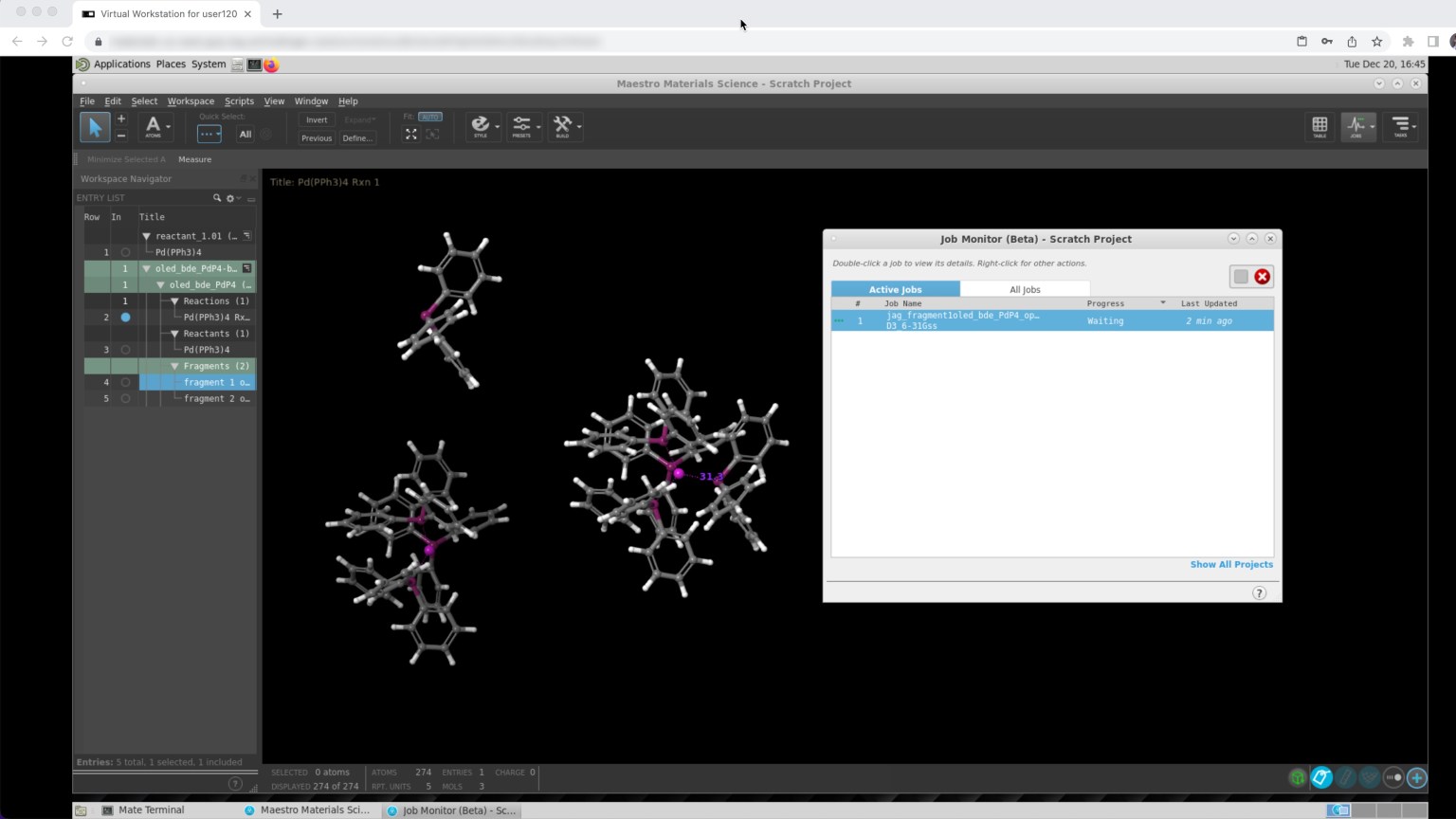
Videos on practical theory break down complex scientific concepts (e.g. Molecular Quantum Mechanics)

Access cloud-based computing resources to perform calculations yourself

Access cloud-based computing resources to perform calculations yourself

Hands-on step-by-step tutorials (e.g. Pharmaceutical Formulations course, pKa prediction)

Hands-on step-by-step tutorials (e.g. Pharmaceutical Formulations course, pKa prediction)

Hands-on modeling in the web-based graphical user interface (e.g. Polymeric Materials course, Diffusion tutorial)

Hands-on modeling in the web-based graphical user interface (e.g. Polymeric Materials course, Diffusion tutorial)

Videos on practical theory break down complex scientific concepts (e.g. Molecular Dynamics)

Videos on practical theory break down complex scientific concepts (e.g. Molecular Dynamics)

On-demand video lessons on materials modeling

On-demand video lessons on materials modeling

Access cloud-based computing resources to perform calculations yourself

Access cloud-based computing resources to perform calculations yourself

Perform case studies with expert feedback (e.g. Organic Electronic Course, Independent Case Study)

Perform case studies with expert feedback (e.g. Organic Electronic Course, Independent Case Study)

Video on practical theory break down complex scientific concepts (e.g. Machine Learning for Chemistry)

Video on practical theory break down complex scientific concepts (e.g. Machine Learning for Chemistry)

Videos on practical theory break down complex scientific concepts (e.g. Periodic Quantum Mechanics)

Videos on practical theory break down complex scientific concepts (e.g. Periodic Quantum Mechanics)

Videos on practical theory break down complex scientific concepts (e.g. Coarse-Graining)

Videos on practical theory break down complex scientific concepts (e.g. Coarse-Graining)

Self-paced video lessons on materials modeling
Videos on practical theory break down complex scientific concepts (e.g. Molecular Quantum Mechanics)
Access cloud-based computing resources to perform calculations yourself
Hands-on step-by-step tutorials (e.g. Pharmaceutical Formulations course, pKa prediction)
Hands-on modeling in the web-based graphical user interface (e.g. Polymeric Materials course, Diffusion tutorial)
Videos on practical theory break down complex scientific concepts (e.g. Molecular Dynamics)
On-demand video lessons on materials modeling
Access cloud-based computing resources to perform calculations yourself
Perform case studies with expert feedback (e.g. Organic Electronic Course, Independent Case Study)
Video on practical theory break down complex scientific concepts (e.g. Machine Learning for Chemistry)
Videos on practical theory break down complex scientific concepts (e.g. Periodic Quantum Mechanics)
Videos on practical theory break down complex scientific concepts (e.g. Coarse-Graining)

Need help obtaining funding for a Schrödinger Online Course?

We proudly support the next generation of scientists and are committed to providing opportunities to those with limited resources. Learn about your funding options for our online certification courses as a student, post-doc, or industry scientist and enroll today!

What our alumni say

“Clear instructions with a well-designed interface allowed me to run some of my own first molecular dynamics simulations. The information from the course felt much more secure than the information from YouTube because I knew it was developed by experts”
Graduate Student
“The course let me talk confidentially about molecular modeling and what it can do. For me, this was a nice experience which left me with many ideas for applying molecular modeling in the research area of our department, not only for me but also for my colleagues.”
Graduate Student
“As always, the course is very well designed. Formulation is quite outside my comfort zone in terms of theory and modeling but this course provided me with knowledge of evaluating what modeling can facilitate in the real world. Really great design and education process.”
Senior DirectorTherapeutic Protein Design

Show off your newly acquired skills with a course badge and certificate

When you complete a course with us in molecular modeling and are ready to share what you learned with your colleagues and employers, you can share your certificate and badge on your LinkedIn profile.

Frequently asked questions

How much do the online courses cost?

Pricing varies by each course and by the participant type. For students wishing to take these courses, we offer a student price of $150 for introductory courses, $305 for the Materials Science bundle, and $870 for advanced courses. For commercial participants, the course price is $575 for introductory courses and $1435 for advanced courses and bundles.

When does the course start?

The courses run on sessions, which range from 3-6 week periods during which the course and access to software are available to participants. You can find the course session and start dates on each course page.

What time are the lectures?

Once the course session begins, all lectures are asynchronous and you can view the self-paced videos, tutorials, and assignments at your convenience.

How could I pay for this course?

Interested participants can pay for the course by completing their registration and using the credit card portal for an instant sign up. Please note that a credit card is required as we do not accept debit cards. Additionally, we can provide a purchase order upon request, please email online-learning@schrodinger.com if you are interested in this option. If you have any questions regarding how to pay for the course, please visit our funding options page.

How can I preview the course before registering?
Are there any scholarship opportunities available for students?

Schrödinger is committed to supporting students with limited resources. Schrödinger’s mission is to improve human health and quality of life by transforming the way therapeutics and materials are discovered. Schrödinger proudly supports the next generation of scientists. We have created a scholarship program that is open to full-time students or post-docs to students who can demonstrate financial need, and have a statement of support from the academic advisor. Please complete the application form if you qualify for our scholarship program!

Will material still be available after a course ends?

While access to the software will end when the course closes, some of the material within the course (slides, papers, and tutorials) are available for download so that you can refer back to it after the course. Other materials, such as videos, quizzes, and access to the software, will only be available for the duration of the course.

Do I need access to the software to be able to do the course? Do I have to purchase the software separately?

For the duration of the course, you will have access to a web-based version of Maestro, Bioluminate, Materials Science Maestro and/or LiveDesign (depending on the course). You do not have to separately purchase access to any software. While access to the software will end when the course closes, some of the material within the course (slides, papers, and tutorials) are available for download so that you can refer back to it after the course. Other materials, such as videos, quizzes, and access to the software, will only be available for the duration of the course. Please note that Schrödinger software is only to be used for course-related purposes.

Related Courses

Molecular modeling for materials science applications: Polymeric materials course Materials Science Materials Science
Polymeric materials

All-atom molecular dynamics and machine learning approaches for studying polymeric materials and their properties under various conditions

Molecular modeling for materials science applications: course bundle Materials Science Materials Science
Course bundle

Access all materials science courses with a single, discounted registration

Molecular Modeling for Materials Science: Pharmaceutical Formulations Materials Science Materials Science
Pharmaceutical formulations

Molecular and periodic quantum mechanics, all atom molecular dynamics, and coarse-grained approaches for studying active pharmaceutical ingredients and their formulations

Supporting Associations

nanoHUB

Battery materials

Battery_Course_Hero

Battery materials


Molecular and periodic quantum mechanics, all-atom molecular dynamics, and machine learning for studying battery materials and their properties under various conditions

Details
Available Languages
Chinese, English, Japanese, Korean
Duration
6 weeks / ~25 hours to complete
Level
Introductory
Cost
$600 for non-student users
$160 for student / post-doc
Course Timeframe
When registering for the course, you will be able to choose your preferred start and end date. Within those dates, you will have asynchronous access to the course to work on your preferred schedule

Overview

Computational molecular modeling tools have proven effective in materials science research and development. Chemists, physicists and engineers working in materials science will increasingly encounter molecular modeling throughout their careers, making it critical to have a foundational understanding of the cutting edge tools and methods. These courses are ideal for those who wish to develop professionally and expand their CV by earning certification and a badge.

These computational chemistry courses offer an effective and efficient approach to learn practical computational chemistry for materials science:

  • Work hands-on with Schrödinger’s industry-leading Materials Science Maestro software
  • Jump start your research program by learning methods that can be directly applied to ongoing projects
  • Learn topics ranging from density functional theory (DFT) to molecular dynamics to machine learning for materials design
  • Perform a completely independent case study to demonstrate mastery of the course content
  • Benefit from review and feedback from Schrödinger Education Team experts for course assignments and course-related queries
  • Work on the course materials on your own schedule whenever convenient for you


This course comes with access to a web-based version of Schrödinger software with the necessary licenses and compute resources for the course:

Requirements
  • A computer with reliable high speed internet access (8 Mbps or better)
  • A mouse and/or external monitor (recommended but not required)
  • Working knowledge of general chemistry
Certification
  • A certificate signed by the Schrödinger course lead
  • A badge that can be posted to social media, such as LinkedIn
background pattern

What you will learn

MS Maestro interface

Learn how to use an industry-leading interface for materials science modeling. No coding or scripting required to run modeling workflows

Quantum mechanics

Learn to apply molecular & periodic density functional theory (DFT) for automated property prediction for organic & inorganic molecules

Molecular dynamics

Learn to leverage all-atom MD simulations for simulating device layers & electrolyte properties

Machine learning

Learn to apply machine learning for rapid & accurate property prediction of battery-relevant organic molecules

Modules

Module 1
2 Hours

Introduction to materials modeling

Video
Video

Introduction to materials modeling & this online course

Video Tutorial
Video tutorial

Introduction to materials science (MS) Maestro

Video
Video

Introduction to modeling for batteries

End checkpoint
Honor code agreement and checkpoint
Module 2
7 Hours + Compute Time

Molecular & periodic quantum mechanics

Video
Video

Introduction to molecular & periodic quantum mechanics (mQM & pQM)

Tutorial
Tutorials
  • Quantum mechanical workflows & properties: Part 1
  • Quantum mechanical workflows & properties: Part 2
  • Bond and ligand dissociation energy
  • Nanoreactor
  • Building bulk crystals and calculating properties
  • Calculating intercalation and voltage curves
  • Lithium ion migration barrier (NEB)
End checkpoint
End of module checkpoint
Module 3
6 Hours + Compute Time

All-atom molecular dynamics

Video
Video

Introducing to molecular dynamics (MD)

Tutorial
Tutorials
  • Disordered system building & MD multistage workflows
  • Building, equilibrating & analyzing polymers
  • Diffusion
  • Polymer electrolyte analysis
  • Liquid electrolyte properties: Part 1
  • Liquid electrolyte properties: Part 2
  • Solid electrolyte interphase builder
End checkpoint
End of module checkpoint
Module 4
3 Hours + Compute Time

Machine learning

Video
Video

Introduction to machine learning (ML)

Tutorial
Tutorials
  • Machine learning property prediction
  • Machine learning for materials science
  • Machine learning for ionic conductivity
  • Molecular dynamics descriptors for machine learning
  • Machine learning for formulations
End checkpoint
End of module checkpoint
Module 5
3 Hours + Compute Time

Guided case study

Tutorial
Case Studies
  • EC decomposition on a Li (001) surface
  • Ab initio molecular dynamics simulations of Li-ion diffusion in solid-state electrolytes
End checkpoint
End of module checkpoint
Module 6
4 Hours + Compute Time

Independent case study

Assignment
Assignment

Modifying battery electrolyte components

Course completion
Course completion & certification
Self-paced video lessons on materials modeling

Self-paced video lessons on materials modeling

Videos on practical theory break down complex scientific concepts (e.g. Molecular Quantum Mechanics)

Videos on practical theory break down complex scientific concepts (e.g. Molecular Quantum Mechanics)

Access cloud-based computing resources to perform calculations yourself

Access cloud-based computing resources to perform calculations yourself

Hands-on step-by-step tutorials (e.g. Pharmaceutical Formulations course, pKa prediction)

Hands-on step-by-step tutorials (e.g. Pharmaceutical Formulations course, pKa prediction)

Hands-on modeling in the web-based graphical user interface (e.g. Polymeric Materials course, Diffusion tutorial)

Hands-on modeling in the web-based graphical user interface (e.g. Polymeric Materials course, Diffusion tutorial)

Videos on practical theory break down complex scientific concepts (e.g. Molecular Dynamics)

Videos on practical theory break down complex scientific concepts (e.g. Molecular Dynamics)

On-demand video lessons on materials modeling

On-demand video lessons on materials modeling

Access cloud-based computing resources to perform calculations yourself

Access cloud-based computing resources to perform calculations yourself

Perform case studies with expert feedback (e.g. Organic Electronic Course, Independent Case Study)

Perform case studies with expert feedback (e.g. Organic Electronic Course, Independent Case Study)

Video on practical theory break down complex scientific concepts (e.g. Machine Learning for Chemistry)

Video on practical theory break down complex scientific concepts (e.g. Machine Learning for Chemistry)

Videos on practical theory break down complex scientific concepts (e.g. Periodic Quantum Mechanics)

Videos on practical theory break down complex scientific concepts (e.g. Periodic Quantum Mechanics)

Videos on practical theory break down complex scientific concepts (e.g. Coarse-Graining)

Videos on practical theory break down complex scientific concepts (e.g. Coarse-Graining)

Self-paced video lessons on materials modeling
Videos on practical theory break down complex scientific concepts (e.g. Molecular Quantum Mechanics)
Access cloud-based computing resources to perform calculations yourself
Hands-on step-by-step tutorials (e.g. Pharmaceutical Formulations course, pKa prediction)
Hands-on modeling in the web-based graphical user interface (e.g. Polymeric Materials course, Diffusion tutorial)
Videos on practical theory break down complex scientific concepts (e.g. Molecular Dynamics)
On-demand video lessons on materials modeling
Access cloud-based computing resources to perform calculations yourself
Perform case studies with expert feedback (e.g. Organic Electronic Course, Independent Case Study)
Video on practical theory break down complex scientific concepts (e.g. Machine Learning for Chemistry)
Videos on practical theory break down complex scientific concepts (e.g. Periodic Quantum Mechanics)
Videos on practical theory break down complex scientific concepts (e.g. Coarse-Graining)

Need help obtaining funding for a Schrödinger Online Course?

We proudly support the next generation of scientists and are committed to providing opportunities to those with limited resources. Learn about your funding options for our online certification courses as a student, post-doc, or industry scientist and enroll today!

What our alumni say

“Clear instructions with a well-designed interface allowed me to run some of my own first molecular dynamics simulations. The information from the course felt much more secure than the information from YouTube because I knew it was developed by experts”
Graduate Student
“The course let me talk confidentially about molecular modeling and what it can do. For me, this was a nice experience which left me with many ideas for applying molecular modeling in the research area of our department, not only for me but also for my colleagues.”
Graduate Student
“As always, the course is very well designed. Formulation is quite outside my comfort zone in terms of theory and modeling but this course provided me with knowledge of evaluating what modeling can facilitate in the real world. Really great design and education process.”
Senior DirectorTherapeutic Protein Design

Show off your newly acquired skills with a course badge and certificate

When you complete a course with us in molecular modeling and are ready to share what you learned with your colleagues and employers, you can share your certificate and badge on your LinkedIn profile.

Frequently asked questions

How much do the online courses cost?

Pricing varies by each course and by the participant type. For students wishing to take these courses, we offer a student price of $150 for introductory courses, $305 for the Materials Science bundle, and $870 for advanced courses. For commercial participants, the course price is $575 for introductory courses and $1435 for advanced courses and bundles.

When does the course start?

The courses run on sessions, which range from 3-6 week periods during which the course and access to software are available to participants. You can find the course session and start dates on each course page.

What time are the lectures?

Once the course session begins, all lectures are asynchronous and you can view the self-paced videos, tutorials, and assignments at your convenience.

How could I pay for this course?

Interested participants can pay for the course by completing their registration and using the credit card portal for an instant sign up. Please note that a credit card is required as we do not accept debit cards. Additionally, we can provide a purchase order upon request, please email online-learning@schrodinger.com if you are interested in this option. If you have any questions regarding how to pay for the course, please visit our funding options page.

How can I preview the course before registering?
Are there any scholarship opportunities available for students?

Schrödinger is committed to supporting students with limited resources. Schrödinger’s mission is to improve human health and quality of life by transforming the way therapeutics and materials are discovered. Schrödinger proudly supports the next generation of scientists. We have created a scholarship program that is open to full-time students or post-docs to students who can demonstrate financial need, and have a statement of support from the academic advisor. Please complete the application form if you qualify for our scholarship program!

Will material still be available after a course ends?

While access to the software will end when the course closes, some of the material within the course (slides, papers, and tutorials) are available for download so that you can refer back to it after the course. Other materials, such as videos, quizzes, and access to the software, will only be available for the duration of the course.

Do I need access to the software to be able to do the course? Do I have to purchase the software separately?

For the duration of the course, you will have access to a web-based version of Maestro, Bioluminate, Materials Science Maestro and/or LiveDesign (depending on the course). You do not have to separately purchase access to any software. While access to the software will end when the course closes, some of the material within the course (slides, papers, and tutorials) are available for download so that you can refer back to it after the course. Other materials, such as videos, quizzes, and access to the software, will only be available for the duration of the course. Please note that Schrödinger software is only to be used for course-related purposes.

Related Courses

Online certification course: Level-up your skill set in catalysis modeling Materials Science Materials Science
Homogeneous catalysis & reactivity

Molecular quantum mechanics and machine learning approaches for studying reactivity and mechanism at the molecular level

Molecular modeling for materials science applications: course bundle Materials Science Materials Science
Course bundle

Access all materials science courses with a single, discounted registration

Molecular modeling for materials science applications: Polymeric materials course Materials Science Materials Science
Polymeric materials

All-atom molecular dynamics and machine learning approaches for studying polymeric materials and their properties under various conditions

Supporting Associations

nanoHUB

Beyond the Lab: Unleashing the Potential of In Silico Modeling in Drug Product Formulation

SEPT 14, 2023

Beyond the Lab: Unleashing the Potential of In Silico Modeling in Drug Product Formulation

Speaker

John Shelley
Fellow

Abstract

In this webinar, we will explore Schrödinger’s leading molecular modeling and machine learning platform, including workflows for:

  • Drug product characterization: Predicting stability & reactivity, solubility, solid form characterization, and crystal polymorphs
  • Drug formulation: Modeling drug-excipient interactions and predicting complex thermodynamic and mechanical formulation properties

You will learn how digital chemistry tools facilitate rapid screening of formulation parameters, aiding in the identification of optimal drug delivery systems, excipient selection, and dosage forms. Following the webinar, a panel of Schrödinger researchers and scientists will be available to answer questions.

Whether you are a pharmaceutical scientist, researcher, or computational chemist, this webinar offers an opportunity to stay ahead of the curve and explore the potential of in silico drug formulation to optimize drug development, reduce costs, and accelerate time to market.

DeepAutoQSAR

DeepAutoQSAR

Automated, scalable solution for the training and application of predictive machine learning models

DeepAutoQSAR

Create high-performing machine learning models using state-of-the-art methods

DeepAutoQSAR is a machine learning (ML) solution that allows users to predict molecular properties based on chemical structure. The automated supervised learning pipeline enables both novice and experienced users to train and inference best-in-class quantitative structure activity/property relationship (QSAR/QSPR) models.

Key Capabilities

Streamline model building with fully automated workflows

Automatically compute descriptors and fingerprints, create models with multiple machine learning architectures, and evaluate model performance.

Customize models to your project with unique project-specific descriptors

Provide your own descriptors in CSV format to be used in addition to or instead of those generated by DeepAutoQSAR for a wide range of applications beyond small molecules, such as polymers, organic electronics, catalysis, and more.

Ensure model optimization using best practices

Employ QSAR/QSPR best practices to minimize the likelihood of overfitting or misrepresenting a model’s performance while ensuring maximum predictive model performance.

Understand the domain of applicability using model confidence estimates

DeepAutoQSAR provides uncertainty estimates alongside model predictions to help determine how much confidence should be placed on predictions generated for candidate molecules which may lie beyond the model’s training set.

Visualize and analyze results to gain further insights 

Visualize color-coded atomic contributions towards target property facilitating ideation of novel chemistry. Visualize and analyze DeepAutoQSAR metrics reports and plots in Maestro to enable further experiments — quickly learn what model architectures are most effective and how models generalize on holdout sets.  

Scalable training to support small or large datasets

Use classical ML methods like boosted trees on smaller datasets while also supporting the largest scale QSAR/QSPR models using graph neural networks and other modern deep learning approaches.

Case studies & webinars

Discover how Schrödinger technology is being used to solve real-world research challenges.

Materials Science Webinar

Accelerating OLED innovation with multi-scale, multi-physics simulations

Join us to explore how integrated digital workflows drive the design of next-generation, high-performance OLEDs.

Materials Science Webinar

Electrodes, electrolytes & interfaces: Harnessing molecular simulation and machine learning for rapid advancements in battery materials development

In this webinar, we demonstrate the application of automated solutions for accurate prediction of electrode materials.

Materials Science Webinar

Schrödinger Materials Science Seminar Japan 2024 

《無料Webセミナー》材料開発向けシミュレーション・ソフトウェアおよびマテリアルズ・インフォマティクスの活用事例を紹介。

Materials Science Webinar

Taking experimentation digital: Materials innovation using atomistic simulation and machine learning at-scale

In this webinar, we introduce a modern approach to materials R&D using a digital chemistry platform for in silico analysis, optimization and discovery.

Materials Science Webinar

In silico materials development: Integrating atomistic simulation into academic chemistry and engineering labs

In this webinar, we explore Schrödinger’s leading physics-based and machine learning computational technologies and provide a comprehensive introduction to the capabilities of computational modeling in chemistry, materials science, and engineering.

Materials Science Webinar

Data-driven materials innovation: Where machine learning meets physics

In this webinar, we demonstrate how Schrödinger’s tools can help overcome these common challenges by using a combination of physics-based simulation data, enterprise informatics, and chemistry-informed ML.

Materials Science Webinar

Cutting-Edge Cosmetics: Innovating for Sustainability with Machine Learning & Molecular Simulations

In this webinar, we explore the challenges chemists face, and how new approaches can help find solutions quicker.

Materials Science Case Study

De novo design of hole-conducting molecules for organic electronics

Materials Science Webinar

Battery Tech – Leveraging Atomic Scale Modeling for Design and Discovery of Next-Generation Battery Materials

In this webinar, we present an advanced digital chemistry platform for developing next-generation battery materials with improved properties.

Materials Science Webinar

Chinese: 利用原子尺度建模设计和发现下一代电池材料 | Leveraging Atomic Scale Modeling for Design and Discovery of Next-Generation Battery Materials

This webinar discussed how to drive the development of novel battery materials with molecular simulations.

Documentation & Tutorials

Get answers to common questions and learn best practices for using Schrödinger’s software.

Materials Science Tutorial

De Novo Design of Novel Compounds with REINVENT

Learn to train a generative ML model with REINVENT to design new compounds with property constraints.
Materials Science Documentation

DeepAutoQSAR

Predict molecular properties based on chemical structure using machine learning (ML).

Materials Science Documentation

Materials Science Panel Explorer

Quickly learn which Schrödinger tools are the best fit for your research.

Related Products

Learn more about the related computational technologies available to progress your research projects.

Virtual Cluster

Secure, scalable environment for running simulations on the cloud

Active Learning Applications

Accelerate discovery with machine learning

FEP+

High-performance free energy calculations for drug discovery

Glide

Industry-leading ligand-receptor docking solution

De Novo Design Workflow

Fully-integrated, cloud-based design system for ultra-large scale chemical space exploration and refinement

Jaguar

Quantum mechanics solution for rapid and accurate prediction of molecular structures and properties

LiveDesign

Your complete digital molecular design lab

MS Informatics

Automated machine learning tools for materials science applications

Quantum ESPRESSO Interface

Integrated graphical user interface for nanoscale quantum mechanical simulations

Publications

Browse the list of peer-reviewed publications using Schrödinger technology in related application areas.

Materials Science Publication

Band Gap and Reorganization Energy Prediction of Conducting Polymers by the Integration of Machine Learning and Density Functional Theory

Materials Science Publication

A machine learning approach for in silico prediction of the photovoltaic properties of perovskite solar cells based on dopant-free hole-transport materials

Materials Science Publication

Machine learning-based design of pincer catalysts for polymerization reaction

Materials Science Publication

Development of Scalable and Generalizable Machine Learned Force Field for Polymers

Life Science Publication

Pathfinder-Driven Chemical Space Exploration and Multiparameter Optimization in Tandem with Glide/IFD and QSAR-Based Active Learning Approach to Prioritize Design Ideas for FEP+ Calculations of SARS-CoV-2 PLpro Inhibitors

Materials Science Publication

Benchmarking Machine Learning Descriptors for Crystals

Materials Science Publication

Machine Learning for the Design of Novel OLED Materials

Life Science Publication

A Descriptor Set for Quantitative Structure-Property Relationship Prediction in Biologics

Materials Science Publication

Active Learning Accelerates Design and Optimization of Hole-Transporting Materials for Organic Electronics

Materials Science Publication

Design of organic electronic materials with a goal-directed generative model powered by deep neural networks and high-throughput molecular simulations

Training & Resources

Online certification courses

Level up your skill set with hands-on, online molecular modeling courses. These self-paced courses cover a range of scientific topics and include access to Schrödinger software and support.

Tutorials

Learn how to deploy the technology and best practices of Schrödinger software for your project success. Find training resources, tutorials, quick start guides, videos, and more.